Search Results for: High Interest Savings

MMB Humble Portfolio 2023 First Quarter Update: Asset Allocation & Performance

Here’s my quarterly update on my current investment holdings at the end of 2023 Q1, including our 401k/403b/IRAs and taxable brokerage accounts but excluding our residence and side portfolio of self-directed investments. Following the concept of skin in the game, the following is not a recommendation, but a sharing of our real, imperfect, low-cost, diversified DIY portfolio. Wouldn’t it be nice if everyone else did the same? (Many people do track the 13F filings of well-known investors.)

“Never ask anyone for their opinion, forecast, or recommendation. Just ask them what they have in their portfolio.” – Nassim Taleb

How I Track My Portfolio
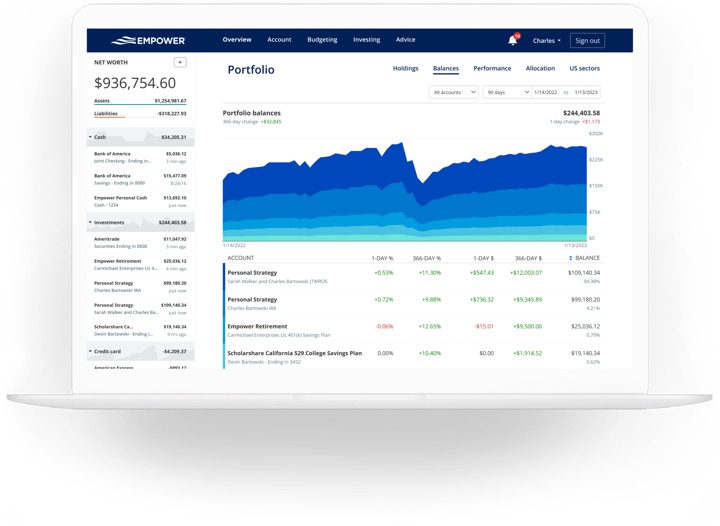
Here’s how I track my portfolio across multiple brokers and account types. There are limited free options after Morningstar discontinued free access to their portfolio tracker. I use both Empower Personal Dashboard and a custom Google Spreadsheet to track my investment holdings:

  • The Empower Personal Dashboard real-time portfolio tracking tools (free) automatically logs into my different accounts, adds up my various balances, tracks my performance, and calculates my overall asset allocation daily.
  • Once a quarter, I also update my manual Google Spreadsheet (free to copy, instructions) because it helps me calculate how much I need in each asset class to rebalance back towards my target asset allocation. I also create a new tab each quarter, so I have an archive of my holdings dating back many years.

2023 Q1 Asset Allocation and YTD Performance
Here are updated performance and asset allocation charts, per the “Allocation” and “Holdings” tabs of my Personal Capital account.

Humble Portfolio Background. I call this my “Humble Portfolio” because it accepts the repeated findings that individuals cannot reliably time the market, and that persistence in above-average stock-picking and/or sector-picking is exceedingly rare. Charlie Munger believes that only 5% of professional money managers have the skill required to consistently beat the index averages after costs.

Costs matter and nearly everyone who sells outperformance, for some reason keeps charging even if they provide zero outperformance! By paying minimal costs including management fees, transaction spreads, and tax drag, you can essentially guarantee yourself above-average net performance over time.

I own broad, low-cost exposure to productive assets that will provide long-term returns above inflation, distribute income via dividends and interest, and finally offer some historical tendencies to balance each other out. I have faith in the long-term benefit of owning businesses worldwide, as well as the stability of high-quality US Treasury debt. My stock holdings roughly follow the total world market cap breakdown at roughly 60% US and 40% ex-US. I add just a little “spice” to the vanilla funds with the inclusion of “small value” ETFs for US, Developed International, and Emerging Markets stocks as well as additional real estate exposure through US REITs.

I strongly believe in the importance of knowing WHY you own something. Every asset class will eventually have a low period, and you must have strong faith during these periods to truly make your money. You have to keep owning and buying more stocks through the stock market crashes. You have to maintain and even buy more rental properties during a housing crunch, etc. A good sign is that if prices drop, you’ll want to buy more of that asset instead of less. I don’t have strong faith in the long-term results of commodities, gold, or bitcoin – so I don’t own them.

I do not spend a lot of time backtesting various model portfolios, as I don’t think picking through the details of the recent past will necessarily create superior future returns. You’ll find that whatever model portfolio is popular in the moment just happens to hold the asset class that has been the hottest recently as well.

Find productive assets that you believe in and understand, and just keep buying them through the ups and downs. Mine may be different than yours.

I have settled into a long-term target ratio of roughly 70% stocks and 30% bonds (or 2:1 ratio) within our investment strategy of buy, hold, and occasionally rebalance. My goal is more “perpetual income portfolio” as opposed to the more common “build up a big stash and hope it lasts until I die” portfolio. My target withdrawal rate is 3% or less. Here is a round-number breakdown of my target asset allocation.

  • 30% US Total Market
  • 5% US Small-Cap Value
  • 20% International Total Market
  • 5% International Small-Cap Value
  • 10% US Real Estate (REIT)
  • 15% US Treasury Nominal Bonds or FDIC-insured deposits
  • 15% US Treasury Inflation-Protected Bonds (or I Savings Bonds)

Commentary. The goal of this “Humble Portfolio” is to create sustainable income that keeps up with inflation to cover our household expenses. According to Empower, my portfolio went up about 4.9% YTD to 4/3/2023. There was only minor rebalancing with cashflows done this quarter.

Due to the rising real yield on TIPS and rising yields on nominal Treasuries and CDs, there is more incentive to micro-managed the bond side a little bit. When the real yields on individual long-term TIPS go above 1.5% and I have cash to reinvest into bonds, that is what I am buying. As usual, I am trying to maintain high yields across a 1 to 5 year ladder horizon by picking between savings accounts, no-penalty CD, longer-term 5-year CDs, and longer-term Treasuries. However, I am also balancing between the extra yield from opening a new account or just staying with an existing bank where I already have a relationship.

I’ll share about more about the income aspect in a separate post.

Ally Bank 11-Month No Penalty CD Review: 4.75% APY (No Minimum)

Rates now up to 4.75% APY. It’s always nice when you can get a higher rate without having to move your money to a whole new bank. Ally Bank raised the rate on their 11-month No Penalty CD to 4.75% APY for all balances with no minimum deposit. If you have older No-Penalty CDs, you may want to take advantage of this higher rate.

The 11-month No Penalty CD is unique in that while the rate is locked in at deposit, you can still withdraw your principal and interest without penalty at any time (well, you must wait at least 6 days from the deposit date). In other words, your interest rate can never go down, but you can still jump ship if rates rise or if there is a better promo elsewhere.

For comparison, the Ally Online Savings account is currently at 3.60% APY (as of 3/20/23) for all balances. The interest rate on the savings account can go up or down. The Ally 12-month CD is at 4.50% APY and 18-month CD is at 5.00% APY, which is fixed but if you withdraw early there is a penalty of 60 days of interest for both CDs.

If you recently opened one of these, remember that Ally Bank offers a “Ten Day Best Rate Guarantee”:

When you fund your CD within 10 days of your open date, you’ll get the best rate we offer for your term and balance tier if our rate goes up within that time. The Ally Ten Day Best Rate Guarantee also applies at renewal.

If you have an existing No Penalty CD past the 10-day rate guarantee, this means you may consider closing it and then opening up a new one at a higher rate. You will have to withdraw everything at once – there are no partial withdrawals allowed on this type of CD. If you have an Ally savings or checking account, you can close the old CD, see the deposit in your savings/checking, and open up a new CD all in minutes online. (Note that savings accounts are limited to 6 withdrawals per month, so use your checking if possible.) You will be extending the term out another 11 months, but since you can always close it at any time it isn’t much of a concern.

Here’s an (old) screenshot of my withdrawal showing no penalty and instant availability when withdrawn directly into an Ally account:

ally_np_withd

You can use my Ultimate Rate-Chaser Calculator to get an idea of how much additional interest you’d earn if you switched over.

Bottom line. The Ally No Penalty CD is unique in that you are always able to move out to a higher rate, but you’ll never get a lower one. This means you can even break the No Penalty CD simply to get another No Penalty CD if/when the rate rises again.

Alliant Credit Union $400 Banking Bonus ($300 For Existing)

Alliant Credit Union has a new FastPass promo worth up to $400 total, broken up as follows:

  • $100 for Savings Account. Open a savings account by March 31, 2023 plus have a minimum $1000 savings average daily balance on April 30, 2023 to earn a $100 bonus.
  • $100 for Checking Account. Open a checking account by March 31, 2023 plus have a minimum $100 checking average daily balance on April 30, 2023 to earn a $100 bonus
  • $100 for Certificate Account. Open a certificate by March 31, 2023 plus maintain a minimum $1000 certificate balance on April 30, 2023 to earn a $100 bonus
  • $100 for $10,000 in total deposits. Deposit a minimum of $10,000 total across any of these three accounts by March 31, 2023 and maintain this minimum balance until April 30, 2023 to earn a $100 bonus.

Useful fine print from the promo FAQ:

Did I open my account(s) correctly to be eligible for the promotion?
If you opened your Alliant account(s) by clicking on the link within a promotional email you received or the myalliant.com/fastpass webpage, you will be eligible for the promotion.

Are current Alliant members eligible for this promotion?
Yes, current Alliant members can still be eligible by opening a checking account and/or certificate and meeting the balance requirements, and/or by incrementally adding $10,000 to their total balance by April 30, 2023.

When is the payout for the promotion?
Accounts will be reviewed after April 30, 2023 to determine eligibility. If all requirements have been met, the bonus payment you earned will automatically be deposited into your savings account within 4-6 weeks after April 30, 2023.

When do I need to make my deposit(s) to qualify for the balance requirement?
For the savings account, the deposit should be made by March 31, 2023 and maintained through April 30, 2023. For Checking and Certificate products, balance should be met by April 30, 2023. Please ensure you allow enough time to open account and receive approval (accounts may be in pending status for 2-5 business days depending on pending reason or documentation needed).

There is a mention later on that “This promotion is for new and existing members of Alliant Credit Union (“Alliant”) who are current or retired employees from one of the many businesses and organizations Alliant partners with in the U.S.” However, this conflicts somewhat with their FAQ, which suggests that as long as you apply through the correct page and use the FASTPASS promo code, you are eligible.

Alliant CU membership eligibility. Alliant CU is one of the top 10 largest US credit unions by assets and their membership eligibility is very open. If you start the online membership application, it will walk you through their various eligibility options. Here are their membership groups:

Any employee or retiree of a Qualifying Company.
Any member of a Qualifying Organization.
Any immediate family member of an existing Alliant member.
Anyone who lives or works in a Qualifying Chicagoland Community.
Anyone who is a member of the Foster Care to Success charity group.

When I applied previously, I found not only does it only cost $5 to join Foster Care to Success, but Alliant will pay that fee on your behalf.

If you are not eligible through another option you can become a member of Foster Care to Success (FC2S) and become eligible for Alliant membership. FC2S serves thousands of foster teens across the United States, focusing on those who are aging out of the foster care system. FC2S awards grants and scholarships for higher education and provides care packages, mentoring and internships. (Alliant will pay the one-time $5 membership fee to FC2S on the member’s behalf.)

Quick thoughts. This is a solid bonus. $100 for a $1,000 deposit to a certificate is a 10% bonus. Even holding $10,000 there for a couple of months for another $100 is not bad, since it is on top of their interest rates. Their High Yield Savings pays 2.95% APY as of 2/4/23. A 12-month certificate pays 4.60% APY as of 2/4/23.

$6,000 IRA Contribution Goal 2022 Final Results: $6,259+ in Total Bonuses

2022 Year-End Update. Each year, I have a side goal of earning the equivalent of the maximum annual IRA contribution limit ($6,000 for 2022) using the profits from various finance promotions alone. In 2021, I reached $5,592 in bonuses and $2,500+ in extra interest. If you had put $6,000 into your IRA every year for the recent 10 year period (2013-2022) and invested in a simple Target Date retirement fund, you would have turned small, weekly deals into a $87,000+ nest egg.

That’s worth repeating: An extra 87 grand has been the real-world result of regularly investing $500 a month for 10 years! A couple could double these numbers.

Ground rules: Real-world results for one real person only. Following with My Money Blog tradition, this will track my personal, real-world results. It would be quite easy to list a bunch of random promotions that add up to $6,000, but these will be promotions that I personally sign up for and complete the requirements (even though I’ve already opened so many bank accounts, credit cards, and brokerage accounts over the years). I will track my individual results only, although my partner does also participate on a more selective basis. Nearly all of them have been documented in real-time in the Deals and Offers category, Top 10 credit cards list, and brokerage bonus list.

Note: I am also excluding the $900 bonus from Chase Ink Business Cash card, since it is meant for small businesses.

2022 bonuses and promotions list. The 💵 symbol means I have received and/or cashed out the bonus successfully. The ⌛ symbol means the promo is still in progress.

Bonuses that required significant assets to max out (but not necessarily participate)

2022 final results. The total tally for bonuses not requiring significant assets was $6,259 total for 2022, which was 104% of the $6,000 annual IRA contribution limit for 2022. This excludes the three bonuses (Public, SoFi, and Ally) that paid out bigger bonuses for larger asset transfers or cash deposits. I acknowledge not everyone has enough assets to max those out, but they were certainly an efficient use of time if you did. If you add in the $3,500 that I received from those bonuses, the total would be $9,759.

Additional background stuff. This is a personal challenge/game that I like to play. I enjoy trying out new apps and services. I look for the best payoff/effort ratio for my situation; your choices won’t look like my choices. In addition, some things I will skip simply because I’ve already done them. For those new to this hobby, I would first grab the low-hanging fruit like the Chase Sapphire Preferred or the Chase Sapphire Reserve and build up a nice stash of flexible Ultimate Rewards points. After that, I would recommend looking at the Citi Premier (ThankYou points), Capital Venture X (Capital One Miles), and American Express Gold (AmEX Membership Rewards points) to jumpstart your points stashes.

These numbers included fixed bonuses for short-term asset transfers, but ignore higher interest rates overall from buying US Treasury bonds or savings bonds. They also ignore ongoing credit card purchase rewards like 2% to 2.6% cash back on all credit purchases (or airline miles or hotel points) and 5% cash back on specific categories or 1% or better cash back on rent.

This is an enjoyable and profitable hobby for me, but I don’t like to waste my time either. I look for a solid return based on the time commitment required. I tend to avoid speculative bets, bonuses that are hard to convert to real value, and anything that requires driving to stores where things may or may not be in stock. The deals that I post usually last at least a few days, but it’s a bit like value investing where you have to be ready to get off your butt and take decisive action when an opportunity shows up, because they won’t last forever.

MMB Humble Portfolio 2022 Year-End Update: Asset Allocation & Performance

portpie_blank200Here’s my quarterly update on my current investment holdings as of the end of 2022, including our 401k/403b/IRAs and taxable brokerage accounts but excluding real estate and side portfolio of self-directed investments. Following the concept of skin in the game, the following is not a recommendation, but just to share our real, imperfect, low-cost, diversified DIY portfolio. Wouldn’t it be nice if everyone else did the same? (Many people do track the 13F filings of well-known investors.)

“Never ask anyone for their opinion, forecast, or recommendation. Just ask them what they have in their portfolio.” – Nassim Taleb

How I Track My Portfolio
Here’s how I track my portfolio across multiple brokers and account types. There are limited free options nowadays as Morningstar recently discontinued free access to their portfolio tracker. I use both Personal Capital and a custom Google Spreadsheet to track my investment holdings:

End of 2022 Asset Allocation and YTD Performance
Here are updated performance and asset allocation charts, per the “Allocation” and “Holdings” tabs of my Personal Capital account.

Target Asset Allocation. I call this my “Humble Portfolio” because it accepts the repeated findings that individuals cannot reliably time the market, and that persistence in above-average stock-picking and/or sector-picking is exceedingly rare. Costs matter and nearly everyone who sells outperformance, for some reason keeps charging even if they provide zero outperformance! By paying minimal costs including management fees and tax drag, you can essentially guarantee yourself above-average net performance over time.

I own broad, low-cost exposure to productive assets that will provide long-term returns above inflation, distribute income via dividends and interest, and finally offer some historical tendencies to balance each other out. I have faith in the long-term benefit of owning businesses worldwide, as well as the stability of high-quality US Treasury debt. My stock holdings roughly follow the total world market cap breakdown at roughly 60% US and 40% ex-US. I add just a little “spice” to the vanilla funds with the inclusion of “small value” ETFs for US, Developed International, and Emerging Markets stocks as well as additional real estate exposure through US REITs.

I strongly believe in the importance of knowing WHY you own something. Every asset class will eventually have a low period, and you must have strong faith during these periods to truly make your money. You have to keep owning and buying more stocks through the stock market crashes. You have to maintain and even buy more rental properties during a housing crunch, etc. A good sign is that if prices drop, you’ll want to buy more of that asset instead of less. I don’t have strong faith in the long-term results of commodities, gold, or bitcoin – so I don’t own them.

I do not spend a lot of time backtesting various model portfolios, as I don’t think picking through the details of the recent past will necessarily create superior future returns. You’ll find that whatever model portfolio is popular in the moment just happens to hold the asset class that has been the hottest recently as well.

Find productive assets that you believe in and understand, and just keep buying them through the ups and downs. Mine may be different than yours.

I have settled into a long-term target ratio of roughly 70% stocks and 30% bonds (or 2:1 ratio) within our investment strategy of buy, hold, and occasionally rebalance. My goal is more “perpetual income portfolio” as opposed to the more common “build up a big stash and hope it lasts until I die” portfolio. My target withdrawal rate is 3% or less. Here is a round-number breakdown of my target asset allocation.

  • 30% US Total Market
  • 5% US Small-Cap Value
  • 20% International Total Market
  • 5% International Small-Cap Value
  • 10% US Real Estate (REIT)
  • 15% US Treasury Nominal Bonds or FDIC-insured deposits
  • 15% US Treasury Inflation-Protected Bonds (or I Savings Bonds)

Commentary. The goal of this “Humble Portfolio” is to create sustainable income that keeps up with inflation to cover our household expenses. According to Personal Capital, my portfolio went down about 16% for 2022. There was only a little minor rebalancing to be done this quarter.

Due to the rising real yield on TIPS, I have shifted back to a target bond allocation of roughly 50% US Treasury/Bank CDs and 50% TIPS/I Savings Bonds. My traditional Treasuries are of intermediate term, and I may convert to a manual ladder of them in the future. My TIPS are also of intermediate to long-term, depending on the real yields available at the time of purchase. I have been manually buying individual TIPS of longer terms this quarter. 1.6% real yield may not be terribly exciting, but it’s a lot better that was available for a long time, and it may be better that what will be available in the future.

I’ll share about more about the income aspect in a separate post.

4% Guaranteed Withdrawal Rate (Inflation-Adjusted) with TIPS Ladder

Retirement income planning would be so much easier if you could buy a known amount of guaranteed lifetime income that automatically adjusted for inflation. However, the reality is that not a single insurance company in the entire world is willing to take on that long-term inflation risk. The only possibility left is to ladder inflation-linked bonds (TIPS) so that each year you would cash out some bonds and interest to create your own DIY inflation-adjusted income.

Thanks to the rising real yields of TIPS, you can now create a 30-year TIPS ladder that will create effectively a 4% guaranteed real withdrawal rate. If you put $1,000,000 into a 30-year TIPS ladder right now, you will get $40,000+ income for year 1 and then another $40,000 adjusted for inflation (CPI-U) annually for the next 29 years. All backed by the US government.

Allan Roth did the hark work and bought a 30-year TIPS ladder x 4.3% real withdrawal rate using $100,000 of his own money on the secondary market. He also introduced me to eyebonds.info, which has a lot of helpful spreadsheets for the hardcore DIY TIPS and Savings I bond investor.

Such a TIPS ladder will only go for 30 years, and you end up with nothing at the end, so it does have some limitations. If you retire at 65 and spend your 4% every year, this portfolio will be completely depleted by age 95. If you start at 55, it will end at 85. Therefore, this tool would work best as a supplement to your Social Security benefits and perhaps keeping some stocks for potential upside…

Now, Allan Roth also wrote about the “No Risk” portfolio where you put most of your money in zero coupon bonds that will guarantee you don’t lose any dollars but put the rest in stocks for upside potential. It feels good to know you’ll both start and end with at least, say $100,000. However, the reality is that you are still exposed to inflation risk, as $100,000 in 10 years may be worth a lot less than $100,000 today.

What if you simply replaced those traditional-style bonds with TIPS as your super-safe base? You’d remove the inflation risk while still keeping minimal credit risk. Enter the concept of Upside Investing by Lawrence Kotlikoff (author of Money Magic).

Upside Investing, as I described in recent Forbes and Seeking Alpha columns, is simple as pie.

– You invest in the S&P and TIPS/I-Bonds and specify a period during which you’ll convert your stocks to TIPS/I-Bonds.

– You build a base living standard floor assuming all stock investments are lost.

– You increase your living standard floor only when and if you convert stocks to TIPS/I-Bonds.

If you can lock in your TIPS ladder at a decent real yield, you could have an intriguing combination of a very safe base income, while still giving you a very good chance of a higher income with stock returns anywhere close to historical averages.

In rough terms, what if a 75% TIPS/25% stock portfolio offered a minimal guaranteed withdrawal rate of 3% real for 30 years (only this low if stocks go to zero!) with the good probability that you would likely be able to withdrawal 4% and quite possibly more. For a conservative investor, knowing you have a rock-solid safe floor would allow you to spend freely with the rest. 🥳 Something to investigate further while TIPS real yields are decent again.

Ally Bank New Deposit Promo: Up to $500 Cash Bonus (Expired, But New CD Opportunity)

Update November 2022: Ally has raised the rates on their CDs and savings accounts, but notably the 11-month No Penalty CD is now at 3.10% APY, which isn’t amazing, but if you are already committed to this deposit bonus, it is a way to raise your effective interest rate while both still qualifying for the deposit bonus and maintaining liquidity. Note the terms state “Your new money must remain in an eligible Ally Bank account: Online Savings, Money Market or a CD.”

Original post (offer is now expired):

Ally Bank has a new “Get Paid” cash deposit bonus (link for existing customers) that is offering a 1% cash bonus (up to $500) on new deposits on top of their existing interest rate. Valid for both new and existing customers. Given the holding period, this roughly equates to the same total interest paid as a 3-month bank CD at 6.25%+ APY. Thanks to reader Paul for the heads up. Here’s how it works:

  • Open an account and/or enroll by 10/21/2022. You must enroll or you won’t get the bonus. New customers use the promo code GETPAID. Existing customers must enroll with the same e-mail as linked to their Ally bank account.
  • Fund your account by 10/31/2022. This means your account has to be approved, opened and funded by this date. Move at least $1,000 from another financial institution to a new or existing eligible Ally Bank account. Remember, transfers can take up to 3 business days.
  • Keep money in your account through 1/15/2023. Your new money must remain in your eligible Ally Bank account through 1/15/2023. Keep in mind, any withdrawals made during this time may reduce your bonus.
  • Get your cash bonus on or by 2/15/2023. Get a 1% bonus on the money you moved, up to $500.

Ally had a similar bonus in 2018 and 2020. Note the following extra details:

  • Cash bonus applies to new money added to an eligible Ally Bank account, not your total balance.
  • Your new money must remain in an eligible Ally Bank account: Online Savings, Money Market or a CD.
  • Minimum cash bonus is $10 ($1,000 deposit), maximum is $500 ($50,000 deposit).

Here’s an example:

1. Take your 10/11 end of day balance total across all eligible accounts. Ex. $5,000.
2. Take your 10/31 end of day balance total across all eligible accounts. Ex. $15,000.
3. Your max possible bonus is 1% of $10,000 = $100. If your total balance across all eligible balance ever goes below 15,000, then your bonus goes down as well. Let’s say your total balances from 10/31 onward through 1/15 varies from $12,000 to $18,000. Your bonus will only be 1% of $7,000 = $70.

Rough math. The current rate on the Ally Online Savings account is 2.25% APY (variable, likely to rise again soon, but who knows what the future holds) as of 10/12/22. Given that you can an additional 1% bonus in roughly 3 months, the bonus itself works out to the equivalent of a 4% annualized yield. 2.25% + 4% = 6.25% total annualized yield over 3 months (no guarantee, this is just an example estimate). You could also open a CD to lock in an even higher rate.

Should I move money out of Ally and back in to qualify? No, it won’t make any difference as Ally has already thought of that. Basically, your comparison point is your balance as of the end of day on 10/11/22. From the full terms and conditions:

We base your Cash Bonus calculation on the New Money you deposit into an eligible Online Savings account, Money Market account, or CD at Ally Bank between 10/12/2022 and 10/31/2022 (and then keep in your account through 1/15/2023). This means money you move out of Ally Bank and then back in won’t qualify for the bonus, and any withdrawals you make from an Online Savings account, Money Market account, or CD between 10/12/2022 and 1/15/2023 may reduce your bonus amount. Transfers of funds between existing Ally Bank accounts won’t qualify for the bonus. Remember, check deposits and transfers from other financial institutions can take a few or more days to complete, so make sure to start any transactions well enough before the 10/31/2022 deadline for those transactions to clear by or before 10/31/2022.

We’re all about playing fair, so if we believe you’re trying to game or abuse this offer, you won’t be allowed to participate in this offer or any future offers.

Existing customers. As a longtime Ally accountholder, I’m happy again to see that this offer includes existing customers, even if it has to be new money.

Bottom line. Ally Bank has a new promotion to attract new money (or bring back old money). You get a 1% cash bonus (up to $500) on new deposits on top of their existing interest rates. At the current rates for their savings account, this works out to a 3-month holding period paying roughly 6.25% annualized interest. You must enroll soon by 10/21/22 and your account must be opened and fully funded by 10/31/22 at the very latest.

Looks like I will be scraping up all the idle cash from my various accounts in the hopes of maximizing this bonus.

MMB Humble Portfolio 2022 3rd Quarter Update: Asset Allocation & Performance

portpie_blank200Here’s my quarterly update on my current investment holdings as of 10/4/22, including our 401k/403b/IRAs and taxable brokerage accounts but excluding real estate and side portfolio of self-directed investments. Following the concept of skin in the game, the following is not a recommendation, but just to share our real, imperfect, low-cost, diversified DIY portfolio. The goal of this “Humble Portfolio” is to create sustainable income that keeps up with inflation to cover our household expenses.

“Never ask anyone for their opinion, forecast, or recommendation. Just ask them what they have in their portfolio.” – Nassim Taleb

How I Track My Portfolio
I’m often asked how I track my portfolio across multiple brokers and account types. There are limited free options nowadays as Morningstar recently discontinued free access to their portfolio tracker. I use both Personal Capital and a custom Google Spreadsheet to track my investment holdings:

  • The Personal Capital financial tools and real-time tracking (free, my review) automatically logs into my different accounts, adds up my various balances, tracks my performance, and calculates my overall asset allocation daily.
  • Once a quarter, I also update my manual Google Spreadsheet (free, instructions) because it helps me calculate how much I need in each asset class to rebalance back towards my target asset allocation. I also create a new tab each quarter, so I have snapshot of my holdings dating back many years.

October 2022 Asset Allocation and YTD Performance
Here are updated performance and asset allocation charts, per the “Allocation” and “Holdings” tabs of my Personal Capital account.

Target Asset Allocation. I call this my “Humble Portfolio” because it accepts the repeated findings that individuals cannot reliably time the market, and that persistence in above-average stock-picking and/or sector-picking is exceedingly rare. Costs matter and nearly everyone who sells outperformance, for some reason keeps charging even if they provide zero outperformance! By paying minimal costs including management fees and tax drag, you can actually guarantee yourself above-average net performance over time.

I own broad, low-cost exposure to productive assets that will provide long-term returns above inflation, distribute income via dividends and interest, and finally offer some historical tendencies to balance each other out. I have faith in the long-term benefit of owning publicly-traded US and international shares of businesses, as well as the stability of high-quality US Treasury and municipal debt. My stock holdings roughly follow the total world market cap breakdown at roughly 60% US and 40% ex-US. I add just a little “spice” to the vanilla funds with the inclusion of “small value” ETFs for US, Developed International, and Emerging Markets stocks as well as additional real estate exposure through US REITs.

I strongly believe in the importance of knowing WHY you own something. Every asset class will eventually have a low period, and you must have strong faith during these periods to truly make your money. You have to keep owning and buying more stocks through the stock market crashes. You have to maintain and even buy more rental properties during a housing crunch, etc. A good sign is that if prices drop, you’ll want to buy more of that asset instead of less. I don’t have strong faith in the long-term results of commodities, gold, or bitcoin – so I don’t own them.

I do not spend a lot of time backtesting various model portfolios, as I don’t think picking through the details of the recent past will necessarily create superior future returns. Usually, whatever model portfolio is popular in the moment just happens to hold the asset class that has been the hottest recently as well.

Find productive assets that you believe in and understand, and just keep buying them through the ups and downs. Mine may be different than yours.

I have settled into a long-term target ratio of roughly 70% stocks and 30% bonds (or 2:1 ratio) within our investment strategy of buy, hold, and occasionally rebalance. This is more conservative than most people my age, but I am settling into a more “perpetual income portfolio” as opposed to the more common “build up a big stash and hope it lasts until I die” portfolio. My target withdrawal rate is 3% or less. Here is a round-number breakdown of my target portfolio.

  • 30% US Total Market
  • 5% US Small-Cap Value
  • 20% International Total Market
  • 5% International Small-Cap Value
  • 10% US Real Estate (REIT)
  • 20% US Treasury Nominal Bonds or FDIC-insured deposits
  • 10% US Treasury Inflation-Protected Bonds (or I Savings Bonds)

Commentary. According to Personal Capital, my portfolio down about 18% for 2022 YTD. My US and International stocks have dropped again (even more than the bonds, which also dropped) and so available cashflow is being placed into buying more of those asset classes.

During this last quarter, I sold all of my municipal bonds and bought US Treasuries instead. Due to the rising rates, I had no capital gains to worry about. When I previously cycled into muni bonds, munis were yielding 24% more than Treasuries even before accounting for the tax benefits. In September 2015, I compared the 1.78% SEC yield of Vanguard Intermediate-Term Tax-Exempt Investor Shares (VWITX) to the 1.48% SEC yield of Vanguard Intermediate-Term Treasury Investor Shares (VFITX). The ratio was 1.24. As of October 2022, the ratio is now 0.93 (3.26% vs. 3.51%). At those levels, I am getting compensated much less for the additional risk of municipal finances. My bond portfolio is now US Treasury bonds, bank/credit union CDs (bought if/when the rates exceed US Treasuries), TIPS, and savings I bonds. Can’t get higher quality than that.

I take solace that for now I see more shrinking P/E ratios as opposed to crashing earnings on the stocks side, my REITs are yielding more, and my bonds are yielding more. One good thing about more “normal” interest rates if they can hold is that it gives conservative (often older) savers a chance to keep their principal safe and still earn a small bit of income without market volatility. My primary fear remains that of war.

I’ll share about more about the income aspect in a separate post.

Citi Self Invest Brokerage: Up to $500 New Deposit or ACAT Transfer Bonus

Citi has started their own self-directed brokerage arm called Citi Self Invest, joining $0 commission bank competitors like Chase, BofA, and Wells Fargo. They are also running a promotion for existing Citi banking or credit card customers to gather new deposits and ACAT transfers, with the current bonus worth up to $500, depending the value of assets that you move over:

  • $100 with $10,000-$49,999 in qualifying new money
  • $200 with $50,000–$199,999 in qualifying new money
  • $500 with $200,000+ in qualifying new money

Here are the steps:

  1. Fund a new or existing Citi Self Invest Account between 3/1/22 and 10/31/22. You must also have an eligible individual Citibank checking or Savings account or an eligible Citi Card account with digital access through Citibank Online.
  2. Fund the Citi Self Invest Account with a minimum of $10,000 in New-To-Citi funds within the Account Funding Period shown below (see below for New-To-Citi funds).
  3. Maintain the New-To Citi funds in your Citi Self Invest account through the Maintain Funds deadline shown below based on month of account opening.
  4. During the account opening process, allow for eDelivery of statements and confirmations,

Here is the deadline calendar:

Here’s their terms on what “new to Citi” funds means:

New-to-Citi Funds are cash that must come from an external, non-Citi, source through a standard transfer method (e.g., a standard Transfer of Assets form, check, electronic funds transfer, ADM deposit). New-to-Citi Funds are: 1) funds deposited from external accounts or payees other than Citibank, N.A. and its affiliates and 2) must be deposited using domestic ACH transfer, Direct Deposit, checks drawn on banks other than Citibank, N.A. wire transfer, trustee to trustee transfer, or ACAT securities transfers.

Update: A rep for Citi reached out to me to say:

To clarify, the value of marketable securities like stocks and ETFS that are transferred via ACAT are included in the definition of “new to Citi funds” and are eligible for the bonus.

This is good news and makes it easier to satisfy the higher tier requirements if you already have a portfolio of ETFs or individuals stocks to move over.

Even if you move over cash, according to the calendar, your minimum holding period is as little as a month. For example, open in August, fund by 9/30, and hold until 10/31 to qualify. The $100 bonus on $10,000 is earning 1% in a month, or the equivalent of 12% APY when annualized. Unfortunately, you have to wait until 1/31/23 to get the bonus, but at least this is a no fee, no minimum balance, no commission brokerage account.

If you keep your cash in there for longer than the minimum of one month, you should also take into account the potential lost interest if you are only using their default cash sweep account. You might consider investing your funds into ultra-short bond ETFs like MINT or Treasury Bill ETFs like GBIL (still possible to lose value). I’m not sure if Citi Self Invest will let you buy Treasury bills directly.

Citi also has an alternative bonus for their Citi Personal Wealth Management account, with better bonus ratios for new deposits of $50,000 and up, and total bonuses worth up to $5,000. However, I’m not sure about the fee structure for the Personal Wealth Management accounts which involve a “dedicated Citi Personal Wealth Management Financial Advisor who can provide personalized planning and investment guidance” with a vague “pricing varies based on investments selected”. Seems like it might be more work if you don’t want their financial advice, but might be worth a phone call to the number in the link if you have $50,000+ as the minimum holding period is still one month.

JP Morgan Guide to Retirement 2022: Personal Finance Charts and Graphics

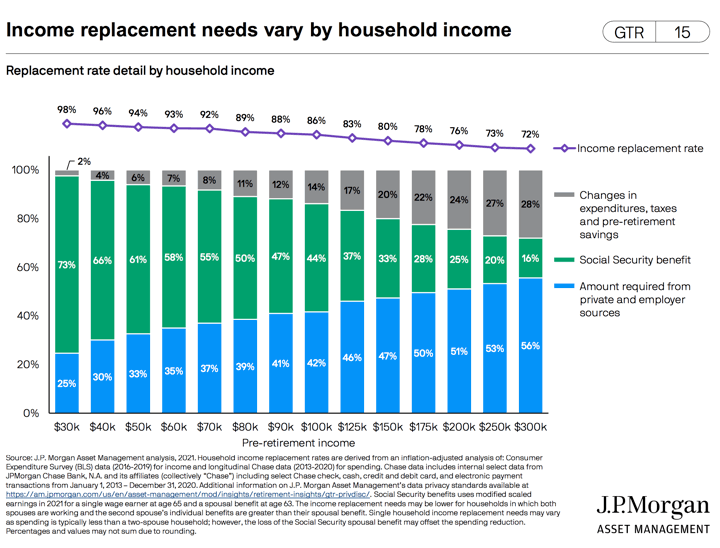
The JP Morgan Guide to Retirement slide deck is provided to its advisors to discuss retirement planning with clients. Updated annually, they kindly share this document publicly and it contains many useful charts and graphs, like the one above that reminds us to focus on what you can control, and to not waste time and energy on what you can’t. Below are a few more highlights from the 52-page 2022 edition that I found most helpful.

How does everyone else manage given all the news of low savings balances? Well, the reason it is called “Social Security” is because without it, there would be widespread poverty amongst seniors. The higher your spending, the more you must rely on your other assets to replace your current income in retirement.

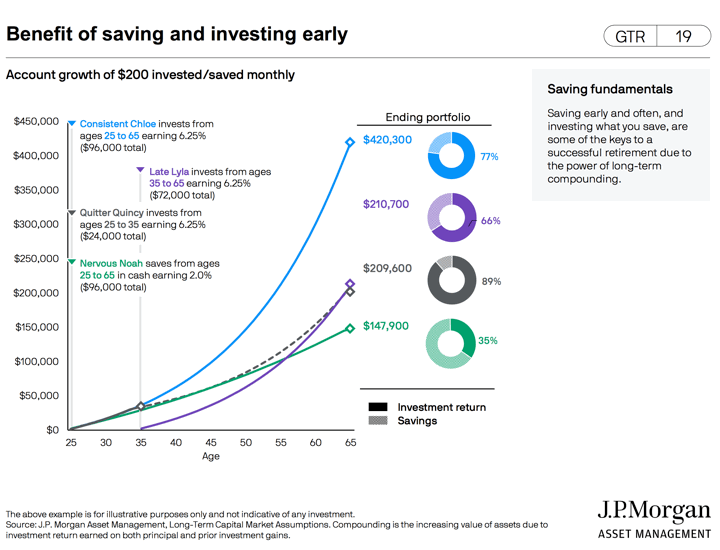
You may have seen variations of this chart elsewhere, where “Quitter Quincy” who starts early but completely stops after only 10 years ends up at the same place as “Late Lyla” who starts late but contributes for another 30 years (triple the time).

How the average household spending changes by age (amongst relatively well-off households).

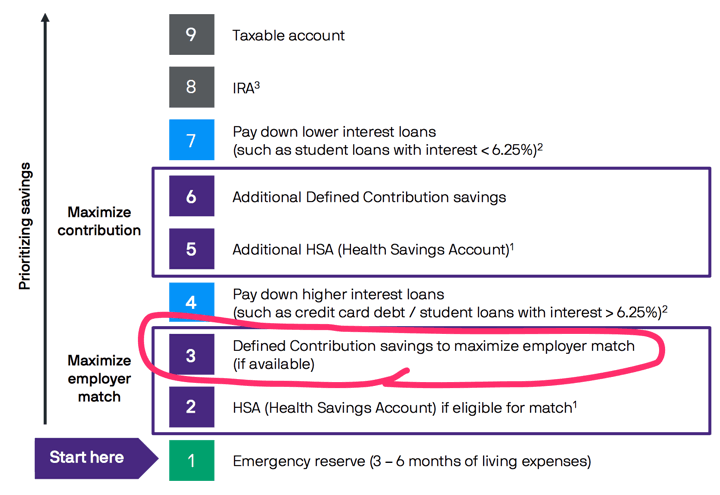
How to prioritize your savings.

Look how “Escalating Ethan” does nearly as well by allowing a 1% auto-escalation once a year.

You might think that because you pay 401k loans back into the original account plus interest that it won’t hurt your final retirement balance, but the missed compounding growth can really impact things.

EFCU Financial Federal Credit Union 5-Year CD

Update: Rate has since dropped to 3.75% APY as of 8/16/22, and they have also stopped accepting application from people joining via a membership in the EFCU Financial Foundation or the Louisiana Wildlife Federation. Hope some folks got in that were interested. Thanks to reader Hugo for the heads up.

Original post:

EFCU Financial Federal Credit Union has some top certificate rates effective 8/11/22. NCUA-insured. Found via DepositAccounts. Here are the rate highlights:
  • Regular 60-month certificate 4.00% APY ($500 minimum)
  • Regular 60-month certificate 4.10% APY (Jumbo $100k minimum)
  • IRA 60-month certificate 4.10% APY ($500 minimum)
  • IRA 60-month certificate 4.20% APY (Jumbo $100k minimum)
  • Also available: 12-month, 18-month, and 24-month at 3.00% APY, 30-month CD at 3.25% with one-time rate bump allowed.

More details:

  • Early withdrawal penalty for 60-month certificate is 180 days of dividends.
  • Hard credit pull with a new membership application.
  • Must keep $5 minimum in Share Savings account as long as you are a credit union member.

Membership eligibility. Their eligibility criteria is open to anyone nationwide. Persons who live, work, worship, or attend school in these nine Louisiana Parishes can join for free: East Baton Rouge, West Baton Rouge, Ascension, East Feliciana, West Feliciana, Iberville, Livingston, Point Coupee, St. Helena. Anyone nationwide can join EFCU Financial with a membership in the EFCU Financial Foundation or the Louisiana Wildlife Federation. The cost is $35 for an annual membership.

Good deal? This is a very competitive CD rate for a 5-year CD, approximately 35 basis points higher than the next best rate. For comparison, as of 8/12/22, the 5-year Treasury bond rate is 2.97%. The hard credit pull and $35 entry fee make it better for high balances to make it worth the trouble.

Based on their website and mobile app, they appear to be using the same backend software as many other credit unions.

As with past credit union certificate deals, I would still recommend acting fast if you are interested. It’s a good enough deal that it is quite possible that there will be enough new applications to overwhelm their limited staff (and deposit needs). You might pony up $35, start the application process, take the credit pull hit, and have the deal fall apart before you can fund the certificate. I’m not saying this will happen, but it is possible. Of course, it is also possible that this is only the start of multiple places offering 4% APY CDs.

Maxing Out the 401k Company Match: How Many Actually Do It?

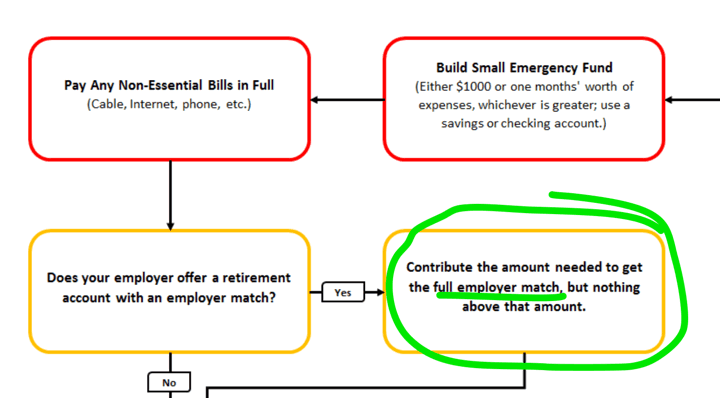
At the top of many personal finance “To-do Lists” is to max out the employer match offered in your 401k/403b retirement plan. It’s usually the first “savings” step after paying down high-interest debt and keeping up with your bills. Here’s a screenshot from the Standardized Personal Finance Advice Flowchart via Reddit:

And here it is again from JP Morgan Asset Management, right after building up an emergency fund:

I’ve read this advice so many times, but how many people even complete this Top 3 item on the list? To be clear, this is just contributing enough to maximize your employer match contribution, not maxing out your allowable employee contribution. (That’s on the list of standardized advice as well, but at a slightly lower priority level.)

Vanguard recently released its How America Saves 2022 report with tons of data about the retirement accounts that they help manage. Let’s see what they found.

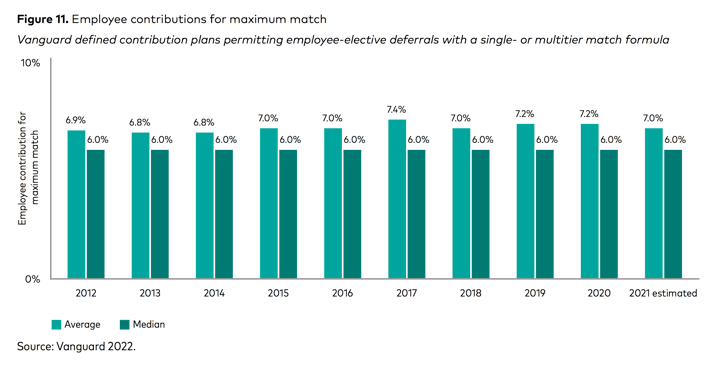
First of all, what does it take to max out your 401k company match? Roughly a 6% contribution rate over the years.

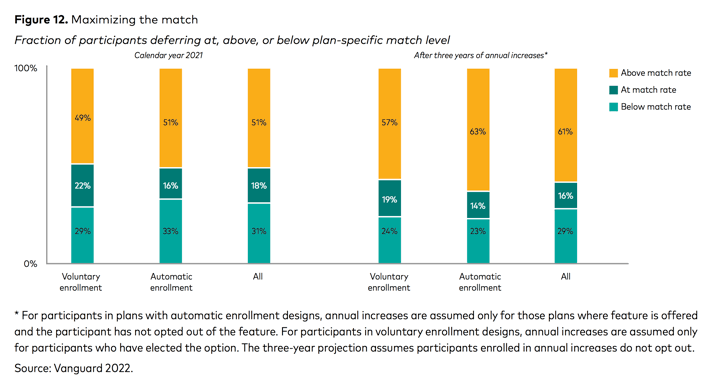
So… how many people actually max out their 401k company match? Roughly 70% of participants contributed at least the max match rate in 2021. For participants in plan with an auto-increase feature, this number goes up to 77% overall after three years.

If you aren’t at least maxing out the company match and getting your “free money”, hopefully this stat provides some peer pressure. Over 2/3rds are doing it! You don’t want to be below-average, do you?? 😱