529 Plan Asset Allocation: Default Glide Path vs. Custom?

My last post on treating your kids’ 529 plans as the equivalent of Roth IRAs had me thinking again about asset allocation.

  • If you plan on spending your 529 assets when your child is age 18-21, then your time horizon starts to get very short, very quickly.
  • If instead you plan on your 529 assets to be eventually rolled over into a Roth IRA, then your time horizon is several decades! In that case, why not 100% equities and let it ride?

If you use the Rule of 72 and assume very roughly that it will double every 10 years, then after 60 years you will have 64 times (!) what you put in initially. Of course with inflation that won’t be as impressive, but still.

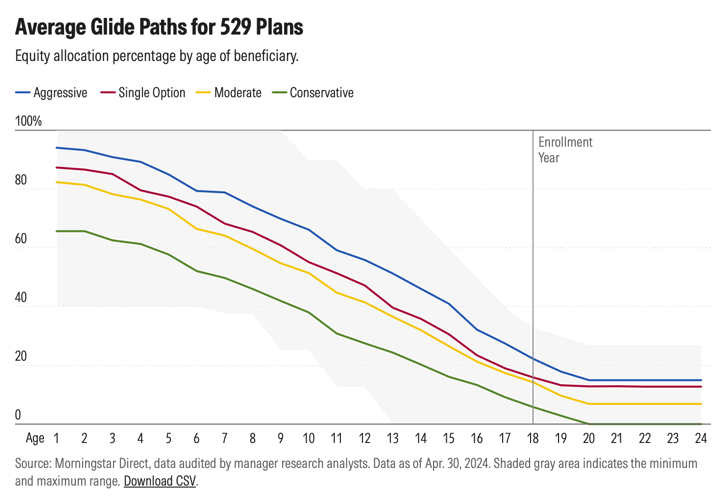
Most 529 owners use the age-based or target-enrollment portfolios from their plan provider. Some only offer one flavor, while others split it into “conservative, moderate, and aggressive” versions. Morningstar analyzed them all in their 529 landscape report and found that they start on average with ~90% stocks and “glide” down to ~16% stocks when the beneficiary turns age 18. Up top is their graphic of average glide path.

I’ve always found this to be a pretty fast descent. If you look carefully, that means that 20% of the stocks you bought when your kid was age 1 might be sold by the time they are age 6 and 50% sold by age 11. That’s not a very long holding period.

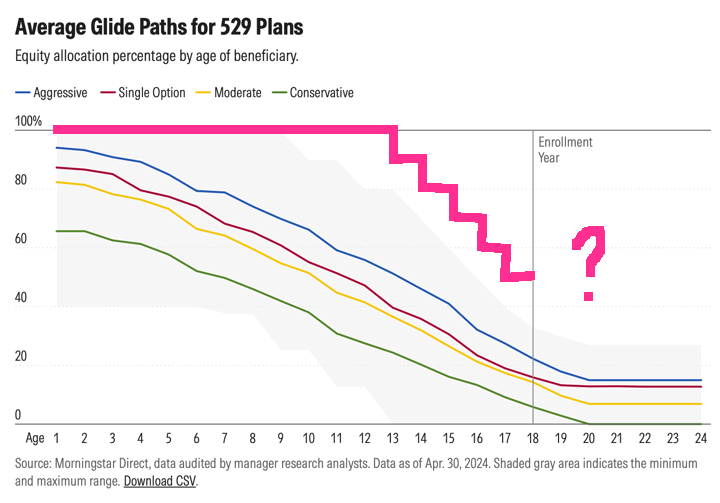
Instead, I decided to start out 100% stocks with the idea that I wanted a long 15 year period of holding stocks for any wobbles to even out, and the plan is to reduce the stock exposure rapidly around high school (10% a year stocks to bonds over the last 5 years or so). I’ve been very fortunate with the high overall stock returns for the last 10+ years. Perhaps I’m pushing my luck now and should cut back sooner to be more in line with these institutionally-approved glide paths. But maybe if stocks tank right before age 18, I’ll just leave some in for a future Roth IRA?
Morningstar also recently updated their Top 5 plans and they mention that Utah (the one I use) remains the only top option that offers a custom glide path option where you can plan it out once and it will follow it for you. For the rest, you’d have to manually make the changes as most plan allow you to change the asset allocation at least once a year.

“Junior Roth IRA”? Maximizing the 529-to-Roth IRA Rollover

A new automated investing app called FutureMoney is advertising something called the Junior Roth IRATM with some pretty awesome “key benefits”, according to their site:

– Tax-free growth potential
– No earned income required to make contributions
– Favorable FAFSA impact when funded by grandparents
– Optimized for long-term generational wealth building
– Within certain limits, can be used for education, a first home, or retirement.

Since it doesn’t required earned income, it’s not an official Roth IRA for kids (aka Custodial Roth IRA). Somehow, is this even better?!

A Custodial Roth IRA has maximum annual contribution room of $7,000 per year. By comparison, you can invest up to $35,000 for your child is a minor with a Junior Roth IRA over its lifetime, with no annual limit.

After a bit of poking around on their site, I realized that under the hood it’s just a 529 plan with the expectation that when the option is available, they will roll over the 529 plans assets into a Roth IRA account. I didn’t know you could advertise the combined benefits for two completely different things (529 and Roth IRA), make up a name for this thing that doesn’t actually exist, and then trademark it?

There is so much obfuscation on this site!

What is a Junior Roth IRA?
The Junior Roth IRA™, exclusively offered by FutureMoney, allows you to invest up to $35,000 while your child is under 18 and grow that money tax free into their retirement, based on a 529 plan to Roth IRA rollover.

It’s a 529 plan. Full stop.

Therefore, to see the limitations of this method, simply look up any article about the new option for rolling over unused 529 funds into the beneficiary’s Roth IRA without a tax penalty. Here are important limitations to consider, per the Secure 2.0 Act of 2022.

  • The originating 529 account must have been maintained for the Designated Beneficiary for at least 15 years.
  • The transferred amount must come from contributions made to the 529 account at least five years prior to the 529-to-Roth IRA transfer date.
  • The target Roth IRA must be established in the name of the Designated Beneficiary of the 529 account.
  • The amount transferred to the target Roth IRA is limited to the annual Roth IRA contribution limit. It is not in excess of the normal contribution limit. This means your child does eventually need to have earned income equal to the amount to be rolled over into the Roth IRA.
  • The aggregate amount (total over multiple years) transferred from a 529 account to a Roth IRA may not exceed $35,000 per individual.

I would add that nobody knows what will happen in the “Secure 5.0 act of 2035”. The Roth IRA window might be narrowed, closed, or even opened further. I do think closing it will hard after it’s already been opened, but 15 years can be a long time.

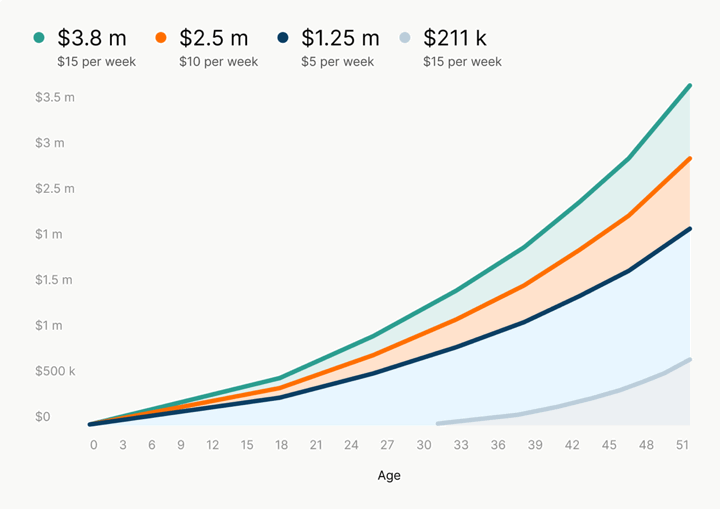
As usual with 529 plans, you can make some pretty impressive claims by combining the power of compounding and a long period of time.

“If a parent invests just $10 a week from their child’s birth to age 18 and then leaves it to grow for 50 years, their child could have a $1 million nest egg, assuming 8% compounding annual returns,” states Dave Fortin, CFA, co-founder of FutureMoney.

Even if it is a 529 plan with a lot of limitations, let’s consider if viewing it as a Roth IRA is actually a good idea. Let’s be honest, this is for relatively rich families that are able to help their kids/grandkids even beyond the enormous, scary cost of a college and post-graduate education. $10 a week ain’t going to do much when college is coming up fast! As they say, the richer you are, the longer your financial time horizon becomes.

For such financially well-off families, I could see this as useful for the years when your child is 16-25. Even though I am a financial nerd now, I didn’t really become financially “aware” until I was 21 years old and didn’t make my first Roth IRA contribution until I was 21 years old. However, I started having “earned income” at age 16 or so. So it may be useful to contribute the money into a Roth IRA at those younger ages (maybe a “parent match”?) when there is a window where they may be earning some money from work, but not enough to be able to defer that money into a Roth IRA on their own.

But again, you can do this with any 529 plan, and the good 529 plans out there already have some low-cost, diversified portfolio options. The Utah plan I picked lets you make a customized glide path using Vanguard and DFA funds. You don’t need this “Junior Roth IRA”.

Utah My529 Plan Lowers Fees Again: A Consistent History of Fee Drops

Updated July 2025. My personal choice amongst all the 529 plans is the My529 (Utah) college savings plan for all three of my children. Formerly known as the Utah Educational Savings Plan (UESP). The Utah My529 plan feels like it has the highest quality of administrative ease/customer service, the widest options for DIY investors (create a custom glide path or use solid prefab options), and long-term commitment to keeping their fees low. Accordingly, they are consistently top-rated by Morningstar and other ratings systems. (I don’t live in Utah; I live in a state with no special tax benefits for 529 contributions.)

As of 2025, I have finishing consolidating all my other 529 plan balances from all my other accounts. I’ve had 529 plans with Ohio CollegeAdvantage, California Scholarshare, Nevada (“Official” Vanguard 529 College Savings Plan), Virginia (Invest529), and maybe some others I’ve since forgotten by now (I have a problem…). Those are all solid plans as well, but over time I found the time to fill out the required forms to perform a direct rollover to Utah. (It was all free but a decent amount of paperwork; I wouldn’t recommend it. Just pick a good one and focus on the contributions.)

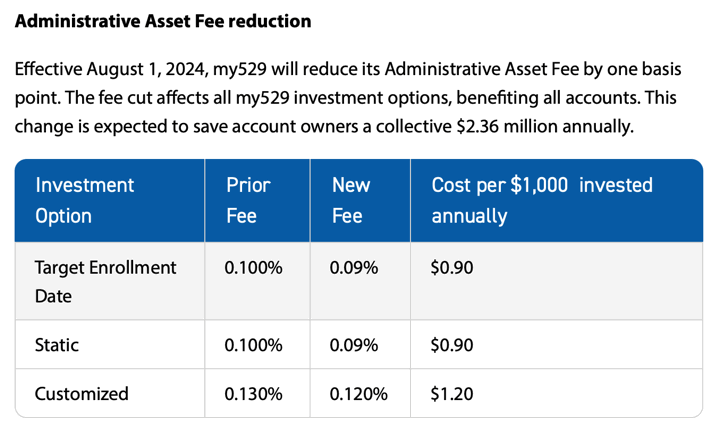
Nearly every year, I get some announcement in their newsletter that Utah is lowering their fees. Every 529 plan charges an administrative fee on top of the expense ratios of the underlying investments like mutual funds. For example, an asset fee of 0.10% is the same as charging $10 a year for every $10,000 in assets invested.

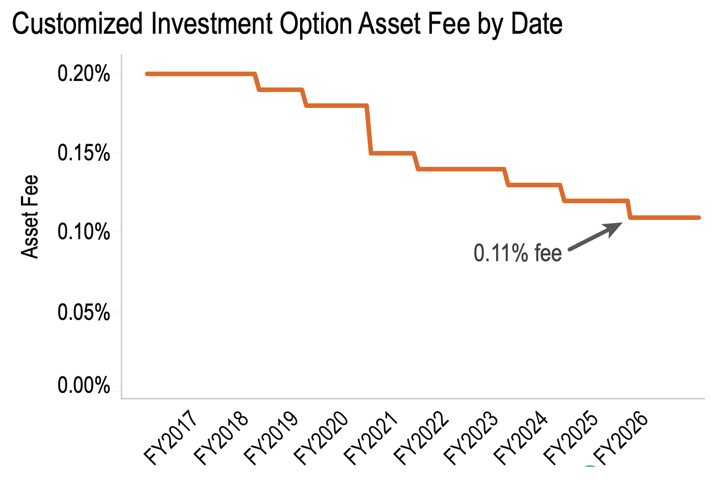
Although Utah may not be the lowest in every option, they consistently are amongst the lowest and keep going lower. Here is a partial history, although I couldn’t dig up every historical change date.

  • July 2025: Administrative Asset Fee for Customized investment options lowered from 0.12% to 0.11% annually.
  • August 2024: Administrative Asset Fee for Target Enrollment Date and Static investment options lowered from 0.10% to 0.09%.
    Customized investment options lowered from 0.13% to 0.12%.
  • July 2023: Administrative Asset Fee for Target Enrollment Date and Static investment options lowered to 0.10%. Customized investment options lowered to 0.13%. (source)
  • […]
  • October 2020: Administrative Asset Fee for Age-Based and Static investment options lowered from 0.13% to 0.12%.
    Customized investment options lowered from 0.18% to 0.15%.
  • February 2018. Utah Educational Savings Plan (UESP) changed its name to my529, effective February 5, 2018.
  • […]
  • July 2017: Administrative Asset Fee for Age-Based and Static investment options lowered from 0.17% to 0.16%.
  • […]
  • June 2013: UESP fees dropped an average of 10% overall. Administrative asset fee was 0.15% to 0.20%, now lowered to between 0.14% and 0.18% most Age-Based and Static investment options. Customized investment option at 0.20% (make your own glide path).

Note: At some point, they changed from the “Age-Based” label to “Target Enrollment Date” but it’s basically the same idea of a glide path that changes as the student ages, in preparation for their college enrollment date.

Each individual annual change may only amount to $1 to $20 a year in savings, but I do think it shows an ongoing commitment to passing on savings as their assets under management grow.

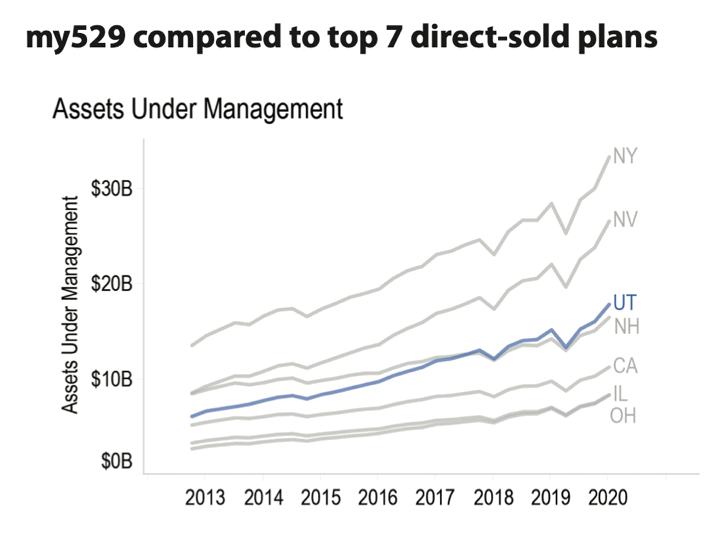
I believe the Utah plan is now the 3rd largest direct-sold plan in the nation. This is especially impressive considering the New York plan at #1 has the benefit of a large in-state tax break (and large population) to help it grow, the Nevada plan is co-branded with Vanguard and their trillions of assets, and New Hampshire is co-branded with Fidelity and their trillions of assets. The Utah plan includes a lot of low-cost Vanguard investments, but remains independent and also includes options from other providers like DFA and PIMCO. I enjoy being able to set up my own glide path with a large menu of investment options.

Big List of 529 College Savings Plan Promotions: 529 Day 5/29 2025

College savings plans that are looking to grow assets tend to have promotions on May 29th, aka “529 Day”. I started gathering up these bonuses from various plans even before having kids, and eventually consolidated them into one single plan. The bonus amounts tend to be pretty modest, and transfers do involve extra legwork, so getting more than one is mostly for the highly-motivated.

Here’s a list of bonuses that include guaranteed amounts; I’m less interested in drawings. I’m listing the state, but you do not have to be a resident of that state to open a 529 account there. You can have multiple 529s from different states, and often you can usually get the bonus once for each child/beneficiary. However, you may need to be a resident to qualify for a specific bonus, or there may be an age restriction on the beneficiary, etc.

  • CaliforniaCA Scholarshare. Open a ScholarShare 529 account between May 20 and May 31, 2025, and receive a $50 bonus. Use promo code 529Day25.
  • FloridaFlorida Prepaid 529. Open a Florida 529 Savings Plan by June 30, 2025, and get $50 added to your account.
  • GeorgiaPath2College 529. Open a Georgia Path2College 529 account between May 20 and May 31, 2025, and receive a $50 bonus! Use promo code 529Day25.
  • KansasLearning Quest 529. Nothing on their site yet, but might be one coming closer to 5/29.
  • MichiganMichigan Education Trust. Purchase a new MET from 5/29/25 to 6/1/25 and get a $50 bonus. A minimum $250 contribution during online enrollment is required, use coupon code 529DAY during enrollment to qualify.
  • MinnesotaMN Saves 529. Open a Minnesota 529 College Savings Plan account between May 20 and May 31, 2025, and receive a $50 bonus! Use promo code 529Day25.
  • NebraskaNEST 529. Nothing on their site yet, but might be one coming closer to 5/29.
  • PennsylvaniaPA 529. There is only a drawing, but wanted to note that all PA children born after January 1, 2019, have a $100 investment available for them in a Keystone Scholars account. You must activate to claim.
  • UtahUtah My529. To be eligible to receive a $25 matching contribution from my529, open an account for a beneficiary who is new to my529 and contribute $25 or more to the new account between May 1 and May 31, 2025. Use the code 529DAY25 during the account setup process. my529 will match the $25 contribution on or around June 16, 2025. Account owners must be Utah residents. The beneficiary does not need to be a Utah resident.
  • VirginiaNEST 529. For one day only, open a new Invest529 account on May 29th and use the gift code 529DAY2025 to receive a bonus initial contribution of $25.

529 plans can now pay for K-12 tuition, apprenticeships, and other educational expenses beyond college tuition and room/board. You can even pay to up to $10,000 of student loans (including your own). Check your own state rules to ensure they enable this option, though. Finally, opening a plan and making any contribution also starts the 15-year clock on potential future 529-to-Roth IRA rollovers.

Most 529 plans also now have convenient contribution links to share with friends and family. Please let me know if you find others.

Sources: NY Times, CollegeSaving.org, specific state websites.

Photo credit: Modified from Pawel Czerwinski on Unsplash

Acorns Early 1% Match on Kid Custodial Accounts / Acorns Later 3% Match on IRA Contributions

Acorns, known for their “Round-Ups” on purchases that encourage recurring small savings of spare change and beyond, also has a match program for IRA contributions. They also just added a new match program for UTMA/UGMA custodial accounts for kids.

Acorns Early is their UTMA/UGMA custodial account for minors, and they will give a 1% match on contributions for Acorns Gold subscribers. These UTMA/UGMA custodial accounts have a few different wrinkles. They are a flexible brokerage account, not like 529 plans where you have to pick from a menu. They can be spent more flexibly as well, not just for qualified educational expenses. A certain amount of income is tax-free each year. However, money in a custodial account is the property of the minor and they assume full control of the account when they become of age.

For 2024, the gift tax exclusion if $18,000 per person ($36,000 from a couple), so the 1% match could be worth up to $180/$360 per kid per year (you can give more, but this is without potentially triggering a gift tax). Friends and family are allowed to contribute as well.

Acorns Later is their IRA account, and they give a 3% match on contributions for Acorns Gold subscribers. Per the 2024 contribution limits, $7,000 x 3% = $210 and $8,000 x 3% = $240 (Age 50+). There is a 4-year hold period.

Acorns Gold costs $12 a month (first month free) and is their highest premium tier with other various perks. So you’d have to balance it all out for your situation.

529 College Savings Plans: All 50 States Tax Benefit Comparison (Updated 2024)

Updated for 2024. Morningstar is a great resource for research on 529 college savings plans, and they have recently updated their annual deep dive on 529 plans: The 2024 529 Savings Plan Landscape (e-mail required).

When choosing a 529 college savings plan, you can open a 529 plan from any state (not just your own). However, each state can vary widely in what they offer in terms of tax deductions and/or tax credits. So how to do you choose?

  • No state tax? ➡ Just pick the best overall plan.
  • No special tax benefits (deduction or credit)? ➡ Just pick the best overall plan.
  • Home state offers tax parity? (the same tax benefits no matter which state’s plan you pick) ➡ Just pick the best overall plan.
  • Home state requires you to contribute to your home state plan to get the tax perk? ➡ Technically, you should compare the annual tax savings against any potential perks from the best overall plan (lower annual expenses, superior investment options). In most cases, I have found that if a state cares enough to offers a state tax deduction or tax credit, and you are contributing an amount under or around the max limit (ex. under $200 a month), then the in-state plan is most likely good enough and you should stick with it. The main exception is if you plan on funding your plan with a large upfront contribution, where a lower expense ratio would really matter.

If you are in the last situation in which you have to do some math, this Morningstar article also runs the numbers for a theoretical couple filing jointly with a gross annual income of $100,000 that deposits $3,000 a year (or $250 a month) into one beneficiary’s 529 account. The chart is useful to provide a quick idea of your state’s tax benefits at a glance, but I would make sure to run the numbers for your income and your expected annual contribution. This Vanguard state deduction calculator tool may be helpful to double-check your calculations.

Finally, note that some states will also recapture any tax benefits if you perform an outbound 529 rollover, or otherwise do not conform with federal tax laws regarding 529 distributions.

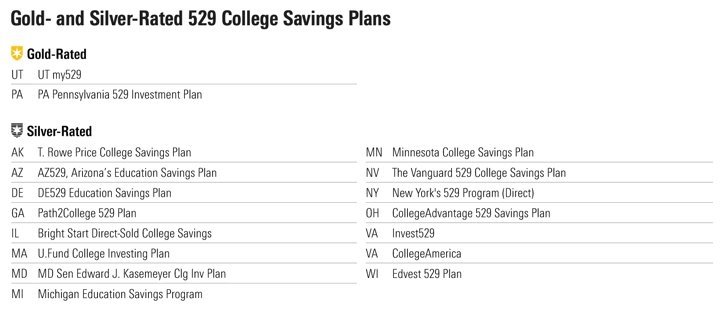
Top plans quick recap. Here are Morningstar’s top Gold and Silver-rated plans as of Summer 2024.

I personally invest in the Utah My529 Plan for my children due to their DIY glide path feature and DFA fund access, but my second choice would be the Vanguard Nevada 529 Plan if you want something that is more “set-and-forget”, especially if you already have other accounts at Vanguard. I wouldn’t spend too much time splitting hairs – taking action and starting an automatic savings plan is the most critical decision.

Opening a plan and making any contribution also starts the 10-year clock on potential future 529-to-Roth IRA rollovers.

Actual Net College Tuition Costs Based On Family Income

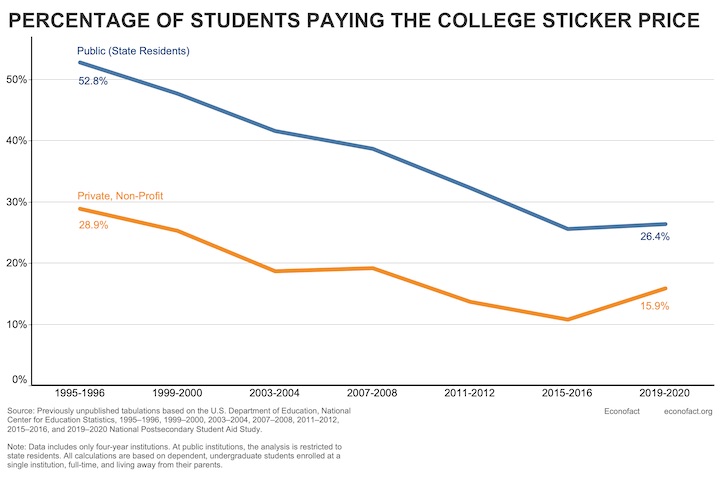
As the published prices for college tuition keep rising to astronomical levels ($100k a year?!), fewer and fewer students are actually paying the “sticker” price. As you can see below, the number is down to ~25% for public and ~15% for private 4-year institutions. This can make it very confusing for a family trying to plan for upcoming college costs.

This chart is taken from the Econofact.org article “How Much Does College Really Cost?” by economics professor Phillip Levine is one of the few articles I’ve seen that analyzes the the data based on household income level.

Colleges use a combination of need-based financial aid and “merit” aid to adjust the pricing of their product to balance their desired class composition and revenue requirements. The chart below shows “Typical College Net Prices At 4-Year Institutions by Family Income, Adjusted for Inflation”. This number does not include student loans and work-study funding.

For households under $100,000 a year, the numbers work out to well over 100% of your annual income for 4 years of tuition at both public and private schools. That seems especially daunting given the rising floor of basic costs like housing, transportation, and food.

Even for a family that earns $100,000 a year, paying for 4 years at a public university will average roughly $100,000 total. If you have multiple kids, that’s getting into the zone of another mortgage. A household earning $200,000 or $500,000 would also pay about the same $100,000 for 4 years of public university.

The private universities are where the higher-income households keep paying more as their income rises. A household earning $200,000 a year can expect to pay $200,000+ for 4-years at a private university.

Worried about Overfunded 529 Balances? The Half-Time Community College Method

If you are considering a year-end contribution to a 529 college savings plan, you may be concerned about the possibility of not using the full balance. To be honest, this is not something that I worry about at all (spread across three kids, I highly doubt I’ll face this issue), but I do find that this question comes up regularly.

Here are the standard ways to assuage these fears:

  • Qualified expenses include a lot of things besides tuition, including room and board, textbooks, computer equipment, etc.
  • Qualified expenses also go beyond a traditional 4-year college to include graduate school and other forms of education including registered apprenticeships and vocational school. You can also use it to help pay for private school K-12 tuition (up to $10k/year) for a younger child or grandchild.
  • You can change the beneficiary to another child, yourself, or a grandchild and keep it invested.
  • If your child ends up receiving merit aid or other scholarships, you are exempt from the additional 10% penalty for non-qualified withdrawals, although you will still be subject to taxes on your investment gains (treated as ordinary income).
  • Other exceptions to the 10% penalty include if the beneficiary becomes disabled, receives employer-based tuition assistance, or attends a US military academy.
  • Starting in 2024, you may be able to use the 529 funds to fund a Roth IRA.

However, here’s one you probably haven’t heard of from Justin of RootofGood:

  • The overall idea is that you are allowed to claim room and board as a qualified expense if you are at least a half-time enrolled student. Room and board is expensive, especially relative to community college tuition.
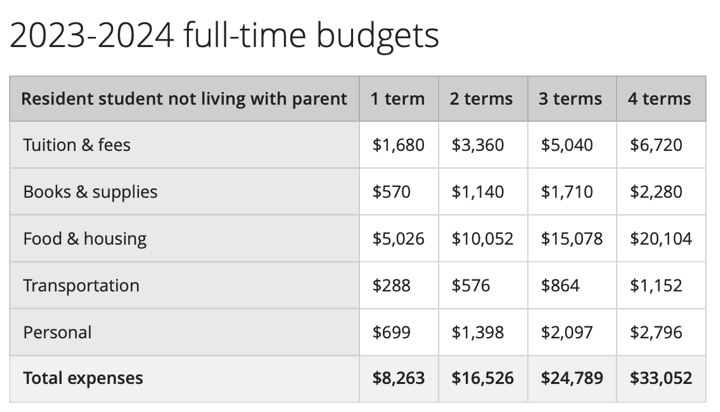
  • If the 529 beneficiary (could be you, could be your child) took community college classes as a half-time student for a single quarter, the tuition may cost you about $800 a term, but would also allow you to claim about $5,000 a term in room and board as qualified expenses. This could scale up to ~$3,200 tuition and ~$20,000 room and board annually.
  • The eligible room and board number is up to the specific college or university’s official published allowance for room and board. Usually shown as something like “resident not living with parents”.
  • This method makes the total amount a qualified expense and thus you avoid both income taxes on any investment gains AND the 10% penalty. $3,200 divided by $23,200 is a little under 14%, which may be a better percentage than what you’d pay with the ordinary income tax bracket. Of course, there is also the value from the increase in your knowledge and community connections.

The specific tuition amounts and food/housing estimates will vary by community college. Some places even offer free tuition for residents (ex. San Francisco). I took my numbers from a place I attended many years ago, Portland Community College:

Basically, instead of worrying about not having a qualified way to take the money out of your 529, here is a way that anyone can be eligible while minimizing the taxes and penalties involved. Nearly anyone can attend community college on a half-time basis.

Michigan MESP 529 College Savings Plan: $100 Bonus Per Accountholder/Beneficiary Combo

The Michigan Education Savings Program (MESP) is offering a $100 bonus when you open a new account by 9/30/23 and deposit $1,000+ within 10 business days of establishing the account. Your $100 matching deposit will arrive by 1/31/24. The 529 account must be open with a non-zero balance to receive the bonus.

Compared to all 529 plans nationwide, MESP is a top overall plan with reasonable costs and good investment options (official plan of Michigan, run by TIAA-CREF), making it an excellent option for those without specific in-state tax incentives. See here to compare 529 tax benefits across all 50 states.

This offer is very similar to the ScholarShare 529 promo, as both are managed by TIAA-CREF and this also has a limit of “one (1) Matching Deposit pernew Michigan Education Savings Program (MESP) account per unique accountholder/beneficiary combination.” Please see that post for more background information. Additional considerations for this promo:

  • Michigan taxpayers may qualify for a state tax deduction up to $10,000 if married filing jointly ($5000 single), for contributions made into an MESP account.
  • You should be able to stack this with other 529 offers like that from California Scholarshare. If you have multiple 529 accounts from different state plans/managers, you can later transfer the balances and merge them into each other, although there may be a modest amount of paperwork required each time. You are allowed one rollover per beneficiary during a rolling 12-month period.

From the full fine print:

Offer Description: The Michigan Education Savings Program (MESP) is a 529 college saving splan administered bythe Michigan Department of Treasury, and managed by TIAA-CREF Tuition Financing, Inc. (“TFI”). To receive a $100 matching deposit (“the Matching Deposit”), eligible individuals must (a) open a new Michigan Education Savings Program (MESP) account (for a new beneficiary) online at www.MIsaves.com between September 1, 2023 at 12:01 AM Eastern Time (ET) and September 30, 2023 at 11:59 PM ET with an initial deposit of at least $1,000 to be contributed and invested at the time the new Michigan Education Savings Program (MESP) account is opened. The initial $1,000 deposit must be received within 10 business days after the account is established. The Matching Deposit will be made to the eligible Michigan Education Savings Program (MESP) account on or before 8:59 PM ET on January 31, 2024. To receive the Matching Deposit, the Michigan Education Savings Program (MESP) account must be open with a dollar balance greater than zero on the day the Matching Deposit is made. Limit: one (1) Matching Deposit per new Michigan Education Savings Program (MESP) account per unique accountholder/beneficiary combination.

Oklahoma 529 College Savings Plan: $50/$100 Bonus Per Beneficiary

The Oklahoma 529 College Savings Plan is offering a $50 or $100 bonus when you open a new account and meet these deposit requirements:

  • $50 bonus: Open with a minimum initial deposit of $250 and set up recurring contributions via bank account or direct deposit) of $50 or more per month until 3/31/2024.
  • $100 bonus: Open with a minimum initial deposit of $500 and set up recurring contributions (via bank account or direct deposit) of $100 or more per month until 3/31/2024. Note that the info on the offer page conflicts with the fine print.
  • After six months, your $50 or $100 bonus will be deposited in your account on or before 5/17/2024.

Compared to all 529 plans nationwide, MESP is an above-average overall plan with reasonable costs and investment options (official plan of Oklahoma, run by TIAA-CREF), making it an acceptable option for those without specific in-state tax incentives. See here to compare 529 tax benefits across all 50 states.

Note that this offer has a limit of “Only one Matching Deposit per new Oklahoma 529 account per beneficiary”, which is more restrictive than the ScholarShare 529 bonus promo. Please see that post for more background information. Additional considerations for this promo:

  • Oklahoma taxpayers may qualify for a state tax deduction up to $20,000 if married filing jointly ($10,000 single) for contributions made into Oklahoma 529 account.
  • You should be able to stack this with other 529 offers like that from California Scholarshare. If you have multiple 529 accounts from different state plans/managers, you can later transfer the balances and merge them into each other, although there may be a modest amount of paperwork required each time. You are allowed one rollover per beneficiary during a rolling 12-month period.

From the full fine print:

PROMOTION DESCRIPTION: To receive a $50 promotion deposit (“the Promotion Deposit”), eligible individuals must (a) open a new Oklahoma 529 account (for a new unique Account Owner/Beneficiary combination) online during the Promotion Period with an initial deposit of at least $250 to be contributed and invested at the time the new account is opened and (b) establish a recurring contribution (from a bank account or by payroll direct deposit) for the new account of at least $50 per month, and shall be maintained at minimum through 11:59 PM CT on March 31, 2024. The Promotion Deposit will be made to the eligible account on or before May 17, 2024.

To receive a $100 promotion deposit, eligible individuals must: a) open a new Oklahoma 529 account (for a new unique Account Owner/Beneficiary combination) online during the Promotion Period with an initial deposit of at least $500 to be contributed and invested at the time the new account is opened and (b) establish a recurring contribution (from a bank account or by payroll direct deposit) for the new account of at least $100 per month, and shall be maintained at minimum through 11:59 PM CT on March 31, 2024. The Promotion Deposit will be made to the eligible account on or before May 17, 2024.

Limit: Only one Matching Deposit per new Oklahoma 529 account per beneficiary. Void where prohibited or restricted by law.

ScholarShare 529 College Savings Plan: $100 Bonus Per Accountholder/Beneficiary Combo

The ScholarShare 529 College Savings Plan is offering a $100 bonus when you open a new account by 9/30/23 and deposit $1,000+ within 10 business days of establishing the account. Your $100 matching deposit will arrive by 1/31/24. The ScholarShare 529 account must be open with a non-zero balance to receive the bonus.

Compared to all 529 plans nationwide, the ScholarShare 529 is a solid overall plan with reasonable costs (official plan of California, run by TIAA-CREF), making it a good option for those without specific in-state tax incentives. See here to compare 529 tax benefits across all 50 states.

I find that having an open 529 plan is a great way to redirect various gifts from friends and family (like grandparents) so that the money doesn’t just get spent mindlessly and then forgotten. If someone gives them a gift card, I just put the equivalent value into the 529 and spend the gift card myself. Since by the time they really understand money it will have been 10 years since birth, it can been a good lesson on how steady saving and investing adds up. Finally, opening a plan and making any contribution also starts the 15-year clock on potential future 529-to-Roth IRA rollovers.

This specific bonus is also interesting due to the limit of “one (1) Matching Deposit per new ScholarShare 529 account per unique accountholder/beneficiary combination.” That means a couple with three children could open six accounts for $600 in total bonuses. It would also require a significant upfront deposit, but many families are already setting aside $100+ each month per kid for future college expenses.

  • Spouse 1 + Child 1
  • Spouse 1 + Child 2
  • Spouse 1 + Child 3
  • Spouse 2 + Child 1
  • Spouse 2 + Child 2
  • Spouse 2 + Child 3

If you have multiple 529 accounts from different state plans/managers, know that you can later transfer the balances and merge them into each other, although there may be a modest amount of paperwork required each time. You are allowed one rollover per beneficiary during a rolling 12-month period.

From the full fine print:

Offer Description: The ScholarShare 529 College Savings Plan (“ScholarShare 529”) is a 529 college savings plan administered by the ScholarShare Investment Board (“SIB”), an instrumentality of the state of California, and managed by TIAA-CREF Tuition Financing, Inc. (“TFI”). To receive a $100 matching deposit (“the Matching Deposit”), eligible individuals must (a) open a new ScholarShare 529 account (for a new beneficiary) online at www.ScholarShare529.com between September 1, 2023 at 12:01 AM Pacific Time (PT) and September 30, 2023 at 8:59 PM PT with an initial deposit of at least $1,000 to be contributed and invested at the time the new ScholarShare 529 account is opened. The initial $1,000 deposit must be received within 10 business days after the account is established. The Matching Deposit will be made to the eligible ScholarShare 529 account on or before 8:59 PM PT on January 31, 2024. To receive the Matching Deposit, the ScholarShare 529 account must be open with a dollar balance greater than zero on the day the Matching Deposit is made. Limit: one (1) Matching Deposit per new ScholarShare 529 account per unique accountholder/beneficiary combination.

List of 529 Day (5/29) College Savings Plan Promotions 2023

Updated for 2023. 5/29 is “National 529 College Savings Plan Day” and every year a few state plan offer promotions and/or giveaways. Most offers end by May 31st. Some offers require in-state residency, but some don’t. 529 plans can now also pay for K-12 tuition and other educational expenses beyond college tuition and room/board.

I find that having an open 529 plan is a great way to redirect various cash gifts from friends and family (like grandparents) so that the money doesn’t just get spent mindlessly and then forgotten. Finally, opening a plan and making any contribution also starts the 15-year clock on potential future 529-to-Roth IRA rollovers.

Here’s a list of what I could find, please let me know if you find more. I’m listing the state, but you do not have to be a resident of that state to open a 529 account there. You can have multiple 529s from different states. However, you may need to be a resident to qualify for a specific bonus, or there may be an age restriction on the beneficiary, etc.