Americans Spend More on Healthcare than Housing?!

Housing has always been considered the biggest expense in a family’s budget. More recently, everyone’s grocery and restaurant bills have skyrocketed, bringing food costs into focus. But the biggest item in your budget is very likely to be healthcare, even if it is often disguised by your employer’s direct payment of part of the premium.

(Although employers seem to cover less and less every year… Employers love Health Savings Accounts (HSAs) as it allows them to justify pushing lower-cost high-deductible health plans (HDHPs) wherever possible. If you are a family with a kid with ongoing medical needs, HSA+HDHP does not work out to be a good deal.)

The NYTimes article How Health Care Remade the U.S. Economy (gift) shows us how this came to be over time. Healthcare costs include insurance premiums as well as drugs and other medical products.
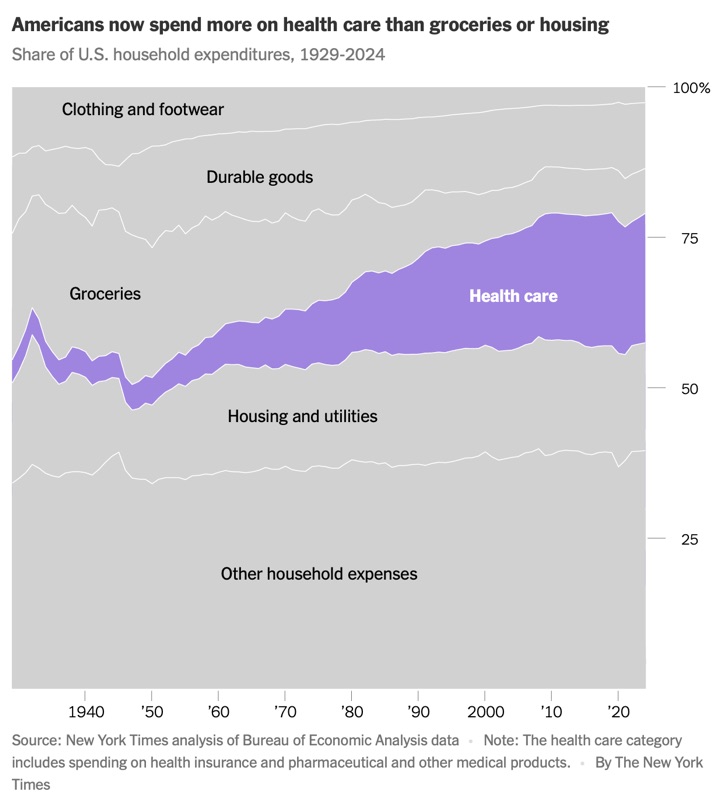
As someone who has been thinking about early retirement since they were 25 years old, I am well aware that health insurance premiums for our family of 5 is roughly $25,000 a year. I’m not even counting our actual healthcare expenses like co-payments and deductibles. Healthcare has always been a huge expense to offset with investment income.

Some people try to keep their modified adjusted gross income low and use ACA subsidies, check out this KFF ACA calculator to estimate your numbers. Note that the ACA income “cliff” is set to return in 2026, meaning household incomes exceeding 400% of the Federal Poverty Level (FPL) will not be eligible for any ACA premium subsidies.


An Ounce of Gold Always Buys 350 Loaves of Bread?

I was reading the thought piece Finance is other people when I came across an intriguing finance nugget:

Suppose you think that bitcoin will, like gold, have enduring appeal. During the reign of the Babylonian king Nebuchadnezzar, an ounce of gold purchased 350 loaves of bread according to Erb and Harvey (2013). Here we are 2,700 years later, and an ounce of gold will still get you around 350 loaves of bread. On the one hand, that’s an amazing record of retaining value. On the other, that’s a zero percent real return! If gold had merely beaten inflation by 30 basis points a year, an ounce of gold would get you a million loaves of bread today, instead of 350.

This claim was so specific, I had to dig further. So I looked up the paper by Erb and Harvey from 2013 called The Golden Dilemma. The only reference to Nebuchadnezzar was in a footnote:

Harmston (1998) mentions that in 562 B.C., during the reign of the Babylonian king Nebuchadnezzar, an ounce of gold purchased 350 loaves of bread. At the recent price of $1,600 an ounce, an ounce of gold could buy 350 loaves of bread priced at $4.57 a loaf.

This led to Gold as a Store of Value, published in November 1998 as a “research study” for the World Gold Council which states:

It is said that an ounce of gold bought 350 loaves of bread in the time of Nebuchadnezzar, king of Babylon, who died in 562 BC. The same ounce of gold still buys approximately 350 loaves of bread today. Across 2,500 years gold has in other words retained its purchasing power, relative to bread at least, and has had a real rate of return of zero.

In the end, I could not find a single piece of historical evidence support this claim. Just a lot of people repeating each other. Feels like a true factoid – an “assumption or speculation that is reported and repeated so often that it becomes accepted as fact”. Like “Humans only use 10% of their brains”.

Obviously, gold has been a store of value for a very long time, but how much money do you really want to commit to something that will end up with a zero return above inflation? Not to mention it is so volatile that it’s not a good short-term store of value. Nobody saves up for their house downpayment with gold coins.

So what’s the point of gold? I still fall back on a scenario where you want to flee quickly as society collapses around you and you want enough assets to start over somewhere else. Imagine you lived in Ukraine. It’s a form of “insurance” you can hold in your hand, and feel a bit more secure in this crazy world. I don’t think it’s completely irrational to put aside a small bit of your net worth into it. Such happy thoughts are echoed in the study:

Gold has not necessarily held its value in terms of purchasing power in times of war. This is partly because at such times the prices of other commodities, more immediately useful for the war effort, have tended to rise faster. However, gold’s liquidity, acceptability and portability are qualities that have been particularly important in times of crises such as occupation by a foreign power or collapse in a monetary system. At such times, these qualities may well be more important than gold’s rate of exchange with paper money. Given this, and gold’s role as a wealth preserver in some of the darkest periods of the twentieth century, gold has proved to be a haven on numerous occasions and in different places.

Photo by Tommaso Urli on Unsplash

TIAA Traditional and Lifetime Income Annuities Now Available to Public via IRA

TIAA-CREF recently announced that they are allowing the public to invest in their fixed and income annuities inside a Traditional or Roth IRA (via Bogleheads). This includes their most well-known TIAA Traditional Annuity, which has traditionally been only available to those working in nonprofit colleges, universities, hospitals (TIAA stands for Teachers Insurance and Annuity Association of America).

This was a Father’s Day coincidence, as what they suggest is very similar to what I helped set up for my father. As a long-time educator, the bulk of his retirement savings was accumulated using the TIAA Traditional annuity through both employer and employee contributions. After considering many factors, I advised him to annuitize a portion of it upon retirement for guaranteed lifetime income. The rest of the portfolio was stock and bond mutual funds.

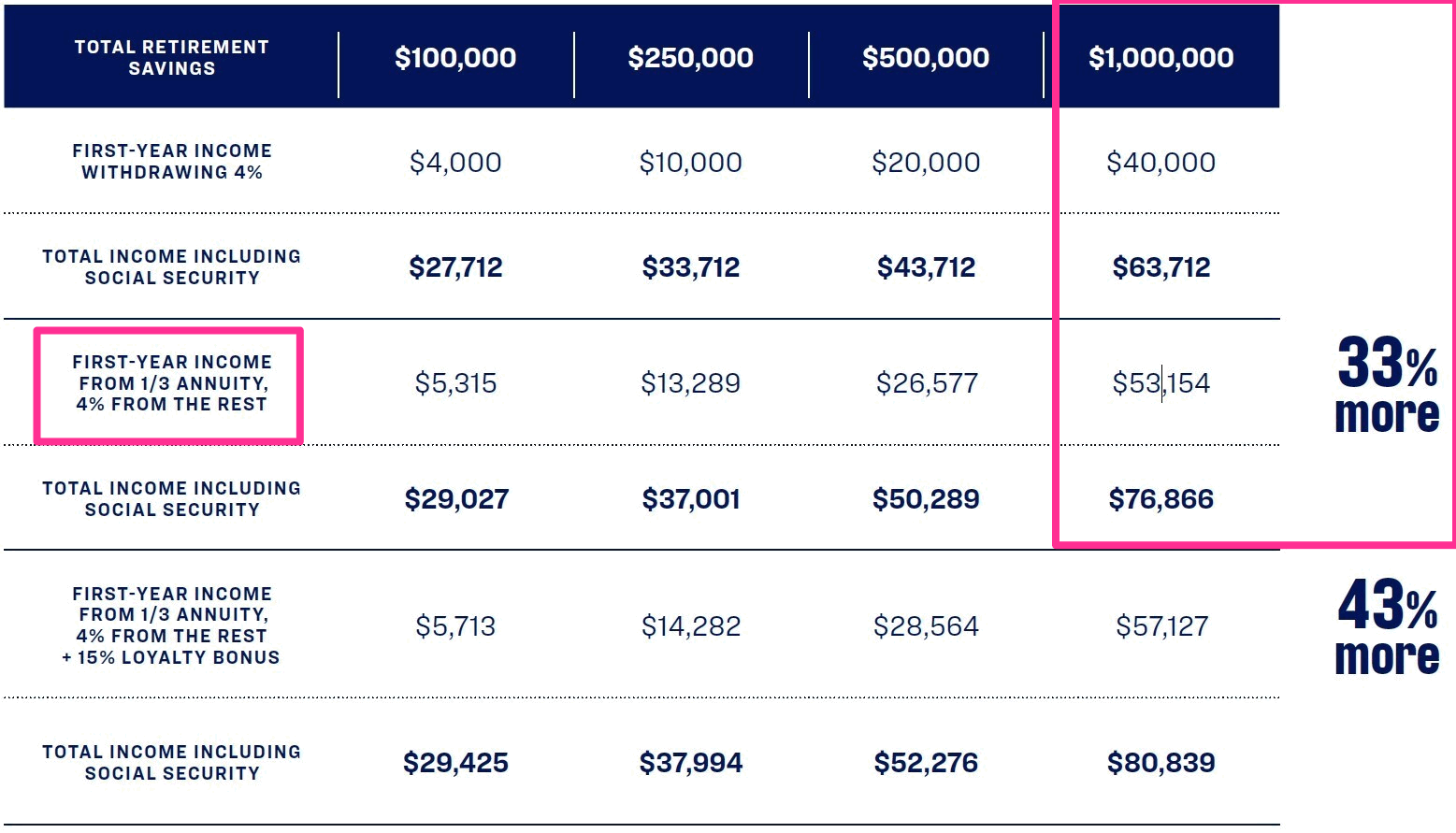
In the example that TIAA provides, they annuitize 1/3rd of the total available portfolio, and the rest is spent down using the popular “4% withdrawal rule”. Their claim is that “annuitizing a portion of your savings with TIAA Traditional offers between 33% and 43% more income than a 4% withdrawal strategy.”

Looking at the fine print, they state:

Calculation uses the TIAA Traditional “new money” income rate for a single life annuity with a 10-year guarantee period at age 67 using TIAA’s standard payment method beginning income on March 1, 2025 (7.9462%).

So a 67yo person taking a single-life income annuity with a 10-year guarantee, which pays out 8% of principal every year. So if you annuitized $1,000,000, you would get roughly $80,000 a year in annual income, guaranteed, every year until death (with minimum 10 years of payments, or $800,000). 8% is double (100% more) what you’d get out from the “4% rule”, so if you annuitize 1/3rd if your portfolio, it would boost the first-year income by 33%. Math works out.

Here are some additional details I would emphasize:

  • With the income annuity used, the 8% withdrawal rate won’t ever go up or adjust with inflation. It’s a fixed payout every year, so the real inflation-adjusted value will decrease over time. After 15 years or 30 years, the payout from $1M would still be $80,000.
  • The “4% rule” taken from perhaps a 60% stock/40% bond portfolio is designed to be raised with inflation each year. After 15 years, the $40,000 a year from $1M would be $62,000 with 3% average inflation and $72,000 a year with 4% average inflation. After 30 years, the $40,000 a year from $1M would be $97,000 with 3% average inflation and $130,000 a year with 4% average inflation.
  • At death, the TIAA annuity would have zero value (assuming past the 10-year guarantee). Your 60/40 portfolio may have a lot (or a little, or nothing) left over.
  • The TIAA annuity is a guaranteed only by the claims-paying ability of TIAA. TIAA is usually one of the absolute top-rated insurance companies in terms of safety, but it doesn’t print its own money.

Overall, I felt that the trade-offs were worth it for my parents. They are financially conservative folks. Their annuitized income was lower because they took a joint-life annuity with my mother, but when added on top of their combined Social Security, their guaranteed monthly paycheck in retirement was large enough to cover all of their basic monthly expenses. Unless there was a big one-time expense, they would not have to take a single penny out of the rest of their investment portfolio.

I knew the value of the TIAA income would decrease over time due to inflation, but some studies have shown that retiree expenses also tend to trend downward over time. Social Security will still go up with inflation, and so should their investment portfolio over the long run.

TIAA Traditional as an accumulation vehicle. My dad was already with TIAA Traditional for decades before I started helping him with his finances, and while I am thankful for the financial stability of TIAA-CREF, I don’t know that I would pick the TIAA Traditional Annuity if I was starting out today. As a fixed annuity, there is a guaranteed minimum interest rate and then they credit extra if their underlying investments do well. The value thus is always increasing steadily and never goes down, which some people may like. Even a “safe” bond fund can have a negative year, as we saw recently.

Based on the numbers that I have seen, the long-term average return of TIAA Traditional will probably be very close to that of a low-cost Total US Bond Fund like BND. So it’s like a bond fund with smoothed returns. But this also means the long-term average return of TIAA Traditional will likely not be as high as if you held a Target Retirement Fund with stocks/bonds. Thus, I could see TIAA Traditional as a partial substitution for the bond portion of your portfolio, especially if you plan on annuitizing it upon retirement and can thus earn some of that vague “loyalty bonus”. THAT is the main advantage of TIAA – the ability to earn an excellent annuitization income rate from a very solid company.

(You can view the current TIAA Traditional interest rates here. Note that there are multiple different rate classes, and since the IRA class is fully liquid, it tends to offer one of the lower rates.)

For my parents, I am quite happy with the results of annuitizing a portion of your retirement portfolio. It depends on your own goals, but a fixed base monthly paycheck in retirement offers great peace of mind. I personally enjoy the fact that they stress much less about market swings. If TIAA continues to offer competitive income payout rates along with their top-tier safety rating, I will definitely keep this option in mind for myself.

Self-Paced CFP: Insurance Planning Highlights and Self-Paced Study Experiences

Finally… I passed the “Insurance Planning” course for my University of Georgia Self-Paced CFP class. That’s only #2 out of the 7 topics, but here are a few quick observations so far:

  • After trying a couple of times… 😅 I was not able to pass the course exams without studying the course materials first. You need 80% correct to pass, and I’d be in the 60% to 80% range without any studying.
  • I’ve been able to pass the exams after only reading the online course slides and review questions. I haven’t opened the textbooks once (as shown in pristine condition above!), even though I spent extra for the physical textbooks (as opposed to electronic-only).
  • As a personal finance geek, I did know a lot of the material beforehand, but there are definitely new bits that I’m learning here and there. The material is dry, but it covers a lot of topics.
  • Like many other professional certification exams, much of passing means studying specifically for the test. The questions aren’t necessarily weighted by what’s commonly used in financial planning practice, but by what is easiest to test in a multiple-choice format. That means memorizing formulas that require a financial calculator, “none of the above”, “all of the above”-type questions, and minor differences in definitions. I now understand why even after completing this educational course requirement, most CFP applicants sign up for another ~$1,000 “cram course” that just drills you on sample test questions.

Back to Insurance Planning. I got stuck on this course for while as it is a very wide topic with some rather dull topics, so here is a high-level overview of what was covered.

Three main categories of “Pure Risk” for individuals and families:

  • Personal
  • Property
  • Liability

Principles and Purpose of Insurance

  • Types of risk (pure vs. speculative)
  • Methods of managing risk (avoidance, reduction, retention, transfer)

Property and Casualty Insurance

  • Homeowners and renters insurance
  • Auto insurance
  • Liability and umbrella policies
  • Business-related coverage

Life Insurance

  • Types (term, whole, universal, variable)
  • Suitability and needs analysis
  • Policy selection, riders, beneficiary designations

Health Insurance and Disability Insurance

  • Health plans (PPO, HMO, HDHP, etc.)
  • Medicare and Medicaid
  • Social Security
  • Disability coverage (short-term, long-term, own vs. any occupation)
  • Long-Term Care Insurance

Employee and Group Benefits

  • Group life, health, and disability plans
  • COBRA and continuation coverage
  • Cafeteria and flexible spending accounts

Annuities

  • Types (fixed, variable, immediate, deferred)
  • Payout options and guarantees
  • Tax treatment and suitability

Role of a financial planner.

  • Coverage level determination
  • Help clients identify coverage gaps or excesses.
  • Refer clients to qualified Property & Casualty (P&C) agents.
  • Evaluate insurance as part of a broader financial plan.
  • Review and update over time

For example, for personal liability insurance you would ask about:

  • Personal Auto Policy (PAP): For motor vehicle-related liabilities.
  • Homeowners Policy: Covers bodily injury/property damage to others.
  • Comprehensive Personal Liability (CPL) Policy: Standalone liability coverage.
  • Umbrella Policy: Broad, high-limit policy supplementing existing coverages.

You may not need all of them individually, but some combination of these should work together to make sure there no holes. It’s also possible that you may have duplicate coverage or otherwise too much insurance.

A lot of financial advice focuses on “offense”: maximizing income, minimizing expenses, and optimizing investments. But “defense” is just as important, as it includes protecting from loss of future income and loss of existing assets.

MYGA Fixed Annuity Warning: Choosing The Highest Rate Can Be Stressful

I’ve written a little about about Multi-year guaranteed annuity (MYGA) fixed deferred annuities in the past, and I actually bought one as one of my “$10,000 Experiments” way back in 2015. I bought the MYGA with the highest available interest rate at the time from a company called Sentinel Security Life. Owning a MYGA is very quiet, I only get a mailed statement once a year and the only action required is to roll it over every 5 years. In 2020, Sentinel still offered the highest rate, so I rolled it over to them again. More quiet…

Fast forward to early 2025, and after my recent post about private equity entering the world of MYGAs, I decided to check in on ole’ Sentinel Security Life. Turns out they have been going through some major drama recently!

  • In December 2024, the Utah Insurance Department issued an emergency order prohibiting Sentinel Security Life, along with its affiliates Haymarket Insurance and Jazz Reinsurance, from issuing new policies after December 31, 2024.
  • In mid-March 2025, a Utah judge paused this emergency order, and allowed them to start issuing policies again, pending the result of a trial to start in May 2025.
  • In March 2025, Utah Insurance Commissioner Jonathan Pike petitioned for Sentinel to be placed into “rehabilitation”, stated that it had a “years-long history of self-dealing, conflicts of interest, and obfuscation.” For example, allegedly, Sentinel Insurance would make substantial risky loans to entities also owned by the same controlling party (Kenneth King and Advantage Capital Partners, known as A-Cap). They also have additional insurance companies in South Carolina that are having similar issues with regulators.

“Drama” and your insurance/annuity provider are not a good combo. I knew that going for the highest interest would involve buying from a riskier insurance company, but went for it anyway because that was the entire point of the experiment. The reason to go for a MYGA instead of an FDIC-insured bank CD is to earn a significantly higher net rate due to the combination of the rate gap and the tax deferral benefits during accumulation. Along with that is the assumption that insurance department will require the insurance companies have proper reserves, and that your state guaranty association will cover you in the unlikely case that your insurance company does fail.

While in the accumulation stage, I feel that I can be more aggressive in using a higher-interest-paying, lower-credit-rating company since my exposure will be limited to the next 5 years. But eventually if I choose to convert the final amount to an annuitized income stream, I would be more conservative since my exposure would be potentially for decades. If I was relying on Sentinel to provide my monthly paycheck in retirement, that would be very stressful.

As it stands, my current 5-year MYGA contract ends in less than 5 months (September 2025), and I will be looking to transfer to another 5-year MYGA from a different insurance provider. Honestly, I’ll still probably be comparison shopping amongst the highest rates. I worry that if I tried to buy only from some old, stodgy traditional insurance company, these days it could be bought out by some private equity firm and transformed within a year anyway.

In the end, like many insurance and annuity products, MYGAs are very complex with a lot of variables and grey areas. As a finance geek, this actually intrigues me, but on the flip side this means they are not very consumer-friendly. I personally don’t view their benefits to justify the added complexity to my overall portfolio, so I have not bought any additional MYGAs since my first and only purchase.

If you do decide to pursue MYGAs, I encourage you to research State Guaranty Associations and be careful to stay under your applicable state limits. Since their beginnings in the 1970s, no state guaranty association has failed to pay a covered claim. However, nobody knows what would happen if there was a large crisis. They are not backed by any Federal guarantee like FDIC or NCUA insurance.

Private Equity Creating Attractive Rates For MYGAs / Life Insurance?

One of the lessons from the 2025 Berkshire Hathaway Annual Meeting was that you never know where your next investment idea will come from, so you should “turn every page”. For example, I like to read the entire transcript of the Q&A session (thanks to Steady Compounding) instead of just reading the WSJ or CNBC articles. Take this question and answer came up from Ajit Jain, their head of insurance:

Becky Quick: This question is from Peter Shen in New Jersey. It’s for Mr. Buffett and Mr. Jain. In recent years, large private equity firms like Blackstone, Apollo, and KKR have aggressively expanded into insurance, raising permanent capital, managing float, and aiming to replicate the model that Berkshire pioneered decades ago. Given that these firms are now directly competing for insurance assets, often using higher leverage and more aggressive investment strategies, how do you view their impact on Berkshire’s insurance operations and underwriting discipline? Do you believe that the private equity model poses risks to policyholders in the broad financial system, and has this competition made it more challenging for Berkshire to find and price insurance opportunities safely and profitably today?

Ajit Jain: Part of the question is very easy. There’s no question the private equity firms have come into the space, and we are no longer competitive in the space. We used to do a fair amount in this space, but in the last 3-4 years, I don’t think we’ve done a single deal.

You should separate this whole segment into two parts: the property casualty end of the business and the life end of the business. The private equity firms you mentioned are all very active in the life end of the business, not the property casualty end.

You are right in identifying the risks these private equity firms are taking on both in terms of leverage and credit risk. While the economy is doing great and credit spreads are low, these firms have taken the assets from very conservative investments to ones where they get a lot more return. As long as the economy is good and credit spreads are low, they will make money – they’ll make a lot of money because of leverage.

However, there is always the danger that at some point the regulators might get cranky and say they’re taking too much risk on behalf of their policyholders, and that could end in tears. We do not like the risk-reward that these situations offer, and therefore we put up the white flag and said we can’t compete in this segment right now.

Basically, Berkshire can’t compete in life insurance right now because private equity firms are flush with money and are expanding into insurance and competing very aggressively on rates. The only real insurance-as-investment product that interests me (I do have term life insurance) are multi-year guaranteed annuity (MYGAs), so I decided to check the current rates.

Sure enough, a new name called Knighthead Life is at the top of the charts at Blueprint Income. Their rates will vary by state and investment amount, but I saw 7-year MYGAs at 6.80% and 5-year MYGAs at 6.55% (simple interest). Knighthead Life even has a relatively solid A- rating for financial strength from AM Best. Usually, the top rate will be offered by an insurer with a lower B++ rating.

Digging further, we find that private equity firm Knighthead Capital Management/Knighthead Insurance Group recently completed a $550 million capital raise, acquired Merit Life Insurance in January 2025, and quickly rebranded it as Knighthead Life.

Another top MYGA provider on the list, Revel One, was founded in 1980 and acquired by private equity firm Axar Capital in 2022.

I’m still trying to keep my investments simple, but these MYGA rates are a pretty significant 2%+ spread above current bank CD rates and Treasuries. They are not directly comparable, but they are comparable. MYGA are much more complicated and there are pitfalls to avoid. Please do your own research before investing.

In addition, perhaps this also makes it a good time to shop for term life insurance rates. I haven’t shopped around in a while. We got ours set up at a reasonable cost before having kids and I’m always happy to know that it is there for my family if they need it.

I wonder if looking back, this will have been an opportunity to take advantage of the consumer-friendly rates resulting from the current rush of money into private equity, or if the risks of “higher leverage and more aggressive investment strategies” will eventually create a crisis event if some of these insurance companies start to fail. (How long will that shiny A- rating last?)

Big List of Free Consumer Data Reports 2025: Check Your Credit, Banking, Rental History, Insurance, and Employment Data

magChecked and updated for 2025. Since these are available every 12 months, it is a good idea to check these near or around the same time each year. A lot of companies make their money by collecting and selling data – your personal data. It can be critical to know what they are telling prospective lenders, landlords, even employers about you. Under the FCRA and/or FACT Act, many consumer reporting agencies (CRAs) are now legally required to send you a free copy of your report every 12 months, as well as provide a way to dispute incorrect information.

Some have an online request form, but some are purposefully making it harder to check your reports by removing the online option. Don’t be afraid to call them if needed. You probably won’t want to bother checking all of them anyhow, but if you’ve experienced any sort of rejection or adverse action in these areas the cause might be found inside one of these databases. Keep in mind that you may not have a file with all of these places. Requesting a copy of your own consumer reports does not hurt your credit score.

The Consumer Financial Protection Bureau has been doing a better job maintaining their own comprehensive list of CRAs (PDF version) recently, so I am editing down this list to include direct links to the overall categories along with the larger and more widely-used consumer reporting agencies.

Credit-Related

Experian, Equifax, and TransUnion. The three major credit bureaus track your credit accounts, payment history, and other related information like bankrupts and liens. Free online credit reports now available weekly (the frequency was increased from annual to weekly during the COVID pandemic, but that change has been made permanent).

(Note: As part of a class action settlement, you may also request up to six additional free copies of your Equifax credit report directly from myEquifax during any 12-month period through December 2026.)

You can also now freeze your credit reports for free, but you must contact each bureau separately. For the contact info, please see Big List of Ways To Protect Your Identity: Free Credit Monitoring, Free Credit Locks, and Free Credit Freezes

LexisNexis. One of the largest personal information databases that includes public records, real estate transaction and ownership data, lien, judgment, and bankruptcy records, professional license information, and historical addresses on file. Free copy, must mail in form.

CoreLogic Credco. One of the largest credit-related CRAs and often used by mortgage lenders, your CoreLogic Credco Consumer File can contain: previous homeownership and mortgage info, rental payment history, any reported delinquencies, and other debt obligations like child support. Free copy once every 12 months.

Banking-Related

Chexsystems. A consumer information database used by an estimated 80-90% of all banks to help determine the risk of opening new accounts. Think of it as the banks’ version of a credit bureau. If a person commits check fraud or overdraws their account, it will be listed here. In addition, the simple act of opening or closing a bank account may be recorded in their database. Having a negative ChexSystems record can leave you blacklisted from opening bank accounts at most major banks. Free copy once every 12 months. You can now request your report online.

Subprime-Related (Payday Lending)

Microbilt and subsidiary Payment Reporting Builds Credit (PRBC). Microbilt is a provider of credit data for the “approximately 110 million underserved and underbanked consumers in the United States.” Free copy once every 12 months.

Rental History

Realpage (LeasingDesk) Consumer Report. Provides tenant screening through their LeasingDesk product, including “the industry’s largest rental payment history database.”

CoreLogic SafeRent. SafeRent provides both tenant and employment screening data, including information regarding landlord tenant and criminal public court records. One free report every 12 months.

Experian RentBureau Rental History Report. “Every 24 hours, Experian RentBureau receives updated rental payment history data from property owners/managers, electronic rent payment services and collection companies and makes that information available immediately to the multifamily industry through our resident screening partners.”

TransUnion Rental Screening Solutions. SmartMove provides tenant credit, eviction, and background checks.

  • MySmartMove.com FAQ page
  • SmartMove will disclose the contents of a criminal and/or credit report retained by SmartMove to an individual who requests a copy of their report. To verify your identity and obtain a copy of your report(s) or dispute any information within that report, please contact customer service at 866-775-0961.

Auto and Property Insurance

C.L.U.E. Personal Property Report. A division of LexisNexis, CLUE stands for Comprehensive Loss Underwriting Exchange, which collects information that is used to calculate your insurance premiums. This report provides a seven year history of losses associated with an individual and his/her personal property. Includes date of loss, loss type, and amount paid along with general information such as policy number, claim number and insurance company name. This also means you can find out about previous claims on the house you are currently renting or recently bought, even if they weren’t made by you.

C.L.U.E. Auto Report. This report provides a seven year history of automobile insurance losses associated with an individual. Includes date of loss, loss type, and amount paid along with general information such as policy number, claim number and insurance company name.

A-PLUS Loss History Reports, subsidiary of Verisk. ISO stands for Insurance Services Office, A-PLUS stands for Automated Property Loss Underwriting System. Auto and property loss claim history.

Utilities

National Consumer Telecom and Utilities Exchange. NCTUE tracks when people don’t pay their phone, cable, or utility bills. One free report every 12 months.

Retail

The Retail Equation. Tracks product return and exchange abuse at retail merchants.

Medical History

MIB (previously known as Medical Information Bureau). Run by 470 insurance companies with a “primary mission of detecting and deterring fraud that may occur in the course of obtaining life, health, disability income, critical illness, and long-term care insurance.” They record information of “underwriting significance” like medical conditions or hazardous activities. If you have not applied for individually underwritten life, health, or disability income insurance during the preceding seven year period, then you probably don’t have a record.

Milliman IntelliScript. Tracks your prescription drug purchase history. “Milliman IntelliScript will have prescription information about you only if you authorized the release of your medical records to an insurance company and that company requested that we gather a report on you.”

Employment History / Background Checks

The following companies all offer background screening services for employers. Most will not have any information about you unless you authorized a potential employer to run a background check on you (probably during the application process). Some will not provide you information unless there was adverse action. Otherwise, you can get one free copy every 12 months. There are a LOT more of these companies in the full list linked above.

The Work Number (division of Equifax). They also keep historical income records.

Backgroundchecks.com

Checkr

Accurate

Self-Paced CFP: Common Examples of Negligence by Financial Advisors (Course Notes #2)

In keeping with my goal of finishing one course per month from the University of Georgia Self-Paced CFP education program, I wrapped up the first course “Fundamentals of Financial Planning” in February (barely). Here were the topics covered (source):

  • The Personal Financial Planning Process
  • Economic Concepts and Consumer Protection Laws
  • Personal Financial Statements
  • Managing Cash Flow and Debt
  • Using the HP-12C Calculator
  • Using the HP-10bII Calculator
  • Educational Savings Techniques
  • Educational Aid and Funding Calculation
  • Regulation of Financial Planners
  • CFP Board Regulatory Requirements

I previously covered the official 7-Step Financial Planning Process in Notes #1, which was enlightening. I ended up spending the most time overall on the HP-12C calculator section, as it took several reps to learn and memorize how to use all of the specialized buttons for the financial calculator.

I personally didn’t learn much new in the Educational Savings and Aid sections, given my previous research as a parent and owner of multiple 529 plans. It did provide a good generic overview for those that haven’t gone down that rabbit hole.

In terms of new practical information, I again found it helpful when they showed me the perspective of practicing advisors. The course wisely warns potential CFPs of the most common mistakes that have resulted in negligence lawsuits…

  • Failure to address risk of disability.
  • Failure to address risk of property loss and attached liability.
  • Failure to timely process a client’s deposit check, resulting in the loss of potential investment gains.
  • Recommending unsuitable investments.
  • Recommending only those products which result in high fees to the planner.
  • Failure to adequately educate the client regarding investment risks, costs, and benefits.
  • Charging fees that were not first disclosed and agreed upon with the client.
  • Failure to monitor investments on the schedule agreed upon in the engagement letter.

In turn, these items can be flipped to create a checklist for the individual client:

  • Do you have adequate disability insurance?
  • Do you have adequate homeowners/rental/landlord insurance, car/boat/vehicle insurance, umbrella liability insurance?
  • After sending in money, did you follow-up to confirm that your funds were deposited and invested as promised?
  • Do you feel that you fully understand the investments made on your behalf? Do you understand why they are better than other alternatives?
  • Did you receive a clear list of all the fees charged?
  • Are you receiving updates that your investments being monitored as promised?

Photo by Reba Spike on Unsplash

Self-Paced CFP: The 7-Step Financial Planning Process (Course Notes #1)

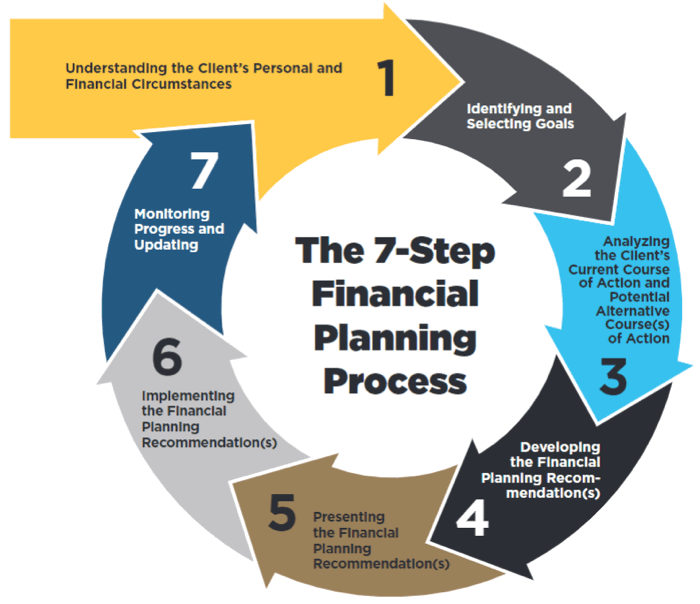
Whew! 😅 I just passed my first mid-term test in about 20 years. The first half of Fundamentals of Financial Planning, the first course from my self-paced CFP program, included coverage of the official 7-Step “Financial Planning Process”. The image above was found in my course materials, but the text (and I believe the graphic itself) is from the CFB Board’s Financial Planning Practice Standards.

Below are my completely non-official notes and takeaways. Remember, this is from the perspective of the financial planner.

Step 1: Understanding the Client’s Personal and Financial Circumstances

  • You must explain, obtain, and analyze all of the qualitative and quantitative information needed to fulfill the scope of your engagement.
  • Qualitative topics include (but are not limited to) health, family, goals, risk-tolerance, and priorities.
  • Quantitive topics include (but are not limited to) income, expenses, cashflow, savings, investments, assets, liabilities (debts), estate plans, and retirement/work benefits.
  • If the client is unwilling or unable to provide sufficient and accurate information (both personal and financial), you must terminate the engagement.

Step 2: Identifying and Selecting Goals

  • Identify potential goals for the client, using the information gathered in Step 1.
  • This means that in addition to the goals the clients brings up themselves, you may find other ones like adequate life insurance or a clear estate plan.
  • After developing this list of potential goals, work with the client to select and prioritize amongst these goals.

Step 3: Analyzing the Client’s Current Course of Action and Potential Alternative Courses of Action

  • Analyze the client’s current course of action. What are they doing now? Will their goals be met this way?
  • Analyze potential alternative courses of action. Find at least one alternative for any goal that won’t be met with current action.

Step 4: Developing the Financial Planning Recommendations

  • Develop a specific recommendation of action for each selected goal. It’s possible that the recommendation is to “stay the course” for one or more goals.
  • If an alternative is presented, work out why it is better than the current action. Include any assumptions and estimates used in your calculations.
  • Consider if each specific recommendation is independent or must be implemented along with another recommendation.

Step 5: Presenting the Financial Planning Recommendations

  • Present your recommendations to the clients. Your goal is to have the client understand all of the factors that were considered and why the recommendation presented is the best recommendation.

Step 6: Implementing the Financial Planning Recommendations

  • Now that the recommended actions have been agreed upon, who is responsible for implementation? Might be you (the financial planner), might be the client.
  • What products, actions, or services are the most appropriate for the job?
  • Select and implement!

Step 7: Monitoring Progress and Updating

  • Who is responsible for monitoring and updating? Might be you (the financial planner), might be the client.
  • If you (the financial planner) is responsible for monitoring and updating, then you must regularly monitor the client’s progress and keep the process going. Update with current client information, update goals, update recommendations, etc.

Other random thoughts:

The CFP Board makes a big deal about the difference between “Financial Advice” and “Financial Planning”. Financial Advice is the more limited act of making a recommendation to act or not to act, often focused on a specific niche topic. On the other end, the most encompassing (and expensive) term is Financial Planning, which requires you to follow all their Standards and obtain a deep understanding of the client’s personal and financial situation. Accordingly, CFPs will ask you to sign an Engagement Letter that clearly outlines the services and products being provided (and how you’ll pay for them).

I also spent a good deal of time learning how to use the HP-12C financial calculator to solve for internal rates of return, time value of money, cash flow analysis, amortization, and other financial scenarios. I have an engineering background, but had never used this calculator before, so I had to order a new one online. In the meantime, I used an HP-12C emulator to do the coursework. It’s definitely handy for finance.

Taking a Self-Paced CFP Education Course For Fun and… Personal Knowledge

While pondering potential goals for the New Year, I ended up poking around Certified Financial Planner (CFP) Certification Education Programs. I have been toying with the idea of taking one of these courses off and on for years, which helps you fulfill the first two requirements of obtaining the CFP certification:

  • Education. Completion of CFP Board-approved coursework, and a bachelor’s degree in any discipline from an accredited college or university.
  • Exam. Pass the CFP® Exam, which is 6 hours long and consists of 170 multiple-choice questions covering a variety of topics.
  • Experience. Complete 6,000 hours of professional experience related to the financial planning process, or 4,000 hours of apprenticeship experience that meets additional requirements.
  • Ethics. Pass the Candidate Fitness and Standards Background Check.

I have no plans to pursue a career as a financial planner, as even helping my parents with their portfolio is stressful enough on it own. Accordingly, I don’t plan on completing the Experience requirement and thus won’t be able to obtain the actual CFP certification. So why bother spending thousands of dollars and hundreds of hours of time?

  • I do plan on managing my own portfolio and financial situation (and portfolio of my parents) for the next few decades and beyond.
  • I know that I enjoy financial topics in general and am curious to fill any knowledge gaps that I have.
  • I’m curious about what the CFP board thinks is important and “correct”.
  • Hopefully I will find some useful information to share with you readers.
  • Even at a robo-advisor-like annual management fee of 0.30%, a $1 million portfolio would still cost $3,000 in fees each year. For someone who has accumulated a significant portfolio, it doesn’t seem completely reckless to spend $3,000 learning this stuff instead.

I read some reviews and comparisons, and somehow ended up on the website for the University of Georgia Self-Paced Online CFP® Program. This wasn’t the most well-known program, or the oldest program, but it seemed like a decent CFP Board-registered program and covered all the required topics at a relatively affordable cost of $3,250 (+$750 for optional textbooks). There are six courses and a capstone course where you develop an actual financial plan:

  • Fundamentals of Financial Planning
  • Insurance Planning
  • Investment Planning
  • Income Tax Planning
  • Retirement Planning
  • Estate Planning
  • Developing the Financial Plan

I filled out the form for a “free Demo”, and shortly thereafter received an e-mail offer for $700 off the “sticker” price. This offer has since expired, but I share this story for those seriously interested as you might also decide to express interest and see if you get an offer. The course itself appears to be run by a third-party called Greene Consulting, which runs the CFP courses for five different universities including UGA. (Yes, I checked them all, and they all list the same prices.)

Get instant access! Test drive the platform and learn why thousands of people have selected this Online CFP® Certification Education Program over the competition.

Complete the form below and get instant access to our online platform. View sample courses and interactive content.

Note: I have no affiliation with this program besides being a paying customer. Oh yes, I forgot, I impulsively bought the program after receiving the discount offer. I had already “anchored” myself to paying the $3,250 and felt it was a good deal… I fell for the old infomercial trick! Still, if you compare prices for CFP courses (full core content, excluding textbooks), this was definitely the cheapest net price that I’ve found.

This self-paced program allows you up to 21 months to complete all of the courses. My plan is to complete one course per month starting this month (February), and so right now I’m only about halfway through the first course “Fundamentals of Financial Planning”. I did go ahead and purchase physical textbooks (I’m old-fashioned… and old), but I haven’t had to open them yet. They use the financial textbooks from Money Education, and I paid $750 through UGA for the complete set.

Note that many financial professionals decide to take an additional “exam cram course” with lots of practice questions that is solely focused on passing the CFP Exam. This adds roughly another $1,000 on top of the ~$925 to actually take the CFP Exam itself! I don’t know if all that extra cost will be worth being able to say “I passed the CFP Exam!” when I don’t need the CFP certification for career advancement purposes.

The Scary Clause in Fixed Index Annuity Contracts

Allan Roth takes a closer look at the role of fixed index annuities as part of an “efficient” portfolio, and as usual makes some great observations. The first thing about fixed index annuities is that no two are the same – the insurance companies don’t want to create a standardized product where they have to compete with each other on price. There are surrender charges, confusing indexes, caps, spreads, market value adjustments, participation rates, just to name a few. Even in the analyzed article, they had to use a theoretical FIA product that nobody can actually purchase. (Comparability is what makes MYGAs and SPIAs different than other annuities.)

The second thing about fixed index annuities is that within nearly every contract, the insurance company can significantly change the crediting rules after purchase.

From Annuity.org:

The growth of indexed annuities aligns with the performance of a particular stock index, such as the S&P 500. Interest rate caps denote the maximum amount of interest an annuity can earn — regardless of the change in the index. Insurance companies have the right to adjust these caps every year.

From Roth’s article:

Every FIA contract I’ve reviewed has the unilateral right of the insurance company to change the terms of the contract, such as lowering that 12% cap. Pfau agreed that insurance companies have that right. I asked Pfau how low those caps could go, and he responded, “As low as 1-2%.” I’ve seen 0.25%, meaning the contract owner would get between 0% and 0.25% annually. This right of the insurance company to slash returns was not mentioned in Pfau’s paper.

Here’s some fine print I just pulled off the internet for the first FIA product I could find:

The rates are guaranteed for the length of the crediting period. They are declared at issue and at the end of the crediting period. The minimum monthly cap for the monthly sum with cap crediting method is 0.50%. The minimum annual cap for the annual point-to-point with cap crediting method is 0.25%. The maximum annual spread for the annual point-to-point with spread crediting method is 12%. The minimum participation rate for the annual point-to-point with a participation rate and the 2-year MY point-to-point with a participation rate crediting methods is 5.0%. The minimum interest rate is 0.10%.

Note that the rates are only guaranteed for “the length of the crediting period” (one year is common, but can be up to 5-7 years). As of this writing, the current “annual point-to-point with cap” is 6.5% for the S&P 500 index. But in the next crediting period, they could lower it down to 0.25%. The current “annual point-to-point w/ participation rate” for the PIMCO Tactical Balanced ER Index+ is 120%. But in the next crediting period, the terms reveal they could lower it all the way down to 5%.

FIAs don’t offer easy comparison shopping that encourage consumer-friendly pricing, the index it tracks never includes dividends (that I’ve ever seen), and the insurance company keeps the power to change the return calculations after purchase. Hard pass.

FDIC Insurance: Don’t Waste This Valuable Insurance

The big financial news over the weekend was the failure of both Silicon Valley Bank and Signature Bank. They failed, the FDIC took over and fulfilled its duties, and then the uninsured business owners convinced the Fed to backstop everything (aka “bail them out”).

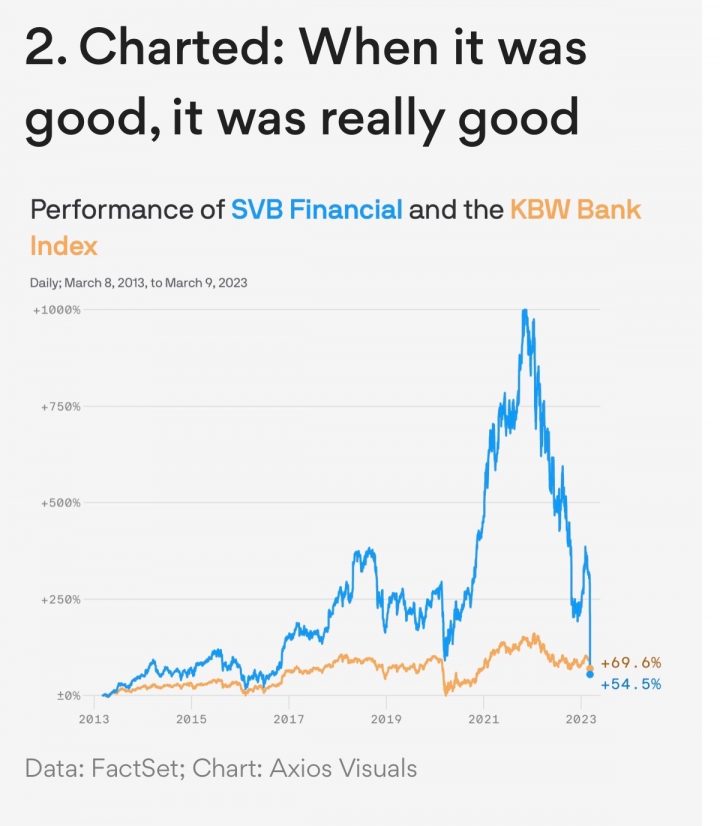
As a simple individual investor trying to keep his family assets safe, my first takeaway was simply that you can’t expect to see a bank failure coming. Silicon Valley Bank was the cool kid for a long time. Here’s a chart from Avios of its stock price vs. an index tracking bank stocks overall:

Most of Silicon Valley Bank’s deposits were from start-up businesses, but individual households had accounts with them as well. I don’t mean to pick on DepositAccounts, but they are a respected site and they gave Silicon Valley Bank a Health Grade of A:

How is the average investor supposed to do any better? This is why I don’t care about health grades for banks from anyone. I don’t need to examine their investment portfolio, underwriting standards, or stock price. As a depositor, either they have FDIC insurance, or they don’t.

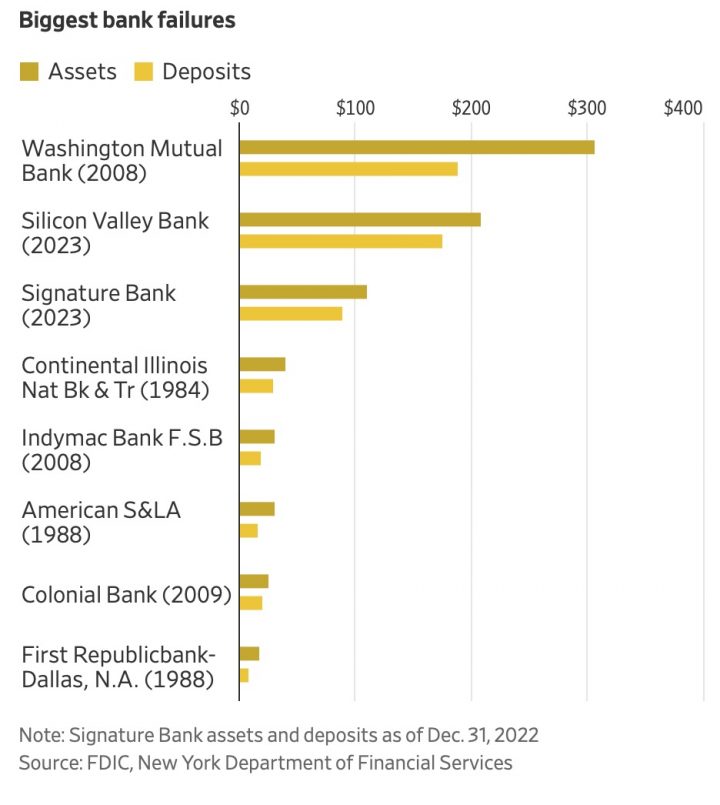
Big name banks can fail even if their assets are greater than their deposits. Silicon Valley Bank and Signature Bank are now the second and third largest bank failures ever (even inflation-adjusted), and only behind to Washington Mutual during the financial crisis. From WSJ:

I wonder how the list will look in a year?

As an individual, there is no reason to exceed the FDIC insurance limits.. FDIC insurance provides great peace of mind. Don’t waste it.

Got anywhere close to $250,000 in a single bank account? Know that the FDIC insurance coverage limit applies per depositor, per insured depository institution for each account ownership category. You may actually achieve more than $250,000 of total coverage at a single bank, depending on how you have titled your accounts. Here are the official online calculators:

NCUA Electronic Share Insurance Calculator (ESIC)
FDIC Electronic Deposit Insurance Estimator (EDIE)