Chime: Free Federal + State Tax Filing for All Customers (+ $100 New User Bonus)

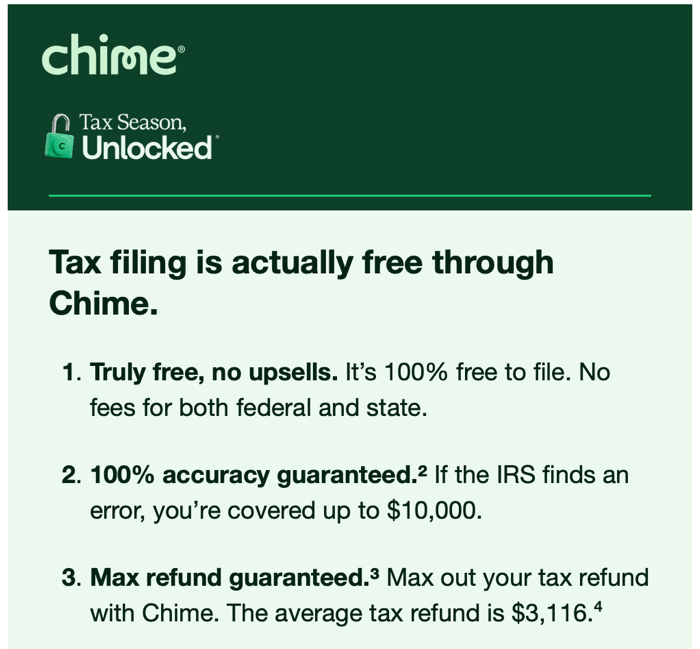
Chime, one of the largest fintech banking apps, just send out an e-mail confirming that they are again offering “100% Free” tax filing software for both Federal and State returns, including e-file. Available for all new and existing Chime users, this is done in partnership with Column Tax and April, both companies that offer white-label “generic” tax software.

To allay fears of sub-par tax software, they include:

  • 100% Accuracy Guarantee: If a user pays an IRS penalty because of a calculation error made by Chime’s tax filing partners april or Column Tax, they will reimburse up to $10,000.
  • Max Refund Guarantee: If a member finds they’re eligible for a higher return elsewhere, they will be reimbursed the difference.

One drawback is that you have to do it in-app, which might be cumbersome if you a lot of manual entries. However, they do allow you to scan your last years’ tax return in order to import your data from last year. Chime does not require you to deposit your refund into your Chime Account to qualify for free tax filing.

According to Chime.com/taxes, they support everything up to W-2 income, self-employed, 1099 freelance, gig work income, unemployment income, crypto and/or stock sales, and itemized deductions. I’d say the sweet spot for this app is if your tax situation isn’t overly complex, but maybe you do have some stock transactions or 1099 income so you’d be nudged to upgrade to a higher TurboTax version that costs extra.

If you are thinking of joining as a new customer, you should first open via a $100 referral link which currently offers a $100 bonus after a $200+ direct deposit within 45 days of opening. That’s mine, thanks if you use it. Chime has no minimum balance and no monthly fees.

“Junior Roth IRA”? Maximizing the 529-to-Roth IRA Rollover

A new automated investing app called FutureMoney is advertising something called the Junior Roth IRATM with some pretty awesome “key benefits”, according to their site:

– Tax-free growth potential
– No earned income required to make contributions
– Favorable FAFSA impact when funded by grandparents
– Optimized for long-term generational wealth building
– Within certain limits, can be used for education, a first home, or retirement.

Since it doesn’t required earned income, it’s not an official Roth IRA for kids (aka Custodial Roth IRA). Somehow, is this even better?!

A Custodial Roth IRA has maximum annual contribution room of $7,000 per year. By comparison, you can invest up to $35,000 for your child is a minor with a Junior Roth IRA over its lifetime, with no annual limit.

After a bit of poking around on their site, I realized that under the hood it’s just a 529 plan with the expectation that when the option is available, they will roll over the 529 plans assets into a Roth IRA account. I didn’t know you could advertise the combined benefits for two completely different things (529 and Roth IRA), make up a name for this thing that doesn’t actually exist, and then trademark it?

There is so much obfuscation on this site!

What is a Junior Roth IRA?
The Junior Roth IRA™, exclusively offered by FutureMoney, allows you to invest up to $35,000 while your child is under 18 and grow that money tax free into their retirement, based on a 529 plan to Roth IRA rollover.

It’s a 529 plan. Full stop.

Therefore, to see the limitations of this method, simply look up any article about the new option for rolling over unused 529 funds into the beneficiary’s Roth IRA without a tax penalty. Here are important limitations to consider, per the Secure 2.0 Act of 2022.

  • The originating 529 account must have been maintained for the Designated Beneficiary for at least 15 years.
  • The transferred amount must come from contributions made to the 529 account at least five years prior to the 529-to-Roth IRA transfer date.
  • The target Roth IRA must be established in the name of the Designated Beneficiary of the 529 account.
  • The amount transferred to the target Roth IRA is limited to the annual Roth IRA contribution limit. It is not in excess of the normal contribution limit. This means your child does eventually need to have earned income equal to the amount to be rolled over into the Roth IRA.
  • The aggregate amount (total over multiple years) transferred from a 529 account to a Roth IRA may not exceed $35,000 per individual.

I would add that nobody knows what will happen in the “Secure 5.0 act of 2035”. The Roth IRA window might be narrowed, closed, or even opened further. I do think closing it will hard after it’s already been opened, but 15 years can be a long time.

As usual with 529 plans, you can make some pretty impressive claims by combining the power of compounding and a long period of time.

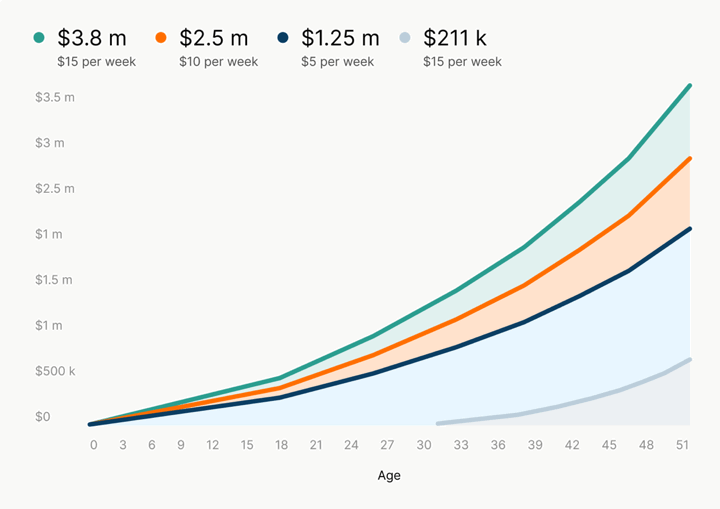
“If a parent invests just $10 a week from their child’s birth to age 18 and then leaves it to grow for 50 years, their child could have a $1 million nest egg, assuming 8% compounding annual returns,” states Dave Fortin, CFA, co-founder of FutureMoney.

Even if it is a 529 plan with a lot of limitations, let’s consider if viewing it as a Roth IRA is actually a good idea. Let’s be honest, this is for relatively rich families that are able to help their kids/grandkids even beyond the enormous, scary cost of a college and post-graduate education. $10 a week ain’t going to do much when college is coming up fast! As they say, the richer you are, the longer your financial time horizon becomes.

For such financially well-off families, I could see this as useful for the years when your child is 16-25. Even though I am a financial nerd now, I didn’t really become financially “aware” until I was 21 years old and didn’t make my first Roth IRA contribution until I was 21 years old. However, I started having “earned income” at age 16 or so. So it may be useful to contribute the money into a Roth IRA at those younger ages (maybe a “parent match”?) when there is a window where they may be earning some money from work, but not enough to be able to defer that money into a Roth IRA on their own.

But again, you can do this with any 529 plan, and the good 529 plans out there already have some low-cost, diversified portfolio options. The Utah plan I picked lets you make a customized glide path using Vanguard and DFA funds. You don’t need this “Junior Roth IRA”.

E-File Federal and State Tax Extension Instantly Online For Free (Updated 2025)

Updated for 2025. This year, the deadline for federal tax filing is Tuesday, April 15th, 2025. If you file for an extension before midnight on that date passes, you can extend the time allowed to file your return by six months to October 15th, 2025. It does not extend the time to pay any tax due. There are many legitimate reasons to ask for such an extension, and the extension is granted automatically without needing to provide a specific reason. In the past, I had a Schedule K-1 that consistently arrived after 4/15, so I would file an extension to file instead of having to make an amended return (I later sold that holding).

Why is filing an extension important? The “Failure to File” Penalty is 5% of the unpaid taxes for each month (or part of the month) that the tax return is late (without extension). The “Failure to Pay” penalty is 0.5% of your balance due for each month (or part of a month). That’s a 10X difference!

The good news is that you can instantly e-file a federal and state tax extension (where available) for free. Advantages of using e-File include:

  • You save the time and postage costs of paper mailings.
  • You can estimate your tax liability using online software and/or calculators.
  • You receive confirmation of receipt via e-mail or text, often within hours.
  • The potential convenience of filing your state tax extension online at the same time.

TaxAct

Tax prep software TaxAct allows you to e-File your Federal and State extension (where applicable) for free through them. I use TaxAct to file my extensions because after using them once, I just found them to offer the most easy and useful user interface. They guide you through the process for federal and every state, letting you choose between printing the form to mail or e-Filing the state extension if available. You don’t need to input payment information, or even use them to file your actual taxes, although you certainly could.

Directions
First, register for free at TaxAct.com with your e-mail address and pick a password if you haven’t previously. You must start a new tax filing, but you don’t need to enter anything. Just look for the option to “File Extension” on the purple left menu bar, and follow their interview directions.

TaxAct supports the electronic filing of extension forms for the following states:

  • Arkansas
  • Arizona
  • California
  • Connecticut
  • District of Columbia
  • Kentucky
  • Louisiana
  • Maryland
  • Massachusetts
  • New Hampshire
  • New Jersey
  • New York
  • North Carolina
  • Oklahoma
  • Pennsylvania
  • Tennessee
  • Texas
  • Virginia
  • West Virginia
  • Wisconsin

Afterward, you can confirm the status of your extension e-file by going to efstatus.taxact.com. They will even send you a confirmation via e-mail or text message. I got my confirmation less than 3 hours after submission.

IRS Direct Pay

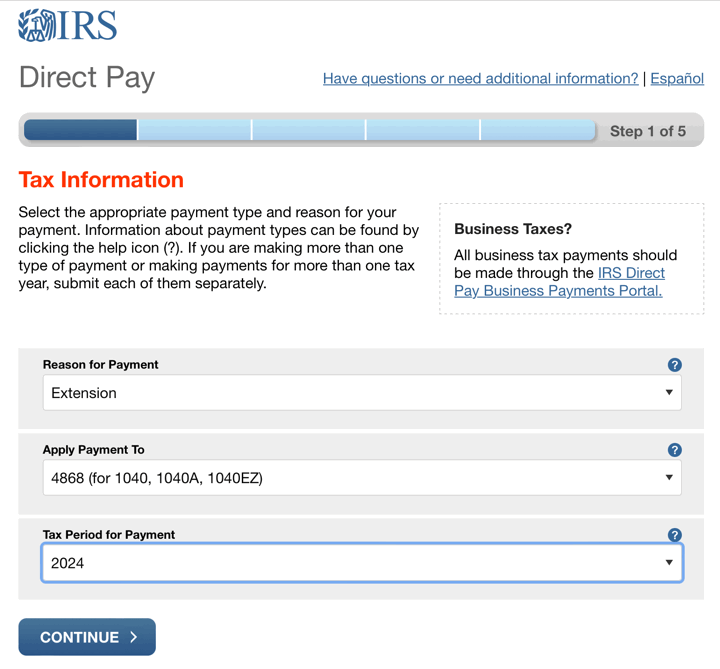
If you only have Federal taxes to worry about, the most direct way to file an extension would be to use IRS Direct Pay. Even if you don’t think you’ll owe any taxes, you can just submit a non-zero payment of $1 (or whatever) and they will file an extension for you along with the payment (remember to note this payment when you later file). As shown in the screenshot above, just choose “Extension” as the Reason for Payment, “Form 4868 (for 1040, 1040A, 1040EZ)” as the Apply Payment To, and 2024 (or whatever applies in your case) as the Tax Period for Payment. You will probably have to answer some identity verification questions, so try to have your previous year’s tax return ready.

Most other tax filing software will also file extensions for you in a similar manner, including TurboTax and H&R Block. I’m not completely sure about all of their state e-File offerings.

(Note: For the 2024 Tax Year, disaster victims in twelve states have automatic extensions to file and pay their 2024 taxes. This includes taxpayers in the entire states of Alabama, Florida, Georgia, North Carolina and South Carolina.)

Fidelity Money Market Funds: Claim Your State Income Tax Exemption (Updated 2025)

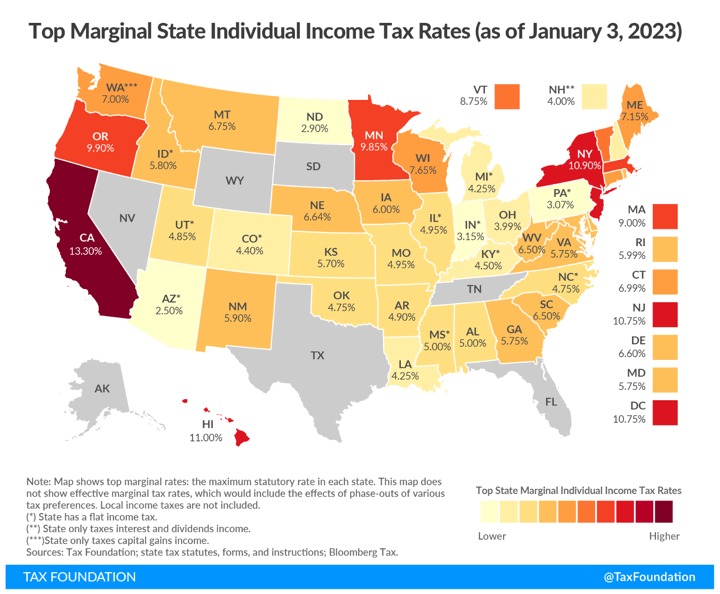
Updated. As the brokerage 1099 forms for the 2024 Tax Year are coming out, here is a quick reminder for those subject to state and/or local income taxes. If you earned interest from a money market fund, a significant portion of this interest may have come from “US Government Obligations” like Treasury bills and bonds, which are generally exempt from state and local income taxes. However, in order to claim this exemption, you’ll likely have to manually enter it on your tax return after digging up a few extra details.

(Note: California, Connecticut, and New York exempt dividend income only when the mutual fund has met certain minimum investments in U.S. government securities. They require that 50% of a mutual fund’s assets at each quarter-end within the tax year consist of U.S. government obligations.)

Fidelity has released US GOI percentages for 2024 on their institutional website, but it’s a little hard to read since it includes a lot of funds and share classes that are used by Fidelity-affiliated financial advisors and institutional portfolios. Their tax document page still says “Expected mid February” – Update 2/22: 2024 Percentage of Income from
U.S. Government Securities now available
. The numbers from both sources are the same, although rounded off differently for some reason.

Here are the results for the most popular core Fidelity money market funds:

  • Fidelity® Treasury Only Money Market Fund (FDLXX, CUSIP 31617H300) – 97.0032%.
  • Fidelity® Government Money Market Fund (SPAXX, CUSIP 31617H102) – 55.0877%.
  • Fidelity® Government Cash Reserves (FDRXX, CUSIP 316067107) – 57.1917%.
  • Fidelity® Treasury Money Market Fund* (FZFXX, CUSIP 316341304) – 50.5640%. *FZFXX did not meet the minimum investment in U.S. Government securities required to exempt the distribution from tax in California, Connecticut, and New York.
  • Fidelity® Government Money Market Fund Premium Class (FZCXX, CUSIP 31617H706) – 55.0877%. This fund has a $100,000 minimum, but also a lower expense ratio than SPAXX, which means it earns about 0.10% more yield annually as of this writing 2/20/25.

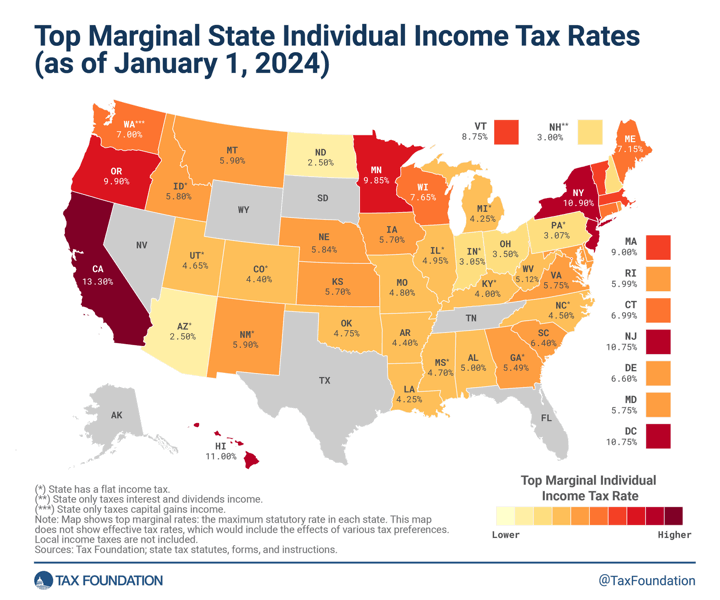
To find the portion of Fidelity dividends that may be exempt from your state income tax, multiply the amount of “ordinary dividends” reported in Box 1a of your Form 1099-DIV by the percentage listed in the PDF. For example, if you earned $1,000 in total interest from Fidelity Treasury Only Money Market Fund (FDLXX) in 2024, then $970.03 could possibly be exempt from state and local income taxes. If your marginal state income tax rate was 10% that would be a ~$97 tax savings for every $1,000 in total interest earned.

On a net after-tax basis, folks with a ~10% state income tax rate will likely find that FDLXX earns more interest than the default core holdings of SPAXX/FZFXX, even though the gross yield of SPAXX/FZFXX is higher than that of FDLXX.

To obtain these tax savings, you’ll have to manually adjust your state/local income tax return. I don’t believe that TurboTax, H&R Block, and other tax software will do this automatically for you, as they won’t have the required information on their own. (I’m also not sure if they ask about it in their interview process.) If you use an accountant, you should also double-check to make sure they use this information. Here is some information on how to enter this into TurboTax:

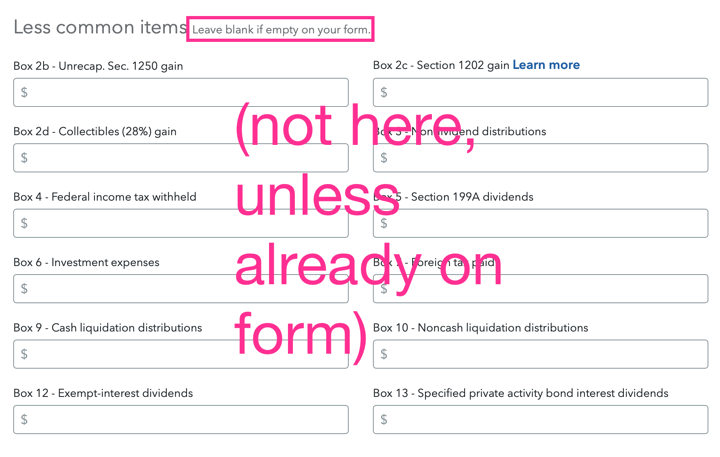
  • When you are entering the 1099-DIV Box 1a, 1b, and 2a – click the “My form has info in other boxes (this is uncommon)” checkbox.
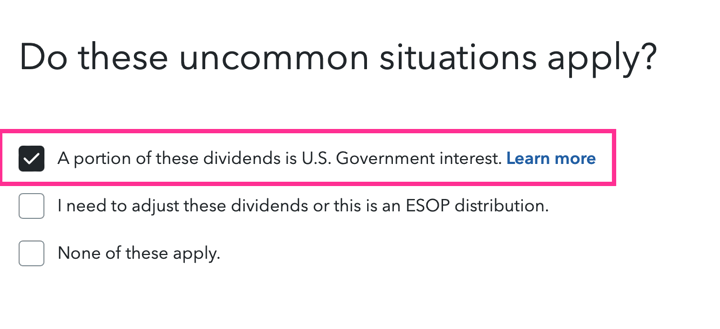
  • Next, click on the option “A portion of these dividends is U.S. Government interest.”
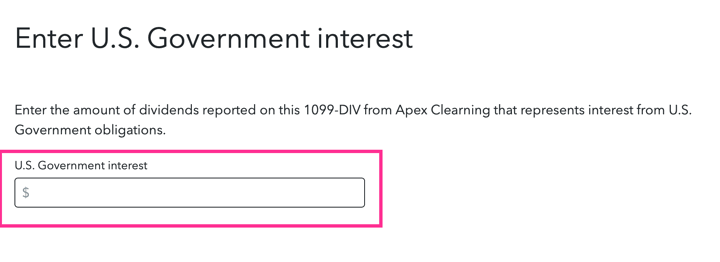
  • On the next screen enter the Government interest amount. This will be subtracted from your state return.

Standard disclosure: Check with your state or local tax office or with your tax advisor to determine whether your state allows you to exclude some or all of the income you earn from mutual funds that invest in U.S. government obligations.

[Image credit – Tax Foundation]

TurboTax Promo: Switch to TurboTax, File on App by 2/28, Get Deluxe/Premium For $0 Federal, $0 State

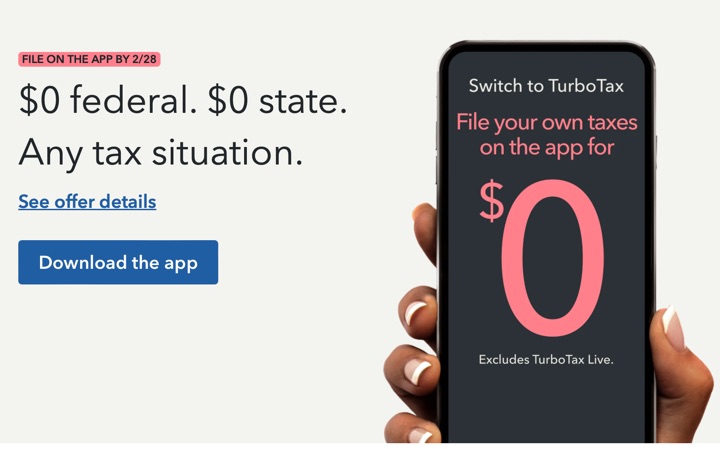
Here is a new TurboTax App promo link that offers free tax filing ($0 Federal, $0 State) for ALL tax situations (not just 1040EZ form users). This includes their TurboTax Standard, Deluxe, and Premium products. Here are the specific set of requirements:

  • Switch to TurboTax. You must not have used TurboTax last year to file your taxes. (If you used TurboTax the year before last, but not last year, you’re still eligible for this offer.)
  • Use the TurboTax app to start and file. You must start and file your taxes using the TurboTax mobile app. The offer link above should provide a QR code to scan.
  • DIY only – TurboTax Live not included. This offer is only available for the “Do your own taxes” product. TurboTax Live products are excluded.
  • File by February 28, 2025. Taxes must be filed by February 28, 2025.

Even if they ask you to “upgrade” in the app, as long as you follow the rules above, the fee should be waived at the checkout. “We might ask you to upgrade, but we’ll waive the fee as long as you file on the app by February 28.”

TurboTax has gotten into trouble in the past for advertising their Free Edition, but often little things like having a single 1099-MISC form would make you ineligible and thus you’d have to upgrade to a paid product. Now, they must disclose that roughly 37% of filers qualify for Free Edition.

Meanwhile, the retail price of TurboTax Premium is now up to $89 Federal + $39 per State. There are discounts everywhere, but it’s still close to $100 total after 30% off. You can get this deal even if you have a 1099-MISC form or two, some investment income from a stock sale on a 1099-B, want to itemize deductions, and have rental income, or something like that.

I’ve never done taxes on an app, but they claim that it’s actually easier since you can take pictures of all your forms to upload them, instead of typing it all in. However, their FAQ seems to offer another workaround if you still want to avoid the app. As long as you *start* on the app, and *file* on the app, you can work on your stuff on a web browser in the middle.

You’re eligible for this offer when you start and file your taxes in the TurboTax mobile app.
If you switch to doing your taxes using a web browser instead of the app, we’ll show you a reminder that you must file in the app to redeem the offer.
If you choose not to file in the app, the cost of TurboTax will go back to regular pricing, which is based on the complexity of your tax return.

Federal and State e-File is included at no additional cost. I know that TurboTax Desktop charges you an additional $25 for a State e-File (you can print and mail for free), but according to their online chat (and some unofficial online sources), this TurboTax State Online/App version includes Federal and State e-File at no additional cost. I don’t like how TurboTax makes this information hard to find, and that there are different policies for Desktop vs. Online.

With a $0 all-in cost including Fed+State eFile if you qualify, this is definitely a strong offer, but the deadline is coming up and I’m still getting late brokerage 1099s trickling in mid-February. 😡 Let’s hope for no amended 1099s! 🤞 I’m looking at you, Apex Clearing…

Disclosure: I am an affiliate of TurboTax. I usually don’t write about TurboTax unless there is an especially good deal on them, and I think this deal is worth sharing since the retail price of TurboTax Premium is $89 Federal + $39 per State.

Vanguard Money Market Funds: Claim Your State Income Tax Exemption (Updated 2025)

Updated February 2025. As the brokerage 1099 forms for the 2024 Tax Year are coming out, here is a quick reminder for those subject to state and/or local income taxes. If you earned interest from a money market fund, a significant portion of this interest may have come from US Treasury bills and bonds, which are generally exempt from state and local income taxes. However, in order to claim this exemption, you’ll likely have to manually enter it on your tax return after digging up a few extra details.

(Note: California, Connecticut, and New York exempt dividend income only when the mutual fund has met certain minimum investments in U.S. government securities. They require that 50% of a mutual fund’s assets at each quarter-end within the tax year consist of U.S. government obligations.)

Let’s take the default cash sweep option for Vanguard brokerage accounts, the Vanguard Federal Money Market Fund (VMFXX), which has an SEC yield of 4.29% as of 1/31/25. Vanguard has recently released the U.S. government obligations income information for Tax Year 2024 [pdf] for all their funds, which states:

This tax update provides information to help clients properly report state and local tax liability on ordinary income distributions received from mutual fund investments in 2024.

On the next page, you’ll find a list of Vanguard funds that earned a portion of their ordinary dividends from obligations of the U.S. government. Direct U.S. government obligations and certain U.S. government agency obligations are generally exempt from taxation in most states.1

To find the portion of Vanguard dividends that may be exempt from your state income tax, multiply the amount of “ordinary dividends” reported in Box 1a of your Form 1099-DIV by the percentage listed in the PDF. Note that on the IRS Form 1099-INT, there is a special Line 3 that includes “Interest on US Savings Bonds & Treasury obligations”. However, for the Vanguard funds, they report on 1099-DIV and not 1099-INT. My Vanguard 1099-INT was all zeros.

For the Vanguard Federal Money Market Fund (VMFXX), this percentage was 59.87% in 2024. (For reference, it was 49.37% in 2023.) Therefore, if you earned $1,000 in total interest from VMFXX in 2024, then $598.70 could possibly be exempt from state and local income taxes. If your marginal state income tax rate was 10% that would be a ~$60 tax savings for every $1,000 in total interest earned. For 2024, this fund met the threshold requirements for California, Connecticut, and New York, which require that 50% of the fund’s assets at each quarter-end within the tax year consist of U.S. government obligations.

In comparison, the Vanguard Treasury Money Market Fund (VUSXX) had a GOI percentage of 100% in 2024. (For reference, it was 80.06% in 2023.) If your marginal state income tax rate was 10% that would be a $100 tax savings for every $1,000 in total interest earned. With a very similar SEC yield of 4.27% as of 1/31/25, this is why many people chose to manually buy VUSXX instead of the default settlement fund as it can earn you a higher after-tax interest rate.

The following Vanguard funds and ETF equivalents have 100% of their interest from US government obligations:

  • Short-Term Treasury Index Fund (VGSH, VSBSX)
  • Intermediate-Term Treasury Index Fund (VGIT, VSIGX)
  • Long-Term Treasury Index Fund (VGLT, VLGSX)
  • Extended Duration Treasury Index Fund (EDV)
  • Short-Term Inflation-Protected Securities
    Index Fund (VTIP, VTAPX)
  • Inflation-Protected Securities Fund (VIPSX, VAIPX)

Note that several other Vanguard funds have a lower but nonzero percentage of dividends from US government obligations, including the popular Vanguard Target Retirement Income funds. It may be worth a closer look for residents of certain states, especially those with larger balances and closer to retirement (holds more bonds).

To obtain these tax savings, you’ll have to manually adjust your state/local income tax return. I don’t believe that TurboTax, H&R Block, and other tax software will do this automatically for you, as they won’t have the required information on their own. (I’m also not sure if they ask about it in their interview process.) If you use an accountant, you should also double-check to make sure they use this information. Here is some information on how to enter this into TurboTax:

  • When you are entering the 1099-DIV Box 1a, 1b, and 2a – click the “My form has info in other boxes (this is uncommon)” checkbox.
  • Next, click on the option “A portion of these dividends is U.S. Government interest.”
  • On the next screen enter the Government interest amount. This will be subtracted from your state return.

Here are some links to find the percentage of ordinary dividends that come from obligations of the U.S. government. You should be able to find this data for any mutual fund or ETF by searching for something like “[fund company] us government obligations 2024”]. If you do not see the fund listed within the fund company, it may be assumed to be 0%. The data is sometimes not released until mid-February.

Standard disclosure: Check with your state or local tax office or with your tax advisor to determine whether your state allows you to exclude some or all of the income you earn from mutual funds that invest in U.S. government obligations.

[Image credit – Tax Foundation]

Last-Minute Healthcare FSA Reminder (Average Loss $441!), Amazon $10 FSA Offer

Updated for 2024, new $10 Amazon bonus. Here’s a year-end reminder to get back all the money sent into Healthcare Flexible Spending Accounts (HC FSA) due to their “use it or lose it” structure (see possible extensions below). According to the latest analysis by EBRI, roughly half (!) of FSA accountholders forfeited funds to their employer in 2022. The average forfeiture was $441.

I am picking up an extra pulse oximeter and forehead thermometer after our multiple fun journeys with kids and respiratory illnesses this year.

Quick ideas. If you didn’t exhaust your funds with insurance copays or deductibles, here are eligible items that you can still buy over-the-counter without a prescription. Just order things online and then submit the receipt. Amazon even has a special FSA-eligible page that directly accepts FSA/HSA debit cards, complete with an “under $25” and “little-known eligible items” section. Consider using this time to stock your hurricane/earthquake/snowstorm emergency kits.

Right now, they are also offering $10 Amazon credit when you spend $50 on eligible FSA items.

(You may need to view this page on the website to see all the Amazon links.)

The 2020 CARES Act added the following categories for 2021 and beyond:

Ideally, if you use an FSA card and shop through an eligible FSA store, things will be auto-approved. Otherwise, when getting a receipt, make sure it clearly includes the following:

  • Date of service or purchase
  • Name or description of the item
  • Amount of purchase

Deadline extensions. Employers have the option of adding one of the following:

  • Some plans allow a grace period until March 15th of the following year as opposed to a December 31st deadline to use your funds, but it may only apply to claims and not late purchases. Check with your employer on if they opted-in to these extensions.
  • Some plans allow participants to carry over up to $500 in unused FSA funds into next year. Check with your employer.

Big, exhaustive lists. Some of these are searchable by keyword as well.

But remember, your FSA administrator has the final say as to the exact guidelines for reimbursement according to your plan. Every year, I have to deal with claim rejections and extra paperwork. The skeptic in me suspects that this bureaucratic nightmare is part of their business model. (Remember mail-in rebates?) Guess who gets to keep unreimbursed FSA funds? The employer, which can then use the money to pay for… the FSA administrator.

Got a Health Savings Account (HSA) and think you are ineligible for an FSA? Look for a “limited-purpose FSA” option that is restricted to dental and vision care services. These have the same max annual salary deduction.

Last-Minute Tax Payment? Increasing Paycheck Withholding (W-4) is Better Than Direct Estimated Tax Payments (1040-ES)

It’s late in the year, and you may have realized that you will owe more income tax than you thought. In order to avoid penalties, you’ll need to send some extra money to the IRS or your state tax collector. Here is the *general* rule to avoid a penalty for underpayment of estimated tax, according to the IRS:

Generally, most taxpayers will avoid this penalty if they owe less than $1,000 in tax after subtracting their withholdings and credits, or if they paid at least 90% of the tax for the current year, or 100% of the tax shown on the return for the prior year, whichever is smaller.

But again, that’s generally. Even if you send it by the end of the year, you may still be on the hook for some penalties because the IRS wants you to pay your taxes evenly throughout the year. For example, technically you’ll need to pay 25% of the tax shown on the return for the prior year for each of the four quarters, adding up to 100% over the entire year. They don’t allow you to pay everything on December 31st.

There are two ways to pay your taxes during the year:

  • Withholding from your pay, your pension or certain government payments, such as Social Security.
  • Making quarterly estimated tax payments during the year.

However, there is a small but potentially important different between the two options. No matter when your withholding is taken out from your paycheck during the year, it is viewed as being paid in evenly. In contrast, any 1040-ES estimated payments are assigned to a specific quarter.

So if you think you’ve underpaid your taxes by enough that penalties may apply, you should consider changing your paycheck withholding to increase your tax payments instead of making a direct payment to the IRS. Many payroll providers will let you adjust things online and you can specifically set the amount of extra withholding for them to take out. Or you may have to submit a W-4 directly to your HR department. This will be step 4(c) on the official W-4 form. Note that this will be the flat amount taken out of each paycheck until you change it back. See top image for reference (source).

IRA and 401k Accounts Can Earn You 30% More After 40 Years

We’re all told that we should use IRA and 401k accounts to save for retirement due to their great tax benefits. But how valuable exactly are those benefits? 🤔 A huge difference? A little difference? This Morningstar article crunches some numbers for “traditional” pre-tax IRA/401ks within a broadly-representative tax situation and three example portfolios. (Although the benefits should be basically the same for Roth accounts, as they end up assuming the same tax rate during the working and retirement years.)

A one-time $5,000 contribution (pre-tax) is invested for 40 years within both the tax-deferred IRA/401k and a taxable brokerage account. The three example portfolios are “100% zero-dividend stocks”, “100% stock index”, and “60% stocks/40% bonds balanced” – essentially most to least tax-efficient. All are assumed to return 8% annually. Here are the results:

Here is the conclusion, quoted directly from the article:

To address this article’s original question, for investments made over a full working career, from age 25 to 65, IRA/401(k) accounts improve the final aftertax value of the study’s assets by 17% for a no-dividend portfolio, 30% for a stock market index fund, and 44% for a low-turnover balanced fund. Those figures, of course, will vary according to personal circumstances, but I conducted enough offscreen spreadsheet tests, using different tax brackets, to conclude that they are broadly representative.

As you might expect, the advantage is greater when the portfolio is less tax-efficient. The more something spins off dividends, capital gains, or interest, the more it should try to go in the tax-deferred bucket.

If you assume the use of the most popular target date retirement funds, they are 90% to 100% stock market index for the majority of the working years (25-65). So there you have it. A 30% boost is a reasonable estimate for most people to carry around in their heads. Roughly 1/3rd more. That’s a lot!

In short, IRA/401(k) plans are a very good deal. And should the latter offer a company match, they become a truly great deal.

Vanguard Digital Advisor: Estimating the Benefit of Tax-Loss Harvesting

One of the features of Vanguard’s Digital Advisor Services (VDAS) that is hardest to replicate on your own is the automated tax-loss harvesting (TLH). VDAS will monitor the prices of each of your stock ETFs daily, sell some or all of them at a loss when they deem appropriate, purchase a surrogate replacement ETF at the same time to avoid IRS wash rules, and keep track of what could be hundreds of different tax lots on an ongoing basis. A DIY investor could perform a similar version of this, but it would definitely be higher on the continuum of effort and skill required.

Therefore, a potential customer might want to estimate the benefit from TLH, and compare that with the VDAS fee of ~0.15% annually. It is possible that the TLH feature could completely offset the cost of the entire service. I dug around and found the following resources that explain everything from the general background behind TLH to how VDAS implements them specifically.

I especially appreciate the intellectual honesty of the research whitepapers because it is one of the few articles from a robo-advisor that actually admits that TLH can actually lower your after-tax return if your personal situation is not ideal. Most other robo-advisors quote some pretty idealistic assumptions to get their numbers. Here’s a quote:

In recent years, tax-loss harvesting (TLH) has been aggressively advertised as a near-certain way to increase after-tax returns by anywhere from 100 basis points to 200 basis points—in some cases even 300!—annually. […] But many individual investors do not fit this mold or should first focus on other more valuable options such as investing in tax-advantaged accounts. These investors will eventually be disappointed with the size of their TLH benefit if they set their expectation at 100 to 200 basis points.

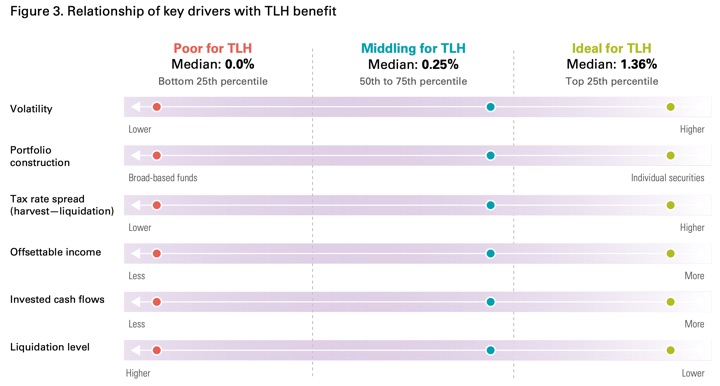
Here are the many factors that will affect the actual benefit from tax-loss harvesting, along with a brief description and how VDAS handles it.

  • Future stock price volatility. You need losses to harvest them, and the bigger the losses, the bigger the harvest. You then need the stock price to bounce right back, preferably quickly after you harvest them. Stable and steadily-growing markets aren’t helpful in creating TLH alpha.
  • How often will you keep making new investments. If you have frequent regular investments of new cashflows, this creates more tax lots where a loss could result, and then harvested.
  • Future time horizon. Markets tend to go up over time. As time goes on, the benefit of TLH will decrease because there will be fewer losses left to harvest.
  • How often will they check for losses. Monitoring the situation daily should help find more opportunities to harvest losses. Vanguard Digital Advisor states they will check daily.
  • Number of different portfolio securities held. The more different things you can sell to create losses, the more TLH opportunities there are. Expect “direct indexing”, where you own a tiny bit of every stock instead of a pooled ETF, to be marketed more and more heavily in the future. Vanguard Digital Advisor holds ETFs, not individual securities.
  • Do you have external capital gains to offset losses? Tax savings are generated by using harvested losses to offset capital gains elsewhere. Without capital gains, taxable ordinary income can only be reduced by up to $3,000 a year. Therefore, people with small businesses, private equity, real estate, or other investments that generate a lot of capital gains are more likely to benefit from harvesting losses.
  • Your current and future tax brackets. Tax savings are generated now by offsetting capital gains and income at your current tax rate. However, you are lowering your cost basis and thus deferring those capital gains to the future. If your future tax bracket is higher, then you may actually end up paying more in taxes later. Note your future tax bracket may be higher due to legislation, not only due to income changes. Others expect to defer “indefinitely” and use the step-up in basis upon death or make a qualifying charitable donation.
  • Reinvesting tax savings. A significant part of the theoretical TLH benefit comes from investing any tax savings so that you are taking advantage of those deferred taxes and growing them further.
  • Future stock market return. This effect from the compounding of reinvested tax savings depends on the size of the market return, obviously.

As you can see, many of these factors depend on your personal situation. Vanguard introduces two imaginary model investors to explain the potential differences. This is my own abbreviated summary.

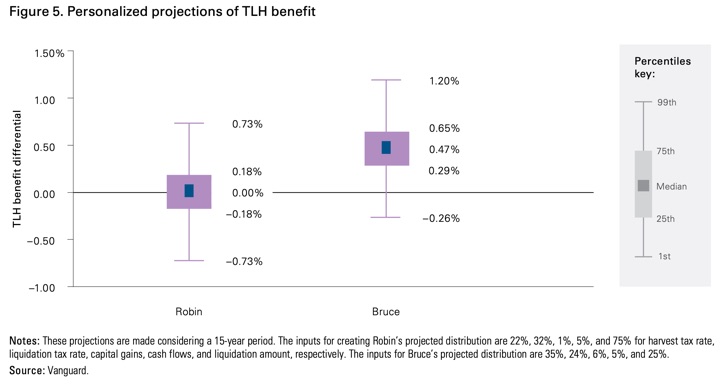
Robin is a doctor in her early 30s. She is currently in the 22% income tax bracket. But after she finishes her residency in two years, she expects to spend most of her career in the 32% bracket or higher. She mostly saves in tax-deferred accounts, so she doesn’t expect to generate significant capital gains. Due to fact that her future tax rate is higher than now, and her low expectations for capital gains, her likely benefit is low, possibly zero or even negative.

Bruce is in his late 50s and a partner at a large consulting firm that regularly realizes capital gains when new partners buy into the partnership and when he eventually sells all his shares for ~$4 million. Essentially, unlimited capital gains to offset losses. He is currently in the 35% bracket, but, based on his plans for a frugal retirement lifestyle, he aims to be in the 24% income tax bracket throughout retirement. Due to the fact that he expects his future tax rate to be lower than now, and his high expectations for capital gains, his likely benefit is high, with a median projected benefit of 0.47% annually.

These appear to be reasonable estimates for the real-world benefit of TLH at two relatively extreme examples. I think most people will be somewhere in between. So a median expectation of 0% to 0.50%, but just as important, a wide possible range of actual results! Many other robo-advisor presentations do not adequately disclose their assumptions, including the possibility of negative “alpha” if your tax rates end up being higher in retirement. (Many people feel that higher tax rates will eventually be coming due after years of deficits.)

I hope that this information will allow a potential VDAS/VPAS customer to manage their own expectations of the benefits of TLH, based on their own individual factors – most importantly, having sizable new investments that may result in temporary losses, the expectation of lower tax rates in the retirement/withdrawal phase, and having enough capital gains from other activities to offset any harvested losses.

IRS Identity Protection PIN: Opt-In to Prevent Tax Return Scams

The next step of my “hardening” against identity theft was to obtain an Identity Protection PIN (IP PIN) from the IRS. The common scam here is that someone with your name, address, and Social Security Number will file a tax return before you do, and then steal the resulting tax refund for themselves. In 2022, over 228,000 taxpayers filed IRS Form 14039, Identity Theft Affidavit, which asserts “I know or suspect that someone used my information to fraudulently file a federal tax return”.

Once you opt-in to the IP PIN program, the IRS will not accept any tax return filed during the current calendar year (even for prior years) without this unique six-digit number. Every calendar year, you’ll get assigned a new IP PIN. So I’ll need to get another one in January 2025, but getting one now will still prevent anyone from filing a fraudulent amended 2024 return during the rest of 2024.

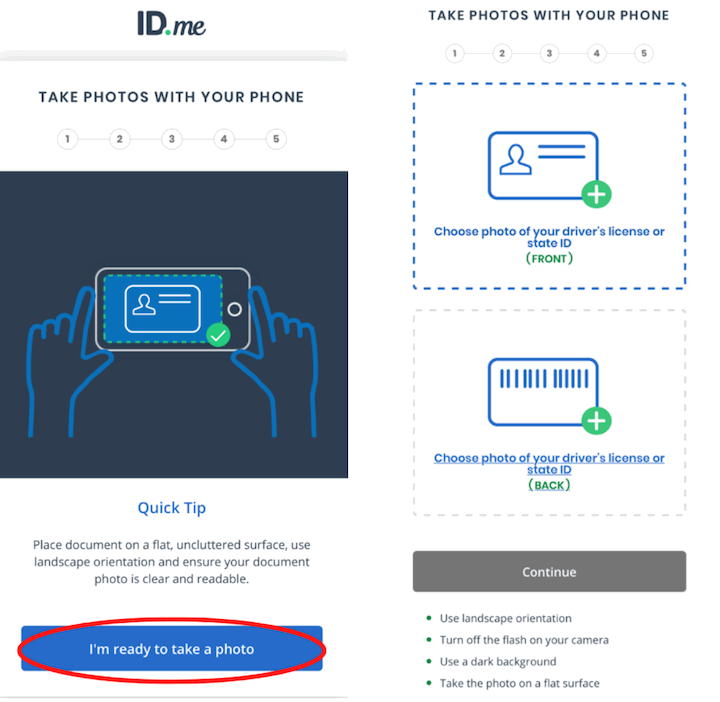
As with setting up credit freezes, this process was also a lot easier than in the past. Well, hopefully. To do it completely online, you’ll need an ID.me account, which is a third-party provider that the IRS trusts to verify your identity. From their page:

You can use either a self-service process that requires a photo of a government ID and selfie, or a live call with an ID.me video chat agent that doesn’t require biometric data.

I had already set up an ID.me account for another purpose years ago, but I do remember that the selfie method worked eventually for me but my wife had to go for the live video chat method. I’ve also had to deal with problems with rejected ID photos, too much glare, software crashes, etc.

If you forget your PIN, you can always sign back into your IRS.gov account and view it again under your Profile. This is another reason to take extra care with your ID.me/IRS.gov passwords and MFA methods. ID.me lets you set up a TOTP Authenticator app for MFA. Also set a reminder to use it when you eventually file taxes, so your return doesn’t get rejected.

More information at the IRS IP PIN FAQ page (that’s a lot of acronyms!).

TurboTax Online Walkthrough: How To Enter US Treasury Interest from Money Market and Bond Funds/ETFs For State Tax Exemption

If you earned interest from a money market fund or bond mutual fund/ETF last year, a significant portion of this interest may have come from US Treasury bills and bonds, which are generally exempt from state and local income taxes. (California, Connecticut, and New York have special rules.) However, in order to claim this exemption, you’ll probably have to manually enter it on your tax return (or be sure to notify your accountant) after digging up a few extra details. The details are almost never included on your 1099-DIV form.

Here’s how to do it in at TurboTax.com, the online version of TurboTax tax software. (I received some requests for a more detailed walkthrough after my H&R Block version.) I found the following information from the TurboTax FAQ:

What about dividends from U.S. government bonds?

The federal government taxes income you receive from its own bonds. Although your state doesn’t tax income generated by U.S. government bonds, each state defines government bonds differently.

To find out if these dividends are taxable in your state, review your 1099-B along with the supplemental pages from your consolidated tax statement. If you can’t find the info, you might be able to get it from your brokerage or mutual fund company website.

Once you have found the info in your documents, just follow the screens here and we’ll help you enter an adjustment for the nontaxable amount in your state. When you get to your state taxes, we’ll subtract the adjustment from the income reported to your state.

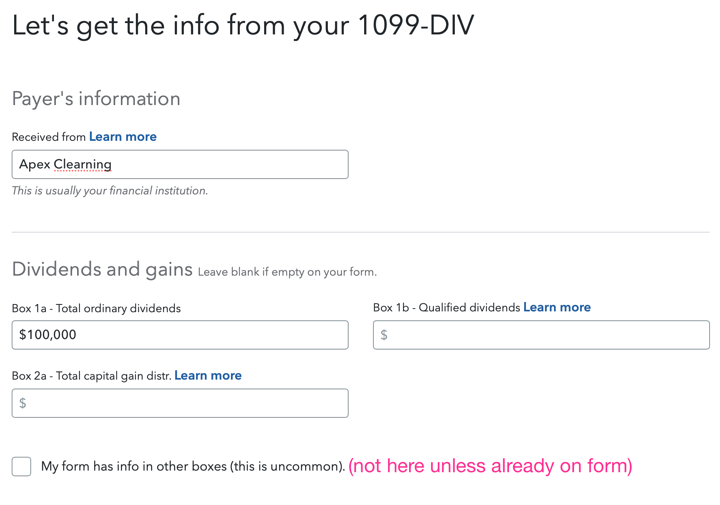
I did not find “just follow the screens” especially helpful, so I started up a dummy return at TurboTax.com for 2023 and manually created a 1099-DIV form from “Apex Clearning” (sic) with $100,000 of total dividends. This is in the Federal return section. You may choose to import this form and then review it afterward.

This part should just be exactly the same as the 1099-DIV form that was sent to you. Don’t add any extra entries and just continue.

On the next screen, you should click on the box for “A portion of these dividends is U.S. Government interest.”

Here, you will enter the amount of interest (out of the amount in line 1a of your 1099-DIV) that represents interest from US government obligations. For example, if you received $100,000 in total dividends from the Vanguard Treasury Money Market Fund (VUSXX) in 2023, you will find it does meet the threshold requirements for California, Connecticut, and New York and it had a US government obligation percentage of 80.06% in 2023. In this example, $80,060 of the $100,000 in dividends would be excludable. I would enter $80,060 in the form below.

This information should carry through to your state tax return, reducing your state taxable income.

Here are some links to find the percentage of ordinary dividends that come from obligations of the U.S. government. You should be able to find this data for any mutual fund or ETF by searching for something like “[fund company] us government obligations 2023”. If you do not see the fund listed within the fund company documentation, it may be because it is 0%.

[Image credit – Tax Foundation]