Search Results for: Safe Banks

The Big Short: Movie Notes and Real World Follow-Up

bigshortpost

I managed to catch the movie The Big Short (trailer) before it left the theaters. Having read the book with great interest back in 2011, I wondered how it would remade for the big screen. Isn’t it hard to believe that the events described started roughly an entire decade ago? There are plenty of reviews at all the big media sites, but here are my notes:

  • The original book The Big Short by Michael Lewis was classified as non-fiction.* The movie, however, is only “based on a true story”. As such, many of the individual names were changed. Steve Eisman (real person) became Mark Baum (movie character). Ben Hockett became Ben Rickert. Charles Ledley & James Mai became Charlie Geller & Jamie Shipley. Cornwall Capital became Brownfield Capital. For some reason, the names of Dr. Michael Burry and his firm Scion Capital went unchanged.
  • The director, Adam McKay, is probably best known for his comedies with Will Ferrell in Anchorman and Talladega Nights. Oh, and the classic short The Landlord (censored version). I suppose The Big Short could be called a dark comedy.
  • In retrospect, it might seem like betting against the housing market was an easy and obvious bet. While the movie might dramatize things, it did take courage and conviction. They had to put up millions of dollars to place the bet, and then more millions to keep the derivative bets running. Most other investors thought they were stupid, and tried to get them to reverse the bets. The banks also tried to make them sell their positions before they could realize profits. They were risking their own money, their family and friends’ money, and their entire careers.
  • The movie does a good job showing you how the bubble persisted for so long because everyone was incentivized to keep it going. Wall Street workers made money by packaging and selling the bonds. The pension funds and large institutions got to buy “safe” high-interest bonds. The money managers got to collect their fees. The mortgage brokers and real estate agents collected commissions. Homeowners saw their equity grow. Everyone was happy.
  • In contrast, the people who did the contrarian bet were all on the margins, outsiders, even a little weird. Hedge funds run by a guy who avoided human contact and wore cargo shorts and a free t-shirt everyday. (Christian Bale actually asked the real Michael Burry to take off his cloths and give them to him.) Another one based out of their parent’s garage.
  • The revolving door between the regulators and the industry that they regulate remains open. People go from big paychecks on Wall Street, to smaller paychecks at the SEC and other government roles, and then go back to big paychecks on Wall Street. People usually don’t like to burn bridges with future employers. See this Michael Lewis interview.
  • * As the book was non-fiction, CDO manager Wing Chau actually sued Michael Lewis for libel. Chau’s defamation lawsuit was dismissed and his appeal was denied. The SEC actually investigated him and his firm, found them both liable for fraud, banned him personally from the industry, and fined them $3 million in total. He probably didn’t like how he was portrayed in the movie, either.
  • Where are they investing now? In a January 2012 post, I wrote about the current investments of Michael Burry and Steve Eisman. Burry’s water investments seem like a long-term play, but Eisman’s bet against for-profit education is already starting to unfold. In May 2015, Corinthian College and twenty four of its subsidiaries (i.e. Heald College, WyoTech) filed for bankruptcy after challenges by both US and Canadian governments.

If you can’t watch some great acting performances by Christian Bale, Ryan Gosling, and Steve Carell, you could always get a refresher course via cartoon stick figures instead. 🙂


Howard Marks Oaktree Client Memo, November 2013

Howard Marks is famous among many investors for his Client Memos as the chairman and cofounder of Oaktree Capital Management. He even weaved many of the older ones into a book, which I read and reviewed. I now try to read every one that comes out. Here’s the most recent client memo dated November 26th, 2013 [pdf]. Below are a few selected excerpts. First, a quick lesson on risk aversion:

Risk aversion is the essential element in sane markets. People are supposed to prefer safety over uncertainty, all other things being equal. When investors are sufficiently risk averse, they’ll (a) approach risky investments with caution and skepticism, (b) perform thorough due diligence, incorporating conservative assumptions, and (c) demand healthy incremental return as compensation for accepting incremental risk. This sort of behavior makes the market a relatively safe place.

In short, it’s my belief that when investors take on added risks – whether because of increased optimism or because they’re coerced to do so (as now) – they often forget to apply the caution they should. That’s bad for them. But if we’re not cognizant of the implications, it can also be bad for the rest of us.

What about now? Marks does see an increase in risk tolerance recently. But how bad is it?

[Read more…]

MYGA Deferred Fixed Annuities: Maximize State Guaranty Coverage Limits

A recent article by Scott Burns talked about investing in deferred fixed annuities with CD-like qualities, an example offered a 3% yield guaranteed for 5 years plus no surrender charges (similar to early withdrawal penalty) after 5 years. This is a better rate than current bank CDs offer, and annuities can grow tax-deferred for those saving for retirement (withdraw as early as age 59.5)*. After the 5 years, you roll the annuity over to another company if the new rate is no longer good enough. These are also referred to as MYGAs (multi-year guarantee annuities). The catch? The annuities that have the best rates often don’t have the highest credit ratings.

A possible solution? Make sure you stay under the coverage limits of your state’s Life & Health Guaranty Association. From NOHLGA.com:

State life and health insurance guaranty associations are state entities (in all 50 states as well as Puerto Rico and the District of Columbia) created to protect policyholders of an insolvent insurance company. All insurance companies (with limited exceptions) licensed to sell life or health insurance in a state must be members of that state’s guaranty association.

These are not federally-backed like FDIC insurance. Instead, all the member insurance companies agree to cover each other in cases of insolvency up to the policy limits. In order to be a licensed insurer, you need to maintain a certain level of financial stability. But just like banks, some insurers are stronger than others. So if you’re going to go over the limits, the standard advice is to go with a top credit rating from AM Best, Moody’s, or S&P. However, credit ratings can go down over time, and you may be holding these annuities for many years. Therefore, it’s still safest to stay under the limits.

(You may not hear much about these guaranty associations because it is illegal for insurance brokers to use them in advertisements as a reason to buy annuities. I find this somewhat ironic, considering all the misleading statements they are allowed to make about equity-linked or equity-indexed annuity products.)

While they vary from state to state, virtually all states offer at least $100,000 in coverage for withdrawal and cash values for annuities. (Connecticut and Washington offer $500,000 in coverage. In California, the limit is 80% not to exceed $250,000.) Look up your specific state’s limits here or here.

In order to maximize your coverage, the process is similar to that for FDIC insurance – spread your money across different institutions and use different ownership titles. Let’s say you have $100,000 in state annuity coverage. The details may vary by state, but for many states that number is per owner designation, per company. The Mr. Annuity website has a helpful article [pdf] about how to structure your annuities to maximize your coverage.

If a client has $300,000 and wants to make certain all the money is protected, including future interest earnings, while taking advantage of the highest rate possible, we set up 3 contracts in Company A for $80,000 each. In annuity 1, the husband is the Owner and Annuitant. In annuity 2, the wife is the Owner and Annuitant. In annuity 3, the husband and wife are Joint Owners with the husband as the Annuitant. Then, we’ll put $60,000 in the next highest rate we can find in Company B, normally with the husband as Owner and Annuitant. That way, as the money grows, it will be protected under the guaranty laws because they are covered up to $100,000 per owner designation, per company.

I made a quick illustration of this theoretical example:

annuitysafe

Notice that you need to leave some room for growth, that way your future earnings are covered as well.

* I’m not saying these annuities are a great deal for everyone. If you are in a situation with a high-income and are already maxing all your other tax-deferred accounts like IRAs, 401ks, and are still looking for safer retirement investments with steady growth then this might be an option to consider due to the ability to get tax-deferred growth with rates competitive with current bond yields. I’m still in research mode.

Capital One Consumer Bank Savings Account Review

Capital One bought ING Direct USA back in early 2012, and has finally completed their transition and re-branding. Their new savings account product is called Capital One Consumer Bank Savings. Since I’ve had an account with them for over a decade (September 2001, as they remind me every time I log in), here’s an updated review of my 2nd oldest bank account meant for both new and existing customers.

User Interface

At first glance, the only thing that really changed was that the primary colors went from orange and blue to Capital One’s red and blue. However, there are a few other tweaks that I noticed were different from the ole’ ING Direct days.

Login. This is still a little unique amongst online savings accounts. You login with either a username/account number and a PIN number (not an alphanumeric pA$sW0rd). If you have an old 4-digit PIN, they’ll ask you to change the PIN to a 6-digit number for better security. In addition, while the default entry method is via mouse clicks to avoid keystroke loggers stealing your password, you can also use a keyboard to enter the PIN with a creative key-to-number conversion that changes each time. See screenshot below:

Main account screen. The home screen is simple and straightforward, as always. There is better integration with their brokerage arm, Sharebuilder, with your balance automatically showing and the ability to perform same-day transfers between accounts. So if you have a Sharebuilder account, you essentially have a high-interest sweep option instead of a money market fund paying zero interest. Screenshot:
[Read more…]

New Checking Account Promotions: Citibank, Chase, M&T Bank

Interest rates looks to remain tiny for a long time, so if you want to boost your interest earned while keeping your money safe in banks, taking advantage of sign-up bonuses is one way to do it. Earning 1% APY on $10,000 is just $100 a year, and it’s even hard to get 1% APY now! Why not double or triple that with some new accounts.

Citibank $50 bonus if you open a Citibank account with $1,000 and complete 1 direct deposit and 1 electronic bill payment for 2 consecutive months. New checking account customers only. There’s no monthly service fee if you maintain a $15,000 combined average monthly balance requirement in eligible products; otherwise $20.00 monthly service fee is applied. Eligible products are linked deposits, loans, mortgages, and investment accounts. $100 bonus available with Citigold account.

Chase Bank $150 bonus when you open a Chase Total Checking account and set up direct deposit (new Chase checking customers only). This account is free if you make a $500+ direct deposit each month, or have $1,500 minimum daily balance.

M&T Bank $100 bonus when you open a MyChoice checking account and set up direct deposit within 90 days. This account is free if you maintain a direct deposit each month or have $500 minimum daily balance. $125 and $150 bonuses also available with upgraded accounts (and higher requirements).

Capital One $100 bonus when you open a Interest Online Checking account by 1/31/2012 using offer code CHEC168DF and make a direct deposit of $250 or more within 90 days. No monthly service fee, and pays 0.75% APY on balances less than $100k.

Reminder: Savings Bonds Monthly Purchase Deadline Tips

Here’s a reminder regarding an opportunity to buy savings bonds near the end of May and receive an annualized return of 2.51% over the next 11 months. This would be 1% more than the highest current CD rates, with potential for continued higher interest. See this previous post for more details. The main catch to this opportunity is that you will not be able to sell your savings bonds at all for the next 11 months.
The reason why you want to buy at the end of the month is that savings bonds are labeled by month, and as long you buy anytime in May, it will be stamped with a May 2011 date. Then, on the first day of May 2012, you can redeem for an entire year’s worth of interest. However, you don’t want to miss the deadline, because then your bond will end up an April 2011 bond. The annual purchase limit is currently $5,000 in paper I-bonds and $5,000 in online I-bonds per Social Security Number. For a couple, that’s $20,000 per year.

For electronic bond purchases, Ken of DepositAccounts conducted an experiment as to how late you can wait to buy them on TreasuryDirect. To summarize, in order to avoid this, you should enter your purchase order a minimum of two business days before the last day of the month. For peace of mind, I would pad it 4 business days. You can schedule your purchase ahead of time online (recommended).

For paper bond purchases, you can visit your local bank and ask to buy them. Here are detailed instructions. Not all banks do this, so check ahead of time. The issue date of the savings bond will be the same day that the bank accepts payment. This date will be noted clearly on the application, and the bank should also stamp it to confirm. In this case, if you are familiar with the bank and you have the money available, you could conceivable wait until the last day the bank is open before the end of the month. Again, I’d try a couple days beforehand to be safe.

Where I Keep My Emergency Fund Cash – January 2011

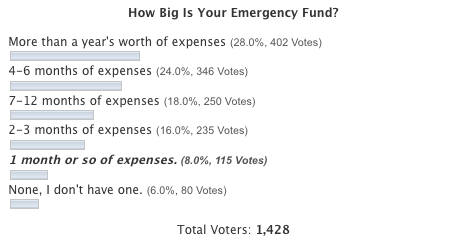
The results of my Emergency Fund survey are in, and appears that there are a lot of big savers out there! 28% of respondents had cash reserves of over 12 months of expenses, and 24% of you had the more-often recommended 4-6 months of expenses.

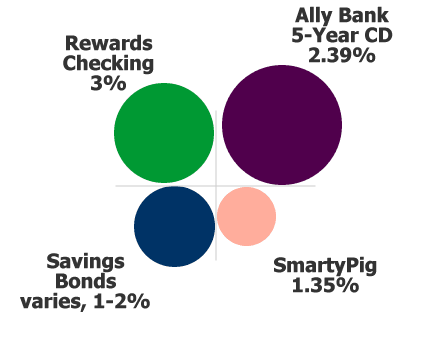
With such sizable cash reserves, where you do guys put it all? I figured I’d share my stash-the-cash choices, which may not be perfectly optimal but I’m open to talking about it. The size of the circles are proportional to how much of my money I keep in each respective account.

With interest rates so low across the board and still dropping it seams, it’s been hard to get really excited about many new options. But remember, it can be better to be earning 2% with low inflation than 5% interest in a high inflation environment. Every basis point helps.

Rewards Checking Accounts

You’ve likely heard of these by now. Usually through local credit unions, these checking accounts pay a higher interest rate if you jump through some hoops each month. However, if you make a mistake you’ll forfeit virtually all your interest for that month, so it can be tricky. More coverage here.

One nationally-open example is DanversBank, which offers their Free Rewards Checking currently paying 3.01% APY on balances up to $25,000, provided you satisfy the following each month:

* perform at least 12 debit card transactions (excluding ATMs);
* receive their monthly statement electronically;
* access Online Banking, and
* sign up for direct deposit or receive a recurring ACH transfer

To find a local rewards checking account limited to your area, check out DepositAccounts and use the filters. Sadly, my local account recently dropped their rate significantly.

Long-Term CDs – Ally Bank

If you have a large cushion, it’s quite possible (if you’re lucky) to not have to touch it for years or more. Therefore, I think it’s okay to put some of it in safe investments but slightly less liquid.

With the Ally Bank certificates of deposit, you can still access your money as long as you pay a early withdrawal penalty of 60 days interest. That’s significantly less than at other banks. I have a 5-year CD paying 3% APY, but the current rate for new deposits is 1.60% APY for a 5-year CD (as of 10/25/13).
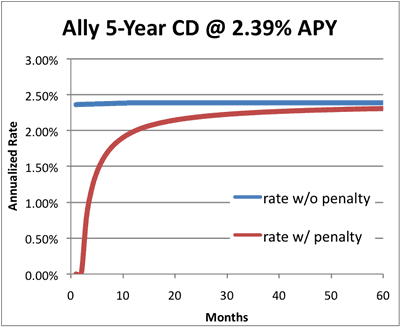
Rates change constantly, but let’s assume you have a certificate of deposit from any bank paying 2.39% APY with an early withdrawal penalty of the last 60 days of interest. (2.39% APY ~= 2.26% rate compounded daily.) Here’s how your actual annualized interest rate would fluctuate given your holding period.

After just 6 months, you’ll already be earning 1.58%, more than a comparable 12-month CD. If you somehow had to withdraw after 1 year, you’d still have earned 1.99% APY. Basically, after just 6 months I have nothing to lose and a lot to gain, so I keep a sizable chunk here.

Savings Bonds

I have some older Series I Savings Bonds, but they aren’t a very good buy right now. The total rate consists of a fixed rate and a variable rate that adjusts with inflation every 6 months. If you bought a bond now, you’d get a 0% fixed rate and only 0.74% from inflation. However, my older bonds have higher fixed rates, and according to my TreasuryDirect statement they are earning 1.74%, 2.25%, and 2.75% right now. The annual purchase limit is now $5,000 in paper I-bonds and $5,000 in online I-bonds per Social Security Number. I’ll keep them for a while, as I like the tax deferral benefits and inflation may come back to bite us.

Online Savings Accounts

Rewards checking account and savings bonds have deposit limits, and you only want to lock up a certain amount in longer-term CDs, so the rest goes into the now-popular online savings account. There are a lot of players out there now, but many of them are packed together with very similar features and interest rates.

Right now the rest of my cash is over at SmartyPig.com, an FDIC-Insured bank account that lets you save for specific goals like an online piggy bank. However, they’ve added so much flexibility that you can pretty much use them like any other savings account. Their rate has dropped recently from 1.75% APY to 1.35% APY for balances up to $50,000. This is still amongst the top rates, but I’ll be watching them closely.

Alternatively, Everbank has their Yield Pledge Money Market paying 1.10% APY for the first 6 months for new accounts. This rate is higher than any 6-month certificates of deposit currently available, while still being available for withdrawals at any time. The rate is guaranteed stay in the top 5% of competitive accounts. Evantage Bank has their Mega Money Market account paying 1.75% APY for balances up to $35k. Most other banks are clustered around the 1% to 1.2% mark.

So… where’s your cash?

2010 Q3 Investment Portfolio Update – Fund Holdings

I’ve already posted my target asset allocation, now here’s my actual portfolio holdings. Again, these are my own choices, governed by the size of my tax-advantaged accounts like IRAs/403b/401ks, the brokerage firms that I use, and my preference of passive management and low fees. Even with the explosion of new blogs, I still don’t see very many people sharing their actual holdings. I hope that if I share, then others will share as well. 🙂

Tax-Efficient Placement

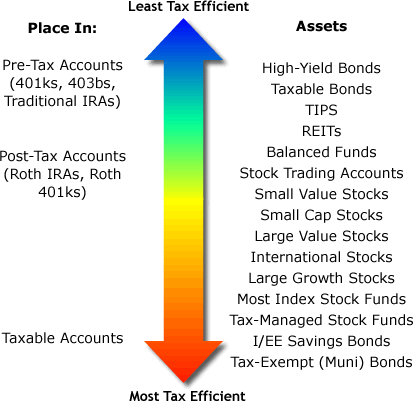
One big change for me over the last two years is that I now run out of room in my IRAs and 401ks each year and now have money sitting in taxable accounts. Since each asset class is taxed differently, where you put your assets can make a big difference in your net return. As a result, I’ve moved some things around. Here’s a handy graphic taken from a post about tax-efficient fund placement:

Chart of Relative Tax Efficiency of Assets

Stocks

US Total Market
I used to own Vanguard Total Stock Market Index Fund (VTSMX) but recently converted that to the ETF share version Vanguard Total Stock Market ETF (VTI) due to the lower 0.07% annual expense ratio. This fund tracks the MSCI US Broad Market Index, and typically holds the largest 1,200–1,300 stocks (covering nearly 95% of the index’s total market capitalization) and a representative sample of the remaining stocks. It currently holds 3,391 different companies. All for $7 a year for each $10,000 hold.

In my 401k, since I have limited options, I hold a mix of 75% Diversified Stock Index Institutional Fund (DISFX) which is basically a S&P 500 fund and 25% Fidelity Spartan Extended Market Index Fund (FSEMX) as it tracks the entire market minus the S&P 500. Together, the track the overall US market very well, at only a slightly higher cost of a weighted 0.25%.

US Small Cap Value
Here, I still hold the Vanguard Small-Cap Value Index Fund (VISVX). I could convert to the Vanguard Small-Cap Value ETF (VBR) with identical holdings and a lower expense ratio of 0.14% vs. 0.28%, but since it is only 5% of my portfolio I haven’t yet. In addition, there are good arguments for alternative ETFs such as iShares Russell 2000 Value Index ETF (IWN) or iShares S&P SmallCap 600 Value Index ETF (IJS). They each track slightly different indices and thus hold different stocks. Something to analyze deeper at a later time.

REIT
I still hold the Vanguard REIT Index Fund (VGSIX) as opposed to the Vanguard REIT ETF (VNQ). Both track the MSCI® US REIT Index. I hold this inside my IRA, so I’d rather just have full investment rather than worry about partial shares and such.

International / Total World excluding US
I used to hold Fidelity Spartan International Index Fund (FSIIX) but now hold the Vanguard FTSE All-World ex-US ETF (VEU) which tracks the FTSE All-World ex US Index and holds 2,239 stocks from around the world. There is the equivalent Vanguard FTSE All-World ex-US Index Fund (VFWIX) but since this is a bigger holding for me, the cheaper expense ratio makes a difference.

Emerging Markets
I converted to the Vanguard Emerging Markets ETF (VWO) from the Vanguard Emerging Markets Stock Index Fund (VEIEX). Even though my overall investment here is low, VEIEX has both a 0.25% redemption fee, and a 0.50% purchase fee, which is just too annoying to stay there. Another option would have been the iShares MSCI Emerging Markets Index (EEM), but it is both more expensive and has had more tracking issues. Here’s a EEM vs. VWO comparison post.

Bonds

Short-Term High Quality Bonds
I used to own the Vanguard Short-Term Treasury Fund Investor Shares (VFISX) but it now only yields 0.41% with an average duration of 2.2 years. If you had an IRA at certain banks, you could buy a CD earning 2-3% over the same time horizon. It would be just as safe. There would be less liquidity, but I’m not really concerned about that. The CD would be even better because you can’t lose what you put in.

I’ve actually gone ahead an put this portion of my portfolio in a stable value fund inside my 401k. I explored the risks and rewards of stable value funds, and while they are not of the utmost safety, the worst-case scenario is on the same order of the worst-case scenario of many short-term bond funds. My stable value fund is earning 3.5% for all of 2010.

I’ve also been looking at municipal bond funds such as the Vanguard Limited-Term Tax-Exempt Fund (VMLTX) and Vanguard Intermediate-Term Tax-Exempt Fund (VWITX) since they are mostly rated AA and above with interest being federally tax-exempt. If I lived in California and had a big bond allocation, I’d still consider a partial holding in the Vanguard California Intermediate-Term Tax-Exempt Fund (VCAIX) since the interest is higher and is exempt from both federal and CA income tax. I wrote about VCAIX in late 2009 when the yield was 3.49%. It’s done quite well since then, although California’s still got major issues to work out. If I lived in New York, I’d consider the same for NY funds.

Inflation-Protected Bonds (TIPS)
Here, the only thing to buy is either individual TIPS bonds or a mutual fund/ETF holding TIPS bonds. Usually buying individual bonds is risky because you aren’t spreading the default risk across hundreds of issuers, but in this case every single bond is just as safe and backed by the US government.

I have my Self-Employed 401k at Fidelity, which allows me to buy individual TIPS with no commission (just bid/ask spread). I bought some longer-term TIPS with real yields of 2-3%, and they’ve been doing well since real yields have dropped since. In addition, I hold shares of the iShares Barclays TIPS Bond ETF (TIP) because I can trade iShares ETFs commission-free at Fidelity.

The Vanguard Inflation-Protected Securities Fund Investor Shares (VIPSX) was also considered, along with new TIPS ETFs that have different maturities such as the PIMCO 15+ Year U.S. TIPS Index ETF (LTPZ).

New Marketing Trick: Short-term FDIC-Insured Bank CDs With Really High Rates

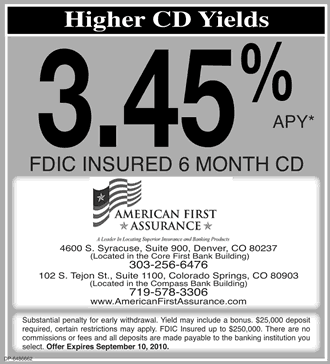
If you still read newspapers like me, you may have come across an advertisement like this one recently touting an abnormally high 3-month or 6-month CD rate in last Sunday’s issue:

According to Bankrate, the current national average for a 6-month certificate of deposit is 0.37% APY, with their top yield being 1.25% APY. Highly-advertised Ally Bank offers less. So how can a tiny local non-bank that you’ve never heard of beat the rates of even online banks by over 2 whole percentage points?

It turns out that this is the newest version of the “free show tickets for timeshare presentations” marketing ploy. In this case, you must go into the office of an life insurance agent and listen to their sales pitch before getting the bank CD. Allan Roth over at CBS Marketwatch visited one of these offices and wrote about it. These non-bank salespeople are supplementing bank CDs from other FDIC-insured banks with their own money to reach the advertised rate. Questionable? Yes. Scam? Well, maybe not.

How It Works…

  1. You respond to the newspaper ad, and the terms always require you to physically come over to their office.
  2. After dealing with varying levels of life insurance and/or annuities salesmanship, you maintain your desire to open the account.
  3. You write the check for the CD directly to an FDIC-insured bank, with which the sales office is not officially affiliated with. This CD has a realistic rate, say 1% APY or similar.
  4. After a week or two, enough to make sure your funds cleared, the insurance people will cut you a check which together with the bank’s interest, add up to the advertised APY (assuming they are still in business).

How Much Extra Interest?

But really how much money are they losing on this? If you buy a six-month CD with an annual percentage yield (APY) of 3.35% and commit $25,000, you’ll earn approximately $418. With a APY of 1.25%, that is $156. The difference is $262. That’s basically the “bonus” that they are paying to get you into the door.

The article by Roth was initially published more than 8 months ago, so that would suggest that this marketing ploy is working and the word is spreading amongst insurance salespeople. Now, I’m sure some people will call about the CD and either not have the $25k or otherwise decided not to go for it, so that improves their bottom line. I am pretty certain that their ad targets those with large cash balances looking for income-type investments, so that they can pitch annuities with seemingly safe and high yields.

Warnings

If you still want to invest in one of these bank CDs + incentives, you should be prepared to be presented with annuities that will actually seem to yield even more that their advertised 3-month CDs. They will be carefully packaged to look like a good deal. They will be described as “insured” and “safe” because they will be backed by an insurance company. The actual yields will be computed by a formula too complex for most math PhDs to fully understand.

Next, you should check if the extra interest is really worth it due to the fact that you’ll have to deal with paper checks. If you are writing a check from a bank account that isn’t earning interest, that is some lost days of interest right there. Since you’ll be receiving the CD funds as a check as well, that’s another few business days of potential lost interest. Use my handy Ultimate Rate Chaser Calculator to see your net interest boost.

Finally, you should be sure to only write the check to an FDIC-insured institution. You should interact with them directly to ensure safe transfer of funds and proper opening of account. Double-check the CD renewal guidelines, so you are not stuck rolling the CD over for another 3 months.

Here’s a list of other companies that I found offering similar ads. Some are pretty shady in my opinion, and pretend to be an elite broker supplying high-yield bank CDs. Others are actually pretty transparent about the fact that they are offering a carrot for you to listen to their pitch. If you know of any others, please leave a comment below, and I’ll add it to the list.

  • Sun Cities Financial Group (http://www.scfg.com)
  • First Fidelity Tax & Insurance (http://www.firstfidelityamerica.com)
  • American First Assurance (http://americanfirstassurance.com)
  • Integrifirst USA (http://integrifirstusa.com)

I personally wouldn’t trust any of these guys with a $9.99 cut-n-paste GoDaddy website and a rented office with any of my personal details.

Emergency: This Book Will Save Your Life (Book Review)

“Terrorist attacks. Natural disasters. Domestic crackdowns. Economic collapse. Riots. Wars. Disease. Starvation. What can you do when it all hits the fan?”

Sounds like great travel reading, right? Well, it was, at least for me. Emergency: This Book Will Save Your Life by Neil Strauss is not, as you might think, a detailed survival manual, but mainly of one guy’s journey to try and protect himself from all that could kill him. He calls himself a “Fliesian”, based on the book Lord of the Flies, which in his words is “someone who believes that people, if put in a world where there are no consequences to their actions, will do horrible things.”

The first half of the book pretty much details all the things that could go wrong in the world, and his primary goal is to get a second citizenship from another country. The idea being that if the sh*t hits the fan here, he could in theory escape to safety to this other country. The main problem is that most countries, unless you are a citizen by birth or family, force you to renounce your US citizenship. However, it turns out that you can essentially “buy” citizenship in several countries for, oh, about $500,000 in the island country of St. Kitts. I thought this was quite anti-climactic, and not very useful knowledge for most of us.

One related theory that I did find interesting was on how to become a “perpetual tourist”, as to minimize your tax burden and maximize your personal freedoms. To achieve this, you will need “three flags” from three different countries:

  1. Have your citizenship somewhere that does not tax income earned outside the country.
  2. Have your businesses in a stable, low or no tax country.
  3. Live as a tourist in countries where you actually like to spend your time.

A nice idea, but we are not told how to make this actually happen. 🙁 We do find out that Swiss banks won’t even talk to U.S. citizens trying to open an untraceable account.

The second half of the book is more focused on actual survival skills. However, again it’s more of a story of how he takes a variety of different courses from shooting guns to camping to recognizing edible plants to tracking animals, and less of how to actually do these cool things.

The most practical part of the book for me was when he did a 3-day test where he shut off all of the utilities in his condo (water, gas, electricity) and tried to survive on his own. This is actually something I want to try. Most people know to keep some water and food. But how much water do you actually need? What if you don’t have enough? Another example of what you might overlook – where will you poop without flushing toilets? The cardboard port-a-potty he bought had bags that disintegrated in less than a day.

He also explores what’s needed in a bug-out bag, which is a kit designed for you to grab, run, and survive for about 72 hours. He points out that in a city-wide disaster like Katrina, it is unlikely that emergency crews will be able to help average citizens for up to a week. They’ll be too busy helping the seriously ill. You’ll be on your own.

This book was a very easy read, and definitely worth it the time spent if only to explore different possibles. I must say, I do have a certain fascination of living “off the grid”. In some areas near me, I figured that I could have a house that is both completely solar-powered with batteries, and could collect enough rainwater if not by a natural water supply. Too bad I get the shakes when I can’t check my e-mail for 24 hours…

Interview: A Couple Spends A Year In Asia For $9/Day Each

This is a interview/guest post with blog reader Ariel Hoffman, who recently spent a year traveling around Asia with his girlfriend Michal with a combined budget of only $10,000 – and managed to come back with $3,500 of it! I love to read nonfiction travel essays, so not only are there some great frugal travel tips below, it was also very exciting to read about their adventures. Thanks again for sharing, Ariel!

What was your inspiration to go on this adventure?
In Israel, it is mandatory to serve in the armed forces for at least 3 years. After that you just want to get away, and Asia is the perfect destination for someone who’s just saved up 3 years worth of the army’s 100$-a-month salary. Also, Israel’s a pretty small country, so there isn’t much domestic travel to be had like there is in the US.

The itinerary my girlfriend (Michal) and I came up with was mostly about avoiding the rainy season, and minimizing air travel. Air travel is expensive and boring, and you try to avoid it if you have a lot of time to spend.

How did you come up with your budget? Did it end up costing more or less than you thought?

We sat down and did some serious homework, mostly on websites like lonelyplanet.com and their forums. The budget they offered sounded ridiculously low, so we nearly doubled everything we read about, and came up with a rough estimate of about 10,000$ for the two of us, for the entire year.

What we realized, however, is that not only were the estimates online pretty accurate, but also that two people don’t spend exactly twice as much as one – lots of things are shared (such as meals, transportation, hotel rooms etc.) and so it’s more like budgeting for a person and a half rather than two.
We were very pleasantly surprised when we came back home to count our remaining traveler’s cheques and see we still have about 3,500$ left over for next time!

How did you fund it? Did you save up the cash upfront, borrow some money, work while on the trip, or some other combination?
In preparation for our trip, we both took on extra work and saved up every Shekel we made. It took us about 5 months. Once we reached our goal of 10,000$, we exchanged all our cash into traveler’s cheques – a great way to keep your money both liquid and safe when abroad. Luckily for us, the exchange rates were in our favor the whole time, which gave our savings an extra 2%-5% throughout the journey.

Walk us through a typical day on your Year in Asia trip.
Most days would begin with trying to find breakfast – not always an easy task. Most Asian countries do not serve what we would consider breakfast, especially my vegetarian Michal. Although chicken porridge and spicy rice is very nice, it’s not everyone’s idea of the right way to start your day. After eating some novel type of cookie in spiced tea, we would set off to whatever National Monument/UNESCO World Heritage Site/Giant Temple/Yearly Festival was in the town on that day. After a day’s tour of the attraction we would start hunting for a suitable lunch, which meant looking around for a street stall with a good crowd, or a local restaurant with a queue. Nothing says fresh like a long line of customers, and Asian vendors normally close their stalls every day when they’ve exhausted all their stock, so food is never kept overnight and doesn’t have time to spoil. Another plus is that the food is not made of pre-cut ingredients, which makes preparation slower, but at least you see exactly what you’re getting so there are no surprises.

Evening was normally a time for sitting on the beach, going to some performance or sitting in some tea-shop with friends. For a while we had a small kitchen in our room, so I would cook dinner for us while Michal practiced yoga. In China we bought a Wii, and at night we’d plug it in and invite friends over for kart racing – it’s OK to enjoy modern fun even when on the road!
We spent a lot of time on trains and buses, getting from A to B. Sometimes as long as 27 hours! Israel’s longest train ride is only 4 hours long.

What are some basic money-saving tips you might offer us readers?
[Read more…]

Picture of California Tax Refund IOU (Registered Warrant)

You may have heard that California is broke, and is sending out IOU slips instead of checks for income tax refunds. I thought that I would be safe as I usually owe taxes, but due to an amendment of my return, I ended up getting one in the mail as well. Here is a scan for historical preservation:


(click for larger version)

Of course, I receive it the day after major banks like Bank of America stopped accepting them. There are some local credit unions that still accept them from members, but as they pay 3.75% interest I might just wait and see how things go.

Hopefully this doesn’t turn out to be really historical, as in “remember when California started printing its own money and the state government imploded?”…