Search Results for: Safe Banks

Places To Open A Foreign Bank Account To Store Gold

After my post about the Permanent Portfolio which included physical gold, a reader asked me where he could open up a foreign bank account to store gold. Well, in the Appendix of the book Fail-Safe Investing, the author did list specific banks that allow U.S. investors to open account and buy gold within them. Here they are:

Anglo-Irish Bank [Austria]
Phone: 011-431 406-6161
URL: http://www.angloirishbank.ie/

Anker Bank / BDGE Group [Switzerland]
Phone: 011-4121 321-0707
URL: http://www.bcge.ch

Canadian Imperial Bank of Commerce [Switzerland]
Phone: 011-4121 215-6087
URL: http://www.cibc.com/

UeberseeBank / AIG Private Bank
Phone: 011-411 267-5555
URL: http://www.ueberseebank.ch/

Browne makes it sound that opening an account at one of these places is as simple as opening an online account with no physical branch near you. He also states that these are either Swiss or Austrian banks, which are bound by the laws of those countries, not the countries of their parent companies. Now, I can’t attest to the accuracy of this list, as the book was last updated around 2001 and I have no personal experience with any of them. Please perform your own due diligence.

The reasons for buying gold in a foreign bank account are primarily to provide a safe store of assets in case of very unlikely (but still possible) situations like war, government collapse/confiscating of assets, or other crisis. I’m not going to participate myself as I see the risks outweigh the benefits – cost, complexity, chance of fraud or loss, etc. – but if you read some of the stories from Argentina’s economic collapse it can get scary.

As for legality, it would seem to be perfect legit. You are simply storing physical gold there. Gold does not produce dividends or interest, so you’d only be liable for taxes if you sold them at a profit.
Conservative 529 Options: CollegeSure Tuition-Indexed CDs vs. Inflation-Protected Bonds (TIPS)

Recently, I have been exploring the “safe” options inside various 529 plans. This would be a good choice for those who want to feel like they are making continuous gradual progress and avoid the swings of the stock market, similar to what is offered in pre-paid tuition plans in certain states like Florida. The problems with those plans are that they are usually limited to residents only, and your kid often has to go to one of the in-state schools to get the guaranteed tuition benefit. One unique pre-paid type of plan is the Independent 529 plan, but it is also restricted to certain schools (mostly private liberal arts colleges).

Next, there are plans with guaranteed-return funds backed by insurance companies, or certificates of deposit from banks. However, these types of investments are still subject to inflation risk. If a period of high inflation occurs, your returns could be squashed. Even with current deflation concerns, given current government policy I think high inflation in the future is still a potential concern.

So what’s left?

CollegeSure Tuition-Indexed CDs

Offered by the College Savings Bank, these are FDIC-insured certificates of deposit which offer an interest rate linked to college tuition levels. The CollegeSure CD earns an annual percentage yield (APY) over the life of the investment that is 3.00% less than the college inflation rate. (For a while, this margin was only 1.5%.) These are only available through either the Montana or Arizona 529 plans, but you can use the proceeds towards a school in any state.

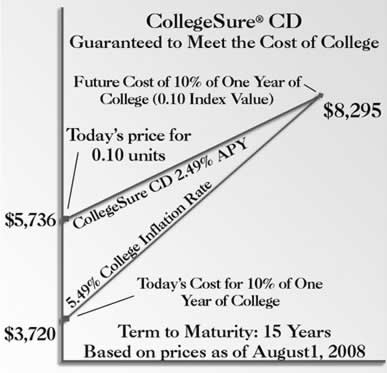
The CDs are available in maturities ranging from 1 to 22 years, so you are basically pre-paying tuition at a fixed premium. Here’s an illustration from their site:

Changes in costs are tracked by the Independent College 500 Index (IC500), which is derived from the average tuition plus housing costs of 500 private colleges. Over the last 10 years, the college inflation rate has been 5.4% annualized, Over the last 20 years, it was 5.7% annualized. Of course, this is just an average and it both excludes public universities and ignores the average aid packages given out, but it seems to be a reasonable index.

Treasury Inflation-Protected Bonds

Treasury Inflation-Protected Securities (TIPS) are bonds that promise you a total return that adjusts with the CPI index for inflation. Very generally, it works like this: if the stated real yield is 2% and inflation ends up at 4%, your return would be 6%. TIPS are issued and backed by full faith of the U.S. government. Right now, they are only available in 529 plans in the form of mutual funds like the Vanguard Inflation Indexed Bond Fund. Some plans offer them as part of their age-based investment mixes, but a few offer them as standalone investment options. The Ohio 529 plan ($25 bonus) looks to offer the cheapest option, with an annual expense ratio of 0.32%.

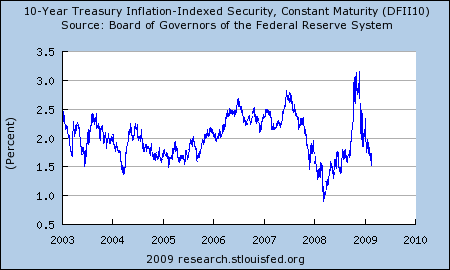
The actual real yield you get varies, but here is some historical market data for a maturity of 10-years, which is close to the average mutual of the Vanguard fund:

To make a rough estimate, I’d say you average about 2% real before fees. After about 0.3% in fees, you’d end up with 1.7% + inflation.

Inflation is tracked here by the CPI-U (Consumer Price Index for All Urban Consumers), a number tracking the price of a wide basket of goods and services. From January 1999 to January 2009, the annualized inflation rate was about 2.5%. Over the last 20 years, it has been about 3.0%.

It does not focus on college tuition, or even include it explicitly as far as I know. However, there should be some correlation to college tuition.

So which is better?

Would you rather have:

Overall Inflation plus 1.7% or College Inflation minus 3%

If we use the average numbers from the last 10 years, the CollegeSure CD would have earned roughly 2.4% annually and the TIPS fund would have earned roughly 4.2% annually. This would seem to tilt in favor of TIPS, but there are two problems:

  • Unlike with the CollegeSure CD, you can’t match the maturity of the TIPS fund with your goals. It’s more or less fixed at 10 years forever. For example, if you only have 2 years left until college, you might want to start moving money out because you can still lose principal in the short-term due to interest rate fluctations.
  • If the rate of college tuition rises significantly higher than overall inflation by greater than 4.7% a year, then the TIPS fund would fall short.

One could always split money between the two as well, but for not I’m just investing in the TIPS. College inflation may continue to outpace overall inflation (or it may not), but I doubt it will do so by more than 4.7% a year for an extended period. Also, I believe that investment options in 529s will only improve with time. One day, I expect to be able to buy individual TIPS to more closely match maturities with our time horizon.

This is not to say I’ll necessarily be 100% TIPS – I’ll most likely throw a bit of stocks in there – but I think it’ll be a big component of our plan.

Your Own Financial Rescue Plan, Part 1: Adequate Cash Reserves

Well, the big boys are getting their rescue/bailout plan, but I guess ours got lost in the mail… So what should we do? I think that everyone should take a second look at their cash reserves. Do you have enough?

What Job Security?
These days, I don’t see any job as safe. My company went from interviewing people to hiring… nobody. Even local and state governments are facing major budget deficits. At a minimum, I would want a few months of living expenses to tide me over until I find another job. I still remember the dot-com bust days when former tech workers ended up living in their cars.

A Reason Not To Invest In Stocks
Hey, if you’re looking for an excuse not to buy any more stocks for a while, beefing up your emergency fund is not a bad one. Any money you may need within 5 years should be in cash or short-term investments anyway.

A Reason *To* Invest In Stocks
Ironically, after you build up a nice cushion, it may actually make you feel better about investing in the stock market. I definitely helps me to keep short-term money separate from long-term money. As such, I’m still applying my upcoming income towards maxing out my 401(k) for 2008. But after that, I will probably start to save another three months of living expenses, for a total of 9 months in cash.

Less Credit Available
A lot of people used to simply assume that their home equity line of credit (HELoC) could serve as their emergency fund. But these days, it just takes one letter in the mail that says your HELOC is frozen or greatly reduced. You don’t want to be forced into taking an early withdrawal from your 401(k) or IRA, or paying exorbitant credit card interest.

If anything, apply for a credit card with a low fixed interest rate now while it is still offered. Here is a list of no fee 0% APR balance transfer credit cards. Just buy goods as you regularly would, and pay the minimum while saving the difference in an interest-bearing account. (Don’t go buying more stuff, obviously!)

Looking Ahead
For me, an alternative reason for increasing my cash reserves is that I can also use it later for investing in real estate. I still don’t see many opportunities with good cashflow right now, and may not see them for another couple of years. But I want to be ready, as the no-money-down days may never come back.

Where do you keep it?
As long as it is safe and liquid, I just go by rate. Use the new FDIC insurance estimator if you have lots of money. Both Vanguard and Fidelity are participating the money market fund insurance program, so they are super-duper safe now. . Well, your old money is safe. Still, I consider money market funds with Fidelity and Vanguard as safe as FDIC-insured, although this is only my opinion. However, my cash is currently split between:

  1. Series I US Savings Bonds – Bought in April with 1.2% fixed rate, now only 0% fixed rate available. Note that they are illiquid for the first 12 months. Rates adjust semi-annually. I earn 4.38% for 1st six months, 6.06% for 2nd six months. With recent inflation, my 3rd six months should also be pretty good. Exempt from state income tax as well.
  2. 12-Month 5% APY CD at WaMu/Chase – Sadly, no longer available.
  3. Low or no-minimum banks with high liquidity – A big chunk currently in transit to Everbank at 1.10% for first 6 months.

WaMu Savings 3.75% APY: Should I Stay With A Struggling Bank?

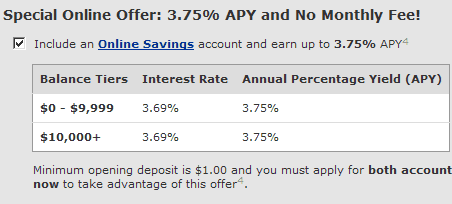
While logging on to my WaMu account I noticed (as did reader Alvin) that the WaMu savings account* is now paying 3.75% APY as of 7/31. Some pages still say 3.30%, but my account details confirm the 3.75% APY. (Login and click on “About this account”.) Or, click here and hit Apply Today, and you should see this:

Of course, if you read the news, you’ll know that Washington Mutual stock is being battered right now. Is this move a sign of desperation? If so, is this rate increase good news or bad news?

It’s All About The FDIC Limits
Well, if you have money over the FDIC insurance limits of $100,000 per titled account, I strongly suggest you stop reading right now and spread it out immediately. Your money is at risk. Here are some good options.

If you are under the limits, then your money is safe. The main things left to worry about are (1) easy access to money, (2) crediting of current interest earned, and (3) future interest rates. But hey, we already have two examples of struggling banks that give us an idea of what we might be in store for.

IndyMac Bank CD Example (FDIC takeover)
I believe that IndyMac failed on a Friday, and branches were closed that day. Over the weekend, branches were closed and the website was down. ATMs and debit cards still worked. By Monday, all the branches were open and the website was back up. Direct deposits, electronic transfers, and written checks went through uninterrupted.

All interest earned in accounts (under the limits) was still credited. Before the failure, IndyMac Bank also had some high interest rates on certificates of deposit (CDs). Upon takeover by the FDIC, an ideal scenario actually happened. For one, you had the option to withdraw your money from a CD with no early withdrawal penalty. Or, if you liked the rate, your CDs could continue to earn the same interest until maturity. This is an even better deal than if IndyMac stayed intact.

Countrywide Example (Bought by Bank of America)
Another struggling bank, this time merged with another existing bank. Currently they are still separate websites, with their own interest rates and products. Nothing really changed from the customer’s point of view. There was no downtime, or lost liquidity. You use the same checks, same debit cards, same website. CD rates and other terms remained the same. A slight bonus was that Countrywide customers could now withdraw money from Bank of America ATMs with no fees. [Merger Info]

So, Will WaMu Fail?
I have no clue. My PTI-style Toss-Up Percentage: 25% Fail, 75% No Fail. But even if it does, given it’s size, I can’t see it disappearing overnight like a small local bank might. It would have to be taken over by another (probably large) bank. In addition, there are so many moving parts that it will probably keeping run as-is for several months even if it does get taken over.

Taking all this into account, I will be sticking with Washington Mutual and happily take the increased interest rate.

* Reminder: This 3.75% rate is only available if you apply online and open a Free Checking account at the same time. If you go into a physical branch, they will deny deny deny! However, after opening you can use it at a branch just like any other savings account. More details.

IndyMac Bank Failure Highlights: Another FDIC Insurance Example

Well, it finally happened. IndyMac Bank has been taken over by the FDIC, becoming the second-largest financial institution failure in U.S. history. I’ve been reading a bunch of new stories about it, and here are what I think are the highlights:


Customers: Don’t Panic!
Most people with regular checking or savings accounts don’t have too much to worry about. The FDIC has set up this official information page for customers. You can still use ATMs. Checks you write will still be processed. Electronic deposits and withdrawals will still go through. Online banking, phone banking and even the physical branches will re-open on Monday. You won’t even lose past interest:

All interest accrued through Friday, will be paid at your same rate. IndyMac Federal Bank will be reviewing rates and will provide further information soon. You will be notified of any changes.

From the LA Business Journal:

The Office of Thrift Supervision transferred control of the company to the Federal Deposit Insurance Corp. The FDIC said it will transfer insured deposits and assets of IndyMac Bank to a new federally operated institution called IndyMac Federal Bank that will open Monday. […] Regulators said that customers of IndyMac will have uninterrupted access to their accounts beginning next week at the bank’s 33 branches.

This is consistent with when I explored What happens if my bank fails? The FDIC seems to do a pretty good job of cleaning things up.

…Unless you exceeded the FDIC insurance limits

Customers are insured 100 percent for deposits up to $100,000. The FDIC said the bank has about $1 billion of “potentially uninsured deposits” held by 10,000 depositors. The FDIC said it will begin contacting uninsured customers on July 14. The agency said it plans to give customers with more than $100,000 at least 50 percent of their uninsured deposit amounts.

Wade Francis, president of Long Beach-based Unicon Financial Services, said there is “very little” chance that uninsured depositors will get all their money back because IndyMac had a large number of home loans, which will be difficult to sell off.

It boggles the mind that so many of the very same people who have enough money to exceed FDIC limits in the first place, don’t bother protecting it properly. The whole point of keeping money in banks is so that it is safe… Instead, people are getting 50% and go home and pray to see the rest again. Ouch.

Ouch For the FDIC, Too
From the LA Times:

Federal authorities estimated that the takeover of IndyMac, which had $32 billion in assets, would cost the FDIC $4 billion to $8 billion. […] The agency’s insurance fund has assets of about $52 billion.

That’s a big chunk of the FDIC’s own “emergency fund”…

Reality vs. Perception of Reality
There is a great quote from the 1992 movie Sneakers:

Cosmo: Posit: People think a bank might be financially shaky.
Martin Bishop: Consequence: People start to withdraw their money.
Cosmo: Result: Pretty soon it is financially shaky.
Martin Bishop: Conclusion: You can make banks fail.
Cosmo: Bzzt. I’ve already done that. Maybe you’ve heard about a few? Think bigger.
Martin Bishop: Stock market?
Cosmo: Yes.
Martin Bishop: Currency market?
Cosmo: Yes.
Martin Bishop: Commodities market?
Cosmo: Yes.
Martin Bishop: Small countries?

This is basically what happened to IndyMac bank. From CNN:

The banking regulator said it closed IndyMac after customers began a run on the lender following the [very public!] June 26 release of a letter by Sen. Charles Schumer, D-N.Y., urging several bank regulatory agencies that they take steps to prevent IndyMac’s collapse. In the 11 days that followed the letter’s release, depositors took out more than $1.3 billion, regulators said.

Iowa Floods: Reconsidering Flood Insurance

altext

This is not how I like to get reminded of things, but sometimes that’s just how it goes. I hope all those out there affected by the floods are at least safe. A few months ago I wrote about buying flood insurance even if you are not required to by your mortgage lender. This means you are outside the 100-year floodplain, but could still be in the 500 year floodplain (1 in 500 chance each year, or 0.2%). Check if you are in a flood plain here. We got quotes, but never actually got around to buying a policy due to a combination of cost concerns and simply forgetting about it.

1 in 500? Why bother? Well, reports say that one third of Iowa is currently underwater. From one local newspaper:

“We’ve been taking a lot of calls, but most people don’t have flood insurance,” said State Farm Insurance Agent Doug Valentine. “This flood has blown through the 500-year flood plain and most only have to have insurance if they are in the 100-year flood plain because the banks require it.”

Valentine said many homeowners will soon face a difficult decision on what they will do given many will still have mortgage payments to be made and no insurance to cover rebuilding. “They may have to plow it down and will have $200,000 in payments on a $100,000 house,” he said.

This got me thinking – how likely do you think it is that your house will burn down, which is a major reason for homeowner’s insurance? Perhaps a 0.2% chance each year of severe flooding is worth insuring against. Insurance is all about paying to transfer the risk for events that can crush you. On that note, I also will need to check if our policy cover sewer backup, which has also caused a lot of damage in the Midwest.

Are We Headed For Financial Armageddon?

Like scary stories? I usually stay away from the horror movies section, but I was intrigued by the idea behind of Financial Armageddon: Protecting Your Future From Economic Collapse by Michael Panzer. This is a book about why our economic system is in danger, how it will collapse, and the bleak future ahead. Keep in mind that this was initially published in March 2007, even before the peak of the subprime mortgage mess and current economic slowdown. The book is separated into four parts: Threats, Risks, Fallout, and Defenses.

Threats
Here, the author lays out a relatively convincing picture of how fragile our economic system really is right now. This is the best part of the book in my opinion, and what you should read it for.

Debt. Our nation is in huge debt. Many consumers are also in huge debt or living paycheck-to-paycheck. We spend and spend, and don’t save for a rainy day. Guess what? Neither does the government. Does this sound healthy?

The Retirement System. We all know that more people are on their own with plans like 401ks, for better or worse (mostly worse). The problems with Social Security are relatively well-known. After a few big blow-ups like United, we now know that many private pensions are underfunded. And you know what? Many public pensions are underfunded as well. This is what happens when you allow politicians who need to get re-elected every few years to make promises for the next 100 years. If you think municipal governments can’t go bankrupt, check out the City of Vallejo. In other words, the things we depend on in our old age are shaky as well.

Federal Guarantees. We all love the FDIC insurance for our bank accounts, since we can basically keep our money anywhere. But due to fractional-reserve banking, for every $1 in checking accounts a bank can make $10 in loans. In other words, if a real “bank run” occurred, the FDIC reserves would be depleted quickly. Imagine what would happen if FDIC insurance started getting revoked. He also picks on Fannie Mae and Freddie Mac, which are both allowed to do some crazy things because they are “government-sponsored” and therefore people assume the government will bail them out if something goes wrong.

The problem with this is that such government guarantees encourage such financial institutions to take huge gambles. *cough* sub-prime mortgage loans *cough*. Indeed, many banks believe themselves to be “too big to fail” because they are so critical to the system. This is how we ended up with Bear Stearns being sold for $2/share. Indeed, Bear Stearns was too big to fail, so the government tried to make the bailout as painful as possible.

Derivatives are the final threat, and are instruments designed to manage risk. The problem is that corporations believe that because they are “covered” by a myriad of derivatives, they can take on some huge bets. But these “no-risk bets” are all based on complex mathematical models, and we all know models and reality are not necessarily the same. You could safely bet that the Cubs won’t win the World Series for last 99 years, but you never know…

Risks and Fallout
Inevitably, all of the these threats are weaved into a saga in which we fall into Financial Armageddon. Economic recession and then depression. Companies faltering. Stock prices plummeting. Bonds defaulting. Real estate prices dropping further. Banks and insurance companies failing. Government guarantees being removed. Skyrocketing unemployment. Entitlement programs are cut due to the lower tax revenues. Rising crime and gang activity. The government tries to print more money, leading to hyperinflation, with the prices of food and other commodities doubling every few months.

Planning
This is the most disappointing part of the book, especially since it offers to “protect our future” on the cover. So what do we do to prepare for Armageddon?! Stop spending so much and save more money for a rainy day. Okay… What about all these dropping stock and bond values? Unfortunately, there is just some vague advice about having to be “smart” and “quick” to make money from the volatility. For the rest of us, we should simply sell everything and buy physical gold because our paper money will be inflated until it is worthless. The old “buy and hold stocks” idea is useless now. We should also buy all the physical goods we can with our cash before hyperinflation hits. Perhaps this really is the best plan, but I was hoping for something more substantial than what I call the standard “buy gold and stock up on Spam ‘n toilet paper” strategy.

Summary
Panzer points out that not one recession in the past 50 years has been predicted in advance by a majority of top economists. While this is supposed to scare you, all it did was remind me that predicting the future reliable is pretty much impossible. I enjoyed reading the first half of this book, because I do think that such a scenario can happen at least to some degree, and the books does a good job of pointing out many of the weaknesses in our financial system. Moreover, it is simply a good “doom and gloom” story that is entertaining to read. Indeed, some of it has already happened! However, I did not find much insightful information in this book on how to actually protect myself from such a collapse.

Lending Club: $50 Bonus + 5% Of Loan Amount If You Lend $5,000+

Wow, here’s an interesting promotion from person-to-person lender Lending Club. They are currently offering a 5% cash bonus if you lend $5,000 or more by February 3, 2008 for both new and existing lenders on top of their $25/$50 sign-up bonus. Here are the details from their announcement:

You will qualify for the bonus by lending $5,000 or more to borrowers between December 14th, 2007 and February 3rd, 2008 (at 11:59PM Pacific time). Your bonus will be 5% of the amount you lend.

For example, if you lend $7,500 Lending Club will credit your Lending Club account with $7,500 * 5% or $375. Funds count as lent once a portfolio (or portfolios) is submitted during the aforementioned eligibility period. The loans do not have to be issued by February 3rd to qualify.

We will notify you of the amount of your bonus by the end of day, Friday, February 8th, 2008, and your account will be credited with your lending bonus by Friday, February 15th, 2008. No special sign-up or tracking is required ? we will run reports on the system to determine bonuses. Feel free to email us at lender.offer@lendingclub.com to ask about your bonus.

[…] Lenders can each earn a maximum payout of $20,000 (if they lend $400,000).

A 5% bonus definitely grabbed my interest again after making a few initial test loans. If you haven’t already, check out my LendingClub review to learn more about their setup for person-to-person lending.

At first I got all excited since banks are only paying 5% interest themselves, but then I remembered that LendingClub loans are spread out over 3 years, so it’s not like you are getting a 5% interest bonus each year (that would be sweet!). Instead, 5% spread out over 3 years is like adding roughly an additional 1.65% annual interest to the existing rate set by LendingClub. (Actually, since the 5% is given upfront, it would actually boost your returns even more.) But remember, these are unsecured loans similar to credit cards, and there is a risk of principal loss. Is that cushion worth putting in $5,000 in?

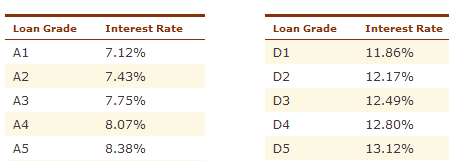
So far all of my existing loans with LendingClub are rated a safe A3-A4 (7.75 to 8.07%). Given that their minimum allowable credit score is 640, and their credit grades run all the way from A1, A2, A3 to G3, G4, G5, I would estimate that such people have credit scores well over 700 as well as other positive criteria like a reasonable debt-to-income ratio. Therefore, I would love so see my return increase to a 9.4 to 10.72% return on high-quality loans. With $5,000 available to spread across 200 loans ($25 each), that would also smooth out the default risk from a few bad loans.

Lending $5,000 for 3 years is a lot of money, but this is the best person-to-person lending deal I’ve found. Hmm… very tempting!

UPromise Holiday Promotion: $25 Bonus With Purchase

UPromise is mainly a cash-back online shopping mall like eBates that deposits money into a 529 college savings fund. If you haven’t opened an account already, now may be a good time to do so if you were planning to do some shopping at the stores below anyways – They are offering a $25 bonus if you are a new sign-up and make one purchase at a qualifying cash-back store before 12/31/07.

Upromise.com

Non-eligible retailers are: Amazon.com, Avis, Bed Bath & Beyond, Butterfield Blooms, Budget, Cryo-Cell, Eddie Bauer, Eddie Bauer Outlet, Florist.com, Flowers U.S.A., FTD.com, Gift Sense, RedEnvelope, Ross-Simons, Sharper Image and Upromise Cruises.

Qualifying retailers are the rest, with some popular ones being Target.com, Walmart.com, eBay, Travelocity, CircuitCity.com, Nordstrom, and JCPenney. Lots of smaller ones too.

I’m not a huge fan of UPromise myself, having only earned about $5 since joining the program. I do link my Safeway Club card so each time I buy my nectar of life (Diet Coke) I get a few pennies back.

If you don’t like the idea of your money being swept into their 529 (no kids?), you can fill out this withdrawal form, mail it in, and have a check sent to you. Instructions are on the form. You need a signature guarantee if it’s more than $200, which is free at many banks and credit unions.

Update: You can also get a $10 bonus from eBates.

Roth IRA Contribution vs. Emergency Fund Savings

altext

Earlier this week I explored how the performance of money invested in a 401(k) should compare to a regular brokerage account. This brought to mind a different debate:

If you had to choose between contributing $4,000 to a Roth IRA or keeping/putting it towards your Emergency Fund, which would should you choose? We’re assuming you don’t have the funds to do both. Many people put Emergency Fund near the top of their priority lists, just below taking advantage of any “free money” 401(k) match, but above all other retirement accounts. This is because you don’t want to have to dip into retirement accounts and face stiff penalties, or otherwise be faced with other forms of high interest debt like credit cards or personal loans if you need money urgently.

However, the annual $4,000 Roth IRA contribution limit is a “use it or lose it” proposition. You can’t put nothing in this year, and then $8,000 the next. Once April 15th rolls around, you’ve missed out on potential tax advantages that may extend several decades (even to your heirs). This may be mitigated somewhat if you also have a Roth 401(k) or other similar account available.

I used to be in the Emergency Fund First camp, but now I think I’ve changed my mind, mainly thanks to commenter Jbo. Here’s my reasoning. Let’s say you go ahead an contribute $4,000 to a Roth IRA but leave it invested in something safe like a money market fund. Many banks also allow you to open IRA accounts holding certificates of deposit. Now, there are basically two possible resulting scenarios after you do this:

You end up needing the money
No problem, you can always withdraw your Roth IRA contributions without any penalty. Just take out what you need (up to $4,000), and leave the rest in the account. Since it’s in a safe investment it won’t have decreased in value due to stock market volatility. You’ll still lose the tax advantages on any withdrawals, but you’d have missed out anyways.

You don’t need the money
More likely than not, you won’t need all the money, and hopefully within a year or so your emergency fund will be replenished from other sources. Now, you can start really taking advantage of the Roth IRA’s tax benefits and move to riskier investments.

Using the same assumptions as before, a $4,000 post-tax Roth IRA contribution would theoretically end up being worth $40,251 after 30 years. If the $4,000 was placed in a taxable account, you’d only end up with $32,834. Even if you assume inflation will run 3% a year, that’s still $3,000 more in today’s dollars that you made on your initial contribution of only $4,000 by putting it in a Roth.

Am I missing anything? It would seem like putting money in the Roth IRA is a pretty safe bet. The downside is very small, and the upside is very high. One key thing to remember is to keep the Roth IRA money in a safe investment while you are treating it as a emergency fund, as stocks have been known to drop as much as 40% in one year. You don’t want to be having to sell your stocks to get cash after that happens!

  • Make sure your current IRA is charging you as little in fees as possible.  Visit Mint.com and their IRA wizard for a quick look into the best discount brokers offering IRA’s.

How Do I Compare The Interest Rates and Yields Between Money Market Funds and Savings Accounts?

An alternative to high-yield bank savings accounts are money market funds held in brokerage accounts. Although both money market funds and savings accounts can change their interest rates paid at any time, comparing their actual returns can be confusing.

Comparing Returns
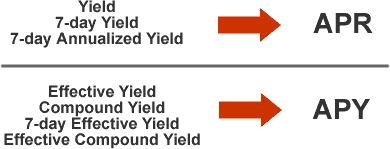
Money market funds usually report their 7-day annualized yield (also listed as just yield, or 7-day yield), which takes the interest paid net of expenses for the last 7 days and assumes that this average continues over an entire year. Compounding is not taken into account, so the 7-day yield should be compared to a bank account’s annual percentage rate (APR).

Some funds also list the 7-day effective yield (also listed as compound yield), which does take into account compounding via the reinvesting of dividends. So the 7-day effective yield should be compared to annual percentage yield (APY).

altext

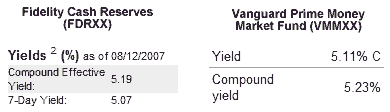
Here are two examples from Fidelity and Vanguard where they list both. In this case the Fidelity fund would be comparable to a bank account earning 5.07% APR or 5.19% APY.

altext

Since banks usually advertise APY, you can convert if needed using this APY to APR calculator. Keep in mind that since these are moving 7-day averages, the numbers given will change from week to week.

Other Types of Money Market Funds
The above comparison is meant for the most common “taxable” money market funds, which are taxalbe on both federal and state levels just like a bank’s savings account. In addition to these, there are a variety of specific types of funds like Treasury funds (exempt from state income tax) and municipal tax-exempt funds (exempt from federal income tax), and state-specific municipal funds (exempt from both fed and state taxes) that offer special tax consideration.

In this case, you can use a tax-equivalent yield calculator to complete the comparison.

But Is The Risk The Same?
While not eligible to be FDIC-insured as they are not banks, money market funds do have to follow strict guidelines as to maintain the highest credit quality and lowest volatility of the underlying investments. The share is always kept at $1. Due to the recent concerns with mortgage-backed bonds, Fool.com recently asked Is Your Money Market Fund Safe? In my opinion, the risk is a definitely higher than a bank account, but if you hold your money market funds from a respected firm like Vanguard or Fidelity, I would sleep just as soundly, as these companies would repay the funds with their own assets rather than let them falter.

There are also other practical differences between specific banks and specific money market funds, which I am ignoring here.

More Ways to Keep Your Bank Balances High, and Make More Money

Everybody has a high-yield savings or checking account paying 4% or more, right? Here are a few other ways to maximize your bank balances and therefore your interest earned.

Stop withholding too much of your taxes
Did you get your tax refund? If so, that means you withheld too much on your paychecks last year. To fix that for this year, you should consider underwitholding your taxes for profit. You can control your withholding amounts by increasing the number of allowances on your W-4. To see the effects of doing so ahead of time, use the calculators at PaycheckCity.

The easiest rule of thumb to avoid any underpayment penalties, if your income will increase, is to simply pay as much taxes this year as you did last year. Since you don’t have to pay in full until April 15th, putting off $4,000 in taxes until it’s due can earn you over $100 in extra interest.

Pay down even small credit card balances
According to recent Federal Reserve study1, many household still carry small balances of a thousand dollars, even though they have the cash available in savings accounts to pay it off. Perhaps people feel that there is safety in having that extra money in the bank, but in reality credit card can be part of your emergency strategy, especially if you already have balances now. You can pay a variety of critical bills with credit cards now – hospital charges, car repairs, groceries, and more. Paying 15% in interest to the credit card companies while only earning 5% in the bank is a losing proposition, and may result in losing hundreds of dollars a year.

If anything, you should flip this in your favor and borrow at 0% and earn 5% from the bank on that money.

Maximize the float on your credit cards
Another benefit of paying your bills in full is that you get the grace period, which is the period between the end of your statement is generated and when the payment is actually due. During this time (about 20-25 days), you don’t have to pay any interest on your balance in addition to the time you have gotten during the billing cycle. Therefore, I like to use Online Billpay to schedule my credit card payment until very close to the due date.

Here is an example using my WaMu account setup (using the Checkfree Billpay system used by many other banks). If you have $1,500 due on June 29th, I will set my checking account to pay by June 28th (Deliver-by date, with 1 extra day of buffer). Then, I just schedule a future transfer from savings to checking of $1,500 on June 24rd, which is the earliest day which the money may be debited (Start on date). That way, my money is staying in my 5% savings account as long as possible. All in all, very little extra time involved as compared to simply paying the bill online. If you’re just starting this out, you may want to set it with a larger buffer times.

If you have a card issued by FIA (formerly MBNA), some people extend this even further by using the BillPay offered by some FIA cards, which allow you to pay certain bills by putting the balance on your credit card. You aren’t actually paying via credit card so you don’t earn any cashback or rewards, but you can get several more days of interest-free, or “float”, time.

If used together to keep your balances high, these strategies can add hundreds of dollars to your bottom line each year.

1Source and reference: SmartMoney magazine article 7 Money Mistakes to Avoid (only partially available online).