Search Results for: Safe Banks

Best Interest Rates on Cash – November 2017

percentage2

Interest rates are slowly inching upwards. Don’t let a megabank pay you 0.01% APY or less for your idle cash. Here is my monthly roundup of the best safe rates available, roughly sorted from shortest to longest maturities. I focus on rates that are nationally available to everyone (not restricted to certain geographic areas or specific groups). Rates checked as of 11/1/17.

High-yield savings accounts
While the huge brick-and-mortar banks rarely offer good yields, there are many online savings accounts offering competitive rates clustered around 1.1%-1.3% APY. Remember that with savings accounts, the interest rates can change at any time.

  • Top rates: DollarSavingsDirect at 1.50% APY. SalemFiveDirect at 1.50% APY. Redneck Bank and All America Bank (they are affiliated) having Mega Money Market accounts paying 1.50% APY on balances up to $35,000.
  • More rates from banks with solid history of competitive rates: CIT Bank at 1.35% APY up to $250k, Synchrony Bank at 1.30% APY, GS Bank at 1.30% APY, and UFB Direct at 1.41% APY ($5k min).
  • I’ve experienced the “bait-and-switch” of moving to a new bank only to have the rate lowered quickly afterward. Until the rate difference is huge, I’m sticking with a Ally Bank Savings + Checking combo due to their history of competitive rates (including CDs), 1-day interbank transfers, and overall user experience. I also like the free overdraft transfers from savings that let’s me keep my checking balance at a minimum. Ally Savings is at 1.25% APY.

Money market mutual funds + Ultra-short bond ETFs
If you like to keep cash in a brokerage account, you should know that money market and short-term Treasury rates have inched upwards. It may be worth the effort to move your money into a higher-yielding money market fund or ultrashort-term bond ETF. The following bond funds are not FDIC-insured, but if you want to keep “standby money” in your brokerage account and have cheap/free commissions, it may be worth a look.

  • Vanguard Prime Money Market Fund currently pays an 1.13% SEC yield. The default sweep option is the Vanguard Federal Money Market Fund, which has an SEC yield of 0.99%. You can manually move the money over to Prime if you meet the $3,000 minimum investment.
  • Vanguard Ultra-Short-Term Bond Fund currently pays 1.57% SEC Yield ($3,000 min) and 1.68% SEC Yield ($50,000 min). The current average effective duration is 1 year.
  • The PIMCO Enhanced Short Maturity Active Bond ETF (MINT) has a 1.54% SEC yield and the iShares Short Maturity Bond ETF (NEAR) has a 1.62% SEC yield while holding a portfolio of investment-grade bonds with an average duration of ~6 months. More info here.

Short-term guaranteed rates (1 year and under)
I am often asked what to do with a big wad of cash that you’re waiting to deploy shortly (just sold your house, just sold your business, legal settlement, inheritance). My standard advice is to keep things simple. If not a savings account, then put it in a short-term CD under the FDIC limits until you have a plan.

  • Ally Bank No-Penalty 11-Month CD is paying 1.50% APY for $25,000+ balances and 1.25% APY for $5,000+ balances. The CIT Bank 11-Month No-Penalty CD is at 1.45% APY with a lower $1,000 minimum deposit and no withdrawal penalty seven days or later after funds have been received. The lack of early withdrawal penalty means that your interest rate can never go down for 11 months, but you can always jump ship if rates rise.
  • GS Bank’s 12-month CD is at 1.65% APY with $500 minimum. For sizeable balances, Advancial Federal Credit Union has a 6-month CD at 1.72% APY ($50k min) and a 12-month CD at 1.87% APY ($50k min). If you don’t otherwise qualify, you can join with a $5 fee to Connex Professional Network and maintaining $5 in a Share savings account. Via DepositAccounts.

US Savings Bonds
Series I Savings Bonds offer rates that are linked to inflation and backed by the US government. You must hold them for at least a year. There are annual purchase limits. If you redeem them within 5 years there is a penalty of the last 3 months of interest.

  • “I Bonds” bought between November 2017 and April 2018 will earn a 2.58% rate for the first six months. The rate of the subsequent 6-month period will be based on inflation again. At the very minimum, the total yield after 12 months will be 1.29% with additional upside potential. More info here.
  • In mid-April 2018, the CPI will be announced and you will have a short period where you will have a very close estimate of the rate for the next 12 months. I will have another post up at that time.

Prepaid Cards with Attached Savings Accounts
A small subset of prepaid debit cards have an “attached” FDIC-insured savings account with high interest rates. The negatives are that balances are capped, and there are many fees that you must be careful to avoid (lest they eat up your interest). The other catch is that these good features may be killed off without much notice. My NetSpend card now only has an eligible balance up to $1,000.

  • Insight Card is one of the best remaining cards with 5% APY on up to $5,000 as of this writing. Fees to avoid include the $1 per purchase fee, $2.50 for each ATM withdrawal, and the $3.95 inactivity fee if there is no activity within 90 days. If you can navigate it carefully (basically only use ACH transfers and keep up your activity regularly) you can still end up with more interest than other options. Earning 4% extra interest on $5,000 is $200 a year.

Rewards checking accounts
These unique checking accounts pay above-average interest rates, but with some risk. You have to jump through certain hoops, and if you make a mistake you won’t earn any interest for that month. Rates can also drop quickly, leaving a “bait-and-switch” feeling. But the rates can be high while they last.

  • Northpointe Bank has Rewards Checking at 5% APY on up to $10k. The requirements are (1) 15 debit card purchases per month (in-person or online), (2) enrolling in e-statements, and (3) a monthly direct deposit or automatic withdrawal of $100 or more. ATM fees are rebated up to $10 per month.

Certificates of deposit (greater than 1 year)
You might have larger balances, either because you are using CDs instead of bonds or you simply want a large cash cushion. Buying finding a bank CD with a reasonable early withdrawal penalty, you can enjoy higher rates but maintain access in a true emergency. Alternatively, consider a custom CD ladder of different maturity lengths such that you have access to part of the ladder each year, but your blended interest rate is higher than a savings account.

  • Advancial Federal Credit Union (see above) has their 18-month CD at 1.96% APY ($50k min) and a 24-month CD at 2.04% APY ($50k min). The early withdrawal penalty is 180 days of interest.
  • Ally Bank also has a 5-year CD at 2.25% APY (no minimum) with a relatively short 150-day early withdrawal penalty and no credit union membership hoops. For example, if you closed this CD after 18-months you’d still get an 1.64% effective APY even after accounting for the penalty.
  • Hanscom Federal Credit Union is offering a 4-year Share Certificate at 2.50% APY (180-day early withdrawal penalty) if you also have Premier Checking (no monthly fee if you keep $6,000 in total balances or $2,000 in checking). HFCU also offers a 3% APY CU Thrive “starter” savings account with balance caps. HFCU membership is open to active/retired military or anyone who makes a one-time $35 donation to the Nashua River Watershed Association.
  • Mountain America Credit Union has a 5-year Share Certificate rate at 2.60% APY ($5 minimum) with a 365-day early withdrawal penalty. Anyone can join this credit union via partner organization American Consumer Council for a one-time $5 fee.

Longer-term Instruments
I’d use these with caution, but I still track them to see the rest of the current yield curve.

  • Willing to lock up your money for 10+ years? You can buy certificates of deposit via the bond desks of Vanguard and Fidelity. These “brokered CDs” offer the same FDIC-insurance. As of this writing, Vanguard is showing a 10-year non-callable CD at 2.65% APY (Watch out for higher rates from callable CDs from Fidelity.) Unfortunately, current long-term CD rates do not rise much higher even as you extend beyond a 5-year maturity.
  • How about two decades!? Series EE Savings Bonds are not indexed to inflation, but they have a guarantee that the value will double in value in 20 years, which equals a guaranteed return of 3.5% a year. However, if you don’t hold for that long, you’ll be stuck with the normal rate which is quite low (currently a sad 0.10% rate). You could view as a huge early withdrawal penalty. You could also view it as long-term bond and thus a hedge against deflation, but only if you can hold on for 20 years. Too long for me.

All rates were checked as of 11/1/17.
Best Interest Rates on Cash – October 2017

percentage2

Interest rates are slowly waking up from their multi-year slumber. Don’t let a megabank pay you 0.01% APY or less for your idle cash. Here is my monthly roundup of the best safe rates available, roughly sorted from shortest to longest maturities. I focus on rates that are nationally available to everyone (not restricted to certain geographic areas or specific groups). Rates checked as of 10/2/17.

High-yield savings accounts
While the huge brick-and-mortar banks rarely offer good yields, there are many online savings accounts offering competitive rates clustered around 1.0%-1.2% APY. Remember that with savings accounts, the interest rates can change at any time.

  • The Mega Money Market accounts of both Redneck Bank and All America Bank (they are affiliated) are paying 1.50% APY on balances up to $35,000. Note that amounts over $35,000 earn only 0.50% APY.
  • Other sample top rates: DollarSavingsDirect at 1.40% APY, CIT Bank at 1.35% APY up to $250k, Synchrony Bank at 1.30% APY, Goldman Bank at 1.20% APY, and UFB Direct at 1.41% APY ($5k min).
  • I’ve experienced the “bait-and-switch” of moving to a new bank only to have the rate lowered quickly afterward. Until the rate difference is huge, I’m sticking with a Ally Bank Savings + Checking combo due to their history of competitive rates (including CDs), 1-day interbank transfers, and a overall user experience. I also like the free overdraft transfers from savings that let’s me keep my checking balance at a minimum. Ally Savings is at 1.20% APY.

Money market mutual funds + Ultra-short bond ETFs
If you like to keep cash in a brokerage account, you should know that money market and short-term Treasury rates have inched upwards. It may be worth the effort to move your money into a higher-yielding money market fund or ultrashort-term bond ETF.

  • The Vanguard Prime Money Market Fund currently pays an 1.12% SEC yield. The default sweep option is the Vanguard Federal Money Market Fund, which has an SEC yield of 0.98%. You can manually move the money over to Prime if you meet the $3,000 minimum investment.
  • Vanguard Ultra-Short-Term Bond Fund currently pays 1.46% SEC Yield ($3,000 min) and 1.57% SEC Yield ($50,000 min). The current average effective duration is 1.0 years.
  • The following bond ETFs are not FDIC-insured, but if you want to keep “standby money” in your brokerage account and have cheap/free trades, it may be worth a look. The PIMCO Enhanced Short Maturity Active Bond ETF (MINT) has a 1.58% SEC yield and the iShares Short Maturity Bond ETF (NEAR) has a 1.60% SEC yield while holding a portfolio of investment-grade bonds with an average duration of ~6 months. More info here.

Short-term guaranteed rates (1 year and under)
I am often asked what to do with a big wad of cash that you’re waiting to deploy shortly (just sold your house, just sold your business, legal settlement, inheritance). My standard advice is to keep things simple. If not a savings account, then put it in a short-term CD under the FDIC limits until you have a plan.

  • Ally Bank No-Penalty 11-Month CD is paying 1.50% APY for $25,000+ balances and 1.25% APY for $5,000+ balances. The CIT Bank 11-Month No-Penalty CD is at 1.45% APY with only a $1,000 minimum deposit and no withdrawal penalty seven days or later after funds have been received. The lack of early withdrawal penalty means that your interest rate can never go down for 11 months, but you can always jump ship if rates rise.
  • Advancial Federal Credit Union has a 6-month CD at 1.63% APY ($50k min) and a 12-month CD at 1.78% APY ($50k min). If you don’t otherwise qualify, you can join with a $5 fee to Connex Professional Network and maintaining $5 in a Share savings account. Via DepositAccounts.

US Savings Bonds
Series I Savings Bonds offer rates that are linked to inflation and backed by the US government. You must hold them for at least a year. There are annual purchase limits. If you redeem them within 5 years there is a penalty of the last 3 months of interest.

  • “I Bonds” bought between May and October 2017 will earn a 1.96% rate for the first six months, and then a variable rate based on ongoing inflation after that. While that next 6-month rate is currently unknown, at the very minimum the total yield after 12 months will around 1% with additional upside potential. More info here.
  • In mid-October, the CPI will be announced and you will have a short period where you will have a very close estimate of the rate for the next 12 months. I will have another post up at that time.

Prepaid Cards with Attached Savings Accounts
A small subset of prepaid debit cards have an “attached” FDIC-insured savings account with high interest rates. The negatives are that balances are capped, and there are many fees that you must be careful to avoid (lest they eat up your interest). The other catch is that these good features may be killed off without much notice. My NetSpend card now only has an eligible balance up to $1,000.

  • Insight Card is one of the best remaining cards with 5% APY on up to $5,000 as of this writing. Fees to avoid include the $1 per purchase fee, $2.50 for each ATM withdrawal, and the $3.95 inactivity fee if there is no activity within 90 days. If you can navigate it carefully (basically only use ACH transfers and keep up your activity regularly) you can still end up with more interest than other options. Earning 4% extra interest on $5,000 is $200 a year.

Rewards checking accounts
These unique checking accounts pay above-average interest rates, but with some risk. You have to jump through certain hoops, and if you make a mistake you won’t earn any interest for that month. Rates can also drop quickly, leaving a “bait-and-switch” feeling. But the rates can be high while they last.

  • Northpointe Bank has Rewards Checking at 5% APY on up to $10k. The requirements are (1) 15 debit card purchases per month (in-person or online), (2) enrolling in e-statements, and (3) a monthly direct deposit or automatic withdrawal of $100 or more. ATM fees are rebated up to $10 per month.

Certificates of deposit (greater than 1 year)
You might have larger balances, either because you are using CDs instead of bonds or you simply want a large cash cushion. Buying finding a bank CD with a reasonable early withdrawal penalty, you can enjoy higher rates but maintain access in a true emergency. Alternatively, consider a custom CD ladder of different maturity lengths such that you have access to part of the ladder each year, but your blended interest rate is higher than a savings account.

  • Advancial Federal Credit Union (see above) has increased their rates a bit since last month, with their 18-month CD at 1.96% APY ($50k min) and a 24-month CD at 2.04% APY ($50k min). The early withdrawal penalty is 180 days of interest.
  • Ally Bank also has a 5-year CD at 2.25% APY (no minimum) with a relatively short 150-day early withdrawal penalty and no credit union membership hoops. For example, if you closed this CD after 18-months you’d still get an 1.64% effective APY even after accounting for the penalty.
  • Hanscom Federal Credit Union is offering a 4-year Share Certificate at 2.50% APY (180-day early withdrawal penalty) if you also have Premier Checking (no monthly fee if you keep $6,000 in total balances or $2,000 in checking). HFCU also offers a 3% APY CU Thrive “starter” savings account with balance caps. HFCU membership is open to active/retired military or anyone who makes a one-time $35 donation to the Nashua River Watershed Association.
  • Mountain America Credit Union has a 5-year Share Certificate rate at 2.60% APY ($5 minimum) with a 365-day early withdrawal penalty. Anyone can join this credit union via partner organization American Consumer Council for a one-time $5 fee.

Longer-term Instruments
I’d use these with caution, but I still track them to see the rest of the current yield curve.

  • Willing to lock up your money for 10+ years? You can buy certificates of deposit via the bond desks of Vanguard and Fidelity. These “brokered CDs” offer the same FDIC-insurance. As of this writing, Vanguard is showing a 10-year non-callable CD at 2.65% APY (Watch out for higher rates from callable CDs.) Unfortunately, current long-term CD rates do not rise much higher even as you extend beyond a 5-year maturity.
  • How about two decades!? Series EE Savings Bonds are not indexed to inflation, but they have a guarantee that the value will double in value in 20 years, which equals a guaranteed return of 3.5% a year. However, if you don’t hold for that long, you’ll be stuck with the normal rate which is quite low (currently a sad 0.10% rate). You could view as a huge early withdrawal penalty. You could also view it as long-term bond and thus a hedge against deflation, but only if you can hold on for 20 years. Too long for me.

All rates were checked as of 10/2/17.

Best Interest Rates on Cash Savings – September 2017

percentage2

Interest rates are slowly waking up from their multi-year slumber, so I’m paying closer attention to the various changes each month. Don’t let a megabank pay you 0.01% APY or less for your idle cash. Here is my monthly roundup of the best safe rates available, roughly sorted from shortest to longest maturities. Rates checked as of 9/4/17.

High-yield savings accounts
While the huge brick-and-mortar banks rarely offer good yields, there are many online savings accounts offering competitive rates clustered around 1.0%-1.2% APY. Remember that with savings accounts, the interest rates can change at any time.

  • The Mega Money Market accounts of both Redneck Bank and All America Bank (they are affiliated) are paying 1.50% APY on balances up to $35,000. Note that amounts over $35,000 earn only 0.50% APY.
  • Other sample top rates without a balance cap: DollarSavingsDirect at 1.40% APY, Synchrony Bank and Goldman Sachs Bank are at 1.20% APY. Notice that BankDirect was 1.35% APY last month, but today is now only 0.15% APY! Boo.
  • As I’ve been “bait-and-switched” a few times myself, I’m still sticking with my Ally Bank Savings + Checking combo due to their history of competitive rates (including CDs), 1-day interbank transfers, and a overall user experience. I also like the free overdraft transfers from savings that let’s me keep my checking balance at a minimum. Ally Savings is at 1.20% APY.

Money market mutual funds + Ultra-short bond ETFs
If you like to keep cash in a brokerage account, you should know that money market and short-term Treasury rates have inched upwards. It may be worth the effort to move your money into a higher-yielding money market fund or ultrashort-term bond ETF.

  • The Vanguard Prime Money Market Fund has increased their SEC yield now to 1.10%. The default sweep option is the Vanguard Federal Money Market Fund, which only has an SEC yield of 0.97%. You can manually move the money over to Prime if you meet the $3,000 minimum investment.
  • The following bond ETFs are not FDIC-insured, but if you want to keep “standby money” in your brokerage account and have cheap/free trades, it may be worth a look. The PIMCO Enhanced Short Maturity Active Bond ETF (MINT) has a 1.55% SEC yield and the iShares Short Maturity Bond ETF (NEAR) has a 1.57% SEC yield while holding a portfolio of investment-grade bonds with an average duration of ~6 months. More info here.

Short-term guaranteed rates (1 year and under)
I am often asked what to do with a big wad of cash that you’re waiting to deploy shortly (just sold your house, just sold your business, legal settlement, inheritance). My standard advice is to keep things simple. If not a savings account, then put it in a short-term CD under the FDIC limits until you have a plan.

  • Ally Bank No-Penalty 11-Month CD is paying 1.50% APY for $25,000+ balances and 1.25% APY for $5,000+ balances. The lack of early withdrawal penalty means that your interest rate can never go down for 11 months, but you can always jump ship if rates rise.
  • Advancial Federal Credit Union has a 6-month CD at 1.63% APY ($50k min) and a 12-month CD at 1.78% APY ($50k min). If you don’t otherwise qualify, you can join this credit union with a $5 fee to Connex Professional Network and maintaining $5 in a Share savings account. Via DepositAccounts.

US Savings Bonds
Series I Savings Bonds offer rates that are linked to inflation and backed by the US government. You must hold them for at least a year. There are annual purchase limits. If you redeem them within 5 years there is a penalty of the last 3 months of interest.

  • “I Bonds” bought between May and October 2017 will earn a 1.96% rate for the first six months, and then a variable rate based on ongoing inflation after that. While that next 6-month rate is currently unknown, at the very minimum the total yield after 12 months will around 1% with additional upside potential. More info here.
  • In mid-October, the CPI will be announced and you will have a short period where you will have a very close estimate of the rate for the next 12 months. I will have another post up at that time.

Prepaid Cards with Attached Savings Accounts
A small subset of prepaid debit cards have an “attached” FDIC-insured savings account with high interest rates. The negatives are that balances are capped, and there are many fees that you must be careful to avoid (lest they eat up your interest). The other catch is that these good features may be killed off without much notice. My NetSpend card now only has an eligible balance up to $1,000.

  • Insight Card is one of the best remaining cards with 5% APY on up to $5,000 as of this writing. Fees to avoid include the $1 per purchase fee, $2.50 for each ATM withdrawal, and the $3.95 inactivity fee if there is no activity within 90 days. If you can navigate it carefully (basically only use ACH transfers and keep up your activity regularly) you can still end up with more interest than other options. Earning 4% extra interest on $5,000 is $200 a year.

Rewards checking accounts
These unique checking accounts pay above-average interest rates, but with some risk. You have to jump through certain hoops, and if you make a mistake you won’t earn any interest for that month. Rates can also drop quickly, leaving a “bait-and-switch” feeling. But the rates can be high while they last.

  • Northpointe Bank has Rewards Checking at 5% APY on up to $10k. The requirements are (1) 15 debit card purchases per month (in-person or online), (2) enrolling in e-statements, and (3) a monthly direct deposit or automatic withdrawal of $100 or more. ATM fees are rebated up to $10 per month.

Certificates of deposit (greater than 1 year)
You might have larger balances, either because you are using CDs instead of bonds or you simply want a large cash cushion. Buying finding a bank CD with a reasonable early withdrawal penalty, you can enjoy higher rates but maintain access in a true emergency. Alternatively, consider a custom CD ladder of different maturity lengths such that you have access to part of the ladder each year, but your blended interest rate is higher than a savings account.

  • Advancial Federal Credit Union (see above) has an 18-month CD at 1.89% APY ($50k min) and a 24-month CD at 2.00% APY ($50k min). The early withdrawal penalty is 180 days of interest.
  • Ally Bank also has a 5-year CD at 2.25% APY (no minimum) with a relatively short 150-day early withdrawal penalty and no credit union membership hoops. For example, if you closed this CD after 18-months you’d still get an 1.64% effective APY even after accounting for the penalty.
  • Hanscom Federal Credit Union is offering a 4-year Share Certificate at 2.50% APY (180-day early withdrawal penalty) if you also have Premier Checking (no monthly fee if you keep $6,000 in total balances or $2,000 in checking). HFCU also offers a 3% APY CU Thrive “starter” savings account with balance caps. HFCU membership is open to active/retired military or anyone who makes a one-time $35 donation to the Nashua River Watershed Association.
  • Mountain America Credit Union is offering a 5-year Share Certificate at 2.60% APY ($5 minimum) with a 365-day early withdrawal penalty. Anyone can join this credit union via partner organization American Consumer Council for a one-time $5 fee.

Longer-term Instruments
I’d use these with caution, but I still track them to see the rest of the current yield curve.

  • Willing to lock up your money for 10+ years? You can buy certificates of deposit via the bond desks of Vanguard and Fidelity. These “brokered CDs” offer the same FDIC-insurance. As of this writing, Vanguard is showing a 10-year non-callable CD at 2.65% APY (Watch out for higher rates from callable CDs.) Unfortunately, current long-term CD rates do not rise much higher even as you extend beyond a 5-year maturity.
  • How about two decades!? Series EE Savings Bonds are not indexed to inflation, but they have a guarantee that the value will double in value in 20 years, which equals a guaranteed return of 3.5% a year. However, if you don’t hold for that long, you’ll be stuck with the normal rate which is quite low (currently a sad 0.10% rate). You could view as a huge early withdrawal penalty. You could also view it as long-term bond and thus a hedge against deflation, but only if you can hold on for 20 years. Too long for me.

All rates were checked as of 9/4/17.

Best Interest Rates on Cash Savings – August 2017

percentage2

Interest rates are slowly waking up from their multi-year slumber, so I’m paying closer attention to the various changes each month. Don’t let a megabank pay you 0.01% APY or less for your idle cash. Here is my monthly roundup of the best safe rates available, roughly sorted from shortest to longest maturities. Rates checked as of 8/1/17.

High-yield savings accounts
While the huge brick-and-mortar banks rarely offer good yields, the online banks with a history of competitive rates offer online savings accounts clustered 1.0%-1.2% APY. Remember that with savings accounts, the interest rates can change at any time.

  • The Mega Money Market accounts of both Redneck Bank and All America Bank (they are affiliated) are paying 1.50% APY on balances up to $35,000. Note that amounts over $35,000 earn only 0.50% APY.
  • Other sample top rates without a balance cap: DollarSavingsDirect at 1.40% APY, BankDirect at 1.35% APY, Synchrony Bank and Goldman Sachs Bank are at 1.20% APY.
  • As I’ve been “bait-and-switched” a few times, I’m still sticking with my Ally Bank Savings + Checking combo due to their history of competitive rates (including CDs), 1-day interbank transfers, and a overall user experience. I also like the free overdraft transfers from savings so I can keep my checking balance at a minimum. Ally Savings is at 1.15% APY.

Money market mutual funds + Ultra-short bond ETFs
If you like to keep cash in a brokerage account, you should know that money market and short-term Treasury rates have been inching upwards. It may be worth the effort to move your money into a higher-yielding money market fund or ultrashort-term bond ETF.

  • The Vanguard Prime Money Market Fund has increased their SEC yield now to 1.10%. The default sweep option is the Vanguard Federal Money Market Fund, which only has an SEC yield of 0.92%. You can manually move the money over to Prime if you meet the $3,000 minimum investment.
  • The following bond ETFs are not FDIC-insured, but if you want to keep “standby money” in your brokerage account and have cheap/free trades, it may be worth a look. The PIMCO Enhanced Short Maturity Active Bond ETF (MINT) has a 1.52% SEC yield and the iShares Short Maturity Bond ETF (NEAR) has a 1.52% SEC yield while holding a portfolio of investment-grade bonds with an average duration of ~6 months. More info here.

Short-term guaranteed rates (under 1 year)
I am often asked what to do with a big wad of cash that you’re waiting to deploy shortly (just sold your house, just sold your business, legal settlement, inheritance). Honestly, I wouldn’t get fancy or take unnecessary risk. Just keep it safe in a short-term CD or online savings account that in insured under the FDIC limits until you have a plan.

  • The Ally Bank No-Penalty 11-Month CD is now paying 1.50% APY for $25,000+ balances and 1.25% APY for $5,000+ balances. The lack of early withdrawal penalty means that your interest rate can never go down for 11 months, but you can still jump ship if rates rise.
  • Salem Five Direct is advertising 1.25% APY on balances up to $500,000. The good news is that this rate is guaranteed until 7/1/18 – more than a year away – and since it is a savings account you can still move your money in and out without penalty. The bad news is that this rate is for new customers only.

US Savings Bonds
Series I Savings Bonds offer rates that are linked to inflation and backed by the US government. You must hold them for at least a year. There are annual purchase limits. If you redeem them within 5 years there is a penalty of the last 3 months of interest.

  • “I Bonds” bought between May and October 2017 will earn a 1.96% rate for the first six months, and then a variable rate based on ongoing inflation after that. While that next 6-month rate is currently unknown, at the very minimum the total yield after 12 months will around 1% with additional upside potential. More info here.
  • In mid-October, the CPI will be announced and you will have a short period where you will have a very close estimate of the rate for the next 12 months. I will have another post up at that time.

Prepaid Cards with Attached Savings Accounts
A small subset of prepaid debit cards have an “attached” FDIC-insured savings account with high interest rates. The risks are that balances are capped, and there are many fees that you must be careful to avoid (lest they eat up your interest). The other catch is that these good features may be killed off without much notice. My NetSpend card now only has an eligible balance up to $1,000.

  • Insight Card is one of the best remaining cards with 5% APY on up to $5,000 as of this writing. Fees to avoid include the $1 per purchase fee, $2.50 for each ATM withdrawal, and the $3.95 inactivity fee if there is no activity within 90 days. If you can navigate it carefully (basically only use ACH transfers and keep up your activity regularly) you can still end up with more interest than other options. Earning 4% extra interest on $5,000 is $200 a year.

Rewards checking accounts
These unique checking accounts pay above-average interest rates, but with some risk. You have to jump through certain hoops, and if you make a mistake you won’t earn any interest for that month. Rates can also drop quickly, leaving a “bait-and-switch” feeling. But the rates can be high while they last.

  • Northpointe Bank has Rewards Checking at 5% APY on up to $10k. The requirements are (1) 15 debit card purchases per month (in-person or online), (2) enrolling in e-statements, and (3) a monthly direct deposit or automatic withdrawal of $100 or more. ATM fees are rebated up to $10 per month.

Certificates of deposit
If you have a large cushion, it’s quite likely to just sit there for years. One option is to keep your money in longer-term investments where you can still take it out in a true emergency and pay a reasonable early withdrawal penalty. Alternatively, you could create a CD ladder of different maturity lengths such that you have access to part of the ladder each year, but your blended interest rate is higher than a savings account.

  • AmboyDirect has a 12-month CD at 1.65% APY if you deposit $10,000. Additional deposits can be made within 6 months of account opening. Note that early withdrawal penalty is a hefty 6-months of interest, however. If asked, provide offer code 601611.
  • Ally Bank also has a 5-year CD at 2.25% APY with a relatively short 150-day early withdrawal penalty and no credit union membership hoops. For example, if you closed this CD after 18-months you’d still get an 1.64% effective APY even after accounting for the penalty.
  • Hanscom Federal Credit Union is offering a 4-year Share Certificate at 2.50% APY (180-day early withdrawal penalty) if you also have Premier Checking (no monthly fee if you keep $6,000 in total balances or $2,000 in checking). HFCU also offers a 3% APY CU Thrive “starter” savings account. HFCU membership is open to active/retired military or anyone who makes a one-time $35 donation to the Nashua River Watershed Association.
  • Mountain America Credit Union is offering a 5-year Share Certificate at 2.60% APY (365-day early withdrawal penalty). $500 minimum deposit. Anyone can join this credit union via partner organization American Consumer Council for a one-time $5 fee.

Longer-term Instruments
I’d use these with caution, but I still track them to see the rest of the current yield curve.

  • Willing to lock up your money for 10+ years? You can buy certificates of deposit via the bond desks of Vanguard and Fidelity. These “brokered CDs” offer the same FDIC-insurance. As of this writing, Vanguard is showing a 10-year non-callable CD at 2.65% APY (Watch out for higher rates from callable CDs.) Unfortunately, current long-term CD rates do not rise much higher even as you extend beyond a 5-year maturity.
  • How about two decades!? Series EE Savings Bonds are not indexed to inflation, but they have a guarantee that the value will double in value in 20 years, which equals a guaranteed return of 3.5% a year. However, if you don’t hold for that long, you’ll be stuck with the normal rate which is quite low (currently a sad 0.10% rate). You could view as a huge early withdrawal penalty. You could also view it as long-term bond and thus a hedge against deflation, but only if you can hold on for 20 years. Too long for me.

All rates were checked as of 8/1/17.

Best Interest Rates on Cash Savings – July 2017

percentage2

Interest rates are slowly waking up from their multi-year slumber, so I am paying a bit more attention to the various changes each month. Don’t let a megabank pay you 0.01% APY or less for your idle cash. Here is my monthly roundup of the best safe rates available, roughly sorted from shortest to longest maturities. Rates checked as of 7/4/17.

High-yield savings accounts
While the huge brick-and-mortar banks rarely offer good yields, the online banks with a history of competitive rates offer online savings accounts clustered around 1% APY. Remember that with savings accounts, the interest rates can change at any time.

  • As I’ve been “bait-and-switched” a few times, I try to stick with savings accounts that have a consistent history of competitive rates and a good user experience. My favorite is currently Ally Bank Online Savings, which recently bumped their rate to 1.15% APY.
  • The Mega Money Market accounts of both Redneck Bank and All America Bank (they are affiliated) are paying 1.50% APY on balances up to $35,000. Note that amounts over $35,000 earn only 0.50% APY.

Money market mutual funds + Ultra-short bond ETFs
If you like to keep cash in a brokerage account, you should know that money market and short-term Treasury rates have been inching upwards. It may be worth the effort to move your money into a higher-yielding money market fund or ultrashort-term bond ETF.

  • The Vanguard Prime Money Market Fund has increased their SEC yield now to 1.07%. The default sweep option is the Vanguard Federal Money Market Fund, which only has an SEC yield of 0.87%. You can manually move the money over to Prime if you meet the $3,000 minimum investment.
  • The following bond ETFs are not FDIC-insured, but if you want to keep “standby money” in your brokerage account and have cheap/free trades, it may be worth a look. The PIMCO Enhanced Short Maturity Active Bond ETF (MINT) has a 1.49% SEC yield and the iShares Short Maturity Bond ETF (NEAR) has a 1.53% SEC yield while holding a portfolio of investment-grade bonds with an average duration of ~6 months. More info here.

Short-term guaranteed rates (under 1 year)
I am often asked what to do with a big wad of cash that you’re waiting to deploy shortly (just sold your house, just sold your business, inheritance). Honestly, I wouldn’t get fancy or take unnecessary risk. Just keep it safe in a short-term CD or online savings account that in insured under the FDIC limits until you have a plan.

  • The Ally Bank No-Penalty 11-Month CD is now paying 1.50% APY for $25,000+ balances and 1.25% APY for $5,000+ balances. The lack of early withdrawal means that you can your interest rate can never go down for 11 months, but you can still jump ship if rates rise.
  • Salem Five Direct is advertising 1.25% APY on balances up to $500,000. The good news is that this rate is guaranteed until 7/1/18 – more than a year away – and since it is a savings account you can still move your money in and out without penalty. The bad news is that this rate is for new customers only.

US Savings Bonds
Series I Savings Bonds offer rates that are linked to inflation and backed by the US government. You must hold them for at least a year. There are annual purchase limits. If you redeem them within 5 years there is a penalty of the last 3 months of interest.

  • “I Bonds” bought between May and October 2017 will earn a 1.96% rate for the first six months, and then a variable rate based on ongoing inflation after that. While that next 6-month rate is currently unknown, at the very minimum the total yield after 12 months will around 1% with additional upside potential. More info here.
  • In mid-October, the CPI will be announced and you will have a short period where you will have a very close estimate of the rate for the next 12 months. I will have another post up at that time.

Prepaid Cards with Attached Savings Accounts
A small subset of prepaid debit cards have an “attached” FDIC-insured savings account with high interest rates. The risks are that balances are capped, and there are many fees that you must be careful to avoid (lest they eat up your interest). The other catch is that these good features may be killed off without much notice. My NetSpend card now only has an eligible balance up to $1,000.

  • Insight Card is one of the best remaining cards with 5% APY on up to $5,000 as of this writing. Fees to avoid include the $1 per purchase fee, $2.50 for each ATM withdrawal, and the $3.95 inactivity fee if there is no activity within 90 days. If you can navigate it carefully (basically only use ACH transfers and keep up your activity regularly) you can still end up with more interest than other options. Earning 4% extra interest on $5,000 is $200 a year.

Rewards checking accounts
These unique checking accounts pay above-average interest rates, but with some risk. You have to jump through certain hoops, and if you make a mistake you won’t earn any interest for that month. Rates can also drop quickly, leaving a “bait-and-switch” feeling. But the rates can be high while they last.

  • Consumers Credit Union offers up to 4.59% APY on up to a $20k balance, although 3.09% APY on a $10k balance is more realistic unless you satisfy a long list of requirements. Note that the 4.59% APY requires you to apply and get approved for an additional credit card through them (other credit cards offer $500+ in sign-up bonuses) and also spend $1,000 on it every month. Keep your 12 debit purchases small as well, as for every $500 in monthly purchases you may be losing out on 2% cashback (or $10 a month on after-tax benefit). Find a local rewards checking account at DepositAccounts.

Certificates of deposit
If you have a large cushion, it’s quite likely to just sit there for years. One option is to keep your money in longer-term investments where you can still take it out in a true emergency and pay a reasonable early withdrawal penalty. Alternatively, you could create a CD ladder of different maturity lengths such that you have access to part of the ladder each year, but your blended interest rate is higher than a savings account.

  • Connexus Credit Union is offering a 1-year Share Certificate at 1.50% APY (90-day early withdrawal penalty) and a 3-year Share Certificate (180-day early withdrawal penalty) at 2.00% APY. Both have a $5,000 minimum deposit. Anyone can join this credit union via partner organization Connexus Association for a one-time $5 fee.
  • Hanscom Federal Credit Union is offering a 4-year Share Certificate at 2.50% APY (180-day early withdrawal penalty) if you also have Premier Checking (no monthly fee if you keep $6,000 in total balances or $2,000 in checking). HFCU also offer a 3% APY CU Thrive “starter” savings account. HFCU membership is open to active/retired military or anyone who makes a one-time $35 donation to the Nashua River Watershed Association.
  • Ally Bank also has a 5-year CD at 2.25% APY with a relatively short 150-day early withdrawal penalty and no credit union membership hoops. For example, if you closed this CD after 18-months, you can get a 1.64% effective APY even after accounting for the penalty.

Longer-term Instruments
I’d use these with caution, but I still track them to see the rest of the current yield curve.

  • Willing to lock up your money for 10+ years? You can buy certificates of deposit via the bond desks of Vanguard and Fidelity. These “brokered CDs” offer the same FDIC-insurance. As of this writing, Vanguard is showing a 10-year non-callable CD at 2.60% APY (2.70% if you log into Fidelity). (Unfortunately, current long-term CD rates do not rise much higher even as you extend beyond a 5-year maturity.) Prices will vary daily.
  • How about two decades!? Series EE Savings Bonds are not indexed to inflation, but they have a guarantee that the value will double in value in 20 years, which equals a guaranteed return of 3.5% a year. However, if you don’t hold for that long, you’ll be stuck with the normal rate which is quite low (currently a sad 0.10% rate). You could view as a huge early withdrawal penalty. You could also view it as long-term bond and thus a hedge against deflation, but only if you can hold on for 20 years. Too long for me.

All rates were checked as of 7/4/17.

Best Interest Rates on Cash Savings – June 2017

percentage2

Over the past month, short-term interest rates have inching upwards while the overall yield curve flattened slightly. The value in chasing interest rates continues to rebound ever so slowly, especially if you have idle cash in a megabank paying 0.01% APY or less. Here is my monthly roundup of the best safe rates available, roughly sorted from shortest to longest maturities. Rates checked as of 6/5/17.

High-yield savings accounts
While the huge brick-and-mortar banks rarely offer good yields, the online banks with a history of competitive rates offer online savings accounts clustered around 1% APY. An important feature to note with savings account is that their interest rates can change at any time.

  • As I’ve been “bait-and-switched” a few times and there are no lucrative rates that make it worth taking another risk, I am currently sticking with Ally Bank Online Savings for their reliably competitive rates and overall good user experience. Their online savings is currently at 1.05% APY.

Money market mutual funds + Ultra-short bond ETFs
If you like to keep cash in a brokerage account, you should know that money market and short-term Treasury rates have been inching upwards. It may be worth the effort to move your money into a higher-yielding money market fund or ultrashort-term bond ETF.

  • The Vanguard Prime Money Market Fund has increased their SEC yield now to 0.97%. The default sweep option is the Vanguard Federal Money Market Fund, which only has an SEC yield of 0.75%. You can manually move the money over to Prime if you meet the $3,000 minimum investment.
  • The following bond ETFs are not FDIC-insured, but if you want to keep “standby money” in your brokerage account and have cheap/free trades, it may be worth a look. Both the PIMCO Enhanced Short Maturity Active Bond ETF (MINT) and the iShares Short Maturity Bond ETF (NEAR) have a 1.43% SEC yield while holding a portfolio of investment-grade bonds with an average duration of ~6 months. More info here.

Short-term guaranteed rates (under 1 year)
I am often asked what to do with a big wad of cash that you’re waiting to deploy shortly (just sold your house, just sold your business, inheritance). Honestly, I wouldn’t get fancy or take unnecessary risk. Just keep it safe in a short-term CD or online savings account that in insured under the FDIC limits until you have a plan.

  • Palladian Private Bank has a 6-month promotional rate of 1.30% APY guaranteed (maximum initial deposit of $100k) for new accounts. After the first 6 months, the rate reverts back to their normal rate (currently 0.90% APY). Since the initial promo rate is fixed, this makes it the highest guaranteed 6-month CD rate available.
  • Salem Five Direct is advertising 1.25% APY on balances up to $500,000. The good news is that this rate is guaranteed until 7/1/18 – more than a year away – and since it is a savings account you can still move your money in and out without penalty. The bad news is that this rate is for new customers only.

US Savings Bonds
Series I Savings Bonds offer rates that are linked to inflation and backed by the US government. You must hold them for at least a year. There are annual purchase limits. If you redeem them within 5 years there is a penalty of the last 3 months of interest.

  • “I Bonds” bought between May and October 2017 will earn a 1.96% rate for the first six months, and then a variable rate based on ongoing inflation after that. While that next 6-month rate is currently unknown, at the very minimum the total yield after 12 months will around 1% with additional upside potential. More info here.
  • In mid-October, the CPI will be announced and you will have a short period where you will have a very close estimate of the rate for the next 12 months. I will have another post up at that time.

Prepaid Cards with Attached Savings Accounts
A small subset of prepaid debit cards have an “attached” FDIC-insured savings account with high interest rates. The risks are that balances are capped, and there are many fees that you must be careful to avoid (lest they eat up your interest). The other catch is that these good features may be killed off without much notice. My NetSpend card now only has an eligible balance up to $1,000.

  • Insight Card is one of the best remaining cards with 5% APY on up to $5,000 as of this writing. Fees to avoid include the $1 per purchase fee, $2.50 for each ATM withdrawal, and the $3.95 inactivity fee if there is no activity within 90 days. If you can navigate it carefully (basically only use ACH transfers and keep up your activity regularly) you can still end up with more interest than other options. Earning 4% extra interest on $5,000 is $200 over a year.

Rewards checking accounts
These unique checking accounts pay above-average interest rates, but with some risk. You have to jump through certain hoops, and if you make a mistake you won’t earn any interest for that month. Rates can also drop quickly, leaving a “bait-and-switch” feeling. But the rates can be high while they last.

  • Consumers Credit Union offers up to 4.59% APY on up to a $20k balance, although 3.09% APY on a $10k balance is more realistic unless you satisfy a long list of requirements. Note that the 4.59% APY requires you to apply and get approved for an additional credit card through them (other credit cards offer $500+ in sign-up bonuses) and also spend $1,000 on it every month. Keep your 12 debit purchases small as well, as for every $500 in monthly purchases you may be losing out on 2% cashback (or $10 a month on after-tax benefit). Find a local rewards checking account at DepositAccounts.

Certificates of deposit
If you have a large cushion, it’s quite likely to just sit there for years. One option is to keep your money in longer-term investments where you can still take it out in a true emergency and pay a reasonable early withdrawal penalty. Alternatively, you could create a CD ladder of different maturity lengths such that you have access to part of the ladder each year, but your blended interest rate is higher than a savings account.

  • Connexus Credit Union is offering a 1-year Share Certificate at 1.50% APY (90-day early withdrawal penalty) and a 3-year Share Certificate (180-day early withdrawal penalty) at 2.00% APY. Both have a $5,000 minimum deposit. Anyone can join this credit union via partner organization Connexus Association for a one-time $5 fee.
  • Hanscom Federal Credit Union is offering a 4-year Share Certificate at 2.50% APY (180-day early withdrawal penalty) if you also have Premier Checking (no monthly fee if you keep $6,000 in total balances or $2,000 in checking). HFCU also offer a 3% APY CU Thrive “starter” savings account. HFCU membership is open to active/retired military or anyone who makes a one-time $35 donation to the Nashua River Watershed Association.
  • Ally Bank Savings also has a 5-year CD at 2.25% APY with a relatively short 150-day early withdrawal penalty and no credit union membership hoops. For example, if you closed this CD after 18-months, you can get a 1.64% effective APY even after accounting for the penalty.

Longer-term Instruments
I’d use these with caution, but I still track them to see the rest of the current yield curve.

  • Willing to lock up your money for 10+ years? Did you know that you can buy certificates of deposit via Vanguard’s bond desk? These “brokered CDs” still offer the same FDIC-insurance. As of this writing, you can get a 10-year non-callable CD that pays 2.75% APY. Fidelity has a new Model CD Ladder tool that will construct a ladder for you, but you need an account to see it in full action. (Unfortunately, current long-term CD rates do not rise much higher even as you extend beyond a 5-year maturity.) Prices will vary daily.
  • How about two decades!? Series EE Savings Bonds are not indexed to inflation, but they have a guarantee that the value will double in value in 20 years, which equals a guaranteed return of 3.5% a year. However, if you don’t hold for that long, you’ll be stuck with the normal rate which is quite low (currently a sad 0.10% rate). You could view as a huge early withdrawal penalty. You could also view it as long-term bond and thus a hedge against deflation, but only if you can hold on for 20 years. Too long for me.

All rates were checked as of 6/5/17.

Best Interest Rates on Cash Savings – May 2017

percentage2

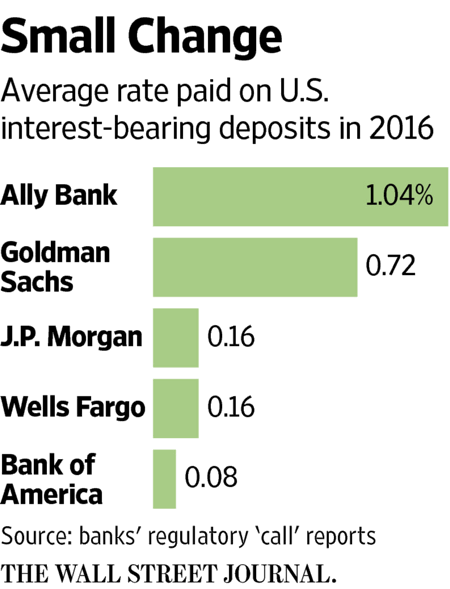
The WSJ article Bank of America Pays Peanuts for Deposits, but the Money Keeps Flowing In (paywall) outlines how BofA gets away with paying less interest on its deposits than nearly any other US bank (not that the other mega-banks are that much better). BofA only pays an average of 0.08% on $796 billion of cash deposits, including certificates of deposit:

bofa_int450

Keep your savings somewhere else! Even if you have a BofA account for the ATM network, you can avoid fees on their basic checking accounts with either a monthly direct deposit, a minimum balance of $1,500 with no direct deposit, or by keeping $20,000 in stocks/ETFs at Merrill Edge with no direct deposit and no minimum balance. Anything above that can easily earn more interest with a companion account like Ally Bank Savings that now has 1-day transfers between linked accounts.

On that note, here is my monthly roundup of the best safe rates available, roughly sorted from shortest to longest maturities. Rates checked as of 5/11/17.

High-yield savings accounts
While the huge brick-and-mortar banks rarely offer good yields, the online banks with a history of competitive rates offer online savings accounts clustered around 1% APY. An important feature to note with savings account is that their interest rates can change at any time.

  • As I’ve been “bait-and-switched” a few times and there are no lucrative rates that make it worth taking another risk, I am currently sticking with Ally Bank for their reliably competitive rates and overall good user experience. Their online savings is currently at 1.05% APY.

Money market mutual funds
If you like to keep cash in a brokerage account, you should know that money market and short-term Treasury rates have been inching upwards. It may be worth the effort to move your money into a higher-yielding money market fund.

  • The Vanguard Prime Money Market Fund has increased their SEC yield to a half-decent 0.95%. The default sweep option is the Vanguard Federal Money Market Fund, which only has an SEC yield of 0.69%. You can manually move the money over to Prime if you meet the $3,000 minimum investment.

Short-term guaranteed rates (under 1 year)
I am often asked what to do with a big wad of cash that you’re waiting to deploy shortly (just sold your house, just sold your business, inheritance). Honestly, I wouldn’t get fancy or take unnecessary risk. Just keep it safe in a short-term CD or online savings account that in insured under the FDIC limits until you have a plan.

  • Palladian Private Bank has a 6-month promotional rate of 1.30% APY guaranteed (maximum initial deposit of $100k) for new accounts. After the first 6 months, the rate reverts back to their normal rate (currently 0.90% APY). Since the initial promo rate is fixed, this makes it the highest guaranteed 6-month CD rate available.

US Savings Bonds
Series I Savings Bonds offer rates that are linked to inflation and backed by the US government. You must hold them for at least a year. There are annual purchase limits. If you redeem them within 5 years there is a penalty of the last 3 months of interest.

  • “I Bonds” bought through the end of April 2017 now will earn a 1.96% rate for the first six months, and then a variable rate based on ongoing inflation after that. While that next 6-month rate is currently unknown, at the very minimum the total yield after 12 months will around 1% with additional upside potential. More info here.
  • In mid-October, the CPI will be announced and you will have a short period where you will have a very close estimate of the rate for the next 12 months. I will have another post up at that time.

Prepaid Cards with Attached Savings Accounts
A small subset of prepaid debit cards have an “attached” FDIC-insured savings account with high interest rates. The risks are that balances are capped, and there are many fees that you must be careful to avoid (lest they eat up your interest). The other catch is that these good features may be killed off without much notice. My NetSpend card now only has an eligible balance up to $1,000.

  • Insight Card is one of the best remaining cards with 5% APY on up to $5,000 as of this writing. Fees to avoid include the $1 per purchase fee, $2.50 for each ATM withdrawal, and the $3.95 inactivity fee if there is no activity within 90 days. If you can navigate it carefully (basically only use ACH transfers and keep up your activity regularly) you can still end up with more interest than other options.

Rewards checking accounts
These unique checking accounts pay above-average interest rates, but with some risk. You have to jump through certain hoops, and if you make a mistake you won’t earn any interest for that month. Rates can also drop quickly, leaving a “bait-and-switch” feeling. But the rates can be high while they last.

  • Consumers Credit Union offers up to 4.59% APY on up to a $20k balance, although 3.09% APY on a $10k balance might be easier to achieve unless you satisfy a long list of requirements. Note that the 4.59% APY requires you to apply and get approved for an additional credit card through them (other credit cards offer $500+ in sign-up bonuses). Keep your 12 debit purchases small as well, as for every $500 in monthly purchases you may be losing out on 2% cashback (or $10 a month on after-tax benefit). Find a local rewards checking account at DepositAccounts.

Certificates of deposit
If you have a large cushion, it’s quite likely to just sit there for years. One option is to keep your money in longer-term investments where you can still take it out in a true emergency and pay a reasonable early withdrawal penalty. Alternatively, you could create a CD ladder of different maturity lengths such that you have access to part of the ladder each year, but your blended interest rate is higher than a savings account.

  • Connexus Credit Union is offering a 1-year Share Certificate at 1.50% APY (90-day early withdrawal penalty) and a 3-year Share Certificate (180-day early withdrawal penalty) at 2.00% APY. Both have a $5,000 minimum deposit. Anyone can join this credit union via partner organization Connexus Association for a one-time $5 fee.
  • Hanscom Federal Credit Union is offering a 4-year Share Certificate at 2.50% APY (180-day early withdrawal penalty) if you also have Premier Checking (no monthly fee if you keep $6,000 in total balances or $2,000 in checking). HFCU also offer a 3% APY CU Thrive “starter” savings account. HFCU membership is open to active/retired military or anyone who makes a one-time $35 donation to the Nashua River Watershed Association.

Longer-term Instruments
I’d use these with caution, but I still track them to see the rest of the current yield curve.

  • Willing to lock up your money for 10+ years? Did you know that you can buy certificates of deposit via Vanguard’s bond desk? These “brokered CDs” still offer the same FDIC-insurance. As of this writing, you can get a 10-year non-callable CD that pays 2.75% APY. (Unfortunately, current long-term CD rates do not rise much higher even as you extend beyond a 5-year maturity.) Prices will vary daily.
  • How about two decades!? Series EE Savings Bonds are not indexed to inflation, but they have a guarantee that the value will double in value in 20 years, which equals a guaranteed return of 3.5% a year. However, if you don’t hold for that long, you’ll be stuck with the normal rate which is quite low (currently a sad 0.10% rate). You could view as a huge early withdrawal penalty. You could also view it as long-term bond and thus a hedge against deflation, but only if you can hold on for 20 years. Too long for me.

All rates were checked as of 5/11/17.

Best Interest Rates on Cash Savings – April 2017

percentage2

Our family keeps a year’s worth of expenses (not income) put aside in cash reserves. Even if you think that’s too much, you still need something. There are many ways that the ROI on emergency funds can be higher than simply the interest rate on your bank statement.

If you have cash, it pays to shop around for the most highest interest rates since they are all equally “safe” as long as they are backed by the US government (FDIC-insured, NCUA-insured, US Treasury Bonds, US Savings Bonds). Chase Bank on a 1-year CD? 0.02% APY. Bank of America on a 10-year CD? 0.15% APY. Seriously, who buys these things?!? As of 4/2/2017, below is a roundup of the best safe rates available, roughly sorted from shortest to longest maturities.

High-yield savings accounts
While the huge brick-and-mortar banks rarely offer good yields, the online banks with a history of competitive rates offer online savings accounts clustered around 1% APY. An important feature to note with savings account is that their interest rates can change at any time.

  • As I’ve been “bait-and-switched” a few times and there are no lucrative rates that make it worth taking another risk, I am currently sticking with Ally Bank for their reliably competitive rates and overall good user experience. Their online savings is currently at 1.05% APY.

Short-term guaranteed rates (under 1 year)
I am often asked what to do with a big wad of cash that you’re waiting to deploy shortly (just sold your house, just sold your business, inheritance). Honestly, I wouldn’t get fancy or take unnecessary risk. Just keep it safe in a short-term CD or online savings account that in insured under the FDIC limits until you have a plan.

  • Palladian Private Bank has a 6-month promotional rate of 1.30% APY guaranteed (maximum initial deposit of $100k) for new accounts. After the first 6 months, the rate reverts back to their normal rate (currently 1.10% APY). Since the initial promo rate is fixed, this makes it the highest 6-month CD rate available.

US Savings Bonds
Series I Savings Bonds offer rates that are linked to inflation and backed by the US government. You must hold them for at least a year. There are annual purchase limits. If you redeem them within 5 years there is a penalty of the last 3 months of interest.

  • “I Bonds” bought through the end of April 2017 now will earn a 2.76% rate for the first six months, and then a variable rate based on ongoing inflation after that. While that next 6-month rate is currently unknown, at the very minimum the total yield after 12 months will be competitive with the best current 1-year CD rates. More info here.
  • In mid-April, the CPI will be announced that factors into the new fixed rate in May, which would give you a very close estimate of the rate for the next 12 months. I will have another post up at that time.

Prepaid Cards with Attached Savings Accounts
A small subset of prepaid debit cards have an “attached” FDIC-insured savings account with high interest rates. The risks are that balances are capped, and there are many fees that you must be careful to avoid (lest they eat up your interest). The other catch is that these good features may be killed off without much notice. My NetSpend card now only has an eligible balance up to $1,000.

  • Insight Card is one of the best remaining cards with 5% APY on up to $5,000 as of this writing. Fees to avoid include the $1 per purchase fee, $2.50 for each ATM withdrawal, and the $3.95 inactivity fee if there is no activity within 90 days. If you can navigate it carefully (basically only use ACH transfers and keep up your activity regularly) you can still end up with more interest than other options.

Rewards checking accounts
These unique checking accounts pay above-average interest rates, but with some risk. You have to jump through certain hoops, and if you make a mistake you won’t earn any interest for that month. Rates can also drop quickly, leaving a “bait-and-switch” feeling. But the rates can be high while they last.

  • Consumers Credit Union offers up to 4.59% APY on up to a $20k balance, although 3.09% APY on a $10k balance might be easier to achieve unless you satisfy a long list of requirements. Note that the 4.59% APY requires you to apply and get approved for an additional credit card through them (other credit cards offer $500+ in sign-up bonuses). Keep your 12 debit purchases small as well, as for every $500 in monthly purchases you may be losing out on 2% cashback (or $10 a month on after-tax benefit). Find a local rewards checking account at DepositAccounts.

Certificates of deposit
If you have a large cushion, it’s quite likely to just sit there for years. One option is to keep your money in longer-term investments where you can still take it out in a true emergency and pay a reasonable early withdrawal penalty. Alternatively, you could create a CD ladder of different maturity lengths such that you have access to part of the ladder each year, but your blended interest rate is higher than a savings account.

  • Connexus Credit Union is offering a 1-year Share Certificate at 1.50% APY (90-day early withdrawal penalty) and a 3-year Share Certificate (180-day early withdrawal penalty) at 2.00% APY. Both have a $5,000 minimum deposit. Anyone can join this credit union via partner organization Connexus Association for a one-time $5 fee.
  • Mountain America Credit Union is offering a 5-year Share Certificate at 2.75% APY (365-day early withdrawal penalty). You are even allowed a one-time rate bump if the rates on this certificate rise. $500 minimum deposit. Anyone can join this credit union via partner organization American Consumer Council for a one-time $5 fee.

Longer-term Instruments
I’d use these with caution, but I still track them to see the rest of the current yield curve.

  • Willing to lock up your money for 10+ years? Did you know that you can buy certificates of deposit via Vanguard’s bond desk? These “brokered CDs” offer the same FDIC-insurance and are often through commercial banks like Goldman Sachs. As of this writing, you can get a 10-year non-callable CD that pays 2.85% APY. (Unfortunately, current long-term CD rates do not rise much higher even as you extend beyond a 5-year maturity.) Prices will vary daily.
  • How about two decades!? Series EE Savings Bonds are not indexed to inflation, but they have a guarantee that the value will double in value in 20 years, which equals a guaranteed return of 3.5% a year. However, if you don’t hold for that long, you’ll be stuck with the normal rate which is quite low (currently a sad 0.10% rate). You could view as a huge early withdrawal penalty. You could also view it as long-term bond and thus a hedge against deflation, but only if you can hold on for 20 years. Too long for me.

All rates were checked as of 4/2/17.

Best Interest Rates on Cash Reserves – November 2016

percentage2

Our family keeps a year’s worth of expenses (not income) put aside in cash reserves; it provides financial insurance with the side benefits of lower stress and less concern about stock market gyrations. Emergency funds can have a better return on investment than what you see on your bank statement. In my experience, having a solid cash cushion is the first step towards financial independence.

I don’t chase rates nearly as much as I used to, but it still pays to shop around. Chase Bank on a 1-year CD? 0.02% APY. Bank of America on a 10-year CD? 0.15% APY. Who buys these things?!? Meanwhile, the rates below vary from 1% up to over 3% annualized.

As of 11/6/2016, below is a roundup of the best rates backed by the full faith and credit of the US government (FDIC-insured, NCUA-insured, US Treasury Bonds, US Savings Bonds). I will try to sort them from the shortest to longest maturities.

High-yield savings accounts

  • Online savings accounts, everyone’s got one these days. Currently, the ones with a history of competitive rates are around 1% APY. These savings accounts can change their interest rate at any time, so if you’re going to just pick the highest one, be ready to move your money. I prefer the ones with a history of competitive rates, and I’ve been with Ally Bank for over 5 years. Their online savings is currently at 1% APY.

Short-term guaranteed rates (under 1 year)

  • If you’ve got a big wad of cash that you’re waiting to deploy shortly (just sold your house, just sold your business, inheritance), I say just keep it safe until you’re ready to invest it properly. Palladian Private Bank has a 6-month promotional rate of 1.30% APY guaranteed (maximum initial deposit of $100k) for new accounts. After the first 6 months, the rate reverts back to their normal rate (currently 1.10% APY). Since the initial promo rate is fixed, this makes it the higher 6-month CD rate available.

Flexible Savings Bonds

  • Series I Savings Bonds offer rates that are linked to inflation. “I Bonds” bought right now will earn a 2.76% rate for the first six months, and then a variable rate based on ongoing inflation after that. You must hold them for a year, and if you redeem them within 5 years there is a penalty of the last 3 months of interest. While future rates are unknown, at the very minimum it will be competitive with the best 1-year CD rates. More info here.

Prepaid Cards with Attached Savings Accounts

  • A small subset of prepaid debit cards have an “attached” FDIC-insured savings account with high interest rates. The risks are that balances are capped, and there are many fees that you must be careful to avoid (lest they eat up your interest). The other catch is that these good features may be killed off without much notice. I pulled my money out of my NetSpend card after the eligible balance dropped to $1,000 (no longer worth the effort for extra $3 a month in interest).
  • Insight Card is one of the best remaining cards with 5% APY on up to $5,000 as of this writing. Fees to avoid include the $1 per purchase fee, $2.50 for each ATM withdrawal, and the $3.95 inactivity fee if there is no activity within 90 days. If you can navigate it carefully (basically only use ACH transfers and keep up your activity regularly) you can still end up with more interest than other options.

Rewards checking accounts

  • These unique checking accounts pay above-average interest rates, but with some risk. You have to jump through certain hoops, and if you make a mistake you won’t earn any interest for that month. Rates can also drop quickly, leaving a “bait-and-switch” feeling. But the rates can be high while they last.
  • Consumers Credit Union offers up to 4.59% APY on up to a $20k balance, although 3.09% APY on a $10k balance might be easier to achieve unless you satisfy a long list of requirements. Note that the 4.59% APY requires you to apply and get approved for an additional credit card through them (other credit cards offer $500+ in sign-up bonuses). Keep your 12 debit purchases small as well, as for every $500 in monthly purchases you may be losing out on 2% cashback (or $10 a month on after-tax benefit).

Certificates of deposit

  • If you have a large cushion, it’s quite likely to just sit there for years. Why not put some money in longer-term investments where you can still take it out in a true emergency and pay an early withdrawal penalty. For example, UNIFY Financial Credit Union (formerly Western Federal Credit Union) is offering a 5-year Share Certificate paying 2.00% APY ($1,000 minimum balance) with an early withdrawal penalty of only 90 days interest. For example, if you withdraw from this CD after 2 years and pay the penalty, your effective rate earned will still be 1.76%. Anyone can join this credit union via partner organization, it appears it might be free or at most a one-time $25 fee.

Longer-term Instruments

  • Willing to lock up your money for 10+ years? Did you know that you can buy certificates of deposit via Vanguard’s bond desk? These “brokered CDs” offer the same FDIC-insurance and are often through commercial banks like Goldman Sachs. As of this writing, you can get a 10-year CD maturing 11/9/2026 that pays 2.10% APY. (Unfortunately, current long-term CD rates do not rise much higher even as you extend beyond a 5-year maturity.) Prices will vary regularly.
  • How about two decades!? Series EE Savings Bonds are not indexed to inflation, but they have a guarantee that the value will double in value in 20 years, which equals a guaranteed return of 3.5% a year. However, if you don’t hold for that long, you’ll be stuck with the normal rate which is quite low (currently a sad 0.10% rate). Think of it as a huge early withdrawal penalty. You really, really want to be sure you’ll keep it for 20 years.

All rates were checked as of 11/6/16.

Citibank $400 Checking Account Bonus

citi400Citibank has a $400 bonus offer for new checking account customers. Here are the highlights:

  • To qualify for a $400 cash bonus, open a new consumer checking account in The Citibank Account Package by 10/31/16.
  • Within 30 days from the date you opened your new checking account, deposit $15,000 or more in new-to-Citibank funds into your new checking account or new or existing Citibank Savings Plus account.
  • A minimum balance of $15,000 is required to be maintained in the new checking account or new or existing Citibank Savings Plus Account, for 30 consecutive calendar days following the date you made your qualifying deposit.
  • The cash bonus will be credited to your new checking account within 90 calendar days from the date when you completed all offer requirements.
  • To be eligible for this offer, you must not currently have a Consumer checking account with Citibank or have been a signer on or owner of a Citibank consumer checking account within the last 60 days.
  • Limit of one of each offer per customer and one offer per account.

Here are details for The Citibank Account Package:

  • $25 monthly service fee waived if you have $10,000 in combined average monthly balances.
  • Interest rate is a tiny 0.01% APY.
  • Free withdrawals from all Citibanks ATMs.
  • Citibank will waive their $2.50 fee for using non-Citibank ATMs, if combined average monthly balances in eligible linked accounts are met. However, you may still be charged a fee by the ATM owner itself.
  • No early account closure fee.

Let’s see… To start, you must not have had a Citibank consumer checking account within the last 60 days. Next, you’ll need to bring in $15,000 of money from a non-Citibank account, and keep it there for 30 days. You’ll need to keep $10,000 in your account to avoid the $25 monthly service fee. You’ll need to keep the account open for up to another 90 days (up to 120 days total) until the $400 bonus arrives.

It is not clear if you need to keep you account at the “Citibank Account” package level past the first 30 days. To be safe, you may want to keep it at that level ($10,000 minimum balance) until the bonus shows up. After that, you may downgrade to their Basic or Access levels with much lower minimum balance requirements, or you may choose to eventually close out the account after that if it doesn’t work for you.

Worth the effort? If you had $15,000 sitting in a 1% APY savings account, you’d earn $50 of interest over 4 months. So you could view this as $350 in extra interest over 4 months. Alternatively, if you earn $400 of interest on a $15,000 balance over 120 days (also ~4 months), that works out to roughly a 8% annualized interest rate. If you take out $5,000 after 30 days and keep $10,000 in there, your effective interest rate will be even higher, closer to 10% annualized interest rate for those 4 months. If the bonus arrives earlier, you could do better. At these assumed balance levels, you will avoid all monthly account fees. Note that the $400 will be reported on a 1099-INT form. Thus your interest is taxable as ordinary income, but any monthly fees you pay are not tax-deductible.

Santander Bank extra20 Checking: Ending July 1st for Existing Customers

Update April 2016. I originally wrote about this promotion in October 2013, and many readers have been getting $20 of interest every month on a relatively low balance (worked out to 16% APY on $1,500 average balance). With a 1% APY savings account, you’d need $24,000 to get the same amount of interest! Unfortunately, Santander Bank recently announced that this promotion will end and accounts will be converted to a Simply Right checking account later this year (reports include either July 1st or December 1st, 2016).

I would note that this deal lasted for over 2.5 years, longer than I thought it would. Just like with 5% APY Netspend prepaid cards, you can’t really predict how long deals will last. Some end earlier than you think, some end later. Don’t forget to close your account in July, unless you’ve gotten attached to your Santander account (which was always the idea!).

Original post from October 2013 (deal is no longer available):

[Read more…]

MaxMyInterest.com Review: Automated Interest Rate Chasing

mmi_logoHere is an updated link to the Best Cash Rates for 2019. But with the growing popularity of “robo-advisors” that manage your retirement portfolio using automated software, what if there was a robo-advisor for rate chasing?

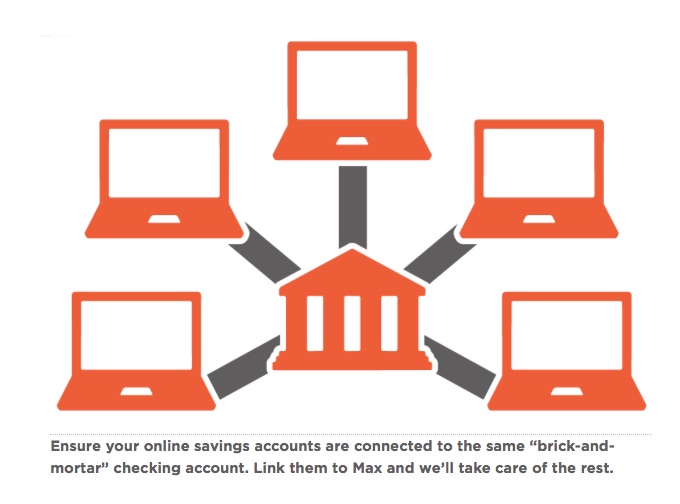
That’s the basic idea behind MaxMyInterest.com (Max). You set a Target Value you’d like to keep in your standard “brick-and-mortar” checking account. Max will then sweep any excess funds into whatever online savings bank has the highest yield. If their rates change, Max can move your money again. If your checking account balance gets low, Max will move money back into your checking account for you. The ole’ hub and spoke graphic:

mmi_spoke

If your balance exceeds the FDIC insurance limits of $250,000 per account type, Max will move the rest into the bank with the next-highest yield, and so on. T

What banks does it work with? They officially support checking accounts from the following big banks. Their application suggests that they may support other checking accounts. (The official list has also expanded a bit since their launch.)

  • Bank of America
  • Citibank
  • First Republic Bank
  • JPMorgan/Chase
  • Wells Fargo
  • Charles Schwab Bank
  • US Bank

Max will use one of these five online banks as your spokes (others may be added in the future, but only these work right now):

  • Ally Bank
  • American Express
  • Barclays
  • Capital One 360
  • GE Capital

You can have them open already, or you can only open a few, or you can use their “common application” to apply for all of them at once.

The cost? 0.02% per quarter, or 0.08% per year.

You can get an idea of their target audience from their marketing materials. I didn’t even know Hermes sold ties, let alone that they cost $200 a pop!

mmi_hermes

Recap. I certainly think the idea is a neat one. But considering the cost and restrictions to the specific five online banks, the greatest appeal of MaxMyInterest is probably to people with $250,000+ balances that want the maintain the safety FDIC-insurance without having to juggle multiple accounts on their own. For most people that don’t have that much sitting around in cash, simply picking a single online savings account with a good track record of offering high interest rates should be good enough.