Search Results for: High Interest Savings

My Money Blog Portfolio Asset Allocation, March 2018

portpie_blank200

Here is a First Quarter 2018 update for my primary investment portfolio. These are my real-world holdings, not a recommendation. It includes tax-deferred 401k/403b/IRAs and taxable brokerage accounts and excludes our primary home, cash reserves, and a few side investments. The goal of this portfolio is to create enough income to cover our regular household expenses. As of 2018, we have started the phase of “early retirement” where we are spending some of the dividends and interest from this portfolio.

Actual Asset Allocation and Holdings

I use both Personal Capital and a custom Google Spreadsheet to track my investment holdings. The Personal Capital financial tracking app (free, my review) automatically logs into my accounts, tracks my balances, calculates my performance, and gives me a rough asset allocation. I still use my custom Rebalancing Spreadsheet (free, instructions) because it tells me where and how much I need to direct new money to rebalance back towards my target asset allocation.

Here is my portfolio performance for the year and rough asset allocation (real estate is under alternatives), according to Personal Capital:

1803_pc1b

1803_pc2b

Here is my more specific asset allocation, according to my custom spreadsheet:

1803_spread1

Stock Holdings
Vanguard Total Stock Market Fund (VTI, VTSMX, VTSAX)
Vanguard Total International Stock Market Fund (VXUS, VGTSX, VTIAX)
WisdomTree SmallCap Dividend ETF (DES)
WisdomTree Emerging Markets SmallCap Dividend ETF (DGS)
Vanguard Small Value ETF (VBR)
Vanguard Emerging Markets ETF (VWO)
Vanguard REIT Index Fund (VNQ, VGSIX, VGSLX)

Bond Holdings
Vanguard Limited-Term Tax-Exempt Fund (VMLTX, VMLUX)
Vanguard Intermediate-Term Tax-Exempt Fund (VWITX, VWIUX)
Vanguard High-Yield Tax-Exempt Fund (VWAHX, VWALX)
Vanguard Inflation-Protected Securities Fund (VIPSX, VAIPX)
iShares Barclays TIPS Bond ETF (TIP)
Individual TIPS securities
U.S. Savings Bonds (Series I)

Target Asset Allocation. Our overall goal is to include asset classes that will provide long-term returns above inflation, distribute income via dividends and interest, and finally offer some historical tendencies to balance each other out. I personally believe that US Small Value and Emerging Market will have higher future long-term returns (along with some higher volatility) than US Large/Total and International Large/Total, although I could be wrong. I don’t hold commodities futures or gold (or bitcoin) as they don’t provide any income and I don’t believe they’ll outpace inflation significantly. I also try to imagine each asset class doing poorly for a long time, and only hold the ones where I think I can maintain faith.

Stocks Breakdown

  • 38% US Total Market
  • 7% US Small-Cap Value
  • 38% International Total Market
  • 7% Emerging Markets
  • 10% US Real Estate (REIT)

Bonds Breakdown

  • 50% High-quality, Intermediate-Term Bonds
  • 50% US Treasury Inflation-Protected Bonds

I have settled into a long-term target ratio is 67% stocks and 33% bonds (2:1 ratio) within our investment strategy of buy, hold, and rebalance. With a self-managed, simple portfolio of low-cost funds, we minimize management fees, commissions, and income taxes.

Real-world asset allocation details. For both simplicity and cost reasons, I am no longer buying DES/DGS and will be phasing them out whenever there are tax-loss harvesting opportunities. New money is going into the more “vanilla” Vanguard versions: Vanguard Small Value ETF (VBR) and Vanguard Emerging Markets ETF (VWO).

I’m still a bit underweight in TIPS and REITs mostly due to limited tax-deferred space as I don’t want to hold them in a taxable account. My taxable muni bonds are split roughly evenly between the three Vanguard muni funds with an average duration of 4.5 years. I have been seriously thinking of going back to US Treasuries due to changes in relative interest rates and our marginal income tax rate.

My stock/bond split is currently at 69% stocks/31% bonds. I continue to invest new money on a monthly basis in order to maintain the target ratios. Once a quarter, I also reinvest any accumulated dividends and interest that we did not spend. I don’t use automatic dividend reinvestment. First of all, we spend some of our dividends now. In addition, I can usually avoid creating any taxable transactions unless markets are really volatile.

Performance and commentary. According to Personal Capital, my portfolio has basically broken even so far in 2018 (-0.70% YTD). I see that during the same period the S&P 500 has lost 0.63% (excludes dividends) and the US Aggregate bond index has actually lost 1.55%.

An alternative benchmark for my portfolio is 50% Vanguard LifeStrategy Growth Fund (VASGX) and 50% Vanguard LifeStrategy Moderate Growth Fund (VSMGX), one is 60/40 and one is 80/20 so it also works out to 70% stocks and 30% bonds. That benchmark would have a total return of -0.98% YTD (as of 4/9/18).

In a separate post, I’ll share about more about the income aspect.

SaverLife Review: Starting Saving $20 a Month, Get Another $10 a Month Boost

saverlife0The importance of an emergency fund is often mentioned, but often the hardest thing is to get started. SaverLife.org is a program run by the nonprofit EARN to help working families by encouraging savings. Their idea here, essentially, is to kickstart a savings habit by paying a cash incentive for saving a least $20 each month for 6 months.

How it works. First, make sure you are age 18+ and have a US bank or credit union account. Taken from their FAQ:

  1. Join now by clicking the “Join Now” button at the top right corner of this page.
  2. Enter your name and email address.
  3. Connect your bank account to SaverLife by entering your online credentials so we can track how much you save.
  4. Save at least $20 each month for 6 months in your own bank account. We don’t touch your money, so you’ll need to move money to your linked account yourself.
  5. Earn $10 in rewards each month that you save at least $20.
  6. After 6 months, you can claim your rewards ($60 max) by completing an exit survey and entering your bank’s routing number and your account number.

You can set a goal higher than $20 a month if you’d like, they just set the bar to be encouraging to as many people as possible to start saving. You’ll receive weekly savings tips as well. SaverLife is not a bank or savings account. The money paid is not interest. If you sign up by April 13th, they promise additional “prizes”. Here’s an example of the motivation behind the nonprofit EARN:

saverlife1

Ideally, you should connect a savings account as they will basically take a snapshot every 30 days to see if your balance is $20 higher than the previous month. For example, if you join on April 10th, then they will check your balance again on May 9th. If you have a savings account, it will be easier to make sure you qualify by simply adding $20 to the account. Having a separate high-yield savings account is a better way to encourage savings anyway.

Bottom line. SaverLife is a free program designed to encourage household savings for working households. Link a bank account and earn $10 cash for every month that you save at least $20 (up to $60 total). I think this is a worthy effort, although I hope they perform some honest, long-term tracking and share if it really helps to develop a regular savings habit.

Free Social Security Calculator Tool: Estimate Your Benefits

socialsecuritycardThere are some (mostly young) skeptics, but Social Security should remain a major pillar of your future retirement income. For over 60% of current retirees aged 65+, Social Security makes up the majority of their income. Therefore, it may be worth spending some extra time figuring out how it works.
First, you should sign up for a mySocialSecurity account at SSA.gov. For many people, this is the only way to view your current benefit eligibility as they are phasing out those annual green paper statements. You will find some interesting information including eligible earnings history. (For example, I earned $1,814 in the summer after high school.) Also, if you claim your account first, it prevents an potential identity thief from opening an account in your name and stealing your benefits.

Second, you can check out this unofficial Social Security helper tool to test out different scenarios. Created by an Google engineer named Greg Grothaus in his spare time, the site takes your earnings history and uses Javascript to analyze it within your browser. No data is submitted over the internet. Found via The Finance Buff.

Here are some scenarios you might test out:

  • What happens to my benefit if I earn additional wages for several more years? What if I stop working forever?
  • How does my benefit change as my total earnings grow during my lifetime?
  • What happens if I choose to take my benefits early? What if I delay and take them late?

You might not know that your eventual benefit is based on your top 35 annual indexed earnings values. Indexed earnings are simply the payroll wages you earned in a year multiplied by a number that adjusts for wage growth. I personally don’t even have 35 working years yet, so every additional year I work will be in my “Top35” and increase my future payout. Here are some charts based on my earnings history:

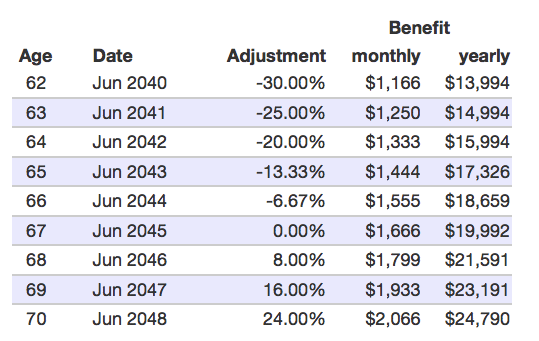
If I stop working immediately and then start taking benefits at my “normal” retirement age of 67 years, I will earn $1,666 per month ($19,992 per year). If I start taking money at age 62, I will earned a reduced $1,166 per month ($13,994 per year). Here’s the full chart:

sstool1

If I keep working for another 20 years at $50,000 per year, then my age 67 benefit will increase to $2,328 per month ($27,936 per year). If I start taking money at age 62, I will earned a reduced $1,630 per month ($19,555 per year). Here’s the updated full chart:

sstool2

Working/waiting an extra year may increase your payout enough to change your lifestyle significantly. An extra $100 per month may not seem that much, but that’s an extra $1,200 each year for the rest of your life that increases with inflation. If you don’t have adequate income from other sources, that could cover your medication copays for the year. It could be the difference between staying home and doing a video chat vs. flying and playing with your grandkids in person each year.

If you are on the early retirement track, that inserts a bunch of zeros in your “Top 35”. With this calculator, you can see how much that actually changes your eventual payout. Even if I continued to work another 25 years at $100,000 per year, my annual benefit at age 67 would be about $33,000 per year.

As a reminder, both SSA.gov and this tool only show you what your benefit will be under current law. Social Security isn’t a savings plan – current retirees are being paid from money taken from current workers. This means that changing demographics will require some sort of modification by 2035. From the Chief Actuary of the Social Security Administration:

Currently, the Social Security Board of Trustees projects program cost to rise by 2035 so that taxes will be enough to pay for only 75 percent of scheduled benefits. This increase in cost results from population aging, not because we are living longer, but because birth rates dropped from three to two children per woman. Importantly, this shortfall is basically stable after 2035; adjustments to taxes or benefits that offset the effects of the lower birth rate may restore solvency for the Social Security program on a sustainable basis for the foreseeable future.

Affirm: Immediate Gratification + Hiding The Pain of Paying Upfront

200jeans

Here is an interesting longform Racked article about Affirm micro-loans. Now, instead of (gasp!) saving up for a few months before paying cash for those $200 jeans, you could have them today for $235. It’s basically credit card debt for people who previously couldn’t get approved for a credit card. Hurray for innovation.

Sure, it may be more transparent and convenient, but here’s the real reason why you’ll soon see it everywhere:

Affirm is not just meeting a demand, but creating one, encouraging shoppers to buy and spend more. Affirm claims an average 75 percent boost in order values across all its merchant partners. Affirm is clearly not just facilitating purchases that would have otherwise happened through other means of credit. Four retailers I spoke with reported significantly higher sales, and more frequent purchases, with Affirm customers.

Saving for retirement is a form of delayed gratification. You could buy buy $235 jeans today, $200 jeans after saving up a few month, or you could invest it and wait 20, 30, 40 years down the road and be able to afford housing, food, and medical care when you’re old. Even if you’re a crazed fanatic like me with a 50% savings rate, you might wait 10 to 15 years before actually being able to “spend” the money you put away.

How can we avoid debt when it means immediate gratification? No easy answers here, but looking back, I used to check my net worth all the time. It’s hard to call that a healthy habit, but then again it did provide a form of immediate pleasure from saving $200 instead of spending it. I liked seeing the number go up. Mentally, I also knew I could use that money as a cushion if I wanted to try a new career path. In that way, having more money in the bank meant more freedom now, not just later.

Added: Dave Ramsey is famous for helping people out of debt, and one of his main tips is to pay cash for everything. At a minimum, use a debit card. (You could even “Debitize” your credit card.) That way, you feel the appropriate pain of each purchase. When you put things on a credit card with the idea of paying “later”, you are hiding that pain. $20 a month feels a lot easier than $200 upfront. This is why Affirm customers end up buying more stuff than cash buyers (on top of paying interest).

Connexus Credit Union 5-Year CD at 3.00% APY: Early Withdrawal Penalty Comparison

percentage2Connexus Credit Union has raised the rates on their 5-year Share Certificate to 3.00% APY with a 365-day early withdrawal penalty. They also have 1-year Share Certificate at 2.01% APY (90-day early withdrawal penalty). Both have a $5,000 minimum deposit. Anyone can join this credit union via partner organization Connexus Association for a one-time $5 fee.

It’s nice to see a 5-year CD hit 3% APY again, but the main drawbacks are that (2) rates may continue rising and (2) a year of lost interest is a significant early withdrawal penalty. To help illustrate this, I ran a comparison with the Ally Bank 5-year CD with a shorter 150-day early withdrawal penalty. The Ally CD is currently paying 2.30% APY with a $5,000 minimum deposit, so I will use that as the comparison rate. (You can also get 2.35% APY with $25,000+.)

con_ally_cd

As you can see, the penalty makes a big difference. Even if you make an early withdrawal at the last possible moment (59 months), you will never get anything higher than 2.39% APY.

If you do end up having to make an early withdrawal, the Ally CD with a smaller penalty will actually net you more money up until about 36 months. After 36 months, the Connexus 5-year wins out. For periods shorter than about a year, the likely best option is to just keep your money in a liquid online savings account. If you think rates will stay higher, you could also buy a 1-year CD and hope to roll it over.

Bottom line. If you’ve been waiting for 3% and/or you’re building a ladder of 5-year CDs where you are confident you won’t have to break it early, this Connexus certificate is currently a top rate and should be considered. Just be aware of the sizable early withdrawal penalty.

My Money Blog Portfolio Asset Allocation, 2017 Year-End Update

portpie_blank200

Here is a year-end update on my investment portfolio holdings for 2017. This is my last-minute checkup in case I need to rebalance to make another other tax-related moves. This includes tax-deferred 401k/403b/IRAs and taxable brokerage holdings, but excludes things like our primary home, cash reserves, and a few other side investments. The goal of this portfolio is to create enough income to cover our regular household expenses.

Actual Asset Allocation and Holdings

I use both Personal Capital and a custom Google Spreadsheet to track my investment holdings. The Personal Capital financial tracking app (my review, join free here) automatically logs into my accounts, tracks my balances, calculates my performance, and gives me a rough asset allocation. I still use my custom Rebalancing Spreadsheet (instructions, download free here) in order to see exactly where I need to direct new investments to rebalance back towards my target asset allocation.

Here is my portfolio performance for the year and rough asset allocation (real estate is under alternatives), according to Personal Capital:

1712_pc1

1712_pc2c

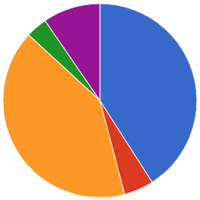
Here is my more specific asset allocation, according to my custom spreadsheet:

1712_portpie

Stock Holdings
Vanguard Total Stock Market Fund (VTI, VTSMX, VTSAX)
Vanguard Total International Stock Market Fund (VXUS, VGTSX, VTIAX)
WisdomTree SmallCap Dividend ETF (DES)
WisdomTree Emerging Markets SmallCap Dividend ETF (DGS)
Vanguard Small Value ETF (VBR)
Vanguard Emerging Markets ETF (VWO)
Vanguard REIT Index Fund (VNQ, VGSIX, VGSLX)

Bond Holdings
Vanguard Limited-Term Tax-Exempt Fund (VMLTX, VMLUX)
Vanguard Intermediate-Term Tax-Exempt Fund (VWITX, VWIUX)
Vanguard High-Yield Tax-Exempt Fund (VWAHX, VWALX)
Vanguard Inflation-Protected Securities Fund (VIPSX, VAIPX)
iShares Barclays TIPS Bond ETF (TIP)
Individual TIPS securities
U.S. Savings Bonds (Series I)

Target Asset Allocation. Our overall goal is to include asset classes that will provide long-term returns above inflation, distribute income via dividends and interest, and finally offer some historical tendencies to balance each other out. I don’t hold commodities futures or gold (or bitcoin) as they don’t provide any income and I don’t believe they’ll outpace inflation significantly. I also try to imagine each asset class doing poorly for a long time, and only hold the ones where I think I can maintain faith.

Stocks Breakdown

  • 38% US Total Market
  • 7% US Small-Cap Value
  • 38% International Total Market
  • 7% Emerging Markets
  • 10% US Real Estate (REIT)

Bonds Breakdown

  • 50% High-quality, Intermediate-Term Bonds
  • 50% US Treasury Inflation-Protected Bonds

I have settled into a long-term target ratio is 67% stocks and 33% bonds (2:1 ratio) within our investment strategy of buy, hold, and rebalance. With a self-managed, simple portfolio of low-cost funds, we minimize management fees, commissions, and income taxes.

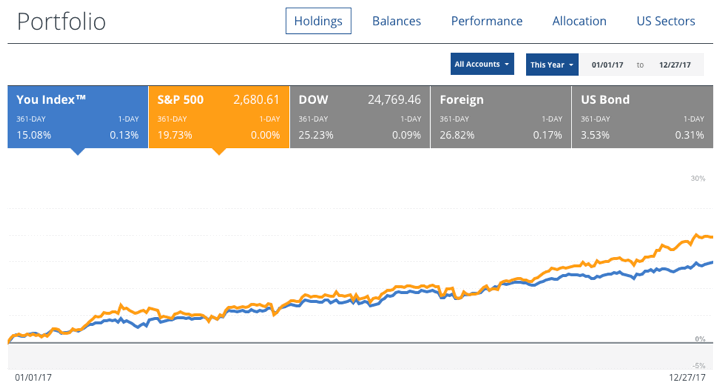
Performance, details, and commentary. According to Personal Capital, my portfolio has gained 15.08% overall in 2017 (with a few days left to go). In the same time period, the S&P 500 has gained 19.73% (excludes dividends) and the US Aggregate bond index has gained 3.53%. For the first time in a while, my sizable allocation to developed international and emerging markets stocks has boosted my overall return.

My stock/bond split is currently at 70% stocks/30% bonds due to the continued stock bull market. I continue to invest new money on a monthly basis in order to maintain the target ratios. Once a quarter, I also reinvest any accumulated dividends and interest. I don’t use automatic dividend reinvestment. This way, I can usually avoid creating any taxable transactions unless markets are really volatile.

For both simplicity and cost reasons, I am no longer buying DES/DGS and will be phasing them out whenever there are tax-loss harvesting opportunities. New money is going into the more “vanilla” Vanguard versions: Vanguard Small Value ETF (VBR) and Vanguard Emerging Markets ETF (VWO).

I’m still somewhat underweight in TIPS and REITs mostly due to limited tax-deferred space as I don’t want to hold them in a taxable account. My taxable muni bonds are split roughly evenly between the three Vanguard muni funds with an average duration of 4.5 years. I may start switching back to US Treasuries if my income tax rate changes signficantly.

Early Retirement Portfolio Asset Allocation, 2017 Third Quarter Update

portpie_blank200

Here is an update on my investment portfolio holdings after the third quarter 2017. This includes tax-deferred 401k/403b/IRAs and taxable brokerage holdings, but excludes things like our primary home, cash reserves, and a few other side investments. The purpose of this portfolio is to create enough income to cover our regular household expenses.

Target Asset Allocation. The overall goal is to include asset classes that will provide long-term returns above inflation, distribute income via dividends and interest, and finally offer some historical tendencies to balance each other out. I don’t hold commodities futures or gold as they don’t provide any income and I don’t believe they’ll outpace inflation significantly. I also try to imagine each asset class doing poorly for a long time, and only hold the ones where I think I can maintain faith.

Stocks Breakdown

  • 38% US Total Market
  • 7% US Small-Cap Value
  • 38% International Total Market
  • 7% Emerging Markets
  • 10% US Real Estate (REIT)

Bonds Breakdown

  • 50% High-quality, Intermediate-Term Bonds
  • 50% US Treasury Inflation-Protected Bonds

I have settled into a long-term target ratio is 67% stocks and 33% bonds (2:1 ratio) within our investment strategy of buy, hold, and rebalance. With a self-managed, simple portfolio of low-cost funds, we minimize management fees, commissions, and income taxes.

Actual Asset Allocation and Holdings

aa_portpie_1710

Stock Holdings
Vanguard Total Stock Market Fund (VTI, VTSMX, VTSAX)
Vanguard Total International Stock Market Fund (VXUS, VGTSX, VTIAX)
WisdomTree SmallCap Dividend ETF (DES)
WisdomTree Emerging Markets SmallCap Dividend ETF (DGS)
Vanguard Small Value ETF (VBR)
Vanguard Emerging Markets ETF (VWO)
Vanguard REIT Index Fund (VNQ, VGSIX, VGSLX)

Bond Holdings
Vanguard Limited-Term Tax-Exempt Fund (VMLTX, VMLUX)
Vanguard Intermediate-Term Tax-Exempt Fund (VWITX, VWIUX)
Vanguard High-Yield Tax-Exempt Fund (VWAHX, VWALX)
Vanguard Inflation-Protected Securities Fund (VIPSX, VAIPX)
iShares Barclays TIPS Bond ETF (TIP)
Individual TIPS securities
U.S. Savings Bonds (Series I)

Performance and commentary. According to Personal Capital, which aggregates all of my investment holdings across different accounts, my portfolio has gained 7.41% over the last 6 months since my last update. In the same time period, the S&P 500 has gained 9.21% (excluding dividends) and the US Aggregate bond index has gained 1.34%.

pcport_1710

Things are currently at 69% stocks/31% bonds. For the most part, I continue to invest new money on a monthly basis in order to try and maintain the target ratios. Once a quarter, I also reinvest any accumulated dividends and interest. I don’t use automatic dividend reinvestment. This way, I can usually avoid creating any taxable transactions unless markets are really volatile.

For both simplicity and cost reasons, I am no longer buying DES/DGS and will be phasing them out whenever there are tax-loss harvesting opportunities. New money is going into the more “vanilla” Vanguard versions: Vanguard Small Value ETF (VBR) and Vanguard Emerging Markets ETF (VWO).

I’m still somewhat underweight in TIPS and REITs mostly due to limited tax-deferred space as I don’t want to hold them in a taxable account. My taxable muni bonds are split roughly evenly between the three Vanguard muni funds with an average duration of 4.5 years. I may start switching back to US Treasuries if my income tax rate changes signficantly.

In a separate post, I will track dividend and interest income.

Wealthfront Review: Feature Breakdown and Comparison

wfront1707_0

Wealthfront is one of the largest independent digital advisory firms (i.e. not tied to a specific brand of funds like Vanguard or Schwab). With a younger target audience (20s to 40s), their offering is for folks that are comfortable having nearly all interactions via smartphone or website. They frequently announce new features and improvements, so I will work to keep this feature list updated.

Diversified portfolio of high-quality, low-cost ETFs. Their portfolios are a diversified mix of several asset classes including: US Total, US Dividend, International Developed, US Corporate Bonds, Muni Bonds, Emerging Market Bonds, REITs, and Natural Resources. For the most part, low-cost Vanguard and iShares ETFs are used. You could argue the finer points of a specific portfolio, but overall it is backed by academic research (Chief Investment Officer is Burton Malkiel).

Direct indexing. If your account is over $100,000, Wealthfront will buy all the stocks in the S&P 500 individually and commission-free. ETF expense ratios are pretty low now, so this is mostly used as an opportunity for more tax-loss harvesting. No other robo-advisor offers this feature. Here is whitepaper that details their position. As long as you meet the $100k minimum, there is no additional cost fee above the standard management fee.

Smart-beta. If your account is over $500,000, Wealthfront created Advanced Indexing as their answer to “smart-beta” investing. It works within its Direct Indexing feature in order to improve tax efficiency. As long as you meet the $500k minimum, there is no additional cost fee above the standard management fee.

wf_new

Financial planning software with outside account integration. Path is Wealthfront’s new financial planning software, launched in February 2017. This service links your external accounts from other banks, brokerages, and 401k plans (similar to Mint and Personal Capital) in order to see your entire picture without having to manually input your balances and transactions. How much do I have invested elsewhere? How much am I spending? How much am I saving? How much can I spend in retirement?

Path can forecast your saving rate using the last 12 months of transactions. Investment returns are estimated using Monte Carlo analysis. It also accounts for your household income, birthdate, and chosen retirement age to estimate how Social Security will affect your retirement income needs. You can change up the variables and see how it will affect your retirement outlook.

College Savings Planning. You can select a college for real-time expense projections, get a customized estimate of financial aid, and receive a personalized college savings plan to cover the difference. This works with or without their own Wealthfront 529 College Savings account.

Account types. Wealthfront now supports taxable joint accounts, trust accounts, 401k rollovers, Traditional IRAs, Roth IRAs, and SEP IRAs. They also offer a 529 College Savings account.

Tax-sensitive account transfers. This is good news if you already have an existing portfolio with unrealized capital gains. Other robo-advisors may have a “switch calculator” to help you decide whether to move over or not, but Wealthfront will actually accept your existing investments and manage it for you alongside your new investments.

If you want to switch advisors or move your brokerage holdings into a diversified portfolio, you typically have to sell all your holdings and move in cash. This means you will more than likely have a large tax bill. Instead of selling your holdings, Wealthfront will directly transfer them into a diversified portfolio tax efficiently, saving you that tax bill.

Tax-efficent asset location. They will place different asset classes in your taxable accounts vs. tax-deferred accounts (IRAs, 401ks) for a higher after-tax return. However, they do not treat them holistically (i.e. putting all one of one asset in IRA and none in taxable). Non-Wealthfront accounts are also not taken into consideration.

Use dividends and new contributions to rebalance. They will use your dividends and new contributions to rebalance your asset classes in order to minimize sells and thus minimize capital gains.

Concentrated holding of a single stock? Wealthfront caters to the tech start-up crowd with a unique Selling Plan service for people with much of their net worth tied up in a single stock. They’ll help you sell your positions gradually in a tax-efficent manner. Currently available to shareholders of: Alphabet, Amazon, Apple, Arista Networks, Box, Facebook, Pure Storage, Square, Twilio, Twitter, Yelp, Zillow.

Daily tax-loss harvesting. Wealthfront software monitors your holdings daily and attempts to find opportunities to harvest tax losses by switching between “similar but not substantially identical” ETFs. If you can delay paying taxes and reinvest them, this can result in a greater after-tax return. The exact “tax alpha” of this practice depends on multiple factors like portfolio size and tax brackets. You can read the Wealthfront side of things in this whitepaper and Schwab comparison. Here is an outside viewpoint arguing for more conservative estimates.

My opinion is that there is long-term value in tax-loss harvesting and especially daily monitoring to capture more losses. However, I also think it’s wise to use a conservative assumption as to the size of that value. (DIY investors can perform their own tax-loss harvesting as well on a less-frequent basis. I do it myself, but it’s rather tedious and I’m definitely not doing it more often than once a year. I would gladly leave it to the bots if it was cheap enough.)

Portfolio Line of Credit. If your taxable balance is over $100,000, Wealthfront will automatically give you a line of credit of up to 30% of your balance. There is no application, no fees, low interest rates, and you can get cash in as little as 1 business day. The rates are advertised to be even lower than a Home Equity Line of Credit (HELOC). Keep your loan balances modest though, as this is a margin lending product and they may force you to sell your investments if your outstanding balance exceeds your available margin.

Fee schedule. The fee schedule for Wealthfront is simple – Everyone gets charged a flat advisory fee of 0.25% of assets annually (first $10,000 waived). All of the features listed above are included. As your asset size increases, you get access to some additional features like Direct Indexing and Advanced Indexing (Smart-Beta).

Bottom line. Wealthfront is an independent digital advisory firm with over $7 billion in assets. Independent which means they aren’t tied to any specific brand of funds like Vanguard, Fidelity, or Schwab. Their main differentiators from the other independent firms (see my Betterment review) are (1) Direct Indexing and Advanced (Smart-Beta) Indexing portfolio management for optimal tax-efficiency and (2) customized assistance with transferring in your existing investments (including company stock) and then selling them tax-efficiently. Other notable features include: Financial planning software that incorporates external accounts, tax-loss harvesting, 529 college saving plan and guidance software, and a portfolio line-of-credit.

Special offer. Open a Wealthfront account via my invite link and get your first $15,000 managed for free, forever. This is an additional $5,000 above the standard $10,000 balance waiver. You can then invite your own friends for more savings (your friend gets $15k managed free as well, and you get another $5k managed for free.)

My Portfolio Asset Allocation Thought Process

portpie_blank200

A reader asked me to expand on the thought process behind my asset allocation choices. I don’t have a highly scientific answer, but here’s how I would explain it to a friend over drinks. Prepare yourself for some rambling…

I know that I could run simulations and backtest return data to figure out exactly which mix of assets have produced the best risk/return characteristics historically. I’ve also looked at various model portfolios based on such analyses. However, perfection can only be seen in retrospect and it is constantly changing. I just try to take away the big nuggets.

The overall goal is to hold asset classes that will provide long-term returns above inflation, distribute income via dividends and interest, and finally offer some historical tendencies to balance each other out.

Stocks Breakdown (Benchmark Ticker)

  • 38% US Total Market (VTI)
  • 7% US Small-Cap Value (VBR)
  • 38% International Total Market (VXUS)
  • 7% Emerging Markets (VWO)
  • 10% US Real Estate (VNQ)

To put it briefly, I am taking the total markets and increasing the portion of one additional asset class which I think has the highest diversification benefits. For example, Small Value is a subset of Total US market, and Emerging Markets is a subset of the Total International market.

38% US Total Market. Instead of “stocks” or “equities”, I prefer to call it “owning businesses”. It’s not just a ticker blip going up and down. I am buying a diversified mix of real businesses that are a critical part of a huge economy. A single company or even a handful of big companies might go bankrupt, but as a whole they are not going anywhere.

The Vanguard Total Stock Market ETF (VTI) holds 3,600 stocks to represent the entire US publicly-listed market from Apple ($770,000 million) to Bridgford Foods Corp. ($100 million). It is market-cap weighted, which means that the amount of each stock held is directly proportional to the total market value of the company. See my VTI review for details.

7% US Small-Cap Value. Historically, small-cap value stocks have produced a higher risk-adjusted return than the entire market. You could also argue that small companies a more representative of the private business market. Therefore, I choose to hold a little more of this asset class via the Vanguard Small-Cap Value ETF (VBR).

You probably haven’t heard of 99% of the stocks in the Small Value index, which is kind of the point. Someone who invests in individual small cap stocks must be wary of that company going bankrupt (or effectively bankrupt). But by owning 828 of these stocks at the same time, I don’t have to worry about VBR ever going to zero (although it can be relatively volatile). Will VBR outperform VTI by a huge margin? Maybe, maybe not, but it probably won’t lag the overall market greatly either.

VTI can be roughly broken down into 85% Large-Cap companies, 10% Mid-Cap companies, and 5% Small-Cap companies. My blend of 85% VTI and 15% VBR is still roughly 72% Large-Cap and 19% Small-Cap. I have “tilted” the amounts, but it’s still predominantly composed of huge businesses like ExxonMobil, Google, and Johnson & Johnson.

International Total Market. The United States is not the only place where businesses create value. Many brands that you deal with every day are listed in foreign countries – Nestle, Shell, Samsung, Toyota, GlaxoSmithKline, Anheuser-Busch InBev. (Bud Light is a foreign company!) The Vanguard Total International Stock ETF (VXUS) holds over 6,000 stocks from around the world according to market-cap weight. See my VXUS review for details.

I also keep to close to the world market-cap split with 50/50 US/non-US. If you want to go 70/30 or 60/40, that’s perfectly fine with me. Again it’s more important that you stick with it than any specific ratio.

Emerging Markets. Within the foreign markets, I choose to put extra money towards Emerging Markets – countries that currently include China, Taiwan, India, Brazil, South Africa, Mexico, Russia, Thailand, and Malaysia. Again, this asset class is more volatile but also has higher historical returns. The Vanguard FTSE Emerging Markets ETF (VWO) allows me to track this asset class in an efficient and low-cost manner. If there were better options for International Small Value stocks, I would have been open to that.

VXUS is 43% Developed Europe, 30% Developed Pacific, 19% Emerging Markets, and 7% Canada. My blend of 85% VXUS and 15% VWO is 37% Developed Europe, 26% Developed Asia, 31% Emerging Markets, and 6% Canada. Again, it’s not a huge tilt.

(Exit option: If something happened to me and my wife wanted to simultaneously simplify the portfolio, reduce the overall risk level, and generate cash, she could simply sell off my US Small Value and Emerging Markets positions that make up ~10% of the entire portfolio. The resulting portfolio would still be diversified.)

Real Estate. The Vanguard REIT ETF (VNQ) holds publicly-traded real estate investment trusts (REITs) which hold things like office buildings, hotels, apartment complexes, nursing homes, self-storage units, and shopping malls. I choose not to be active in residential real estate other than owning my own home, so I like the diversification and income that this asset class provides.

I am sticking with domestic REITs for both simplicity and lower costs. REITS only make up about 7% of my overall portfolio. I might include foreign REITS if it was a larger holding, but I’m going to bother splitting up 7%.

Bonds Breakdown

  • 50% High-quality, Intermediate-Term Bonds
  • 50% US Treasury Inflation-Protected Bonds

I keep roughly 30% of my portfolio in bonds. This is meant to be the stable ballast of my portfolio, but it should also generate some level of interest income. Bonds are debt, so I only lend money to the places that I think will pay me back most reliably:

  • US government, which can both tax residents and print the world’s reserve currency. This includes US Treasuries, FDIC-insured bank accounts, and US Savings bonds. Treasury Inflation-Protected bonds also offer an interest rate that adjusts with inflation.
  • Local municipalities, which can tax residents. If you don’t pay your property taxes, they take your house. “Muni bonds” currently offer the best tax-effective yield for my situation. I hold them through low-cost, actively-managed funds like Vanguard Intermediate-Term Tax-Exempt Fund Investor Shares (VWITX). See, I’m not only about index funds!

I exclude investment-grade corporate bonds because I don’t see enough benefit in taking on extra risk in this manner. I’d rather get 3% dividend yield through stock ownership (which includes unlimited upside potential) than get paid 3% interest (with no upside potential). Corporate bonds don’t have the company interests aligned with you – they want to appear stable and pay as little interest as possible. I’m not overly trusting of bond rating agencies in general.

I also exclude international bonds because what’s the point of diversifying to get a significantly lower interest rate? Vanguard US Total US Bond Market ETF (BND) has a current SEC yield of 2.43%. Vanguard Total International Bond ETF (BNDX) has a current SEC yield of 0.74%. Blech!

Recap. At a basic level, I own baskets of US businesses, international businesses, real estate, and high-quality debt. I plan to eventually spend the dividends from the businesses, rent from the real estate, and interest from the loans. I expect the stock dividends and rent to increase faster than inflation. I expect that the bond interest will at least keep up with inflation. This mix makes sense to me and I believe I can hold it through the ups and downs. It is not perfect but it is good enough.

Early Retirement Portfolio Asset Allocation, 2017 First Quarter Update

portpie_blank200

Here is an update on my investment portfolio holdings after the first quarter 2017. This includes tax-deferred accounts like 401ks, IRAs, and taxable brokerage holdings, but excludes things like our primary home, cash reserves, and a few other side investments. The purpose of this portfolio is to create enough income to cover our regular household expenses.

Target Asset Allocation

The overall goal is to include asset classes that will provide long-term returns above inflation, distribute income via dividends and interest, and finally offer some historical tendencies to balance each other out. I don’t hold commodities futures or gold as they don’t provide any income and I don’t believe they’ll outpace inflation significantly. I also believe that it is more important to have asset classes that you are confident you’ll hold through the bad times, as opposed to whatever has been doing well recently. The things that looked promising in 2000 were not the things that looked promising in 2010, and so on.

Stocks Breakdown

  • 38% US Total Market
  • 7% US Small-Cap Value
  • 38% International Total Market
  • 7% Emerging Markets
  • 10% US Real Estate (REIT)

Bonds Breakdown

  • 50% High-quality, intermediate-Term Bonds
  • 50% US Treasury Inflation-Protected Bonds

Our current target ratio is 70% stocks and 30% bonds within our investment strategy of buy, hold, and rebalance. With a self-managed, simple portfolio of low-cost funds, we minimize management fees, commissions, and income taxes.

Actual Asset Allocation and Holdings

aa_port1704

Stock Holdings
Vanguard Total Stock Market Fund (VTI, VTSMX, VTSAX)
Vanguard Total International Stock Market Fund (VXUS, VGTSX, VTIAX)
WisdomTree SmallCap Dividend ETF (DES)
Vanguard Small Value ETF (VBR)
Vanguard Emerging Markets ETF (VWO)
Vanguard REIT Index Fund (VNQ, VGSIX, VGSLX)

Bond Holdings
Vanguard Limited-Term Tax-Exempt Fund (VMLTX, VMLUX)
Vanguard Intermediate-Term Tax-Exempt Fund (VWITX, VWIUX)
Vanguard High-Yield Tax-Exempt Fund (VWAHX, VWALX)
Vanguard Inflation-Protected Securities Fund (VIPSX, VAIPX)
iShares Barclays TIPS Bond ETF (TIP)
Individual TIPS securities
U.S. Savings Bonds (Series I)

Commentary

In regards to my target asset allocation, I tweaked the stock percentages slightly so that I will end up with at least 5% overall in any given asset class when I reach my final ratio of roughly 65% stocks and 35% bonds in the next few years. Despite the recent outperformance of US stocks vs. the rest of the word, I am still keeping my 50/50 split between US and International holdings.

In regards to specific holdings, I did some tax-loss harvesting between my Emerging Markets and US Small Cap ETF holdings. I am also shifting towards dropping my WisdomTree ETFs and going to the more “vanilla” Vanguard versions: Vanguard Small Value ETF (VBR) and Vanguard Emerging Markets ETF (VWO). This should lower costs and increase simplicity. Otherwise, there has been little activity besides continued dollar-cost-averaging with monthly income.

I’m still somewhat underweight in TIPS and REITs mostly due to limited tax-deferred space as I really don’t want to hold them in a taxable account. My taxable muni bonds are split roughly evenly between the three Vanguard muni funds with an average duration of 4.5 years. I may start switching back to US Treasuries if my income tax rate changes signficantly.

A rough benchmark for my portfolio is 50% Vanguard LifeStrategy Growth Fund (VASGX) and 50% Vanguard LifeStrategy Moderate Growth Fund (VSMGX), one is 60/40 and one is 80/20 so it also works out to 70% stocks and 30% bonds. That benchmark would have a total return of +7.73% for 2016 and +4.96% YTD (as of 4/17/17).

So this is what I own, and in a separate post I’ll share about how I track if I have enough to retire via dividend and interest income.

Barclaycard CashForward World MasterCard Review: 1.5% Cash Back + $200 Bonus

OCB_card_rRGB_CashForward_WM (1)Update – This offer is now EXPIRED.

Barclaycard has improved this offer by increasing the sign-up bonus to $200 after you spend $1,000 in purchases in the first 90 days. The $200 flat bonus makes this card work out better for those folks that don’t put a lot of purchases on their cards. For example, if you were to compare this card’s 1.5% cash back with a 2% cashback card with no sign-up bonus, you would have to spend $40,000 for the 2% card to catch up and break even. That could take years for some users. This offer now also has a 0% intro APR interest on purchases for the first 15 months.

Full Review:

Barclaycard has introduced a new cash back rewards card called the Barclaycard CashForward™ World MasterCard® which earns a flat 1.5% cash back on all purchases with no earnings cap. There is also no annual fee and an upfront sign-up bonus. Here are the highlights:

  • Get a $200 cash rewards bonus after you spend $1,000 in purchases in the first 90 days after account opening
  • Earn unlimited 1.5% cash rewards on every purchase
  • Every time you redeem, get a 5% cash rewards redemption bonus to use toward your next redemption
  • Redeem your cash rewards for a deposit into a U.S. checking or savings account, a statement credit or gift cards. Redemptions start at $50
  • Cash rewards do not expire as long as your account is open, active and in good standing
  • Enjoy a 0% introductory APR for the first 15 months on purchases. Plus, you’ll get a 0% introductory APR for 15 months on balance transfers for each balance transfer made within 45 days of account opening. After that a variable APR will apply, 15.99%, 20.99% or 23.99%, based on your creditworthiness. Please note, there is a fee for balance transfers
  • No annual fee

I suppose the 5% cash rewards redemption bonus could be used to think of this card as a 1.575% cash back card (1.5% times 105%), but keep in mind that it is structured as an incentive to keep you using the card. For example, if you redeem $100 in cash rewards, you will get $5 added to your rewards balance good towards your next redemption. You have to reach $50 to cash out again. As noted in the comments, you could maximize your redemptions by leaving $50 in rewards so that you can cash everything out next time easily. Keep that in mind as your $200 bonus will also get that 5% bonus to become $210.

The competition. Chase and Capital One also have their own versions of 1.5% flat cash back:

These competitors have higher effective cash back rates. Some have a few additional requirements which you may or may not find too much trouble.

If you put a lot of purchases on your credit cards, the gap between a 1.5% and 2% card widens. However, if you are a relatively light spender, it can pay to focus more on the upfront bonus than the cash back rate. For example, if you were to compare a card with 1.5% cashback + $200 upfront bonus with a 2% cashback card + no sign-up bonus, you would have to spend $40,000 to earn an additional $200 in cashback (and thus breakeven with the bonus). If you only charge $500 a month, that would take nearly 7 years. If you charge $1,000 a month, that would take over 3 years.

Bottom line. The CashForward World MasterCard is Barclaycard’s entry into the “simple, no hassle cash back rewards” category. The 1.5% cash back is competitive with similar no-annual-fee offerings from Capital One and Chase (with this card offering an additional small redemption bonus on top), but I would also compare it with the offerings from Citibank and other issuers listed above (especially if you are a big spender). Keep in mind that Barclaycard is currently offering the largest sign-up bonus in this category. You also receive a free FICO score updates from Barclaycard.

Ally Bank 1-Day ACH Funds Transfer Review

ally_logonew

Considering all of the things that can be done instantaneously nowadays, I’m rather disappointed that it still takes 3 business days to move money between most financial institutions. NACHA has been gradually working on same-day ACH transfers – apparently credits are live (like direct deposit), but not debits. Even then, banks may treat this as a premium service and charge a fee.

Ally Bank announced in October 2016 that they would support free 1-day ACH transfers for eligible transfers on 12/3/2016. They later announced a delay until 1/7/17. I finally got around to testing out this new feature in mid-January. Here are their own words:

We can now complete qualified transfers between your Ally Bank and non-Ally Bank accounts in 1 business day – free of charge. If 1-day delivery is unavailable, we’ll deliver your transfer in 3 business days.

Here’s their updated timing chart (note the cut-off times):

ally1day1

Here are the official reasons why a transfer would be ineligible for 1-day delivery:

  • Your one-time transfer is ineligible due to account inactivity, overdrafts or transfer returns.
  • Your transfer is part of a recurring transfer plan.

In my experience playing around with the website, there may be other additional factors. Here are the results of various combinations of to/from between Ally Savings/Checking and a sample External Bank B. This is what Ally is telling me upfront, before initiating the transfer.

  • Ally Savings to External Bank B = 1-day Transfer
  • External Bank B to Ally Savings = 1-day Transfer
  • Ally Checking to External Bank B = 3-day Transfer
  • External Bank B to Ally Checking = 1-day Transfer

Update – Here’s what a commenter Craig said an Ally CSR told him. I haven’t officially confirmed this but it appears to be consistent with my experiences.

To qualify for the 1 day transfer At Ally Bank, you have to do at least one $250 transfer in and out of the external account and then it goes into effect 2 months after that is done…so ALL your transfer accounts can qualify for 1 day transfers if you follow that rule…They should mention on the website…i found it out from a CSR….

Let us not forget that Alliant reduced the amount of outgoing transfers to $25,000 where as Ally allows $150,000 per transfer…

This usually isn’t a problem since I can make an instant transfer between Ally Checking to Ally Savings and then do a 1-day transfer from there, but savings accounts are only allowed six withdrawals per month. If I have a lot of transfers in any given month, I will eventually run into delays.

Ally has redesigned and improved the user interface of their funds transfer page. They now provide a a nice illustration of when your funds will be debited and when they will be deposited at the target location. It is also explicitly states whether it is a 1-day or 3-day transfer. Here’s an Expedited 1-day transfer:

ally1day2

Here’s a Standard 3-day transfer (in this case technically it will take only two days):

ally1day3

Bottom line. Ally Bank now offers 1 business day transfers in eligible cases with an improved user experience. Overall, I’m happy with this development as it applies most of the time (see above for details). I use Ally Bank as my central hub for cash transfers with Ally Bank Savings Account (higher interest, 6 withdrawals per month) as my default location for liquid cash savings and as a free overdraft source from Ally Checking (unlimited withdrawals per month). If I find a high-interest CD that looks good, I move money to/from my Ally account to where it needs to go, so speed can matter.