Search Results for: High Interest Savings

New Year’s Checklists: What Is Your Financial Priority List?

scale_money

Updated for 2017. You’ve worked hard and you have some money to put away for your future self. What should you do with your money? There is no definitive list, but each person can create their own with common components. You may also want to revisit it again every year.

You can find some examples in this Vanguard blog and see what I had down in this 2006 blog post. Here’s my current list:

  1. Invest in your 401(k) or similar plan up until any match. Company matches typically offer you 50 cents to a dollar for each dollar that you contribute yourself, up to a certain amount. Add in the tax deferral benefits, and it adds up to a great deal. Estimated annual return: 25% to 100%. Even if you are unable to anything else in this list, try to do this one as it can also serve as an “emergency” emergency fund.
  2. Pay down your high-interest debt (credit cards, personal loans, car loans). If you pay down a loan at 12% interest, that’s the same as earning a 12% return on your money and higher than the average historical stock market return. Estimated annual return: 10-20%.
  3. Create an emergency fund with at least 3 months of expenses. It can be difficult, but I’ve tried to describe the high potential value of an emergency fund. For example, a bank overdraft or late payment penalty can be much higher than 10% of the original bill. Estimated return: Varies.
  4. Fund your Traditional or Roth IRA up to the maximum allowed. You can invest in stocks or bonds at any brokerage firm, and the tax advantages let you keep more of your money. Estimated annual return: 8%. Even if you think you are ineligible due to income limits, you can contribute to a non-deductible Traditional IRA and then roll it over to a Roth (aka Backdoor Roth IRA).
  5. Continue funding your 401(k) or similar to the maximum allowed. There are both Traditional and Roth 401(k) options now, although your investment options may be limited as long as you are with that employer. Estimated annual return: 8%.
  6. Save towards a house down payment. This is another harder one to quantify. Buying a house is partially a lifestyle choice, but if you don’t move too often and pay off that mortgage, you’ll have lower expenses afterward. Estimated return: Qualify of life + imputed rent.
  7. Fully fund a Health Savings Account. If you have an eligible health insurance plan, you can use an HSA effectively as a “Healthcare Roth IRA
    where your contributions can be invested in mutual funds and grow tax-deferred for decades with tax-free withdrawals when used towards eligible health expenses.
  8. Invest money in taxable accounts. Sure you’ll have to pay taxes, but if you invest efficiently then long-term capital gains rates aren’t too bad. Estimated annual return: 6%.
  9. Pay down any other lower-interest debt (2% car loans, educational loans, mortgage debt). There are some forms of lower-interest and/or tax-deductible debt that can be lower priority, but must still be addressed. Estimated annual return: 2-6%.
  10. Save for your children’s education. You should take care of your own retirement before paying off your children’s tuition. There are many ways to fund an education, but it’s harder to get your kids to fund your retirement. 529 plans are one option if you are lucky enough to have reached this step. Estimated return: Depends.

I wasn’t sure where to put this, but you should also make sure you have adequate insurance (health, disability, and term life insurance if you have dependents). The goal of most optional insurance is to cover catastrophic events, so ideally you’ll pay a small amount and hope to never make a claim.

What Cards Are In My Wallet? 2006 vs. 2016 Flashback Edition

wallet2016

What’s in my wallet? Besides trying to land at least $500 on new sign-ups, which cards do I end up using on a regular basis? Apparently, the last time I answered this question was in 2006, more than a decade ago?! Let’s see if I have made any improvements since then. These are the cards that work best for my spending patterns and redemption preferences.

All-around cash back rewards card.

  • 2006: MBNA/Fidelity Investments 529 College Rewards Card. I still have this card, although it is in sock drawer mode now. This Fidelity-branded card went from being issued by MBNA, to FIA Cardservices (subsidiary of Bank of America), now to Elan Financial services. The 2% rewards did help me rack up over $8,000 in tax-deferred college savings (including appreciation from investments).
  • 2016: BankAmericard Travel Rewards Card. After moving over $100,000 of existing index funds from Vanguard and qualifying for their Platinum Honors tier, this enabled me to earn 2.625% cash back on all my purchases – redeemed as a statement credit offsetting any travel purchase. That’s a 31% improvement on 2% rewards. If you don’t have $100k in assets to move over, 2% is still double the 1% many cards give on all purchases – I have the Citi Double Cash card as backup.

Category-specific rewards credit card.

  • 2006: Citi Dividend Platinum Select Mastercard. This card is no longer available to new applicants, which is probably why the 5% categories got rather stale. I’m a bit embarrassed to admit that I stopped using it so long that Citi closed it due to inactivity. Whoops! It was one of my older cards, but not a big loss as I have so many other cards to contribute to my “average age of accounts” stat.
  • 2016: Chase Freedom Visa and Discover It Card. This quarter, the Chase Freedom is giving 5% cash back at Costco, Sam’s Club, Walgreens, and CVS ($1,500 total). The Discover It card is giving me 5% cash back at Amazon.com. Overall, I think recent competition has made the 5% categories more useful. Note that Chase Freedem technically earns Ultimate Rewards points, which can provide even higher value when redeemed for points/miles (see below).

Points or miles rewards card.

  • 2006: Starwood Preferred Guest American Express Card. Still a good card overall (we’ll see how the merger changes things). If you redeem in 20,000 point increments, it will provide 1.25 miles per dollar spent for a variety of airline programs. However, I don’t travel as much as I used to, and even at a 2 cents per mile valuation, that’s only 2.5% back on value (more than 2%, but less than the 2.625% above). SPG does not transfer 1:1 to United. I don’t travel for business much these days so I can’t rack up SPG points for hotel stays as quickly anymore, and I also don’t need this card to keep my stash of SPG points active and useful.
  • 2016: Chase Sapphire Preferred card. This card gives 2 Ultimate Rewards points per dollar spent on travel and dining out. Ultimate Rewards points transfer 1:1 to both United and Hyatt, for some solid redemption value. If you value at 2 cents per UR points, that’s 4% back value. I also need this card to keep all of my Ultimate Rewards stash active and available to transfer to the various airline and hotel partners. (I also earn UR points elsewhere from Chase Freedom, Ink business card, and their shopping portal.) If you haven’t had 5 new credit cards in the last 24 months, you should check out the Chase Sapphire Reserve card as well.

ATM Debit card.

  • 2006: Bank of America ATM card. I still have this account, but got tired of how BofA pays no interest and charges you money to initiate a transfer out. If I have to use a online bank as a transfer hub all the time, I’m just going to make that hub my primary account.
  • 2016: Ally Bank ATM card. These days, it’s a lot easier to do all of your banking at an online bank with no branches. Mobile deposit with smartphone camera is much easier than scanner. ATM rebates allow me to use any ATM, and up to $10 per statement cycle in rebates is enough for me (Allpoint ATM network is free and doesn’t count towards limit). 1% APY on savings account, which serves as free overdraft source for checking. Their app is solid, I can easily imitate interbank funds transfers (and I can login with just my thumbprint).

So the overall theme of what goes in my wallet has stayed the same, but the players have around changed a bit.

Citibank $400 Checking Account Bonus

citi400Citibank has a $400 bonus offer for new checking account customers. Here are the highlights:

  • To qualify for a $400 cash bonus, open a new consumer checking account in The Citibank Account Package by 10/31/16.
  • Within 30 days from the date you opened your new checking account, deposit $15,000 or more in new-to-Citibank funds into your new checking account or new or existing Citibank Savings Plus account.
  • A minimum balance of $15,000 is required to be maintained in the new checking account or new or existing Citibank Savings Plus Account, for 30 consecutive calendar days following the date you made your qualifying deposit.
  • The cash bonus will be credited to your new checking account within 90 calendar days from the date when you completed all offer requirements.
  • To be eligible for this offer, you must not currently have a Consumer checking account with Citibank or have been a signer on or owner of a Citibank consumer checking account within the last 60 days.
  • Limit of one of each offer per customer and one offer per account.

Here are details for The Citibank Account Package:

  • $25 monthly service fee waived if you have $10,000 in combined average monthly balances.
  • Interest rate is a tiny 0.01% APY.
  • Free withdrawals from all Citibanks ATMs.
  • Citibank will waive their $2.50 fee for using non-Citibank ATMs, if combined average monthly balances in eligible linked accounts are met. However, you may still be charged a fee by the ATM owner itself.
  • No early account closure fee.

Let’s see… To start, you must not have had a Citibank consumer checking account within the last 60 days. Next, you’ll need to bring in $15,000 of money from a non-Citibank account, and keep it there for 30 days. You’ll need to keep $10,000 in your account to avoid the $25 monthly service fee. You’ll need to keep the account open for up to another 90 days (up to 120 days total) until the $400 bonus arrives.

It is not clear if you need to keep you account at the “Citibank Account” package level past the first 30 days. To be safe, you may want to keep it at that level ($10,000 minimum balance) until the bonus shows up. After that, you may downgrade to their Basic or Access levels with much lower minimum balance requirements, or you may choose to eventually close out the account after that if it doesn’t work for you.

Worth the effort? If you had $15,000 sitting in a 1% APY savings account, you’d earn $50 of interest over 4 months. So you could view this as $350 in extra interest over 4 months. Alternatively, if you earn $400 of interest on a $15,000 balance over 120 days (also ~4 months), that works out to roughly a 8% annualized interest rate. If you take out $5,000 after 30 days and keep $10,000 in there, your effective interest rate will be even higher, closer to 10% annualized interest rate for those 4 months. If the bonus arrives earlier, you could do better. At these assumed balance levels, you will avoid all monthly account fees. Note that the $400 will be reported on a 1099-INT form. Thus your interest is taxable as ordinary income, but any monthly fees you pay are not tax-deductible.

Early Retirement Portfolio Asset Allocation, 2016 Mid-Year Update

portpie_blank200Here is a roughly mid-year 2016 update on my investment portfolio holdings. This includes tax-deferred accounts like 401ks, IRAs, and taxable brokerage holdings, but excludes things like our primary home and cash reserves (emergency fund). The purpose of this portfolio is to create enough income to cover household expenses.
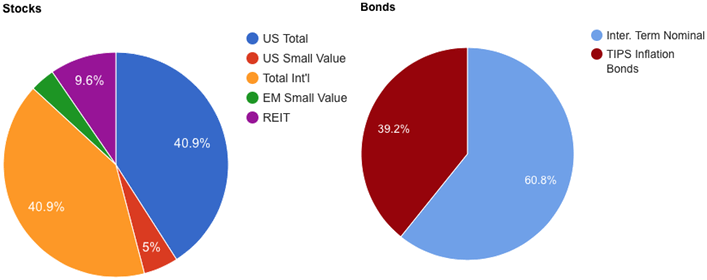
Target Asset Allocation

aa_updated2015

I try to pick asset classes that will provide long-term returns above inflation, distribute income via dividends and interest, and finally offer some historical tendencies to balance each other out. I don’t hold commodities futures or gold as they don’t provide any income and I don’t believe they’ll outpace inflation significantly. In addition, I don’t have enough “faith” in their fundamentals to hold them through an extended period of underperformance (i.e. don’t buy what you don’t can’t stick with).

Our current target ratio is 70% stocks and 30% bonds within our investment strategy of buy, hold, and rebalance. With a self-managed, simple portfolio of low-cost funds, we minimize management fees, commissions, and income taxes.

Actual Asset Allocation and Holdings

1604_portpie

Stock Holdings
Vanguard Total Stock Market Fund (VTI, VTSMX, VTSAX)
Vanguard Total International Stock Market Fund (VXUS, VGTSX, VTIAX)
WisdomTree SmallCap Dividend ETF (DES)
WisdomTree Emerging Markets SmallCap Dividend ETF (DGS)
Vanguard REIT Index Fund (VNQ, VGSIX, VGSLX)

Bond Holdings
Vanguard Limited-Term Tax-Exempt Fund (VMLTX, VMLUX)
Vanguard Intermediate-Term Tax-Exempt Fund (VWITX, VWIUX)
Vanguard High-Yield Tax-Exempt Fund (VWAHX, VWALX)
Vanguard Inflation-Protected Securities Fund (VIPSX, VAIPX)
iShares Barclays TIPS Bond ETF (TIP)
Individual TIPS securities
U.S. Savings Bonds (Series I)

Commentary
Since my last quarterly update, I’ve done the “just keep swimming, just keep swimming” thing and continued dollar-cost-averaging into the same investment mix. Nothing seems like a great deal, but I remain optimistic. I have not made any sell transactions. I still hold WisdomTree SmallCap Dividend ETF (DES) and WisdomTree Emerging Markets SmallCap Dividend ETF (DGS), as I still like the idea of holding a bit extra of those asset classes even though the ETFs available are not all that great.

I’m still somewhat underweight in TIPS mostly due to limited tax-deferred space as I really don’t want to hold them in a taxable account. (I should note that shares of TIP and VIPSX are up roughly 7% YTD, but the forward real yield is now negative). My taxable bonds are split roughly evenly between the three Vanguard muni funds. The average duration across all of them is roughly 4.5 years.

A simple benchmark for my portfolio is 50% Vanguard LifeStrategy Growth Fund (VASGX) and 50% Vanguard LifeStrategy Moderate Growth Fund (VSMGX), one is 60/40 and one is 80/20 so it also works out to 70% stocks and 30% bonds. That benchmark would have a total return of -0.87% for 2015 and +6.61% YTD (as of 7/31/16).

I like tracking my dividend and interest income more than overall market movements. In a separate post, I will update the amount of income that I am deriving from this portfolio along with how that compares to my expenses.

The Power of Default Settings: 401(k) Auto-Enrollment

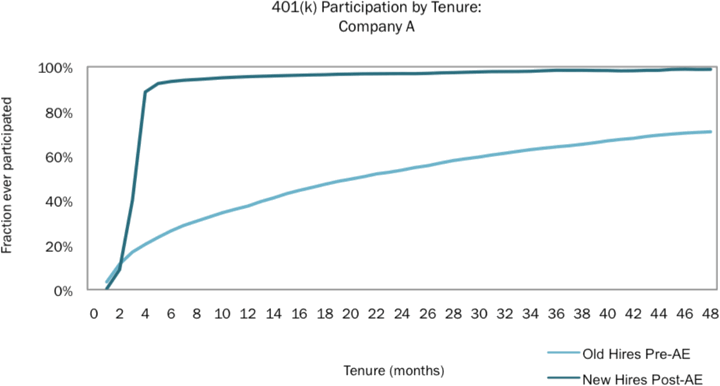
A new ProPublica article by Lena Groeger discusses the power of default settings in our life – from organ donations to computer font settings. Included was an interesting case study of a company who implemented automatic enrollment into the company 401(k) for new employees. Here’s the drastic difference in the 401(k) participation rate (vs. time at company) for the two groups, auto-enrolled (AE) and not:

autoenroll1

Keep in mind, in both cases the employees could have changed their participation status at any time. No change was ever required, only the default initial setting was changed.

The study cited also points out the auto-enrolled default settings could also make some employees save less than they would have otherwise. For example, if the initial deferred percentage is only set at a 2% savings rate however, many people will just stick to that number whereas if they picked on their own it would be higher. People may believe the default setting to be the “expert recommended” or “popular” choice.

The same thing applies for escalation of savings over time. If there is no auto-escalation feature that increases the savings rate as income increases, some people will stay at the initial default savings setting for years or decades.

Suggested Best Practices. By combining their findings, the following best practices are presented as an example.

  1. Auto enroll all current and future employees into the plan.
  2. Set the initial deferral percentage at no less than 6 percent.
  3. Employ an automatic increase of a 1 or 2 percent deferral rate, to a maximum of no less than 15 percent.

Most of have a lot of great goals (eat better, save more, waste less time), but it will always be hard to make the best decisions all the time. We should respect the power of default settings, and use the same concept to help keep us on the right path for the future. For example, at our company retirement plan, we have an auto-escalation feature but we must opt-in manually. If I invest the energy to turn that option on today, we’ll have a better default for future years, knowing we might get lazy in the future.

Ally CashBack Credit Card Review: 2% Cash Back on Gas and Groceries + 10% Relationship Bonus

allycbccIf you have an Ally Bank savings or checking account, you’ve likely been pitched their new Ally CashBack credit card recently. Here are the highlights:

  • $100 bonus when you make $500 in eligible purchases during the first 3 billing cycles.
  • 2% cash back at gas stations and grocery stores
  • 1% cash back on all other purchases
  • No limits on rewards categories.
  • 10% boost on earned rewards when you deposited into an eligible Ally Bank account.
  • No annual fee.
  • Intro 0% APR for 12 billing cycles on balance transfers. (No 0% APR on purchases.) Balance transfer fee is either $10 or 4%, whichever is greater.

As with all the big banks, Ally is working on their cross-marketing. They want you to keep your checking, savings, IRAs, brokerage, and credit cards all at the same place. Ally’s strong in the online banking side (named best online bank by Money Magazine for the fifth year in a row). Credit cards are here, and a brokerage arm is just around the corner (TradeKing). I am personally interested in such convenience, as for years Ally Bank has been my primary checking, savings, and CD accounts.

Including the 10% relationship bonus, this Visa Signature card would get you 2.2% cash back on gas stations and grocery stores and then 1.1% on all other purchases. While this structure is better than the traditional 1% flat credit cards, the competition has heated up in the last few years. Consider:

The best program to compare against is Bank of America. The BankAmericard Cash Rewards Credit Card offers 1% cash back on every purchase, 2% at grocery stores and now at wholesale clubs, and 3% on gas up to the first $2,500 in combined grocery/wholesale club/gas purchases each quarter. Bank of America also offers a 10% bonus on rewards earned when you redeem your cash back into a Bank of America checking or savings account. However, they also have premium relationship tiers that offer up to a 75% bonus on rewards that would work out to 1.75% cash back on every purchase, 3.5% at grocery stores and wholesale clubs, and 5.25% on gas for the first $2,500 in combined grocery/wholesale club/gas purchases each quarter. To me, this made it worth it to build up a “relationship” with them, including opening up a new brokerage account and new credit cards.

Ally touts this new card as “simple”, but what would have really been simple is a flat 2% cash back card on everything and then a small relationship bonus on top of that. That way, when taken together with an Ally Bank account, the card would have been the best in many respects. Combined with their high-interest deposit accounts, you’d have a combo that could shake up the industry. The weakest point of my Bank of America combo is their piddly 0.05% APY on savings accounts and sad CD rates, whereas one of the strongest points of Ally is the 1.00% APY of their savings account and highly-competitive CD rates.

Bottom line. The rewards are above-average overall, and might be worth a look for Ally-centric customers. However, there are top cards in the marketplace that offer close to a flat 2% on everything, and better gas and grocery-specific cards as well. I personally prefer to pick things à la carte unless the sum is greater than the parts, as is the current situation with Bank of America.

Infographic: 401(k) Plan Participation Stats

As we pass the halfway mark of this year, it was time for my quarterly check-in on my 401(k) account. The best-case scenario for a 401(k) plan is:

  • Company match. A little extra help from your employer is always nice.
  • Good default settings. The set-up process should be easy and completely painless. Ideally, you should be automatically opted-in for a some level of savings into a a diversified, low-cost option.
  • Low-cost investment choices. The less you pay, the more you keep.
  • Low account fees. Ditto.

For more and more Americans, the 401(k) is their primary vehicle for retirement. Here’s a good visualization from Bloomberg about the year-by-year decline of pensions (defined-benefit) and the rise of 401/403b/similar (defined-benefit) plans.

401k_bw2

Here’s another infographic from Bloomberg comparing income level, the availability of a 401(k) or similar plan, and the actual participation rate in such a plans.

401k_bw

The higher the income, the more likely you have access to a 401(k) or similar plan. In the highest-paid quartile, 96% of people with the option do participate. Not too surprising. The most interesting takeaway was that even in the lowest income quartile, if you offer a 401(k) plan, the majority of people will participate! The sad part is that only 35% of the lowest income quartile are even given the option.

Improving all the factors I listed first above (company match, lower fees) is still a good thing and is often talked about. However, it would seem like the best thing would be to widen the availability of such an option to everyone. This was probably the thinking behind the creation of myRA, but behaviorally there are still too many obstacles to signing up for the program. It still requires work and opt-in with no immediate benefit. There’s a reason why there are always sign-up bonuses for bank accounts – filling out applications is tedious.

If every time I was harassed to switch to paperless statements with “just one click”, someone was instead harassed into setting up a retirement plan with auto-contributions with “just one click”, there would be a lot more savings.

WiseBanyan Review: Free Portfolio Management Experiences & Screenshots

wb_newlogo

Updated May 2016. WiseBanyan has made some changes to their product. The highlights:

  • New logo, mobile-responsive site design, and smartphone apps.
  • Tax-loss harvesting now available as paid feature. WiseHarvesting is their first premium add-on feature, running 0.25% of assets annually with a $20/month cap.
  • Now accepting IRA, Roth IRA, and 401(k) rollovers.
  • Free financial planning software called Milestones. More thoughts below.

WiseBanyan is an online portfolio advisory service similar to better-known competitors like Betterment and Wealthfront. Differentiating feature: WiseBanyan charges no advisory fees, no trading commissions, and no minimum opening deposit. They will design, buy, hold, and rebalance a basket of low-cost ETFs for free, and all you are left with are the ETF expense ratios which you’d have to pay anyway if you DIY’ed.

Thanks in part to your interest as readers, I was able to get off their waitlist and open an account with $10,000 of my own money back in March 2014. As of May 2016, there is currently no longer a waitlist. Here is my review as an actual user for roughly a year; I have since liquidated my holdings in all robo-advisor platforms.

Application process. The account opening process was similar to other discount brokers and online portfolio managers. You must provide your personal information including Social Security number, net worth, income, investing experience, etc. No credit check. They do check identity, so they may ask for supporting documents if you just moved or something.

There is then a risk questionnaire. The questions can seem mundane but take it seriously, as the 10 answers you provide will directly determine the portfolio asset allocation that they choose for you. There will be no follow-up surveys, e-mails, or phone calls. Here is a screenshot and example question (old interface):

wisebanyan1

Funding. You can fund your deposit electronically, using your bank routing and account number. (They only accept bank wires as an alternative, no paper checks.) The money gets sucked from your bank and the portfolio is bought immediately when they get the money.

Fractional shares. WiseBanyan uses FolioFN as their broker-dealer (separate company that hold your assets in the background) which means they can use their ability to keep track of fractional shares. Most discount brokers and other online portfolio managers require you to own whole shares, so you’ll often have something like $57 sitting in cash.

Recall that WiseBanyan has no required minimum deposit or portfolio balance. If you really did open account with $100, they will actually buy less than one share of several low-cost diversified ETFs and you’ll own tiny, tiny portions of thousands of companies with no idle cash. With a normal discount brokerage, that might not even buy you one share of anything (VTI is over $100 a share on its own).

Portfolio asset allocation. I was assigned a portfolio risk score of 7.7, which corresponded to a stocks/bond ratio of 70%/30%. Screenshot from the old interface:

wisebanyan4

Here is the target asset allocation that I was assigned:

wisebanyan2

My portfolio was constructed using the following seven ETFs:

  • Vanguard Total Stock Market ETF (VTI)
  • Vanguard FTSE Developed Markets ETF (VEA)
  • Vanguard FTSE Emerging Markets ETF (VWO)
  • iShares iBoxx $ Investment Grade Corporate Bond ETF (LQD)
  • Vanguard Intermediate-Term Government Bond ETF (VGIT)
  • Vanguard REIT ETF (VNQ)
  • iShares TIPS Bond ETF (TIP)

My general opinion is that the ETF allocations from all “robo-advisors” are at least 80% the same, and with the remaining 20% you can’t really tell who’s going to win performance-wise anyway. They are all backtested using some form of Mean-Variance Optimization (MVO) and Modern Portfolio Theory (MPT).

While not exactly what I would have chosen for myself, I personally think the portfolios they create are fine. The ETFs have low costs and come from large, respected providers in Vanguard and iShares. All of the major asset classes are covered. There are no commodities futures or natural resource ETFs, which some experts think are useful and other experts think are useless. Note that REITs are considered to be in the bond category.

Website user interface and smartphone apps. The interface has been updated to essentially look like everyone else. It is simple, clean, and mobile-responsive. I like it. There are also companion iOS and Android apps. User reviews for both apps are overall positive. Screenshot from new interface:

wb_newui

Statements and ongoing communication. Electronic statements are free, but paper statements will cost $5 each and paper trade confirmations $2 each.

New Milestones feature. WiseBanyan has a new service called Milestones which helps you direct your investments into specific goals like retirement, emergency funds, college, or vacations. Works in desktop and mobile. You can give a target number and timeframe, and it will recommend a portfolio and a monthly savings amount that theoretically should reach your goal. It will initiate recurring deposits so that things are automated. While I think such basic guidance can be helpful to get you a ballpark figure, I would also be careful on relying too closely on the forecasts as nobody really knows what the stock or bond market will return in the short-term. Screenshot from new interface:

wb_newui2

Free is nice, but how will they make money? Future concerns? According to various sources, the demographics of the average WiseBanyan client is both younger and of more modest means (opening balances under $10,000) than their competitors. They plan on offsetting the costs of maintaining free accounts with their premium add-on features, but will it work? Will enough people pay up for tax-loss harvesting? It remains to be seen if the “Freemium” model can work in this environment.

Bottom line. WiseBanyan is fully functional and delivers on its promise of free automated portfolio management. I joined them in early 2014 when they were still working out some minor kinks, but two years later they are offering a much more polished product. I would even say that their aggressive pricing has helped “nudge” many of their competitors to lower their starting minimums as well.

The main thing that would worry me is that their path to sustainable profitability is not clear. If WiseBanyan is eventually taken over in the event of a merger or takeover, a new owner may charger much higher fees. If you leave for another robo-advisor, there may also be tax consequences. On the positive side, WiseBanyan is not affiliated with any ETF sponsor and can thus invest in the “best-in-class” ETFs without conflict of interest. In the current group of robo-advisors, I would classify them as plucky underdogs.

I wouldn’t let a small sign-up incentive convince you to choose one robo-advisor over another, but new users can get a $20 bonus if they open an account with my referral link. Thanks if you use it.

If The Best Investors Do Nothing, Are the Next Best on Target Fund Auto-Pilot?

tdfautoThis is becoming a recurring theme around here, but I came across an interesting tidbit in this ProPublica article on how your brain plays tricks on you. Emphasis mine:

Fidelity did a study of all their accounts to see what types of investors performed the best. They found that the best investors were the people who had either forgotten they had an account in the first place — or were dead! In other words, most investors succeed in doing the exact opposite of what they set out to do with their money (presumably, make more of it).

In other words, the best investment performance came from doing nothing. That means no buying what looks obviously good, no selling what looks obviously bad, no “taking profits”, no “taking money off the table”.

If doing nothing is best, then you should probably invest in something that encourages inactivity. That’s exactly what a Target Date Fund (TDF) does, manage your asset allocation in an emotionless manner as you age. Auto-pilot.

This Morningstar article appears to confirm this idea: Target-Date Funds: Good Behavior Leads to Better Results. Emphasis mine:

Investor returns, a dollar-weighted return that takes into account cash inflows and outflows to estimate the returns that investors actually experience, gives clues to how target-date investors have fared according to these concerns. The news is good. Whereas most other broad categories show the effects of poor timing–investors tend to buy high and sell low–target-date investors largely avoid that fate.

Investors of target-date funds tend to invest part of every paycheck into employer plans like 401(k)s, and are either (1) lazy and put there by default, which suggests future laziness, or (2) actively chose to be invested in an auto-pilot fund, which suggests they accept that inactivity on their part is a good idea. (I should admit that I did neither and use the self-directed brokerage option… but only to buy TIPS. Honest!)

There is nothing wrong with focusing on your savings rate and using the auto-pilot!

Optimize Your Bank Account Setup: Megabanks, Credit Unions, Online Banks, and Prepaid Cards

crjan2016cover

Consumer Reports is getting more into financial products, with their January 2016 issue cover article on Choosing The Best Bank For You, most of which was also made available to the public without a subscription. If you haven’t optimized your bank account setup recently and you missed it the first time around, the article is worth a read. Perhaps it was just anecdotal, but I read somewhere that most people are still with their first bank account out of high school.

Here are their high-level conclusions:

  • Mega Banks: Best for Convenience, Technology, Security
  • Credit Unions: Best for In-Person Customer Service, Lower Costs
  • Primarily Online Banks: Best for Online Customer Service, Higher Savings Rates, Lower Costs
  • Smaller Regional and Community Banks: Best for Personal Service
  • Prepaid Cards: Easier to get than a bank checking account but some are loaded with gotchas.

It appears that Consumer Reports is still keeping their specific rankings and numbers behind a subscription paywall. But they do agree with me about the idea of spreading your wealth and choosing your financial accounts a la carte to get the best deals.

Now, I am not the ideal person to emulate as I have too much complexity in my financial accounts. The only good news is that I have tried so many of them. Here are the accounts that I currently have open, and what I think about them. For the most part, my experiences align with the Consumer Reports findings.

Megabank: Bank of America

  • Pros: ATMs and branches everywhere nearby. Good online and app user interface (Touch ID). Good perks when combined with brokerage and credit cards.
  • Cons: Basically-zero interest rates.

Credit Union: Local, Community CU

  • Pros: Free notary, low interest rate HELOC.
  • Cons: Small ATM and branch footprint, poor online and app user interface, current low interest rates (used to have a rewards checking account).

Primarily Online Bank: Ally Bank (see Ally review)

  • Pros: High interest rates, fast and flexible interbank transfers, good customer service, good online and app user interface (Touch ID).
  • Cons: No physical branches.

Prepaid Card: NetSpend (see NetSpend review)

  • Pros: 5% APY on $5,000 balance if card kept active. (Update: 5% APY on $1,000 starting 7/1/16.)
  • Cons: Certain fees and fine print to work around.

In terms of the convenience factor, my new favorite feature is Touch ID with Apple iPhones. (Android has their own version, I’m just not familiar with it.) BofA, Ally Bank, Mint, Fidelity, and Robinhood supporting this app feature, I can now get full access to transaction history and even initiate online transfers in under 10 seconds. I hope Vanguard adds this soon (cough, cough!).

Early Retirement Portfolio Income Update, April 2016

dividendmono225I like the idea of living off dividend and interest income. Who doesn’t? The problem is that you can’t just buy stocks with the absolute highest dividend yields and junk bonds with the highest interest rates without giving up something in return. There are many bad investments lurking out there for desperate retirees looking only at income. My goal is to generate reliable portfolio income by not reaching too far for yield.

A quick and dirty way to see how much income (dividends and interest) your portfolio is generating is to take the “TTM Yield” or “12 Mo. Yield” from Morningstar quote pages. Trailing 12 Month Yield is the sum of a fund’s total trailing 12-month interest and dividend payments divided by the last month’s ending share price (NAV) plus any capital gains distributed over the same period. SEC yield is another alternative, but I like TTM because it is based on actual distributions (SEC vs. TTM yield article).

Below is a close approximation of my most recent portfolio update. I have changed my asset allocation slightly to 60% stocks and 40% bonds because I believe that will be my permanent allocation upon early retirement.

Asset Class / Fund % of Portfolio Trailing 12-Month Yield (Taken 4/14/16) Yield Contribution
US Total Stock
Vanguard Total Stock Market Fund (VTI, VTSAX)
24% 1.94% 0.46%
US Small Value
WisdomTree SmallCap Dividend ETF (DES)
3% 2.80% 0.09%
International Total Stock
Vanguard Total International Stock Market Fund (VXUS, VTIAX)
24% 2.82% 0.66%
Emerging Markets Small Value
WisdomTree Emerging Markets SmallCap Dividend ETF (DGS)
3% 3.03% 0.10%
US Real Estate
Vanguard REIT Index Fund (VNQ, VGSLX)
6% 4.21% 0.24%
Intermediate-Term High Quality Bonds
Vanguard Intermediate-Term Tax-Exempt Fund (VWIUX)
20% 2.90% 0.60%
Inflation-Linked Treasury Bonds
Vanguard Inflation-Protected Securities Fund (VAIPX)
20% 0.82% 0.26%
Totals 100% 2.31%


The total weighted 12-month yield was 2.31%. This means that if I had a $1,000,000 portfolio balance today, it would have generated $23,100 in interest and dividends over the last 12 months. Now, that is significantly lower than the 4% withdrawal rate often quoted for 65-year-old retirees with 30-year spending horizons, and is even lower than the 3% withdrawal rate that I have previously used as a rough benchmark. I’ll note that the muni bond interest in my portfolio is exempt from federal income taxes.

Given the volatility of stock returns, the associated sequence of returns risk, and current high valuations, I still like the income yield measuring stick. I feel that the income yield number does a rough job of compensating for market valuations (valuations go up probably means dividend yield go down) as well as interest rates (low interest rates now, probably low bond returns in future). With 60% stocks, I am hoping that the overall income will keep up with inflation and that I will never have to “touch the principal”. Over the last 15 years or so, the annual growth rate of the S&P 500 dividend averaged about 5%.

As noted previously, a simple benchmark for this portfolio is Vanguard LifeStrategy Moderate Growth Fund (VSMGX) which is an all-in-one fund that is also 60% stocks and 40% bonds. That fund has a trailing 12-month yield of 2.12%. Taken 4/14/2016.

So how am I doing? Staying invested throughout the last 10 years has been good to me. Using the 2.31% income yield, the combination of ongoing savings and recent market gains have us at 88% of the way to matching our annual household spending target. Consider that if all your portfolio did was keep up with inflation each year (0% real returns), you could still spend 2% a year for 50 years. From that perspective, a 2% spending rate seems like a conservative number, even with the many current predictions of modest future returns.

Early Retirement Portfolio Asset Allocation Update, April 2016

portpiegenericIt has been a while, so here is a 2016 First Quarter update on my investment portfolio holdings. This includes tax-deferred accounts like 401ks, IRAs, and taxable brokerage holdings, but excludes things like our primary home and cash reserves (emergency fund). The purpose of this portfolio is to create enough income to cover household expenses.

Target Asset Allocation

aa_updated2015

I try to pick asset classes that will provide long-term returns above inflation, distribute income via dividends and interest, and finally offer some historical tendencies to balance each other out. I don’t hold commodities futures or gold as they don’t provide any income and I don’t believe they’ll outpace inflation significantly. In addition, I have doubt that I would hold them through an extended period of underperformance (i.e. don’t buy what you don’t can’t stick with).

Our current target ratio is 70% stocks and 30% bonds within our investment strategy of buy, hold, and rebalance. With a self-directed portfolio of low-cost funds and low turnover, we minimize management fees, commissions, and tax drag.

Actual Asset Allocation and Holdings

1604_portpie

Stock Holdings
Vanguard Total Stock Market Fund (VTI, VTSMX, VTSAX)
Vanguard Total International Stock Market Fund (VXUS, VGTSX, VTIAX)
WisdomTree SmallCap Dividend ETF (DES)
WisdomTree Emerging Markets SmallCap Dividend ETF (DGS)
Vanguard REIT Index Fund (VNQ, VGSIX, VGSLX)

Bond Holdings
Vanguard Limited-Term Tax-Exempt Fund (VMLTX, VMLUX)
Vanguard Intermediate-Term Tax-Exempt Fund (VWITX, VWIUX)
Vanguard High-Yield Tax-Exempt Fund (VWAHX, VWALX)
Vanguard Inflation-Protected Securities Fund (VIPSX, VAIPX)
iShares Barclays TIPS Bond ETF (TIP)
Individual TIPS securities
U.S. Savings Bonds (Series I)

Commentary
In terms of the big picture, very little has changed. I did not accomplish my plan of relocating my holdings of WisdomTree SmallCap Dividend ETF (DES) and WisdomTree Emerging Markets SmallCap Dividend ETF (DGS) into tax-deferred accounts. I pretty much left them where they have been, inside a taxable brokerage account. I am currently leaning towards simply selling them completely and making my overall portfolio more simple. I would just have Total US, Total International, and US REITs for stocks. I would technically still hold a “small value tilt” on my holding in my kid’s 529 college saving plan asset allocation.

As for bonds, I’m still somewhat underweight in TIPS mostly due to lack of tax-deferred space as I really don’t want to hold them in a taxable account. (I noticed that shares of TIP are actually up 4% this year, less than 4 months in). My taxable bonds are split roughly evenly between the three Vanguard muni funds. The average duration across all of them is roughly 4-5 years.

A simple benchmark for my portfolio is 50% Vanguard LifeStrategy Growth Fund (VASGX) and 50% Vanguard LifeStrategy Moderate Growth Fund (VSMGX), one is 60/40 and one is 80/20 so it also works out to 70% stocks and 30% bonds. That benchmark would have a total return of -0.87% for 2015 and +1.42% YTD (as of 3/31/16).

I like tracking my dividend and interest income more than overall market movements. In a separate post, I will update the amount of income that I am deriving from this portfolio along with how that compares to my expenses.