Search Results for: High Interest Savings

Application Tips and Getting Cash From 0% Balance Transfers

[This is Part 3 of an ongoing series about how to make money from 0% APR balance transfers.]

Before I start, someone said that it’s too easy with Citibank, and can I do an example with another issuer. Sure. Let’s run through it with the Discover More Card this time.

First, you do all the scouting and find the following:

Annual Fee: NONE

Balance Transfers APR: 0% until the last day of the billing period ending during May 2009*, then the standard APR for purchases

Annual Percentage Rate (“APR”) for Purchases: 0.0% until the last day of the billing period ending during November 2008;* then the standard APR, a rate between 10.99% and 18.99%**

BALANCE TRANSFER FEE: 3.0% for each balance transfer made under this offer, with a minimum of $10 and a maximum of $75.

Ok, no annual fee, 0% APR until May 2009 (as of this most recent update, perhaps even longer than 12 months) on balance transfers (note the specific wording though, also the exact date may be different depending on how long ago I updated this post). The balance transfer fee is 3% capped at $75.

This means if you transfer $7,500, then $75 is only 1% of that balance. Transfer $15,000, and that’s only a 0.50% fee, and so on. You can still make this up and create profit.

Application Process
Credit card applications are pretty much the same all around, but there are some things to note.

Housing Information
They always seem to ask if you rent or own, your housing payment, and how long you’ve stay at your address. Part of this is probably identity verification, and part of it is screening on their end. So I wouldn’t lie here because you think owning is better. Any mortgage should show on your credit report anyways. I both rent and move a lot, and I haven’t had any problems getting cards.

Employment Information
Same deal, tell the truth. I’m not sure about all companies, but often if you are a full-time student, credit card companies will be more lax with you and still give you a card even with low income.

Household Financial Information
This is important. And vague: Household Annual Income. This number is important. For one, most low-interest cards like this that target people with good credit have a minimum income requirement. It may not be that high but it’s there.

Second of all, it helps determine your credit limit. For the purposes of this activity, you want the highest credit limit you can get. In a way, I think it’s intentionally vague so they can offer you more credit (and earn more potential interest). So you want to say your household annual income is as big as possible. Include everything – your parents income, your roommate’s income, interest income, dividend income, money from grandma. If you can get into that next bracket, all the better.

In this case, Discover is upfront about it:

Except for full-time students, you must have a minimum annual household income of $15,000 to be considered for any Discover Card account. For highest credit line, please include all sources of annual household income.

There are two screens and 7 steps where you enter your information. Click on ‘Submit Application’ (don’t worry, it’s not the last page), and the next screen will ask you for balance transfer information.

Getting Your Money

As part of the application, they will ask you if you want to make a balance transfer, how much you want, and where you want it to go. They want your balances!

How much you want?
When requesting a balance transfer amount, I recommend for reaching for the sky. Ask for double or triple what your current limits are, or even higher. They won’t reject you for asking for too much, in the end they get to decide what kind of credit limit you can get. For example, if you just ask for $5,000, maybe they’ll just give you $5,000 or $7,000. But if you ask for $10,000, they may just give it to you as that means more guaranteed business for them.

When I applied for the Discover Miles Card, I asked for a $15,000 in balance transfers and got an $11,000 limit. I only had one Discover card a few years before this one, so I was pretty happy.

While you may want to ask for the balance transfer with the application to haggle a higher credit limit, other times you may want to put it off. This is so you can transfer some of the credit limits on your other cards within the same issuer in order to get a much higher limit. For example, if you got a $10,000 limit on your new AT&T/Citibank card and already had $10,000 on another Citi card, you could make it so that you had $19,000 on the new card and leave $1,000 on the old card.

Getting the Money Directly
Some card issuers may allow you to issue yourself a check for the balance transfer amount, or even deposit it electronically into your bank account with bank account and routing number. The latter is preferred since you’ll be losing potential interest while the check is in the mail and waits to clear. Two banks I have gotten direct checks are AT&T/Citibank and Chase, but this may vary. This is by far the easiest way to get your money.

Citibank is the easiest to get a check from. Click here for a step-by-step guide on how to request a balance transfer check online after you get the card.

Indirectly
If they don’t, then you’ll have to do it indirectly. This will require another credit card, and it doesn’t even have to have a balance. Let’s say you request a $10,000 transfer from Card A to Card B. Once approved, it will show up on Card B as a $10,000 payment, and you will now have a negative (credit) balance on card B. If you make a lot of purchases you could just use it up that way, but most people will have to ask for a credit balance refund in the form of a check.

It matters what card issuer you use for Card B. AT&T/Citibank is the easiest to transfer TO as well, in the fact that you can request it online directly and without even human interaction. Here is a screenshot of the menu option you should look for:
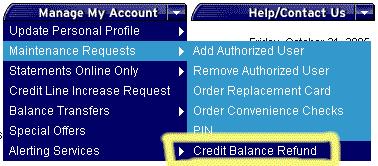
AT&T Citibank Screenshot

I’ve gotten negative balances even greater than my credit limit with Citi (ex. credit limit $5,000 and then goes to -$10,000 with a received transfer), with zero problems.

I have also done this with American Express by calling in. Sometimes they will make you wait for a few days to make sure the payment clears before issuing the check. Now, if you send a big fat payment to a card that you never use, they might become suspicious. I have sent it to my American Express Starwood card which I already use regularly as a rewards card, and they’ve never given me a hard time.

Do not send it to MBNA, they may reject the transfer. I have also reported some success with Discover in the past, but I am not so sure about Chase, Advanta, and others. If you do try one of these, it’s better to use a card that already has a balance on it to fly “under the radar”. Honestly, I almost always just use AT&T/Citibank, switching to a different Citi card sometimes if I do more than one a month. Last time I used American Express was mainly an experiment to make sure they still did it.

With my Discover Miles card, I sent $7,000 to Citibank and $7,000 American Express. American Express sent me a check for the overpayment after verifying the balance transfer with Discover, which ended up making their check arrive about 4 days later than Citibank’s.

Either directly or indirectly, you should have money now in the form of a check or online transfer.

Where do you put the money?
If you already have higher-interest loans, like a home equity line of credit or other credit card debt, you could just move it there.

Otherwise, I recommend putting the money into an FDIC-insured or similarly safe checking or savings account that is relatively liquid. Here are some online savings account options, and this is my current setup to maximize interest. One reason why is that you must still make the minimum payments on the card, with are usually about 2% of the principal. So on $10,000 that would about $200 a month, decreasing each subsequent month as you pay it down. The second reason is more practical – if somehow you make a late payment, you can minimize the damage by simply paying the entire balance off immediately. Even at 20% APR, if you can pay it off in a few days the damage won’t be devastating.

Of course, some people may place it into bonds, dividend-yielding stocks, or other investments. To each their own, but I would not take that kind of risk for short-term loaned money.

Next up: Setup and management of the balance transfer. How do you manage the payments and due dates?


Skip To Another Part
I. Introduction and Warnings About 0% Balance Transfer Offers
II. Scouting For 0% Balance Transfer Offers
III. Application Tips and Getting Cash From 0% Balance Transfers
IV. Setup And Management of 0% APR Balance Transfers
V. Best Pre-Screened No Fee 0% APR Balance Transfer Offers

Introduction and Warnings About 0% Balance Transfer Offers

[This is Part 1 of an ongoing series. I am going to break it up into several smaller segments due to time constraints, and keep track of them in this index of posts.]

Most likely you have seen these offers shower your mailboxes, credit card companies enticing you to use their cards with incredibly low interest rates, many even as low as 0% APR. Borrow money for free? Too good to be true. Must be a catch. Well, yes and no. It’s like cooking outdoors over an open flame. If you understand the hazards take the proper precautions, you won’t get burnt and you can get some tasty results.

What tasty result? Simply put – Free Money. You can make major bucks off of other people’s money. So that’s what this series of posts is going to be about. Sure, you can get $100 for a quickie signup bonus, and I do that too. But with this strategy, you can make hundreds if not over a thousand dollars with just one card. I am personally going to make over a thousand dollars this year.

What? Huh? Give me the Big Picture.
There are plenty of reasons for borrowing money for free. The most obvious is to pay down debts with high interest rates – car loans, home-equity loans, even other credit cards. In each case, you would be saving the interest you would be otherwise paying on those loans. That saved interest is money in your pocket.

But what if you don’t have any debt? Well, these days even big banks like Washington Mutual are paying you 5% a year or more on your idle cash. If you were to get your hands on a $10,000 free loan for a year, that’d be roughly $500 at the end. You borrow $10k, keep the $500 interest, and then repay the $10,000 back. Nothing to buy, nothing to sell, just shuffling money around between the credit card company and a bank. You don’t even need to use any of your own money.

I currently have almost $30,000 of borrowed money sitting in the bank right now. I don’t know about you, but making more than an extra grand a year for paying some bills sounds good to me!

What’s the Catch?
Borrowing money from credit card companies is not for everyone. As I’ve been told many many times, credit card companies aren’t stupid. They aren’t highly profitable corporations because of their love of philanthropy. They are enticing you with easy credit for the sole reason that if you don’t pay off your balance in time, they will start charging interest. And lots of it.

Therefore, there are mainly three types of people I’d recommend staying away from credit card companies:

#1 – You Have Poor Credit and/or Carry Balances Regularly – First of all, if you have poor credit, you probably can’t get a really low interest rate anyways. Second, you probably have shown that you can’t handle credit responsibly and very likely may just pile on additional debt by doing these activities.

Then there are people with great credit, but carry balances. Here’s a straightforward rule: If you don’t pay off all your statement in full every month and regularly pay credit card interest, this may not be for you. Check out my Frugal Living section and pay off that debt first. Now, you may consider a 0% balance transfer to lower your interest rate on that debt – that’s probably okay. But I wouldn’t recommend getting any more than that; You might just accumulating more debt.

#2 – You Need A Top Credit Score Soon – These there are some things that require a decent credit score, and some things you want a tip-top credit score for. The best example of this is if you are shopping for a mortgage. Having some balance transfers will not necessarily hurt your credit significantly, but in order to get the best loan rate you’ll want to keep your credit score as high as possible. I am going to probably shop for a mortgage in about a year, so I plan on paying off all my balances a couple months before then. That will give my credit score time to bounce back and peak.

#3 – You Forget To Pay Bills. Here’s another easy rule: If you’ve paid more than one bill late within the last year, this may not be right for you. Credit card companies love when you pay late. They get to charge you late fees and jack up that nice 0% rate to 20%+ instead. You can probably get one late payment forgiven once in a while, but I wouldn’t push it. Now, there are lots of tools to remind you about payments and such which I will cover later, but some people just don’t keep up with their bills all that well. And some people are pretty militant about it, like me.

Going back to my fire analogy, if you’re a pyromaniac or really clumsy, maybe cooking over an open flame isn’t the best idea. Stick with Outback Steakhouse 🙂

Now, I do not claim to be the inventor of this activity, in fact my own mother used low-interest credit cards to help finance my education before I even knew what a credit card was. I will try my best to present helpful and accurate information possible based on my own experiences and research, but I am not perfect.

For those ready to break out the charcoal, the next step is Scouting For 0% Balance Transfer Offers, including how to read the fine print to find a truly good offer. Read on!


Skip To Another Part
I. Introduction and Warnings About 0% Balance Transfer Offers
II. Scouting For 0% Balance Transfer Offers
III. Application Tips and Getting Cash From 0% Balance Transfers
IV. Setup And Management of 0% APR Balance Transfers
V. Best Pre-Screened No Fee 0% APR Balance Transfer Offers

Finding A Good HSA Administrator

Health Savings Accounts (HSAs) can be a great way for people to save money on health insurance, especially if you are young and healthy. I looked at compatible high-deductible plans last year but missed some deadlines, and need to start again. I found quotes online as low as $80 a month at eHealthInsurance, whereas I currently pay about $200 a month as part of my wife’s plan. I could even stay with the same company (BlueCross/BlueShield), just with different deductibles.

Now, HSAs are great mainly due to the fact that earnings grow tax-free, and when used for healthcare expenses withdrawals are tax-free too. (I list additional HSA pros and cons here). I think of it as a Health Roth IRA. Accordingly, the ideal way to take advantage of this is to max out the HSA (up to your deductible) when you are young, and not use it. You want to pay out-of-pocket now, and leave the HSA money in some mutual funds to compound away until retirement (when you’ll really need it).
[Read more…]

Other Places To Stash Your Cash

piggy bankBeing my money blog and all, I inherently have a biased focus on the best places to keep own my money based on my own personal tax situation, time horizons, and existing accounts. So far I’ve mostly talked about the banks in my online savings accounts comparison, savings bonds, and Treasury bills. However, I do feel like I should point out that there are definitely some alternative options to safely ‘stash your cash’ that also offer good if not better interest rates depending on your own preferences. They include other online banks, bank CDs, brokerage taxable and tax-exempt money market funds:
[Read more…]

NY Times Article on Online Banks

Thanks to David for sending me this New York Times article about online savings accounts. I really think this market is maturing, especially since Citibank is entering the fold. Here’s an interesting quote:

Unlike credit card users, who freely hop from one product to the next to get a better rate, savings account holders tend to be more loyal, Mr. Newman said. Thus, he said, HSBC Direct does not feel compelled to offer the very highest yield.

This inertia explains HSBC’s drop back to 4.5% and ING’s recent lagging rates. But with no minimums, I’ll be working hard to keep them honest.

Predicting the New I-Bond Rates: Yawn.

Just like last October, using the information in my How To Predict I-Bond Savings Bond Rates post, we can now try to predict the upcoming I-Bond rate announcement on May 1st. For more information on savings bonds, check out my Savings Bond category, starting with my intro to I and EE bonds. Let’s just jump into it:

The CPI-U in September 2005 was 198.8.
The CPI-U in March 2006 was 199.8.
[Read more…]

Citibank’s Capital One 360 Clone – 4.50% APY

This is interesting – Citibank finally fully rolled out its e-Savings Account, which has no minimum balance requirement and currently pays 4.50% APY. Why not just call it CitiDirect? It’s not the highest rate for a no-minimums online saving account, but it’s still really good for a bank with such a wide physical branch network.

What’s the catch? “To open a Citibank e-Savings Account you must have or open a checking account in the Citibank EZ Checking, Citibank Account, Citibank Everything Counts Account or CitiGold Account relationship package.” The EZ Checking looks like the easiest option:
[Read more…]

Build Emergency Fund or Pay Down Credit Cards?

Here’s a tough question I got via e-mail, paraphrased:

“I finally got a stable job. I have $9,000 in credit card debt, half at 12.99% and half at 8.99% APR. I have no emergency funds at all, that is why I have so much debt. Should I pay down the credit cards or should I build a backup money fund? Do you think I should apply for more credit cards to lower the APR?”

This was in response to my Emergency Fund options post. As I am not the best person to ask about getting out of credit card debt, I’m throwing this out there for feedback. Here’s what I have off the top of my head:
[Read more…]

Beware! Some Banks Lie About No Minimum Balances

A great thing about online savings accounts with no minimum balances is that theoretically you can just move all your money to the one currently paying the highest interest! (If it’s worth it.) But, from e-mails I have gotten and other reports on the web, you might want to leave some more spare change in those accounts. Specifically, Capital One 360 and Emigrant Direct have closed people’s accounts without warning for having balances of less than $1. On top of that, Emigrant doesn’t pay interest if your account is closed before the end of the month!

But they have no minimum balance you say. Yes, but in their fine prints they can also close your accounts at any time, for any reason. So I’d advise keeping $5+ in your accounts to avoid account closure and lost interest. This way, if the rate leaders change, your options stay open.

Rate Chasers – Should You Move Your Money?

With the proliferation of new high-yield savings accounts and them leapfrogging each other’s rates, we come to the all-important question – Should I move my money to the higher rate? Well, with the data from my transfer-time experiment, I can better gauge the answer.

First, let’s find the formula for figuring out how long you must keep the money at the new higher rate account to counteract any interest lost during the transfer. I’m not the inventor of this simple formula, I just derived it right now with good ole’ pencil and paper.
[Read more…]

Online Bank Comparison: Capital One 360, VirtualBank, Emigrant Direct, and HSBC Direct

Update: This post is no longer updated. Please see my new online bank comparison, which includes current high-yield savings accounts from a variety of FDIC-insured banks.

I have redone my old Online Bank Comparison to drop Presidential Premier Savings and add HSBC Direct instead. This way, all four accounts compared have no minimum balance requirements, no monthly fees, and no other strings attached. That way, one can always move money away without issues. There may be other banks with higher rates, but also higher balance requirements to get those rates. The best value for each feature is bolded:

[Read more…]

When Is It Worth It To Move Your Money?

Another good question spurned by fellow rate-chasers’ comments. We now have a lot of competition in the high yield savings account arena. So, a good question asked is “When it worth it to move your money”? This is because there may be a gap in between money transfers from Bank A to Bank B where your money will not be earning any interest, which could negate much of the benefits of moving. (Another good question is which bank or entity is earning money off the float.) Things to consider:

1) When does Bank A stop paying interest?
2) How long does it take to for the transfer?
3) When does Bank B start paying interest on your deposit?
[Read more…]