Search Results for: High Interest Savings

March 2007 Financial Status / Net Worth Update

Net Worth Chart March 2007

About My Credit Card Debt
Newer readers may be alarmed by my high levels of credit card debt. In short, I’m borrowing money for free and keeping it in safe investments while earning me 5-6% interest. Along with other things, this helps me earn extra side income of thousands of dollars a year. Recently I put up a series of step-by-step posts on how I do this. Please check it out first if you have any questions.

Commentary

  • The stock market stalled a bit this month, as should be expected given its healthy run for the last two years.
  • The big drop in cash reserves and credit card debt is due to the ending of one of my 0% balance transfer cards in February (Discover Miles Card). Everything went smoothly and it was paid off without a hitch.
  • Our combined incomes continue to far exceed our spending, which is great. I still need to finish tallying up last month’s budget results.
  • We still haven’t done our taxes, as I am still waiting on some corrected 1099s and trying to organize my business records. I have a feeling we might have to file an extension this year.
  • I know this is poor form, but I have mentioned previously that I keep forgetting to include a $2,000 taxable investment I made in a micro-cap mutual fund (BRSIX) several months ago. If it doesn’t show up in Yodlee, it’s almost like it isn’t there 😉 Anyhow, I’ve finally accounted for it and it’s helped the numbers a bit.
  • We are now at $48,167 in net cash and $57,288 in total non-retirement assets. That’s 57% of our mid-term goal, and 96% of our (much easier) May goals regarding saving up for a house down payment. I remain completely confused about housing prices…

You can see all my previous net worth updates here.
Prosper.com Person-to-Person Lending Review, Part 1: First Looks

Prosper.com is a person-to-person lending service where you can lend out money to complete strangers. My first and only post about Prosper was back on February 13, 2006, when it was first released to the public. Since then, I haven’t written a peep about them. An online service that offers high interest rates for my cash? Why haven’t I written about them? The simplest answer is that I’ve been waiting for more information to review.

Here is a first look at Prosper from a potential lender perspective.

This is not a short-term, safe investment.

You may have seen this ad, it says something to the effect of “Why settle for 5% APY from banks? Get 15%+ interest from Prosper”. Comparing itself to an online savings account is misleading for a couple of reasons:

Your money is not 100% liquid. The loan term is three years. All loans on Prosper are lent for 3 years. In a bank account, I can just walk over and take my money out. You will gradually get your principal back and might have some pre-payments, but your money is pretty much locked up for the short term.

Your money is now unsecured debt, which carries the possibility of loss of principal. Bank accounts are FDIC-insured. Your Prosper loan is not backed up by anything except for the word of the borrower. The only thing keeping them paying is either a sense of personal responsibility, or the threat of a black mark on their credit report. What happens when their credit is already bad? Will they view Prosper as a serious lender on par with credit card companies? What happens if Prosper goes out of business?

There are a variety of ways you can get higher interest for extra risk. Look at some Canadian Oil Trusts like PGH (15% yield), or high-yielding REIT stocks like LUM (13% yield). I don’t recommend these either, but my point is that you should compare apples to apples.

Prosper is an intermediate-term investment opportunity with lots of inherent risk. In addition, not everyone will get the same results. While one person may get 16% annual return, another person with a similar loan portfolio may have low or even negative returns.

What am I basing my decisions on?

Let’s look at the three major pieces of information you get when you are deciding on which loan to fund:

The Story. This is coming from the cynic inside me, but how accurate are these? I do believe most of them to be truthful, perhaps with a little positive glow on things. But how do I know if it’s not? Do I really need to read “I am very dependable and promise to pay you back”? Some group leaders will vouch for borrowers, but in the end, I put very little weight on this area.

Besides, which is better? The business start-up loan? The “fresh start” loan? The credit card consolidation loan? The I-want-a-new-Lexus loan? Here we might also be mixing emotion and business, which is fine if you want, but I’d personally rather not be emotionally invested in my lending.

Credit Profile. This is actually very useful. In addition to the credit grade which essentially gives you a range for their credit score, you can find out some details on the credit report. These include the number of delinquent accounts, how much was delinquent, negative public records, and their current revolving credit balance. More information here.

Employment Data. This includes both whether they are employed or not, how long they’ve been employed, and their income. This gives you their current debt-to-income ratio. Again, this is all self-reported by the borrower. I believe it would be far too costly for Prosper to actually verify this data, but it would be nice.

Of course, Prosper says that it is a crime to lie on a lending application, but my question is how many people have they caught and prosecuted for this crime? My guess is zero. In June 2006, in response to this criticism they started performing spot-checks for the “identity, address and income of a select number of borrowers.” They do not release the frequency or passing rate of these checks. Therefore, I also put relatively little weight on this area. I treat it like a very rough estimate.

In the end, all I am comfortable relying upon is the credit report, just like the credit card companies. I think the card companies are pretty good at what they do, so the only way us individuals are going to make money is to be satisfied with thinner margins than them (lend at cheaper rates), while at the same time trying to achieve close the same level of diversification.

Is this possible? Is it worth the effort needed? Check out Part 2, where I dig into the numbers.

Capital One 360 Checking Account: Feature Review

Capital One 360 is trying to stir things up again by rolling out a new high-yield 360 Checking account. Paradoxically, there will be no checks. Initially available only to “active” users of their 360 savings account ($25 signup promotion), it is not available to everyone. It offers the following features:

  • 1.75% APYif your balances is under $50,000, 3.20% APY for $50-100k, 3.40% APY for $100k+
  • No minimums or monthly fees
  • Free ATM access at 32,000 locations nationwide
  • Free BillPay and Debit Card
  • No checkbooks, but you can send paper checks online.

My initial feature review:

Interest Rates – The rates are above average, but not the best. The fact that it has no minimum balance does make it unique. Otherwise, if you can satisfy some minimum balance or direct deposit requirements you can get a higher rate at various other banks including Everbank. It’s interesting to note that ING has added a tiered system now. I would remember to be careful not to exceed FDIC insurance limits.

No ATM rebates? – It turns out those “32,000 locations nationwide” are the AllPoint Network. These ATMs are often in random restaurants, so you have to go during business hours. I was hoping for something special, like the ATM fee rebates that Everbank and others provide.

Must Mail In Checks – This is my main annoyance with all online checking accounts. You can’t make deposits via ATMs, so you have to snail mail them in. Besides having to pay extra for postage, it only takes one lost check to cause a huge headache.

What Do You Mean, No Checks? – This is supposedly the most innovative thing about this account. They don’t give you checks, and you can’t even buy third-party checks with your account and routing number. You can request paper checks to be sent to specific people online, or you can send them an “electric” check with their account and routing number.

Conclusion
From the features list and what I’ve read about Capital One 360’s customer service history, I think this is a decent product. Much like their savings account, it does not have all the best features, but due to it’s relative simplicity it will work for a lot of people. If you can live with mailing in all your check deposits and live near some AllPoint ATMs, it could probably work as your main checking account. Otherwise, it may just be nice addition to your their savings account due to the lack of fees (if you use it).

Right now, I still think the best options are for people who live in a Citibank or Washington Mutual area to get a checking + 5% APY savings combo with them. You get checks, ATM deposits, high interest, and instant inter-account transfers to maximize your savings balances.

My Money Blog’s Rough Guide To Money

Here is a collection of previous posts I’ve written that I am trying to organize into a more orderly fashion. It’s definitely a work-in-progress, but hopefully it can help you save and invest your money more wisely.

Inspirational

  1. Make a Goal!
  2. Spend 5 Minutes Towards Your Goal Today.
  3. True Cost of Frivolous Spending

Starting Out / Budgeting
Here you are trying to set up your finances, so you can reliable spend less than you earn.

  1. Remember the Big Picture
  2. Where Is Your Money Going?
  3. Free Tools to Manage Your Spending

Deciding On Where To Put It
You now have some money set aside every month. Do you put it towards debt, retirement, emergency fund, or what?

  1. Rankings Of Where To Put Your Money First

Banking
Your first line of financial tools is your checking and savings account. A high-yield savings account is also a good place to put your emergency fund.

  1. Setting up direct deposit, automatic transfers, etc.
  2. Open a savings account for your emergency fund + Earn interest on your existing money

General Investing
Capitalism is an incredible thing, with millions of people working hard everyday to create value. Invest soundly and watch your money grow.

  1. A Better Way To View Stock Market Risk
  2. Specific Mutual Fund Investment Ideas For Beginners
  3. Target Retirement Mutual Funds: T. Rowe Price vs. Vanguard
  4. My Top Recommended Books on Investing
  5. Model Portfolio Samples From Respected Sources
  6. Tax Efficient Mutual Fund Placement For Maximum Return

My Asset Allocation Plan

Section 1: Simplified Theoretical Stuff

  1. Disclaimer and General Philosophy
  2. Consider Simply Buying The Entire Market
  3. Efficient Frontier and Modern Portfolio Theory

Section 2: Choosing An Asset Allocation

  1. Deciding On The Stocks/Bonds Ratio
  2. Deciding On The Domestic/International Ratio
  3. Considering The Diversification Benefits Of Small and Value Stocks
  4. Equity Asset Allocation: Comparison of 8 Model Portfolios
  5. Investing In Real Estate Through REITs?

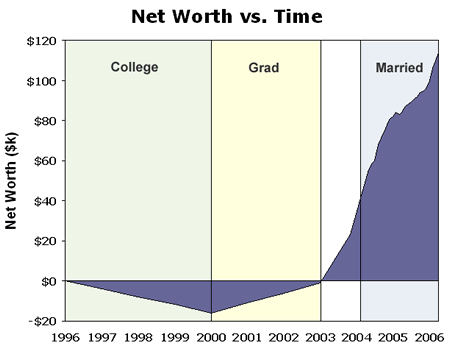
A Decade Of Net Worth History Revealed

Net Worth vs. Time

A voyeuristic blow-by-blow after the jump…
[Read more…]

Is 0% APR On Purchases Better Than Cashback?

Back in my post Why You Shouldn?t Settle For a 1% Cashback Credit Card, commenter TW raised a good question:

Isn?t the best ?return? on credit card use found using a 0% on purchases card and put the money you would use to pay it off in an interest account (5.5% E-Loan account, etc.) instead of trying to use the best rewards bonus card where you?d need to pay off the monthly balance to avoid fees?

On one side, we have the interest earned off of “borrowing” at 0%. On the other side, you have plain cashback rebates. Which is better? This is a question I asked myself a couple of years ago, but due to the low interest rates back then it definitely wasn’t worth it. Now that ELoan Savings is offering 5.5% APY and other banks are close to that, I think I need to run the numbers again.

Calculations For Using 0% APR Purchases Card
First of all, you’ll need to find a new credit card with an introductory rate of 0% APR on purchases. To get an average picture, let’s say you spend an even $1,000 every month on it, or $12,000 annually (although this example would work for any dollar amount). Instead of paying the balance in full at the end of the month, you put it into an interest-bearing account. Let’s use 5.50% APY, although rates may rise (or fall) in the coming year.

Instead of nitpicking with grace periods and minimum payments, let’s say the bank interest earned is the same as taking the average, $6,000, for 12 months at 5.50% APY. This will give you a rough estimate of ~$330 in interest at the end of the year. Now, you have to pay taxes. Let’s use a 25% marginal rate.

$330 x 75% = $247.50

$247.50 earned on $12,000 of spending is 2.06% cash back.

Ok, 2%, not bad. If you spend more early on you’ll do better, if you spend more late in the year you’ll do worse.

This is the part I forgot initially – If you can get a card that gives you 0% APR on purchases and cashback, that rebate percentage can be stacked on top. Remember, cashback rebates are not taxable. So let’s say you get a card with 1% flat back on purchases, that would give you something in the neighborhood of 3% cash back.

Some other things that came to mind:

  1. You need a high enough credit limit fully take advantage of your spending. If you spend $500 a month you’ll need a $6,000 limit, otherwise you’ll need another card.
  2. Some people just don’t have the discipline to put away that money into a savings account every month. Don’t do this if this means you!
  3. You’ll need to get a new 0% card every 12 months to keep this up. Given the fast-changing nature of credit card rewards programs anyways these days, I personally don’t really care.

Conclusion
Look like TW was right. Although you get 5%/6% back on certain cards in specific categories, if you are only using one card, you really can’t beat 3% back on all purchases. Finally, if you find a card with some introductory bonus cashback offers you can do even better.

Here are some cards that would work well with this idea:
Chase PerfectCard MasterCard – No annual fee, 0% APR on purchases for 12 months, 6% cashback on gas for first 90 days, 3% on gas after that, and 1% back on everything else. Rebates credit monthly directly to statement.

Discover Open Road Card – No annual fee, 0% APR on purchases for 12 months, 2% back on gas.

Chase Home Improvement Visa – No annual fee, 0% APR on purchases for 12 months, 3% back on home improvement purchases, 1% back on everything else. Free laser level with first purchase.

I am leaving out cards that have no-fee balance transfer offers, as it would be more profitable to max those out for the full 12 months via balance transfers.

Predicting the New I-Bond Rates For November

It’s time again to predict the upcoming I-Bond rate announcement for November, as the September CPI-U numbers were just announced. We did this successfully for both last October and April, using the information in my How To Predict I-Bond Savings Bond Rates post.

For more information on savings bonds in general, check out my Savings Bond category. Otherwise, let’s get to it:
[Read more…]

Setting Up Buffer / Firewall Bank Accounts

Unless you’ve been under a rock for the last few years, you’ve gotten 124 PayPal phishing e-mails telling you that your account has been suspended, yada yada, gimme your login and password. New variations come out every day. I bet that more people are being fooled than we know of, mostly due to the shame of admitting it.

I was just reminded me of one way to fight this problem by keeping a “firewall” checking or savings account. Basically, if you do a lot of online transactions with payment processors like PayPal or Neteller, or are simply paranoid about identity theft in general, you can set up an separate, empty bank account to act as a buffer. Let me illustrate:
[Read more…]

0% Balance Transfers Questions & Answers: 3rd Half

Here is the 3rd half of questions submitted to me. Yes, 3rd half. I thought I could finish last time, but some of the comments had 6 questions within one comment 😉 Not a problem, just took another post. This should just about finish my series on How To Make Money From 0% APR Balance Transfers (index of all posts).

[Read more…]

0% Balance Transfers Questions & Answers: 1st Half

Ok, I’ve been thinking of ways to handle all the questions on this topic I still haven’t answered in my 4-Part series on How To Make Money From 0% APR Balance Transfers. I decided simply to answer them all, Cramer-Lightning-Round-style. Questions may have been edited for length, spelling, and clarity. Remember, the answers are from me – one imperfect man with an opinion.

Here’s the first half:
[Read more…]

Setup And Management of 0% APR Balance Transfers

[This is Part 4 of an ongoing series about how to make money from 0% APR balance transfers.]

So now you have the money and are ready to earn some interest. How do I set this up so I don’t spent all day on it?

Overall, It’s Easy
Seriously, when people say it’s too much trouble to keep track of, I just don’t understand. It’s a credit card bill. I’m sure most people already get 5 bills a month. You get a bill, you pay the bill. What’s so hard about that? The only thing slightly taxing is to remember to pay it off completely by the end of the 0% period.

Put another way, the risk here is in your control, unlike stock market risk or even real estate. If you make your payments, your profit is virtually guaranteed.

Now, there are three main objectives here – pay the minimum payment on time, keep earning max interest, and then pay off the entire balance before the 0% period expires.

Minimum Payment Setup
There are two basic ways to pay your credit card bills, either “push” them the money via check or online BillPay, or have the credit card compnay “pull” the money out of your bank account:

Manual Push
This is what I do. It’s a bit old-fashioned, but it just makes sense to me. The 0% balance transfer is just another bill I have. I get the paper (or online) bill, put it my ToDo box, and then within a few days I pay it online with my bank’s online billpay. I can schedule the payment ahead of time, and the bank tells me when the payment will arrive. This way, I keep earning interest on my money as long as possible. You may want to test out your online billpay system if you don’t trust it just yet. You could do this with checks too, but why waste the stamp these days?

Automatic Push
Since your first minimum payment will be the largest minimum payment (unless they change it on you), you can just try to send the same amount every month at the same time. Bill due dates are usually about the same time of each month. For example, let’s say my MBNA card is due from the 25-27th of each month and the first payment was $245. Due to weekends and stuff, I could schedule a repeating monthly payment of $250 every month on the 20th.

This way, it’s all done for you. Every month your job is to just to glance at the bill and make sure the minimum payment is not bigger than your previous payment, which would indicate they changed the minimum payment rules (uncommon, but possible).

Note that both of these is assuming you use a checking account with billpay. If you can absorb the minimum payments using your usual checking account, great. Nowadays Citibank and Washington Mutual also have savings accounts earning 5% APY right now. I just move money into my checking account twice a month from savings to cover bills.

Manual Pull
This method has the benefit of being able to use high-yield savings accounts. You must make sure that they accept such external requests (Emigrant Direct no longer does.) If this is the first time doing this, I try to pay very early the first month and ensure that it posts correctly.

I’ve done this with HSBC Direct, WaMu, and others. You just have to give your credit card company your bank’s routing number and account number. Then each month, after getting the bill, you log in, and have them take out the minimum payment. You can also specify the posting date – again, waiting until the due date gives you more time earning bank interest.

This method allows you to just move all the money into a high-yield account and have it sit there the whole time. You just pay the credit card company back a bit of their own money each month, and watch interest accumulate.

Automatic Pull
I thought more credit card companies did this, but I just did a quick look and didn’t find any. The idea is for you to authorize the credit card company to pull out a set amount (the minimum payment for example), every month from your savings account. No fuss, no muss. I dislike the lack of control here, but others may not mind.

Payment Reminders

There are several ways to remember to pay your bill:

1) Most credit card companies also offer free email alerts to remind you to pay your bill. For example, I think I have one set to remind me 5 days before the due date.

2) If you use Outlook or a PDA, just stick in recurring monthly reminder on there. Use Snooze as needed, but not too often 🙂

3) I used to use Yahoo Calendar, but now my favorite is Google Calendar. Both allow you to set up both e-mail and SMS text message reminders to your cell phone, which I like.

Pin down the period end and set multiple reminders
You want to make sure of the end date of your 0% APR. Check the fine print. Call your card issuer and confirm. It should coincide with your statement cycle end date. If the CSR doesn’t sound confident, call and speak to another one.

Examples: The Discover Miles Card says “0% until the last day of the billing period ending during April 2008”. So if your billing period ends on every 23-25th, then be sure to pay it off by April 23rd, 2008. Give yourself a buffer, maybe have it paid off by the 17th.

The Citi Home Rebate Platinum Select MasterCard says “0.00% for 12 months from date of first balance transfer.” Check your statement to find out the actual date for the balance transfer.

Set multiple reminders! I usually make a little list of deadlines, which I check against each month whenever I get a bill.

Ok, I think that’s the bulk of the walkthrough. If you’re ready, use one of the cards I mentioned or see this list of the best cards with no-fee 0% balance transfers.

If you still have some concerns, I made a list from your questions and gave my answers. See Part 1, Part 2, and Part 3. Please read through it, I think 95% of questions should be answered by the end. If not, leave a comment. Thanks!


Skip To Another Part
I. Introduction and Warnings About 0% Balance Transfer Offers
II. Scouting For 0% Balance Transfer Offers
III. Application Tips and Getting Cash From 0% Balance Transfers
IV. Setup And Management of 0% APR Balance Transfers
V. Best Pre-Screened No Fee 0% APR Balance Transfer Offers

EverBank FreeNet Checking: Intro 1.10% APY + $50 To Leave

Everbank Logo

Multiple people have now contacted me about how the Everbank FreeNet Checking Account offers a good high-interest checking account with a lot of great features. I admit that I didn’t know much about them because their regular interest rates (currently 0.70-0.86% APY) are lower than my main checking account bank, Presidential Bank (4.50% APY Checking, 5.12% APY Savings). But if you ignore the interest rate difference, it truly does have the makings of a good main checking account. Right now I use a combo of Bank of America (deposit checks + ATMs) and Presidential (higher interest rate + bill pay).

Here’s a brief review of what it offers:

Intro Rate of 1.10% – To start you off, they offer you 1.10% APY for the first six months. After that it drops off to the regular interest rates of 0.70-0.86% APY depending on your balance. That’s still much better than most banks. In fact, they “pledge to keep the yield on your FreeNet Checking Account and Yield Pledge Money Market Account in the top 5% of competitive accounts as tracked in the Bank Rate Monitor National Index? of leading banks and thrifts.”

ATM rebates, No monthly minimums, No direct deposit requirement, Postage-paid deposit envelopes – These are all features that Presidential does not have. ATM rebate details:

EverBank will even reimburse you for up to $6.00 a month in surcharges levied by ATM operators (simply use one of our convenient bank-by-mail envelopes to mail EverBank your ATM receipts within 90 days of the transaction)!

Finally, they even partner with other banks to waive ATM fees and make deposits. In my area, they partner with US Bank, which has a pretty big network here.

More Details – Free initial 50 checks. Minimum opening deposit $1,500. Account closed within 30 days of opening – $25.00 fee. $1,500 minimum balance for free Online Billpay.

EverOne Financial Center – This online account aggregation product sounds a lot like Yodlee. I hear it stopped working for Emigrant and Capital One 360 recently after their new security upgrades, but hopefully it’s just a matter of time before that’s fixed. (Edit: Emigrant access is reportedly fixed)

Guarantee: $50 to close your account – If you open the FreeNet account, keep it open for 3 months, pay at least 3 bills online, and still close your account within 30 days of the 3-month anniversary, they will send you a check for $50. Giving you an incentive to leave, that’s new 🙂

Overall, that is a pretty outstanding feature set. I don’t know of any bank that offers the above and decent interest. If you just want the money, think of it as 1.10% APY for 6 months + a $50 bonus. Add in the claims of good customer service, and I may just have to give Everbank a try sometime.

(Side note: Somebody also mentioned City National Bank. CNBT also has a high-interest checking account with no minimum fees, but you need direct deposit and it has this really weird requirement of using their check card 10 times every month for purchases or else you lose the interest. That’s just way too annoying.)