Search Results for: High Interest Savings

PayPal Money Market Account Review: Is It Safe?

For a while now, online payment service PayPal.com has offered an extra reason to keep money in their accounts – a money market fund paying around 5% interest annually. I get asked about it regularly, and here I will explain in detail why I do not recommend keeping any significant amount of money in this account.

Now, when you think about a money market account, what are the top three things you look for? Here are mine, from most important down to least important:

  1. Safety. This is cash savings, so the top priority is that you don’t want any risk or chance of loss.
  2. Liquidity. This is not a certificate of deposit; You want to be able to access the money at any time.
  3. Yield. You want to earn a competitive rate of interest.

I’ll address them in reverse order:

Yield
Its 7-day average yield as of 8/16/07 was 5.04%. This isn’t bad, and historically the fund has offered competitive rates, although they are not necessarily the highest. In looking at the prospectus [pdf], these higher yields appear to be the result of temporary fee waivers. Without the ongoing fee waivers, the yield would be about 0.70% lower. Whether or not they will keep the yield competitive with these waivers in the future is unknown.

Safety Concerns
As with all money market mutual funds, they are not FDIC insured. PayPal is not a bank. However, the money market fund is still subject to the same restrictions as any other retail money market fund, and must invest in the highest rated securities out there. In addition, PayPal is a subsidiary of eBay, and the fund is run by Barclays Global Investors, a big name that manages trillions of dollars of assets. A retail money market mutual fund has never gone below the standard $1 per share for an individual investor, and I don’t expect it to here.

However, there is also the different safety concern of what happens if someone fraudulently gains access to your account. If someone hijacks your bank account, what can they really do? They can’t just go out and buy something. In order to set up an online transfer, they still need to provide account and routing numbers to a bank account with the same name on the account. Even if you do lose money, you are protected by Federal Reserve Board?s Regulation E and have your personal liability capped.

On the other hand, PayPal is inherently risky because it allows the instant ability to spend your money! In fact, they can send money to anyone with an e-mail address. If someone steals your password, they can start sending money right away to various vendors and other users. Such fraud can be very hard to track. And then who decides if you get your money back? PayPal.

There are countless complaints of people who’ve been on the bad end of a PayPal dispute. I’d be very careful. Worst case – you lose money!

Liquidity
Again, here PayPal gets to write it’s own rules. It is not a bank, and is not subject to the many regulations that a bank has to follow. They can freeze your account at any time. PayPal froze my account once for no good reason. (Unless you count a complaint of one nervous buyer who mistyped his tracking number and thought I was scamming him.) This can lead to weeks if not months of faxing them different documents in order to prove you’re you, or you didn’t scam someone else, or whatever. Meanwhile, you can’t withdraw any of your money, and they may even take some of it away from you.

The point here is that you are not guaranteed access to your money. Again, PayPal is sole judge and jury.

Conclusions
The PayPal Money Market Fund account, while offering a decent interest rate and a little bit of added convenience, fails to satisfy the two most critical requirements of a cash savings vehicle – to maintain the highest levels of both safety and liquidity. Sure, if you use PayPal a lot, you might sign up for it to earn a bit of interest on your in-transit money, but I wouldn’t keep large sums of money in such an account.

There are so many other FDIC-insured, highly-regulated banks that offer similar levels of interest and easy online access, why would you want to?

Why Paying Down Your Mortgage Early Can Be A Smart Investment

Still no house yet. But I have been reading about mortgages, and one common debate amongst mortgage holders is whether to send in extra money towards the principal in addition to the required monthly payments. Usually, the argument evolves into these two opposing views:

No, you shouldn’t pay extra because:

If you put that money in stocks instead, you would most likely get a higher return on your money in the long term. Mathematically, paying down a mortgage is like leaving money on the table.

Yes, you should pay it down because:

Stock market returns aren’t guaranteed, whereas paying down the mortgage is guaranteed savings. Debt is a burden, and it’s hard to put a price tag on the psychological benefit of owning your house free and clear.

Now, I understand both of these views, and in the big picture, I really think if this is what you’re worrying about then you’re already ahead of the game. You might even think you already know which view I personally lean towards. But what if there was another perspective that satisfied both sides?

What happens when you pay extra towards your mortgage?
With a mortgage, your monthly payments are amortized, which means each one includes a portion that goes to pay interest and a portion to pay down your remaining loan balance, or the principal. If you make an extra payment towards principal, then this in turn directly decreases the amount of interest you’ll be paying in the future.

So if you pay $1,000 towards your mortgage with an interest rate of 6%, then you’re saving $60 of interest that you would have otherwise had to pay every single year for the rest of your mortgage term.

Put differently, it’s like you’re earning an after-tax return of 6% every year on your money.

But wait, what about the tax benefits of mortgage interest?
Yes, mortgage interest is tax-deductible, but you have to temper this with a few realizations:

  1. Everyone already gets the standard deduction, which in 2007 is $5,350 for singles, and $10,700 for married folks. Only the amount that your itemized deductions exceed this amount actually saves you money.
  2. The amount of interest you pay on your mortgage decreases every year, so your tax benefit will decrease as well over time.

For example, let’s say you are a married couple with a $250,000 mortgage loan balance for 30 years at a fixed 6% rate, and in the 25% income tax bracket. $250,000 x 6% is only about $15,000 of interest paid in the first year. Subtract out the standard deduction of $10,700, and your additional deduction is only $4,300. So you’re only saving 25% of $4,300 and not the whole $15,000. This means your 6% interest rate only goes down to the equivalent of about 5.6%. In addition, according to the standard amortization schedule your annual interest paid will go down to less than $11,000 in year 15. So after 10-15 years, your mortgage deduction will be less than the standard deduction, leaving you with possibly no benefit at all.

Now, if you have a large mortgage or have lots of other itemized deductions, then your tax benefits may be much more significant. In this case, your equivalent interest rate may be extraordinarily low. But for many homeowners, it’s not as large as they might think. (If you have a ton of other itemized deductions, also be wary of the AMT.)

For this example, you could be conservative and say that paying extra towards your mortgage is only earns about a 5.5% annual after-tax return for the rest of the scheduled term of the loan.

A fixed rate of return, every year, for a long time. Hmmm… that sounds like a bond! In comparison the 30-year Treasury bond is currently yielding only 4.88%. After a 25% federal tax, that return is only 3.66%! I choose Treasury bonds because they also contain essentially zero risk of default.

In other words, paying down your mortgage can very similar to holding an attractively-priced long-term bond. (If you have a rock-bottom rate, it could also be an unattractive bond.) So maybe that’s how we should treat it. Just like you don’t compare stocks directly to bonds because they have different risk/reward relationships, perhaps we shouldn’t compare paying down a mortgage to stocks either.

Right now, I currently hold about 10% bonds in my retirement investment portfolio. My prospective interest rate is around 6% if I get a mortgage. I could simply decrease my position in bond mutual funds and put that money instead towards paying extra towards a mortgage. When looking solely at my mutual fund accounts, this would result in my percentage of stocks increasing. This way, I can potentially get the best of both worlds:

  • I’m improving my overall investment portfolio. I am essentially buying a bond that brings me a return higher than what is otherwise available, perhaps by up to 1-2 percentage points. I do lose some liquidity as I can’t get my money out without taking a home equity line of credit and paying additional fees. But as long as it’s not my whole bond allocation, I can still rebalance as needed. My intended bond allocation will only increase as I get older, in any case.
  • I also pay my house off earlier, complete with all the happy fuzzy feelings attached. 😀

What if you don’t own any bonds? Well, if you’re the type of person who’s 100% stocks, then you’re probably so confident in the markets that you wouldn’t want to pay down your mortgage early anyhow. If you do want to pay it down, then consider it a small allocation to bonds that will lower the overall volatility of your portfolio.

Now, this doesn’t mean that paying down a mortgage should be a higher priority than things like maxing out your IRA, paying down higher-interest debt, or even an emergency fund. But it does provide me a way to pay down my future mortgage without having to worry that I am losing money somewhere else.

Make Money From Credit Cards: 0% Balance Transfer Profit Calculator Tool

My series of articles on How To Make “Free” Money From 0% APR Balance Transfers has been very popular and many readers have also jumped in. Despite the risks, I’m still happily earning some money from the credit card companies for a change, and haven’t missed any payments. From the beginning, people have asked me to make a spreadsheet or calculator in order to estimate the potential profit from such endeavors. I initially decided against doing so because there are lots of different variables at stake that make an exact prediction close to impossible. However, I think it may still be useful to obtain some more realistic numbers.

Without further ado, I present to you the…

0% Balance Transfer Profit Calculator

Enter savings account APY: %
Enter starting balance: $
Enter the monthly minimum payment percentage (2%) %
Your interest earned:   $
(See assumptions and definitions below)

Inputs and Definitions

  1. Arbitraged Interest Rate (APY) – Where are you putting the money you’re borrowing for free? This is the interest rate of the investment vehicle (savings account, CD, Treasury bond) you are using, or perhaps the interest rate of the existing loan (car, home equity, student) that you are paying down.
  2. Starting Balance (dollars) – How much money are you transferring?
  3. Monthly Minimum Payment (%) – Usually you must still make a monthly minimum payment on the outstanding balance during the 0% period, which will decrease your profit potential slightly. This is usually around 2%, but may vary between 1.5% and 4%.

Assumptions

  1. The balance transfer is for 12 months at 0% APR, with no balance transfer fee. You can find my list of the best 0% APR offers here with low or no balance transfer fees here.
  2. The interest is assumed to compound monthly, which allows me to convert from APY to APR, and then to a periodic rate. Compounding frequency is a variable here, but doesn’t change the numbers too much.
  3. I am ignoring the time required to actually convert the balance transfer into cash earning interest. Sometimes this can take up to a few weeks, sometimes it is much faster. Instead of guessing, I just leave it be.
  4. I am also ignoring things like grace periods and the timing of statement cycles and due dates, which can actually increase the time that your borrowed money is earning interest, and thus your profit.
  5. If you are earning interest in a taxable bank account, you will likely owe income tax on that interest at your marginal rate. This is not accounted for in the calculator, but is a simple calculation.

(If you’re confused about what I am talking about, please refer to the tutorial mentioned above.)

Example Profit Calculation
Let’s say you obtain $15,000 and place it in a bank account paying 5.25% APY, with a 2% monthly payment. Using our assumptions, the 5.25% APY is equivalent to 5.13% APR, or earning 0.4273% of the balance each month.

Beginning of Month #1: You have $15,000 in the bank. Total balance left on credit card: $15,000. Nothing is due yet.
End of Month #1: You earn $64.10 in interest, but also need to pay back $300 (2% of $15,000) out of your bank balance for the minimum payment.

Beginning of Month #2: Total in bank:$14,764.10. Total balance left on credit card: $14,700.
End of Month #2: You earn $63.09 in interest, but also need to pay back $294 (2% of 14,700).

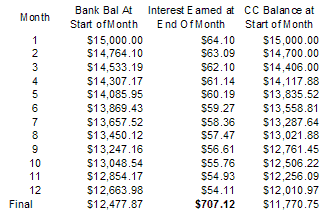
This continues for 12 months, as shown below:

altext

At the end of the 12th month, your bank balance is $12,477.87, and you still owe $11,770.75 on the card. You pay it off completely, leaving you with the resulting estimated profit of $707.12.

Play around with the calculator. Some people actually have over $100,000 out at once, earning them thousands of dollars a year. My credit limits aren’t quite that high…. yet!

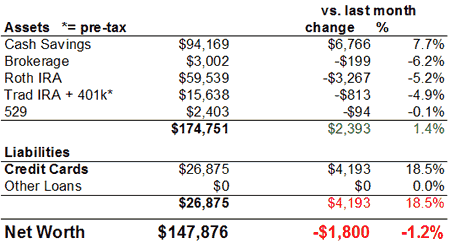
August 2007 Financial Status / Net Worth Update

Net Worth Chart August 2007

About My Credit Card Debt
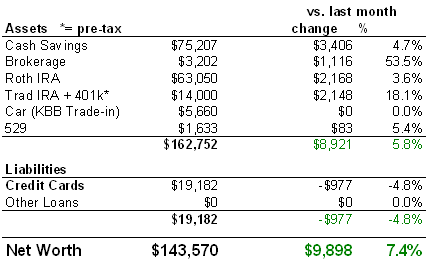
Newer readers may be alarmed by my high levels of credit card debt. In short, I’m borrowing money for free and keeping it in safe investments while earning me 5-6% interest. Along with other things, this helps me earn extra side income of thousands of dollars a year. Recently I put up a series of step-by-step posts on how I do this. Please do check it out if you are curious. This is why, although I have the ability to pay the balances off, I choose not to.

Commentary
What a crazy month July was. Saying goodbye, packing up, visiting family, celebrating a marriage, moving, saying hello! In the meantime, our net worth dropped, again! What happened?

» Stock Market Blues. With everything that’s been happening, I haven’t been keeping up with this wild stock market ride. Losing 5% in one month in our investments was a surprise. Sub-prime loans are either a real factor to worry about or mainly just a cover-up for the fact that people really don’t know what to think right now. I certainly don’t, but I never try to understand the short-term movements of the markets.

» Moving Chaos. Moving cross-country really throws off a budget. We ate out a lot. We paid for travel costs. We had to pay for movers, but are waiting to get reimbursed by our employers. We bought some new furniture. We only had to pay for rent for a part of July, but we’re still waiting for our security deposit back.

» New Jobs. We’re both in our new positions and faced with new co-workers and bosses, bigger (upcoming) paychecks, and a whole new set of challenges. I have to decide on investments and contribution levels for a new 403(b), as well as other benefits like health insurance, dental insurance, and disability insurance. Lots of stuff to talk about in August!

Quick summary time… We are still saving cash, with our non-retirement funds now add up to $72,699, and total cash is $67,294 (+$2,573 from last month). Read about our mid-term and long-term goals and take a look back at our previous net worth updates.

Reader Question: Pay Off Credit Cards vs. Invest Your Money?

I’ve gotten a few variations of this question recently:

I’ve only got about $5,000 in savings and about $4,000 in credit card debt. I’m not sure if I should pay off my cards first before I decide to invest or what. I’m just looking for a way to make my money work harder. – Michael, New Investor

I indirectly addressed this topic in my post titled You Have Some Money. Where Do You Put It?, where the my top 4 were listed as:

  1. Invest in your 401(k), if you have one, up until the match.
  2. Pay down your high-interest credit card debt.
  3. Create an emergency fund with at least 2 months.
  4. Fully fund your Roth IRA.

If you read through the many thoughtful follow-up comments, you’ll see that many people have differing views on this. I’ll try to clarify my own positions here, but although I will try to provide good reasons behind then, I do agree that this is all very subjective. As usual, the ultimate goal is to present all the arguments in order to help everyone better determine their own personal solution.

#1 Invest in your 401(k), if you have one, up until the match.
Many employers offer matching 401(k) contributions. So if you contribute $100 from your paycheck, your employer will also chip in $50-$100. This is an instant 50-100% return… Some would even call this free money! Unless your credit card interest rates are over 50%, mathematically you are ahead by far. In addition, you have now started your nest egg for retirement.

Exception: The benefit of this match gets a little hazy as often you have to work for a number of years before the matched amount “vests”, or officially becomes yours. You may never actually get to keep much of the match if you only work for a year or two, so take your long-term prospects into account.

#2 Pay down your high-interest credit card debt.
Here we reach one critical debate: Paying Down Debt vs. Roth IRA. On one side, we have high interest (say, over 8% right now) debt. On the other, we have the opportunity for tax-free growth.

My argument here is, again, simple math. If on one hand you have money in stocks growing (maybe) at 10% tax-free, and on the other hand you have money shrinking at 18% with no tax deductions, you’re still losing money! Therefore, I feel the best general decision is put all that money towards your debt. Yes, saving now may mean much larger balances later, but remember, here you are choosing one or the other here, and not paying off the credit cards puts you behind.

The counterargument to this is that you only get to put in $4,000 in a Roth every year and that is precious. You can’t put nothing in this year and $8,000 next year. If you are sure that your tax rate to be higher in retirement than now, and you don’t expect to have access to other similar options like a Roth 401(k) or 403(b) in the future, then I can see how putting money towards the Roth may be better.

(Now that I think of it, another reason might be that Roth IRAs are protected in case you decide to wipe out all your credit card debt in bankruptcy court…)

Exception: One should always try to lower their interest rates if possible by calling the credit card issuers directly or, if your credit is high enough, try to get a low interest balance transfer onto another card.

#3 Create an emergency fund with at least 2 months.
Here is another hard question: Where does an emergency fund play into all of this? Overall, I think people should pay down their high-interest debts as much as possible before saving up 6-12 months of emergency funds.

Why? For one thing, if an emergency does occur, many expenses can be simply be put back onto those same credit cards: utilities, food, clothing, medical bills, etc. Other things like rent can be paid via cash advance. Since it’s most likely an emergency won’t occur, you’ll be saving a lot of interest by paying off the high-interest debt now.

The reason I put 2 months down is because I wanted to designate this a “barebones” emergency fund. The actual amount needed depends heavily on the individual: How stable is your job? Do you have disability insurance? Would your parents or someone else bail you out?

Fully fund your Roth IRA.
Although you can withdraw your contributions out of a Roth if you need to, the Roth should be a last resort. Therefore, you have the “barebones” emergency fund first, and then the Roth IRA. Should a Roth be above even a barebones emergency fund? That’s a judgment call. In my mind, a barebones emergency fund is maybe $2,000. Otherwise, you’re literally living paycheck-to-paycheck, during which I would worry about now first before the future and Roth IRAs.

Exceptions: As noted earlier, the Roth IRA is really only better than a Traditional IRA or 401k if you expect your marginal tax rate to be higher in retirement than when you make your contributions. If you expect them to be the same, they are essentially equal, with the Roth taking perhaps a slight edge. Here’s the math showing why… Say you have $10,000 pre-tax income to contribute, 25% marginal income tax rate both now and in retirement, 8% annual return, and a 30 year horizon.

401k (pay tax later):
( 10,000 x 1.08^30 ) [compounding] x ( 1 – .25%[tax later] ) = $75,469

Roth (pay tax now):
( 10,000 x ( 1 – .25%[tax now] ) )x (1.08^30) [compounding] = $75,469

If your tax now > tax later, the 401k comes out ahead. If tax now < tax later, the Roth wins. Please share your thoughts in the comments, if I haven't confused you completely already...

Dad’s Retirement Plan: Learning About The TIAA-CREF Traditional Annuity

While visiting the parents, I was also asked to provide some input on their retirement savings. I don’t want to invade their privacy, but I’m sure they share common concerns with others out there. My father, who is in the non-profit/education sector, has much of his retirement money with TIAA-CREF (Teachers Insurance and Annuity Association – College Retirement Equities Fund). They are one of the biggest financial services companies in the U.S., and are operated on a non-profit basis.
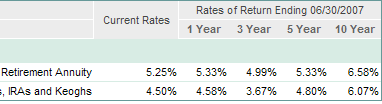
As you might guess from their name, a very popular option for members is the TIAA Traditional Annuity, holding over $163 billion. I was not at all familiar with this beast, so I decided to learn more about it. Here’s a quick rundown from the website:

A guaranteed annuity backed by TIAA’s claims-paying ability, TIAA Traditional guarantees your principal and a minimum interest rate, plus it offers the opportunity for additional amounts in excess of the guaranteed rate. TIAA has credited additional amounts of interest every year since 1948.

The annuity primarily invests in publicly traded bonds, commercial mortgages, direct loans to business, and real estate. It has no loads, no surrender charges, no maintenance fees, and very low annual operation expense ratios of about 0.25%. (Sources: SURS, Dixie State Univ. )

Accumulation Stage
So you invest in this annuity, your account value will never decrease as long as TIAA is around. In fact, it will go up in value by at least 3% every single year, and most likely more depending on market conditions. Think of the savings on antacids during the next stock bubble! There are two tiers of performance – From what I understand, the higher paying tier is for money that is contributed directly by the employing company or group, whereas the lower paying tier is for voluntary contributions from the individual. Here are the historical returns:

altext

For comparison, the venerable Vanguard S&P 500 Index Fund (VFINX) has a 10-year trailing return of 7.05%, and the Vanguard Total Stock Market Index Fund (VTSMX) has a 10-year return of 7.60%. The Vanguard Total Bond Market Index Fund (VBMFX) has a 10-year return of 5.74%.

Withdrawal Stage
When you reach retirement and are ready to start take money out of your annuity, you have a variety of options. There are one-lifetime income options, two-lifetime income options, fixed-period (ex. 10-year) income options, interest-only payments, and also a few others involving taking a lump-sum or just the required minimum distributions.

Of course, all annuities are simply a promise, not a 100.00% guarantee. In this regard, TIAA does have the highest possible credit ratings from all the major agencies: A++ by A.M. Best, AAA by Fitch, Aaa by Moody’s, and AAA by S&P.

Summary
Overall, it was very interesting learning about this additional investment option. Here were my tentative opinions:

  • There is an expected trade-off of lower long-term performance in exchange for a guaranteed minimum return if you purchase this annuity. For those with longer time horizons and the discipline to ride out the market’s ups and downs, it may be better to invest in low-cost stock/bond mutual funds or ETFs instead. Those that are very risk-averse will love this investment.
  • The lifetime income options are nice and reliable, but you could also do the same with a portion or all of any retirement portfolio. Just cash out your stocks and bonds, and go buy an immediate annuity with a lifetime payout option.
  • Still, if you’re going to buy such an annuity, TIAA-CREF offers some of the best and safest returns along with the lowest fees available in the annuity marketplace.
  • As my father is nearing retirement and I think the safety of this investment is very comforting to him, I think this option will work adequately for him. The majority of his annuity holdings are also in the higher-paying tier. I am, however, providing him some guidance in the rest of his portfolio to provide some diversification, as well as telling him what questions to ask his group’s financial advisor.

Zecco Free Trades Broker Review, Part 2: Corrections, Funds Transfers, and Trading Experiences

This is the second part of my review of the Zecco brokerage account. If you haven’t already, please read the first part of this review, where I went over the main draws of Zecco and the account opening process. Here, I will finish up my review of the opening process and also talk about my trading experiences.
Funds Transfer Speed and Experience
I initiated an online funds transfer from the Zecco website early on Tuesday. The funds were taken out of my savings account on Wednesday. The funds appeared in my Zecco account on Thursday and was available for trading. You probably still want to avoid straddling a weekend, but I’ve made two transfers and both took one business day. I’m glad the transfers are prompt.

One thing about the transfer system is that it can be tricky to find your pending transfer request after you submit it. You actually have to search by processing date, which is tedious.

Trading Interface
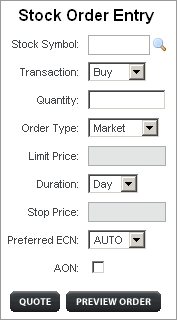
I am not an active stock trader, so I am not an expert at determining the quality of their real time quotes, options setup, or other such things. I thought the trading interface was fine, and similar to the many other brokers I have used. I just want to buy and sell stocks every so often, not day-trade. A screenshot of the order entry form is on the right.

Trading Experience
What I have done so far is make two test trades of the Vanguard Total Stock Market ETF, symbol VTI.

#1: On Day 1, VTI’s last trade was at 149.23, with a bid of 149.16 and ask price of 149.22. I placed a limit order at 3:39pm to buy just one single share at $149.18. The order was filled six minutes later at $149.16 , 2 cents below my limit amount. (As an aside, a bid/ask spread of 5 cents on a $150 ETF seems very reasonable. More on this later.)

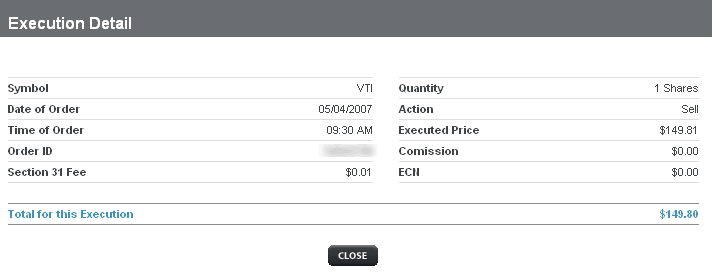
#2: After the market closed on Day 1, I went ahead and placed a sell order on my single share of VTI at my buy price of $149.16. My goal was simply to get my money back. My order was filled right at market open (9:30am) for $149.81. Here is a screenshot from my order history.

I was not charged any commission for either trade, as promised. On the sell order, I was charged a penny for a Section 31 fee. This is a small fee charged by the SEC in order to help fund their overseeing activities, which brokers pass on to us. It’s assessed only when you sell a stock.

What are Section 31 fees and how are they calculated?
The normal calculation for Section 31 fees is $30.70 per $1,000,000 in principle amount on sales. A principle amount of $140 would be subject to a Section 31 fee of $.01.

So I feel my trades were filled successfully and also promptly as the market allowed. There were no indications of shady behavior. For example, with my limit order of $149.16, they could have just given me $149.16 instead of the market price that was $0.65 higher. I would be comfortable using market orders if my goal was to dollar-cost-average into ETFs. Overall, it was pretty cool to be able to trade small amounts and not have to worry about commissions.

Few More Details
» Cost Basis Accounting – They use the FIFO (first-in first-out) method by default on 1099s, and don’t support HIFO (highest-in first-out) on their end. If you want to use HIFO, you’ll have to calculate it manually.

» You get a paper confirmation snail-mailed to you every time you make a trade, which can’t be turned off at this time. This could be a plus or a minus depending on the person.

» Checkwriting and an ATM card is available at an additional cost of $30 annually. I’m not interested, but it’s an option.

» Their reorganization fee of $15 is cheaper than most other brokers I’ve used. Therefore, I also plan to use this account for any future going-private transactions I participate in.

Summary
Overall, Zecco.com fulfills its promise of providing free trades and provides the basic features expected of a legitimate discount broker. My idle cash is even getting 4.38% APY in a money market sweep, which together with the free trades makes the overall cost of this account much less than other discount brokers like Scottrade and Ameritrade (who charge for trades and offer low interest). However, getting the account opened and ready for trading is more difficult than it should be. In other words, the customer service is slower than those same other discount brokers.

The question is simply, is it worth it to you to swap slower customer service for free stock trades? For me, I am definitely keeping this account open, and it is now my primary taxable brokerage account. I have dealt with Penson Financial Services in the past, and I feel they are adequate at their back-end duties. I am not a demanding trader and my balances are not large, so the free trades are simply too enticing. With my personality, paying $5+ for a trade when there is a free option available would nag at me.

Navigation
Zecco Review, Part 1
Zecco Review, Part 2

May 2007 Financial Status / Net Worth Update

Net Worth Chart April 2007

About My Credit Card Debt
Newer readers may be alarmed by my high levels of credit card debt. In short, I’m borrowing money for free and keeping it in safe investments while earning me 5-6% interest. Along with other things, this helps me earn extra side income of thousands of dollars a year. Recently I wrote up a series of step-by-step posts on how I do this. Please check it out if you are curious.

Commentary

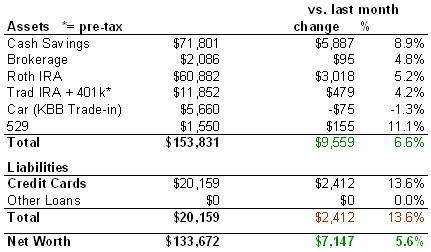
  • The stock market apparently went up this month, again confounding many experts and increased our IRA balances. I continued my monthly contributions towards buying FSTMX within my Self-Employed 401(k).
  • I moved $1,050 into my Zecco brokerage account and made a few free experimental ETF trades. I’ll share the details in the 2nd part of my Zecco review.
  • Another good month of controlled spending gets us to $66,520 of non-retirement funds, reaching 67% of our midterm goal of house down payment. Total cash is now $56,025.
  • Two things that helped boost our savings were the $350 from Vegas gambling winnings and $520 from optimizing credit card cashback on my Citi Drivers Edge MasterCard. 😀

You can see all my previous net worth updates here. Looking ahead to future expenses, we need to start looking into moving companies.

Six Key Principles of Saving for Retirement

Ben Stein has an good read on Yahoo Finance about what he terms the Six Key Principles of Saving for Retirement. Although I agree with all six main ideas, I question some of the specific numbers. Here are some excerpts and my comments:

1. How much you save.
Simply put, if you’re a typical American (who happens to save close to zero right now), you have to save more. When you’re young, 10 percent of your income will get you there. If you don’t start saving until middle age, aim closer to 15 or 20 percent. If you don’t start until later than middle age, save every penny you can.

Interesting. Is 10% really enough? If so, maybe I really am saving too much for retirement. 🙂 To what degree of certainty is that true?

2. How long you give your savings to compound.
A thousand dollars socked away when you’re 20 and growing at 10 percent per year will be almost $73,000 when you’re 65. The same sum saved when you’re 50 will grow to $4,200 at age 65. That’s a stunning truth that should compel any young person to start saving early — and the rest of us to start right now.

As for timing your retirement, Ray advises that if you can push it back by even five years you’ll allow your money to grow and have fewer years to need it.

Compound interest is truly powerful. A dollar saved now is worth more than a dollar saved later.

Although it hasn’t been helping me control my spending as much as I’d like either, I did make the horribly unpopular true cost of frivolous shopping calculator. 😉

3. How you allocate your assets.
Typically, for those who start early, stocks are the answer. Over long periods, a diversified basket of common stocks wildly outperforms bonds, cash, and real estate. The differences are breathtaking.

But, as we’ve seen lately, there’s also a lot of volatility in stocks. As you age, you’ll want more of your money in bonds and money market accounts. These have lower returns than stocks, but they also have far lower volatility.

Phil DeMuth recommends that, as a basic portfolio, you have half of your savings in the broadest possible common stock index such as the Vanguard Total Stock Market Index (VTSMX) and half in the Vanguard Total Bond Market Index (VBMFX)… To me, that’s a bit conservative if you’re young. I would have more in stocks and also a good chunk in international markets.

Here is a compilation of various model asset allocations from other respected sources. Pretty pie charts included!

4. How much your investment returns annually.

Now, this is largely unknown from year to year. But over long periods, stocks return close to 6.5 percent after inflation, and about 10 percent before inflation.

Can we expect 6.5% real returns in the future? Lots of conflicting opinions out there on this, but I really want to look into this more.

5. How low you keep your fees and costs.

This principle is largely about using index funds and no-load mutual funds, which makes perfect sense.

Costs matter, whether you go actively or passively managed. I’ve seen some really expensive index funds. Always look up the expense ratios and any commissions you have to pay either when you buy or when you sell for all the investments you own.

6. How closely you keep an eye on taxes.
Finally, Ray advises maxing out your tax-protected accounts like IRAs and 401(k)s; keeping high-dividend stocks in accounts that are tax-deferred; and, when retiring, carefully considering what bracket you’ll be in and drawing out your funds to remain in the lowest possible one.

Ah, taxes. Here is a discussion on where you should place investments for maximum tax-efficiency.

J.D. of Get Rich Slowly also shared his thoughts on these six points, and believes the most important factor in retirement savings is psychological.

April 2007 Financial Status / Net Worth Update

Net Worth Chart April 2007

About My Credit Card Debt
Newer readers may be alarmed by my high levels of credit card debt. In short, I’m borrowing money for free and keeping it in safe investments while earning me 5-6% interest. Along with other things, this helps me earn extra side income of thousands of dollars a year. Recently I wrote up a series of step-by-step posts on how I do this. Please check it out if you are curious.

About My Goals
I haven’t explained the goals in the progress bar on the top right of this page recently, either. First, I have a mid-term goal of $100,000 in net non-retirement funds (everything but IRAs/401ks). This is designed to help us save for a house downpayment. We’ll also need enough for any closing costs plus some for our emergency fund. Second, we have a long-term goal of one million dollars in total net worth by the age of 45. This is not our end goal, as we plan to keep working past 45, but it is something for us to work towards. 65 is just too far away, as are crazy numbers like $3,000,000 🙂

These goals were set more than two years ago, and while our situation has changed a lot since, I am still keeping them around. I may revise them later, especially if we buy a house near the end of this year.

Commentary

  • Our investment portfolio blipped back up in March. Honestly, this is becoming the only time of the month I even catch a whiff of what’s going on in the markets.
  • We had some pretty large pseudo-unexpected expenses this month. Coupled with our planned Vegas trip, we put a lot of stuff on the credit cards this month. (We never carry a balance though, it’s just for the rewards.)
  • Still, we continue to save more than half of our take-home income while our housing costs are lower. We did track our expenses for February, which was a helpful exercise. I think our spending is in an acceptable range for now. But anything to help us grow that downpayment is good!
  • Other stats: $51,600 in net cash and $60,900 in total non-retirement assets.

You can see all my previous net worth updates here. I’m getting excited about starting to look at houses, if only to keep an eye on the real estate prices.

Are You A “Maestro Of Money Management”?

A friend of mine sent me this link, and I think he was trying to mock me! 😉 It’s an article from the Wall Street Journal entitled Nickel-and-Diming Your Way To Riches, if That’s Your Thing Here’s an excerpt:

I thought I was fairly deft at handling money. But that was before I met the maestros of money management.

We’re talking here about the legions of Americans who manipulate their monthly cash flow like chess masters, along the way snagging frequent-flier miles, cash rewards and interest income.

Am I such a maestro? Are you? Let’s see:

Maestro Activity #1: Maximizing Bank Interest

Consider Dan Goldzband, a cost accountant in San Diego. He has his paycheck deposited directly into a high-yield savings account, where the money sits until he transfers it to his checking account to pay bills. His reward: $35 to $85 in interest each month.

“My checking-account balance rarely exceeds $100,” Mr. Goldzband says. “If it does for more than a couple of days, I am doing something wrong. Of course, only a compulsive like me could make this work. But the general idea, less rigorously applied, would still work for many people.”

Well, my checking account usually hovers around $500-$2,000, because we often have to write paper checks for weddings/graduations/baby showers/birthdays/donations. It’s not writing the checks that’s the problem, it’s that we can never tell when people are actually going to deposit them. Shrug. I also have one free overdraft per year on my Washington Mutual free checking account (review) as a backup anyhow.

But someone is exaggerating… At $35 a month in a 5% APY account, that is suggesting that he would otherwise have $8,000 sitting around earning 0%. ($85 would be $20,000+!) I doubt he needs that much for everyday cashflow. I would bet a good chunk of that is considered his emergency fund or other cushion. Not putting that away into a high-yield saving account would just be silly. The author agrees:

Meanwhile, if your checking account is on the plump side, keep enough there to avoid triggering fees and move the rest into a high-yield savings account or a money-market fund. If you shift $5,000 into an account paying 5%, you will pick up $250 in interest over the next 12 months.

Maestro Activity #2: Credit Card Arbitrage

Don’t have much money in your savings account? No problem. Maestros will borrow from credit cards with 0% introductory rates and then use the money to earn a little interest, often stashing the cash at EmigrantDirect, HSBC Direct or one of the other banks with high-yield online savings accounts.

Okay, I’m definitely guilty of this. I even got so many questions about it that I wrote a detailed, step-by-step Guide On How To Make Money From 0% APR Balance Transfers. Don’t miss the introduction though – this is definitely not for everybody.

Maestro Activity #3: Using Credit Cards But Paying In Full To Reap Rewards

When the maestros aren’t gaming those 0% offers, they’re hunting for the credit cards with the best rewards. Thanks to this strategy, Mr. Bilker says he hasn’t paid to take his family to the movies for two years. He’s also got $500 in convenience-store gift cards, and he garnered a $1,700 discount by charging $17,000 in kitchen remodeling expenses.

For many cardholders, the prize is frequent-flier miles. Bob Smith, a retiree in rural Michigan, has 30 credit cards. He charges everything, from groceries to utility bills, to whichever card is currently paying the highest reward. He figures he and his wife have collected more than 100,000 frequent-flier miles over the past year.

Yes, yes, I do this too. Here are the three cards that I keep in my wallet. The article even admits this may be worth the effort on a smaller scale:

Forget shuffling back and forth between your checking account, your savings account and the latest, greatest credit-card offer. Instead, go for the easy money. Pile your expenses onto a good rewards card and be sure to pay off the balance every month. Let’s say you charge $1,000 a month to a credit card that earns frequent-flier miles. That should give you enough points every two years to get a domestic round-trip ticket worth perhaps $400 — and maybe two or three tickets if the card pays double miles and gives you a sign-up bonus.

Maestro Activity #4: Keep Your Investment Expenses Minimal

Most important, focus first on your portfolio rather than your monthly cash flow. Suppose you revamp your $300,000 mutual-fund portfolio, cutting your annual fund expenses by half a percentage point. That would save you $1,500 a year — without the ongoing hassles that come with juggling credit cards and bank accounts.

Sure, that would be great, except my mutual fund portfolio expenses are already under 0.30% annually. 😛

Nickel and Diming, Huh, Punk?
Actually, I pretty much agree with the premise of the article. As I’ve said before, the time I spent talking about a subject is not directly proportional to how important I think it is. Mentally, I divide them into the big things that help guarantee I’ll reach my goals, and also the small things that will make those goals arrive earlier. Besides, it’s fun to have a profitable hobby. (My other hobbies aren’t cheap!)

Are We Saving Too Much For Retirement?

piggy bankOne contrarian article deserves another. This one, courtesy of the New York Times is titled “Save Less and Still Retire With Enough”. The main premise is that contrary to popular opinion, most of us are actually doing just fine money-wise. All this talk of impending consumerism-drive doom? It’s a big scam by the investment companies, who have a vested interested in us keeping big balances in our brokerage accounts.

The more realistic amount could be as little as half the typical recommendation made by Fidelity, Vanguard or any number of other financial institutions. For a middle-income couple, that could mean trading $400,000 in retirement money for about $3,000 a year more during prime working years to spend on education or home improvement. ?For a middle-class household, that?s a lot of money,? said Laurence J. Kotlikoff, a Boston University economics professor, who is on the forefront of this research into spending and savings, and is selling his own retirement calculator.

You can read more of Mr. Kotlikoff’s research here. Here is an excerpt from one paper:

TIAA-CREF is recommending a retirement ?salary replacement? target equal to 80 percent of annual labor earnings. For our stylized household [couple earning $125,000 with two kids], this equals $100,000… This is 78.0 percent higher than the appropriate target!

In other words, his “appropriate” target replacement salary is actually only about 45% of their previous income, or $56,000, for a couple earning $125,000 a year. This is due to a number of factors which aren’t explained in detail, but factor in that their house should be paid off and the kids will be gone during retirement. However, I saw no mention of the increased costs from health insurance and other medical costs that increase with age. He also expects the their investments to earn 9% a year (6% real, 3% inflation), which is a bit optimistic to me.

In the end, of course some people are saving too much. I mean, if you’re eating Cup o’ Ramen ten times a week and checking your million-dollar bank balance on the free computers at the public library, sure, maybe you need to loosen up a bit. I’ve never met any of these people, have you? There’s no way that they outnumber the ones that are saving too little.

And how do we even know what will be too much or too little? Every retirement calculator is simply trying to predict the future. Note the huge “we are not liable if this is wrong” disclaimers. I’ve read a lot of articles that also support the fact that the stock market will only earn about 6% annually in the future, and similar ones that say that the long-term expected returns of stocks will be the same as bonds. Japan’s stock market has been in the dumps for more than decade.

A possible personal solution?
I’m trying to come up with what I call the Core Lifestyle, which essentially includes everything that I would personally really want out of life – things like a job that I value, a small house in a specific area, a skiing season pass, and an international trip every year. The idea that this should require a certain amount of money, for example $100,000 a year. (Yes, I am aware that this is a lot of money. I’m also living in a big West Coast city…) My feeling is that after a certain point, any extra spending just ends up on “stuff” like nice cars, gadgets, brand name clothes, and bigger houses that really won’t improve my quality of life.

Anything above that threshold goes into investments. This is opposite of some plans which suggest socking away a specific percentage of your gross income each year. Then, as our wealth builds, whenever it is that we have enough to cut back on working, we will! It could be 39, 45, or 52. There would be no “squandering of youth”. We’ll live well now, and then we’ll live even better after that. Sounds easy, doesn’t it? We’ll see how it goes 😛

Do you feel like you’re depriving yourself now to save for retirement? If your retirement planner told you that you could save less, would you do it?