Search Results for: High Interest Savings

$100 Bonus from Suze Orman and TD Ameritrade

While skimming my new Suze Orman eBook, I ran across her SaveYourself promotion that I blogged about almost a year ago, but is still going on for a little while longer.

You can get a $100 bonus after one year (expired) if you open an account at Ameritrade by March 31, 2008 and set up an automatic deposit of at least $50 per month for 12 consecutive months. This deal isn’t bad as a mandatory cash savings vehicle if you don’t need to withdraw the money. They even offer a special money market rate much higher than their usual piddly 0.05% rate:

Get started on Suze’s Save Yourself Plan by opening a new account with TD AMERITRADE, featuring a special high-yield deposit account with a 2.78% Annual Percentage Yield (as of February 1, 2008). Your cash is held in an FDIC-insured Money Market Deposit Account (MMDA) at TD Bank USA, N.A.

There are no maintenance fees on the account, plus you receive the $100 offer for making 12 monthly automatic deposits of at least $50 each to help you build up your account balance. […] Should you need to withdraw the money prior to the twelve-month commitment, you may withdraw all of your deposits, plus the interest earned. However, you will forfeit the $100 bonus.

Doing the math
Looked at one way, if you just put in the minimum $50 in each month, at the end of a year you will effectively have earned 35% interest on your money. If you are truly starting out on a savings plan, this is a pretty nice guaranteed return. $50 a month isn’t too painful, and at the end of the year you’ll end up with over $700 tucked away for your emergency fund, Roth IRA contribution, or whatever. It’s a good incentive to get in the habit of saving.

Alternatively, if you’re already saving all you want in high-yield savings accounts, you’ll still be ahead by about $90 in extra interest.

I wouldn’t necessarily stay and invest with TD Ameritrade, though. They are alright, but at $10 per trade with potentially small balances, here are a few alternatives that I suggest exploring. Note that TD Ameritrade has a $75 fee for transferring out your account directly to another broker. Keep your money in cash, and then simply withdraw it and close your account with no fee when you wish to leave.

Choosing Between a Fixed or Adjustable Rate Mortgage

Before shopping for rates, we had to figure out what kind of mortgage loan we were going to get. The first decision was between a fixed-rate or an adjustable-rate mortgage. Quickly, here are some very general definitions:
  • Fixed rate mortgages (FRMs) provide a constant monthly payment for the life of the loan, no matter what interest rates do in the meantime. Common lengths are for 15 and 30 years.
  • Adjustable rate mortgages (ARMs) offer a lower monthly payment for a certain initial period, and then adjust periodically afterwards. Common initial periods are 1, 3, 5, and 7 years. For example, if you see a “5/1” ARM, the rate and payments are fixed for the first 5 years, and then will adjust according to a pre-determined formula one a year after that. A “5/5” ARM adjusts only once every 5 years. Usually they are also based on a 30-year amortization, but not always.

Here were my three main considerations for choosing between ARMs and FRMs:

How long do I expect to stay in the home?
I’ve read statistics that people tend to move about once ever 5-7 years, and that the average mortgage only lasts 7-8 years before being refinanced or paid off (usually from the sale of the home). But who cares about average? Everyone is different.

It’s true that if I bought a “starter home” that with the arrival of kids we might need a quieter neighborhood or more space. In our case, we ended up finding a home that has everything we need for the foreseeable future. While trying to be as objective as possible, if I had to lay odds I’d say that there is a 95% chance that we’d stay past 5 years, and 75% that we’d stay for 15+.

What’s the interest rate savings if I go with an ARM?
Here you’d have to look at current rate curves. At one unlikely extreme, if you’re getting the same rate for both types of loans, of course you’d go for the fixed. Right now, the spread is about 0.5% between a 5/1 ARM and a 30-year fixed mortgage, which is pretty narrow. In the past the spread has been as little as 0.1% and as high as 1-1.2%, possibly more.

Although many mortgages brokers will tell you “even if you end up staying longer than 5 years, you can always refinance”, that’s just not true. You can’t always refinance – check out all those sub-prime borrowers who can no longer get a loan anywhere. They are stuck with rates resetting in the 15% range!

And even if you can refinance, it might be ugly… What if your credit score drops in that time? What if lending standards continue to tighten? What if rates rise significantly? What if your home value drops and your loan-to-value (LTV) ratio is now horrible?

I think ARMs can be a smart buy if you can assess your situation accurately. Some people know they’ll be gone in four years or less. Who knows, rates might actually drop like we’ve seen recently. But no matter what there is an element of risk involved. With rates still at historical lows, we see the downside being a lot worse than any potential upside.

Do I want to rent it out?
This is one consideration I don’t always see mentioned. If I do end up moving, there is a very good chance that I’d like to make my home a rental property. With a fixed mortgage, again I have stability. Rents will rise with inflation, but my mortgage payment will always stay the same. I also don’t have to worry about obtaining a investment-property mortgage, as primary-home loans are usually much cheaper.

In the end, all the signs pointed towards a fixed-rate mortgage for our situation, so that’s what we’re getting. 🙂

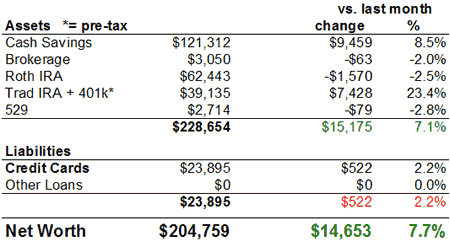
February 2008 Financial Status / Net Worth Update

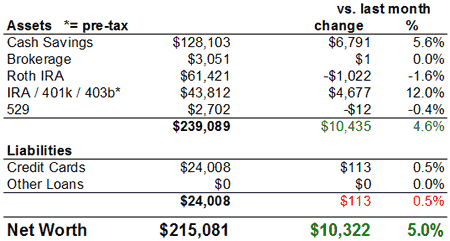
Net Worth Chart February 2008

Credit Card Debt
If you’ve recently starting reading, you may have some concerns about my high levels of credit card debt. I’m actually taking money from 0% APR balance transfer offers and instead of spending it, I am placing it in high yield savings accounts that actually earn me 5% interest or more, and keeping the difference as profit! :D

Along with other deals that I write about, this helps me earn extra side income of thousands of dollars a year. Recently I put together a series of step-by-step posts on how I do this. Please check it out first if you have any questions. This is why, although I have the ability to pay the balances off, I choose not to.

Cash Savings, Home Purchase
We’re still in the process of buying a home. There will be big drops on the cash column soon as we finally spend our down payment funds as well as pay for things like closing costs and home improvements for our home.

$5,000 was put towards the earnest deposit, and I just marked it as spent. But I will have to decide on how to account for my home value in my net worth. I’m leaning towards just keeping it simple and taking option #2, but that may be considered a cop-out if my home value drops.

Retirement and Brokerage accounts
For the third month in a row, our investments overall have dropped in value by 2-3%. Good thing I only check in once a month. I gloomily predict that things will get significantly worse before they get better… but I don’t actually risk my money on guesses. I continue to “stay the course” and keep making regular investments into my asset allocation.

New Midterm Goals?
Although I still want to visit Brazil, Australia, and Southeast Asia, it looks like we’ll probably be spending the next 6 months instead installing hardwood floors, remodeling bathrooms, and jackhammering some concrete. I don’t know if we’ll have the time or money to visit any other place besides the wonderful world of Home Depot. We’ll have to see.

You can see our previous net worth updates here.

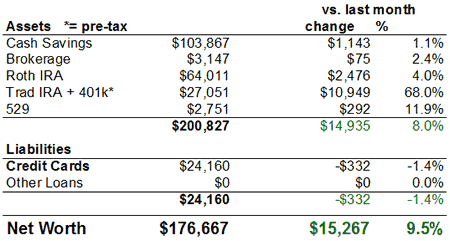
January 2008 Financial Status / Net Worth Update

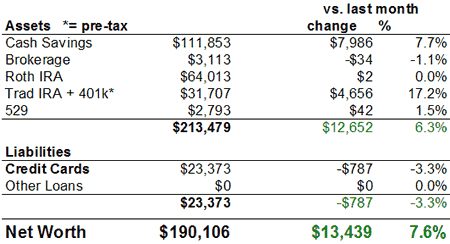
Net Worth Chart January 2008

Credit Card Debt
If you’re a newer reader, you may have some concerns about my high levels of credit card debt. I’m actually taking money from 0% APR balance transfer offers and instead of spending it, I am placing it in high yield savings accounts that actually earn me 5% interest or more, and keeping the difference as profit! :D

Along with other things, this helps me earn extra side income of thousands of dollars a year. Recently I put together a series of step-by-step posts on how I do this. Please check it out first if you have any questions. This is why, although I have the ability to pay the balances off, I choose not to.

Cash Savings, Unknown Goals
These numbers are as of January 1st, but I didn’t post them because I was hoping to announce new goals at the same time. But I haven’t pinned them down exactly yet. I know that do want to create a formal emergency fund, as opposed to just relying on the existing cash cushion we have right now from our future house down payment. So that’s where the cash increase will go towards. We also still need to re-examine our insurance needs.

(Added) Again for newer readers, this is the total net worth for both my wife and myself. We are (now) both working professionals in our late 20s making sizable incomes in the six-figure range. Until recently I was still in school (again). Our expenses are low right now right now, not having a huge mortgage to support… yet. But we do want a house and want to put 20% down if we can, so that is what the large amounts of cash savings are for.

Retirement and Brokerage accounts
Our investments overall have dropped another 2-3% since last month. As reported in our retirement portfolio update, we have both placed $15,500 into each of our 401k/403b plans this year. For 2008, I think we will try and make the contributions more spread out across the year in order to dollar-cost-average and make our cashflow more consistent.

You can see our previous net worth updates here.

2008 Financial Jump-Start Checklist: 5 Actions That Can Take 5 Minutes Or Less!

Even if you don’t do resolutions per se, I think most of us still have areas of improvement that we want to work on for 2008. The problem is that is it so easy to keep putting off taking action to reach our goals. Given that I think little steps are the best way to solve big problems, here is a little action checklist that may be handy (complete with handy checkboxes if you want to print it out). How about at least one per day?

Reduce or Remove A Monthly Expenditure
  • Objective: Got a gym membership but haven’t gone in months? Yard man coming too often? Got some Netflix DVDs that have been sitting on your desk for weeks? Cable bill too high?
  • Action Required: Pinpoint a monthly expense that you don’t need anymore (or as often), and make the phone call to cancel. Stop putting it off.

Raise Your 401k/403b Contribution by 1%

Lower Your Interest Rate on Credit Card Debt

  • Objective: If you’re paying any sort of interest on credit card debt, it’s worth a call to see if they’ll lower it. Interest rates have been dropping again, and the banks are as competitive as ever for your money.
  • Action Required: Call up your highest rate credit issuer, and ask for a lower rate. Quote a few of the better offers you’ve been getting in the mail. If you have good credit and are serious about paying it off, it may be best to switch to a card with a 0% intro rate on balance transfers for 12 months.

Start an Automatic Transfer To Online Savings Account

  • Objective: If you’re not saving as much as you’d like manually, try using psychology to your advantage and make it automatic instead. You can always move the money back later if it doesn’t work out.
  • Action Required: If you don’t have an high-yield savings account paying at least 4% interest, pick one and open it right away. Then log in and schedule an automatic and recurring transfer into it of $100 or whatever every month. Use multiple accounts for different goals.

Set A Short-Term Goal

  • Objective: Forget “save for retirement’ or other vague goals. Setting specific, attainable short-term goals really helps keep me on track. One of my goals is to cook dinner at home one more day each week.
  • Action Required: Think about what would make you feel really good to have accomplished 1-3 months from now, write it down, and tell your significant other or close friend about it. Set a specific end date.

My short-term attainable goal for this week: By Sunday 1/6, I will have at least re-allocated my investment portfolio to the proper stock/bond ratio and US/International ratios that I explored previously. It should only take part of an evening, as I’ve already chosen them.

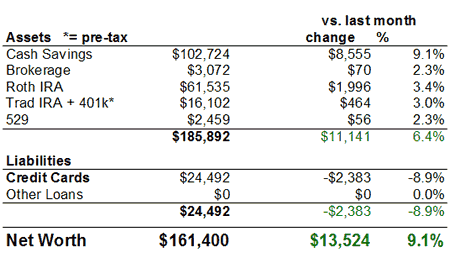
December 2007 Financial Status / Net Worth Update

Net Worth Chart December 2007

About My Credit Card Debt
If you’re a newer reader, you may have some concerns about my high levels of credit card debt. I’m actually taking money from 0% APR balance transfer offers and instead of spending it on junk, I am placing it in high yield savings accounts that earn me 5% interest or more, and keeping the difference as profit.

Along with other things, this helps me earn extra side income of thousands of dollars a year. Recently I put up a series of step-by-step posts on how I do this. Please check it out first if you have any questions. This is why, although I have the ability to pay the balances off, I choose not to. Also mixed in are our monthly credit card charges, which we do pay off each month.

Commentary

Cash Savings, Midterm Goal Done. We have successfully reached our mid-term goal of $100,000 to put towards a house downpayment. This goal was set initially on April 2, 2005 – right here on this blog, with a deadline of mid-2007. Since then, I quit my 9-5 job, went back to school, changed fields, and now work both on my own independent ventures and a salaried “W-2” job. That transition set us back, but we finally got there, just 6 months late. 🙂

Of course, now we have to set another mid-term goal. For now, I think a proper goal would be probably to keep accumulating more cash, as if we do have to buy a house there are tons of other costs like closing costs, mortgage points, moving costs, initial home repairs, and so on to worry about. Not to mention also keeping an emergency fund, which is pretty critical once you have a mortgage to worry about.

Retirement and Brokerage accounts. Our investments overall have dropped about 2-3% since last month. We have again juiced up our retirement contributions this month, because unlike IRAs, the 401k contributions for 2007 have be in by the end of the year to count under the 2007 annual contribution limits. Thanksgiving managed to sidetrack me from my asset allocation series. It must be done by 2008!

You can see our previous net worth updates here.

November 2007 Financial Status / Net Worth Update

Net Worth Chart October 2007

About My Credit Card Debt
If you’re a newer reader, you may have some concerns about my high levels of credit card debt. I’m actually borrowing money for free at 0% interest, putting it in high yield savings accounts that earn me 5% interest or more, and keeping the difference as profit. Along with other things, this helps me earn extra side income of thousands of dollars a year. Recently I put up a series of step-by-step posts on how I do this. Please check it out first if you have any questions. This is why, although I have the ability to pay the balances off, I choose not to.

Also mixed in are our monthly credit card charges, which we do pay off each month.

Commentary

Cash Savings. We continue to have a big cash hoard to try and reach our mid-term goal of $100,000 to put towards a house downpayment in an expensive area of the country. We are now at $94,386 in non-retirement funds (cash + brokerage + 529 – credit cards). Getting close! We continue to browse for that perfect home that fits us, and we’re starting to learn more about the ins and outs of mortgages.

Retirement and Brokerage accounts. Performance-wise, there seems to have been little movement over the last month. The increase in value is primarily due to my wife starting to contribute to her new 403b, which is finally set up properly. We hiked up the percentages in order to try and build up some pre-tax contributions before the end of 2007. Still have to decide whether to contribute to a Non-deductible IRA this year. Finally, I’ll be finishing up my series on rebuilding our portfolio this week.

That’s it for this month. As always, we’re not racing against anyone else but ourselves. Take a peek back at our previous net worth updates here.

Signup Bonuses: $100 From LaSalle Bank, $50 From NewBank

LaSalle Bank (now owned by Bank of America) is offering a $100 bonus for opening a checking account, savings account, and using the debit card once. Likes like you need $250 for the checking and $100 for the savings. Keep the minimum amount in there ($250 for checking, none for savings*), and that’s a very nice rate of return.

In addition, you can even fund with a credit card (up to $1,000 per account) and have it count as a purchase. Great for those with rewards credit cards.
[Read more…]

We Got Pre-Qualified For A Mortgage, And It Was Shocking!

We decided to sit down with a mortgage broker and get officially pre-qualified for a mortgage. Actually “officially pre-qualified” is an oxymoron because the whole process only involved a legal pad and a calculator. The following is just our experience, yours might vary significantly, I really don’t know.

If you’re not familiar with the terms, “pre-qualified” is just a very rough estimation of what kind of loan you can get from a lender. You tell them your credit score (roughly), your income, your debts, and your current assets. They don’t verify any of this, or run a credit check. It’s basically means nothing to a seller. On the other hand, a “pre-approval” is based on your actual credit score and verification of all your numbers (at least for a full-documentation loan). You need to submit tax returns, old W-2 forms, bank statements, paystubs – basically your entire financial life laid bare. This may offer an edge if a seller is comparing offers between you and another seller without a pre-approval.

Lender Ratios
But for me, the main reason for doing this is to find out what their lender ratios were. Also called the debt-to-income ratio, this is all your monthly liabilities (housing payments, car notes, credit card payments, student loan payments) divided by your gross income. This gives you the maximum debt load that the lender will accept and still lend you money. By housing payments, this usually means PITI, or principal + interest + taxes + insurance, so it’s a little more than just the straight payment from a mortgage calculator.

Also, historically, there were two lender ratios, at “top” and “bottom” value (Example: 28%/36%). The bottom (lower) number was the max ratio allowed for [housing] divided by [gross income]. The top (higher) number was the max ratio for [housing + other debt] divided by [gross income]. You had to be below both ratios to qualify for the loan. But I was told that if you have no other debt, that we can bump right up to the top value. I guess before they figured you had a good chance of adding on more “other debt” later in life, but now they just care about total debt load. So really there is only one ratio in many instances – the top one.

Historically, the top lending ratios were somewhere in the neighborhood of 38%. But I was surprised to hear that it’s more like 45-50% now in expensive areas like California, and he has seen as high as 60%! Keep in mind this is a percent of gross income before income taxes! 😯

A 5.75X Income Multiplier!?
Let’s say your gross income is $100,000/year ($8,333/month) and you manage to be clear of any other debts. (This is just for a round number.) Using this Mortgage Qualification Calculator, I plugged in zero down payment, the default property tax (1%) and insurance (0.5%) rate estimates, a 6% mortgage rate, and a 50/50 lender’s ratio. Here are my results:

[Read more…]

10 Reasons You Should Never Pay Off Your Mortgage

A mortgage broker I was introduced to recently just sent me this article on 10 Great Reasons to Carry a Big, Long Mortgage by Ric Edelman. Apparently Mr. Edelman is the expert to be quoted on this subject, as I’ve heard his name associated with this idea several times. Here are his ten reasons along with limited excerpts of the original article. My response is included at the end.

Reason #1: Your mortgage doesn’t affect your home’s value.
You’re buying your home because you think it will rise in value over time. Yet, the eventual rise (or fall) in value will occur whether you have a mortgage or not. So go ahead and get a mortgage: Your house’s value will be unaffected.

Reason #2: You’re going to build equity anyway.
Many homeowners try to build equity in their house by paying off the mortgage. But that produces weak results when compared to the equity you’ll build simply by watching the house appreciate in value. So go ahead – keep the mortgage. You’ll build plenty of equity anyway.

Reason #3: A mortgage is cheap money.
[…] You’ll find that mortgages offer you perhaps the cheapest way to borrow. Mortgage loans offer low interest rates because you post the house as collateral: If you fail to repay the loan, the lender sells your house to recoup its money.

Reason #4: Mortgage interest is tax-deductible.
Not only are mortgage loans low in cost, the interest you pay is tax-deductible. You can save as much as 35 cents in taxes for every dollar you pay in interest. That means a 6% mortgage loan really costs as little as 3.9%. Why carry 18% credit cards, paying interest that is not tax-deductible, when you can instead carry a 6% mortgage with interest that is tax-deductible? Your mortgage is probably the cheapest money you can borrow, so it makes sense to get as much of it as you can.

Reason #5: Mortgage interest is tax-favorable.
Assume you have both a 6% mortgage and a 6% profit on your investments. The mortgage is deductible at your top tax bracket, but the investments are taxed as low as 15%. For someone in the 25% tax bracket, that means the mortgage costs them 4.5% while the investment nets them 5.1% after taxes. In other words, tax law makes it beneficial for you to maintain your mortgage.

Reason #6: Mortgage payments get easier over time.
[…] You might be struggling to make your mortgage payment at first, but over time you can expect your payments to become cheaper relative to your income – especially if yours is a fixed-rate loan. That way, your payment never rises, but your income does.

Reason #7: Mortgages let you sell without selling.
In time, you may well find that your home has grown substantially in value, and you may begin to worry that you might lose that equity if there’s a decline in real estate values. You don’t want to sell the house, which is the obvious way you can capture the value, but there is another answer: get a mortgage. By cashing out some of the equity, you essentially collect the value of the house in cash without actually having to sell the house.

Reason #8: Large mortgages let you invest more money more quickly.
Assume you own a house and want to buy a larger home. So you sell your old house and net $300,000. Now you’re ready to purchase a new $500,000 home. How much should you put down? Should you make a 10% down payment of $50,000? Or should you put down the entire $300,000 in proceeds from the sale of the old house?

Big mortgages mean small down payments. Small down payments mean you retain lots of cash that you can then invest.

Reason #9: Long-term mortgages let you create more wealth.
Do you merely want to eliminate your debt, or do you want to truly build wealth? Please realize that the former does not automatically result in the latter. Indeed, many people who are debt-free are also dead broke.

So, the real goal is to create wealth. You do that by adding as much money as you can to your savings and investments. And the best way to do that is to lower your monthly expenses. That’s why long-term loans are better than short-term loans: the longer the term, the lower your monthly payment. And the lower the payment, the more money you have left over that you can place into investments.

Reason #10: Mortgages give you greater liquidity and greater flexibility.
(Long story about Sam and Nick).

My Reaction
I’m not going to refute any of his overall points – they are mostly true but his main problem is that he tends to overgeneralize. Instead, I’ll just say that the basic premise of this argument is actually very simple. Essentially you are trying to perform an arbitrage – you wish to borrow money cheaply (mortgage), and you invest it at a higher rate (stocks), with the difference being your profit. This is very similar to what people used to do with no fee 0% balance transfers and high-interest bank accounts back when they were paying 5% interest.

However, an important difference is that you don’t know what your investment returns will be, and the arbitrage gap is not definite. Edelman uses in his Sam/Nick story an assumed annual return of 8% after taxes. He doesn’t acknowledge that there is no investment product that Sam can buy that guarantees that (very optimistic) return. In reality, people invest in expensive mutual funds with varying returns, endure tax consequences from frequent trading, or attempt market timing with bad results. The market may return 8%, but the average person might only get 6% after all is said and done. Someone will do worse, others will do better. Of course, most people think they will do better…

As other have put it – If someone walked up to you an offered you a credit card with a 5% APR for life with no cash advance fees or other catches, would you use it to buy stocks? Say you expect 8% investment returns. Does that mean you’d even borrow money at 7.8%? There’s got to be some room for error.

If I had a 5% mortgage rate and had a lot of itemized deductions, I would be pretty comfortable not paying it off early – especially if I had not maxed out my contribution to tax-deferred accounts like 401ks yet. However, if I had a 6.5% mortgage rate and had lost my interest deduction due to the AMT, it would be a much closer call. In that case, I would probably treat paying it off like a bond.

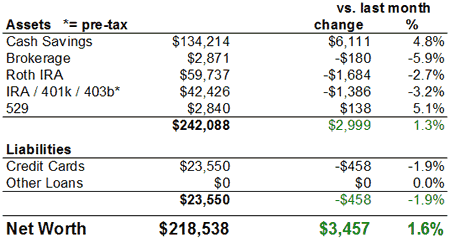
October 2007 Financial Status / Net Worth Update

Net Worth Chart October 2007

About My Credit Card Debt
If you’re a newer reader, you may have some concerns about my high levels of credit card debt. I’m actually borrowing money for free at 0% interest, putting it in high yield savings accounts that earn me 5% interest or more, and keeping the difference as profit. Along with other things, this helps me earn extra side income of thousands of dollars a year. Recently I put up a series of step-by-step posts on how I do this. Please check it out first if you have any questions. This is why, although I have the ability to pay the balances off, I choose not to.

Commentary

Retirement and Brokerage accounts. Last month’s update was right before the drop in the Fed Funds rate, which resulted in another big jump in our account values this time around. In addition, I made a large $10,000 contribution to my Self-Employed 401k at Fidelity.

I’m glad to get our retirement contributions back on track since we haven’t done very much in that department this year. I still have to figure out how much more I want contribute this year, as I do have a some flexibility with the account due to the ability to add profit-sharing contributions. Another thing on my mind is whether to contribute to a Non-deductible IRA this year.

Cash Savings. This actually didn’t go up as much, due to the big contribution to our 401k.

Quick summary. Our non-retirement funds went up slightly to $85,605, which puts us at almost 86% of our mid-term goal of $100,000 towards a house downpayment. Total net cash is at $79,707 (+$1,475 from last month). Take a look back at our previous net worth updates here.

September 2007 Financial Status / Net Worth Update

Net Worth Chart September 2007

About My Credit Card Debt
Newer readers may be alarmed by my high levels of credit card debt. I’m actually borrowing money for free, putting it in safe investments that earn me 5-6% interest, and keeping the difference as profit. Along with other things, this helps me earn extra side income of thousands of dollars a year. Recently I put up a series of step-by-step posts on how I do this. Please check it out first if you have any questions. This is why, although I have the ability to pay the balances off, I choose not to.

Commentary
August was still a very transitional month with starting new jobs, meeting new people, and getting used to living in the in-law unit of a family member. Most of our things are still stuffed in the basement. The positives definitely overwhelm the negatives however:

Cash Savings. It’s showtime! With dual incomes, no kids, and no rent or mortgage, the next several months should allow us to save money faster than ever before. This is a great opportunity, so I really want to take full advantage of it.

We’ve tried to alleviate the no-rent guilt by buying food, power tools, and football season tickets for our family. But they all know the whole point of living here is to save up for a house, and have done the same thing themselves, so hopefully there won’t be much tension.

Retirement and Brokerage accounts. There seems to have been a bounce since last month, with our accounts going up about 3% and ~$2,500. I don’t think we’re out of the woods yet, though. I do need to catch up on my Solo 401k contributions, and make sure to finish setting up our new Roth 403b plan.

Quick summary. Our non-retirement funds now add up to $83,763, which puts us at 84% of our mid-term goal of $100,000 towards a house downpayment. Total net cash is at $78,232 (+$10,938 from last month). Take a look back at our previous net worth updates here.