Search Results for: High Interest Savings

July 2008 Financial Status / Net Worth Update

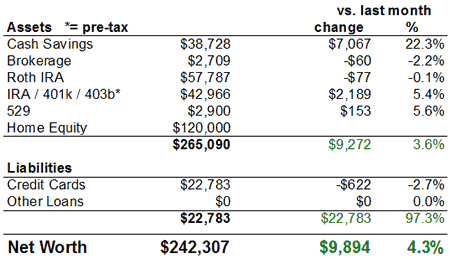
Net Worth Chart July 2008

Credit Card Debt
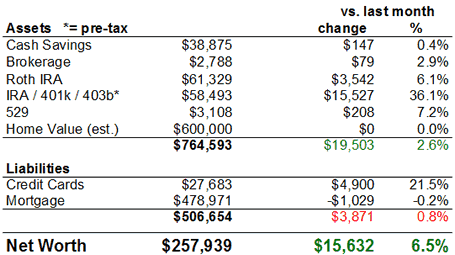
If you’re a new reader, let me start out as usual by explaining the credit card debt. I’m actually taking money from 0% APR balance transfer offers and instead of spending it, I am placing it in high-yield savings accounts that actually earn 3-4% interest or more, and keeping the difference as profit. Along with other deals that I blog about, this helps me earn extra side income of thousands of dollars a year. Recently I put together a series of step-by-step posts on how I do this. Please check it out first if you have any questions. This is why, although I have the ability to pay the credit card balances off, I choose not to.

Retirement and Brokerage accounts
Apparently this was the worst June since the Great Depression, with the S&P 500, Nasdaq, and Dow all losing around 9 to 10% last month alone. But it was only the worst June, not the worst month ever. Our overall portfolio didn’t fair quite so poorly due to our diversification into international stocks and bonds, but still sank nearly $7,000 in one month.

However, I remain confident in the fact that a globally diversified portfolio will perform adequately well over my time horizon of 20+ years. Add in the fact that shuffling investments around only serves to worsen my chances, and you get my same old brilliant plan of… doing nothing. I seriously had to skip over half of my financial magazines this month, with all their suggestions for “recession-proof” stocks.

Cash Savings and Emergency Funds
Our mid-term goal is to have $30,000 in net cash put aside for emergencies, for example if both of us find ourselves unemployed for an extended period and even have to start paying for things like health insurance on our own. We are now nearly 80% there at $23,810. After this is done, then I will focus on more contributions to my Self-Employed 401(k) plan at Fidelity. My timing just happened to work out well so far, with us accumulating cash while the markets are dropping.

Home Equity
Another tiny ~$500 of loan principal paid off. Since this is a “bad” month, I decided to pile on and reduce our estimated home value by 6%. Six percent is the approximate amount charged by a real estate agent, so we might as well count that in. I don’t like how our net worth is overly affected by such home value guesses, and am looking for a better way to measure our progress towards financial freedom.

You can see our previous net worth updates here.
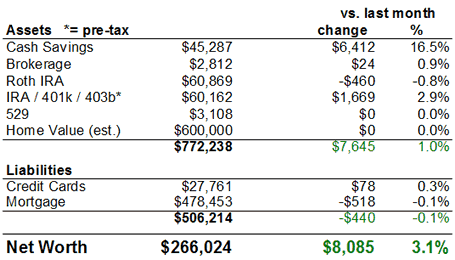
June 2008 Financial Status / Net Worth Update

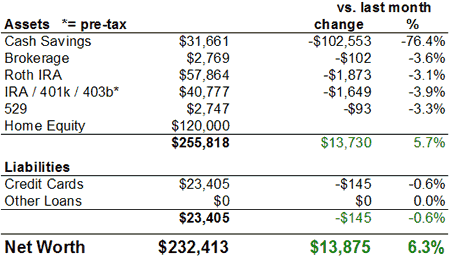
Net Worth Chart June 2008

Credit Card Debt
If you’re a new reader, let me start out as usual by explaining the credit card debt. I’m actually taking money from 0% APR balance transfer offers and instead of spending it, I am placing it in high-yield savings accounts that actually earn me 4% interest or more, and keeping the difference as profit. Along with other deals that I blog about, this helps me earn extra side income of thousands of dollars a year. Recently I put together a series of step-by-step posts on how I do this. Please check it out first if you have any questions. This is why, although I have the ability to pay the credit card balances off, I choose not to.

Retirement and Brokerage accounts
It seems like the markets were relatively idle over the last month. We made $2,141 in pre-tax 403(b) contributions. Not much else to report here, although our 403(b) plan did announce some new lower-cost fund choices for later this year, which is nice. I should do another portfolio update soon.

Cash Savings and Emergency Funds
Our mid-term goal is still to have $30,000 in net cash put aside for emergencies, which is 6 months x $5,000 per month in estimated expenses if both of us find ourselves unemployed. We are now a bit over halfway there at at $17,526. This fits in with our overall “just-in-case” focus for this month, hopefully we will also be getting some life insurance soon.

Home Equity
Another $500 of loan principal paid off. Housing values look to continue to be dropping a bit in our neighborhood, although nothing is really selling so it’s hard to tell. I’m definitely aware of this, but I’m still not going to try and re-value my house every month. I’ve found that Cyberhomes.com offers some good data on tracking median prices by zip code. Again, can be tricky to apply if only a few houses sell in your zip code and they aren’t really comparable in size or neighborhood.

Overall, a relatively quiet month financially. You can see our previous net worth updates here.

(By the way, my post yesterday on emergency planning was messed up due to some typos which cut out some parts, you can re-read it if you’d like.)

Women and Money by Suze Orman: One Man’s Review

Initially, I had intended this to be review of Suze Orman’s newest book Women & Money: Owning the Power to Control Your Destiny to be done by my wife. However, she expresses no interest in doing so. So I read it myself, and found out that her reaction was actually a bit ironic. Here is my review of this book both from the perspective of a male and the husband of a smart, capable woman who doesn’t like dealing with money.

The first half of this book deals primarily with the question of Women can handle money as well as any man… So why don’t they? It’s tough to deal with this subject obviously, because not all women are the same and you don’t want to be accused of stereotyping. But at the same time I’m glad that Suze tried. Here are a few ideas.

Women feel like coveting money is wrong. For some reason, it is okay to be proud to have a good job and a good family, but it’s wrong to openly admit you want lots of money. It could be that women tend to be more nurturing and taking care of others versus themselves. They don’t want to be considered selfish.

But at the same time that they try not to focus on money, they still worry about being broke. The book quotes a study that showed 90% of women describing themselves as feeling insecure when it came to their finances. In the same survey, nearly half the respondents said that the prospect of ending up a bag lady has crossed their minds.

Women are more team-oriented, as opposed to individually oriented. When a man thinks about money, they are at war – it’s a competitive battle. Me, me, me. When a woman thinks about money, she wants to make sure the whole team is treated fairly, and wants everyone to get along without hurting anyone else’s feelings.

An example of this is during salary negotiations. The book states that research has shown that women are 2.5 times more likely to say they feel “a great deal of apprehension” about negotiating. In one study, men used the metaphor of “winning a ballgame” to describe negotiating, while women picked the metaphor of “going to the dentist.”

I have personally experienced this with my wife. Although her performance reviews are always great, she has always been very passive when it comes to salary negotiations. Despite my suggestions, she has never asked for an higher raise than offered, and never put in a counter-offer when accepting a new job. Suze puts it this way – “You are not on sale. Do not undervalue yourself.”

Save Yourself Plan
The second half of the book is a condensed version of all her personal finance tips, broken down into 5 steps. The idea is that a woman should finish one manageable step per month. The advice is solid and straightforward, if a bit one-size-fits-all. Here’s a brief summary of each step:

  1. Checking and savings accounts. Get organized, get a free checking account, open up a higher-yield savings account, etc.
  2. Credit cards and FICO scores. Check your credit score, build up your credit if you don’t have any, pay down bills, pay less fees, etc.
  3. Retirement Investing. Start putting something away, invest in 401ks and Roth IRAs, buy low-cost index funds, etc.
  4. Must-Have Documents. Wills, living revocable trusts, advanced directives, etc.
  5. Protecting Your Family and Home. Life insurance, renters or homeowner’s insurance, personal liability insurance, etc.

Overall Review
I would read Women and Money if you (or someone important you know) feels like they should learn more about money, but for whatever reason haven’t been able to do so. This books tries to find the right buttons to push, and if it works then it will be worth it. It’s pretty popular so I’m sure most libraries have a copy. The advice included afterwards is good enough as starter material, but is not a source for advanced financial tips.

As for me, this book has caused me to want to involve my wife more in the day-to-day activities, if only to get her more familiar with things. I will continue to encourage my wife to read this book, and will probably include it in my Financial Will. Any thoughts from the women who’ve read this book?

May 2008 Financial Status / Net Worth Update

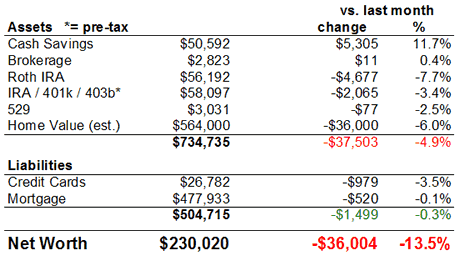
Net Worth Chart May 2008

Credit Card Debt
If you’re a new reader, let me start out as usual by explaining the credit card debt. I’m actually taking money from 0% APR balance transfer offers and instead of spending it, I am placing it in high-yield savings accounts that actually earn me 4% interest or more, and keeping the difference as profit. Along with other deals that I blog about, this boring activity helps me earn extra side income of thousands of dollars a year. Recently I put together a series of step-by-step posts on how I do this. Please check it out first if you have any questions. This is why, although I have the ability to pay the balances off, I choose not to.

Retirement and Brokerage accounts
There were three paydays in April for us based on a biweekly pay schedule. In addition stock prices are up about 6% from my last update on April 1st, making this month extra juicy. I estimate that capital gains accounted for ~$6,000 of the net worth increase. We also made our IRA contributions for 2007 before the April 15th deadline ($4,000 x 2), as well as $4,451 in 401k contributions in order to be on track to max out this year. All these things together made the value of our portfolio jump a lot.

Cash Savings and Emergency Funds
We did a bad job on increasing our cash savings, due to a big hardwood flooring purchase on top of the late decision to contribute to non-deductible IRAs. Taking into account the increased credit card balances, our net cash actually shrank. Need to fix this next month.

Home Equity
I’ve decided to switch to a simpler way to track home equity, as the previous method was a bit confusing. I have my estimated home value in the asset column, and my remaining loan balance in the liabilities column. The difference is home equity. I don’t use a Zillow estimate because that would put my house at nearly $700,000 in value, and although that sounds nice it’s not very accurate.

You can see our previous net worth updates here.
How I Plan To Shop For My Next Mortgage Loan, Part 2

altext

Continued from Part 1, where you should have figured out what type of loan you want to get, gathered copies of your important paperwork, and gathered a list of potential lenders. Now to narrow things down to one final lender.

III. Narrowing Down The List
To trim down your list, you may want to call some of them up and ask them a few questions.

1) What type of loans do they specialize in? (Don’t tell them what you’re looking for yet.)
2) What do you need for a rate quote and Good Faith Estimate? What is your quote? Many will give you a rate quite easily, but the GFE is sometimes harder without submitting private information. Just remember, any such quote is only as good as the information you provide.
3) How fast can they lock their quoted rate/points if you choose them? Can I lock this quote you just gave me today? Will they provide written lock confirmation? Will they guarantee their lender fees? (See below.)

Some other people throw in some quiz questions that relate to guessing future mortgage rates, but I don’t really care about that. Your final list might look something like this:

  1. A few Upfront Mortgage Lenders. These lenders have agreed to disclose accurate rates/points for the market niche they service, as well as guarantee their lender fees. At the very least, you should be able to get a good idea of a competitive current rate.
  2. First-time homeowner programs in your area, or perhaps you have a preferred lender for your housing project.
  3. Credit unions that are either local or otherwise restrictive (only teachers in your county, military affiliation, etc.)
  4. A broker that was highly recommended by a trusted friend experienced in real estate.
  5. A loan officer from a “big” bank, perhaps where you have an existing relationship.

IV. Compare Good Faith Estimates
When you apply for a mortgage, the government requires your lender to give you a Good Faith Estimate (GFE) within three days of your application. But you should be able to get one, or something similar to one, beforehand with no cost. When done, you should have GFEs from about 2-5 people to compare side-by-side. The actual document looks like a huge list of different fees and can be pretty confusing, but you need to simply break it down into three parts:

a. Interest Rate / Discount Points
– Use interest rate, not APR
– Also note lock period

b. Fees Paid To Lender (Add these all up)
– Application Fee
– Commitment Fee
– Rate Lock Fee
– Origination Fee
– Funding Fee
– Administrative Fee
– Transfer Fee
– Processing Fee
– Loan Set-up Fee
– Wiring Fee
– Discount Fee
– Flood Certification Fee
– Tax Service Fee
– Underwriting Fee
[Read more…]

Save For Specific Goals With Your Own Online Piggy Bank

piggy bankYou may be expecting a review of the new online service SmartyPig. Well, that review is in-progress, but while doing my research I was reminded of an alternate way to create your own online “piggy bank”. Remember how you’d actually have to save your quarters to buy what you wanted? Oh, the good old days… 😉

Let’s say you want to set up multiple “baskets” or “piggy banks” of money for specific goals. Maybe you have

  • an ongoing pet medical fund to which you add to regularly instead of paying for insurance ($50 per month?)
  • an ongoing car maintenance/repair fund (I need one of these)
  • a summer vacation fund (goal: $1,000?)
  • a Christmas fund
  • …or that all-purpose emergency fund!

You want separate balances and accounting for each account to keep things neat, but you don’t want to open up 3 new accounts at 3 different banks. The good news is that this can all be done with Capital One 360 – they let you easily and instantly create multiple savings accounts that have their own balance and nickname. No credit checks, no applications, and it earns interest. Here’s how:

1) First, you’ll need a Capital One Consumer Bank account. If you have one already, you’re all set. If you opened one before and it got closed to due low balance or inactivity, you can have them re-open it by calling 1-888-ING-0727 (or you can login and do it). If you are a new customer, you can earn a $25 sign-up bonus here by opening with at least $250.

2) Open up an additional savings account (or several!). It’s not all that complicated, but it still confused me initially so I broke down the steps below with screen-by-screen walkthrough. Click on the thumbnail images for a full size screenshots.

3) Set up an automatic savings plan
Although you can schedule manual transfers, why not make it easy on yourself and set up an automated transfer schedule? You can set a fixed amount of automatic withdrawals if you have a specific goal ($100/month x 1 year = $1,200 = HDTV), or you can make it repeat indefinitely (great for our often-used pet fund).

And you’re done! You can make as many of these sub-account as you like. The cool thing is you can make withdrawals at any time (max 6 per month), and there are no minimum balances or fees. The interest rate at 0.75% APY isn’t the absolute highest, but comparatively it’s no longer that far behind other similar banks.

(FYI – I was talking with my sister about this and she told me she didn’t use her Capital One 360 account anymore. When I asked why, she said it was not because the interest rate wasn’t high enough, it was simply because they made you log in with your customer number, and she would never remember it! I just wanted to point out that now you can pick your own username (like “janedoe444”). Use it carefully though, as your password is still just a 4-digit PIN.)

Daydreaming: How Can I Retire In 10 Years?

After months of being stuck in the day-to-day issues of buying a house, moving, and work, I spent a lot of time today… daydreaming! Mainly because I am getting tired of only having 2-3 weeks of vacation per year, I went back to thinking about how early I can achieve financial freedom. Let’s say I really want to retire in 10 years by age 40. What do I need to do?

Part #1: Pay off the house
I’m not saying everyone should buy a house, but I have one and would psychologically love to have it paid off before I retire. For me, housing is by far my largest expense. Using this mortgage payoff calculator, I would need to increase my monthly payments by $2,500 per month to pay off my mortgage in 10 years. For a 20-year payoff, I would need only $600 per month in additional payments.

Part #2: Estimate remaining expenses
Things now simplify greatly. What else do I need to pay for in retirement? This is for two people, kids will increase some items. I will ignore scary things like college tuition. All costs are monthly with some padding.

  1. Food, both groceries and dining out: $600
  2. Communications + Utilities: $350
  3. Gas, not much need if retired: $100
  4. Transportation, amortized cost of one car: $150
  5. Housing maintenance plus property taxes: $350
  6. Clothing, Entertainment, Travel: $250
  7. Healthcare: ???

Total without healthcare: $22,000 per year. Note that this isn’t my barebones spending, this is about what we spend now, and what I’d be happy with indefinitely. Of course, we could do better.

So how much will health insurance cost? This is a huge unknown. We are relatively healthy now, but who knows. Let’s say you get an individual high-deductible health plan for $100/month per person and get cancer (knock on wood). Can the insurer drop you or raise rates? I don’t know the answer, but I’m guessing they can at least raise rates at some point.

It’s possible that within the next decade we will have some form of universal healthcare system. If not, we may need to investigate ways to get on a group plan somehow. I will put in a wild guess of $8,000 per year.

Total with healthcare: $30,000 per year (after-taxes)

Part #3: Set up portfolio to produce this income
Using current tax brackets, we will have to pay very little income tax to achieve an after-tax income of $30,000 per year. For federal taxes, the first ~$18,000 is not taxed at all, and the rest would be taxed at 10% (married filing jointly). That’s an overall tax rate of less than 5%. We have no pensions or other annuities, just maybe Social Security down the road.

(Side note: If I have no other income from sources like pensions or annuities, this means I should lean towards contributing to Traditional IRAs and 401(k)s exclusively right now instead of Roth’s since my tax rate in retirement should be very low – much lower than I might have guessed before.)

Anyhow, if I use a 4% withdrawal rate, I would need $750,000 in today’s dollars. I will start with the $120,000 I have now and estimating returns at 8% annually, with inflation at 3%. Using this savings calculator with a goal of $750,000 in 10 years, I would have to save $3,600 per month for 10 years, or $1100 per month for 20 years.

Bottom Line
I know this is all guesses upon guesses, but here’s what my back-of-the-envelope daydreams give me:

  • To retire in 10 years, I would need $6,100 in excess income every month.
  • To retire in 20 years, I would need $1,700 in excess income every month.

Retiring so early just doesn’t give compound interest enough time to work its magic. It will be tough to integrate all this with our actual goals. But this is still encouraging for me, as I love having even rough numbers in mind to provide something to reach for.

April 2008 Financial Status / Net Worth Update

Net Worth Chart April 2008

About My Credit Card Debt
If you’re a new reader, let me first explain my high levels of credit card debt. I’m actually taking money from 0% APR balance transfer offers and instead of spending it, I am placing it in high-yield savings accounts that actually earn me 4% interest or more, and keeping the difference as profit! :D Along with other deals that I blog about, this helps me earn extra side income of thousands of dollars a year. Recently I put together a series of step-by-step posts on how I do this. Please check it out first if you have any questions. This is why, although I have the ability to pay the balances off, I choose not to.

Cash Savings and Emergency Funds
As stated last month, our immediate goal is to replenish our cash savings in order to have at least a 6-month emergency fund. (9-months would be better.) It feels a bit scary not to have a big pile o’ cash right with such a big mortgage to pay. I’m even holding off on my Solo 401k contributions for the time being. However, we decided that we will start funding her 403b plan through a regular monthly withdrawal to reach the max of $15,500 for 2008 (about $1,500 per month). Currently, we are about halfway to this goal.

After the e-fund is created, we plan to start paying down our 2nd “piggyback” mortgage which is at nearly 8% interest. I feel that at 8% interest even with an interest itemized deduction that the payoff is worth it. With US Treasury bond yields so low right now, this also works well into the concept of treating additional mortgage payments as increasing your bonds allocation. Where else can I find a low-risk bond are paying a 8% coupon.

Lazy Home Equity
Previously, I considered a few different ways to track home equity, one of which was using the formula of Home value – Loan balance. My home value is subjective and probably going to decrease. My loan balance will inch up a small bit after each mortgage payment. I’m not too excited about tracking either one, so I’m only going to estimate this once every six months or so. So no change this month. Sound reasonable?

Retirement and Brokerage accounts
Not much action here, I’m boring. Market prices are still slightly down. I need to put together another portfolio update soon.

You can see our previous net worth updates here.

Money Merge Accounts Explained, Part 1: The Basics Of Accelerated Mortgage Payoff

Now that I have a mortgage of my own, I finally spent the time to read up on Money Merge Accounts – also known as Mortgage Offset Accounts, Mortgage Acceleration Programs, Equity Accelerators, etc. You may see them sold by various companies like United First Financial or Tardus. All of them offer to make it easy to pay off your 30-year mortgage earlier by 10 or 20 years without changing your spending habits. My goal here is to be educational without being inflammatory and using words like “scam”.

I think the best way to do this is for people to view their own 15-minute sales presentation video, and have me explain afterwards how the numbers really shake out. If you’re short on time, you can drag the little arrow to the middle and pay attention to their walkthrough of the $200,000 accelerated mortgage paydown.

Breaking It Down: Simplified Version

Finished? Okay, here is a simplified version of the situation in the video. Let’s just say you have plain loan with a $200,000 balance being charged 6% simple interest (accrued daily). You can pay the balance down, or borrow more money as you wish. You don’t have any minimum payments for the time being. You earn $5,000 each month, and have $4,000 in expenses. There are two sources of potential savings through this account.

Source #1: Interest Offset
If you simply deposited your entire paycheck into the loan balance, it would reduce the loan balance temporarily to $195,000. As you pay your $4,000 in bills throughout the month, you balance will go back up to $199,000. But your lower balance throughout this time will reduce the amount of interest you’re being charged. This is what they call “interest cancellation” or “interest offset”.

This interest savings will repeat each month. In an ideal situation, it would be like having your loan balance decreased constantly by $4,000. At 6% annual interest, this would be $240 a year, or $20 a month. Actual net savings would most likely be far less if you usually keep your idle cash in an interest-bearing account, but let’s just leave this number to be generous. Again, we are ignoring additional fricton

Source #2: Additional Principal Paydown
But hey, notice that after the first month your loan balance is now only $199,000. This is because you have $1,000 in extra income each month. Let’s assume you wish to keep paying down this loan with it. Besides lowering the amount owed, it also saves you interest this year and all the years after that. That’s $1,000 each month + 6% interest. In one year, you will have paid down the loan by $12,000 and also avoided $387 in interest. That’s a “savings” of $12,387 a year.

My point? Most of the benefit of this program is due to the fact that you are using all of your excess money to pay down your loan, not the interest offsets. This is also confirmed using their own numbers:

Breaking It Down: Using The Provided Example

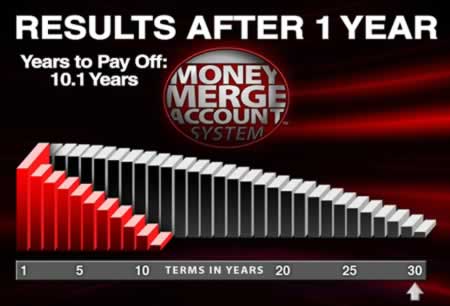
In the marketing video, by using their special optimizing algorithms and juggling money between their Home Equity Line of Credit and the $200,000 mortgage, they claim to have shortened a 30-year fixed mortgage so that it can be completely paid off in 10.1 years.

altext

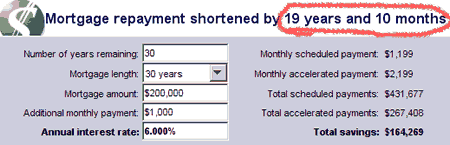
However, this result can be matched almost exactly by simply using this Mortgage Payoff calculator. Using the inputs of a new 30-year mortgage of $200,000 at a rate of 6%. Now let’s put that $1,000 as an additional monthly payment on top of the required $1,199. Again, you’ll see that your mortgage is shortened by 19 years and 10.5 months – the same as having it paid off in… 10.1 years! Virtually all of the mortgage acceleration is explained by paying extra towards your mortgage.

altext

One of the first things you learn about in investing is the power of having your money earn compound interest. Well, holding a mortgage is like paying compound interest to the banks. A $200,000 mortgage for 30 years at 6% ends up being $431,677 in total payments. On the flip side, paying a seemingly small additional amount of money per month towards your mortgage can shorten your loan drastically. Bookmark the calculator above and simply type in your own remaining mortgage balance. You’ll see that even an extra $50 per month would shave off 3 years from the example 30-year mortgage!

Conclusions So Far
Before even considering these programs, you have to ask yourself if you really do want to pay off your home early. That is a separate argument, and there are several arguments against it.

If you do decide to do this, I hope that I’ve illustrated (as many others have also discovered) that if you strip away all of the marketing distractions, the actual monetary benefit of this program is probably around 1% interest offset and 99% old-fashioned mortgage principal pre-payment. Simply keeping your idle cash in a high-yield bank account, and putting the cash you have left over towards your mortgage principal each month, will yield virtually the same results. All of the optimizing software in the world won’t change this fact by any significant amount.

What this software will also provide is give directions for payment each month, as well as continually update your projected payoff date. Is this worth $3,500? Definitely not for me, but I’ll try to show next why it’s also not worth it for most people. Meanwhile, consider this: Putting $3,500 towards the $200k mortgage – instead of buying this software – would shave over a 1.3 years off the loan length and save over $16,000 in potential interest all by itself.

Additional Resources

Test Driving The Financial Life You Want

Now that we have a fixed monthly mortgage payment for the foreseeable future, we are looking ahead to our true mid-term goal of living on one income. Specifically, we’d like to live on two half-incomes when we have children. We live in one of the most expensive areas in the country. Can we do it?

Both of our incomes are somewhat comparable, so our plan is to actually pretend that only one of us is working, deposit that person’s paycheck into a checking account, and work only from that checking account. The mortgage note, utilities, food, gas, all expenses will be deducted from that account. A reasonable percentage (15%? 20%?) for retirement will still be taken out. I have no idea what a child will cost, but maybe we’ll take out an extra $500 a month for food and diapers as well? The second person’s income will still be dealt with, but just separately.

This way, we will get as close as we can to simulating living on one income. If the checking account starts to shrink too fast, we’ll have to think of ways to cut expenses further. I think this is an interesting idea that could be applied to anyone who wants to stretch into a new financial goal. You may think you can do it, but failure might be costly.

  1. Buying a new home. Can you afford a mortgage payment that is significantly higher than your rent? You should be sure, otherwise you might be joining the million other people in foreclosure.
  2. Kickstarting your retirement contributions. Maybe you’re afraid of putting too much in a 401(k) or IRA and not being able to take it out. Why not just use savings account and stick your imagined contributions in there for a while? That way you won’t have to deal with penalties.
  3. Increasing your debt payments. Some people are afraid to pay off too much debt in case they need the money for later. An emergency fund would help solve this, but also the “pretend” debt account might be a good temporary solution.
  4. Going back to school, switching careers, etc. Again basically the same idea – how will you react to living on less income?

Reasons All Homeowners Should Get A HELOC? (Home Equity Line of Credit)

With my new fat mortgage, I’m considering whether to also take out a Home Equity Line of Credit (HELoC). This is not a home equity loan where you take out a lump sum at a fixed rate, but is a line of credit usually at a variable rate. I think of it as a credit card that is secured by my house (!). I don’t plan on actually using it, but I think it might nice to have around as long as the upfront costs to me are minimal. Here’s why:

Safety Net / Emergency Funds
Although having adequate emergency funds in cash is always preferable, it is nice to know that you have a HELOC as a backup in case of prolonged job loss or health problems. It’s always better to line up credit ahead of time while you have good credit rather than when you are already desperate. Using a HELOC can be preferable over paying sky-high credit card interest or falling behind bills (late fees, damaged credit score). Ironically, you might even use it to temporarily keep current on your mortgage to avoid penalties or even foreclosure. Let’s hope not.

Cheap and Flexible
The nice thing about a HELOC with no fees is that if you don’t take any money out, you don’t pay anything. And because the money is secured by your home, this assurance makes your interest rate relatively low. The rate is usually close to the WSJ Prime rate, which is currently 6% APR. On top of that, your interest paid might even be tax-deductible.

The interest is accrued daily, which makes it good for quick loans. So if you do need to take out $10,000 on short notice and you don’t have the cash on hand, using a HELOC might be the most economical way to do it. At 6%, your interest owed on $10,000 is only $1.64 a a day. Of course, for many folks this convenience might just provide too much temptation. All debt can turn into a double-edged sword. Know thyself, is all I can say.

Tool for Credit Card Profit Games
Here’s a trick to go along with making money with 0% balance transfers that is a good example of that flexibility. With certain credit card issuers it can be difficult to turn your balance transfer into cash in your pocket, especially when you have no existing balances. But here’s an example of how to use your HELOC to extract $10,000:

  1. Request a balance transfer from your 0% APR credit card for $10,000 directly to your HELOC. Since this is loan they won’t mind at all.
  2. Shortly before the balance transfer is scheduled to arrive, write a check for $10,000 from the HELOC to your interest-bearing bank account. Now you have created a temporary $10,000 debt at 6% and $10,000 bank balance earning ~4% (minus some possible lost days of interest).
  3. When the balance transfer payment arrives a fews days to a week later, your HELOC debt will be paid off.
  4. A week’s worth of interest at 6% APR ion $10,000 is only $11.50. And that is partially countered by interest earned in your savings account.
  5. Voila! For around ten bucks, you now have $10,000 at 0% APR in your bank account to do as you wish. 😉

Finding a HELOC – What To Look Out For
Now, I don’t want a home equity line if it’s going to cost me a bundle. Here’s a quick rundown of important factors when looking for a HELOC, based on an article by the Mortgage Professor.

  • Introductory rate and period. Temporary teaser rate to suck you in.
  • Margin. This is usually how your non-teaser interest rate is determined, relative to the Prime rate.
  • Minimum draw. How long can you take money out?
  • Required average balance. Do you have to take some money out?
  • Upfront lender fees. These days, you should be able to eliminate these.
  • Upfront third party fees. Harder to get waived, but try.
  • Annual fee. Just say no, again. Sometimes only waived for first year.
  • Cancellation fee. Many have these, I guess so you don’t bail and go to another bank. This is especially the case if they waive all the upfront costs above, since they are losing money on you so far. As long as you can keep your balance at $0 with no fees, just keep it open and don’t use it.

I see a lot of competition out there now that rates are low, so definitely shop around. As a data point, I just saw a special offer from Bank of America for a no closing cost, no application fee, no annual fee HELOC. Don’t forget to try your local credit unions as well.

March 2008 Financial Status / Net Worth Update

Net Worth Chart March 2008

“Good” Credit Card Debt
If you’re a new reader, you may have some concerns about my high levels of credit card debt. I’m actually taking money from 0% APR balance transfer offers and instead of spending it, I am placing it in high-yield savings accounts that actually earn me 4% interest or more, and keeping the difference as profit! :D Along with other deals that I blog about, this helps me earn extra side income of thousands of dollars a year. Recently I put together a series of step-by-step posts on how I do this. Please check it out first if you have any questions. This is why, although I have the ability to pay the balances off, I choose not to.
Cash Savings, Home Purchase
If my posting has been a bit light lately, it has been because I’ve been bogged down by a combination of illness, travel, and the home-buying process. Also, I didn’t want to do it in real-time because there were some snags along the way… but we’ve finally closed!! I have lots of house-related posts coming about mortgages, inspections, and so on… but first here are a few details that will help explain this net worth update.

Purchase price $600,000
Down payment (20%) $120,000
Discount points paid (1%) $6,000
Buyer’s agent rebate (1.5%) $9,000
Closing Costs ~$3,000 (rest paid by lender)

Our purchase price of $600,000 was more than the $500,000 we estimated we wanted to spend a couple years ago, but we are now in a 4-bedroom single-family home that we can see ourselves living in forever. In addition, we didn’t stretch too far as we can handle the mortgage payment on either one of our incomes.

We believe we got a good deal even though the short-term market looks bad, and the house has tons of potential. We’re even going to rent out a room to a relative. Our home appraisal actually came in at $640,000 – we’ve been told an appraisal coming in higher than purchase price doesn’t happen very much in this scared housing market. Using this value would actually leave our home equity at $160,000 instead of just the down payment of $120,000. However, I’m just going to be conservative and leave it at $120,000 for now.

As you can see, our 50% buyer’s agent rebate helped offset our closing costs and the points on the loan. Of course, mentally we are using the $9,000 rebate towards all the home improvement projects we have brewing. 😉 Finally, adding back in the $5,000 earnest deposit that I had marked as spent last month makes the numbers look a lot better than they really were.

Emergency Fund?
Our net cash balances have taken a big hit to less than $10,000, and that makes me nervous given that our monthly expenses just shot up drastically. Our foreseeable mid-term goal will definitely need to be to build up a proper emergency fund, which we’ve never officially had since we basically treated our downpayment funds as such. Visiting Brazil and Australia will have to be placed on the backburners for now…

Retirement and Brokerage accounts
February is the fourth month is a row that our IRAs and 401k/403bs have dropped by 3%. We may need to start setting up some regular monthly investments in order to help force ourselves to keep investing.

It’s been a wild month! You can see our previous net worth updates here.