Search Results for: High Interest Savings

Shorter Full-Retirement vs. Longer Semi-Retirement?

Which would you rather do:

A) Work 40 hours/week for 15 years, and then not work at all for the next 15 years, or

B) Work 20 hours/week for 30 years?

If you were to ask me a few years ago, I would have picked A. Now, I’d much rather have B. Of course, it’s not as simple as just picking one or the other. Some sample considerations:

  • At most jobs, you can’t simply decide to work less hours and get pro-rated pay. A job change or some clever negotiations with management might be necessary. Self-employment may be better suited to option B.
  • Even if you can work half-time, often you lose your healthcare benefits. This might be reasonable if you are single, but for a family with kids the costs can be pretty high. Might need to investigate alternative ways to get group coverage (professional association, creating your own small business insurance group).
  • For option B, you have less money coming early on, but you have more time for compound interest to occur before taking withdrawals. The opposite is true for option A – more money upfront, but you’ll need to start spending sooner.
  • The (historically) optimal investing asset allocation might be different for both situations.
  • With option B, depending on timing and desire, you would have more ability to spend time with your children when they are young. Is time upfront worth more than time later? Quite possibly.
  • I think it would be hard for me not to work at all. For one, there is the stress of trying to live off a finite amount of money. Second, one would need to find another purpose in life to fill all the hours. Others might find it really easy…
  • Option A gives you a bit of leeway if investment returns don’t pan out as you’d like. Maybe you’ll work a bit longer than 15 years. Trying to make up lost savings when you are older may be more difficult (ageism) and/or tiresome (just age).
  • Lower annual income with option B might leave you with lower overall tax hit.
  • Behaviorally and psychologically, it may be easier to spend less if you force yourself to make less.

I need a better name than “semi-retirement”. Downshifting? Half-retirement? Half-working? Working 9-1?

Series I Bonds November 2008 Fixed Rate: 0.7%

The new fixed rate for Series I Savings Bonds (“I Bonds”) was announced on Monday to be 0.7%. A few readers asked if I thought this was a good time to buy.
As a long-term investment, a 0.7% real yield makes I-Bonds a poor choice, as you can buy TIPS with much better yields. As of yesterday, a 5-year TIPS had a 3.66% real yield.

As a short-term investment, it depends on how you think inflation will turn out in the near future.

If you buy now in November, you will earn 0.7% fixed + 4.94% based on inflation = 5.64% for the first 6 months. The second 6-month rate will be 0.7% + a variable rate based on inflation from September 2008 to March 2009. So far, the markets seem to suggest that there is a decent possibility that there might even be deflation for this period. Reminders: You must hold for at least a year (or 11 months and a day if you buy on the last day of the month). If you hold for less than 5 years, there is a penalty of the last 3-months interest.

Worst case scenario, there is deflation of worse than 0.7% which makes the total rate zero for the 2nd six months. Earning 5.64% for 6 months with an 11-month holding period gives you only an effective 3.07% APY. If say, inflation is 1%, you’d get an effective 3.54% APY for the minimum 11-month hold. Even if this is exempt from state taxes, the tax-equivalent yield won’t be far above 4%. You can do better with bank CDs.

The only scenario where I-Bonds may be better than what you can get from a bank is if you think annualized inflation will be higher than 1.5% over the next 6 months. Personally, combined with the lack of short-term liquidity, I don’t think I’d take that bet right now.

For more background, see my last post on savings bonds.

November 2008 Financial Status / Net Worth Update

Net Worth Chart 2008

Credit Card Debt
If you’re a new reader, let me start out as usual by explaining the credit card debt. I’m actually taking money from 0% APR balance transfer credit cards and instead of spending it, I am placing it in high-yield savings accounts that actually earn 3-4% interest or more, and keeping the difference as profit. I put together a series of step-by-step posts on how I do this. Please check it out first if you have any questions. This is why I have credit card balances – I am not accumulating more consumer debt.

Retirement and Brokerage accounts
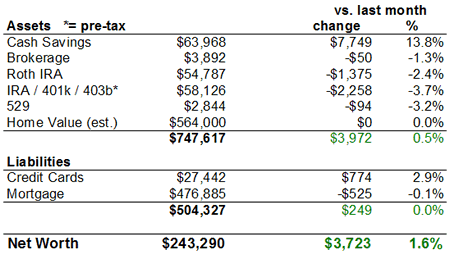
Well, it’s time to uncover my eyes and peek at my financial statements. My retirement accounts have lost another $15,000 (14%) over the last month, in addition to the $12,000 from last month. I did not make any further investments besides the $5,000 in early October.

However, I am still planning to max out my 401k salary deferral by the end of the year, and will still be buying stocks according to my previously set asset allocation plan. I still believe that stocks are the best bet for inflation-beating returns in the long run.

Cash Savings and Emergency Funds
I remain a big proponent of emergency funds held in safe cash or cash-equivalent accounts. We now have approximately 7 months of our actual monthly expenses saved up. Increasing this is a lower priority than the 401k contributions, though.

Home Equity
I am testing out a new way of estimating our house’s value. First, I take the average estimates provided by Zillow, Cyberhomes, Coldwell Banker, and Bank of America. Then, I shave off 5% to be conservative and subtract 6% for expected real estate agent commissions (11% total). I use this final number as my estimate for home value.

I know that each of these sites can be inaccurate, but I am primarily looking for overall trends based on recent comparable sales, and this should take care of that with minimal effort. Feedback is welcome. The mortgage amount is taken directly from my loan statement. Which reminds me, I might need to see if I can argue with the tax collector about my property tax appraisal.

We are still socking away about half of our take-home pay each month, but this looks like the worst drop ever in our net worth. Let’s hope it stays the worst! 😉

You can see our previous net worth updates here.

Your Own Financial Rescue Plan, Part 1: Adequate Cash Reserves

Well, the big boys are getting their rescue/bailout plan, but I guess ours got lost in the mail… So what should we do? I think that everyone should take a second look at their cash reserves. Do you have enough?
What Job Security?
These days, I don’t see any job as safe. My company went from interviewing people to hiring… nobody. Even local and state governments are facing major budget deficits. At a minimum, I would want a few months of living expenses to tide me over until I find another job. I still remember the dot-com bust days when former tech workers ended up living in their cars.

A Reason Not To Invest In Stocks
Hey, if you’re looking for an excuse not to buy any more stocks for a while, beefing up your emergency fund is not a bad one. Any money you may need within 5 years should be in cash or short-term investments anyway.

A Reason *To* Invest In Stocks
Ironically, after you build up a nice cushion, it may actually make you feel better about investing in the stock market. I definitely helps me to keep short-term money separate from long-term money. As such, I’m still applying my upcoming income towards maxing out my 401(k) for 2008. But after that, I will probably start to save another three months of living expenses, for a total of 9 months in cash.

Less Credit Available
A lot of people used to simply assume that their home equity line of credit (HELoC) could serve as their emergency fund. But these days, it just takes one letter in the mail that says your HELOC is frozen or greatly reduced. You don’t want to be forced into taking an early withdrawal from your 401(k) or IRA, or paying exorbitant credit card interest.

If anything, apply for a credit card with a low fixed interest rate now while it is still offered. Here is a list of no fee 0% APR balance transfer credit cards. Just buy goods as you regularly would, and pay the minimum while saving the difference in an interest-bearing account. (Don’t go buying more stuff, obviously!)

Looking Ahead
For me, an alternative reason for increasing my cash reserves is that I can also use it later for investing in real estate. I still don’t see many opportunities with good cashflow right now, and may not see them for another couple of years. But I want to be ready, as the no-money-down days may never come back.

Where do you keep it?
As long as it is safe and liquid, I just go by rate. Use the new FDIC insurance estimator if you have lots of money. Both Vanguard and Fidelity are participating the money market fund insurance program, so they are super-duper safe now. . Well, your old money is safe. Still, I consider money market funds with Fidelity and Vanguard as safe as FDIC-insured, although this is only my opinion. However, my cash is currently split between:

  1. Series I US Savings Bonds – Bought in April with 1.2% fixed rate, now only 0% fixed rate available. Note that they are illiquid for the first 12 months. Rates adjust semi-annually. I earn 4.38% for 1st six months, 6.06% for 2nd six months. With recent inflation, my 3rd six months should also be pretty good. Exempt from state income tax as well.
  2. 12-Month 5% APY CD at WaMu/Chase – Sadly, no longer available.
  3. Low or no-minimum banks with high liquidity – A big chunk currently in transit to Everbank at 1.10% for first 6 months.

October 2008 Financial Status / Net Worth Update

Net Worth Chart 2008

Credit Card Debt
If you’re a new reader, let me start out as usual by explaining the credit card debt. I’m actually taking money from 0% APR balance transfer offers and instead of spending it, I am placing it in high-yield savings accounts that actually earn 3-4% interest or more, and keeping the difference as profit. Along with other deals that I blog about, this helps me earn extra side income of thousands of dollars a year. Recently I put together a series of step-by-step posts on how I do this. Please check it out first if you have any questions. This is why, although I have the ability to pay the credit card balances off, I choose not to.

Retirement and Brokerage accounts
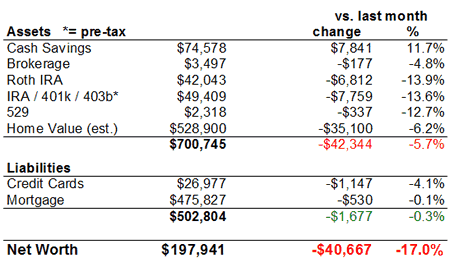
Whew! Ignoring new investments, the value of my holdings lost nearly $12,000. I won’t go into why, I think most people have heard the overall reasons. I did a portfolio update in mid-September to better understand what happened specifically. Accordingly, I am directing future contributions as I can to help rebalance my portfolio back towards the target asset allocations (mainly international developed and emerging markets stocks).

I did make an $5,000 contribution to my self-employed 401k, although I am still left in negative territory for the month. I do hope to contribute at least the $15,500 maximum salary deferral in 2008, as this has been my only contribution so far this year. My wife has already maxed out her 401(k).

Cash Savings and Emergency Funds
Last month, we achieved our mid-term goal of six months of expenses ($30,000) in net cash put aside for emergencies. Once my retirement accounts are funded, I may try to increase this cushion. An alternate reason for increasing cash is for potential real estate opportunities (way) down the road.

Home Mortgage
Another ~$500 of loan principal paid off. According to Zillow, the estimate of the value of my house is still higher than what I originally paid for it, but has also dropped 3% in the last month alone.

Big Expenses
We are taking a trip to Spain in November, which will cost us about $1,000 each. I wrote earlier about how we tried to save money on travel and how we manage cash and credit cards abroad. The airfare has already been paid for (charged on the credit cards to earn rewards, of course).

Basically, I still consider myself doing well, but I guess it is hard to avoid what everyone else is experiencing. Shrinking 401(k). Dropping house value. Rumors of potential layoffs for part-time employees at work (who’s next?). Lots of red in my net worth chart. 🙁 Fun times, eh?

You can see our previous net worth updates here.

Bought Some More 5% APY Bank CDs From WaMu/Chase

I went ahead today and bought some more of the 12-month CD at 5% APY from Washington Mutual/Chase. Here’s why:

Reason #1: Chase agreed to honor WaMu CD rates
From the official FDIC WaMu takeover page:

6. Will I continue to earn interest at the same rate?
JPMorgan Chase accepted Washington Mutual’s interest bearing accounts including CD’s at the contract rate; therefore, they are not waiving early withdrawal penalties.

Even though there was speculation that Chase would only pay interest up to the failure date as was the minimum requirement, Chase went as far as to not even allow early withdrawals without penalty. They have committed to honoring these rates, which also worked out great for those that jumped on it last month.

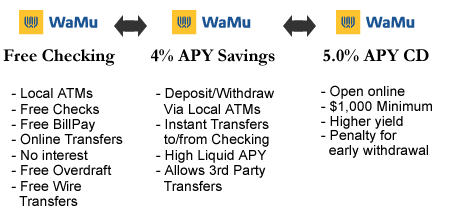
Reason #2: They are still offering the 5% APY 12-month CD
A week later, the same high rate is still on their website:

This can’t have been an accident. 13-month CD is available too.

Reason #3: It’s FDIC-insured, now with a more stable bank
For those that worried about WaMu service interruption or lost liquidity (which never happened) , now it should be even more stable with Chase Bank.

Reason #4: It’s still a top rate, and it might change at any time.
Maybe there is some sort of behind-the-scenes rate freeze agreement that we don’t know about. Their popular Online Savings + Free Checking combo is still paying 4.00% APY on savings and the checking perks haven’t changed (WaMu review). Savings accounts at any bank are always subject to change, so there is nothing I can do about that. But I can sure lock in this rate now and keep my system going as long as possible:

Reason #5: Fed may drop interest rates soon
Bailout plan or not, this economy ain’t doing so well. Although I don’t make big bets on such forecasts, there is a good possibility that Fed will lower interest rates by the end of the year (see USA Today, WSJ).

If your funding source is not WaMu, they let you fund electronically with another bank’s routing and account number. You have to remember to verify the test deposits, though.

Money Market Fund Breaks The Buck: What’s Safe Now??

One of the largest and first money market mutual funds ever has broken the buck yesterday. The Primary Fund, run by The Reserve, with $65 Billion in assets, saw it’s per-share price drop from the standard $1 to 97 cents, due to it’s holdings of Lehman Bros. debt. They are also restricting withdrawals for up to 7 days. According to the NY Times, this is only the second time in history this has ever happened.

In the aptly titled Pride Goeth Before a Fall, NY Times blogger Floyd Norris points out how The Reserve actually made fun of other money market funds for being careless. This is from a letter from The Reserve to shareholders from earlier this year:

When we created the world’s first money fund in 1970, we clearly stipulated the tenets that define a money fund: sanctity of principal, immediate liquidity, a reasonable rate of return — all while living under the overarching rubric of boring investors into a sound sleep. Unfortunately, a number of firms that sponsor money funds, and a number of investors that selected them, have lost sight of the purpose of a money fund and the simple rules that guide them in their foolhardy quest for a few extra basis points. […] Thank you for your confidence in our Reserve. We never forget you have entrusted us with your reserve(s).

Yeah, you’re welcome. Can I have my money back now? 😛 If you trade with TD Ameritrade and have a money market sweep set up with them, I believe they use The Reserve.

Where Should I Put My Cash?

Consider sticking with an FDIC-insured bank account. Money market funds are not insured. If you want that, you should stick with an FDIC-insured bank and mind the FDIC insurance limits carefully.

Besides, it’s more profitable right now. You can get a savings account today with no fees or minimums that earns up to 3.75% APY. The fund that failed above was only yielding 1.19%, and I don’t know of any money market fund that yields higher than 3%. (Even if it does, be suspicious!). Why settle for less interest and more risk?

Invest in a Treasury money market fund. But many of us have brokerage accounts with an automatic sweep or “core” option. We have to pick some sort of money market fund. In this case, to get the most safety you should choose the “Treasury” money market option, because these only invest in Treasury securities which are backed by the U.S. Government. You often end up with a lower yield, but some of it is recovered if you live in a state with income taxes. Treasury interest is exempt from state income taxes.

For example, with Zecco Trading their taxable money market (CSAXX) is yielding 1.81% while their Treasury MM (ITRXX) is only at 1.16%.

Invest in big fund companies with lots of assets. You might be surprised to know that many other money market funds would have broken the buck this year, except that the fund companies stepped in with their own money to prop things up. The Wall Street Journal reports that “20 money-fund advisers have moved to support their funds within the past 13 months”. One recent example is the influx of money by Wachovia Corp. into the money market funds from Evergreen Investments, which they own.

Why do they do this? Not out of the goodness of their hearts. It is to protect the trust of their brand and to prevent a huge onslaught of withdrawals. I would certainly never invest in a company that I can’t even trust with my cash. Therefore, if you are going to invest in a money market fund, buy one in a company which would spend every last penny to protect it’s name brand. From Marketwatch:

Phillips speculated that because The Reserve is solely a money market shop, it didn’t have the resources to bail out Primary Fund in the way a diversified mutual-fund giant such as Fidelity Investments, Vanguard Group or Evergreen Investments, which is owned by Wachovia Corp , would be able.

FYI for those who invest in Vanguard money market funds:

Vanguard Group’s money-market funds have no exposure to commercial paper from Lehman, Merrill Lynch & Co., Morgan Stanley, Goldman Sachs Group Inc., Washington Mutual or AIG, according to a spokesman for the Valley Forge, Pa., asset manager.

As for Fidelity:

Fidelity’s taxable, general purpose money market funds have no exposure to any Lehman Brothers entity, Crowley said. The taxable money market funds do have “modest” exposure to two issuers that are subsidiaries of troubled American International Group.

Although most of my cash is in FDIC banks right now for the higher yield, I would personally still sleep well with money kept in a money market fund from Fidelity or Vanguard.

September 2008 Financial Status / Net Worth Update

Finally got around to adding up the numbers for the last month:

Net Worth Chart July 2008

Credit Card Debt
If you’re a new reader, let me start out as usual by explaining the credit card debt. I’m actually taking money from 0% APR balance transfer offers and instead of spending it, I am placing it in high-yield savings accounts that actually earn 3-4% interest or more, and keeping the difference as profit. Along with other deals that I blog about, this helps me earn extra side income of thousands of dollars a year. Recently I put together a series of step-by-step posts on how I do this. Please check it out first if you have any questions. This is why, although I have the ability to pay the credit card balances off, I choose not to.

Retirement and Brokerage accounts
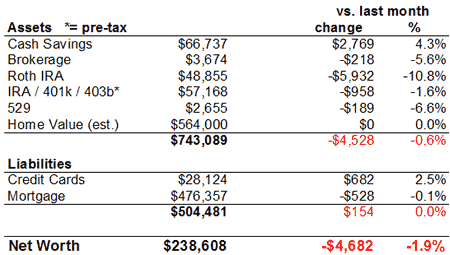
The bad news is that the market value of our investments went down over $3,500. And this is despite my wife being able to finally max out her 401k for 2008 (total of $15,500 as of this month). At least I don’t own much Fannie Mae stock…

The good news is that I am finally ready to make some big contributions to my Fidelity Self-Employed 401k, at the same time that the markets are near their 2008 lows. Buy low, sell high! Why now? I like to wait because my income fluctuates and this way I have a clearer idea of what my contribution limits will be, as they are based on gross income.

Cash Savings and Emergency Funds
Our mid-term goal was to have six months of expenses ($30,000) in net cash put aside for emergencies. This is now done. As mentioned, future cashflow will be put towards retirement accounts. Speaking of emergencies, with all these hurricanes, I have been checking out portable generators as well.

Home Mortgage
Another ~$500 of loan principal paid off. Housing prices are still dropping in my area. I will probably have to adjust my home value estimate in the future, a short-term goal might be to pick a simple benchmark to follow. After a few other financial priorities are taken care of, perhaps I’ll start a DIY biweekly mortgage plan.

We had some visitors and took a tiny bit of vacation this month, so it was a nice end to the summer. You can see our previous net worth updates here.

Archives: Useful Homebrew Financial Calculators

calc.jpgIf have to repeatedly have to make a calculation and I can’t find it elsewhere to my liking, I usually try and make my own calculator to save time in the future. Below are links to ones that I still use regularly, I wanted to point them out because they tend to get lost in my archives. Hopefully, they can be useful to you as well.

Ultimate Interest Rate Chaser Calculator
A “rate chaser” is someone who move their money to whichever bank offers the highest interest rates. For example, due to various promotions I have over 10 accounts open at various online banks. This calculator helps you figure out how much money you’ll earn by switching.

True Cost of Impulse Buying Calculator
Being smart with money is all about choices and priorities. Would you rather have another $300 iPod, or realize that with compound interest you could have an $2,000 more (inflation-adjusted!) later on. You’re not just saving $300, you’re shaving weeks off your retirement date!

Your Portfolio’s Rate of Return – Estimation Calculator
When trying to figure out your portfolio’s performance, don’t just trust the performance stats of your mutual fund or that number on your statement. Calculate it independently using this simple calculator. It gives surprisingly good estimates.

Your Portfolio’s Rate of Return – Exact Calculator
Slightly more complicated to use, but more accurate. You must know the dates and corresponding amounts of cash inflows and outflows.

Asset Allocation Guide: Percentage Of Your Portfolio In Stocks?
The calculator at the bottom shows you how your stocks/bonds ratio might look if you use popular Target Date mutual funds as a reference.

0% Balance Transfer Profit Calculator Tool
My series of articles on How To Make “Free” Money From 0% APR Balance Transfers has been very popular and many readers have also jumped in. Despite the risks, I’m still happily earning some money from the credit card companies for a change, and haven’t missed any payments.

This calculator is for the analytical types that want to have a better idea of profit potentials. The calculator takes into account minimum payments required by credit card issuers. Use in conjunction with my list of best 0% APR balance transfer offers.

5% APY 12-Month CD From Washington Mutual

WaMu has rolled out a new 5% APY 12-month CD, which is a very high yield for that term length. Yes, WaMu has had some issues like other banks, but I’ve already explained why I am sticking with them as long as I’m under the FDIC insurance limits.
Convenience Factor
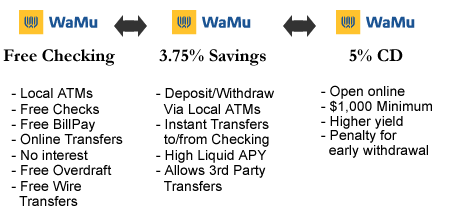
If you already bank at WaMu, you can fund it easily online with a minimum of $1,000. With their existing Free Checking and 3.75% APY Online Savings combo, it makes a convenient package:

Early withdrawal penalty is 90 days interest. You can fund directly from your existing accounts. I might move some money around for this one.

Combine with 0% APR Balance Transfers
For those that are interested in making some profit using 0% balance transfers, but have been holding off due to the narrowing interest rate spreads, this might be an opportunity to jump back in. Here is a list of no fee 0% APR balance transfer credit cards.

Borrowing the money at 0% and putting it in 5% CD for 12 months gives the following rough math: Gain of 5% interest on $12,000 = $600. Minus $75 fee and taxes to get your final profit. You can do better if you get a larger credit limit. If you can handle the minimum payments of 2% of balance per month ($200 initially each $10,000) with your regular cashflow, then you could stick the entire amount in the CD. The actual terms say that the introductory period lasts “until the last day of the billing period ending during September 2009”.

August 2008 Financial Status / Net Worth Update

Net Worth Chart July 2008

Credit Card Debt
If you’re a new reader, let me start out as usual by explaining the credit card debt. I’m actually taking money from 0% APR balance transfer offers and instead of spending it, I am placing it in high-yield savings accounts that actually earn 3-4% interest or more, and keeping the difference as profit. Along with other deals that I blog about, this helps me earn extra side income of thousands of dollars a year. Recently I put together a series of step-by-step posts on how I do this. Please check it out first if you have any questions. This is why, although I have the ability to pay the credit card balances off, I choose not to.

Retirement and Brokerage accounts
We added another $3,048 in 401(k) contributions, which given the numbers above means our retirement accounts actually lost about $1,000 in value. YTD performance numbers are… not good. I just hope that the prices stay low until I can start buying again now that I am done with the Emergency Fund.

In my brokerage accounts, I sold all of my “play money” stocks (only valued at ~$2,000) and instead participated in a minor arbitrage attempt. It worked out well, I made a gain of 10% in 17 days. It’s all in cash now and I again have no position in individual stocks at all.

Cash Savings and Emergency Funds
Our mid-term goal is to have $30,000 in net cash put aside for emergencies, for example if both of us find ourselves unemployed for an extended period and even have to start paying for things like health insurance on our own. We are basically done, with about $500 to go. Now to find better uses for our incoming cashflow.

Home Mortgage
Another ~$500 of loan principal paid off. I am debating whether to start paying extra towards my mortgage right now. In my mind, it would feel nice to have a home paid off as part of my grand early retirement plan. However, I also like the idea that such a long-term loan at <6% can act a nice inflation hedge. Besides healthcare costs, I view unexpected inflation as another scary unknown for early retirees.

You can see our previous net worth updates here.

One Way To Track Your Progress Towards Financial Independence

Another more conventional definition of financial freedom is when you have “passive” income that covers your expenses so that you no longer have to work. Usually, this comes from paper investments like stocks, bonds, or annuities. In the book Your Money or Your Life, the authors outline a somewhat unique way to track your progress towards financial independence (FI).

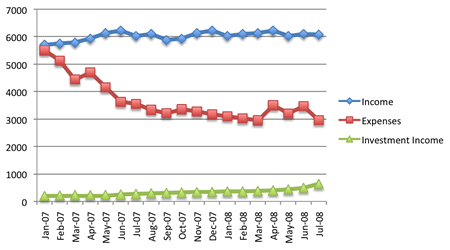
First, you should go out and buy a huge wall-sized piece of graph paper and put it up somewhere you’ll see every day. Create a chart with the horizontal axis being time, and the vertical axis being money. Each month, you should record the following items:

  1. Your monthly income
  2. Your total monthly expenses
  3. Estimated investment income

Here is a sample of what it might look like:

Line 1 – Graphing Your Income Each Month
While many personal finance articles focus on spending less, the book does a good job of reminding us that income matters and we can always do something to increase it. It also tells us that the path towards a happier life and a career you enjoy of also tends to increase your income. The book summarizes this with the following:

“Increase your income by valuing the life energy you invest in your job, exchanging it for the highest pay consistent with your health and integrity.”

Line 2 – Graphing Your Expenses Each Month
Note that we are not making a budget here. A budget often seems to suggest a goal of “I will spend this much”. Instead, here you are first making an assessment of your situation from last month. You then attempt a few (or several) changes, and re-assess again a month later. This continual feedback should ideally help you see what is working and what’s not.

For those dealing with debt, the Expenses line might even be higher than your Income line at first. This should provide a nice incentive to get to the first “crossover point” where you at least earn what you spend. Gradually, we can shave off those lower priority expenditures as we keep seeing that gap between income and expenses grow wider and wider.

Line 3 – Graphing Your Expected Income From Investments
Here, the simple formula given for finding the income you can derive from your investments is this:

savings x interest rate / 12 = monthly investment income

The suggested investment here is to use is that of the 30-year U.S. Treasury Bond, currently yielding somewhere around 4.5%. This means if you bought $100,000 of these bonds with your savings, you would earn $375 reliably every month for 30 years without risking your principal. Other people might use dividend payments from stocks, or use a historically-safe withdrawal rate.

Either way, the big goal is to make this third line meet up with the expenses line. As time goes on this line will hopefully curve up exponentially, providing inspiration to reach this “crossover point”. The idea of working for only a finite period of time can be very motivating.

Given that this book was written in 1992, I am going to guess that doing this using a spreadsheet program like Excel is also acceptable. While a physical chart may work better for some people and provide a more constant and tangible reminder, I think perhaps making the chart your Desktop wallpaper might serve a similar purpose. (Or you could create blog about it…)

This is a pretty cool idea. Perhaps I should stop tracking net worth and simply do this? For us, as mentioned before, once our mortgage is paid off the expense line should drop dramatically. Separating out the non-housing expenses into a separate line might help me focus better.