Search Results for: High Interest Savings

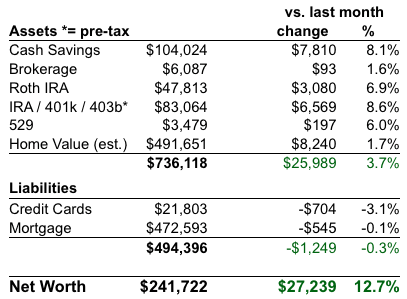
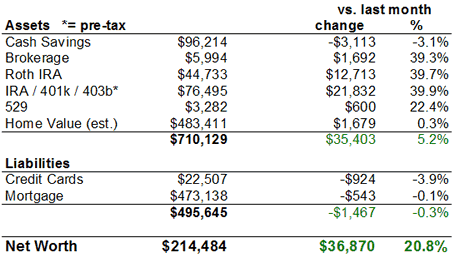
Monthly Financial Status / Net Worth Update (May 2009)

Net Worth Chart 2009

Credit Card Debt
In the past, I have taken money from credit cards at 0% APR and placed it into high-yield savings accounts or similar safe investments that earn 4-5% interest or more, and keeping the difference as profit. I even put together a series of step-by-step posts on how to make money off of credit cards in this way. However, given the current lack of great no fee 0% APR balance transfer offers, I am have not been as active in this “game” recently. My credit score remains high enough that I haven’t seen any negative actions.

Retirement and Brokerage accounts
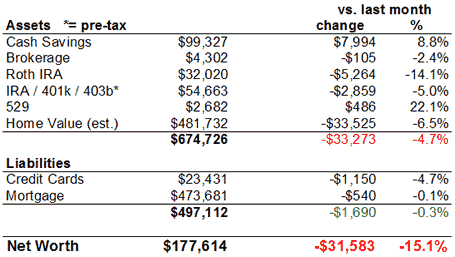
The market rally was sustained during April, so our predominantly passive investment portfolio increased a bit. We contributed another $2,312 in 401(k) salary deferrals this month including company match. See my investment portfolio page for more details.

I get attracted to various different ideas as time passes, but I really haven’t changed my investment portfolio in about two years now. I always need to remind myself to stick to the basics.

Cash Savings and Emergency Funds
Our cash savings rose again, and although I want to keep one year of expenses for our emergency cash reserves, I need to start putting more money to work in the stock market and other investments. It’s just hard to let go of the security of cash right now. We are contemplating whether we want to save up for a rental property.

Home Equity
I used the same internet valuation tools as before – Zillow, Cyberhomes, Coldwell Banker, and Bank of America (old version).

I have zero personal input here, I just average out what the sites say. They say up. The number shown is after an additional 11% reduction to be more conservative. Not that it really matters, as I am primarily focused on paying off the mortgage, as outlined in my quick and dirty plan for financial freedom!

WaMu Free Checking is now Chase Free Extra Checking

More changes… WaMu bank accounts are gradually being converted into Chase accounts, and customers will have to log in at Chase.com with new usernames. Mine is switching over May 22nd. The popular WaMu Free Checking account becomes the Chase Free Extra Checking account, and keeps a lot of the useful perks. I received another mailed pamphlet from Chase outlining all the details, but I couldn’t find a link online, so I typed out the highlights below.
Benefits

  • No monthly service fee, no minimum balance requirement.
  • No fee for money orders, cashier’s checks and travelers checks.
  • No Chase fee for non-Chase ATM withdrawals.
  • No fee for Domestic Outgoing for Foreign Outgoing Wire Transfers.
  • You will continue to receive your discounted or free check orders when ordered from us.
  • One insufficient funds/Returned Item Fee will be refunded annually. However, the refund will no longer be automatic, you must call in and specifically request it. Also, it will no longer carry over if unused.

Changes

  • The 0.03 Cash Back debit rewards program is discontinued.
  • We may change your account to a Chase Better Banking Checking account when you do not have at least one customer-initiated transaction over the past six monthly statement cycles (which has a $12 monthly fee if minimum balance is not met).

The WaMu Online Savings account will be converted to a Chase Premier Savings account, with the monthly fee “waived at this time”. I could not find any information on the interest rate, but I have a feeling this account will not return to its former high yields.

Added: According to the letter I received, the account numbers, checks, and ATM/debit cards will remain the same and active.

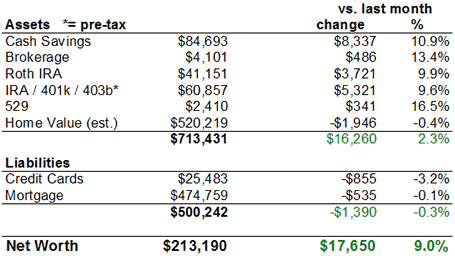
April 2009 Financial Status / Net Worth Update

Net Worth Chart 2009

Finally a bit of green!

Credit Card Debt
For newer readers, don’t worry. In the past, I have been taking money from credit cards at 0% APR and immediately placing it into high-yield savings accounts or similar safe investments that earn 5% interest or more, and keeping the difference as profit. I even put together a series of step-by-step posts on how to make money off of credit cards this way. However, given the current lack of good no fee 0% APR balance transfer offers, I am just waiting to pay off my existing balances.

Retirement and Brokerage accounts
March was a rebound month for the stock market, and our balances went up accordingly. We contributed $10,000 into IRAs, and $12,969 in 401(k) salary deferral and company match. A chunk of that was a true-up contribution from 2008. Score! See my 2009 Q1 portfolio update for more details.

Cash Savings and Emergency Funds
Our cash savings did drop due to the IRA contributions, but we still have over a years worth of expenses set aside. I want to keep one year of expenses for our emergency fund, and start looking for places to invest the rest.

Home Equity
I used the same internet valuation tools as before – Zillow, Cyberhomes, Coldwell Banker, and Bank of America (old version). The magical elves have decided that my home is worth a tiny bit more this month. The number shown is after another 11% reduction to be more conservative.

It’s been about a year that I’ve had this mortgage, and I am wondering if I should commit some cash towards paying down the mortgage principal too. If I make an extra mortgage payment each year, I replicate a biweekly accelerated payment plan, and can shave around 5 years off my 30-year mortgage.

Walking Out On My Mortgage? My View

Here’s my personal response to my question: Would You Ever Walk Away From Your Mortgage? I didn’t initially mean to make this a separate post, but it ended up being a bit long. Ethics are always a fuzzy area and very difficult to explore clearly on paper. The question also hits close to home, because it’s quite possible in the near future that I could also owe more on my mortgage than my house is worth. Hurray leverage!

Ethics and Debt
Everyone has their own ethical standards. When thinking about this problem, the first example I thought of was unsecured debt like credit cards. Let’s say you could extract $100,000 cash from credit cards (actually not that hard just a year ago). What’s to keep you from running away with it? Besides an sense of honor, one major deterrent would be that your credit score would be junk for 7 years or so.

But what if that obstacle was removed? Let’s say you knew you were going to move to Thailand forever. Then you could keep the money and there would be no financial consequences. (Heck, $100k would probably fund a few years in Thailand…) Now, I think most people would agree that this would be unethical. I do. Of course, some might point out that Citibank or American Express knew this was a possibility, so too bad for them, right?

Going back to mortgages, the only addition is that your house is now placed as collateral. Does the addition of collateral change the ethics of paying the loan back? I don’t think so. If somebody walks away, then they’re basically saying their collateral isn’t worth much anyway. So I must conclude that there is still an ethical obligation to at least attempt to repay any loan.

Practical Matters: Hardship and Math
Now, it’s easy to say you’ll always repay your loan when you’re not staring down the possibility of bankruptcy or losing decades worth of saving.

Extreme Example #1: Easy Money
Let’s say you have $100k in the bank, but you decide to go ahead and buy a $300k house with 0% down. The local economy collapses, and the house is now only worth $100k. Certainly, you could suck it up and keep paying your mortgage even though you have $200k of negative equity to overcome. How can anyone not be tempted to just walk away and go buy the house next door for cash with only $100k? You’d be walking away from $200,000.

Here is a video from CNBC about a guy asking about if he should walk away from his home (via TBP). Starts at 0:30.

He bought the house for $600k and says it is only worth $270k now. His outstanding balance is $350k, so he’s underwater by about $80k. All of the show’s hosts tell him that it his is obligation to keep paying. They even suggest that he is irresponsible for having a interest-only mortgage which resulted in some negative amortization. However, this guy initially put up a 50% downpayment on this house. Yes, the guy has already lost $300,000! What if he had put down nothing? Can these they each honestly say they would walk away from $330,000?

Sure, if I was only $10,000 or probably even $100,000 underwater on my mortgage, I wouldn’t walk away if I could still make the payments. The phrase “good faith effort” comes to mind. But to be honest, I think there would be a point where practicality would step in. It might be high, but the point is the number exists. Would I be willing to work for an additional decade in order to feel better about paying off a mortgage? I don’t think so. So I can’t necessarily judge others who have done the same, even if their tipping point was lower.

Extreme Example #2: Impending Bankruptcy
This time, imagine you just lost your job. Your ARM loan has reset, you can’t refinance, and your mortgage payment is now $3,000 per month. Rent on a comparable house would be $1,000 per month. You have $25,000 in savings. You can either walk away now, and make a go with your $25,000, or wait it out and face probable bankruptcy. Then you’ll not only lose your house but also be broke. In this situation, I’d definitely cut my losses. I would not sacrifice the financial security of me and my family over a house loan.

MicroPlace Review: Earn a 5% Return and Help Fight Poverty Too?

“A billion people around the world work hard every day to lift themselves out of poverty. They don’t want your charity. They want your investment. Invest today, earn a return, provide them with a livelihood.” – Microplace.com homepage.

Sounds pretty good, huh? Microplace is owned by Ebay, and is an SEC-registered broker of microfinance securities to individual investors. Loans are classified by level of poverty, financial return, length of investment, and geographical location. Recently, they got my attention by offering a 2-year loan with a promised interest rate of 5% per year, and a 4-year loan at 6%.

What is microfinance?
Microfinance is the supply of loans, savings, insurance and other basic financial services to low-income households and businesses, usually in areas where people don’t have access to formal banks. Microcredit is the extension of very small loans (microloans) to these poor entrepreneurs. A big name in this arena is the Grameen Foundation.

Tell me more about this 5% return…
Here is the loan listing page, and here is a link to the long 63-page prospectus for these Global Poverty Alleviation Notes (how’s that for an investment title?). I have looked through it, but haven’t digested it all. They are offered by Micro Credit Enterprises (MCE), a 501(c)(3) nonprofit organization. MCE seems to focus on women entrepreneurs, which have made up about 90% of their borrowers. They seem to participate in a variety of countries on 4 continents, from Armenia to Bolivia to Cambodia.

These notes are not a mutual fund, and is not FDIC or SIPC insured. These are unsecured debt obligations, with partial backing of “philanthropic guarantors”. Basically, wealthy individuals and/or groups promise to repay parts of this loan if there are enough defaults. The details are a bit vague, but there seems to be a networked agreement across multiple guarantors. However, risks definitely remain.

The actual interest charged to local microfinance institutions (MFIs) are stated to be from 8-10%. The rates paid by actual individuals are not stated, but can be as high as 30%. But these are often short-term loans to people with no collateral and few alternatives. The historical repayment rate is listed to be 96%.

What about MicroPlace vs. Kiva.org?
Kiva.org also lends small amounts to low-income entrepreneurs in the developing world. However, Kiva currently does not offer interest to lenders since it is a non-profit organization and is not registered with the SEC. Also, it has more of a person-to-person lending structure where you can choose the specific person you wish to lend to. However, I have read that Kiva is trying to offer interest in the near future.

Are you going to invest?
I’ve put some money to “work” at Kiva already, and my personal repayment rate on my completed loans from Kiva has been 98% so far. Given that I am still not very familiar with these investments, I still can’t treat the 5% Microplace note as a reliable investment. However, I am still leaning towards putting a chunk of money into it, because I do think significant principal loss is unlikely, and I want to give them a chance. If it works out, I think microfinance would really take off if there was also a financial benefit to investors.

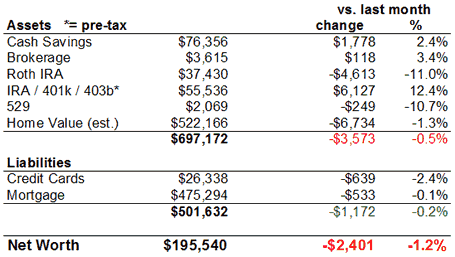
March 2009 Financial Status / Net Worth Update

Net Worth Chart 2009

Time for another super-happy-fun net worth update…

Credit Card Debt
For newer readers, don’t worry. In the past, I have been taking money from credit cards at 0% APR and immediately placing it into high-yield savings accounts or similar safe investments that earn 5% interest or more, and keeping the difference as profit. I even put together a series of step-by-step posts on how to make money off of credit cards this way. However, given the current lack of good no fee 0% APR balance transfer offers, I am just waiting to pay off my existing balances.

Retirement and Brokerage accounts
Unless you’ve been completely devoid of human contact for the last few weeks, you know the market is in the dumps. I really don’t have much market commentary to make, besides the fact that I still intend to keep investing. I’ve been trying to cut back on the CNN/CNBC-types of financial news actually and focus more on things I can change, which as a result has helped keep me a bit more optimistic.

Cash Savings and Emergency Funds
Our emergency fund has increased a bit, but this snapshot was taken before we each put $5,000 into our 2008 IRA contribution. So really it remains at about a year of our current expenses.

Home Equity
This is where most of this month’s drop comes from. I used the same internet valuation tools as before – Zillow, Cyberhomes, Coldwell Banker, and Bank of America (old version) – but while most of them continued their gradual decline, the Coldwell Banker estimate dropped by over $140,000 in one month! After taking off 5% to be conservative and 6% for expected real estate agent commissions (11% total), the overall average estimate dropped by $34k. Well look at that, I am nearly “underwater” on my house despite putting 20% down a year ago. Oops.

Conservative 529 Options: CollegeSure Tuition-Indexed CDs vs. Inflation-Protected Bonds (TIPS)

Recently, I have been exploring the “safe” options inside various 529 plans. This would be a good choice for those who want to feel like they are making continuous gradual progress and avoid the swings of the stock market, similar to what is offered in pre-paid tuition plans in certain states like Florida. The problems with those plans are that they are usually limited to residents only, and your kid often has to go to one of the in-state schools to get the guaranteed tuition benefit. One unique pre-paid type of plan is the Independent 529 plan, but it is also restricted to certain schools (mostly private liberal arts colleges).

Next, there are plans with guaranteed-return funds backed by insurance companies, or certificates of deposit from banks. However, these types of investments are still subject to inflation risk. If a period of high inflation occurs, your returns could be squashed. Even with current deflation concerns, given current government policy I think high inflation in the future is still a potential concern.

So what’s left?

CollegeSure Tuition-Indexed CDs

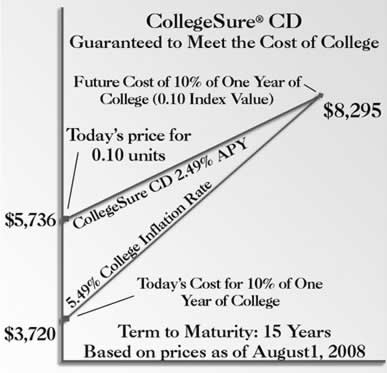
Offered by the College Savings Bank, these are FDIC-insured certificates of deposit which offer an interest rate linked to college tuition levels. The CollegeSure CD earns an annual percentage yield (APY) over the life of the investment that is 3.00% less than the college inflation rate. (For a while, this margin was only 1.5%.) These are only available through either the Montana or Arizona 529 plans, but you can use the proceeds towards a school in any state.

The CDs are available in maturities ranging from 1 to 22 years, so you are basically pre-paying tuition at a fixed premium. Here’s an illustration from their site:

Changes in costs are tracked by the Independent College 500 Index (IC500), which is derived from the average tuition plus housing costs of 500 private colleges. Over the last 10 years, the college inflation rate has been 5.4% annualized, Over the last 20 years, it was 5.7% annualized. Of course, this is just an average and it both excludes public universities and ignores the average aid packages given out, but it seems to be a reasonable index.

Treasury Inflation-Protected Bonds

Treasury Inflation-Protected Securities (TIPS) are bonds that promise you a total return that adjusts with the CPI index for inflation. Very generally, it works like this: if the stated real yield is 2% and inflation ends up at 4%, your return would be 6%. TIPS are issued and backed by full faith of the U.S. government. Right now, they are only available in 529 plans in the form of mutual funds like the Vanguard Inflation Indexed Bond Fund. Some plans offer them as part of their age-based investment mixes, but a few offer them as standalone investment options. The Ohio 529 plan ($25 bonus) looks to offer the cheapest option, with an annual expense ratio of 0.32%.

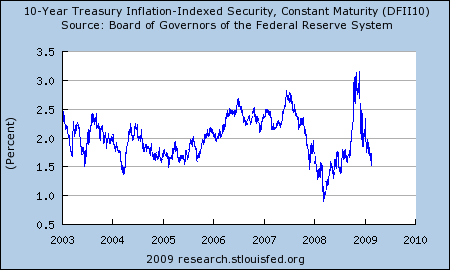
The actual real yield you get varies, but here is some historical market data for a maturity of 10-years, which is close to the average mutual of the Vanguard fund:

To make a rough estimate, I’d say you average about 2% real before fees. After about 0.3% in fees, you’d end up with 1.7% + inflation.

Inflation is tracked here by the CPI-U (Consumer Price Index for All Urban Consumers), a number tracking the price of a wide basket of goods and services. From January 1999 to January 2009, the annualized inflation rate was about 2.5%. Over the last 20 years, it has been about 3.0%.

It does not focus on college tuition, or even include it explicitly as far as I know. However, there should be some correlation to college tuition.

So which is better?

Would you rather have:

Overall Inflation plus 1.7% or College Inflation minus 3%

If we use the average numbers from the last 10 years, the CollegeSure CD would have earned roughly 2.4% annually and the TIPS fund would have earned roughly 4.2% annually. This would seem to tilt in favor of TIPS, but there are two problems:

  • Unlike with the CollegeSure CD, you can’t match the maturity of the TIPS fund with your goals. It’s more or less fixed at 10 years forever. For example, if you only have 2 years left until college, you might want to start moving money out because you can still lose principal in the short-term due to interest rate fluctations.
  • If the rate of college tuition rises significantly higher than overall inflation by greater than 4.7% a year, then the TIPS fund would fall short.

One could always split money between the two as well, but for not I’m just investing in the TIPS. College inflation may continue to outpace overall inflation (or it may not), but I doubt it will do so by more than 4.7% a year for an extended period. Also, I believe that investment options in 529s will only improve with time. One day, I expect to be able to buy individual TIPS to more closely match maturities with our time horizon.

This is not to say I’ll necessarily be 100% TIPS – I’ll most likely throw a bit of stocks in there – but I think it’ll be a big component of our plan.

February 2009 Financial Status / Net Worth Update

Net Worth Chart 2008

I pretty much have a general feeling of malaise right now. Hiring freeze at one job, big group meeting about how “we don’t have to worry about layoffs… right now” at the other. And now it’s time to look at my incredibly shrinking net worth… I know I have it really good in general, but let’s just make this quick. 😉

Credit Card Debt
I do not carry consumer debt. In the past, I have been taking money from credit cards at 0% APR and immediately placing it into high-yield savings accounts or similar safe investments that earn 5% interest or more, and keeping the difference as profit. I even put together a series of step-by-step posts on how I make money off of credit cards this way. However, given the current lack of good no fee 0% APR credit card offers, I am just waiting to pay off my existing balances.

Retirement and Brokerage accounts
The media has pronounced last month as the “Worst January Ever” for the Dow (-8.8%) and the S&P (-8.6%). The value of our passively-managed portfolio shrank accordingly. Our 401(k) contributions for the month and new company match got swallowed up instantly by losses. Same old, same old.

Cash Savings and Emergency Funds
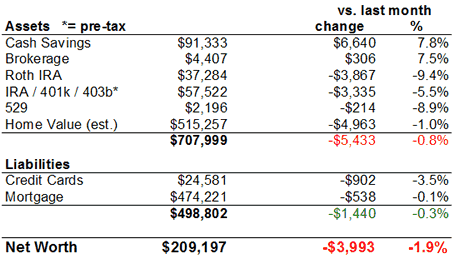
Our net cash balance (aka emergency fund) increased a bit, and remains more than 12 months of our total monthly expenses. Let’s hope we don’t need it.

I intend to contribute again to a non-deductible Traditional IRA for 2008. My reasons are basically the same as last year: Should I contribute to a non-deductible IRA? The limits for Roth conversions are removed in 2010, which is just around the corner.

Home Equity
I continue to estimate our home value using internet tools, starting with the average estimates provided by Zillow, Cyberhomes, Coldwell Banker, and Bank of America. After taking off 5% to be conservative and 6% for expected real estate agent commissions (11% total), I am left with $515,257.

I need to work out the last few kinks in my new long-term goals, in order to regain some focus. You can see our previous net worth updates here.

January 2009 Financial Status / Net Worth Update

Net Worth Chart 2008

Credit Card Debt
I have no actual consumer debt. In the past, I have been taking money from credit cards at 0% APR and immediately placing it into high-yield savings accounts or similar safe investments that earn 5% interest or more, and keeping the difference as profit. I even put together a series of step-by-step posts on how I make money off of credit cards this way. However, given the current lack of no fee 0% APR credit card offers, I haven’t been as active with this recently.

Retirement and Brokerage accounts
The value of our passively-managed portfolio bounced back by about 10% compared to last month. There were no new contributions. As noted, we did manage to max out both of our 401(k)s this year, and plan on making 2008 IRA contributions by the April deadline.

Cash Savings and Emergency Funds
Our emergency fund balance is nearly at 12 months of our total monthly expenses. So theoretically both my wife and I could be laid off and we would be okay for 12 months without having to sell any longer-term investments. I am very happy with this cash cushion.

Where is it? I suppose you could say I “actively manage” my cash, putting it in various places to maximize yield while maintaining the highest possible safety. For example, I have some in a previous WT Direct promo at over 6% annualized interest, some in Series I Savings Bonds at over 6%, and a chunk at a WaMu 12-month CD paying 5% APY with about 10 months remaining.

Compare this to the piddly 0.14% for 90-day T-Bills and 0.43% on 1-year Treasuries! If you didn’t get in on any or all of these, keep reading or subscribe to updates for new deals as they come up.

Home Equity
I continue to estimate our home value using internet tools, starting with the average estimates provided by Zillow, Cyberhomes, Coldwell Banker, and Bank of America. This left me with $584,516. Then, I shave off 5% to be conservative and subtract 6% for expected real estate agent commissions (11% total) to reach my final estimate. Fortunately, we bought as prices were falling already, and the area where we live has not been hit nearly as bad as other major metropolitan areas.

Looking ahead, I am working on new goals for 2009, and also better metrics for measuring our financial progress. You can see our previous net worth updates here.

Saving More May Allow You To Take Less Stock Market Risk

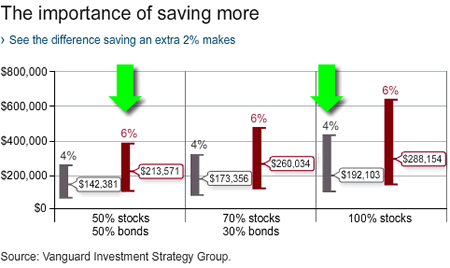
Vanguard has a new article titled The importance of saving more, which tries to address evidence that investors may believe that “choosing investments that offer the possibility for relatively higher returns—and accepting the accompanying greater degree of risk—is a more viable alternative than saving more.”

In addition, the last few months probably have many of us re-examining the amount of risk we are comfortable with in our portfolios. I know I have. So what can we do?

Taken from the article, the figure below shows hypothetical outcomes for different portfolios based upon the following scenario: A 35 year-old individual begins saving 4% (grey bars) of his gross annual salary ($50,000, adjusted annually for inflation) each year for 30 years. In the red bars, the same individuals instead saves 6% of his salary. I highlighted two of the more interesting situations with the green arrows:

Here you see that based on historical data, the combination of a 50% stock/50% bond allocation and a 6% contribution rate leads to a similar range of outcomes as a 100% stock allocation and a 4% contribution rate. In fact, the former has a slightly better median outcome with much smaller swings over the years.

For example, a 50/50 asset allocation this year would have been down only around about 20%, instead of the stomach-churning 40% drop of a 100% stock portfolio. Wouldn’t that have been nice?

Higher savings provides a higher probability of success by shifting some of the responsibility for accumulation from the less-certain return stream of risky assets to a more-certain savings stream. In the end, if an investor is trying to maximize future wealth, a marginally higher savings rate rather than a substantially higher risk portfolio is the most likely path to retirement success.

As opposed to many rules of thumb, not everyone at the same age has to have the same asset allocation. Savers may get to take less risk and sleep better at night. 🙂 Something to think about…

December 2008 Financial Status / Net Worth Update

Net Worth Chart 2008

Credit Card Debt
I have no actual consumer debt. In the past, I have been taking money from credit cards at 0% APR and immediately placing it into high-yield savings accounts or similar safe investments that earn 3-5% interest or more, and keeping the difference as profit. I even put together a series of step-by-step posts on how I make money off of credit cards this way. However, given the current lack of good low fee 0% APR credit card offers, I don’t think I’ll be doing anymore in the near future.

Retirement and Brokerage accounts
Ignoring new contributions, my retirement accounts have lost about ~$8,500 over the last month. I will perform another portfolio update soon to find more accurate year-to-date return numbers.

I have sent in another $5,000 late last month and $5,000 this month in order to max out my pre-tax 401k contributions for this year. My asset allocation is way off target so I need to sit down and try to rebalance using these funds today. It might be tricky to due to the $10,000 minimums for index funds at Fidelity, and I might actually buy ETFs and pay the trade commission.

Cash Savings and Emergency Funds
Why am I not panicking (yet)? Well, I think a big part is my fat cash pile that serves as my emergency fund. In my mind, having a separate short-term reserve keeps me from worrying about my long-term “can’t touch” portfolio.

I have about $49,000 net in sitting in different forms of safe cash earning from 3 to 6% interest, while now my entire retirement portfolio is worth about $93,000. I will keep accumulating cash until I reach a full year’s worth of expenses, which is about $60,000. I think this is prudent given the high unemployment rate right now.

Home Equity
This is the second month of testing out my new way of estimating our house’s value. Again, I take the average estimates provided by Zillow, Cyberhomes, Coldwell Banker, and Bank of America. Then, I shave off 5% to be conservative and subtract 6% for expected real estate agent commissions (11% total). I use this final number as my estimate for home value. Looks like my home value has dropped by another 1% or so.

Overall, another tough month. However, I am very thankful we both still have jobs – knock on virtual wood!

You can see our previous net worth updates here.

Entrepreneur Interview: Maury of PennyPortrait.com

Today, I wanted to share an interview involving a unique website business thought up, constructed by, and maintained primarily by just one person. Maury is a long-time MMB reader and e-mailed me recently about his new venture – PennyPortrait.com. There, you can purchase a kit that allows you to create a portrait of Abraham Lincoln solely out of differently-shaded pennies:

Each kit includes a poster of Abe Lincoln made from images of actual pennies. The poster is suitable for framing as is, but with a little effort, some glue, and 846 of your own pennies, you can have a unique work of art that truly shines. (No, really… it shines!)

Here’s the interview:

Where did you get the idea or inspiration?
I read an article online about a father and son who created a giant portrait of Abe Lincoln out of pennies. Their image was 24″ x 36″ and they used two shades of pennies. I thought other parents and kids might enjoy a project like this and went about trying to create an improved, easier to assemble version on my computer. Using four shades of pennies, I was able to decrease the size of the image to 18″ x 24″ (846 pennies) which seemed a bit more
manageable.

Did you set up the website yourself? Do you have previous experience in this area?
I have a background as a graphic designer, but had only created a handful of small sites previously. The trick was to use one of the various free CSS templates available on the web and go from there. For example, the Penny Portrait site is based on this free template. Using a free CSS template allows you to create an impressive site in short order. Some of the graphic
elements took a little bit longer, but the layout was a snap.

Is this your first side business?
This is my first retail business of any kind. I’ve had a lot of experience with service businesses (animator/designer/consultant), but I’d never actually sold anything tangible before. Part of the reason I wanted to do this project was to learn how a retail business works with inventory,
suppliers, sales tax, credit card processing etc. It has been extremely educational from that standpoint.

Who sorts the pennies? Are you using child labor? (You could fund your child’s IRA this way…)
I just sell the kits, so customers are responsible for supplying and sorting their own pennies to glue on the poster. I had considered selling completed portraits, but I think the real satisfaction with something like this is to have something on the wall you created yourself. (That and shipping all those pennies could get expensive!) The sorting part is surprisingly easy if you have a bunch of pennies to start off with. I was able to sort enough pennies watching TV one night for at least two portraits. As far as funding my kid’s IRA, I toyed with the idea of paying him a “talent” fee to be included in the photos, but thought I’d better not push my luck with the IRS – He is only eleven months old.
(My mistake, the buyers provide the pennies. That’s much better!)

Do you construct the kits yourself, or are they put together by a third party?
I have a little assembly line in a spare room where my wife and I put the kits together ourselves. Each tube holds a poster, a booklet with fun facts about Lincoln and coin collecting, an assembly guide and a pouch with a 1943 Steel Penny. At this point, other than marketing, that is really the only time consuming part of our business.

How did you decide on pricing, and not making it too high or too low?
Pricing was one of the toughest decisions to make. I talked to a number of people including retailers to get a general idea. It is a unique product with no competition, so I’m not forced into competing on price – which is nice. My competition ends up being other unique products you can buy for about the same amount. One thing I learned is that brick and mortar resellers of your product typically use “keystone” pricing. This means that retailers expect you to sell them products at 50% off the suggested retail price. So if the suggested retail price is $20, a retailer will want to buy them from you for $10. This only applies to bulk orders, but my suggested retail price needed to be high enough that I could still make a little profit through traditional retail channels in addition to e-commerce.

What other difficult decisions have you had to make?
The toughest decision was how many poster to purchase initially. I wanted a high quality product, so didn’t want to skimp on printing or materials, but printing can be quite expensive. There are online places like PSPrint.com, which will print posters for you at great prices, but the paper quality is lower and when you include shipping, the savings disappear. I ended up going with a respected local printer to avoid shipping costs and to oversee the quality of the product. The trick with printing a poster this size is the initial setup fee is about $1,000 whether you print one poster or one thousand. My fun little “learn about e-commerce” project suddenly got expensive! Of course, the more you order, the cheaper it is, but it was
nearly impossible to guess initially what the demand for a product like this would be.

Another tough decision involved shipping tubes. I really liked the way my product looked in a clear tube, but the cheapest supplier of clear tubes charged $1.40 per tube and had a minimum order of 500 units. Cardboard tubes cost about half that and I could order just a few at a time. I ended up breaking down and ordering 500 clear tubes, but am using those strictly
for retail. Online orders I ship in the more durable white cardboard tubes. It was a tough decision at the time because $700 is a pretty big upfront expense for shipping tubes! (Not to mention I have a garage full of them.) This is one situation where my design sense vetoed my business sense. We’ll see how it works out.

How many hours a week do you spend on this project?
I would guess we spend about 5-10 hours a week on it at the moment. I have a full time job, so I mainly work on this in the evenings or on weekends. At this point, it is simply a matter of assembling the kits, and shipping them out as we get orders. My wife recently left her job to stay at home with our first child, so she is a big help in this regard. The only other thing that takes time is marketing. I’ve found that sales are directly proportional to how much effort we put into marketing. My wife does a lot with marketing as well.

What forms of advertising are you pursuing?
We use Google Adwords which is absolutely fascinating. It allows you to run variations of ads and use different keywords to generate targeted, effective ad campaigns. Google has shown my ads thousands of times and provided me with valuable feedback on who my target market really is. At the end of the day, it is a great business model because their interests are perfectly aligned with yours. They only make money when people click on ads, so it is in their best interest to make sure your ads appear where they will be clicked. I have an advertising degree, and one of the things that stuck with me all these years is that by simply adding the words “free” or “new” to an ad will cause it to drastically improve results. I tried this theory out in Adwords, and sure enough those ad variations were my most effective. Google
Analytics has also helped me in seeing what parts of the site people visit after they hit my homepage. I’ve been so impressed by Google I actually broke my rule of only buying index funds and picked up a little GOOG after the recent market crash.

In addition to Adwords, I’ve also had success advertising in various online forums. For example, I will hop onto a coin collecting message forum and give a free kit to anyone who guesses a number I’ve chosen between 1 and 100. I end up giving away a free kit, but I typically get about 50 potential customers to look at my product and even comment on it! It has been useful as a marketing tool and also for improving my product based on comments.

Oddly, one of the most successful forms of advertising I had nothing to do with! Someone submitted my site to “Stumbleupon” and it immediately received over 1000 hits. Stumbleupon is a very cool social networking application where users give a “thumbs up” to sites they find interesting or entertaining. By installing the Stumbleupon toolbar, you can rate sites you visit or click on “stumble” to have it take you to random sites others with your same interests rated highly. I was pleased to see so many people liked my site.

What other backend tools and/or third-party systems do you use?
I use E-junkie for my shopping cart system and have been blown away by the product and support. It costs me $5 a month for a polished shopping cart system that works flawlessly. I even contacted them about a unique problem I had (Texas charges taxes on shipping & handling, many states don’t) and they were nice enough to add that ability to their system. They also have a simpler version they provide for free if you don’t need certain features.

I went with Google Checkout for the payment processor for a couple of reasons. It was really easy to setup and was cheaper than PayPal. I was worried with PayPal that people would think they needed a PayPal account when in fact, all they need is a credit card. Google charges me 2% of the purchase price + .20 cents per transaction. So I pay Google .60 for every 20 transaction which is reasonable. They have a complete system you log into that makes billing and shipping a snap. The final reason for using Google Checkout was that when I spend money via Google Adwords, they kick me back a portion of what I spend on advertising in the form of free transactions. So if I spend $50 on Adwords in a month, Google will process
$500 worth of transactions free for me that month. PayPal and other merchant processors couldn’t compete with that.

Great. So how’s business?
Business is going well! We’ve sold over 100 kits so far and are really just learning how to advertise via the internet. This week, for example, we are exploring marketing via Amazon and Yahoo in addition to Google. We are also looking at the possibility of getting in some retail catalogs and have been working with local toy and coin shops who are now stocking the product. It’s very satisfying whenever an order pops up in my inbox.

Has your businesss been affected by the economic slowdown, or is it too early to tell?
The product is pretty unique, so I think for the people who want it, the price is not prohibitive. My main problem is making sure people know my product exists! It really doesn’t fit into a traditional product category which makes it a bit tricky to advertise. As the product just launched, I’m going to miss some Christmas opportunities (e.g. catalogs and retailers) but I’m hoping 2009 will be a good year for this product. There will be four new penny designs released next year to commemorate the 100th anniversary of the penny and Spielberg is also making an Abe Lincoln movie starring Liam Neeson. I’m hoping these events might generate some interest in pennies and Abe Lincoln. They certainly can’t hurt!

— End of interview —

Recap
I want to thank Maury for letting me pick his brain and see into the “nuts and bolts” behind PennyPortrait.com. I think there are a lot of us (me included) that have had their own niche ideas but haven’t gotten over the hump to making it happen, and I think he showed us some practical tools and tips to help us along.

Look for a giveaway of these neat kits soon. If you can’t wait, you can get $5 off using the coupon code “MyMoneyBlog” (I get nothing). If you have any further questions for Maury, please leave a comment below. If you’re an entrepreneur with a unique story and would like to be interviewed here as well, please feel free to contact me.

Past Entrepreneur Interviews: