Search Results for: High Interest Savings

4 Stash Your Cash Deals Most People Haven’t Heard Of

Here are four places to stash your cash that aren’t advertised very heavily, so your co-workers probably haven’t heard of them. They are all FDIC-insured, and offer higher yields than most of their direct competitors. Each one is best depending on your investment time frame and deposit size.

Free Rewards Checking at DanversBank

DanversBank offers their Free Rewards Checking account paying 4.01% APY on balances up to $25,000, provided you satisfy the following each month:

* perform at least 12 debit card transactions (excluding ATMs);
* receive their monthly statement electronically;
* access Online Banking, and
* sign up for direct deposit or receive a recurring ACH.

There are no minimum balance requirement or fees, and ATM fees are refunded as well if you meet the above requirements. The branches are located in the Boston area, but accounts are open to anyone in the US. If you can be diligent every month (otherwise you get piddly interest), these types of account are great interest boosters.

Ally Bank 5-Year CD with Small Early-Withdrawal Penalty

Ally Bank LogoOkay, so Ally does spend a lot of money on advertising, but a feature they rarely mention is actually the best reason to open an account with them. They only hit you with a early withdrawal penalty of 60-days of lost interest if you “break” a CD with them. The Ally Bank 5-year CD currently yields 1.60% APY (as of 10/25/13). Rates change constantly, but let’s assume you have a certificate of deposit from any bank paying 2.99% APY with an early withdrawal penalty of the last 60 days of interest. (2.99% APY ~= 2.95% rate compounded daily.) Here’s how your actual annualized interest rate would fluctuate given your holding period.
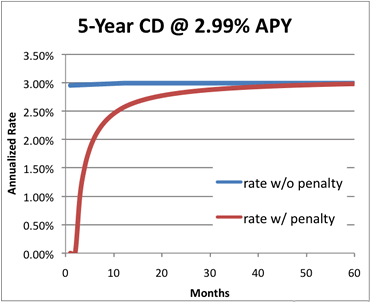
If you look carefully at this charts, you’ll see some great deals:

  • After only 4 months, your annualized rate is 1.48%. (Essentially you 2 months out of 4, which is half of 3.04%). This isn’t bad at all, considering their liquid online savings account is currently paying 0.85% APY.
  • After 1 year, your annualized rate is 2.49%. You can’t find a better rate than this at any other bank for a 1-year CD. Likewise, after 2 years, your annualized rate is 2.87%, compared to Ally’s current 2-year CD at 1.05% APY, although it does have a “raise your rate” feature that lets you bump it up once if rates rise.
  • After 3 years, your annualized rate is 2.83%, again a top rate. Thus, even opening a 5-year CD and holding for anywhere between four months and 3 years gets you a better rate than any other bank currently out there (including Ally itself). There’s also no minimum deposit required to open, so you can make each CD as small as you like!

SmartyPig FDIC-Insured Online Piggy Bank

I reviewed SmartyPig.com a while back when they had just broke onto the scene, but they have made a lot of improvements in response to customer feedback since then. You can think of them like an online piggy bank that helps you towards savings goals, but they’ve added so much flexibility that you can pretty much use them like any other savings account. The best part? They currently pay 2.15% APY on balances up to $50,000 (FDIC-insured). That’s better than any other savings account out there, with no additional requirements. No minimums, no maintenance fees.

An added feature is that if you set a savings goal and reach it, they offer “boosts” if you redeem your cash for a gift card in their mall. My favorite is the 4% boost at Amazon, which for example will get you a $260 gift card for $250 cash. Other highlights include Macy’s at 12% and Travelocity at 10% boost.

Sallie Mae Bank – Online Savings Account

Sallie Mae is best known as the huge student loan originator and servicer. Their new Sallie Mae Bank is an FDIC-insured bank that offers a very competitive 1.40% APY in their online savings account. Not a bad deal to lend out money to captive students at high interest rates, and pay much less as a bank! Hopefully this means that they can keep their rates higher than other banks.

The quickest way to describe it is as another clone of Capital One 360 (currently paying 0.75%). That means… liquid, no minimum balance, no minimum fees, and no deposit caps or tiers (just the $250k FDIC insurance limit to worry about). It’s designed to complement your existing accounts. You can link an unlimited amount of other bank accounts for easy online transfers, which take the usual 2-3 days to complete. Interest is compounded daily and credited monthly.

Also, if you have an account at Upromise, you can link your Sallie Mae account and have your Upromise earning deposited there. You can even get a 10% extra bonus if you do one of the following:

To be eligible for the 10% annual match on your Upromise earnings from Upromise you must link your High-Yield Savings Account to your Upromise Account and, within 90 days of opening your High-Yield Savings Account, either: (1) set up an Automatic Savings Plan with a monthly deposit of $25 or more, or (2) fund the account with $5,000 or more. Upromise will match 10% of your Upromise earnings posted as “funded” to your Upromise Account during the calendar year of January 1 through December 31. Your 10% annual match will be deposited into your High-Yield Savings Account in February of the following year provided that both accounts remain active and are in good standing at the time of transfer.
Betterment.com Review: Investing Made Simple, But Is It Worth The Cost?

New start-up website Betterment.com wants to make investing more easy… imagine something as simple as your existing savings account but with higher returns. Too good to be true?

How does it work?

At it’s very core, Betterment is a standard brokerage account, like E*Trade or Scottrade, which holds stocks and bonds in the form of exchange-traded funds (ETFs). On top of this, Betterment provides a lot of automation and simplification so that a user’s required day-to-day involvement is minimized.

Using a short questionnaire or a simple slider bar, you can choose a basic asset allocation (AA) of, say, 80% stocks and 20% bonds. After that, you just link a checking account and transfer money in and out as you please. When you move money into Betterment, they’ll buy ETFs automatically for you according to your chose asset allocation. If you want to withdraw, they’ll make the needed sell trades for you. Dividends are reinvested automatically, and your portfolio is rebalanced quarterly if off by more than 5%.

Asset Allocation Tools

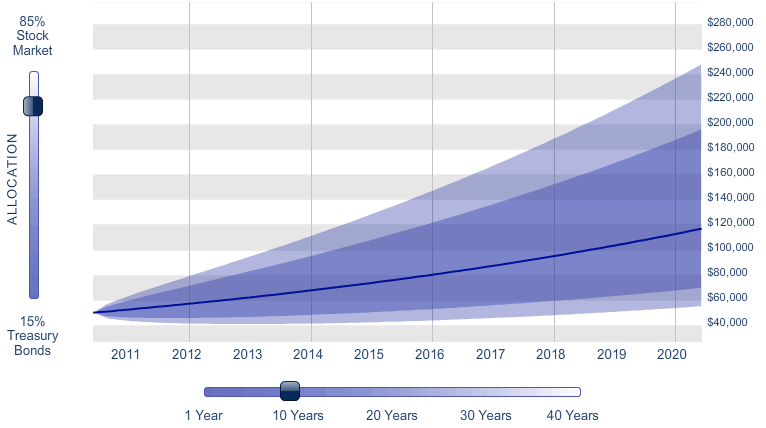
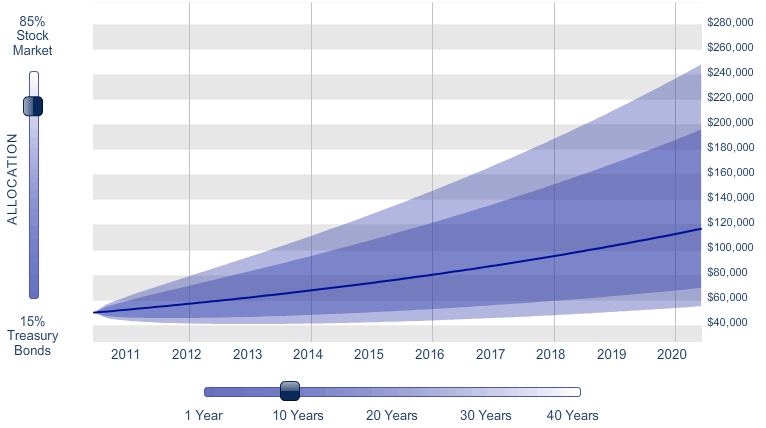
For me, the part I played with the most was the interactive demo that illustrated potential returns based on past results. The dark blue line shows the historical average, dark blue bands indicate where 80% of outcomes have fallen, and the light blue bands show where 95% of outcomes have fallen. Here are some screenshots for a $50,000 portfolio of 85% stocks/15% bonds over 1 year and 10 years (click to enlarge).

(Past performance does not guarantee future results…)

Replace your savings account?

Betterment.com has been getting some heat – in my opinion rightfully so – for some of it’s marketing slogans as a “savings account replacement” or “better than a bank”. This is not a bank. You are buying stocks and bonds. You can lose a lot of money. Even their most conservative option of inflation-linked bonds can lose money in the short-term due to interest rate fluctuations. Yes, they admit this all somewhere, but it should be clearer. You just can’t compare yourself even indirectly with a savings account when the risk levels are so different.

Another example is this quote in their “Safe and Secure” section on the front page:

We are a member of the Securities Investor Protection Corporation (SIPC), which means the securities in your account are protected up to $500,000.

SIPC-insured is not the same as FDIC-insured. SIPC only covers restoring assets to investors if your firm goes bankrupt. It does not insure the value of those assets. It does not cover investment fraud. Will people get confused? I think there is a good likelihood that some will.

Portfolio

So what are you actually buying? For the stock portion of your account, you are buying a basket of ETFs broken down as follows:

  • 10% SPDR Dow Jones Industrial Average ETF
  • 20% iShares S&P 500 Value Index ETF
  • 20% iShares S&P 1000 Value Index ETF
  • 15% iShares Russell 2000 Value Index ETF
  • 15% iShares Russell Midcap Value Index ETF
  • 20% Vanguard Total Stock Market ETF

In my opinion, there is a lot of unnecessary overlap here. Of course, they’re paying for the trades, so maybe that in itself doesn’t matter that much. But more importantly, where’s the international exposure? I’d rather be invested in something as simple as 50% Vanguard Total Stock Market (VTI) and 50% Vanguard FTSE All-World ex-US ETF (VEU). You’d own fewer ETFs but more different companies and be globally diversified.

As for the bond portion, that’s 100% Treasury Inflation-Protected bonds via the iShares Barclays TIPS Bond ETF (TIP). Here, I’d rather see a 50% split between TIP and some nominal Treasuries bonds like IEF or SHY. (As recommended by David Swensen.) More diversification, same high credit quality.

Fees

There are currently no minimum balances required to invest. You don’t pay commissions per trade, but instead are charged a flat 0.9% annual management fee on top of the ETF management fees of about 0.20%. Just for their fees, that’s $45 a year on a $5,000 account, and $450 a year on a $50,000 account. So what you have here is a really simple wrap account. (Compare with Fidelity Portfolio Advisory Services.) In exchange, you get a lot of automation. No manually placing trades or remembering to rebalance.

If you have a low-balance account, this works out to be a pretty good deal *if* you like their portfolio above. Even a discount brokerages range from $7/trade at Scottrade to $3.95/trade at OptionsHouse. If you have only a couple thousand dollars to invest, Betterment can be very economical. (Though I suspect that they will have to change their pricing structure at some point for small accounts that trade a lot.) If you have $25,000 or more in assets, you can do much better on your own, and it’s more likely to be worth your time to expand your investment mix.

Reinventing the wheel?

Time to compare this with existing alternatives. You can already buy a nice all-in-one mutual fund from Vanguard like the Vanguard 2045 Target Retirement Fund (VTIVX) with a $3,000 now $1,000 minimum investment. In a similar manner, you can choose your general asset allocation and they’ll maintain and rebalance for you as well, gradually becoming more conservative as time goes on. International stock exposure including emerging markets is included. They’ll let you transfer funds to/from a bank account in $100 increments. Those trades are also free when you hold them at Vanguard.com, and all this costs just 0.20% annually including all fees. Compare this to 1.1% in total expenses you’ll pay at Betterment.

Finally, a quick note about tax efficient placement of assets. When possible, it’s usually better to place less tax-efficient assets like bonds into tax-sheltered accounts like IRAs and 401k plans. You can’t do this easily with such all-in-one systems.

Notes and Lessons from Liar’s Poker: Rising Through the Wreckage on Wall Street

Here’s a book review of an oldie-but-goodie. Liar’s Poker by Michael Lewis is a non-fiction account of the author’s experiences as a 24-year old the 1980s who started working as a bond salesman for Salomon Brothers, one of the most powerful investment banks at the time (now folded into Citigroup).

Half of the book is an insider’s view of the fast-paced and testosterone-driven world of trading and sales on Wall Street. Lewis explains terms like “Big Swinging Dick” and how he made of dollars of profits for the company, sometimes by necessarily screwing a few customers over. Don’t ever forget their priorities! Here is a quote from a 2008 Portfolio article where Lewis takes a look back:

When I sat down to write my account of the experience in 1989—Liar’s Poker, it was called—it was in the spirit of a young man who thought he was getting out while the getting was good. I was merely scribbling down a message on my way out and stuffing it into a bottle for those who would pass through these parts in the far distant future. Unless some insider got all of this down on paper, I figured, no future human would believe that it happened.

The other half explains how some of the most powerful securities in the world were created – namely high-yield “junk” bonds (which exploded in the late 1980s) and mortgage-backed securities (which took longer, and exploded in the late 2000s). They saw an opportunity:

From the early 1930s legislators had created a portfolio of incentives for Americans to borrow money to buy their homes. The most obvious of these was the tax deductibility of mortgage interest payments. The next most obvious was the savings and-loan industry.

The savings and loan industry made the majority of home loans to average Americans and received layers of government support and protection. The breaks given savings and loans, such as deposit insurance and tax loopholes, indirectly lowered the interest cost on mortgages, by lowering the cost of funds to the savings and loans. The savings and loan lobbyists in Washington invoked democracy, the flag, and apple pie when shepherding one of these breaks through Congress. They stood for homeownership, they’d say, and homeownership was the American way. To stand up in Congress and speak against homeownership would have been as politically astute as to campaign against motherhood. Nudged by a friendly public policy, savings and loans grew, and the volume of outstanding mortgages loans swelled from $55 billion in 1950 to $700 billion in 1976. In January 1980 that figure became $1.2 trillion, and the mortgage market surpassed the combined United States stock markets as the largest capital market in the world.

Following the money, in 1986 Salomon Brothers created the first mortgage derivative. Soon after, they figured out how to take BBB-rate bonds with a unknown maturity and perform financial voodoo to create top AAA-rated bonds with more predictable maturities. (A good explanation of collateralized debt obligations (CDOs) and tranches is in the video Crisis of Credit Visualized.)

Lewis also learned the trader mentality:

Many of the trades that [mentor] Alexander suggested followed one of two patterns. First, when all investors were doing the same thing, he would actively seek to do the opposite. The word stockbrokers use for this approach is contrarian. Everyone wants to be one, but no one is, for the sad reason that most investors are scared of looking foolish. Investors do not fear losing money as much as they fear solitude, by which I mean taking risks that others avoid. When they are caught losing money alone, they have no excuse for their mistake, and most investors, like most people, need excuses. They are, strangely enough, happy to stand on the edge of a precipice as long as they are joined by a few thousand others. But when a market is widely regarded to be in a bad way, even if the problems are illusory, many investors get out.

All in all, this book was a very fun read. It reminded me of somewhat of Ugly Americans by Ben Mezrich, but Liar’s Poker had a much more authentic and feel of historical significance to it.

15-Minute Resolution #4: Automate Your Emergency Fund

It’s Friday, so here’s an easy slam dunk resolution involving emergency funds. If you’ve done any sort of financial reading lately, you know that many folks recommend having at least 3-6 months of living expenses put aside. Given the current high unemployment rates, I personally wasn’t comfortable until I had 12 months of expenses. Not only could you lose your job, but there could be unexpected health expenses, car repairs, or whatever. But that’s not the main point here.

The easiest way to build your emergency fund is to put it on auto-pilot. Your task for today is to schedule an automatic, repeating monthly transfer of $100 into a savings account.

Just about every savings account available allows you to set up an automatic monthly transfer from your checking account. Here is how to do it with Capital One 360’s Automatic Savings Plan. I just chose $100 as a round number, but change it as you like.

(Perhaps you’ve already got a healthy emergency fund. If so, then you can apply this resolution to another specific savings goal, like a new car fund or in our case a pet healthcare fund to replace costly pet insurance.)

Instead of telling you more reasons to do it, I’m going to try to counter any reasons NOT to do it.

  • Don’t wait until tomorrow. It won’t get any easier later on, only harder.
  • Don’t open up a new account, if you already have one available. If you don’t, one of the fastest applications I’ve seen online is at Capital One Consumer Bank. Takes less than five minutes.
  • Don’t worry about interest rates. It doesn’t matter if your savings account doesn’t earn as much interest as some of the top accounts. This can all be changed later.
  • Don’t worry about not being able to keep it up. Start with as much or as little as you feel comfortable. It doesn’t matter if it’s $100 or $1,000. I don’t even care if it’s $10.

The hardest part is starting. You can always change your mind later, it’s still your money. But hopefully, in several months you’ll wake up to a big chunk of money you didn’t even realize you saved.

See the rest of my 2010 Instant New Year’s Resolutions here!

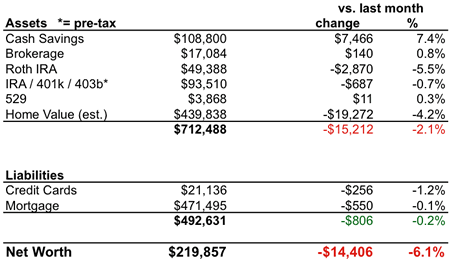
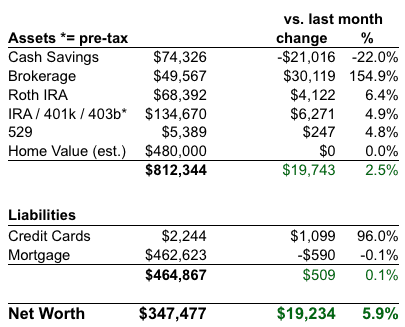
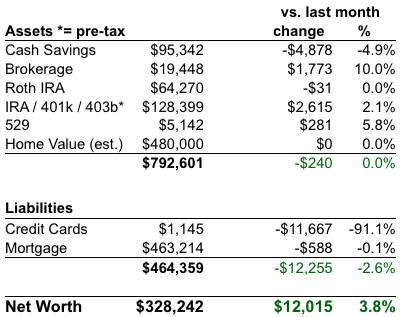
Monthly Net Worth & Goals Update – December 2009

Net Worth Chart 2009

Wow, December already…

Credit Card Debt
Up until now, I have taken money from credit cards at 0% APR and placed it into online savings accounts, bank CDs, or savings bonds that earn up to 4-5% interest (less recently), and keeping the difference as profit. However, given the current lack of good no fee 0% APR balance transfer offers , I am no longer playing this “game”. The balance that you do see is either before the end of the statement or during the grace period, where I’m also not paying any interest.

Retirement and Brokerage accounts
Mrs. MMB and I have both maxed out our 401k salary deferrals for 2009. We have also started to invest in regular taxable accounts by investing $30,000 that was previously being held as cash. I’ll outline the trade activity in an upcoming portfolio update.

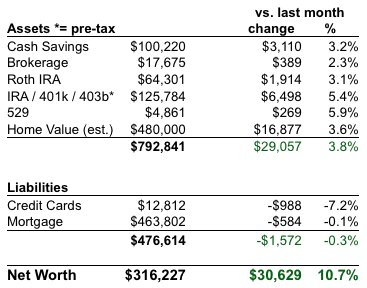
Our total retirement portfolio is now $231,368 or on an estimated after-tax basis, $191,475. At a theoretical 4% withdrawal rate, this would provide $638 per month in after-tax retirement income, which brings me to 26% of my long-term goal of $2,500 per month.

We are also getting ready for a Traditional-to-Roth conversion once the income limits are removed in 2010. We’ll need to gather up some information in order to see how much tax we owe on any gains. More details on this to come.

Cash Savings and Emergency Funds
We keep a year’s worth of expenses in our emergency fund. Potential large expenses include $10,000 for home improvement projects (minor roof repair and solar water heating), as well as $15,000-$20,000 on a new car to replace our 1995 Nissan. Hope it can last us 15 years as well!

Home Value
I am no longer using any internet home valuation tools to track home value. Some people have suggested using my tax assessed value, but I also think that is too high. I simply picked what I felt is a conservative number based on recent comparables, $480,000, and keep it for at least 6 months if not a year. (Currently on month 3 out of 6.) For the most part I am concerned about mortgage payoff, which I still plan to accomplish in 20 years at most.

You can view previous net worth updates here.

Monthly Net Worth & Goals Update – November 2009

Net Worth Chart 2009

Credit Card Debt
In the past, I have taken money from credit cards at 0% APR and placed it into online savings accounts, bank CDs, or savings bonds that earn 4-5% interest (much less recently), and keeping the difference as profit. I even put together a series of step-by-step posts on how to make money off of credit cards in this way.

However, given the current lack of great no fee 0% APR balance transfer offers, I am no longer playing this “game” and have just paid off my last 0% offer for now. This makes the net worth chart a bit funny, but it should clear up next month.

Retirement and Brokerage accounts
Our total investment portfolio increased by a few thousand dollars since last month. DW’s 401k was already maxed out at $16,500. I made another $1,000 contribution to my Solo 401k, for a total of $16,500 contributed in 2009 as well. (I forgot the limit was $16,500 and not $15,500 last month…) This makes us done with our goal of maxing out both our 401k salary contributions for 2009.

I am starting to build up too much cash, and have started investing for retirement in a taxable brokerage account as well. In the interest of tax efficiency, I’ll have to move around some investments in order to keep bonds in the tax-advantaged IRAs/401k and the “extra” stocks in taxable. I expect to finish investing $20,000 this week.

Taking that additional 20k into account, our total retirement portfolio is now $211,095, or on an estimated after-tax basis, $170,047. At a 4% withdrawal rate, this would provide $567 per month in tax-free retirement income, which brings me to 23% of my long-term goal of $2,500 per month.

Cash Savings and Emergency Funds
We keep a year’s worth of expenses in our emergency fund. Another $10,000 is earmarked for upcoming home improvement projects that I keep putting off (minor roof repair and solar water heating).

Home Value
I am no longer using any internet home valuation tools to track home value. Some people have suggested using my tax assessed value, but I also think that is too high. I simply picked what I felt is a conservative number based on recent comparables, $480,000, and keep it for at least 6 months if not a year. (Currently on month 2 out of 6.) For the most part I am concerned about mortgage payoff, which I still plan to accomplish in 20 years at most.

You can view previous net worth updates here.

P2P Lending Update: LendingClub Loan Performance (+$25 Bonus)

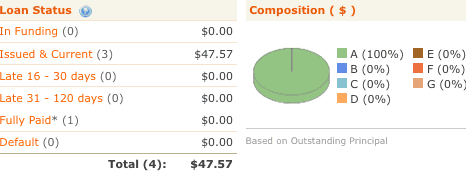
Here’s an update for my person-to-person (P2P) lending activity at LendingClub, which are unsecured loans between U.S. residents. It could be to help people pay off credit card debt, home improvements, business financing, or even buying a house. You can think of it as taking out the bank middleman, which pays tiny interest on checking account balances and then charges much higher rates to borrowers.

LendingClub Portfolio
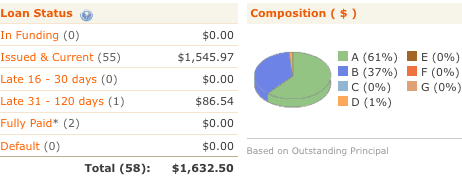
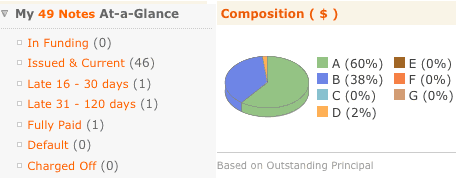
I now have made 62 active loans with $1,680.08 in outstanding principal. Most are A grade, with a decent spattering of Bs. Keep in mind that a borrower has to have a 660 credit score as well as other additional requirements just to make their lowest G grade. (Only about 10% of loan applications are accepted.) Although they do have an automated service to pick for you, I tend to pick my own loans to try and find both a combination of good risk profile and also a person who I want to help out. It’s kind of a hobby of mine. Here is a screenshot from my account page:

Performance & Commentary
The good news is that out of my two previous late loans, one of them is now current again and the other one is on a “payment plan”. I am not sure if that means they lowered the amount due, or that they are just allowing a slower payback temporarily, but it is again showing regular payments (and contact) from the borrower. Much better than reading “left voicemail. left voicemail. we haven’t heard from them in 4 months…”. I have no defaults to date.

According to LC, my “Net Annualized Return on Investment” based on my interest payments received so far is 9.14%. As an investor, I would not expect this rate to be my actual rate to maturity, but so far so good. While my goal is to get a substantially higher yield than from a online savings account, it also comes with a healthy dose of risk. Don’t put your emergency fund here!

$25 New Lender Bonus
If you are interested trying P2P lending with no risk, you can still use this special $25 lender sign-up link to get a free $25 to try it out with no future obligation. There is no credit check and you don’t even have to deposit anything. After you are approved, the $25 will show up in your account balance, and you can lend it out immediately.

If you’re looking to borrow at LendingClub, it’s relatively straightforward. Send in your information, and see what interest rate they offer you. Compare it with your credit card or other financing options. If you like it, fill out your application carefully (verify income if possible) and go for it. If you don’t like the rate or the full amount is not funded, you can either accept partial funding or walk away with no obligation.

Monthly Net Worth & Goals Update – October 2009

Net Worth Chart 2009

Credit Card Debt
For newer readers, I have taken money from credit cards at 0% APR and placed it into online savings accounts, bank CDs, or savings bonds that earn 4-5% interest (much less recently), and keeping the difference as profit. I even put together a series of step-by-step posts on how to make money off of credit cards in this way. However, given the current lack of great no fee 0% APR balance transfer offers, I am mostly waiting on existing offers to end.

Retirement and Brokerage accounts
Wife’s 401k was already maxed out at $16,500 for 2009. I made another $5,500 contribution to my Solo 401k, for a total of $15,000 contributed in 2009. This makes us about 95% done with our goal of maxing out both our 401k salary contributions for 2009.

Our total retirement portfolio is now $190,085, or on an estimated after-tax basis, $152,349. At a 4% withdrawal rate, this would provide $508 per month in tax-free retirement income, which brings me to 20% of my long-term goal of $2,500 per month.

Cash Savings and Emergency Funds
We still have a little over a year’s worth of expenses in our emergency fund. Part of the cash is earmarked for some smaller home improvement projects.

The next step is to put future funds into buying ETFs in a taxable brokerage account since I no longer have room in tax-sheltered accounts. I’ll probably use TradeKing or Scottrade as my buy-and-hold ETF broker, and keep Zecco as my “play money” account.

Home Value
I am no longer using any internet home valuation tools to track home value. If I still did, it would have been $572,000. Some people have suggested using my tax assessed value, but I also think that is too high. I am simply picked what I felt is a conservative number based on recent comparables, $480,000, and keep it for at least 6 months if not a year. This way, I just focus on the mortgage payoff, which I still plan to accomplish in 20 years at most.

You can view previous net worth updates here.

Should You Keep Your Emergency Fund In Your 401k?

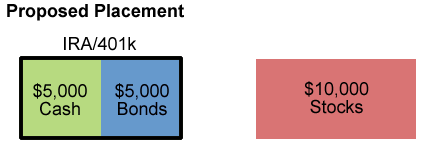
Before you jump to an answer or nasty comment, please give me a chance to elaborate. 🙂 Recently, I ran across an interesting article in the Bogleheads Wiki titled Placing Cash Needs in a Tax-Advantaged Account. Essentially, because of the way the U.S. tax code works it can often be better to keep certain asset classes like cash inside tax-advantaged accounts like IRAs and 401ks. Therefore, if your emergency fund is cash, why not put it inside as well?

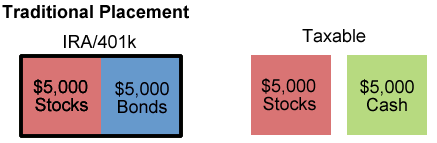
I’ll use the example given. Let’s say you have a 401(k) with a balance of $10k and also taxable assets of $10k, for $20,000 total. You choose to have $10k in stocks, $5k in bonds, and $5k in cash for your emergency account. The “traditional” placement for an emergency fund is in your regular taxable account, perhaps in a bank savings account. The rest of the assets are distributed according to this tax-efficient placement chart.

However, in this scenario all your interest earned on your cash will be taxed at your marginal ordinary income tax rate, which can be as high as 35%. See table of 2009 Marginal Tax Rate Brackets. Meanwhile, your stocks will mostly give off dividends, which are taxed at a current maximum rate of 15%, and possibly quite less. So why not put the cash into the 401k?

Emergency!

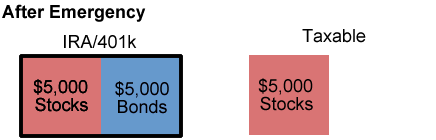
You may wonder what happens if you do need access to that $5,000. You would simply sell $5,000 of the stocks in your taxable account, and simultaneously buy $5,000 of stocks in your 401k plan. This way, your final asset allocation will look exactly the same as if you just spent your cash from the traditional setup:

If you happen to sell your stocks at a loss, then you may be able to deduct a loss if you avoid a wash sale. You can do this by not purchasing a “substantially identical” security within 30 days, but you can buy something very similar. For example, you might buy the S&P 500 ETF (IVV) and sell the Russell 1000 ETF (IWB). They are very strongly correlated, as shown in this chart. This may or may not be worth the hassle depending on how big a loss you’re looking at.

If you happen to sell your stocks at a long-term gain, then you’ll again only paid long-term capital gains taxes of at most 15%. If you sell at a short-term gain (held less than a year), then you’ll have to pay ordinary taxes on the gain. So it might be good to wait a year to institute this new setup.

The Catch
So there you have it, there is an argument for some people to put their emergency funds into their 401ks! However, for most people I don’t think this idea is very practical. For one, most people have relatively small emergency funds, so the difference in taxation scenarios won’t be very high. This is especially true in the current low-interest rate environment. The highest potential tax savings would go to those with large 401k balances and high income tax brackets.

Finally, besides a few stable value funds that I’ve seen, the yields on money market funds found inside retirement plans are rarely the best available. I can usually find much higher interest rates outside my 401k, usually by at least 2% APY or more.

P2P Lending Update: LendingClub Loan Performance

Here’s an update for my person-to-person (P2P) lending activity, which for me are unsecured loans between U.S. residents. It could be for credit card debt consolidation, car financing, business financing, or even buying a house. You can think of it as taking out the bank middleman, which pays tiny interest on checking account balances and then charges high interest to borrowers.

LendingClub Portfolio
I do my P2P Lending at LendingClub, where you can loan as little as $25. You can read more background in my previous update. Although they do have a service to pick for you, I tend to pick my own loans to try and find both a combination of good risk profile and also a person who I want to help out. It’s kind of a hobby of mine.

I now have a total of 49 active loans with $1,548.42 in outstanding principal. Most are A grade, with a decent spattering of Bs. Keep in mind that a borrower has to have a 660 credit score as well as other additional requirements just to make their lowest G grade. (Only about 10% of loan applications are accepted.) Here is a screenshot from my account page:

Performance & Commentary
According to LC, my “Net Annualized Return on Investment” based on my interest payments received so far is 9.06%. The bad news is that I now have two late loans in my portfolio. One has negotiated a temporary reduced payment plan, while the other seems to be dodging phone calls. Also, one loan was paid off early. But I suppose this is par for the course, you get late payments and defaults. If your interest rate is high enough and you have enough diversification in loans, you’ll still end up ahead. We’ll see what happens, even with a default my rate of return so far is still higher than what I’d have gotten with an online savings account. But the risk is still certainly there for more downside.

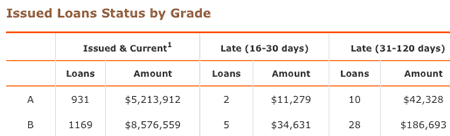
What really baffles me is that both of my late loans are A-rated. According to the LC stats page, out of all the A loans issued so far, there are only 12 late loans out of 943 still active. That’s a tiny 1.3% late rate with zero defaults for LendingClub in general, and yet I managed to invest in 2 out of the 12 late ones. So either I’m very unlucky or I stink at picking loans, or… both. 😛

$25 New Lender Bonus
If you are interested trying P2P lending with no risk, you can still use this special $25 lender sign-up link to get a free $25 to try it out with no future obligation. There is no credit check and you don’t even have to deposit anything. After you are approved, the $25 will show up in your account balance, and you can lend it out immediately.

If you’re looking to borrow at LendingClub, it’s relatively straightforward. Send in your information, and see what interest rate they offer you. Compare it with your credit card or other financing options. If you like it, fill out your application carefully (verify income if possible) and go for it. If you don’t like the rate or the full amount is not funded, you can either accept partial funding or walk away with no obligation.

Monthly Net Worth Update – July 2009

Net Worth Chart 2009

Credit Card Debt
I have taken money from credit cards at 0% APR and placed it into online savings accounts, bank CDs, or savings bonds that earn 4-5% interest (much less recently), and keeping the difference as profit. I even put together a series of step-by-step posts on how to make money off of credit cards in this way. However, given the current lack of great no fee 0% APR balance transfer offers, I am mostly waiting on existing offers to end. My credit score remains high enough that I haven’t seen any negative actions.

Retirement and Brokerage accounts
Markets most went sideways this past month. 401k contributions are still going regularly, and I want to make my 2009 non-deductible IRA contributions soon. I still think the best thing to do is to keep investing regularly, although it is quite boring to watch.

Cash Savings and Emergency Funds
We still have a year’s worth of expenses in our emergency fund, and it is still growing. Possible uses for extra cash might include capital improvements to the house, including a solar hot-water system to reduce electricity bills, or a photovoltaic system to possibly eliminate them! I love the idea of selling electricity back to the city.

Home Equity
Using four different internet valuation tools – Zillow, Cyberhomes, Coldwell Banker, and Bank of America (old version) – I took the average and took off 5% to be conservative and 6% for real estate agent commissions.

We remain “underwater”, with our outstanding mortgage balance greater than what we probably would net after selling our home. Home equity variations continue to dwarf all other activity, which is somewhat annoying since it’s not that important. Just gotta shrink that mortgage!

Monthly Financial Status / Net Worth Update (June 2009)

Net Worth Chart 2009

Credit Card Debt
In the past, I have taken money from credit cards at 0% APR and placed it into online savings accounts or similar safe investments that earn 4-5% interest or more, and keeping the difference as profit. I even put together a series of step-by-step posts on how to make money off of credit cards in this way. However, given the current lack of great no fee 0% APR balance transfer offers, I am have not been as active in this “game” recently. My credit score remains high enough that I haven’t seen any negative actions.

Retirement and Brokerage accounts
Markets went up, although as usual I don’t know why. I’ve been swearing off CNBC so I’m especially detached from all the buzz. Most of our retirement accounts rose about 10% the last month, which was over a $10,000 gain. I actually wish it stayed down so I could start investing some of my new cashflow at lower prices. However, waiting for it to drop again is not logical behavior, or so I keep reminding myself…

Cash Savings and Emergency Funds
We did still save a good deal of cash from our income this month, but I shifted about $10,000 of it into my brokerage account so that I can start investing in taxable accounts, which skewed the values above a bit. We still have a year’s worth of expenses in our emergency fund, which always gives me the warm fuzzies.

Home Equity
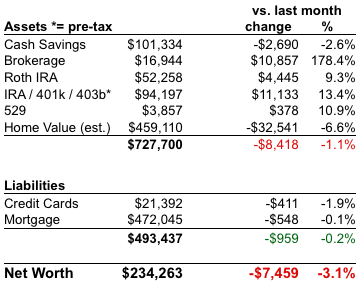
Using four different internet valuation tools – Zillow, Cyberhomes, Coldwell Banker, and Bank of America (old version) – I took the average and took off 5% to be conservative and 6% for real estate agent commissions. These sites are really wonky. Last month I was actually up, but this month my home’s estimated value dropped over $32,000 in a month. Shrug. I’m lucky that our work situation is doing well and we have no plans on moving.

According to my quick and dirty plan for financial freedom I should start paying extra towards my mortgage, but I’m having a hard time pulling the trigger on this one as well. I feel inflation coming. Should I just invest in stocks, and keep my 5% mortgage as long as possible?