Search Results for: High Interest Savings

Questioning the Value of a College Degree

With the rising costs of college tuition coupled with high unemployment for new grads, it is becoming very fashionable to question the value of a college degree. At least, that’s what this long New York Magazine article (via TML) says. Most articles in the past have focused on the pay gap between a median bachelor degree holder and a high school graduate, which recently has increased to $21,900 a year.

Now, there are more articles about how a college degree is worthless. As part of their argument, if you assume a high school graduate goes out, gets a job, and starts earning their lower salary and investing money right away, that person’s nest egg will outpace a college graduate that eventually earns a higher income has to start later and pay off a ton of debt first. Given the head start and lack of debt, the high school graduate actually ends up with more money. This is fed even further with the notion of a college tuition bubble.

Is college worth it? My answer is the most common true answer. It depends! One way I started thinking about it was by going backwards in a way. Let’s look at some possible outcomes and how that may affect how you look at college tuition.

Outcome #1 – You won’t need a college degree.
There are several outcomes that won’t have needed a college degree. You could end up working in a skilled trade such as electrician, plumber, or carpenter that earns a healthy salary. If you add in some business acumen (no MBA required), you could own your own business and end up like the millionaires profiled in the popular book The Millionaire Next Door. You might prefer to be a outdoor adventure guide or flight attendant.

Outcome #2 – Any college degree will do.
There are many jobs out there that simply require some sort of undergraduate degree. It’s just a lazy screening process for applicants, but that’s reality. In this case, the best value would have come from getting your degree from any accredited university for the least amount of money. Perhaps this involves two years of community college and one year of intense upper division coursework at an in-state university (taking additional courses during the summer as possible) to graduate in a total of three years. It’s possible, and you could end up paying less than $10,000 even without any financial aid.

Outcome #3 – You’ll actually use the technical skills you learned.
Professions that come to mind are accountant, doctor, nurse practitioner, engineer, lawyer, professor, teacher. Here, it’s more likely that you’ll use the technical skills you learned in school. If you’re talking about a profession that requires a graduate degree like law or medicine, then the final school is the matters the most in terms of prestige. If you really take full advantage of your education, then your return on investment can be high. I know doctors with $250k of debt, but now they make $250k a year.

Playing The Odds

The fact is, nobody really knows ahead of time which outcome will actually happen. But you probably have an idea of the relative odds based on the child’s interests and motivation levels. I would say take into account all your options, and make a decision based on the individual and your financial situation.

The reason why many pushy parents want their kids to be either a doctor, lawyer, or engineer is that this increases the probabilities that the kid will get a decent job and support themselves. Sure, some engineers or lawyers don’t make that much, but how many of them are starving? Parents are playing the odds. I imagine if I really wanted to play the odds these days, I’d teach my kid a skilled trade (ASE certified mechanic? Electrician?) in high school, and then continue to push them towards college and a professional degree.

Ally Bank Rolls Out eCheck Check Deposit: Scan Your Checks Online

The Ally Bank blog recently announced that they are gradually rolling out their eCheck Deposit service, where you can use a scanner and submit your deposits over the internet without having to visit a branch or mailing anything in. This is another step towards being able to step away from the big Brick & Mortar banks and take advantage of the higher interest rates and lower fees of internet banks.

The service is currently only available by invited account holders of an Ally Interest Checking account, but you can call them at 1-877-247-2559 and ask to be added to their next rollout list. They expect to continue expanding this service throughout 2011. (Update: Ally contacted me and said that invited account holders of their online savings account and money market account are also eligible.)

This adds another feature to my Ally Bank Checking account review, which I found comparing the features to be one of the best online checking account alternatives out there. No minimums, no direct deposit required, all ATM fees refunded, 24/7 phone reps, and a decent interest rate.

Reaching the “I Can Do This” Moment

Like millions of other people out there, I decided to start trying to lose weight and get in better shape on January 1st. I cut out virutally all meat and was eating tons of fresh vegetables and whole grains. I went to the gym, ran outside, or played sports with friends nearly every day. I rarely ate out at restaurants, and when I did I ordered things like steamed vegetables and brown rice. I lost 15 lbs. within the first month.

Then I hit the wall. I was still exercising almost every day, but I started to dread the workouts. Even worse, I stopped losing weight. I started eating meat again, and adding some snacking back in. I could feel myself losing willpower. I was horrified to discover I had gained weight back.

I knew I had to make some changes. I allowed myself one “cheat day” per week so that I could eat out or drink a beer. I made an exercise routine for the whole week in to be more efficient and starting doing some workouts first thing in the morning before work. I try to only have one big meal a day and the rest much smaller. I acknowledge that I have my weaknesses (like snacking while watching ESPN, and getting hungry after watching Food Network) and avoid doing those activities. I started losing weight again, at a more regular pace of 1-2 pounds per week. More importantly, it didn’t feel like deprivation.

I’ve read that it takes 30 days to break a habit. Well, it took me 30 days to perhaps break my habit, but it took another 30 days to create a new habit that I feel that I can live with for the long run. The best part is the feeling of control that I have now. I know the things I need to do to lose weight. I know the things that I could do that will make me gain weight. It’s up to me. I call this the “I Can Do This” moment.

Applications to Saving Money

Like many other folks, I draw parallels between the actions of saving money and losing weight. In dealing with food, I often tell myself I have 1,500 calories a day to “spend” and so I should get the most value from my calories in terms of flavor, texture, and hunger satisfaction.

When I thought about this, I remember the same thing happened when I graduated college and started earning money on my own. Could I pay down my $20,000+ in student loans? How long would it take? Could I still afford the things I wanted? But the paychecks started coming in, and you started having to balance what was coming in and what was going out. Some things like electricity cost about the same each month, but then you learn to deal with things like car repairs and new computers. Eventually, I reached the “I Can Do This” moment where I felt a connection between my actions and the resulting surplus I had each month.

Here are some observations about reaching this point, which you may or may not agree with:

  • When starting a difficult task, it’s good to go all out for a while even if you run out of willpower eventually. I needed that first 15 lb. loss. The same could be said about going on a “no-spending month” and saving up $500 or $1,000. I had built up something that I didn’t want to lose.
  • It’s important to see a direct connection between your actions and the results. (At least initially.) This is why I no longer like articles with “52 ways to start investing with $100”. If you’ve managed to save $100 a month, it should go in the bank. If you invest it and one day your $1,000 balance turns to $500, then it affects your emotions and motivation. You’ve just lost 5 months of hard work. With a interest-bearing savings account, the amount will always be higher than yesterday. These days it’s not much, but it’s still higher.
  • Routine makes everything easier. Make less decisions. Don’t make every single thing another mental decision. “Should I work out today?” “What about tonight or tomorrow instead?” That’s exhausting. Go to your Yoga class every Tuesday and Thursday. Every. Week. Tell everyone you’ll be there and not at happy hour. Remove the decision. Along the same lines, having money taken out of your paycheck or bank account automatically just keeps your mind from decision fatigue.
  • Keep supportive friends. Changing your lifestyle often alienates you from some of your existing friends, and they may see it as a negative judgment upon themselves. They can sabotage your best intentions with their own selfishness, so be sure to find and keep people who support your decisions.

Do you remember your own “I Can Do This” moment?

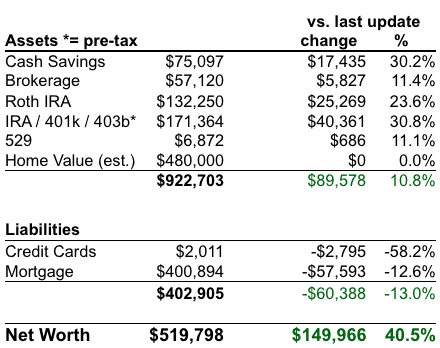
Net Worth & Goals Update – March 2011

Net Worth Chart 2011

Oh alright, here’s another net worth update. My last snapshot was about 9 months ago. I know people like the voyeurism, but hopefully my commentary will also provide some helpful insights as to achieving our goals.

Credit Card Debt
I used to take money from credit cards at 0% APR and place it into online savings accounts, bank CDs, or savings bonds that earned 4-5% interest (yes I know, much less recently), keeping the difference as profit while taking minimal risk. (Minimal in regards that the risk was only dependent on my behavior and not outside factors.) However, given the current lack of great no fee 0% APR balance transfer offers, I am currently not playing this “game”.

Most credit cards don’t require you to pay the charges built up during a monthly cycle until after a grace period of about 14 days. This theoretically provides enough time for you to receive your statement in the mail and send back a check. As this is simply a snapshot of my finances, my credit card debt consists of just these charges. I don’t carry any balances or pay any interest charges.

Retirement and Brokerage accounts
Since my last update, the broad stock indexes have risen significantly, about 25% including dividends according to Vanguard Total World Stock Index ETF (VT) that I use as a general benchmark. Although these high valuations make me nervous, I am still a believer in stocks for the (very) long run and rebalancing your asset allocation regularly. Don’t buy high and sell low.

Here is our target asset allocation. Being heavy in stocks, our portfolio bounced back significantly as well.

Our total retirement portfolio is about $360k or on an estimated after-tax basis, $318,000. At a theoretical 4% withdrawal rate, this would provide $1,060 per month in retirement income, which brings me to 42% of my long-term goal of generating $2,500 per month. These are all really rough numbers, but helpful to measure progress and visualize living off your portfolio.

Cash Savings and Emergency Funds
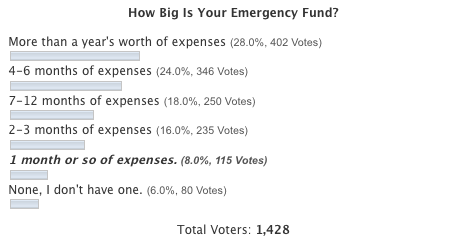
We are happy to hold a year’s worth of expenses (conservatively estimated at $60,000) in our emergency fund. According to my emergency fund poll, many of you readers also have substantial savings set aside, with most having at least 4 months of expenses. Very nice.

Recently I wrote about how I maximize interest in my emergency fund, including the specific banks and institutions I use.

Home Equity
I would like my house paid off in 15-20 years at most, so I’ve been putting some extra money towards the mortgage. Note that this is only after maxing out both our 401k plans, fully funding IRAs every year, and creating a one-year emergency fund. I’d like our mortgage pay-down progress to parallel our portfolio growth so that both are ready for at least partial retirement in about 10 years.

So there you have it. Mrs. MMB and I both earned a six-figure salary again last year, which combined is in the top 5% of households. We try to save a lot of it while it stays this way. 🙂 The future is hard to see, but we’re getting there a lot faster than we thought we could.

Prosper P2P Lending 1% Cashback + Potential Market Inefficiency

I kinda missed the boat last Thursday 2/17 because peer-to-peer lending site Prosper.com had a promotion going on for borrowers that stated that they would make a entire month’s loan payment for you. A quote from their e-mail:

It’s our fifth birthday, and to celebrate we have a special gift just for you! If you apply for a loan and submit a listing on our site today, February 17th, we will make your second loan payment (up to $300)*!

Astute borrowers realized that they could simply take out a loan and pay it back after 2-3 months since there was no pre-payment penalty. After all loan initiation and other fees, the borrower could still net a little over a hundred bucks. Not bad for “borrowing” money!

However, this also meant that somebody had to fund their loans. I’m sure some potential investors found it weird that Prosper suddenly had a lot of AA-rated loans from folks with very good credit and peculiar descriptions like “I really don’t need this money for anything, and intend to pay this loan off in 3 months.” 🙂 The requested loan amounts will also be very close to $3,500, the ideal amount for profit maximization.

To top it off, I just got this e-mail from Prosper regarding getting 1% cash back on any bids placed on Monday, February 21, 2011. Here’s the e-mail text. No special link or promo code was given, so I can only assume it is open to all.

This offer is as straight-forward as they come: invest in any listing on the site today, and you’ll earn 1.0% cash back*! With a cash back offer and returns averaging 10.1%**, why wait?

* The promotional period begins at 12:01 AM PT and ends at 11:59 PM PT on Monday, February 21, 2011. 1.0% cash back will be paid on all bids placed during the promotional period that ultimately become funded loans. Cash bonus will be deposited to your Prosper account by March 31, 2011.

Update: Promotion extended to end of 2/23:

* The promotional period began at 12:01 AM PT on Monday, February 21, and will end at 11:59 PM PT on Wednesday, February 23, 2011. 1.00% cash back will be paid on all bids placed during the promotional period that ultimately become funded loans. Cash bonus will be deposited to your Prosper account by March 31, 2011.

Now, if you could technically find and fund several of these high-quality borrowers who have an incentive to pay off their loan in 3 months, you could have an investment that would return around 1% in interest + 1% cash back over a period of just around 3 months. That’s a lot better than a savings account.

I know that some of you readers got in on this. If you’re still looking to get funded, share your loan listing below using your usual commenter e-mail. This is not risk-free as you are still lending money to strangers, but if you’re an AA borrower on Prosper who initiated a loan listing on 1/17th or shows as early on 1/18th for ~$3,500, then I am more willing to take the risk. I am relatively comfortable with P2P lending with certain criteria, and already have over a few thousand dollars in highly-rated loans on LendingClub.

FDIC-Insured Bank Accounts Holding Chinese Renminbi (CNY) (RMB)

Reader Jonathan wrote in the tell me that the Bank of China (BoC) is offering FDIC-insured bank accounts that are denominated in renminbi, the official currency of China. Also referred to by the primary unit yuan, you may have heard about how China tightly controls this currency in the news. Since many sources view the yuan as being undervalued relative to the dollar due to artificial exchange rates, some people view holding yuan as a good investment. Here’s how the Bank of China news has played out in financial websites.
  • 1/12 – The Financial Times blog BeyondBRICs brings up the ability to open accounts in yuan, but says “No need to rush out and open a renminbi account just yet.” They note that this ability has actually been around since February 2010, but nobody in the media really noticed.
  • 1/12 – The Reuters blog by Felix Salmon picks it up and brings it a step further, pointing out that US officials have said the yuan is overvalued, so that “Chinese revaluation is going to happen at some point, and when it does, you’ll make money”, and “the downside is limited”. More excitement.
  • 1/14 – The Wall Street Journal blog ROI joins the fray, stating (1) It’s very unlikely to go down. (2) It’s very likely to go up. (3) You won’t miss out on a lot of interest elsewhere, as nowhere else is paying a lot of interest. (4) It will diversify your portfolio. (5) It may offer you and your family something of a hedge against the decline of the U.S. economy. Can you feel the buzz?
  • 2/7 – Time Magazine blog Curious Capitalist has another post on the topic a few weeks later. It provides more detail on what this account does not offer: interest, the ability to withdraw yuan, deposit yuan, write checks, or use debit cards. Basically you can speculate on the conversion rate of USD-CNY and that’s it. More below.

So, should you go out and open an account? Well, first you must go in person to a Bank of China branch in New York City, either at Madison & 48th St or in Chinatown. Some of the articles erroneously reported that you can open up an RMB account at the Los Angeles branch. According to the Bank of China website, this is not true. The branch does not offer FDIC-insured accounts, and doesn’t offer personal account of any kind.

The limit a U.S.-based individual customer can exchange is $4,000 a day. From what I have gathered, you open an account and “buy” RMB from Bank of China using your U.S. dollars. Your deposits are FDIC-insured against bank failure, but not losses from currency fluctuations. If you wish to withdraw, you must again exchange your RMB back to USD, leaving you again with dollars. You can’t withdraw any RMB, here or in China. The savings account earns no interest. So any difference will be due to the exchange rate.

According to the Wikipedia entry for Remminbi, academic studies have shown then yuan to be undervalued relative to the dollar using “purchasing power parity analysis”. The Treasury Secretary called it “substantially undervalued” a month ago. Per this article, the rate of 6.5855 CNY to 1 USD set just yesterday (2/16) is a record high, leaving the yuan up 3.6% since last June.

I honestly don’t pay enough attention to currency markets and all the politically-related news to really weight the pros and cons properly. Even if it does seem like the yuan is undervalued right now, but who knows when or how it will be corrected? China sets the exchange rate for the most part, so it could be years or more. During that time, its economy could experience high inflation as well which could make RMB even weaker relative to USD.

I see no sure bet here, just a speculative investment. But if you have a “play money” account capped at 5% of your portfolio like I do at times, this might be one idea that you could drop some bucks on. What do you think?

Update: You can get basically the same thing online at Everbank WorldCurrency Access deposit account. It doesn’t currently earn any interest, and unfortunately there are no interest-bearing CD options available right now either. But it does let you get it renminbi-denominated.

Where I Keep My Emergency Fund Cash – January 2011

The results of my Emergency Fund survey are in, and appears that there are a lot of big savers out there! 28% of respondents had cash reserves of over 12 months of expenses, and 24% of you had the more-often recommended 4-6 months of expenses.

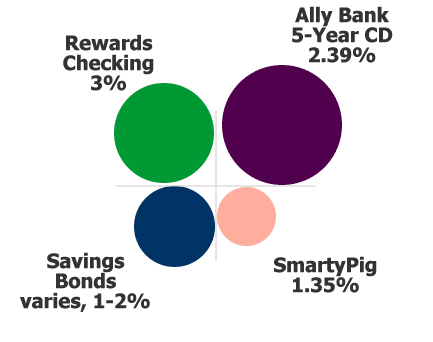
With such sizable cash reserves, where you do guys put it all? I figured I’d share my stash-the-cash choices, which may not be perfectly optimal but I’m open to talking about it. The size of the circles are proportional to how much of my money I keep in each respective account.

With interest rates so low across the board and still dropping it seams, it’s been hard to get really excited about many new options. But remember, it can be better to be earning 2% with low inflation than 5% interest in a high inflation environment. Every basis point helps.

Rewards Checking Accounts

You’ve likely heard of these by now. Usually through local credit unions, these checking accounts pay a higher interest rate if you jump through some hoops each month. However, if you make a mistake you’ll forfeit virtually all your interest for that month, so it can be tricky. More coverage here.

One nationally-open example is DanversBank, which offers their Free Rewards Checking currently paying 3.01% APY on balances up to $25,000, provided you satisfy the following each month:

* perform at least 12 debit card transactions (excluding ATMs);
* receive their monthly statement electronically;
* access Online Banking, and
* sign up for direct deposit or receive a recurring ACH transfer

To find a local rewards checking account limited to your area, check out DepositAccounts and use the filters. Sadly, my local account recently dropped their rate significantly.

Long-Term CDs – Ally Bank

If you have a large cushion, it’s quite possible (if you’re lucky) to not have to touch it for years or more. Therefore, I think it’s okay to put some of it in safe investments but slightly less liquid.

With the Ally Bank certificates of deposit, you can still access your money as long as you pay a early withdrawal penalty of 60 days interest. That’s significantly less than at other banks. I have a 5-year CD paying 3% APY, but the current rate for new deposits is 1.60% APY for a 5-year CD (as of 10/25/13).
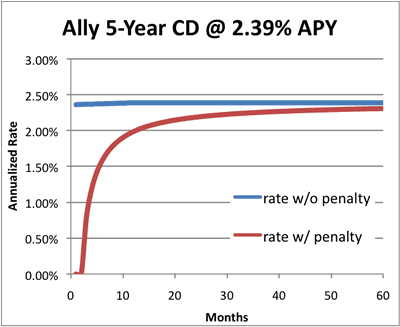

Rates change constantly, but let’s assume you have a certificate of deposit from any bank paying 2.39% APY with an early withdrawal penalty of the last 60 days of interest. (2.39% APY ~= 2.26% rate compounded daily.) Here’s how your actual annualized interest rate would fluctuate given your holding period.

After just 6 months, you’ll already be earning 1.58%, more than a comparable 12-month CD. If you somehow had to withdraw after 1 year, you’d still have earned 1.99% APY. Basically, after just 6 months I have nothing to lose and a lot to gain, so I keep a sizable chunk here.

Savings Bonds

I have some older Series I Savings Bonds, but they aren’t a very good buy right now. The total rate consists of a fixed rate and a variable rate that adjusts with inflation every 6 months. If you bought a bond now, you’d get a 0% fixed rate and only 0.74% from inflation. However, my older bonds have higher fixed rates, and according to my TreasuryDirect statement they are earning 1.74%, 2.25%, and 2.75% right now. The annual purchase limit is now $5,000 in paper I-bonds and $5,000 in online I-bonds per Social Security Number. I’ll keep them for a while, as I like the tax deferral benefits and inflation may come back to bite us.

Online Savings Accounts

Rewards checking account and savings bonds have deposit limits, and you only want to lock up a certain amount in longer-term CDs, so the rest goes into the now-popular online savings account. There are a lot of players out there now, but many of them are packed together with very similar features and interest rates.

Right now the rest of my cash is over at SmartyPig.com, an FDIC-Insured bank account that lets you save for specific goals like an online piggy bank. However, they’ve added so much flexibility that you can pretty much use them like any other savings account. Their rate has dropped recently from 1.75% APY to 1.35% APY for balances up to $50,000. This is still amongst the top rates, but I’ll be watching them closely.

Alternatively, Everbank has their Yield Pledge Money Market paying 1.10% APY for the first 6 months for new accounts. This rate is higher than any 6-month certificates of deposit currently available, while still being available for withdrawals at any time. The rate is guaranteed stay in the top 5% of competitive accounts. Evantage Bank has their Mega Money Market account paying 1.75% APY for balances up to $35k. Most other banks are clustered around the 1% to 1.2% mark.

So… where’s your cash?

Mortgage Refinance and Resetting the Clock

The following is a guest post from reader TFB, who blogs anonymously at The Finance Buff where he covers investing, taxes, banking, mortgage, insurance, and other personal finance related topics. You can find more of his posts about mortgage refinances under the “refi” tag.

I refinanced my mortgage recently. The rate on my 15-year loan went down from 4.25% to 3.75%. With a lender credit covering the bulk of my closing cost, I spent about $200 on a refinance that will save me over $1,000 interest every year.

Some people don’t like to refinance their mortgage even when the rate is lower and there’s no fee, because they fear it’s going to reset the clock for the eventual payoff. They reason that when they refinance to a new loan, the payoff date will be extended, and they will end up paying more interest over the life of the loan than they would if they didn’t refinance.

In some cases it’s true. For example, if you are five years into a 30-year mortgage at 5.25% with $200k principal balance remaining, keeping the current loan at 5.25% for another 25 years will cost you additional $159,384 in interest. Refinancing the $200k principal balance into a new 30-year loan at 4.5% will push out the payoff date by five years and cost you $164,813 in interest in 30 years. By refinancing, you end up paying more interest.

  Old Loan New Loan New – Old
Principal Balance $200,000 $200,000 $0
Rate 5.25% 4.5% -0.75%
Years to Pay Off 25 30 +5
Remaining Interest $159,384 $164,813 +$5,429

It doesn’t have to be that way.

[Read more…]

SmartyPig: Tips and Tricks To Use Like a Bank Account

In a previous post about 4 Stash Your Cash Deals Most People Haven’t Heard Of, I mentioned the new FDIC-insured savings site SmartyPig.com since they have consistently high yields, currently at 2.15% APY on balances up to $50,000 with no minimums or monthly fees. Funds are held at BBVA Compass Bank.

I also mentioned that even though they do have a some restrictions due to their “piggy bank” image, they have added enough flexibility (in response to user feedback, which should be applauded) that you can use it virtually like any other savings account. I got a few questions on what I actually meant by that statement, so here are a few “hacks” that I have used to increase the flexibility of my savings. I prefer to think of it as getting around their gentle nudges to keep saving. 🙂

Ground Rules

When transferring money into SmartyPig, you must do it in the form of Savings Goals. Your goal can be anywhere between $250 and $250,000, and you must transfer in at least $25 from a linked bank account to get it started. You can also schedule a recurring deposit of at least $10 a month towards the goal, but you don’t have to.

  • You can make as many goals as you like.
  • You can make additional one time, non-recurring contributions to a goal.
  • You can end a goal at any time without penalty, but you will have to redeem the entire existing balance all at once. There are no partial redemptions.
  • You can change your goal amount at any time.
  • You can transfer funds in between goals instantly. There is a limit of five outgoing transfers per calendar month per goal. Accrued interest cannot be transferred and will remain in the goal where it was earned.

Emergency Fund / Partial Redemptions

Setting up SmartyPig as an emergency fund is straightforward. I set a big goal like $25,000, and then put in a regular contribution. But what if something comes up and I want to make a withdrawal of say $1,000 out of the $5,000 I’ve already set aside? According to the site, I must end the entire goal and cash it out completely. Not so fast. In this case, I would:

  • Start a new goal, call it Emergency Fund 2.0.
  • Transfer $4,000 from my original goal into the new 2.0 goal.
  • Now, I should be left with $1,000 in my original goal, and I can cash it out by clicking on “Stop Goal”. I’ll also be cashing out all the remaining accrued interest.
  • I am left with a new goal with $4,000 still earning 2.15% APY, and $1,000 is headed to my main checking account to pay for the unexpected expense.

“Boosted” Gift Cards to Multiple Retailers

Another perk of SmartyPig is the ability to redeem your cash goal for a retailer gift card with a “boost”. You can get a 1% bonus at Wal-mart, 3% at Lowes, 4% at Amazon.com (my fave), and 12% at Macy’s. So for a $250 goal, I could cash out for $260 at Amazon. By default, you can only redeem a goal for one retailer. But by using the method above, you can effectively split your goal balances into smaller chunks.

EverBank Yield Pledge Money Market & Checking: Good Offer For $10k+ Balances

Everbank has 6-month bonus rates for their Yield Pledge Money Market and FreeNet Checking accounts. Both of these offers are targeted at new customers opening with at least $1,500, but in the end do offer some of the top rates available for an FDIC-insured bank account with these terms.

Yield Pledge Money Market

With a 6-month guaranteed introductory rate of 1.10% APY, this is higher than any available 6-month CD out there, which again is better than any 6-month CD offer out there.. After that, it is like other online savings accounts with a variable ongoing APY (currently 0.86%).

This online savings account “pledges” to keep the yield on your account in the top 5% of competitive accounts as tracked by Bankrate. (Everbank has indeed ended up on lists of best banks with consistently high rates.) Since it is a savings account, you are still limited to 6 withdrawals or outgoing transfers each month. There is a minimum average balance of $5,000 to avoid a $8.95 monthly fee.

FreeNet Checking

A checking account version, this also has a a 6-month guaranteed introductory rate of 1.10% APY, with a tiered interest rate afterward. (Current tiers and ongoing Annual Percentage Yields are: $100,000 at 0.86% APY, $50,000 – $99,999.99 at 0.83% APY, $25,000 – $49,999.99 at 0.78% APY, $10,000 – $24,999.99 at 0.76% APY and under $10,000 at 0.70% APY). There is no monthly fee.

Again, if you do the math this effectively extends the bonus rate of 1.10% out to between 5 and 6 months on a $10,000 balance, which is still better than any other CD offer of the same length. This account also pledges to keep the yield on your account in the top 5% of competitive accounts, but remember in this case that checking accounts in general have slightly lower rates.

If you are looking to get high FDIC-insured interest rates on a sizable balance for between a couple months to a year, without having to jump through any hoops like required monthly transfers or 15 debit card purchases a month, then this continues to be one of the best rates out there.

Mortgage Loan Refinance Breakeven Points

Sometimes saving money just involves being lucky. I don’t really keep up with mortgage rates anymore, but last week an e-mail subject line just happened to catch my eye that mortgage rates are at “record lows”. I always figured that my 5.125% rate was so low that another refinance or loan modification probably would never be worth it, but it turns out that rates are so low they just might. Here’s a quick snapshot of rates from a Wall Street Journal article on 7/16/10:
The 30-year fixed-rate mortgage averaged 4.57% in the week ended Thursday, unchanged from a week earlier and down from 5.14% a year earlier. Rates on 15-year fixed-rate mortgages were 4.06%, extending the lowest point since Freddie started tracking it in 1991, and down from 4.07% last week and 4.63% a year earlier. […] To obtain the rates, the mortgages required payment of an average 0.7 point. A point is 1% of the mortgage amount, charged as prepaid interest.

has ads now for 4.25% fixed for 30 years and 3.75% for 15 years. As for me, I might be able to get my interest rate below 4.75% and have a “breakeven” period of less than 3 years. I’m awaiting official paperwork. Ask your loan servicer and/or mortgage broker what they can do for you. Can’t hurt to ask!

Meanwhile, I was playing with the Refinance Breakeven calculator over at DinkyTown and found out that there are multiple definitions of “breakeven period”. Before, I simply figured that a refinance would cost X dollars upfront in fees and closing costs, but would save me Y dollars per month. Divide X by Y, and you’d have a breakeven point. For example, if it cost you $2,400 in fees but saved you $100 per month, you’d break even in 24 months. Past that, you’re saving $100 every month. In this case, if you plan to keep your mortgage for longer than 24 months, then refinancing makes sense.

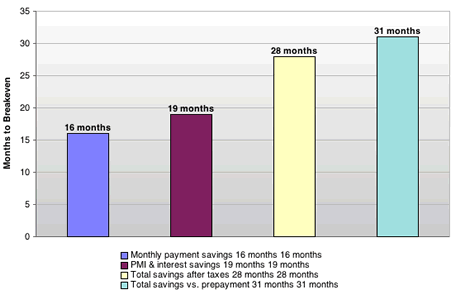
However, there are actually four possible breakeven methods presented:

  1. Monthly payment savings. The simple formula described above. The number of months it will take for your monthly payment reduction to be greater then your closing costs. Doesn’t take into account that you may be making more monthly payments.
  2. Interest savings (plus PMI if applicable). The number of months it will take for your interest and PMI savings to exceed your closing costs.
  3. After-tax interest savings (plus PMI if applicable). The number of months it will take for the after-tax interest and PMI savings to exceed your closing costs. This takes into account that the interest and PMI being paid may be tax-deductible, while the closing costs are paid with after-tax money only. Depends on your income tax rate.
  4. Total after-tax interest savings vs. prepayment. This is the most conservative breakeven measure, and will result in the longest breakeven time period. This method considers that you could take the amount spent on refi closing costs and instead make a large prepayment on your existing mortgage. Then, it calculates the number of months it will take for the after-tax interest and PMI savings to exceed both the closing costs and any interest savings from prepaying your mortgage.

Which method is best?

First, I should add that you could complicate things even further by assuming any money not paid out immediately could earn a rate of return (savings accounts, CD, etc.) But that would make my head explode, so I won’t. The calculator suggests that methods #2 and #3 are most commonly accepted, and I would tend to agree. If you are sure that your interest is 100% tax-deductible (you exceed the standard deduction provided by the IRS without it), then you should use the value from #3. Otherwise, something in between #2 and #3 is probably the most accurate.

Method #4 compares with another theoretical situation that only applies if you really want to make a lump-sum prepayment and keep the higher monthly mortgage payment over a shorter mortgage term. For many people, the goal is to lower the monthly outlay and improve cashflow as well as save money on interest.

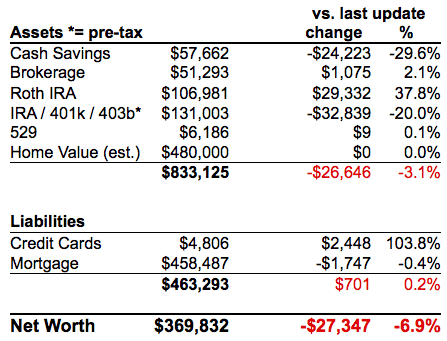
Net Worth & Goals Update – July 2010

Net Worth Chart 2010

Time for another net worth update… last one was back in April.

Credit Card Debt
I used to take money from credit cards at 0% APR and place it into online savings accounts, bank CDs, or savings bonds that earned 4-5% interest (much less recently), keeping the difference as profit while taking minimal risk. (Minimal in regards that the risk was under my control.) However, given the current lack of great no fee 0% APR balance transfer offers, I am currently not playing this “game”.

Most credit cards don’t require you to pay the charges built up during a monthly cycle until after a grace period of about 14 days. This theoretically provides enough time for you to receive your statement in the mail and send back a check. As this is simply a real-time snapshot of my finances, my credit card debt consists of just these charges.

Retirement and Brokerage accounts
We recently converted our Traditional IRA balances to Roth IRAs, as the income restrictions were lifted this year. The choice to convert was rather simple for us, as we had non-deductible contributions that will now be able to be withdrawn tax-free. (We still owe taxes on very modest gains.)

Our total retirement portfolio is now $289,277 or on an estimated after-tax basis, $249,976. At a theoretical 4% withdrawal rate, this would provide $833 per month in after-tax retirement income, which brings me to 33% of my long-term goal of generating $2,500 per month.

Cash Savings and Emergency Funds
We are now a bit below a year’s worth of expenses (conservatively estimated at $60,000) in our emergency fund. This is after withholding some money for paying taxes on the Roth IRA conversion above, and also for undisclosed, one-time recent expenses. It’d be fun to say that we picked up a convertible or something, but the reality is much less exciting. 😛

Our cash savings is mostly kept in a combination of a rewards checking account (with debit card usage requirements), a SmartyPig account at 2.15% APY currently, or in a 5-year CD from Ally Bank, which despite the long term still provides a very competitive yield even if you withdraw early before the 5 years is up. (See here for more details.)

Home Value
I am still not using any internet home valuation tools to track home value. After using them for a year and finding them unreliable, I am back to maintaining a conservative estimate and focusing on mortgage payoff. If we get some positive cashflow after retirement savings, I do want to pay it down faster.