Search Results for: High Interest Savings

Practical Portfolio Rebalancing Tips from Vanguard (+My Rebalancing Strategy)

Are stocks too overpriced? Is inflation coming to crush bonds? The media is not incentivized to tell you what is often the best advice: do absolutely nothing. If you still want to take action, consider rebalancing your portfolio. If you’ve stayed invested throughout the last several years, your portfolio may have shifted as in the scenario above:

For example, imagine you selected an asset allocation of 50% stocks and 50% bonds. If 4 years go by during which stocks return an average of 8% a year and bonds 2%, you’ll find that your new asset mix is more like 56% stocks and 44% bonds.

Here are some quick tips about rebalancing your portfolio back towards your target risk level, taken from Vanguard article #1 and Vanguard article #2.

Here are three possible rebalancing strategies:

  • Time: Rebalance your portfolio on a predetermined schedule such as quarterly, semiannually, or annually (not daily or weekly).
  • Threshold: Rebalance your portfolio only when its asset allocation has drifted from its target by a predetermined percentage.
  • Time and threshold: Blend both strategies to further balance your risk.

Here are three practical tips from Vanguard to rebalance with minimal tax drag:

  • Focus on tax-advantaged accounts. Selling investments from a taxable account that’s gained value will most likely mean you’ll owe taxes on the realized gains. To avoid this, you could rebalance within your tax-advantaged accounts only.
  • Rebalance with portfolio cash flows. Direct cash inflows such as dividends and interest into your portfolio’s underweighted asset classes. And when withdrawing from your portfolio, start with your overweighted asset classes. (If you’re age 72 or over, take your required minimum distribution (RMD) from your retirement account(s) while you’re rebalancing your portfolio. You can then reinvest your RMDs in one of your taxable accounts that has an underweighted asset class.)
  • Be mindful of costs. To minimize transaction costs and taxes, you could opt to partially rebalance your portfolio to its target asset allocation. Focusing primarily on shares with a higher cost basis (in taxable accounts) or on asset classes that are extremely overweighted or underweighted will limit both taxes and transaction costs associated with rebalancing.

These tips are very closely related to my own simple rebalancing system. Here’s what my process looks like these days:

  • Only peek once a quarter. I update my Google portfolio spreadsheet and log into Personal Capital once a quarter. Otherwise, try not to track daily movements in my portfolio or the stock market in general. Consuming more information is not always better, as you start to confuse noise vs. signal.
  • Rebalance first with available cash. In my Solo 401k and taxable brokerage accounts, this includes bond interest, dividends, and capital gains distributions. During the accumulation stage, this included regular savings from job income.
  • If the stock/bond ratio is still off by more than 5%, then rebalance more using tax-advantaged accounts. I have multiple asset classes, but for triggering rebalancing, I focus on the overall stocks/bonds ratio during my quarterly check-up. My equities are all “risk on” (including Small Cap Value, Emerging Markets, and REITs) and my bonds are all “risk off” (US Treasuries, TIPS, and FDIC/NCUA-insured CDs only). I can use my 401k balance (including brokerage window), IRAs, and Solo 401k brokerage plan to make adjustments with no capital gains.
  • If absolutely required in a rare case, make taxable sale using specific ID of tax lots. I select the “Specific ID” method at Vanguard to identify the tax lots when selling. I can thus choose to realize a bigger gain when my tax rates are low, and a lesser gain when my tax rates are high.

Rebalancing should be a relatively minor adjustment, but selling 5% can be enough to feel like you took some positive action. (I try to avoid large, sudden changes for any reason, even though I do feel the fear at times.) If stocks go down, you can be happy you sold some stocks while they were “up”. If stocks keep going up, you’ll still be mostly invested and participating in those gains.

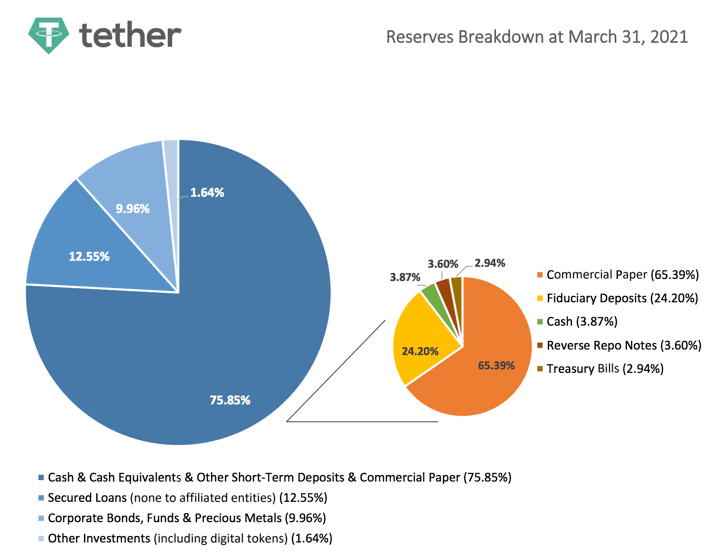
Tether Reserves Breakdown: A Clear Example of Stablecoin Risk

Tether is the largest US dollar stablecoin in the world, with a market cap of about $58 billion. Stablecoins are supposed to be backed by an equal amount of fiat money held in a trust account. 1 USDT should be backed by $1 USD. But how do you know? Tether just released a report outlining the collateral backing its stablecoin as of 3/31/2021, and it’s…. a huge warning sign. Less than 7% is held in cash and Treasury bills, with the rest being a mix of vague commercial paper, loans to unknown entities, and honestly who-knows-what.

Alignment of interest. Keep in mind the concept of alignment of interest from David Swensen. Tether wants to seem as credible and legitimate and “NOT A SCAM” as possible. Everything they say will try to put them in the best light possible. In fact, Tether is only doing this because of a legal settlement with the New York Attorney’s General Office after being fined $18 million for lying in the past. (As recently as March 2019, Tether claimed it was backed by 100% USD cash.) Yet… this is the best they can do?

A single glance at this chart and I know that Tether is not taking my US dollar and whisking it away safely into a trust account at a regulated US bank. Instead, the people running Tether are using the collateral for their own personal gain. They are making loans, earning interest, all things that add risk while using other people’s money. Banks are allowed to do that within a highly-regulated environment. Tether is not a bank.

Liquidity risk. There is a reason why Warren Buffett only holds Treasury bills when he says “cash” and not commercial paper. When the poo hits the fan – and it will sooner or later – “cash” means you get your money out immediately and reliably. Tether will not be able to do this, given the composition of its reserves. This op-ed on the future of stablecoins covers a lot of related concerns.

As the volume and velocity of stablecoins grow, the liquidity risk, of course, will grow too. For this reason, it will become increasingly important for the banks managing stablecoin cash to be nonlending banks or perhaps liquid asset banks that ring-fence the investments in segregated, bankruptcy-remote accounts — and, again, invest the assets backing stablecoin deposit liabilities in 100 percent risk-free, short-term, and liquid assets. Indeed, one reason why Wyoming chose its Special Purpose Depository Institution (SPDI) charter to be a nonlending charter is precisely because leverage and digital assets do not mix. Let me pause and repeat that — leverage and digital assets do not mix. Digital assets generally settle in minutes and with settlement finality, which means leveraged financial institutions that handle them could quickly find themselves in trouble if they don’t manage the liquidity risk well — digital assets move fast. So, there’s a fundamental reason why digital assets should interface with the traditional financial system via nonleveraged banks whose demand deposit liabilities are 100 percent backed by risk-free, short-term, liquid assets.

Instead of 100% risk-free, short-term, liquid assets, Tether is less than 7% risk-free, short-term, liquid assets. Commercial paper? Backed by whom exactly? Fiduciary account? At which remote offshore bank owned by a third-party? They could be pointing to a half-eaten sandwich and calling it collateral.

As a result, I would never own Tether, and if such behavior continues to be allowable, it would make me more skeptical of the other stablecoins like USD Coin (USDC) and Gemini Dollar (GUSD), even though they do claim to be fully-backed by dollar reserves in a US Bank. (Gemini and Circle are also regulated by the New York State Department of Financial Services, while Tether is not.) Regulation around stablecoins is so limited that we’ll probably have to experience some sort of major loss event before this gets addressed, just as we had to suffer deposit losses from failed banks before FDIC-insurance came around.

Having a clear stance on cryptocurrencies is tricky. On one hand, it is definitely a “Wild West” situation and there is certainly fraud and shady practices involved. On the other hand, this is how disruption works, and I don’t like anyone confidently telling me the future when nobody knows the future. I would rather try to learn about it, look for opportunities, but also remain very skeptical and careful. If you are holding a lot of Tether, possibly due to the high 8%+ interest rates available, please consider yourself warned.

Also see: Potential Risks of High Interest Stablecoin Savings Accounts

MMB Portfolio Update April 2021: Asset Allocation & Performance

portpie_blank200

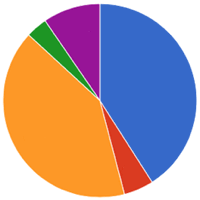
Here’s an update on my current investment holdings as of April 2021, including our 401k/403b/IRAs, taxable brokerage accounts, and savings bonds but excluding our house, cash reserves, and a small portfolio of self-directed investments. Following the concept of skin in the game, these are my real-world holdings and what I’ll be using to create income to fund our household expenses. We have no pensions or other sources of income.

Actual Asset Allocation and Holdings
I use both Personal Capital and a custom Google Spreadsheet to track my investment holdings. The Personal Capital financial tracking app (free, my review) automatically logs into my different accounts, adds up my various balances, tracks my performance, and calculates my overall asset allocation. Once a quarter, I also update my manual Google Spreadsheet (free, instructions) because it helps me calculate how much I need in each asset class to rebalance back towards my target asset allocation.

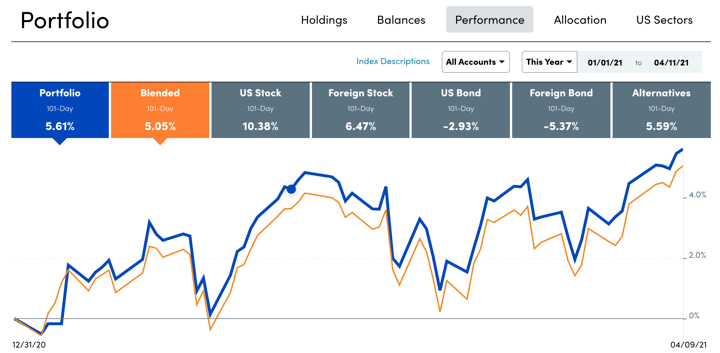
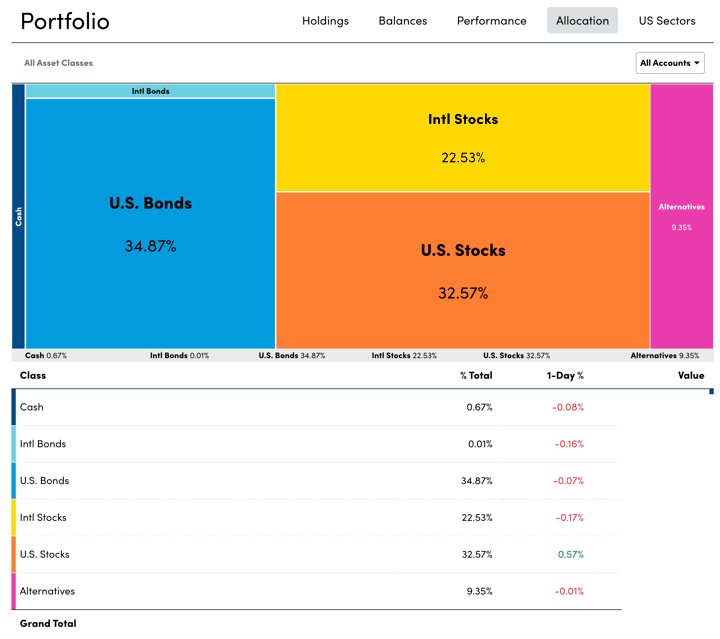
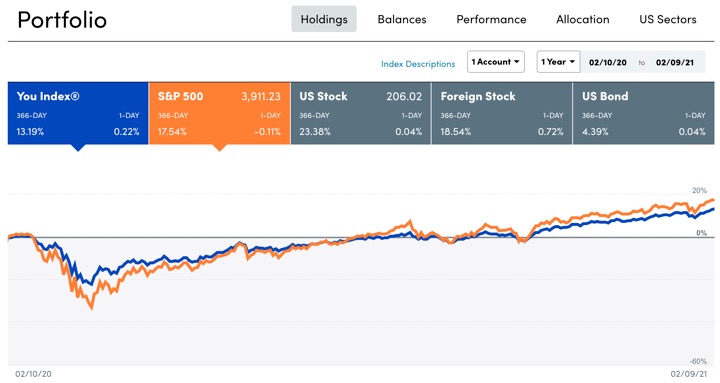
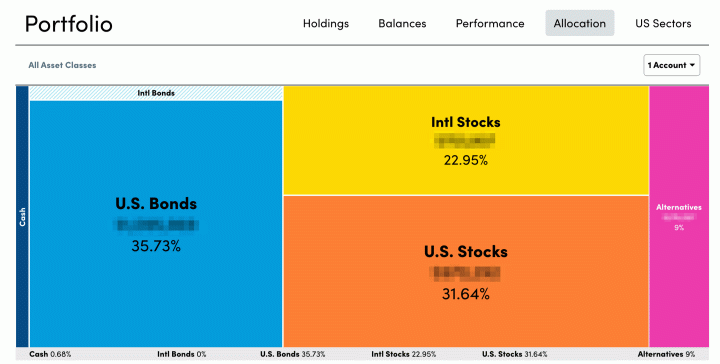
Here are updated performance and asset allocation charts, per the “Allocation” and “Holdings” tabs of my Personal Capital account, respectively:

Stock Holdings
Vanguard Total Stock Market (VTI, VTSAX)
Vanguard Total International Stock Market (VXUS, VTIAX)
Vanguard Small Value (VBR)
Vanguard Emerging Markets (VWO)
Vanguard REIT Index (VNQ, VGSLX)

Bond Holdings
Vanguard Limited-Term Tax-Exempt (VMLTX, VMLUX)
Vanguard Intermediate-Term Tax-Exempt (VWITX, VWIUX)
Vanguard Intermediate-Term Treasury (VFITX, VFIUX)
Vanguard Inflation-Protected Securities (VIPSX, VAIPX)
Fidelity Inflation-Protected Bond Index (FIPDX)
iShares Barclays TIPS Bond (TIP)
Individual TIPS bonds
U.S. Savings Bonds (Series I)

Target Asset Allocation. I do not spend a lot of time backtesting various model portfolios, as I don’t think picking through the details of the recent past will necessarily create superior future returns. Usually, whatever is popular in the moment just happens to hold the asset class that has been the hottest recently as well.

Mainly, I try to own broad, low-cost exposure to asset classes that will provide long-term returns above inflation, distribute income via dividends and interest, and finally offer some historical tendencies to balance each other out. I make a small bet that US Small Value and Emerging Markets will have higher future long-term returns (along with some higher volatility) than the more large and broad indexes, although I could be wrong.

While you could argue for various other asset classes, I believe that it is important to imagine an asset class doing poorly for a long time, with bad news constantly surrounding it, and only hold the ones where you still think you can maintain faith through those fearful times. I simply don’t have strong faith in the long-term results of commodities, gold, or bitcoin. (In the interest of full disclosure, I do own tiny bits of gold and BTC amongst my self-directed investments.)

My US/international ratio floats with the total world market cap breakdown, currently at ~57% US and 43% ex-US. I’m fine with a slight home bias (owning more US stocks than the overall world market cap), but I want to avoid having an international bias.

Stocks Breakdown

  • 43% US Total Market
  • 7% US Small-Cap Value
  • 33% International Total Market
  • 7% Emerging Markets
  • 10% US Real Estate (REIT)

Bonds Breakdown

  • 33% High-Quality Nominal bonds, US Treasury or FDIC-insured
  • 33% High-Quality Municipal Bonds
  • 33% US Treasury Inflation-Protected Bonds

I have settled into a long-term target ratio of 67% stocks and 33% bonds (2:1 ratio) within our investment strategy of buy, hold, and occasionally rebalance. I will use the dividends and interest to rebalance whenever possible in order to avoid taxable gains. I plan to only manually rebalance past that if the stock/bond ratio is still off by more than 5% (i.e. less than 62% stocks, greater than 72% stocks). With a self-managed, simple portfolio of low-cost funds, we minimize management fees, commissions, and taxes.

Holdings commentary. Overall, all these numbers keep going up since the March 2020 drop, but I remain anxious about the future. There seems to be lots of money and optimism sloshing around, but there are also so many people still struggling. All I can do is listen to the late Jack Bogle and “stay the course”. I remain optimistic that capitalism, human ingenuity, human resilience, and our system of laws will continue to improve things over time.

In specific terms, I seem to be a little overweight REITs and underweight International Stocks. I may rebalance within tax-deferred accounts if this continues.

I have also been following with interest the new ETFs from both Dimensional Fund Advisors and Avantis (started by former DFA employees). Right now, I don’t need to rebalance out of anything, but in the future I may purchase the DFA Emerging Core Equity Market ETF (DFAE) and Avantis U.S. Small Cap Value ETF (AVUV) instead of my current holdings.

Performance numbers. According to Personal Capital, my portfolio is already up +5.6% since the beginning of 2021. Wow. I rolled my own benchmark for my portfolio using 50% Vanguard LifeStrategy Growth Fund and 50% Vanguard LifeStrategy Moderate Growth Fund – one is 60/40 and the other is 80/20 so it also works out to 70% stocks and 30% bonds. That benchmark would have a total return of +5.2% for 2020 YTD as of 4/9/2021.

The goal of this portfolio is to create sustainable income that keeps up with inflation to cover our household expenses. I’ll share about more about the income aspect in a separate post.

ZYNLO Bank Review: 1.25% APY (No Longer Available To New Signups), 100% Match on Roundups

Update: As of 4/8/21, the ZYNLO website now lists their money market as “no longer available”, although the rate is still 1.25% APY if you opened it in time. The savings account pays 0.80% APY and still includes the roundups. There is a new “Tomorrow Savings” account that only pays 0.40% APY, so I’m not sure why anyone would pick that one.

ZYNLO Bank is another new “digital-first” bank, backed by the FDIC insurance of PeoplesBank in Massachusetts. Along with the common features of no monthly fees and Allpoint ATM network access, ZYNLO differentiates itself from the banking app crowd in a few different ways.

0.80% to 1.25% APY. Their main page advertises 0.80% APY on their Money Market account, which is already a competitive rate, but if you enter the promo code BANK (should auto-populate at this promo link) at account opening, they promise a higher promo rate of 1.25% APY on up to $250,000. Looks like promo code NERD gives the same result. Unfortunately, there is no rate guarantee as to how long either rate will last.

100% match on Roundups. When you purchase something with the ZYNLO debit card from their checking account (ex. $4.44), they will round up the transaction to the nearest dollar (ex. $5), deposit that amount (ex. 56 cents) into your savings account, and also match that amount (ex. another 56 cents). Their Savings Account (not the same as Money Market) offers a 100% match on “roundups” during their first 100 days. After that, you must maintain an average daily balance of $3,000 to continue to receive a 100% match. Otherwise, you only get a 25% match. The savings account pays negligible interest.

Let’s say you make 20 debit card purchase per month. If your purchase amounts are random over time, you will average a roundup of 50 cents per transaction. At a 100% match, that works out to $10 a month in matches per month (plus $10 of your own money being put aside in savings for you). 40 debit transaction per month = $20 a month at 100% roundup, and so on. If you make a lot of debit card purchases, it might be worth keeping a $3,000 balance to keep that 100% match.

Note that they don’t accept applications from a few states:

Who can use ZYNLO?
Any U.S. citizen 18 or older with a valid Taxpayer Identification Number. We can open accounts for people throughout the United States with the exception of CA, CT, MA, & NY.

My take. The money market promo rate may be attractive to those with very high balances as it applies to balances up to $250,000. The roundup matching might be attractive for people that make a lot of purchases on their debit cards. The negative is that there is no rate guarantee period and thus the slightly higher promo rate may not be high to guarantee a solid return over what might be a short period of time, given the other bank options near 3% APY available.

Hat tip to DepositAccounts.

TIPS Inflation Bonds Performance: Breakeven vs. Actual Inflation Rates

I own inflation-linked bonds as part of my investment portfolio. Specifically, Treasury Inflation-Protected Securities (TIPS) make up about 1/3rd of the bond portion, or 10% of my total portfolio. I go into more detail in my post Reasons To Own TIPS, but essentially they pay interest based on a fixed real yield plus ongoing inflation. To simplify: if the real yield is 1% and inflation is 3%, they pay 4%.

Traditional “nominal” Treasury bonds simply pay a flat interest rate that doesn’t change with inflation (i.e. 3%). The difference between the TIPS real yield and the nominal Treasury yield is at any given time is what inflation would have to be for them to pay out the exact same total yield, called the “breakeven inflation rate”. If the real yield on TIPS is 1% while the nominal rate is 3% at the same moment, then the breakeven rate is 2%. You could call it a market-based prediction of future inflation.

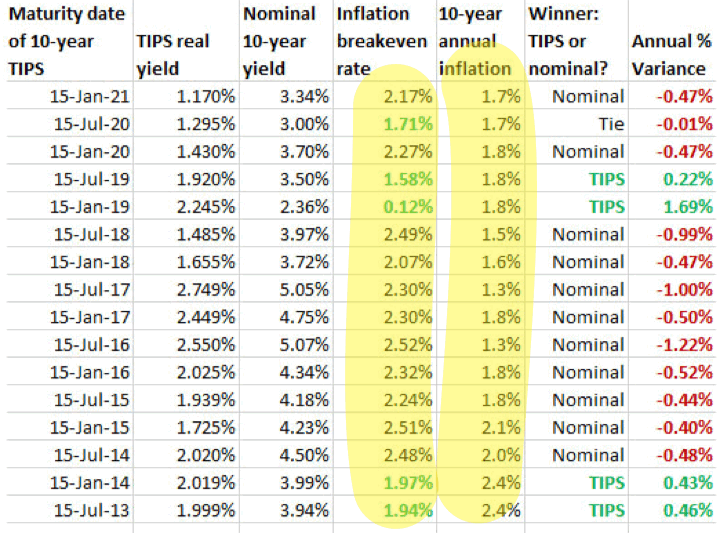
It turns out that 10-year TIPS bonds that matured over the last several years mostly underpeformed regular nominal Treasuries, as the actual inflation turned out to be less than the breakeven inflation rate. David Enna of TIPS Watch created the interesting chart below comparing the final performance of TIPS vs. nominal Treasury bonds maturing over the last several years, where green means that TIPS “won” and red means TIPS “lost” in terms of total return. I removed some columns and highlighted the initial breakeven rate (the market-based guess) and the actual inflation rate.

Enna states:

Still, the market-determined inflation breakeven rate measures sentiment and should not be viewed as an accurate prediction. In fact, the market often does a lousy job of predicting future inflation. The fact is, over the last decade, investors have been betting on higher inflation than actually resulted, and that has led to TIPS (in general) under-performing nominal Treasuries of the same term.

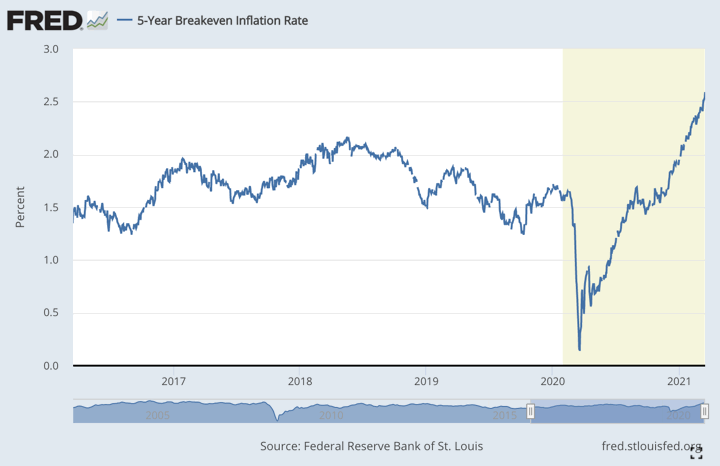
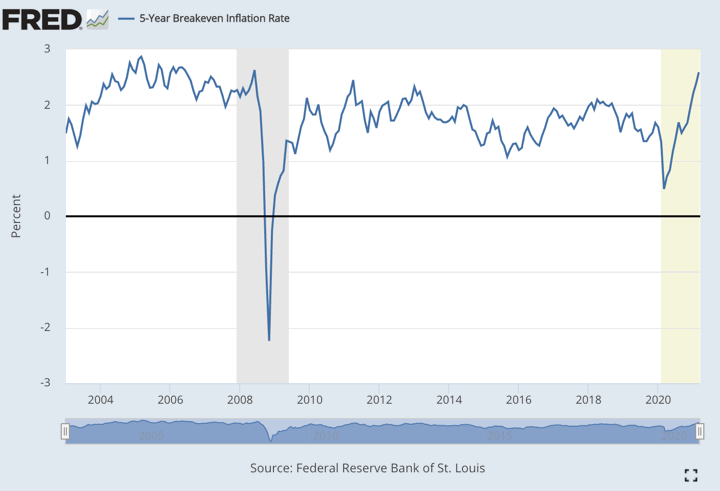
I have read some articles suggesting that you could adjust your TIPS holdings based on the real yield, but perhaps another way is to adjust your holdings based on inflation breakeven rate instead. You can track the 5-year and 10-year breakeven inflation rates at FRED. As of this writing in March 2021, the breakeven inflation rate has been rising very quickly since dropping quickly in early 2020.

The last time that the breakeven inflation rate dropped so drastically was in 2009. As with stocks, it can pay off to buy when everyone else is afraid. I was lucky to buy a chunk of long-term TIPS in 2009, but I didn’t buy much in 2020 since the real yields were still quite low.

I hold Treasuries, TIPS, and FDIC/NCUA-insured CDs because I like my “safe” assets to be of the highest quality, with no worries about getting both my principal and interest. In addition, TIPS also serves as a hedge against higher-than-expected inflation. However, that also means I might suffer if there is lower-than-expected inflation. My “insurance” didn’t pay out over the last 10 years, but that’s okay. I’m also fine if my don’t make a claim on my auto insurance, homeowners insurance, (and definitely life insurance!).

p.s. If you want to buy TIPS, these days you should consider buying Series I Savings Bonds first these days (up to the purchase limits). Their 0% real yield is better than the negative real yields on nearly all TIPS right now.

Berkshire Hathaway 2020 Annual Letter by Warren Buffett

Berkshire Hathaway (BRK) released its 2020 Letter to Shareholders over the weekend. If you also found reading this letter and Charlie Munger’s Daily Journal transcript an enjoyable way to spend your weekend… you might be an investing geek! As usual, the letter is not long at 15 pages. Here are my personal highlights.

I found the overall theme to be “Here’s a reminder of the many ways that Berkshire Hathaway is different than other companies”. For example, Buffett and Munger both started out with partnerships, where they invested nearly all their own net worth alongside their partners. They treated the investments as carefully as if it was their own money, because it was! I want to take the same care in writing this blog. I want to write things that I would want to read myself, and make recommendations that I would want to see being made to my own family and friends.

A minor surprise was that Buffett’s biggest purchase was $25 billion of BRK’s own shares in 2020 – roughly 5% of all outstanding shares! In other words, they though BRK itself was one of the best investments available in 2020. I guess I should have bought more BRKB when it was lingering at $165 a share.

Last year we demonstrated our enthusiasm for Berkshire’s spread of properties by repurchasing the equivalent of 80,998 “A” shares, spending $24.7 billion in the process. That action increased your ownership in all of Berkshire’s businesses by 5.2% without requiring you to so much as touch your wallet.

He also bought shares of a few big companies like Chevron ($8.6 billion) and Verizon ($4.1 billion), but it would seem that he thinks that most public and all available privately-held businesses are overpriced right now.

While Buffett indirectly pointed out that his Apple shares have gained nearly $90 billion for shareholders ($120B current value minus $31B cost basis), he also admitted a mistake in the price he paid for Precision Castparts:

The final component in our GAAP figure – that ugly $11 billion write-down – is almost entirely the quantification of a mistake I made in 2016. That year, Berkshire purchased Precision Castparts (“PCC”), and I paid too much for the company.

High prices for a stock can be a temporary illusion:

Investing illusions can continue for a surprisingly long time. Wall Street loves the fees that deal-making generates, and the press loves the stories that colorful promoters provide. At a point, also, the soaring price of a promoted stock can itself become the “proof” that an illusion is reality.

But, we should still appreciate our ability to own shares of wonderful businesses by buying shares with just a few clicks:

It took me a while to wise up. But Charlie – and also my 20-year struggle with the textile operation I inherited at Berkshire – finally convinced me that owning a non-controlling portion of a wonderful business is more profitable, more enjoyable and far less work than struggling with 100% of a marginal enterprise.

Be realistic about your expectations for bonds:

And bonds are not the place to be these days. Can you believe that the income recently available from a 10-year U.S. Treasury bond – the yield was 0.93% at yearend – had fallen 94% from the 15.8% yield available in September 1981? In certain large and important countries, such as Germany and Japan, investors earn a negative return on trillions of dollars of sovereign debt. Fixed-income investors worldwide – whether pension funds, insurance companies or retirees – face a bleak future.

Don’t take on unknown risk to chase higher yields:

Some insurers, as well as other bond investors, may try to juice the pathetic returns now available by shifting their purchases to obligations backed by shaky borrowers. Risky loans, however, are not the answer to inadequate interest rates. Three decades ago, the once-mighty savings and loan industry destroyed itself, partly by ignoring that maxim.

Buffett shared some historical profiles of Berkshire-owned companies that started out only as an idea from a single person or couple with limited funds. Through many years of hard work, determination, and taking advantage of the opportunities available in America, these turned into huge businesses. You may recognize the names: GEICO, See’s Candies, Clayton Homes, and Pilot Travel Centers.

Our unwavering conclusion: Never bet against America.

On the creation of wealth (reminds me of this):

Productive assets such as farms, real estate and, yes, business ownership produce wealth – lots of it. Most owners of such properties will be rewarded. All that’s required is the passage of time, an inner calm, ample diversification and a minimization of transactions and fees. Still, investors must never forget that their expenses are Wall Street’s income.

Past shareholder letters.

  • 1977-2020 are free on the Berkshire Hathaway website (PDF). 1965-2019 are $2.99 at Amazon (Kindle). Three bucks seems pretty reasonable for a permanent copy with the ability to search text and maintain highlights.
  • 2018 Letter discussed why BRK will continue to do fine without Warren Buffett around.
  • 2018 Letter discussed using debt very sparingly and the importance of holding productive assets over a long time.
  • 2017 Letter discussed patience, risk, and why they have so much cash.
  • 2016 Letter touched on the rarity of skilled-stock pickers and some insight on his own stock-picking practices.
  • 2015 Letter discussed his optimism in America and his “Big 4” stock holdings.
  • 2014 Letter discussed the power of owning shares of productive businesses (and not just bonds).
  • 2013 Letter included Buffett’s Simple Investment Advice to Wife After His Death.

The annual shareholder meeting will be virtual again this year, but at least it will include Charlie Munger! Yahoo Finance will livestream it on May 1st at 1pm EDT. I will probably wait to listen in the car via the Yahoo Finance podcast version.

MMB Portfolio Asset Allocation Update, February 2021

portpie_blank200

A central idea here is skin in the game, showing what someone really does with their own money. Too often, what the “experts” tell you to do is quite different than what they own themselves. Here’s my current portfolio as of February 2021, including our 401k/403b/IRAs, taxable brokerage accounts, and savings bonds but excluding our house, cash reserves, and a few side investments. I use these updates to help determine where to invest new cash to rebalance back towards our target asset allocation.

Actual Asset Allocation and Holdings

I use both Personal Capital and a custom Google Spreadsheet to track my investment holdings. The Personal Capital financial tracking app (free, my review) automatically logs into my different accounts, adds up my various balances, tracks my performance, and calculates my overall asset allocation. Once a quarter, I also update my manual Google Spreadsheet (free, instructions) because it helps me calculate how much I need in each asset class to rebalance back towards my target asset allocation.

Here are some performance and asset allocation charts, per the “Allocation” and “Holdings” tabs of my Personal Capital account, respectively:

Stock Holdings
Vanguard Total Stock Market (VTI, VTSAX)
Vanguard Total International Stock Market (VXUS, VTIAX)
Vanguard Small Value (VBR)
Vanguard Emerging Markets (VWO)
Vanguard REIT Index (VNQ, VGSLX)

Bond Holdings
Vanguard Limited-Term Tax-Exempt (VMLTX, VMLUX)
Vanguard Intermediate-Term Tax-Exempt (VWITX, VWIUX)
Vanguard Intermediate-Term Treasury (VFITX, VFIUX)
Vanguard Inflation-Protected Securities (VIPSX, VAIPX)
Fidelity Inflation-Protected Bond Index (FIPDX)
iShares Barclays TIPS Bond (TIP)
Individual TIPS securities
U.S. Savings Bonds (Series I)

Target Asset Allocation. I do not spend a lot of time backtesting various model portfolios, as I don’t think picking through the details of the recent past will necessarily create superior future returns. I mainly make sure that I own asset classes that will provide long-term returns above inflation, distribute income via dividends and interest, and finally offer some historical tendencies to balance each other out. I make a small bet that US Small Value and Emerging Markets will have higher future long-term returns (along with some higher volatility) than the more large and broad indexes, although I could be wrong.

While you could argue for various other asset classes, I believe that it is important to imagine an asset class doing poorly for a long time, with bad news constantly surrounding it, and only hold the ones where you still think you can maintain faith through those fearful times. I simply don’t have strong faith in the long-term results of commodities, gold, or bitcoin. (In the interest of full disclosure, I do own tiny bits of gold and BTC, but at less than 1% of net worth.)

My US/international ratio floats with the total world market cap breakdown, currently at ~57% US and 43% ex-US. I think it’s okay to have a slight home bias (owning more US stocks than the overall world market cap), but I want to avoid having an international bias.

Stocks Breakdown

  • 43% US Total Market
  • 7% US Small-Cap Value
  • 33% International Total Market
  • 7% Emerging Markets
  • 10% US Real Estate (REIT)

Bonds Breakdown

  • 33% US Treasury Bonds, intermediate (or FDIC-insured)
  • 33% High-Quality Municipal Bonds (taxable)
  • 33% US Treasury Inflation-Protected Bonds (tax-deferred)

I have settled into a long-term target ratio of 67% stocks and 33% bonds (2:1 ratio) within our investment strategy of buy, hold, and occasionally rebalance. I will use the dividends and interest to rebalance whenever possible in order to avoid taxable gains. I plan to only manually rebalance past that if the stock/bond ratio is still off by more than 5% (i.e. less than 62% stocks, greater than 72% stocks). With a self-managed, simple portfolio of low-cost funds, we minimize management fees, commissions, and taxes.

Holdings commentary. I should be happy that my portfolio numbers seem to keep going up and up after the March 2020 scare, but instead I am mentally preparing myself for some low future returns over the next decade or so. I’m not making any big moves, but in keeping with my investment plan, I will be selling some US stocks this month as part of normal rebalancing. I remain optimistic that capitalism, human ingenuity, human resilience, and our system of laws will continue to improve things over time.

I’ve been seeing various articles about how to adjust your investing after the Gamestop short squeeze. Given that my holding strategy doesn’t require me to follow any market news at all, I don’t need to do any adjusting! 🙂

Performance numbers. According to Personal Capital, my portfolio ended up about 14% over all of 2020. An alternative benchmark for my portfolio is 50% Vanguard LifeStrategy Growth Fund and 50% Vanguard LifeStrategy Moderate Growth Fund – one is 60/40 and the other is 80/20 so it also works out to 70% stocks and 30% bonds. That benchmark would have a total return of +14.5% for 2020 YTD as of 11/3/2020.

The goal of this portfolio is to create sustainable income that keeps up with inflation to cover our household expenses. I’ll share about more about the income aspect in a separate post.

Beam App Complaints: Frozen Bank Deposits and Lessons Learned

(Follow-up 11/27: CNBC reports that progress had been made towards customers getting their funds back, although not everything has been resolved.)

Beam Financial was yet another fintech app that promised a high interest rate along with (what they think are) clever hurdles to get it. They’ve had various hiccups since their delayed launch in 2019, but most recently many customers found themselves unable to withdraw their own funds. This certainly sounds like a nightmare! As more news has slowly trickled out, important details of the story have emerged – see CNBC, American Banker #1 (paywall?), American Banker #2 (paywall?), Google app complaints, and BBB complaints.

To be blunt, it seems that Beam simply didn’t know how to run a bank properly. Here are the highlights:

  • Beam opened some sort of commercial custody account with Huntington Bank (a real FDIC-insured bank), but that account didn’t allow withdrawals (!). Beam apparently didn’t know that before they opened the account (!!).
  • Beam then added Dwolla as their ACH provider (to provide transfers, not to hold any money), but Dwolla terminated their agreement as of October 1st, 2020 with a (disputed) one month of notice for violating their agreement.
  • Dwolla was supposed to manage transfers between Huntington and another deposit network provider R&T (which also provides FDIC insurance). R&T also terminated their relationship with Beam at the end of October 2020 for violating their agreement.
  • Beam used to list Wells Fargo, Citigroup, Morgan Stanley, and US Bank as examples of banks they work with on their website. When contacted, none of those banks stated they had a relationship with Beam. Those names are now gone.
  • Beam lost up to $300,000 due to a deposit chargeback scam that seemed easily avoidable (details below).
  • BBB complaints about account access started as early as December 2019. They were officially investigated by the Federal Trade Commission (FTC) for the second time by May 2020.
  • Beam says the money is all just stuck somewhere now, with no way to get it back to their rightful owners. They have given no date as to when this will be fixed.

Within its first 3 months of existence, Beam was apparently defrauded out of about $300,000 by the modern version of check kiting. A malicious customer would initiate an ACH transfer of funds to Beam, and then Beam would let them withdraw it to another account before it fully cleared. Meanwhile, the malicious customer would cancel their initial ACH transfer. Net result: No money in, just money out! I guess they never saw the movie Catch Me If You Can. This is why most banks have clear funds availability policies to protect themselves.

Why didn’t I open an account with Beam? After searching my emails, I found that I did submit my email for the Beam waitlist in August 2017. They invited me to their private beta in April 2018. I declined. I didn’t know any of this would happen, but I do remember that they were vague about the name of their partner bank that would provide FDIC-insurance, despite so many loud emails with emojis and a very aggressive referral program. So much hype, but so many delays. I thought they’d be “vaporware” forever. When it did finallly arrive, I didn’t like their confusing model of offering 7% interest for a single day if I jumped through their hoops. How was I supposed to track that? I usually only like to share offers that I’d take advantage of myself, so I never mentioned it here (thankfully).

I would have found more red flags if I did open an account…

What are some quick checks to perform before depositing substantial amount of money? Here are some steps that I take when dealing with a new financial account. My most recent account opening was HM Bradley, so let’s run through them as an example.

If they are a banking app, what financial institution is providing the FDIC insurance? What is the certificate number and what is the name on it? These days, many banks have multiple names or they offer deposit services to other financial companies.

The HMBradley website claims says that “All deposit accounts are provided by Hatch Bank, Member FDIC.” The FDIC BankFind website shows certificate #25803 for Hatch Bank in San Marcos, CA. There is one location, which per Google Maps is a strip mall with the name “Rancho Santa Fe Thrift & Loan” as of April 2019. According to this announcement:

Rancho Santa Fe Thrift & Loan Association changed its name to Hatch Bank, effective April 12, according to the California Department of Business Oversight’s monthly bulletin.

The San Marcos, Calif.-based bank is a subsidiary of Conshohocken, Pa.-based Firstrust Savings Bank, and Semperverde Holding Co. is the ultimate parent of both.

Fun fact: Firstrust Bank was started in 1934 and is the largest family-owned bank in the Philadelphia region and the official bank of the Philadelphia Eagles.

Beam would not provide an FDIC certificate and just stated that they use a “network” of banks including US Bank, Citibank and Wells Fargo (all of which denied any relationship with Beam when contacted).

Does that named financial institution actually acknowledge the named fintech app somewhere? Either verify via phone call, website link, press release, something to confirm this claim from both directions.

On the Hatch Bank website, HM Bradley is clearly mentioned and linked to on the front page.

After signing up for the account, does the routing number match up with the promised bank?

The routing number provided was 322286188. According to the official site of ABA routing numbers, ABA.com, this matches up with Hatch Bank.

Based on my research, Beam would NOT provide a routing number, ostensibly so they could maintain their overall $15,000 deposit limit and $5,000 maximum deposit per day.

If I link the account to another savings account (ex. Ally Bank), can I push/pull funds without issue?

Ally Bank allows a high number of linked banks, and it is free to simply push and pull $1 to/from an external account. HMBradley lets me push and pull from Ally and other external banks with no issue.

Beam would NOT give you a routing number and account number, so you couldn’t link it other accounts and push/pull. You can only initiate transfers within the Beam app itself. This is a HUGE red flag and instant deal-breaker in my opinion.

Does the bank have a working customer service phone number? If not, how responsive are they to email or Live Chat?

If they have a phone number, just call it and ask for something mundane, like verifying your account balance. Phone customer service is expensive, but it’s still very nice to have. HM Bradley does not have a phone number that I can find, but it does have Live Chat from 9-5pm Pacific, Monday through Friday. I have contacted them via both Live Chat and e-mail support (support@hmbradley.com) multiple times and have gotten satisfactory support. Mostly, I bug them to mark my direct deposit as such to qualify for the higher savings tiers.

Beam had no phone number or live chat, only an e-mail address.

How much venture capital have they received? When? From whom?

These banks may have various business models with fancy projections, but honestly, in the beginning your interest is being paid out of venture capital. HM Bradley apparently got $3.5 million from 6 VC firms in a seed round in November 2019. PayPal founder Max Levchin is an investor through his HVF Labs.

I could not find any evidence that Beam Financial received any substantial venture capital at all. Note that there is a startup called Beam Solutions that raised $9M of venture capital before recently being acquired, but that is not Beam Financial.

A high interest rate doesn’t automatically mean danger. There are definitely many different sources of revenue in the banking world, and I have (and continue to) receive much higher interest in my bank accounts than if I just kept it in Bank of America or Chase, earning nothing. ING Direct was a young start-up once, and it changed the entire industry. Banks have paid me over ten thousand dollars to switch to them. Rewards checking accounts come and go, oftentimes with very high rates. Prepaid debit cards gave me 5% to 6% APY for a long time. Credit unions offered me long-term CDs at interest rates double or triple the national average, all because they have unique funding needs. I have literally earned tens of thousands of dollars in extra interest by taking advantage of offers that are only available to individuals (not huge institutions) and for a limited-time. This is not a highly “efficient” market, not least because most people hate changing banks.

There is always some risk involved. Doing all of the above doesn’t mean that HM Bradley or any financial institution won’t have problems in the future. In the end, there is always some risk of bad actors at least delaying access to your money. Don’t put all your eggs in one basket. While the “smell” test is important, I focus on making sure that my funds are landing in an FDIC-insured account. It remains to be seen if Beam will make all of their customers whole without government intervention. I certainly hope so. I hope this added publicity brings more attention to their plight.

* Beam’s website at MeetBeam(dot)com still says nothing about their issues. They are still gathering e-mail addresses for new sign-ups. That is not right, and so I’m not linking to their site.

** I have no financial interest in Beam or HMBradley, in terms of you opening an account. My only “skin in the game” is that I have my own cash at HMBradley. Please do your own due diligence.

MMB Portfolio Asset Allocation Update, November 2020

portpie_blank200

I support the idea of skin in the game, and I wish more “experts” would simply share what they actually own. Here’s my current portfolio update as of November 2020, including all of our 401k/403b/IRAs, taxable brokerage accounts, and savings bonds but excluding our house, cash reserves, and a few side investments. I use these updates to help determine where to invest new cash to rebalance back towards our target asset allocation.

Actual Asset Allocation and Holdings

I use both Personal Capital and a custom Google Spreadsheet to track my investment holdings. The Personal Capital financial tracking app (free, my review) automatically logs into my different accounts, adds up my various balances, tracks my performance, and calculates my overall asset allocation. I still use my manual Google Spreadsheet (free, instructions) because it helps me calculate how much I need in each asset class to rebalance back towards my target asset allocation.

Here are my YTD performance and current asset allocation visually, per the “Allocation” and “Holdings” tabs of my Personal Capital account, respectively:

Stock Holdings
Vanguard Total Stock Market (VTI, VTSAX)
Vanguard Total International Stock Market (VXUS, VTIAX)
Vanguard Small Value (VBR)
Vanguard Emerging Markets (VWO)
Vanguard REIT Index (VNQ, VGSLX)

Bond Holdings
Vanguard Limited-Term Tax-Exempt (VMLTX, VMLUX)
Vanguard Intermediate-Term Tax-Exempt (VWITX, VWIUX)
Vanguard Intermediate-Term Treasury (VFITX, VFIUX)
Vanguard Inflation-Protected Securities (VIPSX, VAIPX)
Fidelity Inflation-Protected Bond Index (FIPDX)
iShares Barclays TIPS Bond (TIP)
Individual TIPS securities
U.S. Savings Bonds (Series I)

Target Asset Allocation. I do not spend a lot of time backtesting various model portfolios, as I don’t think picking through the details of the recent past will necessarily create superior future returns. I mainly make sure that I own asset classes that will provide long-term returns above inflation, distribute income via dividends and interest, and finally offer some historical tendencies to balance each other out. I make a small bet that US Small Value and Emerging Markets will have higher future long-term returns (along with some higher volatility) than the more large and broad indexes, although I could be wrong.

While you could argue for various other asset classes, I believe that it is important to imagine an asset class doing poorly for a long time, with bad news constantly surrounding it, and only hold the ones where you still think you can maintain faith through those fearful times. I simply don’t have strong faith in the long-term results of commodities, gold, or bitcoin.

Instead of staying with my fixed 50/50 target, I am explicitly letting my US/international ratio float with the total world market cap breakdown. I think it’s okay to have a slight home bias (owning more US stocks than the overall world market cap), but I want to avoid having an international bias. I just want to maintain the balance of the total world market cap, which has become roughly 60% US and 40% international. This also means less need for rebalancing.

Stocks Breakdown

  • 46% US Total Market
  • 7% US Small-Cap Value
  • 30% International Total Market
  • 7% Emerging Markets
  • 10% US Real Estate (REIT)

Bonds Breakdown

  • 33% US Treasury Bonds, intermediate (or FDIC-insured CDs)
  • 33% High-Quality Municipal Bonds (taxable)
  • 33% US Treasury Inflation-Protected Bonds (tax-deferred)

I have settled into a long-term target ratio of 67% stocks and 33% bonds (2:1 ratio) within our investment strategy of buy, hold, and occasionally rebalance. I will use the dividends and interest to rebalance whenever possible in order to avoid taxable gains. I plan to only manually rebalance past that if the stock/bond ratio is still off by more than 5% (i.e. less than 62% stocks, greater than 72% stocks). With a self-managed, simple portfolio of low-cost funds, we minimize management fees, commissions, and taxes.

Holdings commentary. 2020 has been… well… you know. Many times I just have to keep reminding myself that I cannot predict the future, even there appears to be impending doom around the corner. There is no possible way I will know how the stock market will react in a week, a month, or a year. Some businesses will fail and new businesses will start. I just have to trust in capitalism, human ingenuity, human resilience, and our system of laws to allow capital to flow where it can work best over time.

When my equities had dropped significantly and my unrealized gains were low, I thought about moving towards simplicity and selling my positions in the US Small Value (VBR) and Emerging Markets (VWO) classes. However, I realized I actually liked having some extra moving pieces that didn’t move in concert with my relatively large VTI and VXUS positions. I did sell some tax lots of Wisdomtree ETF positions and swapped over to the closest Vanguard ETF equivalents.

I was not disappointed in my decision to hold only the highest-quality bonds and cash equivalents. US Treasuries, TIPS, investment-grade municipal bond funds, FDIC or NCUA-insured certificates of deposit, US savings bonds.

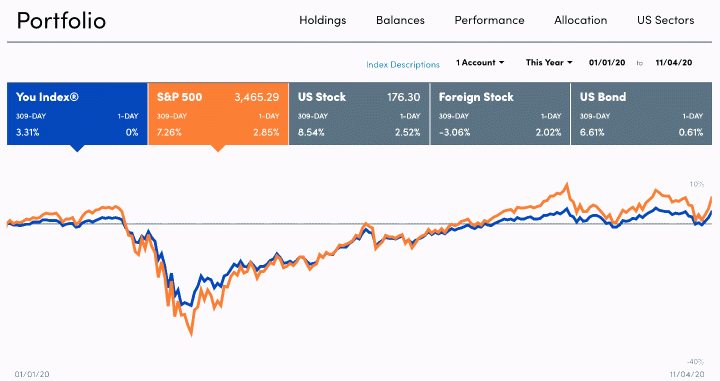
Performance numbers. According to Personal Capital, my portfolio went up about 3% so far in 2020, although the ride has not been nearly as boring as that sounds! I see that during the same period the S&P 500 has gone up +7%, Foreign Developed stocks down -3%, and the US Aggregate bond index was up about +6.6%. These numbers could change quite a bit in a week, so it’s not very useful information.

An alternative benchmark for my portfolio is 50% Vanguard LifeStrategy Growth Fund and 50% Vanguard LifeStrategy Moderate Growth Fund – one is 60/40 and the other is 80/20 so it also works out to 70% stocks and 30% bonds. That benchmark would have a total return of +3.8% for 2020 YTD as of 11/3/2020.

The goal of this portfolio is to create sustainable income that keeps up with inflation to cover our household expenses. I’ll share about more about the income aspect in a separate post.

Vanguard Prime Money Market Fund Changes

Vanguard is making a few changes to their Vanguard Prime Money Market Fund, which is often their highest-yielding option:

  • Name change. Vanguard Prime Money Market Fund will change its name to Vanguard Cash Reserves Federal Money Market Fund.
  • Even safer. It will now invest only in securities fully backed by the U.S. government or cash. I believe that they used to invest in some highly-rated short-term commercial paper.
  • Even cheaper. Basically, everyone will get the lower expense ratio from Admiral shares which previously had a $5,000,000 minimum (!). The minimum investment to get started is still $3,000.
  • No more checkwriting. You can still get checkwriting with certain other funds, including the Vanguard Federal Money Market Fund.

The actionable event here is that if you own the Prime Investor Shares (VMMXX), you can manually convert to the Admiral Shares (VMRXX) to immediately take advantage of the lower expense ratio (and thus higher yield) instead of waiting until possibly 2021:

Existing Investor share owners (VMMXX): You have the option to immediately convert† to Admiral Shares to begin taking advantage of the lower expense ratio. You can find simple step-by-step instructions here. If you don’t initiate a conversion, you’ll be automatically converted sometime between late 2020 through 2021. Note: Our checkwriting service isn’t available for the fund’s Admiral share class. Checkwriting is available for Vanguard Federal Money Market Fund and other Vanguard money market funds.

While this fund usually offers one of the highest cash sweep amongst brokerage accounts, the interest rate is still really low at about 0.10% SEC yield right now. At the same time, many online savings accounts are at about 0.80%. Still, if you own this fund you might as well convert now. The Vanguard Federal Money Market Fund remains Vanguard’s default cash sweep option, which historically has yielded slightly less than Vanguard Prime.

MMB Household Money Flowchart (Money Map)

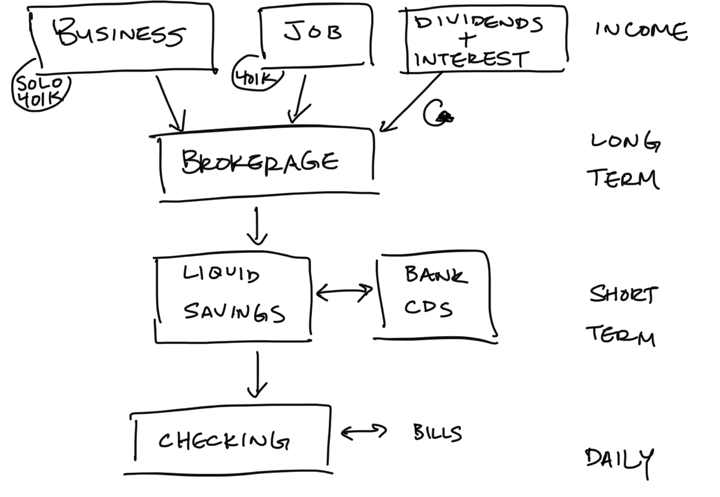
funny flowchart exampleA reader asked me to complete a money map to help visualize how I manage our finances, as per this neat Money Map chain. I wasn’t sure exactly how much detail to add, but the flowchart below is a good representation of how I organize things mentally. Specifics like brokerage or bank choices may change a few years from now, but this overall structure probably won’t.

Income sources. We receive income via business profits, W-2/contractor jobs, and our portfolio. A portion is automatically directly into 401k, HCFSA, DCFSA, and Solo 401k accounts. (We are not eligible for an HSA.) The dividend and interest income is a circular arrow because technically it is generated and then held in the brokerage account. One day, this might include Social Security, rental income, annuity payments, etc.

Long-term investments (5+ years time horizon). Historically, all our income flows directly into our brokerage accounts (most brokers allow direct deposits). I used to invest monthly, but now the business/job income flows are much smaller in semi-retirement. Dividends arrive into the taxable account quarterly, so I now check once every three months to manually reinvest and/or distribute funds as needed. Other than this check-in every 3 months, this tier is “consciously neglected” and designed to grow over time and eventually become self-sustaining. Here are my intermittent portfolio updates.

Short-term investments (1 month to 5 years). This tier is basically my “emergency fund”. In the accumulation stage, it was between 6 months to a year of expenses. Now, I keep five years of expenses as I am much more reliant on unstable portfolio income and there is less stable job income (human capital). Money comes in quarterly from above, and is taken out monthly for household expenses. This tier is “actively-managed” as I aim for higher returns without extra risk to principal (everything is US gov’t/FDIC/NCUA-insured).

  • Liquid savings. Roughly one year of expenses are kept in a 100% liquid savings account. The location can vary but the default is Ally Bank, as they have a good balance of decent rates, solid user interface for interbank transfers, and human customer service. You can also create multiple savings accounts, all with no minimum balance.
  • Certificates of deposit, etc. The other 4 years of expenses are moved roughly into a 5-year CD ladder, adjusted based on rates. Savings bonds and Treasury Bills may also be used if priced competitively. I tried to take advantage of CD rates when they were 3.5 to 4% APY. I write about these banking opportunities regularly and summarize them monthly.
  • Bank bonuses. If CDs rates are not worthwhile, cash may also be optimized via banking promotions. Banks offer you an incentive to try their product, and I accept the offer if the terms are agreeable. I also write about these opportunities here as they come up.

Day-to-day needs. Each month, a “paycheck” transfer goes from savings to checking. Wherever possible, our day-to-day expenses are put on credit cards to trigger the best credit card bonuses. After the float period, it is paid off in full from checking. A larger purchase may require a direct withdrawal from savings account (i.e. estimated tax payments) or one-time transfer to checking (i.e. fix the fridge). I also use Ally Checking, as you can assign one of your savings accounts as a no-fee overdraft backup source.

This design includes a few purposeful features.

  • Savings to 401k are automatic and first, which is critical when that is your major source of savings. It should happen without any energy requirement. No effort, no reminders.
  • Work income is separated from our spending. In the accumulation stage, you want to get bigger paychecks over time but try your best to ignore them when it comes to spending. Instead, all the income gets mixed together and the first place it lands is long-term investments. In semi-retirement, our incomes fluctuate (quite downward in 2020) and we smooth things out with portfolio withdrawals.
  • Portfolio fluctuations are also tempered by a big cash bucket. It’s easier to sleep at night when you have five years of expenses in safe cash readily available. We didn’t need this much cash in the accumulation stage, but when you rely on the stock market for part of your monthly income, it really helps. Is it psychological? Yes.
  • The “fun” hobby stuff is optional. Don’t feel like chasing rates? Just consolidate at one bank. Don’t feel like a different credit card every quarter? Just switch to one.
  • All accounts are joint where possible. That is simply what has worked best for us.

Anyhow, that’s how it works for us. That monthly transfer from savings to checking gives me a rough idea of our monthly and thus annual spending. As long as that number stays a reasonable percentage of our total portfolio, things are happy. We have had a lot of luck, and I don’t want to squander it.

HSBC Bank Promo: 3% Cash Bonus on New Deposits, Up to $600 Total

Interest rates on liquid savings accounts keep dropping, making bank bonuses more attractive on a relative basis. Opening new accounts are more hassle, so I usually want at least double the interest rates I could get by doing nothing. This $240/$600 HSBC bank bonus satisfies that requirement at over 12% APY. This bonus is not as simple as I’d like, so let’s unpack the details a bit.

Premier Checking (up to $600) bonus details.

  • Open by 9/30/2020. Customers who held an HSBC consumer deposit or investment account from June 29, 2017 through and including June 29, 2020 are not eligible for this offer.
  • 3% cash bonus on qualifying direct deposits, up to $100 per calendar months for 6 months ($600 total). The 6 calendar months begin with the first full calendar month after account opening.
  • Qualifying Direct Deposits are electronic deposits of regular periodic payments (such as salary, pension, Government Benefits or other monthly income) made into your HSBC Premier checking account from third parties at least once per calendar month.
  • Bonus arrives 8 weeks after qualifying activity. To be eligible for the offer, your HSBC Premier checking account must be open without being changed to a product with lower balance requirements, and in good standing at the time of fulfillment.
  • Limit one 3% Promotional Offer or New Consumer Deposit Offer per customer, including all individual and joint accounts — the first line name on the joint account is considered the customer for gift purposes.

HSBC Premier checking has a $50 monthly maintenance fee, unless you have one of the following:

  • Balances of $75,000 in combined U.S. consumer and qualifying commercial U.S. Dollar deposit and investment* accounts; OR
  • Monthly recurring direct deposits totaling at least $5,000 from a third party to an HSBC Premier checking account(s); OR
  • HSBC U.S. residential mortgage loan with an original loan amount of at least $500,000, not an aggregate of multiple mortgages. Home Equity products are not included.

This is not official, but to me the wording suggests that a regularly scheduled monthly ACH transfer pushed from an external bank can count as a direct deposit. The comments under this Doctor of Credit post support this. Obviously, you may want to switch over a payroll if that is an option for you. HSBC doesn’t have any high-interest bank accounts where it would be beneficial to park $75,000 (even if you had this large amount available), so this leaves the best move as making an ACH transfer of $5,000 per month into the account during those 6 months (wait to start until the next new month after opening). This triggers the full bonus and you can then withdraw the funds as you wish, as you have already done the deposits and waived the monthly fee. Limit one per customer, so you and a spouse/partner can each get a bonus, but as usual I would make two individual accounts instead of joint accounts.

The fact that you don’t keep those $5,000 monthly deposits in the account is what I missed initially, and what makes this bonus worth a second look. You can just cycle it: deposit $5k, spend/transfer out $5k, and then deposit $5k again. Now you’re earning a $600 bonus on $5,000 instead of $30,000 or $75,000 in committed cash. Even if you were loose with the math and assumed you had to keep $5,000 in the account for 12 months, a $600 bonus would be 12% annualized. Don’t downgrade your account until get the bonus!

Advance Checking (up to $240) bonus details.

  • Open by 9/30/2020. Customers who held an HSBC consumer deposit or investment account from June 29, 2017 through and including June 29, 2020 are not eligible for this offer.
  • 3% cash bonus on qualifying direct deposits, up to $40 per calendar months for 6 months ($240 total). The 6 calendar months begin with the first full calendar month after account opening.
  • Qualifying Direct Deposits are electronic deposits of regular periodic payments (such as salary, pension, Government Benefits or other monthly income) made into your HSBC Advance checking account from third parties at least once per calendar month.
  • Bonus arrives 8 weeks after qualifying activity. To be eligible for the offer, your HSBC Advance checking account must be open without being changed to a product with lower balance requirements, and in good standing at the time of fulfillment.
  • Limit one 3% Promotional Offer or New Consumer Deposit Offer per customer, including all individual and joint accounts — the first line name on the joint account is considered the customer for gift purposes.

HSBC Advance checking has a $25 monthly maintenance fee, unless you have one of the following:

  • Balances of $5,000 in combined U.S. consumer and qualifying commercial U.S. Dollar deposit and investment* accounts; OR
  • Monthly recurring direct deposits (of any amount) from a third party to an HSBC Advance checking account(s); OR
  • HSBC U.S. residential mortgage loan (of any amount). Home Equity products are not included.

You can either park $5,000 there for about 8 months, or you can make a small direct deposit of any amount each month to waive the monthly fee. However, you will need to deposit at least $1,334 each month to max out the bonus at $40 per month. Even if you were loose with the math and assumed you had to keep $1,500 in the account for 12 months, a $240 bonus would be 16% annualized. Don’t downgrade your account until get the bonus!

Which one? If you have $5,000 that you can cycle, then the $600 Premier bonus is a better use of your time as this bonus will require you to set up multiple transfers and take 8-9 months to complete. If you only have $1,500 to cycle, getting a $240 bonus is still pretty good. Bank bonuses require attention to detail, a tracking/reminder system, and patience. It helps to have that quirk where getting the equivalent of guaranteed 12% annual return on your money is “fun”. 🙂

Thanks to reader Brian M for the tip.