Search Results for: High Interest Savings

Chase You Invest Brokerage Transfer Bonus: Up to $725 Cash

Financial institutions increasingly want all of your money under one roof. Brokerage firms and robo-advisors are adding savings accounts and debit cards. Banks want to let you trade stocks. If you have built up some sizeable assets, you can make extra money when they decide to pay you to move over your assets. Try them out, see if you like them, and move again if you need to.

The self-directed brokerage arm for Chase is You Invest, and they are currently offering up the following transfer bonuses:

  • $200 with $25,000-$99,999 in qualifying new money
  • $350 with $100,000–$249,999 in qualifying new money
  • $725 with $250,000+ in qualifying new money

The cash bonus applies to any new You Invest Trade account (Brokerage, Traditional IRA, or Roth IRA) and is limited to one per customer. You can only participate in one Chase Private Client Checking, Chase Sapphire Checking or You Invest new money bonus in a 12 month period from the last bonus enrollment date. New money must come from outside J.P. Morgan, Chase, or their affiliates.

The $200 bonus is best in terms of percentage (0.8% of $25,000), but in terms of time/effort you may just want to get the biggest bonus. Funds must arrive within 45 days of opening your account, and you must keep it there for 90 days after funding. Bonus arrives 10 business days after that, and may be reported on 1099-MISC. Given the current low interest rates, you may even consider depositing cash. I’m sure their interest in cash sweep is zero or close enough to zero, but you might also consider ultra-short bond ETFs like MINT (still possible to lose value).

If you have that much in ETFs, mutual funds, or stocks at another broker, you could perform an in-kind ACAT transfer over to You Invest, and all of your tax basis information should also move over. Your old broker may charge you an outgoing ACAT fee about about $75, although you should ask You Invest if they will reimburse you for this fee.

There have been some higher bonuses in the past for Sapphire Banking in which you could use You Invest assets to count towards the requirements (ex. $1,000 for $75k in assets), but they are not currently available. This is a relatively new product for Chase, so I wouldn’t expect a top-quality trading interface. If you mostly hold index ETFs, it should be fine.

Also see: BofA/Merrill Edge transfer bonus, M1 Finance transfer bonus

Financial Independence Not As a Number, But Creating a Content Lifestyle

If you’re reading this, then financial independence is probably a goal of yours. Yet, most people who accumulate a pile of money big enough to retire upon keep on working if they are able. Why? They may truly love their job and be willing to work for free, they may worry that they won’t have enough, they might decide they’d rather have nicer things, or they may simply not have fully considered a life after paid work.

The problem is that reaching your “Number” is like finally buying that big house or fancy car or 100,000th social media follower. There is never a point at which you can say “I’m here! I’ll be forever happy and satisfied from now on.” It is always tempting to keep reaching for more. As the saying goes: If all you care about is money, you’ll never have enough money. If all you care about is social prestige, you’ll never have enough social prestige. You are forever stuck on the hamster wheel.

The article Redefining Success So It Doesn’t Crush Your Soul touches on many concepts related to this puzzle.

It’s high time to redefine success. Success is not something that you reach—not something that is outside of yourself, just down the field. Success is creating a life you want to live in right now. The great tragedy, Fromm writes, is that “man misses the only satisfaction that can give him really happiness—the experience of the activity in the present moment—and chases after a phantom that leaves him disappointed as soon as he believes he has caught it—the illusory happiness called success.”

According to decades of psychological research, a successful life is one in which your basic needs for food, shelter, health care, and income are met and in which you have a sense of autonomy, mastery, and belonging. A life that is not about enduring means you can’t stand in order to reach ends you are supposed to want; but rather, about selecting pursuits based on how much you’ll enjoy the process of doing them.

Happiness is not a goal. It is a side effect of how you spend each day. Imagine a day where money is not limitless, but it also doesn’t matter to your wellbeing. You can pick to “work” on something you both enjoy and find meaningful, while also spending time with people you love. What would that look like? I completed a similar Dream Day activity in 2005, and the improved clarity definitely helped.

Starting out, I thought of financial independence as a race to a fixed goal. Track numbers, plot them on a chart. I’d work hard, save hard, reach my net worth target, and finally turn in my resignation letter and disappear.

Looking back, what worked better was a gradual transition between two versions of the same sustainable lifestyle. To build up your assets, you have to enjoy your daily process so you don’t burn out, while also maintaining a gap between your income and expenses. Invest that excess money into productive assets (building a private business, buying stock shares of public businesses, rental real estate, etc), and over time your choices expand. You can work the same job but less hours, work a different job with lower pay/lower stress, decline promotions, or simply do nothing (much rarer than you think). Part of this is the ability to be content with your non-work lifestyle and expenses. Life should just keep getting better and better, instead of you simply wanting more and more.

But it all starts with that work lifestyle, which requires something meaningful, moderately enjoyable, and pays well. Even with an aggressive savings rate, you’ll need to work for more than a decade, so invest money into yourself first! Get a job that is more interesting, more enjoyable, or just pays better. Use your money to take time off, switch to a entry-level job in a different industry, go back to school full-time, or spend nights and weekends working on new skills. Perhaps find a government-based job with a secure pension agreement if that fits you.

caddell620

I plan to advise my own kids to spend their 20s in this manner. Live cheaply and invest in yourself. An emergency fund is important, but after that – What are you willing to spend 80 hours a week doing? Take the job that opens up future opportunities. Work with a great mentor. Study hard and don’t settle until you finally get into your target professional school. Work 80 hours a week because you (and maybe your friends) are building a business from scratch. Take asymmetric risks with big upsides and minimal downsides. Find your joys, and don’t waste money on the rest.

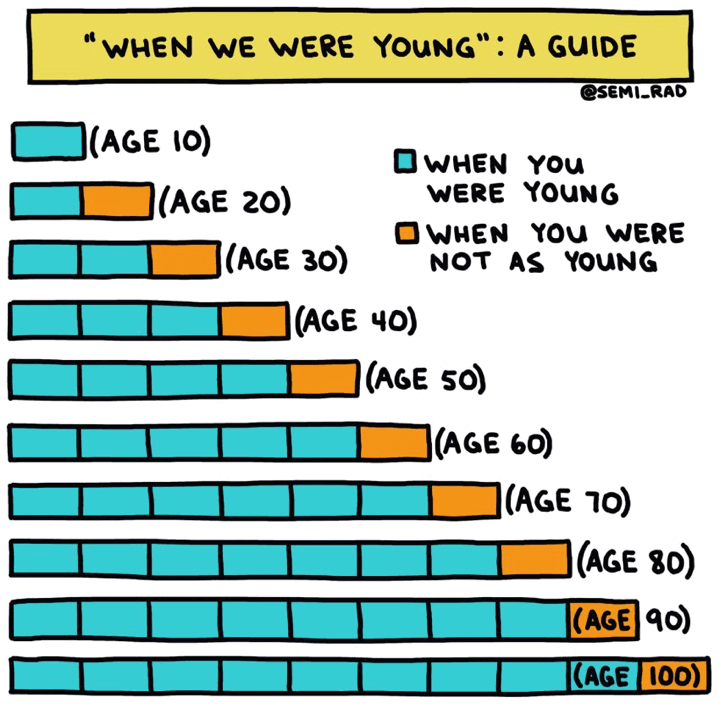
I’m still working on improving my own daily routine. I look back onto my 20s as a special period because time felt so abundant before you have others to support (partners, kids, parents). Having dependents also makes it harder to take risks and change your life. These two factors help explain why life satisfaction is lowest in your 40s. Yet harder doesn’t mean impossible. My father went back to school in his 30s and didn’t finish his schooling until I was already 10 years old. I constantly remind myself that I will eventually think of today as “back when I was young”:

Bottom line. Financial independence is not simply a faraway number like accumulating $1,000,000 in 30 years. Most important is figuring out how to enjoy the process by creating a content lifestyle that is meaningful and aligned with your values so that saving regularly doesn’t feel like a constant struggle. You want life to keep getting even better as you go vs. simply wanting ever more.

Bank of America Travel Rewards Credit Card Review: Up to 2.62% Back on Travel and Dining with Preferred Rewards

Update February 2021: The Bank of America Travel Rewards Credit Card has expanded the eligible categories of spending against which you can get their 1.5% to 2.62% back from only Travel purchases to include both Travel and Dining (including takeout). This change will apply indefinitely, and should make it much easier to redeem your points for optimal value. Here is the fine print:

Flexibility to redeem points for a statement credit to pay for travel and dining purchases, such as flights, hotel stays, vacation rentals, baggage fees, and also at restaurants – including takeout.

Full card review:

bofa_travelrewards191The Bank of America Travel Rewards Credit Card is the main “travel rewards” credit card branded by Bank of America. In this review, I’ll cover the card features but also focus on a lesser-known opportunity – if you’re a Preferred Rewards client, you can increase that bonus to 25% – 75%. For such “relationship” customers, the bonus can change this card from good to great, making it my current base rewards card (after any bonus 5% cash back categories, sign-up bonus cards, etc). Read on for details.

Here are the highlights of this card:

  • Earn unlimited 1.5 points per $1 spent on all purchases, with no annual fee and no foreign transaction fees and your points don’t expire.
  • 25,000 online bonus points if you make at least $1,000 in purchases in the first 90 days –  that can be a $250 statement credit toward travel/dining purchases.
  • Redeem points for a statement credit to pay for travel and dining purchases, such as flights, hotel stays, vacation rentals, baggage fees, and also at restaurants – including takeout.
  • 0% Introductory APR offer. See link for details.
  • 10% customer bonus when you have an active Bank of America checking or savings account.
  • If you’re a Preferred Rewards client, you can increase that bonus to 25% – 75%. See details below.
  • No foreign transaction fee.
  • No annual fee.

Preferred Rewards bonus. The Preferred Rewards program is designed to rewards clients with multiple account and higher assets located at Bank of America banking, Merrill Edge online brokerage, and Merrill Lynch investment accounts. Here is a partial table taken from their comparison chart (click to enlarge):

bofa_pref1

Let’s consider the options. Bank of America’s interest rates on cash accounts tend to be lower than highest-available outside banks (read: nearly zero), so moving cash over to qualify may result in earning less interest on your cash deposits. Merrill Lynch advisory accounts also usually come with management fees. The sweet spot is therefore the Merrill Edge self-directed brokerage, where you can move over your existing brokerage assets like stocks, mutual funds, and ETFs held elsewhere (Vanguard, Fidelity, Schwab, etc).

In the past, moving over to Merrill Edge at the Platinum and Platinum Plus levels also led to 30 to 100 free online stock trades every month. Fast forward to now, and nearly all major online brokers offer commission-free trades anyway.

Personally, I moved over $100k of brokerage assets from Vanguard to Merrill Edge to qualify for Platinum Honors. You should ask Merrill Edge if they will cover any ACAT transfer fees involved. I realize not everyone will have this level of assets to move around, but if you do then it is worth considering. Keep in mind that it will take a while for your “3-month average combined balance” to reach the $100k level and officially qualify for Platinum Honors. You might become Gold first, then Platinum, and so on. After that, the 25%-75% rewards bonus on credit card rewards kick in. Once you reach a certain tier, BofA guarantees that you will stay there for a year no matter what, even if your balance fluctuates.

Note that the terms state “The Preferred Rewards bonus will replace the customer bonus”, which means that you will lose the 10% customer bonus when you qualify for the 25% to 50% bonus.

Cash Back Rewards Tiers for Preferred Rewards

This card has a relatively simple rewards structure; you earn 1.5 points per dollar spent on all purchases. 1 point = 1 cent statement credit against any travel or dining purchase made on the card (flights, hotels, vacation packages, cruises, rental cars, or baggage fees, restaurants, take-out). As long you as you travel or eat at restaurants at least occasionally, I feel it is okay to value them at 1 cent per point, which means you could call this a “1.5% back on all purchases, if applied towards travel and dining purchases” rewards card. Here’s how the bonuses then work out:

  • Platinum Honors: 2.625% back, if applied towards travel and dining, or 2.625 points per dollar spent on any purchase (75% bonus).
  • Platinum: 2.25% back, if applied towards travel and dining, or 2.25 points per dollar spent on any purchase (50% bonus).
  • Gold: 1.875% back, if applied towards travel and dining, or 1.875 points per dollar spent on any purchase (25% bonus).

For more details, here are my redemption tips and experiences on qualifying for and receiving 2.625% back towards travel.

Their plan is working because Bank of America has managed to convince me to go from only having a checking account with them to now also having a Merrill Edge brokerage account and a Bank of America credit card. I definitely realize not everyone will have this level of assets to move around, and so this is somewhat a restricted offer. But if you do then it is worth considering. Both Platinum and Platinum Honors levels allow you to reach tiers that effectively give you over 2% back on all purchases, with the important caveat that your rewards must offset previous travel purchases on the card.

Bottom line. If you are able and willing to keep enough brokerage assets ($50k/$100k) at Merrill Edge, it will qualify you for their Preferred Rewards program. By using investment assets and not cash balances, it won’t cost you any potential interest from elsewhere. This allows the Bank of America Travel Rewards Credit Card to earn up to 2.6% back on ALL purchases in the form of statement credit offsetting any travel purchases within the last 12 months.

Citibank $200/$400/$700 Checking Account Bonus 2020

Citibank has tiered $200, $400, and $700 bonus offers when you open a new eligible Citi checking account by 6/30/20 and deposit and maintain a certain balance for 60 to 150 days. There is also a $1,500 bonus if you have $200,000 to move over. This offer is restricted to those who have not had a Citibank checking account within the last 180 calendar days. Here are the highlights followed by a few tips on how to optimize the bonus.

$200 bonus details:

  • Open a new eligible checking account in the Basic Banking Package during the offer period 4/01/2020 to 6/30/2020.
  • Within 30 days of opening your account, deposit $5,000 in New-to-Citibank funds into the new checking account.
  • Maintain a minimum balance of $5,000 for 60 consecutive calendar days.
  • You will receive your cash bonus within 90 days after you complete the required activities.
  • For the Basic Banking Package, to waive the $12 monthly service fee, make one qualifying direct deposit per statement period and one qualifying bill payment per statement period, or maintain a $1,500 or more combined average monthly balance in eligible linked accounts.

$400 bonus details:

  • Open new eligible checking and savings accounts in the Citibank® Account Package during the offer period 4/01/2020 to 6/30/2020.
  • Within 30 days of opening your account, deposit $15,000 in New-to-Citibank funds between the new checking and savings accounts.
  • Maintain a minimum balance of $15,000 between the checking and savings accounts for 60 consecutive calendar days.
  • You will receive your cash bonus within 90 days after you complete the required activities.
  • A monthly service fee of $25 and a $2.50 non-Citibank ATM fee apply to the checking account in the Citibank Account Package if a combined average monthly balance of $10,000 or more is not maintained.

$700 bonus details:

  • Open new eligible checking and savings accounts in the Citi Priority Account Package during the offer period 4/01/2020 to 6/30/2020.
  • Within 30 days of opening your account, deposit $50,000 in New-to-Citibank funds between the new checking and savings accounts.
  • Maintain a minimum balance of $50,000 between the checking and savings accounts for 60 consecutive calendar days.
  • You will receive your cash bonus within 90 days after you complete the required activities.
  • A monthly service fee of $30 applies to the checking account in the Citi Priority Account Package if a combined average monthly balance of $50,000 or more is not maintained. There is no monthly service fee for a checking account in the Citigold Account Package.

$1,500 bonus details:

  • Open new eligible checking and savings accounts in the Citigold Account Package during the offer period 4/01/2020 to 6/30/2020.
  • Within 30 days of opening your account, deposit $200,000 in New-to-Citibank funds between the new checking and savings accounts.
  • Maintain a minimum balance of $200,000 between the checking and savings accounts for 60 consecutive calendar days.
  • You will receive your cash bonus within 90 days after you complete the required activities.
  • If you do not maintain a minimum combined average monthly balance of $200,000 in eligible linked deposit, retirement and investment accounts, your Citigold Account Package will be converted to the Citi Priority Account Package and your accounts will be subject to the terms and conditions then in effect for that package.

Fine print analysis and value calculations. A tricky part of this bonus is the following fine print:

At the time the Cash Bonus is paid, it will be credited to the new Eligible Checking Account. If the Eligible Checking Account is closed, then the Cash Bonus will be credited to the new Eligible Savings Account. Open accounts must be in good standing.

You explicitly cannot “downgrade” your account to one with lower monthly fees during the 60 day maintenance period, but this seems to also suggest that you need to maintain the package that you opened until the bonus arrives. (It’s not 100% clear, but that is the conservative interpretation.) That means that in order to avoid the possibly hefty monthly fees, you would have to leave a certain amount of money in the account not for 60 days, but up to 150 days until the bonus is deposited.

After the 60 day maintenance period, you would want to withdraw everything not need to avoid the monthly fees, as both the checking and savings account pay negligible interest. Here’s how that would work for each tier:

  • $200 bonus tier. Deposit and maintain $5,000 for 60 days, then lower to $1,500 for 90 days.
  • $400 bonus tier. Deposit and maintain $15,000 for 60 days, then lower to $10,000 for 90 days.
  • $700 bonus tier. Deposit and maintain $50,000 for 150 days.
  • $1,500 bonus tier. Deposit and maintain $200,000 for 150 days. (There may be some alternatives like moving over some investments to satisfy the Citigold requirements.)

Bonus will be reported on 1099-INT (as should be expected). Here is the rough equivalent annualized APY earned from each bonus if you followed the schedule above exactly, got the promised bonus at the 150 day mark, and then downgraded/closed/moved your money out:

  • $200 bonus works out to ~16.5% annualized interest.
  • $400 bonus works out to ~8.0% annualized interest.
  • $700 bonus works out to ~3.4% annualized interest.
  • $1,500 bonus works out to ~1.8% annualized interest.

I have done Citibank bonuses in the past and haven’t had any issues, although they did wait until the last possible moment to post the bonus. I did not experience a hard credit check upon opening. However, others have reported having to call them up and ask for the bonus, and some have reported that they were denied the bonus improperly. Their above-average complaints of unreliability is a big reason why I would not downgrade the accounts, in order to help maintain proper bonus tracking. For all bank bonuses, be sure to keep track of your promotion details and transaction dates in a Google Doc or other spreadsheet.

Bottom line. Citibank has a set of tiered bonuses for opening a new checking and savings accounts with them, which I have broken down how to optimize based on the fine print. If you were planning on opening an account anyway, this can be a good offer. Be sure you understand the terms and conditions first.

Top 10 Sources to Raise Emergency Cash, Ranked

While not exactly a fun exercise, do you know where you’d turn for some extra cash in an extended emergency? Morningstar has 10 Sources of Emergency Cash, Ranked from Best to Worst which contains many good points, but I would differ in my rankings.

I wondered about severity and duration. Is this money you expect to be able to pay back within a year, or is it a one-time permanent expense? You may not know the answer for sure, but for the purposes of this list I will assume that I become unemployed for an extended period and can’t start paying the loan back for 12 months.

1. Do the legwork and delay, defer, or work out a payment plan. Many lenders will work with you if you are in a temporary cash crunch, but you have to take the initiative. It may be possible to defer mortgage payments, put your student loan into forbearance, or get other forms of relief. By delaying any of these bills and ideally adding the payment due to the end of your term, you can save cash now for something else that can’t be put off until later.

2. Existing emergency fund. The standard advice is to keep 3-6 months of expenses in a liquid savings account. Has there been a reliable study on how many households actually have this? I would keep a little held back if possible and move down to the next available option below.

3. Sell the stuff. If you own things you don’t truly need, like a second car, timeshare, boat, jewelry, or other non-essential assets, it may be time to sell even at a loss. Your pride shouldn’t come in the way of protecting your family’s financial security.

4. 0% APR credit cards. Sure, credit card interest rates can be very high, but that’s because they can’t take away your house, car, or 401k balance away from you if you can’t pay it back! This is an important detail! If you’ve been taking good care of your credit score, you can score some low-interest financing for over a year. You can either go for a 0% APR balance transfer or simply put everything possible on your card to take advantage of 0% APR for purchases. If I was really hurting, cashing one of these 0% APR checks I keep getting and paying an upfront 3% balance transfer fee would be fine. If you don’t have them lined up yet, you should apply before you lose your job, as the credit card companies are tracking your employment nowadays and they may know if you’ve been laid off recently.

5. Taxable brokerage account. If you have stocks and bonds held outside employer plans and IRAs, these are fair game to sell. If I was really paying 17% interest, I would pay off the credit cards with some of this. I would first stop reinvesting dividends and start taking them as cash. Most places say to sell your bonds because they probably have minimal capital gains and haven’t dropped significantly in value during a crisis. You may also look for stock lots with tax losses that you can harvest. Again, it would depend on the tax situation; I might move on below if the expense is a temporary one.

6. Margin loans. Don’t want to sell some of your positions? Margin loans are backed by the value of your brokerage assets, and you can get it as cold hard cash. The risk is that if your collateral (stocks, bonds, ETFs, mutual funds) drop steeply in value, your broker will force you to sell them to cover your loan. That could be a double-whammy of badness! Therefore, you should only borrow a very small percentage of the available amount. (In other words, this option is best if you have a big brokerage balance.) If you believe there is a good chance you will use this feature, consider moving your account over to Interactive Brokers as they have some of the lowest margin rates available (currently 1.55% on $25k). Margin requirements can get a little complex, see this Fidelity article.

7. Home Equity Line of Credit (HELOC). Here’s another place I differ from Morningstar. I would much rather draw some money from my HELOC at about 5% interest for maybe a few months to a year than pull out a Roth IRA contribution that I can’t replace ever again. The catch here is that during a crisis, many banks may stop accepting applications or even freeze your existing HELOC. As of this writing, Wells Fargo and Chase have already stopped opening up new HELOCs. You should set one up now and not wait to pull money out at the last minute.

8. IRA “Loan” (CARES Act.) This is specific to right now. The CARES Act now allows you to take up to $100,000 out of your IRAs, after which you have 3 years to put it back into your IRA again without penalty or tax. It’s kind of like a really long rollover window. However, you will owe income tax on whatever partial amount is not put back within 3 years. This is called a coronavirus-related distribution (CRD) and is limited to those affected by the coronavirus (ex. diagnosed with COVID-19, experienced a layoff, furlough, reduction in hours, or inability to work due to COVID-19, or lack of childcare because of COVID-19.)

9. Life insurance cash values. I don’t have any whole life insurance myself, but built-up cash values seem like an acceptable place to draw some money in a true emergency. The loan option seems to be more complicated.

10. 401k loans. If one person in the household has a job that is very secure, then a 401k loan can offer a very low interest rate. You also pay the interest back into the 401k balance, so the only effective “cost” of the loan is that you will pay income tax on the interest an extra time. For example if the interest rate is 8% and your marginal income tax rate was 25%, you’d only effectively be paying 2% interest. The CARES Act now allows you to take out 100% of the vested balance, up to $100,000. The risk with a 401k loan is that if you get laid off, you must pay back the loan within 90 days or it will count as an unqualified withdrawal (taxes + penalties) until you are over age 59.5.

Everything else. Other options may include taking Social Security early, taking out a reverse mortgage on your home, and other forms of personal loans. My overall theme is that I want to protect my tax-sheltered assets if possible. I don’t want to touch my Traditional IRA, Roth IRA, 401(k). These are meant to grow for decades and decades, and since the contribution amounts are limited each year, I can’t get them back once I have taken them out as a hardship withdrawal.

2020 Berkshire Hathaway Annual Shareholder Meeting Video, Transcript, and Notes

The 2020 Berkshire Hathaway Annual Shareholder Meeting was on May 2nd, 2020 and is now available as a recorded video on Yahoo Finance and a handy Rev.com transcription. As usual, I recommend listening or reading on your own, as my notes always differ slightly from what the business media chooses to highlight.

What makes Berkshire Hathaway (BRK) interesting to me is that it all started out as Buffett investing his own money alongside a few close family and friends. He’s always had nearly all of his own money in it. Even today, Berkshire is the main investment vehicle for many family members. People you run into at the store. People with whom you’ve shared a meal. This changes the types and amounts of risk you take.

And, now, I would never take real chances with money, of other people’s money under any circumstances. Both Charlie and I come from a background where we ran partnerships. I started mine in 1956 for really seven either actual family members or the equivalent. And Charlie did the same thing six years later. And we never, neither one of us, I think, I know I didn’t, and I’m virtually certain the same is true of Charlie, neither one of us ever had a single institution investment with us.

Buffett has stated that when he writes his annual letters, he imagines his sister reading them. That’s how I try to write as well, as an enthusiast making careful shares and recommendations to family. This overall sentiment helps you understand how BRK is run.

He started out with a familiar story of “betting on America”. This country has been though a lot, and it will recover again.

One of the scariest of scenarios, when you had a war with one group of States fighting another group of States, and it may have been tested again in the great depression, and it may be tested now to some degree, but in the end the answer is never bet against America, and that in my view is as true today as it was in 1789, and even was true during the civil war, and the depths of the depression.

In terms of investing, this means holding onto stocks for 20 or 30 years. But to survive the shocks during those times, you should never borrow money to invest in stocks, you need to have adequate reserves in 100% safe cash, and you need the proper psychological temperament.

The American tailwind is marvelous. American business represents, and it’s going to have interruptions, and you’re not going to foresee the interruption, and you don’t want to get yourself in a position where those interruptions can affect you either because you’re leveraged or because you’re psychologically unable to handle looking at a bunch of numbers.

You just don’t know what’s going to happen. You know, at least in my view, you know that America’s tailwind is not exhausted. You’re going to get a fine result if you own equities over a long period of time. And the idea that equities will not produce better results than the 30-year Treasury bond, which yields one and a quarter percent now, it’s taxable income. It’s the aim of the Federal Reserve to have 2% a year inflation. Equities are going to outperform that bond. They’re going to outperform Treasury bills. They’re going to outperform that money you’ve stuck under your mattress.

Simple, low-cost S&P 500 index fund for growth. Avoid the salespeople.

So find businesses. Get a cross section. And in my view, for most people, the best thing to do is to own the S&P 500 index fund. People will try and sell you other things because there’s more money in it for them if they do. And I’m not saying that that’s a conscious act on their part. Most good salespeople believe their own baloney. I mean, that’s part of being a good salesperson. And I’m sure I’ve done plenty of that in my life too, but it’s very human if you keep repeating something often enough.

100% backed-by-the-government cash for safety. For them, it means Treasury-backed bills. For individual investors, this extends to FDIC-insured savings accounts and certificates of deposit.

And that means we own nothing but treasury bills. I mean, we’ve never owned, we never buy commercial paper. We don’t count on bank lines and a few of our subsidiaries have them, but we basically want to be in a position to get through anything. And we hope that doesn’t happen but you can’t rule out the possibility anymore than in 1929 you could rule out the possibility that you know you would be waiting until 1955, or the end of 1954, to get even.

Ignore the two things above if you have credit card debt.

My general advice to people, I mean, we have an interest in credit cards. But I think people should avoid using credit cards as a piggy bank to be rated. I had a woman come to see me here not long ago, and she’d come on some money. Not very much, but it was a lot to her. She’s a friend of mine, and she said, “What should I do with it?” I said, “Well, what do you owe on your credit card?” She says, “Well, I owe X.” I said, “Well, what you should do…” I don’t know what interest rate she was paying, but I think I asked her and she knew. It was something like 18% or something. I said, “I don’t know how to make 18%.” I mean, if I, owed any money at 18% the first thing I do with any money I had would be to pay it off. It’s going to be way better than any investment idea I’ve got. That wasn’t what she wanted to hear.

Be safe with your finances at this time. You don’t sell your airline stocks at a multi-billion dollar loss if you think a V-shaped recovery is likely. Just because we are still recovering from one horrible event, doesn’t mean another might not happen.

I would say that there are things that I think are quite improbable. And I hope they don’t happen, but that doesn’t mean they won’t happen. I mean, for example, in our insurance business, we could have the world’s, or the country’s, number one hurricane that it’s ever had, but that doesn’t preclude the fact that could have the biggest earthquake a month later. So we don’t prepare ourselves for a single problem. We prepare ourselves for problems that sometimes create their own momentum. I mean 2008 and 9, you didn’t see all the problems the first day, when what really kicked it off was when the Freddie and Fannie, the GSEs went into conservatorship in early September. And then when money market funds broke the buck… There are things to trip other things, and we take a very much a worst case scenario into mind that probably is a considerably worse case than most people do.

After listening to this entire Buffett talk and reading this Munger interview, the overall takeaway is definitely that of safety. They have been safe and will stay safe, no matter who complains about their cash levels. The world has changed, and just because something has a lower price today than in January, doesn’t automatically mean it is a better deal than in January.

Here is a NYT Dealbook article by Andrew Ross Sorkin, who has attended many shareholder meetings in person and also sensed a different tone this year.

You can find links to previous years’ Berkshire Hathaway Shareholder Meeting Full Videos, Transcripts, and Podcasts here.

CARES Act: Stimulus Checks, Unemployment, Student Loan, IRA/401k, HSA/FSA Changes

In response to the coronavirus outbreak, the federal government approved a third round of economic relief. There is plenty of media coverage, but after reading multiple articles I noticed that nearly all of them miss at least one thing that another covered. Here’s my own mixtape of highlights so that you can research further if it applies to your situation.
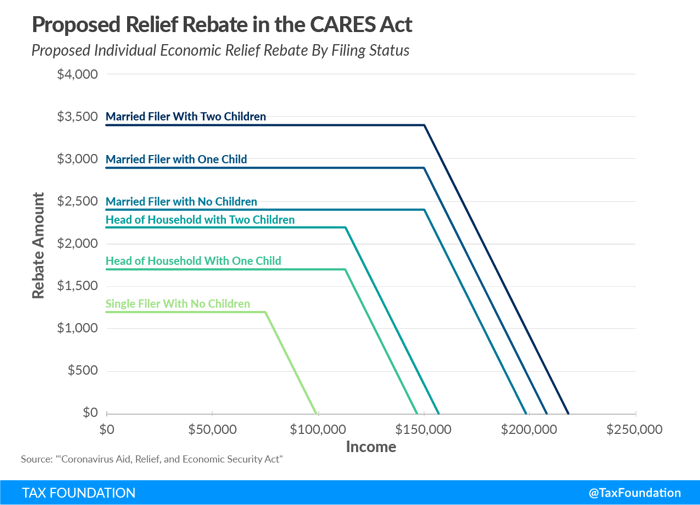
$1,200 for each adult + $500 per child 16 or under. You may want to wait to file. Individuals under $75,000 adjusted gross income get the full amount, and married filing joint under $150,000 get the full amount. Fully phased out at $99,000/$198,000. You can find AGI on Line 8b on 2019 Form 1040 2019, Line 7 on 2018 Form 1040. Based on 2018 tax filing if you haven’t filed for 2019, and 2019 tax filing if you did file. So if got a big raise in 2019, you should delay filing. If your income went down in 2019 or you didn’t file before, you should file now. Finally, if you made a lot in 2019 and expect to make less in 2020, you may still be able to get the money eventually when filing your 2020 taxes.

There is no clawback provision on overpayments, so it doesn’t matter if you end up making more than the income limits in 2020. If you listed a bank account for direct deposit of tax refund, they will try to send your money that way (and then send you a snail mail confirmation). The target date is April 17th. Otherwise, you will likely have to wait longer for a physical check. The money is not taxable.

Unemployment benefits expanded again. The bill has expanded eligibility for unemployment benefits to self-employed and part-time workers. Eligibility also expanded to cover those unable to work due to the coronavirus outbreak. The eligible period is also extended by 13 weeks. There will also be an increased benefit amount (up to $600 per week) on top of your state benefits for up to 4 months.

401(k) and IRA early withdrawal penalties waived up to $100,000. You can now take up to $100,000 out of your IRAs and you have 3 years to put it back into your IRA again without penalty or tax. It’s kind of like a really long rollover window. However, you will owe income tax on whatever partial amount is not put back within 3 years. This is called a coronavirus-related distribution (CRD) and is limited to those affected by the coronavirus.

Instead of a hardship withdrawal, you may wish to take a 401k loan instead. The retirement plan loan limit is also raised to the smaller of $100,000 or up to the full amount vested. Anything that can permanently damage your retirement savings should all be avoided if possible, of course.

Required minimum distributions are waived for 2020. This applies to everyone, even if not affected by the coronavirus. If you don’t need to make the distribution, this can save you on taxes.

Extended student loan relief. Loan and interest payments will be deferred through September 30th without penalty for all federally owned student loans.

Expanded use of Health Savings Accounts (HSAs) and Flexible Spending Accounts (FSAs). Tele-medicine services can now be used before meeting the plan deductible. You can again buy over-the-counter drugs without a prescription. Certain menstrual care products, such as tampons and pads, are also now eligible medical expenses.

Sources: NYT, Tax Foundation, NPR, Accounting Today, SHRM, SGR Law

Ally Bank New Deposit Promo 2020: Up to $250 Cash Bonus

Ally Bank has a new cash deposit bonus that is offering a 1% cash bonus (up to $250) on new deposits on top of their existing interest rates. Valid for both new and existing customers. Given the holding period, this roughly equates to the same total interest paid as a 3-month bank CD at 5%+ APY. Here’s how it works:

  • Enroll by 3/20/20. You must enroll or you won’t get the bonus. Existing customers must enroll with the same e-mail as linked to their Ally bank account.
  • Fund account by 3/31/20. This means your account has to be approved, opened and funded by this date. Move at least $1,000 from another financial institution to a new or existing eligible Ally Bank account. Remember, transfers can take up to 3 business days.
  • Maintain funds through 6/30/20. Your funds need to remain in an eligible Ally Bank account through 6/30/20. Any withdrawals made during this time may reduce your bonus.
  • Get cash bonus on 7/30/20. Get a 1% cash bonus back on the money you moved, up to $250. That means $25,000 would max out this bonus.

Ally had a similar bonus in 2018, but with higher deposit limits. Note the following regarding which are eligible Ally accounts:

What accounts are eligible?
New or existing Ally Bank Online Savings Accounts, Money Market Accounts, and CDs are eligible for the cash bonus. If you have more than one of these accounts, we’ll consider all of them when calculating your bonus. Remember, the total maximum bonus you can receive is $250.

What accounts are not eligible?
Interest Checking accounts, Individual Retirement Accounts (IRAs), accounts owned by a trust, custodial accounts, Uniform Gift to Minors Act (UGMA) accounts, and Uniform Transfers to Minors Act (UTMA) accounts aren’t eligible for the cash bonus. New money you add to these accounts, or money you move from these accounts to your eligible accounts, won’t qualify for the bonus.

Rough math. The current rate on the Ally Online Savings account is 1.50% APY, and the 11-month No Penalty CD is 1.75% APY on $25k+ balances (as of 3/15/20). Given that you can an additional 1% bonus in 3 months, the bonus itself works out to the equivalent of a 4% annualized yield. 1.5% plus 4% = 5.5%, but given the recent market volatility, the savings rate may be cut down to 1% in the coming months. However, the No Penalty CD at 1.75% would be locked in. So you’re looking at the equivalent of a 3-month CD at roughly 5% – 5.75% APY for new money deposits between $1,000 and $25,000.

Should I move money out of Ally and back in to qualify? No, it won’t make any difference as Ally has already thought of that. All new funds added after 3/13/20 will count as new money for this promotion. They’ve already set the start date in the past, so you gain nothing by delaying your enrollment.

Existing customers. As a longtime Ally accountholder, I’m happy again to see that this offer includes existing customers, even if it has to be new money.

Bottom line. Ally Bank has a new promotion to attract new money (or bring back old money). You get a 1% cash bonus (up to $250) on new deposits on top of their existing interest rates. For their savings account, this works out to a 3-month holding period paying roughly 5% annualized interest. You must enroll soon by 3/20/20 and your account must be opened and fully funded by 3/31/20 at the very latest.

Simple Bank Bonus: $400 Bonus + 1.75% APY for $20,000 New Deposit

Bonus back again 3/3/20. Simple is one of many fintech startups adding fancy tech and smartphone app sprinkles to your vanilla checking account. They were acquired by the big European-based bank BBVA in 2014. They just updated their $200 and $400 new customer bonuses with new expiration dates.

$200 Bonus Details ($10,000+)

  • Open a new Simple Account by 3/15/2020 at 4:59 PM PT.
  • Deposit(s) totaling $10,000 or more must post to the new account by 4:59PM PT within 15 calendar days after the account is opened.
  • Maintain a balance of at least $10,000 through 5/31/20 4:59 PM PT.
  • The combined balance between your Simple Account and Protected Goals Account counts towards this bonus. The Protected Goals account currently pays 1.75% APY while the primary checking only pays 0.01% APY, so I would recommend opening one of those as well. Note that balances in *Shared* Accounts and *Shared* Protected Goals Accounts do not toward this bonus.
  • Qualifying customers will receive the bonus credit into the eligible Simple account by 6/15/2020 at 4:59pm PT.

$400 Bonus Details ($20,000+)

  • Same as above, except you’ll need to deposit $20,000+ within 15 calendar days of opening, and you’ll get a bigger $400 bonus.

This works out to a 2% bonus after 60 days, which makes it roughly 12% APY annualized. The bonus is on top of the variable interest rate of their Protected Goals account, currently 1.75% APY (as of 3/3/20). That is a pretty good return on FDIC-insured cash in this current rate environment.

Note that this offer is for new accounts only. They’ve been running this on and off since July 2019 (thus the old comments below) so many of us are no longer eligible. Here is their full fee schedule.

Note that for some reason Simple limits ACH transfers to/from an external account to $5,000 cumulative during the first 30 days, when initiated on the Simple website. However, you can simply initiate a transfer from another bank (Ally Bank, Marcus, CIT, etc.) and there are no transfer limits.

Bottom line. Simple is offering a $200/$400 bonus on $10,000/$20,000 of new money into a new account. This works out to a very high APY for a 60 day holding period. Currently, there are also new deposit bonuses from CIT Bank and CIBC Bank. Compare with my most recent roundup of best interest rates.

Fort Bragg Federal Credit Union Certificate Deal: 5-year at 2.99% APY

Fort Bragg Federal Credit Union has some solid rates on their term share certificates, most notably the 5-year jumbo certificate at 2.99% APY ($25,000 minimum) and 2.89% APY ($5,000 minimum). Available both in regular taxable and IRAs. These are even “step-up” CDs where you can bump up the rate once if the advertised rates rise. NCUA-insured. Found via DepositAccounts.

This is a relatively small credit union, so this rate probably won’t last very long. I would also expect it to require a little effort to be opened if you don’t live near their branches in North Carolina. Even their 2.99% APY is a bit odd. When it’s a loan where you pay interest, you always see APRs of 2.99% or 9.99%. When it’s a bank account where you get paid interest, you always see APYs of 2.00% or 2.05%. It’s almost like they don’t want people to notice that they have the highest 5-year CD rate in the country by a decent margin.

Membership eligibility. Credit union membership is open to:

  • Active-Duty or Retired military service member
  • Family member of primary member
  • Regularly works on Fort Bragg
  • Most persons who live, work, worship, or attend school in, and businesses and other legal entities in Cumberland County, NC
  • Members of the Braxton Bragg Chapter of AUSA

The last option makes membership open to anyone nationwide. Here is the PDF application which shows the cost of $40 for a 2-year membership, but you may wish to try and apply over the phone at 855-246-6269. Be sure to join the Braxton Bragg Chapter. You will need your AUSA membership number before they can finish your credit union application.

Many credit unions do a hard credit pull upon joining, but I’m not sure about Fort Bragg.

Early withdrawal penalties and limitations. Please note the following language taken from the Full membership agreement (PDF). The penalty is short (3 months), but there may be restrictions for early withdrawals.

Early Withdrawal Penalties – All Term Share Certificate Accounts. You have agreed to leave the principal of this account on deposit for the full term stated in your Certificate. If all or part of the principal is withdrawn before the maturity date, the Credit Union may charge you a penalty. Withdrawal of the principal amount of your Certificate may be made only with the consent of the Credit Union. Unless stated otherwise, owners of non-IRA Term Share Certificate accounts shall forfeit an amount equal to three (3) months dividends on the amount withdrawn. Owners of IRA Term Share Certificate accounts shall forfeit an amount equal to three (3) months AND assessed an Administrative Fee, refer to Term Share/IRA Certificates Rates for current fee. The penalty may be calculated at the rate paid on the deposit at the time of the withdrawal. The penalty will, if necessary, be taken from the principal amount of the deposit.

Bottom line. Fort Bragg FCU has a 5-year share certificate at 2.99% APY. As of 2/19/2019, a 5-year Treasury bond currently yields only about 1.4%. The SEC yield of the Vanguard Total Bond Market ETF (BND) is only 2.14% and it has a longer duration. This margin means this rate won’t last very long. The possible credit check and $40 entry fee make it better for high balances to make it worth the trouble.

I am skipping this one as I don’t have any CDs maturing soon. Still, this is another example of smaller credit unions offering up a very high rate for a limited-time. Such opportunities only available to motivated individual investors and not big institutions.

MMB Portfolio Asset Allocation Update, December 2019 (Q4)

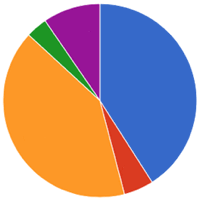
portpie_blank200

Plenty of people will tell you what you should own, but I’d rather they just share what they actually own. Here’s my year-end portfolio update for Q4 2019, including all of our 401k/403b/IRAs, taxable brokerage accounts, and savings bonds but excluding our house, cash reserves, and a few side investments. Dividends tend to arrive on a quarterly basis, and this helps determine where to invest new cash to rebalance back towards our target asset allocation.

Actual Asset Allocation and Holdings

I use both Personal Capital and a custom Google Spreadsheet to track my investment holdings. The Personal Capital financial tracking app (free, my review) automatically logs into my accounts, adds up my balances, tracks my performance, and calculates my asset allocation. I still use my manual Google Spreadsheet (free, instructions) because it helps me calculate how much I need in each asset class to rebalance back towards my target asset allocation.

Here are my YTD performance and current asset allocation visually, per the “Allocation” and “Holdings” tabs of my Personal Capital account, respectively:

Stock Holdings
Vanguard Total Stock Market (VTI, VTSAX)
Vanguard Total International Stock Market (VXUS, VTIAX)
WisdomTree SmallCap Dividend (DES)
Vanguard Small Value (VBR)
Vanguard Emerging Markets (VWO)
Vanguard REIT Index (VNQ, VGSLX)

Bond Holdings
Vanguard Limited-Term Tax-Exempt (VMLTX, VMLUX)
Vanguard Intermediate-Term Tax-Exempt (VWITX, VWIUX)
Vanguard Intermediate-Term Treasury (VFITX, VFIUX)
Vanguard Inflation-Protected Securities (VIPSX, VAIPX)
Fidelity Inflation-Protected Bond Index (FIPDX)
iShares Barclays TIPS Bond (TIP)
Individual TIPS securities
U.S. Savings Bonds (Series I)

Target Asset Allocation. I do not spend a lot of time backtesting various model portfolios, as I don’t think picking through the details of the past will necessarily create superior future returns. I mainly make sure that I own asset classes that will provide long-term returns above inflation, distribute income via dividends and interest, and finally offer some historical tendencies to balance each other out. I make a small bet that US Small Value and Emerging Markets will have higher future long-term returns (along with some higher volatility) than the more large and broad indexes, although I could be wrong.

While you could argue for various other asset classes, I believe that it is important to imagine an asset class doing poorly for a long time, with bad news constantly surrounding it, and only hold the ones where you still think you can maintain faith through those fearful times. I simply don’t have strong faith in the long-term results of commodities, gold, or bitcoin.

Stocks Breakdown

  • 38% US Total Market
  • 7% US Small-Cap Value
  • 38% International Total Market
  • 7% Emerging Markets
  • 10% US Real Estate (REIT)

Bonds Breakdown

  • 33% US Treasury Bonds, intermediate
  • 33% High-Quality Municipal Bonds (taxable)
  • 33% US Treasury Inflation-Protected Bonds (tax-deferred)

I have settled into a long-term target ratio of 67% stocks and 33% bonds (2:1 ratio) within our investment strategy of buy, hold, and occasionally rebalance. I will use the dividends and interest to rebalance whenever possible in order to avoid taxable gains. I plan to only manually rebalance past that if the stock/bond ratio is still off by more than 5% (i.e. less than 62% stocks, greater than 72% stocks). With a self-managed, simple portfolio of low-cost funds, we minimize management fees, commissions, and taxes.

Holdings commentary. I know that US stock valuations are on the higher side, but this year of all-time US highs is another reminder that you still need to stay in the game. My forward expectations for US stock returns are muted, but I’m not selling a single share. International stocks have also hit an all-time high, but nobody really noticed because US stocks have still outperformed by a long shot this decade. I remain satisfied with my mix, knowing that I will own whatever successful businesses come out of the US, Europe, China, or wherever in the future.

On the bond side, my primary objective remains to hold high-quality bonds with a short-to-intermediate duration of under 5 years or so. This means US Treasuries, TIPS, or investment-grade municipal bonds. FDIC or NCUA-insured certificates would also fit in there. I don’t want to worry about my bonds. I then tweak the specific breakdown based on my tax-deferred space available, the tax-effective rates of muni bonds, and the real interest rates of TIPS. Right now, it is roughly 1/3rd Treasuries, 1/3 Muni bonds, and 1/3rd TIPS.

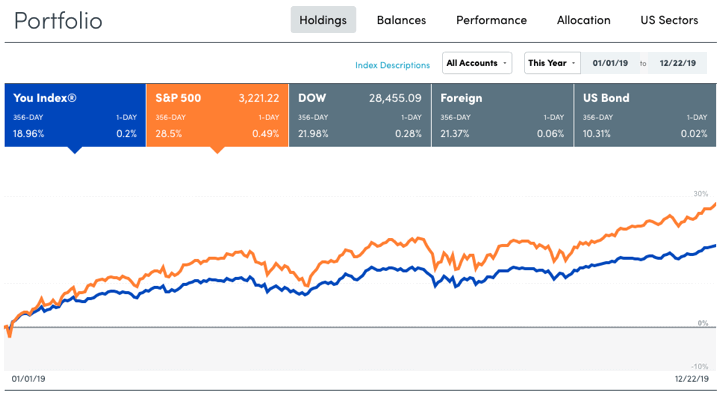
Performance numbers. According to Personal Capital, my portfolio went up +19% so far in 2019. I see that during the same period the S&P 500 has gone up +29%, Foreign Developed stocks up +21%, and the US Aggregate bond index was up about +10%.

An alternative benchmark for my portfolio is 50% Vanguard LifeStrategy Growth Fund and 50% Vanguard LifeStrategy Moderate Growth Fund – one is 60/40 and the other is 80/20 so it also works out to 70% stocks and 30% bonds. That benchmark would have a total return of +20.9% for 2019 YTD.

The goal of this portfolio is to create sustainable income that keeps up with inflation to cover our household expenses. I’ll share about more about the income aspect in a separate post.

Keep or Close Old Bank Accounts? How To Manage Multiple Bank Accounts

In 2019, I opened new accounts at the following banks and credit unions in order to earn higher interest on my cash reserves. Some of the offers are now expired, but the idea is to show you that I do accumulate new accounts every year:

For the most part, I keep these new accounts. I also profited from these promotions via accounts I opened prior to 2019:

I’ve gotten a few questions about what I do with all of these accounts. Do I keep them forever? Close them immediately? Here’s my thought process.

Opening new accounts. In general, I will consider opening a new bank account or credit union account if the following conditions are met: Is the net benefit is roughly $100 or higher? Are the monthly fees avoidable? Is my money not already tied up elsewhere? Does it incur a hard credit check upon opening? Most banks do not perform a hard credit check for new accounts. Many credit unions do, however, as their business model is strongly dependent on lending between members. This used to matter more when you could open 20 credit cards in a year and thus you’d want to avoid having too many inquiries on your report, but nowadays the credit card issuers have limits based specifically on your credit card history and less about your number of inquiries.

However, a lot of it also depends on soft factors. Does it seem like it will be a hassle to collect the bonus? Does this bank/CU offer a history of competitive rates and offers? Does it have a reputation for good customer service?

For inactive bank accounts that you don’t care about. For a bank that is no longer offering me something useful and doesn’t look like it will in the future, I will set it to paperless statements, remove all external bank account links, and withdraw all my money. Usually, if there is no activity and $0.00 inside for over a year, the bank will quietly close the account for me. If not, there is minimal ongoing mental load and I’ll usually just let it sit idle indefinitely. If the account charges a monthly fee or somehow causes me hassle, I will go ahead and close it manually.

For inactive bank accounts that you want to keep open. For a bank where I don’t keep my cash there anymore, but I still want to keep it open in case the interest rate improves, a future promotion pops up, or to maintain a perk like free notary service, I will keep at least $10 in the account and also make a $1 in/out transaction once every 12 months. This keeps the account active so that they won’t close it without at least some sort of warning.

Finally, I track all my bank accounts using Mint and Personal Capital. I also use a password manager to keep complex, distinct passwords at each financial institution. Enable two-factor authentication where available.

By monitoring all of my open accounts using such services, I help guarantee that I will stay well within the 60-day window provided by Regulation E to notify the bank of any unauthorized activity. If you lose your debit card (“access device”) and report it lost or stolen no more than two days after becoming aware of the theft, your liability is limited to $50. If you experience an unauthorized ACH transfer, you must report it within 60 days of the statement. Here’s an example from ConsumerFinance.gov:

For example, a consumer’s account is electronically debited for $200 without the consumer’s authorization and by means other than the consumer’s access device. If the consumer notifies the institution within 60 days of the transmittal of the periodic statement that shows the unauthorized transfer, the consumer has no liability. However, if in addition to the $200, the consumer’s account is debited for a $400 unauthorized transfer on the 61st day and the consumer fails to notify the institution of the first unauthorized transfer until the 62nd day, the consumer may be liable for the full $400.