Search Results for: High Interest Savings

Lafayette Federal Credit Union Review: 2.02% APY on $25,000, $100 Bonus

Update: $100 bonus is expired. Wanted to report that I am had a bad experience with LFCU after being locked out of my account for over a week. Phone hold times were very long, I got routed to a service that promised to call me back, and then never called me back. E-mails also went unreturned. Maybe it’s just me.

Original post, may be outdated:

Lafayette Federal Credit Union (LFCU) has a respectable history of offering competitively-priced banking products. I recently joined and here is a quick review of their current promotions and the application process. Highlights:

  • 2.02% APY Checking account on up to $25,000 balance (details below).
  • $100 bonus for new members (details below)
  • Competitive CD rates: 7-month at 0.70% APY, 3-year at 1.01% APY, 5-year at 1.26% APY

Membership eligibility. You can view your membership eligibility options here, including working/living in the Washington, DC area. Anyone nationwide can join LFCU by joining the Home Ownership Financial Literacy Council (HOFLC) for a one-time $10 fee.

Account opening process. I went to the HOFLC.org website and paid my $10 to join. (I hope to spend more time exploring their resources later.) I had to attach a screenshot of my membership approval e-mail as part of my LFCU application. The LFCU application was finished completely online. I also had to upload a photo scan of my drivers license. My application was approved after a couple of days.

During the application, I was able to charge my initial opening deposit up to $750. This was classified as a purchase on my credit card (worth $15 at 2% cash back). Note that you must keep $50 that is “untouchable” in your Share Savings account as long as you are a member, which is a bit higher than that of other credit unions (usually around $10 to $25).

I applied through this $100 bonus page which includes promo code DD2022. (Update: I honestly can’t remember where I entered the code. You can however secure online message them directly through the membership application portal and confirm that you are signed up for this promotion. I received such a confirmation message promptly.) I must open a checking account and set up a $500+ direct deposit, and I can’t close the account within the first 6 months. Details:

Members who open a checking account and initiate a qualified direct deposit to Lafayette Federal Credit Union will receive a $50 deposit to their savings account. An additional $50 will be awarded after first direct deposit which must be deposited no later than 45 days after account opening. Cannot be combined with any other new member offers. Qualified direct deposit is a recurring direct deposit of a paycheck, pension, Social Security or other periodic payment of at least $500 into a checking account on a month-to-month basis made by an outside organization or agency. Must be eligible for membership. If account is closed within first 6 months, initial $50 promotional deposit will be deducted from account.

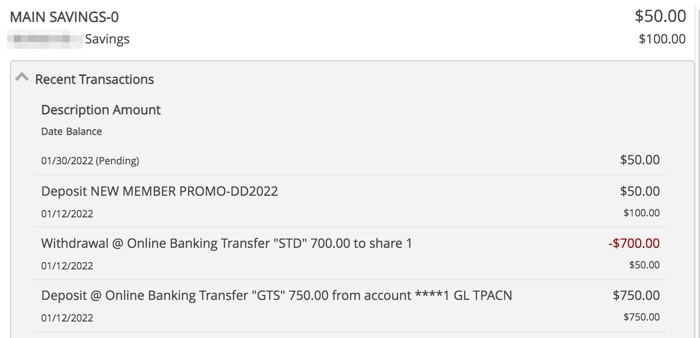
The first $50 showed up quickly:
Checking account 2.02% APY details. With the Checking account, they have “2% for ’22” promotion which pays 2.02% APY with a qualified monthly direct deposit of $500 or more on balances up to $25,000. The checking account otherwise has no minimum balance requirements or monthly maintenance fees.

To earn the 2.02% APY3 bonus rate, member must maintain at least one (1) qualified direct deposit of at least $500 per month. 2Qualified direct deposit is a recurring direct deposit of a paycheck, pension, or Social Security periodic payment of at least $500 into a checking account on a month-to-month basis made by an outside organization or agency.

If I keep $25,000 in there at 2% APY, that’s $500 of interest over a year. That’s also $275 more than it would earn in a 0.5% APY savings account. You can use that metric to judge if it is worth your additional efforts. That rough calculation also assumes both those rates stay constant over the next year.

So far, LFCU has been pleasant to work with and my questions were answered quickly and courteously. I hope that they continue to be aggressive in their banking products.
MMB Portfolio 2021 Year-End (Late Update): Asset Allocation & Performance

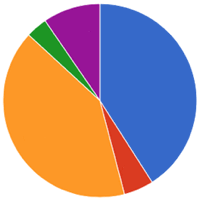
portpie_blank200Here’s my (late) quarterly update on my current investment holdings, as of 1/23/22, including our 401k/403b/IRAs and taxable brokerage accounts but excluding a side portfolio of self-directed investments. Following the concept of skin in the game, the following is not a recommendation, but just to share an real, imperfect, low-cost, diversified DIY portfolio. The goal of this portfolio is to create sustainable income that keeps up with inflation to cover our household expenses.

Actual Asset Allocation and Holdings
I use both Personal Capital and a custom Google Spreadsheet to track my investment holdings. The Personal Capital financial tracking app (free, my review) automatically logs into my different accounts, adds up my various balances, tracks my performance, and calculates my overall asset allocation. Once a quarter, I also update my manual Google Spreadsheet (free, instructions) because it helps me calculate how much I need in each asset class to rebalance back towards my target asset allocation.

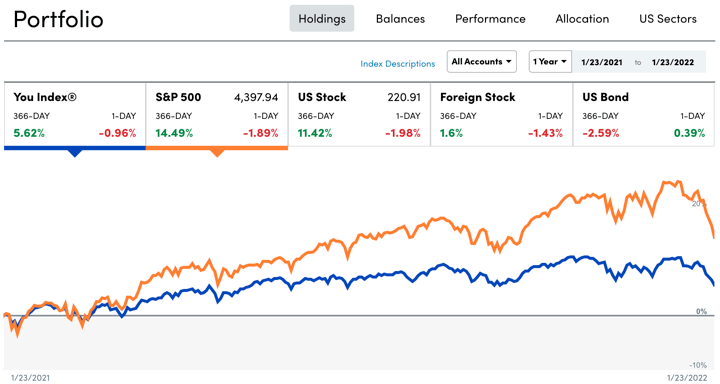
Here are updated performance and asset allocation charts, per the “Allocation” and “Holdings” tabs of my Personal Capital account.

Stock Holdings
Vanguard Total Stock Market (VTI, VTSAX)
Vanguard Total International Stock Market (VXUS, VTIAX)
Vanguard Small Value (VBR)
Vanguard Emerging Markets (VWO)
Avantis International Small Cap Value ETF (AVDV)
Cambria Emerging Shareholder Yield ETF (EYLD)
Vanguard REIT Index (VNQ, VGSLX)

Bond Holdings
Vanguard Limited-Term Tax-Exempt (VMLTX, VMLUX)
Vanguard Intermediate-Term Tax-Exempt (VWITX, VWIUX)
Vanguard Intermediate-Term Treasury (VFITX, VFIUX)
Vanguard Inflation-Protected Securities (VIPSX, VAIPX)
Fidelity Inflation-Protected Bond Index (FIPDX)
iShares Barclays TIPS Bond (TIP)
Individual TIPS bonds
U.S. Savings Bonds (Series I)

Target Asset Allocation. This “Humble Portfolio” does not rely on my ability to pick specific stocks, sectors, trends, or countries. I own broad, low-cost exposure to asset classes that will provide long-term returns above inflation, distribute income via dividends and interest, and finally offer some historical tendencies to balance each other out. I have faith in the long-term benefit of owning publicly-traded US and international shares of businesses, as well as high-quality US federal and municipal debt. My stock holdings roughly follow the total world market cap breakdown at roughly 60% US and 40% ex-US. I also own real estate through REITs.

I strongly believe in the importance of “knowing WHY you own something”. Every asset class will eventually have a low period, and you must have strong faith during these periods to truly make your money. You have to keep owning and buying more stocks through the stock market crashes. You have to maintain and even buy more rental properties during a housing crunch, etc. You might own laundromats or vending machines or an online business. A good sign is that if prices drop, you’ll want to buy more of that asset instead of less.

Find a good asset that you believe in and understand, and just keep buying it through the ups and downs.

I do not spend a lot of time backtesting various model portfolios, as I don’t think picking through the details of the recent past will necessarily create superior future returns. Usually, whatever model portfolio is popular in the moment just happens to hold the asset class that has been the hottest recently as well. I’ve also realized that I don’t have strong faith in the long-term results of commodities, gold, or bitcoin. I’ve tried many times to wrap my head around it, but have failed. I prefer things that send me checks while I sleep.

Stocks Breakdown

  • 45% US Total Market
  • 7% US Small-Cap Value
  • 31% International Total Market
  • 7% International Small-Cap Value
  • 10% US Real Estate (REIT)

Bonds Breakdown

  • 66% High-Quality bonds, Municipal, US Treasury or FDIC-insured deposits
  • 33% US Treasury Inflation-Protected Bonds (or I Savings Bonds)

I have settled into a long-term target ratio of 67% stocks and 33% bonds (2:1 ratio) within our investment strategy of buy, hold, and occasionally rebalance. This is more conservative than most people my age, but I am settling into a more “perpetual” as opposed to the more common “build up a big stash and hope it lasts until I die” portfolio. My target withdrawal rate is 3% or less. With a self-managed, simple portfolio of low-cost funds, we can minimize management fees, commissions, and taxes.

Holdings commentary. I’ve been investing steadily for over 15 years, and the results have exceeded my expectations. There is ALWAYS something that looks worrying. Looking back, my best investment decisions were to NOT do anything different during times of stress. Maybe 2022 will have more such times. Ignore the noise, if you can.

I often wonder how I can teach my children such patience in investing, and that seems to be the hardest aspect.

Performance numbers. According to Personal Capital, my portfolio is up another +13.9% for 2021.

I’ll share about more about the income aspect in a separate post.

Hanscom Federal CU Thrive Review: 5.00% APY Saving Habit Builder and Maintainer

savebuttonbankHanscom Federal Credit Union (HFCU) has hiked back up the rate on their CU Thrive account to 5.00% APY, which is a capped certificate of deposit that rewards consistent saving. The rate is set for 12 months, and during those 12 months you can transfer up to $500 every month from a HFCU checking account. No monthly fees. However, you cannot make any withdrawals during those 12 months, or you will be subject to an early withdrawal penalty of 90 days interest.

This product is not meant for big balances. Instead, it is meant to encourage the creation AND maintenance of a modest savings habit. 5.00% APY is more than 10 times what the top “high-yield” savings accounts offer right now.

How much interest can I earn? At 5% APY, if you maxed out this account and set aside the full $500 a month for 12 months, at the end you’d have put in $6,000 and earned about $150 in interest by the end of the year (~$162 if you made every transfer on the 1st of the each month by my quick calculations). $6,000 also happens to be just about the same amount as a full Roth IRA contribution (hint hint) or the foundation of a solid emergency fund.

At the end of the 12 months, all accrued savings plus earned dividends will be transferred into your primary savings account. It will NOT automatically renew at maturity. Each member can only have one CU Thrive account open at one time, but after one 12-month period ends you can open up another one to keep up the savings habit (assuming it is still offered). Full disclosure (PDF).

Eligibility details. To open a CU Thrive account, you must first open an HFCU checking account in addition to the savings account required for all members. HFCU offers a free checking account with no direct deposit and no minimum balance requirement. HFCU membership is open to active duty or retired military along with many other groups (see application), but anyone can also join the Air Force Association, Paul Revere Chapter for a one-time $20 fee and be eligible. On the application, choose the option “I am a member of or will be joining a sponsoring member organization.” You must also keep $25 in the share savings account as long as you are a member.

New refer-a-friend program. HFCU has a referral program which offers an additional $30 cash bonus after your new savings and checking accounts are open and in good standing for 90 days. The referring member gets $30 as well. If you would like a referral from me, please me send your full name, e-mail address, the text “HFCU referral” via my contact form. I will use this information only to fill out their referral form.

Account opening process (from a few years ago). I started the online application and had to provide the usual personal information and then answer questions based on my credit report to verify my identity. Based on my free credit monitoring, they did not perform a hard pull on my credit report. You can fund with an online bank transfer but they also gave me the option to fund with credit card up to $2,000 (not sure if this is still an option today). They didn’t mention if this would be considered a cash advance or not, but it showed up as a purchase for me. Finally, you must print out, sign, and mail in a signature card. You can also open an account in-person. All of their physical branches appear to be located in Massachusetts.

My 1-year experience. I had set the maximum $500 to be transferred every month to my CU Thrive account from my HFCU Checking account. I made 11 transfers but missed one because my checking balance was too low on the date of automatic transfer. My fault. When that happens, the account basically just skips the transfer. There is no penalty, you just don’t get to add that money to the account. I called them but they said there was no way to replace that transfer, even if I moved more money into the checking account a day later. Other than that, everything went very smoothly and I was paid my interest as promised. At the 1-year maturity date, the funds were automatically transferred to my HFCU savings account and the CU Thrive no longer shows up on my online account page. I can now open up another CU Thrive account, if I wish.

I also discovered that Hanscom Federal has paid a Loyalty Dividend to its Credit Union members for over 20 consecutive years. When I had this account, I earned another $1.57 in bonus loyalty dividends on top of my $78.46 of interest earned.

In addition to the CU Thrive and free checking options, HFCU also has a Kasasa Cash Checking account that offers up to 1.00% APY on balances up to $15,000 if you make at least 12 debit card or credit card purchases per month, complete at least 1 ACH Credit/Direct deposit per month, and enroll in online statements. This isn’t the highest Kasasa rate available nationwide, but if you’re already a member, it may be convenient.

Bottom line. The CU Thrive account is a good option for people looking to build up a savings habit, with 5.00% APY for 12 months. However, the system really works best if you use HFCU’s free checking as your primary checking account. (You may also consider their Kasasa Cash checking account with higher interest but debit card activity requirements.) Juggling it as an external savings account is perfectly possible, but you have to keep on top of your transfers to avoid idle cash earning zero interest. I received all of the interest promised, the customer service was nice and polite when contacted, and any errors were my own.

MMB Portfolio Update October 2021 (Q3): Asset Allocation & Performance

portpie_blank200Here’s my quarterly update on my current investment holdings as of October 2021, including our 401k/403b/IRAs and taxable brokerage accounts but excluding our house, “emergency fund” cash reserves, and a side portfolio of self-directed investments. Following the concept of skin in the game, the following is not a recommendation, but just to share an actual, low-cost, diversified DIY portfolio complete with some real-world messiness. The goal of this portfolio is to create sustainable income that keeps up with inflation to cover our household expenses.
Actual Asset Allocation and Holdings
I use both Personal Capital and a custom Google Spreadsheet to track my investment holdings. The Personal Capital financial tracking app (free, my review) automatically logs into my different accounts, adds up my various balances, tracks my performance, and calculates my overall asset allocation. Once a quarter, I also update my manual Google Spreadsheet (free, instructions) because it helps me calculate how much I need in each asset class to rebalance back towards my target asset allocation.

Here are updated performance and asset allocation charts, per the “Allocation” and “Holdings” tabs of my Personal Capital account, respectively. (The blue line went flat for a while because the synchronization stopped and I don’t checked my performance constantly.)

Stock Holdings
Vanguard Total Stock Market (VTI, VTSAX)
Vanguard Total International Stock Market (VXUS, VTIAX)
Vanguard Small Value (VBR)
Vanguard Emerging Markets (VWO)
Avantis International Small Cap Value ETF (AVDV)
Cambria Emerging Shareholder Yield ETF (EYLD)
Vanguard REIT Index (VNQ, VGSLX)

Bond Holdings
Vanguard Limited-Term Tax-Exempt (VMLTX, VMLUX)
Vanguard Intermediate-Term Tax-Exempt (VWITX, VWIUX)
Vanguard Intermediate-Term Treasury (VFITX, VFIUX)
Vanguard Inflation-Protected Securities (VIPSX, VAIPX)
Fidelity Inflation-Protected Bond Index (FIPDX)
iShares Barclays TIPS Bond (TIP)
Individual TIPS bonds
U.S. Savings Bonds (Series I)

Target Asset Allocation. This “Humble Portfolio” does not rely on my ability to pick specific stocks, sectors, trends, or countries. I own broad, low-cost exposure to asset classes that will provide long-term returns above inflation, distribute income via dividends and interest, and finally offer some historical tendencies to balance each other out. I have faith in the long-term benefit of owning publicly-traded US and international shares of businesses, as well as high-quality US federal and municipal debt. My stock holdings roughly follow the total world market cap breakdown at roughly 60% US and 40% ex-US. I also own real estate through REITs.

I strongly believe in the importance of doing your own research. Every asset class will eventually have a low period, and you must have strong faith during these periods to truly make your money. You have to keep owning and buying more stocks through the stock market crashes. You have to maintain and even buy more rental properties during a housing crunch, etc. A good sign is that if prices drop, you’ll want to buy more of that asset instead of less.

I do not spend a lot of time backtesting various model portfolios, as I don’t think picking through the details of the recent past will necessarily create superior future returns. Usually, whatever model portfolio is popular in the moment just happens to hold the asset class that has been the hottest recently as well. I’ve also realized that I don’t have strong faith in the long-term results of commodities, gold, or bitcoin. I’ve tried many times to wrap my head around it, but have failed. I prefer things that send me checks while I sleep.

This is not the optimal, perfect, ideal anything. It’s just what I came up with, and it’s done the job. You may have different beliefs based on your own research and psychological leanings. Holding a good asset that you understand is better than owning and selling the highest-return asset when it is at its temporary low point.

Stocks Breakdown

  • 45% US Total Market
  • 7% US Small-Cap Value
  • 31% International Total Market
  • 7% International Small-Cap Value
  • 10% US Real Estate (REIT)

Bonds Breakdown

  • 66% High-Quality bonds, Municipal, US Treasury or FDIC-insured deposits
  • 33% US Treasury Inflation-Protected Bonds (or I Savings Bonds)

I have settled into a long-term target ratio of 67% stocks and 33% bonds (2:1 ratio) within our investment strategy of buy, hold, and occasionally rebalance. This is more conservative than most people my age, but I am settling into a more “perpetual portfolio” as opposed to the more common accumulate/decumulate portfolio. I use the dividends and interest to rebalance whenever possible in order to avoid taxable gains. I plan to only manually rebalance past that if the stock/bond ratio is still off by more than 5% (i.e. less than 62% stocks, greater than 72% stocks). With a self-managed, simple portfolio of low-cost funds, we can minimize management fees, commissions, and taxes.

Holdings commentary. The fact that I did research about Shiba Inu coins today is the latest evidence that there is too much money sloshing around chasing speculative investments. Somehow, I own 4,000,000 SHIB from a recent Voyager referral promotion! You really have to wonder how 2021 events will be described in 2030 or 2040. All I can do is listen to the late Jack Bogle and “stay the course”. I remain optimistic that capitalism, human ingenuity, human resilience, human compassion, and our system of laws will continue to improve things over time.

My thought for the quarter is that there is all this focus on tech/crypto/cloud but I hope we still invest enough in physical things like farming/energy/infrastructure.

Performance numbers. According to Personal Capital, my portfolio is up +11.4% for 2021 YTD. I rolled my own benchmark for my portfolio using 50% Vanguard LifeStrategy Growth Fund and 50% Vanguard LifeStrategy Moderate Growth Fund – one is 60/40 and the other is 80/20 so it also works out to 70% stocks and 30% bonds. That benchmark would have a total return of +10.1% for 2021 YTD as of 10/15/2021.

I’ll share about more about the income aspect in a separate post.

Kabbage Business Checking Review: 1.10% APY + Public $300 Bonus

(Update October 2021: Post has been updated to reflect a new public $300 bonus. I posted about a $300 bonus in the past, but it ended up being targeted select AmEx business cardholders. This one is open to the public. You must scroll down a bit to see the bonus info, screenshot below. Note that you may be asked to provide supplemental business documentation like Articles of Incorporation.)

Updated full review:

Kabbage offers financial solutions for small businesses, and was acquired by American Express in late 2020. On top of the very competitive interest rate of 1.10% APY, there is currently a public $300 bonus for their business checking account. Here are the highlights:

  • 1.10% APY on balances up to $100,000
  • No monthly maintenance fees.
  • No minimum balance requirements.
  • Free ATM access. Check app for a map to the nearest in-network ATM.
  • Deposit checks for free via mobile app.
  • Deposit cash at one 90,000 participating retailers nationwide (including Walgreens, CVS, Walmart) for a variable fee up to $4.95. Check app for a map to the nearest location.
  • Need paper checks? $20 fee for one pack of 100 personal-sized checks.

Looks like if you like doing all your business banking via a mobile app, this would be a good fit. If you deal with a lot of physical cash or write a lot of checks… not so much, since you would have to pay a fee for each cash deposit and a $20 fee for every 100 checks. However, at 1.10% APY and no minimum balance requirement, you could just use this as a business savings account.

Other Kabbage products include a business line of credit and a service to send invoices and accept payments. (They also helped dole out a lot of PPP loans.)

Kabbage Checking is provided by Green Dot Bank, member FDIC. The routing number may show up as “GoBank, A Division of Green Dot Bank.”

$300 bonus details.

New accounts earn a cash deposit of $300. Earn a $300 cash deposit into your Kabbage Checking account after you complete a total of 5 debit card purchases within 45 days of account opening. (You must apply and be approved by 12/15/2021. Terms apply.)

This promotion is being offered by American Express Kabbage Inc. (“we”, “us” or “our”). The Kabbage Checking account is provided by Green Dot Bank. Green Dot Bank will deposit a $300 cash deposit into your Kabbage Checking account subject to the terms of this offer as stated below. To be eligible to earn the $300 cash deposit, you must 1) apply and be approved for a Kabbage Checking account opened between October 1, 2021 and December 15, 2021 at 11:59 p.m. ET, and 2) successfully complete 5 debit and/or virtual card purchases within 45 calendar days of the opening of your Kabbage Checking account. Only transactions that clear within 45 calendar days of Kabbage Checking account opening will qualify. Transactions that do not clear within this 45-day period will not qualify. To receive the $300 cash deposit from Green Dot Bank, your Kabbage Checking account must be open and in good standing at the time of fulfillment. Once you have completed all the above eligibility requirements, the $300 cash deposit will be deposited into your Kabbage Checking account between 45 to 90 calendar days from the date your Kabbage Checking account was opened. Limit one offer per new Kabbage Checking account. This offer (i) is not available to existing Kabbage Checking customers, (ii) is non- transferable, and (iii) cannot be combined with any other offer.

This bonus was previously targeted to holders of an American Express business credit card, but a representative messaged me and said this one is now fully open to the public.

Bottom line. Kabbage offers a digital-first business checking account that would work well for small businesses that don’t deal with a lot of physical cash deposits or paper checks (due to the fees involved). I get the feeling that it is only a matter of time before this becomes the “American Express business checking account”. Hopefully the interest rate stays high for a while.

Porte Banking App Review: 3% APY on up to $15,000

Update October 2021: On 10/1/2021, Porte announced that starting on 1/1/2022 they will be adding some significant new requirements to obtain the 3% APY on balances up to $15,000. You must have each of the following during each calendar quarter:

  • Receive at least $3,000 in Qualifying Direct Deposits of payroll, pension, or government benefits payments from an employer or government agency into your Porte Spending Account.
  • Make at least 15 Qualifying Debit Card Purchase Transactions with a merchant for goods or services (excludes transfers and/or cash withdrawals) from your Porte Spending Account.

Again, this goes into effect on January 1st, 2022, so I am not updating my review below. If you meet these qualifications during a quarter in 2022, you’ll get 3% APY for that same quarter (they only pay out interest quarterly). The new requirements aren’t horrible (works out to $1,000 direct deposit and 5 debit purchases per month on average), but definitely makes their offering more hassle and less competitive. If you don’t meet these new requirements, then you’ll only get 0.20% APY on balances under $15,000. All balances over $15,000 will also earn 0.20% APY as of 1/1/2022.

Original full review:

Porte is another banking fintech app, this time with the notable feature of 3.00% APY on up to $15,000 on their attached high-yield savings account. To enable access to this account, you must have a one-time occurrence of $1,000+ of direct deposits within one month. There doesn’t appear to be any ongoing requirements after that.* This makes it a more simple setup than the 3% APY accounts of HM Bradley and One Finance, albeit with a lower balance limit. Thanks to reader Matt for the tip.

Referral bonus. New sign-ups can also earn an additional $50 bonus if you open a new account via referral link (follow the direction if not on a mobile browser) and establish a direct deposit of at least $500. That’s my link and I will also get the same bonus, so thanks if you use it! If you have issues with the bonus posting, please let me know.

Quick 3% APY math. If you were to max out the $15,000 at 3% APY and this interest rate holds for a year (a big if), you would get $450 of interest over that year. Compare with a 0.50% APY savings account that would earn $75 in interest on $15,000 in a year, for a difference of $375 a year. As long as that gap stays wide enough, that could be an ongoing $20 to $30 a month in extra interest income.

Additional features.

  • No monthly fees, no minimum balances.
  • Fee-free access to Moneypass ATM network (32,000+ locations).
  • Free debit Visa card.
  • Mobile check deposit via app.

They have “real human” (their words) customer service available at 800-267-7080. FDIC insurance is provided by their partner bank, MetaBank. This is the same bank behind Netspend, which used to have a more interesting 5% APY prepaid card. Note that interest also posts quarterly.

An important missing feature is that you can’t use their app to link an external bank account to make ACH deposits/withdrawals. You can make one-time deposits via a debit card from one of your other accounts (they use Plaid). You will have to link this account using another online bank as the hub (Ally, CapOne 360, Marcus, etc) to make ACH transfers. Otherwise, you’ll have to use their debit card and use Venmo/Apple Cash or similar. Little things like this show that it is a small start-up.

* Fine print. The wording on the site is a little ambiguous, but if you look through the fine print you’ll see that you only need one direct deposit to open the savings account, and once it is open, everybody gets the higher interest rate (3% APY as of this writing). There are no ongoing hoops listed.

No minimum balance to open Savings Account or obtain the yield(s). However, you must receive direct deposit(s) totaling at least $1,000 within one (1) calendar month to be eligible to open a Savings Account.

If the Average Daily Balance is $15,000.00 or less, the interest rate paid on the entire balance will be 2.97% with an annual percentage yield (APY) of 3.00%.

My experience. I opened the checking account and was allowed to open the savings account immediately after making $1,000 in qualifying direct deposits. (They don’t seem to be highly discerning as to what constitutes a direct deposit, but no guarantees.) You must manually transfer your funds from the checking to savings in order to get the 3% APY, which makes the funds inaccessible to your debit card. Even so, I declined their “Overdraft Service”, as I’d rather they just reject any transaction that would send me into negative territory. It doesn’t appear that the savings can be used as an overdraft source. My routing number is 073972181, which matches MetaBank, NA. I was able to make deposits and withdrawals to this account.

Bottom line. Porte is a new fintech app that offers a notable 3% APY on balances up to $15,000 once you complete a one-time direct deposit of $1,000 within a month. This is currently a much higher interest rate than the competition. The rest of the app is similar to other fintech offerings, but the high-yield savings account may be attractive for savers. There is special sign-up bonus via referral link (see above).

Richer, Wiser, Happier: Notes From 40+ Super Investors NOT Named Warren Buffett

It was very telling that the first chapter of Richer, Wiser, Happier: How the World’s Greatest Investors Win in Markets and Life by William Green was a profile of Mohnish Pabrai. In other words, not Warren Buffett! If you aren’t a student of value investing, then you probably have never even heard of him before. He is best known for a being a “clone” investor.

“I’m a shameless copycat,” he says. “Everything in my life is cloned.… I have no original ideas.” Consciously, systematically, and with irrepressible delight, he has mined the minds of Buffett, Munger, and others not only for investment wisdom but for insights on how to manage his business, avoid mistakes, build his brand, give away money, approach relationships, structure his time, and construct a happy life.

That descriptor always seemed a bit derogatory, but after reading more about Pabrai in this book, I grew quite a lot of appreciation and respect for his approach. If you also like collecting outside wisdom (especially about investing) and incorporating into your life, you will likely enjoy this book as well. Green is an excellent writer and journalist that has managed to interview over 40 of the world’s greatest investors (many of which I’d never heard of until now), and this became the most heavily-highlighted book in my Kindle. Here are a fraction of them:

Mohnish Pabrai

Rule 1: Clone like crazy. Rule 2: Hang out with people who are better than you. Rule 3: Treat life as a game, not as a survival contest or a battle to the death. Rule 4: Be in alignment with who you are; don’t do what you don’t want to do or what’s not right for you. Rule 5: Live by an inner scorecard; don’t worry about what others think of you; don’t be defined by external validation.

Cloning Buffett, who once showed him the blank pages of his little black diary, Pabrai keeps his calendar virtually empty so he can spend most of his time reading and studying companies. On a typical day at the office, he schedules a grand total of zero meetings and zero phone calls. One of his favorite quotes is from the philosopher Blaise Pascal: “All of humanity’s problems stem from man’s inability to sit quietly in a room alone.” […] He says it helps that his investment staff consists of a single person: him. “The moment you have people on your team, they’re going to want to act and do things, and then you’re hosed.”

John Templeton

To his credit, Templeton was especially demanding of himself. Take his attitude toward saving and spending. “After my education, I had absolutely no money and neither did my bride,” he told me. “So we deliberately saved fifty cents out of every dollar we earned.”

Distrustful of debt, he always paid cash for his cars and homes. He also claimed that his wartime bet was the only time he ever borrowed money to invest. During the Great Depression he’d seen how easy it was for overextended people to come undone, and he regarded fiscal discipline as a moral virtue.

Howard Marks

“Look, luck is not enough,” he says. “But equally, intelligence is not enough, hard work is not enough, and even perseverance is not necessarily enough. You need some combination of all four.

He plans to work indefinitely because he finds it intellectually rewarding, not because he has an “unquenchable” thirst for money or status. He recalls his Japanese studies professor explaining a Buddhist teaching that “you have to break the chain of getting and wanting”—an aimless cycle of craving that leads inevitably to suffering.

Irving Kahn

Kahn became Graham’s teaching assistant at Columbia in the 1920s, and they remained friends for decades. I wanted to know what he’d learned from Graham that had helped him to prosper during his eighty-six years in the financial markets. Kahn’s answer: “Investing is about preserving more than anything. That must be your first thought, not looking for large gains. If you achieve only reasonable returns and suffer minimal losses, you will become a wealthy man and will surpass any gambler friends you may have. This is also a good way to cure your sleeping problems.”

Just think for a moment about those basic ingredients that helped to make for a richly rewarding life. Family, health, challenging and useful work, which involved serving his clients well by compounding their savings conservatively over decades. And learning—particularly from Graham, an investment prophet who, Kahn said, “taught me how to study companies and succeed through research as opposed to luck or happenstance.”

Joel Greenblatt

This raises an obvious but crucial question: Do you know how to value a business? There’s nothing admirable or shameful about your response. But you and I need to answer this question honestly, since self-delusion is a costly habit in extreme sports such as skydiving and stock picking. “It’s a very small fraction of people that can value businesses—and if you can’t do that, I don’t think you should be investing on your own,” says Greenblatt. “How can you invest intelligently if you can’t figure out what something is worth?”

These experiences have led him to an important revelation: “For most individuals, the best strategy is not the one that’s going to get you the highest return.” Rather, the ideal is “a good strategy that you can stick with” even “in bad times.”

Charlie Munger

Munger often preaches about the importance of avoiding behavior with marginal upside and devastating downside. He once observed, “Three things ruin people: drugs, liquor, and leverage.”

Asked for career advice, he opines: “You have to play in a game where you’ve got some unusual talents. If you’re five foot one, you don’t want to play basketball against some guy who’s eight foot three. It’s just too hard. So you’ve got to figure out a game where you have an advantage, and it has to be something that you’re deeply interested in.”

Survivorship bias! I would say that one of the dangers of this book is that it may make you want to be a stock picker. All of the people profiled are probably have a net worth of over $50 million if not much more. Many made a few bold bets, and they paid off big. I want an oceanfront house in Newport Beach, my own private jet, and a vintage car to drive across Asia too!

The rewards for investing intelligently are so extravagant that the business attracts many brilliant minds.

Beating the market means being different. Can you make “unconventional bets that the crowd would consider foolish”? Are you a good fit for the “bizarrely lucrative discipline of sitting alone in a room and occasionally buying a mispriced stock”? Do you have enough humility to make a good judgment, mixed with the self-confidence to bet big when you think you have an edge?

Even if you think you do, survivorship bias reminds us that there are many, many highly-intelligent, hard-working people who tried their best to apply these concepts, but did not succeed. They are missing from the pages of this book, and you’ll never read their stories.

The true goal is independence. The good news is that you don’t need be a great stock picker. Even if you just invest in low-cost index funds and can stick with it, you can do quite well and still achieve the ability to be independent and become in control of your time on Earth.

Buffett said, “If you’re even a slightly above average investor who spends less than you earn, over a lifetime you cannot help but get very wealthy.”

Howard Marks: “Most people should index most of their money.”

The pattern is clear. In their own ways, Greenblatt, Buffett, Bogle, Danoff, and Miller have all been seekers of simplicity. The rest of us should follow suit. We each need a simple and consistent investment strategy that works well over time—one that we understand and believe in strongly enough that we’ll adhere to it faithfully through good times and bad.

“You build capital and then you can do whatever you want because you’re independent.” For many of the most successful investors I’ve interviewed, that freedom to construct a life that aligns authentically with their passions and peculiarities may be the single greatest luxury that money can buy.

p.s. Here is a list of the people profiled in this book; I can’t guarantee I got all of them but it’s definitely close. A good source for additional research.

  • Sir John Templeton
  • Irving Kahn
  • Bill Ruane
  • Marty Whitman
  • Jack Bogle
  • Charlie Munger
  • Ed Thorp
  • Howard Marks
  • Joel Greenblatt
  • Bill Miller
  • Mohnish Pabrai
  • Tom Gayner
  • Guy Spier
  • Fred Martin
  • Ken Shubin Stein
  • Matthew McLennan
  • Jeffrey Gundlach
  • Francis Chou
  • Thyra Zerhusen
  • Thomas Russo
  • Chuck Akre
  • Li Lu
  • Peter Lynch
  • Pat Dorsey
  • Michael Price
  • Mason Hawkins
  • Bill Ackman
  • Jeff Vinik
  • Mario Gabelli
  • Laura Geritz
  • Brian McMahon
  • Henry Ellenbogen
  • Donald Yacktman
  • Bill Nygren
  • Paul Lountzis
  • Jason Karp
  • Will Danoff
  • François Rochon
  • John Spears
  • Joel Tillinghast
  • Qais Zakaria
  • Nick Sleep
  • Paul Isaac
  • Mike Zapata
  • Paul Yablon
  • Whitney Tilson
  • François-Marie Wojcik
  • Sarah Ketterer
  • Christopher Davis
  • Raamdeo Agrawal
  • Arnold Van Den Berg
  • Mariko Gordon
  • Jean-Marie Eveillard
  • Guy Spier

Turning Small Deals into a $100,000 Nest Egg

There is a story circulating about MIT students offered $100 in free Bitcoin back in 2014. A few quickly spent it on dinner at a local sushi restaurant. Some kept it all, now worth about $14,000. Some agreed to help fellow students set up a crypto wallet to hold their Bitcoin, in exchange for some of it. 1 BTC was worth about about $300 back then, and about $45,000 now. Those sushi dinners ended up being quite expensive, but can you really blame them? How many of us went out and backed the truck up on Bitcoin in 2014?

However, that got me thinking about the various deals that I post on this blog. I don’t know what you do for work, but I trust that you work hard and balance your levels of passion, income, and ability. I can’t help you much with your career, but these deals are a way to find common ground, as they are available to the great majority of readers. You may think of them as “free sushi dinners”, but they can equally be a powerful source of retirement savings and income.

1. Consider a target of $500 monthly profit coming from whatever deals are currently available. It could be higher interest on savings accounts, bank sign-up bonuses, credit card cash back, credit card sign-up bonuses, brokerage bonuses, US Mint purchases, savings on your normal everyday purchases, solo-business promotions, and so on. This is a relatively aggressive target, but if you consider everything together and average it out, it can add up quickly. I’ve been doing similar deals since I was 21 years old making $20,000 a year with $30,000 in student loans.

2. $500 a month = $6,000 a year = Maxed-out Roth IRA contribution. The 2021 contribution limit for Roth IRAs in $6,000 a year, with an additional $1,000 for those aged 50+. I always find this a very handy target to help me focus my profit from the “deals and offers” game. If you have a partner, going for $12,000 combined is an even better target. I’ve made every effort to do the max for 20 years now.

3. Invest in simple, transparent, productive assets. Some people are great with real estate, others reinvest in their own private small businesses. We should appreciate that anyone with $1,000 can open a IRA at Vanguard with minimal fees and invest in the all-in-one Vanguard Target Retirement Fund, which is a low-cost, diversified mix of global stocks and bonds. You don’t need to gamble on options at Robinhood, put too much in Bitcoin lottery tickets, or get insider access to a trendy “alternative/long/short/volatility-managed” hedge fund. Put it in, turn on automatic reinvestment of dividends, and walk away. Inside a Roth IRA, you don’t have to worry about taxes on dividends or capital gains distributions.

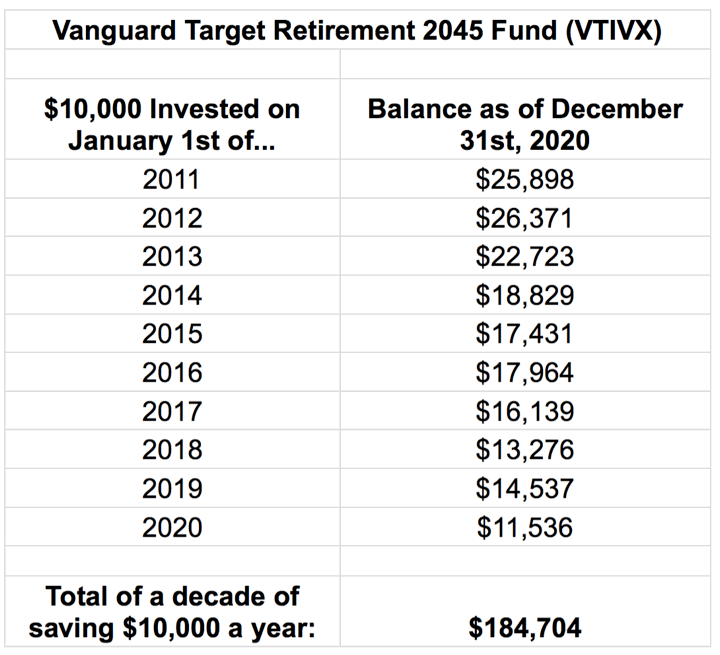
4. Repeat for 10 years. If you did this from 2011-2020, you’d have over $100,000. Every January, I show how regular, steady investments over time can end up with excellent results. Here is a table from What If You Invested $10,000 Every Year For the Last 10 Years? 2021 Edition:

Global stock markets are up even further in 2021 (VTIVX is up another 12% YTD as of this writing), but we can simply stick with these numbers. The chart assumes a $10,000 annual investment ($833 a month), but we can easily scale it down to our $6,000 annual investment.

If you invested $6,000 a year into the Vanguard Target Retirement 2045 Fund, every year for the past 10 years (2011-2020), you would have ended up with a total balance of $110,822. (If two people did this, they would have over $220,000!) These are real-world numbers based on $500 a month, not a theoretical result from a calculator. You can argue the details, but even with only $250 a month, you’d have ended up with over $50,000. (You would have done even better going all-in with an S&P 500 index fund as well, but this is an easy, set-and-forget choice including global stocks and bonds.)

I admit, I like to play the game of “winning” easy/free money. I find it much more enjoyable than any video game. I also try to only pick and choose those that offer a good payout/effort ratio, usually over the equivalent of $100 an hour. Now, these small deals will never replace a successful career, which can supercharge your savings into the realm of financial independence. However, this is yet another reminder that small amounts, however attained, can add up to a surprisingly big number over time when invested productively and left alone. I have the Vanguard IRA statements to prove it. 😀

USDC Stablecoin Reserves Breakdown July 2021

For those following stablecoin, Centre (founded by Circle) has released another breakdown of USDC reserves as of July 16, 2021. The accounting firm Grant Thornton attests that the total fair value of US dollar denominated assets held in segregated accounts are at least equal to the now $22.2 billion of USDC in circulation. Here is their breakdown of the reserves:

I honestly don’t see why they don’t just keep it all in cash. If they maintain the highest level of trust, they can make so much money elsewhere. Yet, while I am not a fan of seeing the 9% in commercial paper and 5% in corporate bonds, this breakdown is much better than Tether (USDT) reserves breakdown. Tether reported only 3% in cash and 65% in commercial paper, which would make it one of the the largest commercial paper holders in the world, yet nobody has any idea whose paper they own! I’m disappointed in USDC, but I would never actually own USDT.

Bloomberg’s Matt Levine has observed that “most of what actually happens with Bitcoin is about rediscovering financial history and re-creating the traditional financial system from scratch.” The same goes for stablecoin deposits, as we are seeing banking without FDIC insurance to even the playing field amongst big and small banks (and protect individual depositors). As in the past, since there is the chance of a “bank failure” and/or fraud, people demand higher interest for higher risk, while the safer places can get away with paying less interest. Consider the current interest rates on USDC deposits:

Although if we keep following that history model, then at some point there will be a stablecoin crisis where some portion of folks will lose money, leading to much tighter regulations about maintaining reserves, etc.

The poor transparency about stablecoin reserves and the lack of FDIC-insurance are why I don’t list these APYs in my monthly updates on the best rates on cash. You must perform your own due diligence on stablecoin risks.

MMB Portfolio Update July 2021: Asset Allocation & Performance

portpie_blank200

Here’s my quarterly update on my current investment holdings as of July 2021, including our 401k/403b/IRAs, taxable brokerage accounts, and savings bonds but excluding our house, cash reserves, and a small portfolio of self-directed investments. Following the concept of skin in the game, the following is not a recommendation, but a real-world example of a mostly low-cost, diversified, simple DIY portfolio with a few customized tweaks. The goal of this portfolio is to create sustainable income that keeps up with inflation to cover our household expenses.

Actual Asset Allocation and Holdings
I use both Personal Capital and a custom Google Spreadsheet to track my investment holdings. The Personal Capital financial tracking app (free, my review) automatically logs into my different accounts, adds up my various balances, tracks my performance, and calculates my overall asset allocation. Once a quarter, I also update my manual Google Spreadsheet (free, instructions) because it helps me calculate how much I need in each asset class to rebalance back towards my target asset allocation.

Here are updated performance and asset allocation charts, per the “Allocation” and “Holdings” tabs of my Personal Capital account, respectively:

Stock Holdings
Vanguard Total Stock Market (VTI, VTSAX)
Vanguard Total International Stock Market (VXUS, VTIAX)
Vanguard Small Value (VBR)
Vanguard Emerging Markets (VWO)
Vanguard REIT Index (VNQ, VGSLX)

Bond Holdings
Vanguard Limited-Term Tax-Exempt (VMLTX, VMLUX)
Vanguard Intermediate-Term Tax-Exempt (VWITX, VWIUX)
Vanguard Intermediate-Term Treasury (VFITX, VFIUX)
Vanguard Inflation-Protected Securities (VIPSX, VAIPX)
Fidelity Inflation-Protected Bond Index (FIPDX)
iShares Barclays TIPS Bond (TIP)
Individual TIPS bonds
U.S. Savings Bonds (Series I)

Target Asset Allocation. I do not spend a lot of time backtesting various model portfolios, as I don’t think picking through the details of the recent past will necessarily create superior future returns. Usually, whatever model portfolio is popular in the moment just happens to hold the asset class that has been the hottest recently as well.

I believe in the importance of doing your own research and owning productive assets in which you have strong faith. Every asset class will eventually have a low period, and you must have strong faith during these periods to truly make your money. You have to keep owning and buying more stocks through the stock market crashes. You have to maintain and even buy more rental properties during a housing crunch, etc.

Personally, I try to own broad, low-cost exposure to asset classes that will provide long-term returns above inflation, distribute income via dividends and interest, and finally offer some historical tendencies to balance each other out. I have faith in the long-term benefit of owning publicly-traded US and international shares of businesses as well as high-quality US federal and municipal debt. I also own real estate through REITs.

Again, personally, I simply don’t have strong faith in the long-term results of commodities, gold, or bitcoin. I own my own house, but I choose not to participate in the higher potential gains but also higher potential risks (of both requiring more time and money) of rental real estate.

My US/international ratio floats with the total world market cap breakdown, currently at ~58% US and 42% ex-US. I’m fine with a slight home bias (owning more US stocks than the overall world market cap), but I want to avoid having an international bias.

Stocks Breakdown

  • 43% US Total Market
  • 7% US Small-Cap Value
  • 33% International Total Market
  • 7% Emerging Markets
  • 10% US Real Estate (REIT)

Bonds Breakdown

  • 33% High-Quality Nominal bonds, US Treasury or FDIC-insured
  • 33% High-Quality Municipal Bonds
  • 33% US Treasury Inflation-Protected Bonds

I have settled into a long-term target ratio of 67% stocks and 33% bonds (2:1 ratio) within our investment strategy of buy, hold, and occasionally rebalance. I use the dividends and interest to rebalance whenever possible in order to avoid taxable gains. I plan to only manually rebalance past that if the stock/bond ratio is still off by more than 5% (i.e. less than 62% stocks, greater than 72% stocks). With a self-managed, simple portfolio of low-cost funds, we can minimize management fees, commissions, and taxes.

Holdings commentary. The world seems to have stabilized since the March 2020 market drop and overall panic, but I try not to get too attached to these numbers. They seem too good to be true, even as things continue to open up. All I can do is listen to the late Jack Bogle and “stay the course”. I remain optimistic that capitalism, human ingenuity, human resilience, human compassion, and our system of laws will continue to improve things over time.

I would like to note that when few people were paying attention, TIPS have had a pretty good run for an insurance-like investment. The iShares TIPS ETF (TIP) went up 8.3% in 2019 and 10.9% in 2020. The 10-year breakeven inflation rate between TIPS and Treasury is currently about 2.3%. I’m still happy owning a chunk of my bonds as TIPS.

Performance numbers. According to Personal Capital, my portfolio is up +9.4% for 2021 YTD. I rolled my own benchmark for my portfolio using 50% Vanguard LifeStrategy Growth Fund and 50% Vanguard LifeStrategy Moderate Growth Fund – one is 60/40 and the other is 80/20 so it also works out to 70% stocks and 30% bonds. That benchmark would have a total return of +8.2% for 2021 YTD as of 7/18/2021.

I’ll share about more about the income aspect in a separate post.

HM Bradley Credit Card Review: 3-2-1 Cash Back, Saving Tier APY Boost

Update December 2021: On December 15th, 2021, HMBradley announced upcoming changes to their interest rate that will become effective February 1st, 2022, along with changes to their credit card boosts that are effective January 1st, 2022. See my HM Bradley review for additional commentary.)

Original post (will be outdated as of 1/1/2022):

I’ve reviewed the HM Bradley Checking account as a new bank option offering interest rates of up to 3% APY on balances up to $100,000, depending on factors like savings rate and direct deposit. Last week, I finally managed to qualify for their HM Bradley credit card, which offers additional advantages when used with their banking product:

  • Savings Tier Boost: Get boosted to the next highest Savings Tier APY when you spend at least $100 each monthly cycle on the HM Bradley credit card AND have a least $2,500 in monthly direct deposits for each month of the previous quarter. If you are already at the highest Savings Tier, they will increase your APY by another 0.5% APY. (Currently, this makes it a possible 3.5% APY.)
  • Savings Tier Protection: When you pay your HMBradley Credit Card with your deposit account, it won’t count against your Savings Tiers.
  • Annual fee waived for the first year, then $60 (charged as $5 per month?).

3-2-1 Cashback rewards on credit card purchases details:

  • 3% cash back on your top eligible spending category each monthly statement cycle
  • 2% cash back on your next eligible spending category each monthly statement cycle
  • 1% cash back on everything else.

How do I apply for the HM Bradley credit card? I can’t find the application. As someone who already had a sizable amount deposited at HM Bradley, I was definitely interested in that 0.5% APY boost. However, I couldn’t find an application link anywhere! This is what they tell you to do:

With an active HMBradley account, you just need to opt into One Click Credit, and we will automatically notify you if you are eligible for the HMBradley Credit Card. We send offers at the beginning of every month, so be sure to check your account and email to see if you qualify. With One Click Credit, you authorize us to make a soft inquiry on your credit report each month for twelve months to determine if you are eligible for the HMBradley Credit Card. The inquiry does not affect your credit score and is not an application for credit.

I followed their directions have been opted in to “One Click Credit” for several months. Yet, what I didn’t know was that they also screen people based on income (not only credit score), AND they estimate your income based on your direct deposits to HM Bradley. I split my direct deposit many different ways, so they thought my income was too low.

It turns out the magic number for me was about $2,500 in direct deposits within a month. As soon as my HMB direct deposit was higher than that threshold, I was invited with an email subject “You have a new credit offer!”. This also happens to match their ongoing requirements, but I can’t be sure that this is the same number for everyone. I’m just reporting my own experience.

Alternatively, if you click on the “Insights” tab on the left, you can also self-report your income now in order to help you qualify for this credit card. Again, I am not sure what minimum income they are looking for, but the range looks to be above a minimum of roughly $35,000 per year.

List of eligible categories. Taken from their fine print:

• Education
• Motor Vehicle
• Pets
• Groceries
• Utilities
• Financial
• Gas
• Shopping
• Entertainment
• Alcohol & Bars
• Dining
• Healthcare & Childcare
• Professional Services
• Health & Fitness
• Home
• Furniture
• Personal Care
• Business Services
• Electronics & Software
• Air Travel
• Ground Transportation
• Lodging
• Sporting Goods

My take and a warning. Their 3-2-1 cash back rewards structure includes some unique categories that I don’t see on other credit cards, and another positive factor is a lack of a cap on earned rewards. Thus, if you happen to make large credit card purchases in specific niche categories like Education or Healthcare/Childcare, then the 3% cash back may be attractive. Otherwise, you may be better off with a flat 2% cash back on everything with no annual fee, especially given that HMB will charge a $60 annual fee after the first year.

More significant to me was the Savings Tier Boost. As I’m already at the 3% APY tier, earning an additional 0.5% APY could be worth up to hundreds of dollars a year. $10,000 at 0.50% APY would be another $50 a year, almost covering that eventual $60 annual fee. $50,000 at 0.5% APY would be $250 in additional interest per year. $100,000 at 0.5% APY would be $500 in additional interest per year. Definitely a nice ongoing perk to encourage me to use their bank and credit card frequently.

However, I just noticed this line in their fine print about the Saving Tier Boost promo: “Offer expires December 31, 2021.” That was a surprise. I don’t like the idea of promoting something as a headline credit card feature when you already plan on having it expire in less than 7 months. I do hope they extend it, as without this feature I would not have applied for this card.

Bottom line. The HM Bradley credit card offers a unique set of perks that currently mesh really well with their banking product. Be aware that you must maintain an certain minimum monthly direct deposit into their HM Bradley checking account in order to be invited to apply (roughly $2,500 a month for me). Before applying, be aware that the Savings Tier Boost feature is set to end on December 31, 2021.

Target Deal Days 2021: 5% Off Gift Cards 6/16-6/19

In an amazing coincidence, Target is having their Target Deal Days from June 20-22, overlapping with Amazon Prime Day. The tagline is “3 days of spellbinding savings with no membership fees”. New deals will be added every day, with the following 5% gift card discount beforehand:

From June 16–19, Target GiftCards are 5% off on Target.com (Target Circle offer valid online only. $500 limit. Terms & conditions apply). For even more discounts every day, join our free loyalty program Target Circle and reach for your Target RedCard. Let the savings begin!

The 5% discount is not as good as the 10% off in previous years, but the $500 purchase limit is higher. I’ll try to update this post with any specific deals of interest that are announced.