Search Results for: High Interest Savings

MMB Portfolio Asset Allocation & Performance Update – July 2024 (Post Q2)

Here’s my 2024 Q2 update for our primary investment holdings, including all of our combined 401k/403b/IRAs and taxable brokerage accounts but excluding our house and side portfolio of self-directed investments. Following the concept of skin in the game, the following is not a recommendation, but a sharing of our real-world, imperfect, low-cost, diversified DIY portfolio.

“Never ask anyone for their opinion, forecast, or recommendation. Just ask them what they have in their portfolio.” – Nassim Taleb

How I Track My Portfolio
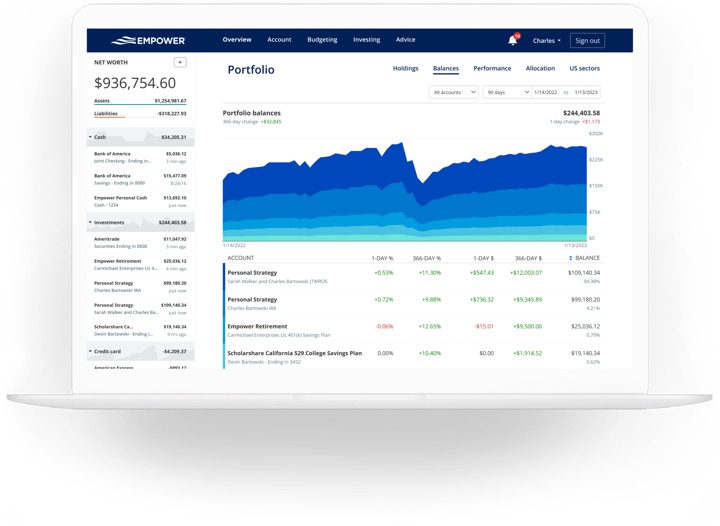
Here’s how I track my portfolio across multiple brokers and account types. There are limited free advanced options after Morningstar discontinued free access to their portfolio tracker. I use both Empower Personal Dashboard (previously known as Personal Capital) and a custom Google Spreadsheet to track my investment holdings:

  • The Empower Personal Dashboard real-time portfolio tracking tools (free) automatically logs into my different accounts, adds up my various balances, tracks my performance, and calculates my overall asset allocation daily. Formerly known as Personal Capital.
  • Once a quarter, I also update my manual Google Spreadsheet (free to copy, instructions) because it helps me calculate how much I need in each asset class to rebalance back towards my target asset allocation. I also create a new tab each quarter, so I have a personal archive of my holdings dating back many years.

2024 Q2 Asset Allocation and YTD Performance
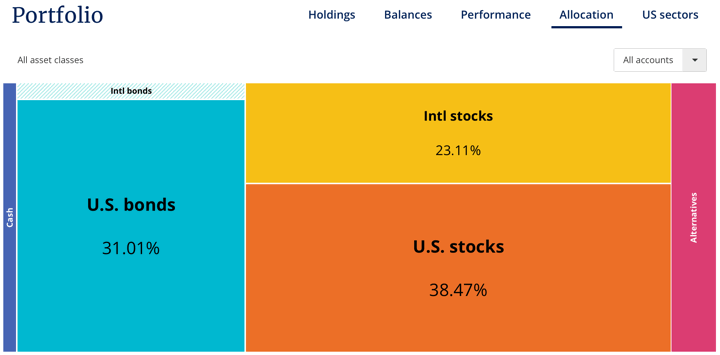
Here are updated performance and asset allocation charts, per the “Holdings” and “Allocation” tabs of my Empower Personal Dashboard.

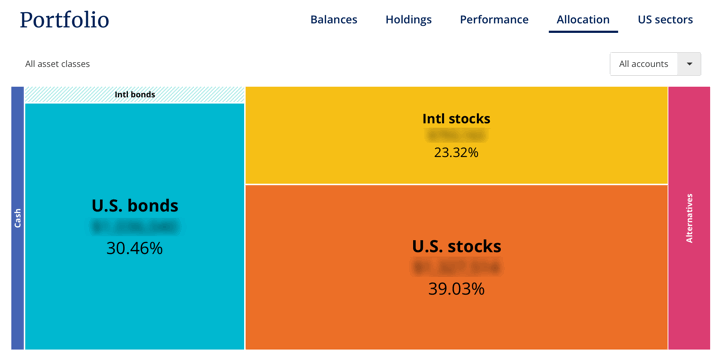
I own broad, low-cost exposure to productive assets that will provide long-term returns above inflation, distribute income via dividends and interest, and finally offer some historical tendencies to balance each other out. I have faith in the long-term benefit of owning businesses worldwide, as well as the stability of high-quality US Treasury debt. My stock holdings roughly follow the total world market cap breakdown at roughly 60% US and 40% ex-US. I do add just a little “spice” to the broad funds with the inclusion of “small value” factor ETFs for US, Developed International, and Emerging Markets stocks as well as diversified real estate exposure through US REITs. But if you step back and look at the big picture, my target portfolio is quite boring.
By paying minimal costs including management fees, transaction spreads, and tax drag, I am trying to essentially guarantee myself above-average net performance over time.

The portfolio that you can hold onto through the tough times is the best one for you. Every asset class will eventually have a low period, and you must have strong faith during these periods to earn those historically high returns. You have to keep owning and buying more stocks through the stock market crashes. You have to maintain and even buy more rental properties during a housing crunch, etc. A good sign is that if prices drop, you’ll want to buy more of that asset instead of less. I don’t have strong faith in the long-term results of commodities, gold, or bitcoin – so I don’t own them.

I do not spend a lot of time backtesting various model portfolios, as I don’t think picking through the details of the recent past will necessarily create superior future returns. You’ll usually find that whatever model portfolio is popular at the moment just happens to hold the asset class that has been the hottest recently as well.

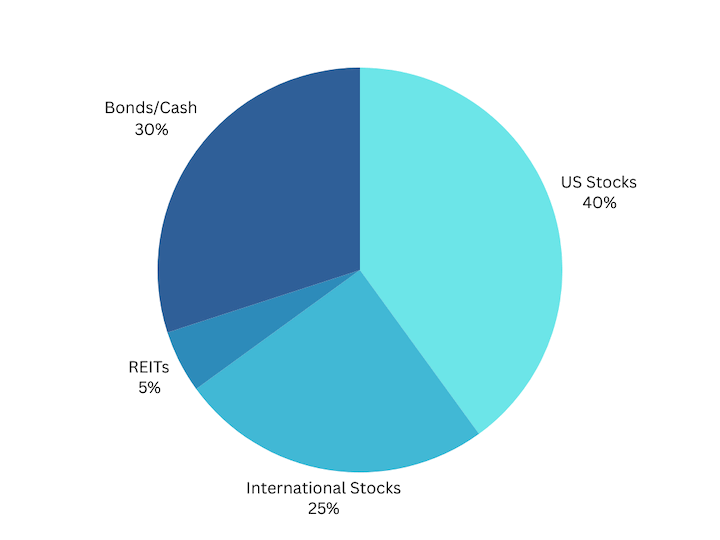
I have settled into a long-term target ratio of roughly 70% stocks and 30% bonds within our investment strategy of buy, hold, and occasionally rebalance. My goal has evolved to more of a “perpetual income portfolio” as opposed to a “build up a big stash and hope it lasts until I die” portfolio. My target withdrawal rate is 3% or less. Here is a round-number breakdown of my target asset allocation along with my primary ETF holding for each asset class. The reality is of course a bit more messy.

  • 35% US Total Market (VTI)
  • 5% US Small-Cap Value (VBR)
  • 20% International Total Market (VXUS)
  • 5% International Small-Cap Value (AVDV)
  • 5% US Real Estate (REIT) (VNQ)
  • 15% US “Regular” Treasury Bonds or FDIC-insured deposits
  • 15% US Treasury Inflation-Protected Bonds (or I Savings Bonds)

Performance details. According to Empower, my portfolio is up about 6% so far in 2024. The S&P 500 is up about 14.5% YTD, while the US Bond index is down around 1%. I hold enough bonds and international stocks that I’m always going to be lagging the hottest sector, and I’m pretty much used to that now.

As usual, not much action. These quarterly updates are mostly for me to manually log into all my accounts to make sure they still exist. I didn’t sell a single share of anything. I did reinvest some dividends and interest to bring me back towards my target numbers. The US capital markets continue to reward the long-term investors who take on the risk of owning stocks.

I’ll share about more about the income aspect in a separate post.

Juno Finance App: Banking Interruptions, 5% APY and 5% Cashback Terminated

Update May 2024: Juno just sent out the following e-mail today, which may be the best of example of public relations double-speak that I’ve seen in a while. Look at all those meaningless words! 😳 Juno paid out a lot of above-average valuable perks for a while, even before their crypto pivot, and I’m still not sure where the money came from. Unfortunately, the music has finally stopped and the party looks to be over. 🎉 🙅 They are reporting banking interruptions (ACH transfers + debit cards) and are terminating their 5% APY interest and 5% cashback program with only 48 hours notice (5/15/24). If you still have money there, I would recommend starting the withdrawal process but also having some patience. I have no reason to expect any principal losses but these types of disruptions do occur with fintech apps at times, unfortunately. This tweet says they are looking to switch banking providers in the next 4 weeks (!), but when you allow something like this to happen, that may be too little too late.

Dear Jonathan,
Juno stands at the intersection of banking and cryptocurrency, providing the quickest and easiest access to over 20 blockchains in the United States through ACH, Wire, Cash App, and more. We pride ourselves on promoting self-custody by eliminating mandatory holding periods for crypto withdrawals, distinguishing us from many U.S. crypto exchanges.

The past 18 months have witnessed remarkable growth in crypto and stablecoin sectors. These innovations are essential for creating fair and transparent financial services. At Juno, we are committed to a future where financial control rests with the users, not the banks.

In the past few days, banking services on Juno have been temporarily disrupted. Our team is hard at work collaborating with our banking services provider, Evolve Bank & Trust, and brokerage partner, Synapse Brokerage LLC., to resolve the disruptions as quickly as possible. This disruption, however, further strengthens our commitment to build a future where you are in control of your money at all times, not the banks.

Introducing Juno 2.0 – Reimagining Banking for Tomorrow

In 2024, Juno will focus intensively on developing financial services centered around crypto and stablecoins to ensure that you are always in control of your money. Our goal is to seamlessly integrate banking and crypto infrastructures to foster innovative experiences in savings, payments, and investments, making crypto and stablecoins practical for everyday use.

As part of this strategic realignment, starting May 15, 2024:

Cash held in Juno accounts will no longer accrue the 5.00% bonus, regardless of the account balance.
Additionally, purchases made with the Juno card will no longer receive a 5% cashback.

We recognize that these changes might be disappointing. However, please be assured that this decision was made with careful consideration of our long-term vision to give Juno members financial freedom by placing crypto and stablecoins at the heart of banking and financial services.

Thank you for your understanding and continued support. Should you have any questions or need more information, our customer support team is always here to assist you.

Update January 2024: Juno is now paying a 5.00% annualized bonus on balances from $20,000 up to $250,000 and 3.00% annualized on balances below $20,000.

Original post below, now outdated, last updated circa 2023:

Juno.finance (formerly OnJuno) is a fintech that combines an FDIC-insured bank account and a crypto custodian. Details:

  • New: Earn 5.00% annualized bonus on all cash deposits up to $250,000 and 3.00% annualized on balances below $20,000. This applies to traditional cash deposits (USD), which are FDIC-insured through Evolve Bank & Trust. Applies to both the Basic and Metal tiers. No transaction or direct deposit requirements.
  • New: JCOIN Loyalty Program. Earn loyalty tokens “JCOIN” when you complete certain actions with Juno. Existing users should check their accounts as Juno may have given you a bunch for free that you must claim. These loyalty tokens are redeemable inside the app for various perks including gift cards.

OnJuno partners with Evolve Bank and Trust for FDIC insurance. A reminder that cryptocurrencies, including USDC stablecoins, are not covered by FDIC insurance even though the creators claim they are backed 1:1 by US dollars. Juno has added support for crypto and external wallets. Don’t confuse your FDIC-insured USD deposits with stablecoins.

Traditional Bank-to-bank transfers. OnJuno uses the Plaid service to link with external bank accounts for funding and free ACH transfers (both deposits and withdrawals). They also provide you with the full account number and routing number, which you can use to connect with other banks like Ally, Marcus, CapOne 360, etc. The routing number is 084106768 which is confirmed as that of Evolve Bank & Trust. I was able to make a deposit and withdrawal initiated at Ally without issue (subject to transfer limits of $20,000 daily/$500,000 monthly). As with some other fintechs, their in-house limits are lower.

Bonus rate, not APY? You may notice that they don’t use “APY” and instead say “bonus rate”. Here’s their reason:

The Bonus Rate is offered entirely by OnJuno and is not interest provided by Evolve Bank and Trust. The bonus rate You earn will be credited to Your account at the beginning of each month. Your funds begin generating a bonus rate once they are available on Your OnJuno Checking Account. Please note that OnJuno reserves the right to cancel, remove, and change this bonus at any time. OnJuno also reserves the rights, in sole discretion, to refuse this bonus without cause, reason, and notice.

I’ve been getting my bonus rate every month without issue at the proper annualized rate, so this just seems to be a legal thing. Your interest is still shown on a 1099-INT at the end of the year.

Additional details.

  • Customer service. You can contact them via phone at 415-969-5775 (9am to 6pm Pacific) or online message (they replied to me within a few hours).
  • No minimum balance requirement.
  • Fee-free access to both Allpoint and Moneypass ATM networks (85,000+ locations).
  • Free debit Mastercard.
  • No mobile check deposit yet.

Bottom line. Juno is a fintech banking app with a high-interest checking account with no direct deposit or debit card usage requirements. FDIC-insurance from Evolve Bank and Trust. It does have ties with crypto, which may be either a plus or minus for you.

MMB Portfolio Asset Allocation & Performance Update – April 2024 (Q1)

Here’s my 2024 Q1 update for our primary investment holdings (numbers taken after market close 3/29), including all of our combined 401k/403b/IRAs and taxable brokerage accounts but excluding our house and side portfolio of self-directed investments. Following the concept of skin in the game, the following is not a recommendation, but a sharing of our real-world, imperfect, low-cost, diversified DIY portfolio.

“Never ask anyone for their opinion, forecast, or recommendation. Just ask them what they have in their portfolio.” – Nassim Taleb

How I Track My Portfolio
Here’s how I track my portfolio across multiple brokers and account types. There are limited free advanced options after Morningstar discontinued free access to their portfolio tracker. I use both Empower Personal Dashboard (previously known as Personal Capital) and a custom Google Spreadsheet to track my investment holdings:

  • The Empower Personal Dashboard real-time portfolio tracking tools (free) automatically logs into my different accounts, adds up my various balances, tracks my performance, and calculates my overall asset allocation daily. Formerly known as Personal Capital.
  • Once a quarter, I also update my manual Google Spreadsheet (free to copy, instructions) because it helps me calculate how much I need in each asset class to rebalance back towards my target asset allocation. I also create a new tab each quarter, so I have a personal archive of my holdings dating back many years.

2024 Q1 Asset Allocation and YTD Performance
Here are updated performance and asset allocation charts, per the “Holdings” and “Allocation” tabs of my Empower Personal Dashboard.

I own broad, low-cost exposure to productive assets that will provide long-term returns above inflation, distribute income via dividends and interest, and finally offer some historical tendencies to balance each other out. I have faith in the long-term benefit of owning businesses worldwide, as well as the stability of high-quality US Treasury debt. My stock holdings roughly follow the total world market cap breakdown at roughly 60% US and 40% ex-US. I add just a little “spice” to the broad funds with the inclusion of “small value” factor ETFs for US, Developed International, and Emerging Markets stocks as well as diversified real estate exposure through US REITs.

By paying minimal costs including management fees, transaction spreads, and tax drag, I am trying to essentially guarantee myself above-average net performance over time.

The portfolio that you can hold onto through the tough times is the best one for you. Every asset class will eventually have a low period, and you must have strong faith during these periods to earn those historically high returns. You have to keep owning and buying more stocks through the stock market crashes. You have to maintain and even buy more rental properties during a housing crunch, etc. A good sign is that if prices drop, you’ll want to buy more of that asset instead of less. I don’t have strong faith in the long-term results of commodities, gold, or bitcoin – so I don’t own them.

I do not spend a lot of time backtesting various model portfolios, as I don’t think picking through the details of the recent past will necessarily create superior future returns. You’ll usually find that whatever model portfolio is popular at the moment just happens to hold the asset class that has been the hottest recently as well.

I have settled into a long-term target ratio of roughly 70% stocks and 30% bonds within our investment strategy of buy, hold, and occasionally rebalance. My goal has evolved to more of a “perpetual income portfolio” as opposed to a “build up a big stash and hope it lasts until I die” portfolio. My target withdrawal rate is 3% or less. Here is a round-number breakdown of my target asset allocation along with my primary ETF holding for each asset class.

  • 35% US Total Market (VTI)
  • 5% US Small-Cap Value (VBR)
  • 15% International Total Market (VXUS)
  • 5% International Small-Cap Value (AVDV)
  • 10% US Real Estate (REIT) (VNQ)
  • 15% US “Regular” Treasury Bonds or FDIC-insured deposits
  • 15% US Treasury Inflation-Protected Bonds (or I Savings Bonds)

Performance details. According to Empower, my portfolio is up about 5% so far in 2024. The S&P 500 is up about 10% YTD, while the US Bond index is down around 1%. I hold enough bonds and international stocks that I’m always going to be lagging the hottest sector, and I’m pretty much used to that now.

As usual, not much action. These quarterly updates are mostly for me to manually log into all my accounts to make sure they still exist. I didn’t sell a single share of anything. I did reinvest some dividends and interest into TIPS and Treasury bonds to bring me back towards my target numbers. I also made my 2024 contributions to a Backdoor Roth IRA and bought VNQ in it.

I’ll share about more about the income aspect in a separate post.

Greenlight Debit Card For Kids: Free Subscription for PSECU Members ($60/year Value)

Greenlight is a popular reloadable debit card service for kids, where parents can manage and track their kids spending. You can also add an allowance, payments for recurring chores or one-time jobs, and teach them compound interest via “parent-paid interest”. I suppose its wise to show the kids how handle digital spending before the credit card offers arrive.

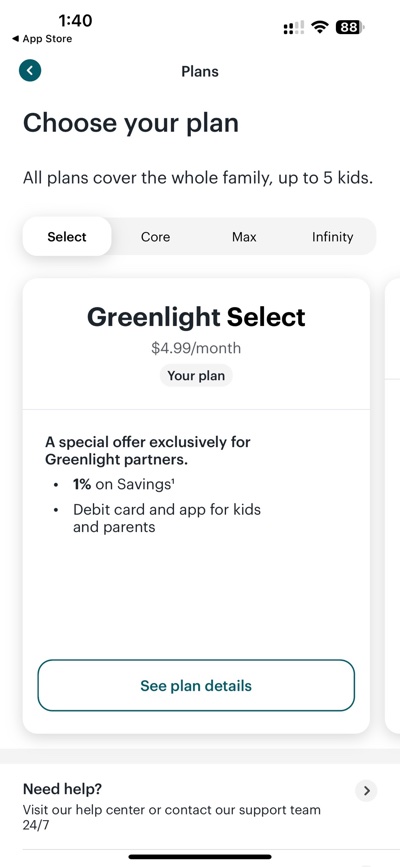
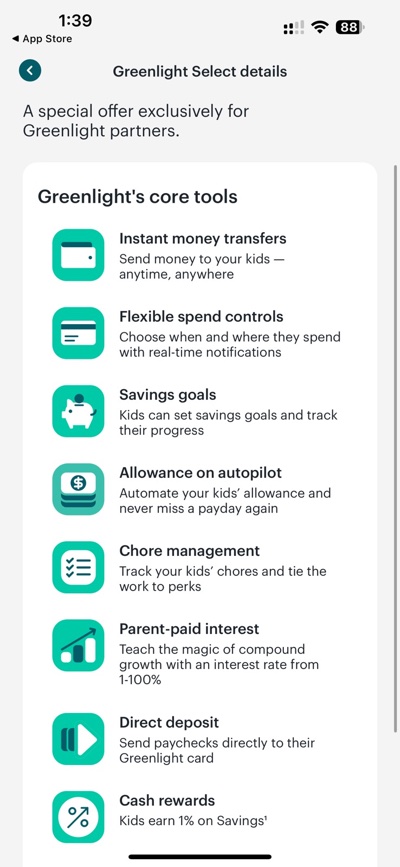
I decided to try out the new PSECU perk that offers the basic tier of Greenlight for free. (I did the PSECU $300 checking promo first.) You must enroll at Greenlight.com/PSECU and link a PSECU checking account in order to get the benefit. The “Greenlight Select” membership is a special tier for such partners, but is mostly comparable to the “Greenlight Core” tier on their website, which costs $4.99 a month. Included in the “Greenlight Select” membership:

  • Debit Mastercards for up to 5 kids. Send money instantly and keep tabs on spending with real-time notifications.
  • Educational app. The parents have their app where they get notified of every purchase, and the kids have their own app with educational games and short lessons (optional). Kids can divide their money into “savings” or “giving” baskets as well as create specific savings goals.
  • Parental controls. Created automated allowance payments. Set category and store-level spending limits.
  • 1% APY interest. This is the lowest tier and the lowest interest, although some other apps don’t pay any interest at all. You can get up to 5% APY on $5,000 if you upgrade to the $15/month tier.
  • Roundup feature. You can set it to round up purchases to the next dollar and put the difference in a savings account.
  • No overdraft fees. Does not allow overdrafts, so no overdraft fees.
  • Banking services provided by Community Federal Savings Bank, member FDIC.

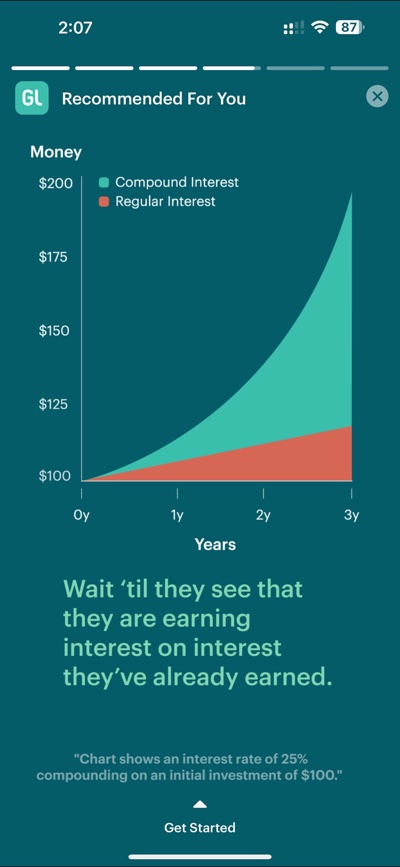
Teaching compound interest with higher interest rates. It can be hard to visualize compound interest at low interest rates, so parents can increase it by paying a higher “interest” rate out of their own pockets. For example, here is an illustration of $100 earning a 25% interest rate (paid by the parent) as opposed to a 5% interest rate. It makes the idea of earning interest on interest more immediate and tangible. Ideally, this can teach them that delayed gratification turns it into future rewards. You can set interest rates from 1% up to 100%.

Unfortunately, to add on investments, I would have to upgrade to the $10 a month tier or higher. If I had a teen ready for investing, I’d probably use the Fidelity Youth account instead (available for age 13-17 only, and my kids aren’t that old yet).

For kids under 13, I think that Greenlight would serve as a nice alternative to piggy banks. (Greenlight has no minimum age requirement.) While I suppose $5 a month isn’t a lot of money for all these features, I still like “free” better. After a few quick internet searches for “Greenlight Select”, I found multiple local banks and credit unions in my area that offered this free tier of service. If you plan on paying for it, there is $30 bonus available with a 1-month free trial (bonus not stackable with this free offer).

Best 0% APR Balance Transfer Credit Cards – Updated 2024

0aprLooking to pay off any remaining credit card debt? 📈 Shopping around for the best balance transfer offer can save you thousands of dollars in interest. Below is a freshly updated list of the best 0% APR balance transfer offers. I try to include both the big banks and lesser-known credit unions with easy membership requirements.



Best No Balance Transfer Fee 0% APR Offers

Fairwinds CU Cash Back Card0% Introductory APR for 12 months on purchases and balance transfers and no balance transfer fees. After the intro APR offer ends, a variable APR will apply. You must be an Fairwinds Credit Union member to obtain this card, but membership is open to everyone. You must also keep a nominal $5 in a share savings account. Also earns 1.5% cash back on purchases. No annual fee.

La Capital FCU Rewards Card0% Introductory APR for 12 months on balance transfers and no balance transfer fee during the first 90 days after account opening. After the intro APR offer ends, a variable APR will apply. You must be an La Capitol Federal Credit Union member to obtain this card, but membership is open to everyone who joins a partner organization for as little as $20 (Louisiana Association for Personal Financial Achievement). You must also keep a nominal amount (usually around $5) in a share savings account. No annual fee.

Navy Federal CU Platinum Card0.99% Introductory APR for 12 months on balance transfers during the first 60 days after account opening and no balance transfer fees. (This is not 0%, but ~1% is still quite rare in the current interest rate environment.) After the intro APR offer ends, a variable APR will apply. You must be an Navy Fedral Credit Union member to obtain this card, and membership is limited to those with a military affiliation, although it does include anyone whose immediate family member serves or has ever served in the military. You must also keep a nominal amount (usually around $5) in a share savings account. No annual fee.

Comparing a shorter no-fee balance transfer vs. a longer one with a modest fee. As of January 2024, the average credit card interest rate is roughly 24% APR (!). If you are paying 24% APR, that’s like paying 2% on your balance every month (!). Paying a 3% upfront fee for an 21 month period of 0% would be like paying your current interest rate for 1.5 months and then getting 0% interest for the remaining 19.5 months. That may be preferable to 12 months at 0% with no balance transfer fee, especially if you spread out your payments over the entire period and use that additional time to pay it all off by the end. Here is an example comparison.

  • $5,000 balance, 24% APR, 12 month payoff = $472 per month for 12 months. ($5,673 total paid)
  • $5,000 balance, 0% APR + No BT fee, 12 month payoff = $417 per month for 12 months. ($5,000 total paid)
  • $5,000 balance, 24% APR, 21 months payoff = $293 per month for 21 months. ($6,172 total paid)
  • $5,000 balance, 0% APR + 3% BT fee, 21 month payoff = $245 per month for 21 months. ($5,150 total paid)
  • $5,000 balance, 0% APR + no BT fee, 21 month payoff = $238 per month for 21 months. ($5,000 total paid) ** not an available offer **

I can see how one might prefer the $245 per month for 21 months, even thought it results in a slightly higher total amount paid than the $417 per month for 12 months. Especially if this creates an attainable plan that the end of 21 months, you are debt-free and you saved over $1,000 in interest ($6,172 vs. $5,150). Even if there was no balance transfer fee for 21 months (which unfortunately isn’t an option), the difference would only be $7 per month.

If you are sure you can pay it all off within the shorter 0% period, then you should pick the no balance transfer fee option.

Best Low Fee, Longer-Term 0% APR Balance Transfer Offers

US Bank Visa Platinum Card  – 0% Intro APR on purchases and balance transfers for 21 billing cycles. After the intro APR offer ends, a variable APR will apply. There is a 3% balance transfer fee ($5 minimum). Side perk of up to $600 in cell phone protection. No annual fee.

Citi Simplicity® Card – 0% Intro APR on balance transfers for 21 months from date of first transfer. All transfers must be completed in first 4 months. This unique card has no late fees and no penalty interest rate. You also get 0% Intro APR on purchases for 12 months from date of account opening. After the intro APR offer ends, a variable APR will apply. There is a 3% balance transfer fee ($5 minimum). No annual fee.

BankAmericard Credit Card – 0% Intro APR for 18 billing cycles for purchases and balance transfers made in the first 60 days of opening your account. After the intro APR offer ends, a variable APR will apply. There is a 3% balance transfer fee. No annual fee.

Wells Fargo Reflect Card – 0% Intro APR on balance transfers and purchases for 21 months from date of account account opening. Balance transfers must be made within 120 days from account opening There is 5% balance transfer fee (min $5). No annual fee.

Wells Fargo Reflect Card – 0% Intro APR for 18 months for purchases and balance transfers. After the intro APR offer ends, a variable APR will apply. There is a 3% balance transfer fee ($5 minimum) for balance transfers made in the first 60 days of opening your account. No annual fee.

Ally Bank Deposit Bonus: 0.50% of New Deposits, Up to $125 (New Customers via Referral Only)

Ally Bank is one of my favorite banks in terms of user interface, practical features, and reliability. They were my primary checking account for years. Unfortunately, their savings account rates have been lagging the top rates by about 1% recently. Despite that, I still keep some active accounts there because I use them as my central hub connecting all my many different bank accounts.

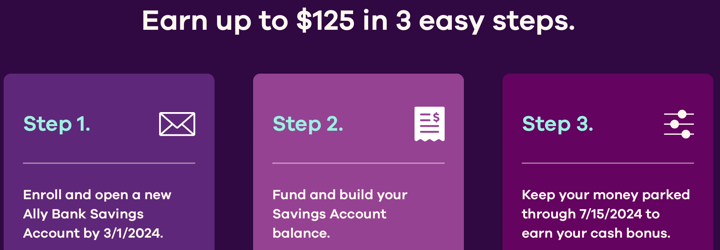
Ally is running a new up to $125 deposit bonus by referral only (that’s mine). You get a 0.50% cash bonus on new money deposited (3/29/24 to 7/15/24) on top of their standard interest rate. Here are the details, direct from the offer page:

  • Enroll and open a new Ally Bank Savings Account by 3/1/2024. Enter your name and email address below to start your enrollment in the program. Be sure to open your Savings Account with the same email address you enroll with by 3/1/2024.
  • Fund and build your Savings Account balance. Deposit new money from another financial institution to your newly opened Savings Account by 3/25/2024. You can make multiple funding transactions between the account opening date and 3/25/2024, however your account must be funded within 30 days of opening, or it will be closed. You are eligible to receive a 0.50% cash bonus on the new money you deposit, up to $25,000 (max $125 cash bonus).
  • Keep your money parked through 7/15/2024 to earn your cash bonus. You will receive a 0.50% cash bonus, up to $125, on the new money you deposit into your Savings Account by 3/25/2024 as long as you retain your funds from 3/25/2024 through 7/15/2024. Your cash bonus will be deposited into your Savings Account on or by 7/31/2024.

Napkin math. You have to open by 3/1/24, but there is no minimum balance and you don’t need to make the qualifying deposit until 3/25. The minimum hold period is thus from 3/25 to 7/15, which is 112 days. If we round up to 120 days, then the 0.5% bonus works out to an extra 1.5% annualized yield during that hold period.

If you assume the current interest rate of 4.35% APY holds during the minimum hold period, your total annualized yield would be 4.35 + 1.5 = 5.85% APY. This is a net profit from the current top rate but isn’t an amazingly high number, so I probably wouldn’t do this deal unless you wanted an Ally Savings Account as a long-term account for other reasons beyond highest yield. Ally has done other deposit promos in the past that benefited existing customers. (I wonder if they’ve been losing a lot of deposits recently.)

MMB Portfolio Asset Allocation & Performance Update – Year-End 2023

Here’s my year-end 2023 update for my investment holdings (published January 2024), including all of our combined 401k/403b/IRAs and taxable brokerage accounts but excluding our primary residence and side portfolio of self-directed investments. Following the concept of skin in the game, the following is not a recommendation, but a sharing of our real-world, imperfect, low-cost, diversified DIY portfolio.

“Never ask anyone for their opinion, forecast, or recommendation. Just ask them what they have in their portfolio.” – Nassim Taleb

How I Track My Portfolio
Here’s how I track my portfolio across multiple brokers and account types. There are limited free advanced options after Morningstar discontinued free access to their portfolio tracker. I use both Empower Personal Dashboard (previously known as Personal Capital) and a custom Google Spreadsheet to track my investment holdings:

  • The Empower Personal Dashboard real-time portfolio tracking tools (free) automatically logs into my different accounts, adds up my various balances, tracks my performance, and calculates my overall asset allocation daily. Formerly known as Personal Capital.
  • Once a quarter, I also update my manual Google Spreadsheet (free to copy, instructions) because it helps me calculate how much I need in each asset class to rebalance back towards my target asset allocation. I also create a new tab each quarter, so I have an archive of my holdings dating back many years.

2023 Year-End Asset Allocation and YTD Performance
Here are updated performance and asset allocation charts, per the “Holdings” and “Allocation” tabs of my Empower Personal Dashboard.

Humble Portfolio Background. I call this my “Humble Portfolio” because it reminds me to accept the repeated findings that the ability to know when stocks or bonds will outperform is exceedingly rare. Charlie Munger believes that only 5% of professional money managers have the skill required to consistently beat the index averages after costs.

Instead, by paying minimal costs including management fees, transaction spreads, and tax drag, you can essentially guarantee yourself above-average net performance over time.

I own broad, low-cost exposure to productive assets that will provide long-term returns above inflation, distribute income via dividends and interest, and finally offer some historical tendencies to balance each other out. I have faith in the long-term benefit of owning businesses worldwide, as well as the stability of high-quality US Treasury debt. My stock holdings roughly follow the total world market cap breakdown at roughly 60% US and 40% ex-US. I add just a little “spice” to the broad funds with the inclusion of “small value” factor ETFs for US, Developed International, and Emerging Markets stocks as well as diversified real estate exposure through US REITs.

I strongly believe in the importance of knowing WHY you own something. Every asset class will eventually have a low period, and you must have strong faith during these periods to earn those historically high returns. You have to keep owning and buying more stocks through the stock market crashes. You have to maintain and even buy more rental properties during a housing crunch, etc. A good sign is that if prices drop, you’ll want to buy more of that asset instead of less. I don’t have strong faith in the long-term results of commodities, gold, or bitcoin – so I don’t own them.

I do not spend a lot of time backtesting various model portfolios, as I don’t think picking through the details of the recent past will necessarily create superior future returns. You’ll find that whatever model portfolio is popular at the moment just happens to hold the asset class that has been the hottest recently as well.

Find productive assets that you believe in and understand, and just keep buying them through the ups and downs. Mine may be different than yours.

I have settled into a long-term target ratio of roughly 70% stocks and 30% bonds (or 2:1 ratio) within our investment strategy of buy, hold, and occasionally rebalance. My goal has evolved to more of a “perpetual income portfolio” as opposed to the more common “build up a big stash and hope it lasts until I die” portfolio. My target withdrawal rate is 3% or less. Here is a round-number breakdown of my target asset allocation along with my primary ETF holding for each asset class.

  • 30% US Total Market (VTI)
  • 5% US Small-Cap Value (VBR)
  • 20% International Total Market (VXUS)
  • 5% International Small-Cap Value (AVDV)
  • 10% US Real Estate (REIT) (VNQ)
  • 15% US “Regular” Treasury Bonds or FDIC-insured deposits
  • 15% US Treasury Inflation-Protected Bonds (or I Savings Bonds)

Performance details. According to Empower, my portfolio is up about 15.1% for 2024. The S&P 500 is up about 25% YTD, while the US Bond index is up around 6%. My overall return lagged the US broad market due to my international stock holdings and bond holdings, but I am still happy with my risk positioning (also see above regarding ups and downs).

Yet again, there was little action on my part this year. I didn’t sell a single share of anything, and that’s how I like it. I did reinvest some dividends and interest into TIPS, but the timing plus the year-end bull run of the US stock market still left me again with a higher stock percentage. Unless something extreme happens, I plan to use my future cashflows to rebalance back into bonds.

I’ll share about more about the income aspect in a separate post.

Fidelity Bloom App: Fintech App from Traditional Broker

Update July 2024: Looks like Fidelity is ending this little experiment. They are no longer accepting new applications. It was fun to try out and collect the various incentives.

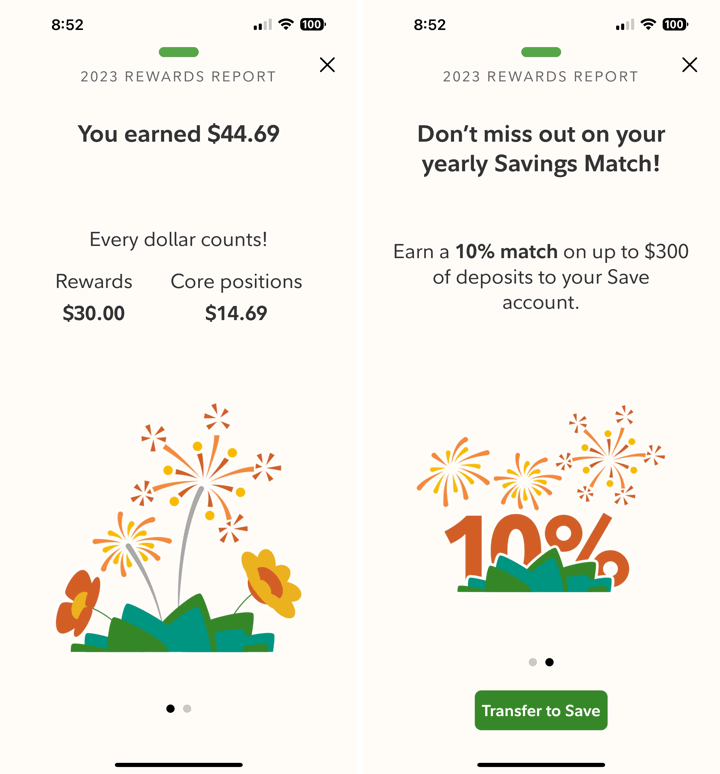
Update January 2024: If you have the Fidelity Bloom app, this is a reminder that the 10% annual savings match is reset and you can again get $30 for a $300 transfer into your Fidelity Bloom Save account. If you use the SPAXX option for cash sweep, you are also earning close to the equivalent of 5% APY (as of 1/3/24). Here is a screenshot of my 2023 rewards:

Full review:

Fidelity Bloom is a new(er) app from Fidelity Investments targeted at helping young adults become more financially aware and develop better savings habits. iOS and Android. Fidelity has included many “behavioral psychology” features from other fintech startup apps like a match on savings transfers, debit card cash back rewards, rounding-up purchases and saving the difference, and shopping portal cashback. The highlights:

  • (No new user bonus at the moment. Was $100.)
  • 10% annual savings match (up to $30). Get a 10% match on the first $300 saved into their Bloom Save account (up to a $30 match on $300 of new money deposited).
  • 10 cents from Fidelity with every debit card purchase. Fidelity will automatically deposit a fixed 10 cents into the Fidelity Bloom Save account every time customers use the Fidelity Bloom debit card. Reminds me of the Citi Rewards+ credit card.
  • Automatically round up purchases into savings. Customers can automatically round up purchases to the nearest dollar and have the difference moved to savings from their Fidelity Bloom Spend to their Fidelity Bloom Save account.
  • Up to 25% cashback through shopping portal. Receive up to 25% cash back into your Fidelity Bloom Save account when you shop in-app with 1,100+ participating retailers.

Interest rate is competitive (up to ~5% as of 1/3/24 with SPAXX), but it’s a brokerage account. Is it a bank account? Is it a brokerage account? It’s a SIPC-insured brokerage account:

The Fidelity Bloom App is designed to help with your saving and spending behaviors through your Save and Spend accounts, which are brokerage accounts covered by SIPC insurance. They are not bank accounts and therefore are not covered by FDIC insurance.

You do get a routing number and account number for your two accounts, but the cash is held like their other non-retirement accounts. During the sign-up process, you can pick between one of three options for your core position:

  • Fidelity® Interest-Bearing Option (FCASH)
  • Fidelity Government Money Market Fund (SPAXX)
  • Fidelity Treasury Money Market Fund (FZFXX)

Although I have confidence in Fidelity’s long-term experience and conservatism in running these money market mutual funds, the lack of FDIC coverage is something to note. The rates may change daily. View current rates here.

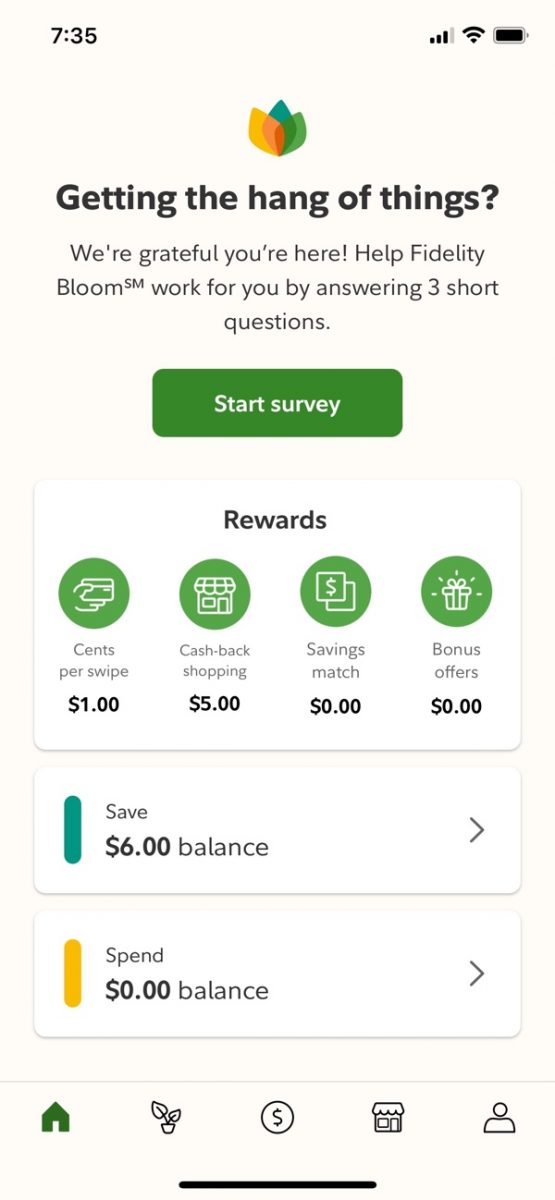
After you open via app, you can see the account balances at Fidelity.com but you’ll still need the app to change any settings. Here’s a screenshot from my app.

Fidelity recently shut down another of its experimental apps called “Fidelity Spire”, so we’ll see if this one catches on a bit better.

For posterity, here are the terms & conditions for the (expired) $100 limited-time offer:

This offer is valid for new or existing Fidelity Brokerage Services LLC (“Fidelity”) customers who make an initial total deposit of at least $50 (“Qualifying Deposit”) into their Fidelity Bloom Spend account or Fidelity Bloom Save account on or after August 13, 2023 through the Fidelity Bloom app. This offer is limited to one cash award per individual. For clarity, existing Bloom clients who have not yet made any deposits into either of their Fidelity Bloom Spend or Fidelity Bloom Save accounts can participate in this offer by making a Qualifying Deposit by August 27, 2023. Existing Fidelity customers who have previously made deposits into their Fidelity Bloom Spend or Save accounts, including individuals who have already participated in the Bloom $50 offer, are not eligible for this offer.

Best No Fee / Low Fee 0% APR Balance Transfer Offers – Updated 2024

0aprLooking to pay off any remaining credit card debt? 📈 Shopping around for the best balance transfer offer can save you thousands of dollars in interest. Below is a freshly updated list of the best 0% APR balance transfer offers. I try to include both the big banks and lesser-known credit unions with easy membership requirements.

Best NO FEE Offers Only

Fairwinds CU Cash Back Card0% Introductory APR for 12 months on purchases and balance transfers and no balance transfer fees. After the intro APR offer ends, a variable APR will apply. You must be an Fairwinds Credit Union member to obtain this card, but membership is open to everyone. You must also keep a nominal $5 in a share savings account. Also earns 1.5% cash back on purchases. No annual fee.

La Capital FCU Rewards Card0% Introductory APR for 12 months on balance transfers and no balance transfer fee during the first 90 days after account opening. After the intro APR offer ends, a variable APR will apply. You must be an La Capitol Federal Credit Union member to obtain this card, but membership is open to everyone who joins a partner organization for as little as $20 (Louisiana Association for Personal Financial Achievement). You must also keep a nominal amount (usually around $5) in a share savings account. No annual fee.

Navy Federal CU Platinum Card0.99% Introductory APR for 12 months on balance transfers during the first 60 days after account opening and no balance transfer fees. (This is not 0%, but ~1% is still quite rare in the current interest rate environment.) After the intro APR offer ends, a variable APR will apply. You must be an Navy Fedral Credit Union member to obtain this card, and membership is limited to those with a military affiliation, although it does include anyone whose immediate family member serves or has ever served in the military. You must also keep a nominal amount (usually around $5) in a share savings account. No annual fee.

Comparing a shorter no-fee balance transfer vs. a longer one with a modest fee. As of January 2024, the average credit card interest rate is roughly 24% APR (!). If you are paying 24% APR, that’s like paying 2% on your balance every month (!). Paying a 3% upfront fee for an 21 month period of 0% would be like paying your current interest rate for 1.5 months and then getting 0% interest for the remaining 19.5 months. That may be preferable to 12 months at 0% with no balance transfer fee, especially if you spread out your payments over the entire period and use that additional time to pay it all off by the end. Here is an example comparison.

  • $5,000 balance, 24% APR, 12 month payoff = $472 per month for 12 months. ($5,673 total paid)
  • $5,000 balance, 0% APR + No BT fee, 12 month payoff = $417 per month for 12 months. ($5,000 total paid)
  • $5,000 balance, 24% APR, 21 months payoff = $293 per month for 21 months. ($6,172 total paid)
  • $5,000 balance, 0% APR + 3% BT fee, 21 month payoff = $245 per month for 21 months. ($5,150 total paid)
  • $5,000 balance, 0% APR + no BT fee, 21 month payoff = $238 per month for 21 months. ($5,000 total paid) ** not an available offer **

I can see how one might prefer the $245 per month for 21 months, even thought it results in a slightly higher total amount paid than the $417 per month for 12 months. Especially if this creates an attainable plan that the end of 21 months, you are debt-free and you saved over $1,000 in interest ($6,172 vs. $5,150). Even if there was no balance transfer fee for 21 months (which unfortunately isn’t an option), the difference would only be $7 per month.

If you are sure you can pay it all off within the shorter 0% period, then you should pick the no balance transfer fee option.

Best LOW FEE Offers Only

US Bank Visa Platinum Card  – 0% Intro APR on purchases and balance transfers for 21 billing cycles. After the intro APR offer ends, a variable APR will apply. There is a 3% balance transfer fee ($5 minimum). Side perk of up to $600 in cell phone protection. No annual fee.

Citi Simplicity® Card – 0% Intro APR on balance transfers for 21 months from date of first transfer. All transfers must be completed in first 4 months. This unique card has no late fees and no penalty interest rate. You also get 0% Intro APR on purchases for 12 months from date of account opening. After the intro APR offer ends, a variable APR will apply. There is a 3% balance transfer fee ($5 minimum). No annual fee.

BankAmericard Credit Card – 0% Intro APR for 18 billing cycles for purchases and balance transfers made in the first 60 days of opening your account. After the intro APR offer ends, a variable APR will apply. There is a 3% balance transfer fee. No annual fee.

Wells Fargo Reflect Card – 0% Intro APR on balance transfers and purchases for 21 months from date of account account opening. Balance transfers must be made within 120 days from account opening There is 5% balance transfer fee (min $5). No annual fee.

Wells Fargo Reflect Card – 0% Intro APR for 18 months for purchases and balance transfers. After the intro APR offer ends, a variable APR will apply. There is a 3% balance transfer fee ($5 minimum) for balance transfers made in the first 60 days of opening your account. No annual fee.

Primis Bank Novus Checking: 6% APY Guaranteed for 6 Months (4.00% APY Standard)

Primis Bank just rolled out a new Novus Checking account that includes an introductory period of 6.00% APY guaranteed for 6 months on up to $50,000 with qualifying direct deposits. Hat tip to reader Bill P. Highlights:

  • 6.00% APY guaranteed on up to $50,000 for 6 months, when you set up and use direct deposit within 60 days of opening your account and maintain it through the 6-month period.
  • Otherwise, earn 4.00% APY (with no direct deposit or after the initial 6 months). Note this is a variable rate.
  • No minimum balance requirement.
  • Open with just $1.
  • Must open online.
  • Free starter pack of 40 checks (upon request).
  • Free cashier’s checks.
  • Free ATM rebates.

Napkin math. If you consider the 6% APY to be a 1% APY improvement over 5% APY, on a $50,000 balance that works out to $250 extra interest over 6 months. Of course, interest rates could change in the future (up or down). The fact that this is a checking account rather than a savings account makes it easier to maximize your interest earned while still performing everyday transactions.

You may recall that Primis Bank was mentioned previously for their 5.07% APY Premium checking and 5.07% APY Primis savings accounts (rate as of 11/15/23). These still exist. The problem is, I’m not really sure what the difference between the “Novus” and the “Premium” accounts are… could it be that the Premium may be phased out soon in favor of the Novus with lower base interest rate? Perhaps it is a good idea to open up those accounts now as well to take advantage if they grandfather in existing customers?

Premium Checking details:

  • 5.07% APY as of 11/15/23.
  • No minimum balance requirement.
  • Open with just $1.
  • Must open online.
  • Free cashier’s checks and starter pack of checks.
  • Free ATM rebates.

Primis Savings details:

  • 5.07% APY as of 11/15/23.
  • No minimum balance requirement.
  • Open with just $1.

Reader Adam says to make sure to download the “Primis Digital Mobile App” and not the other one which applies to their physical branch accounts (their two systems are currently separate). Also, you may have issues syncing your existing bank (or Personal Capital) with Primis because they try to log into the physical branch account interface and not their online-only accounts.

BMO Alto Online Certificates of Deposit: 5-year CD at 5.25% APY

BMO Alto is the online-only division of BMO Bank N.A. (member FDIC). You can only access BMO Alto products through its unique website, not any existing BMO login. As of 11/8/23, they are offering very competitive rates for CDs (certificates of deposit) which would be very suitable for a ladder:

  • 5-year at 5.25% APY
  • 4-year at 5.20% APY
  • 3-year at 5.10% APY
  • 2-year at 5.00% APY
  • 1-year at 5.65% APY
  • 6-month at 5.50% APY
  • Liquid savings at 5.10% APY (variable).

Additional details:

  • No minimum to open.
  • No monthly maintenance fees.
  • Online statements only.
  • Unfortunately, they do not offer IRA CDs at this time.
  • If your savings account has a zero balance for 90 consecutive days it will be automatically closed. You must also fund your CD within 10 calendar days or it will be automatically closed.

Early withdrawals. The early withdrawal penalty (EWP) for CD maturities of 1 year or more is 180 days of interest. For CD maturities of 11 months or less, the EWP is 90 days of interest. Note that they reserve the right to prohibit early withdrawals entirely:

We reserve the right to permit withdrawals of principal only upon maturity. If we permit you to make an early withdrawal of principal before maturity, you will pay an early withdrawal penalty. The penalty is calculated using the interest rate applicable to the CD at the time of early withdrawal. If the amount of the penalty exceeds the amount of your accrued and unpaid interest, then a reduction of principal would be required in order to pay the penalty.

I maintain a 5-year ladder of CD and/or Treasury bonds with a rung that matures each year, so I don’t really worry about early withdrawals for liquidity, only as an option in case rates go much higher quickly.

You may be able to get similar or better tax-equivalent yields if you are subject to state/local income taxes with US Treasury bonds (4.51% at 5-year on 11/8/23), but if you don’t have such taxes, these BMO Alto rates are some of the best available. These BMO Alto rates are also higher than the best brokered CDs available at the moment.

If interest rates change between your CD opening date and the funding date, you will receive the higher APY. No minimum balance and $0 minimum opening deposit required. You have 10 days from account opening to fund your CD. Early withdrawal penalties may apply. Funds may not be withdrawn for 15 days after initial funding.

Treasury Bills + State Income Tax Exemption = 6%+ Effective APY (October 2023)

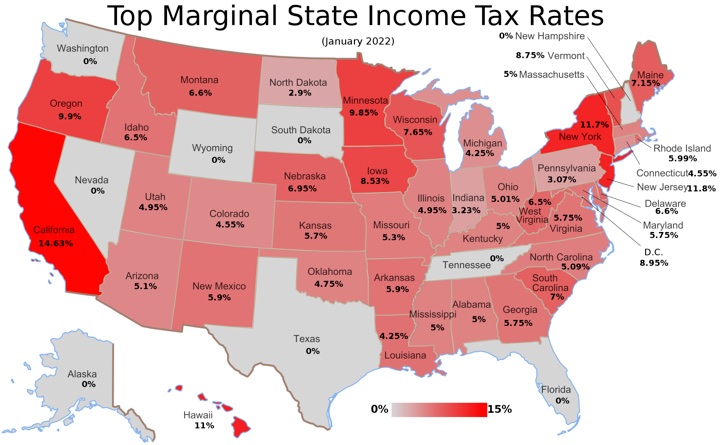
I’ve mentioned this before, but here’s a quick reminder as the tax-equivalent yields are now at 6% APY in most states with income taxes (anything 5% and up, see above graphic). Due especially to high state income taxes, my cash is mostly held in Treasury bills and money market funds that contain 90%+ treasury bills. Both can be owned within most major brokerage accounts that allow the purchase of individual bonds from either auction or secondary markets. (Treasury Direct allows purchase at auction, but I don’t like the user interface or customer service.)

So while I enjoy keeping track of new fintech apps, unless there is a good upfront bonus, it’s hard for me to justify another application at current rates. I skipped Milli when it hit 5.25% APY in August 2023. I skipped Elevault when it hit 5.50% APY in October 2023. I will likely skip Domain Money at 6% APY.

Treasury bond interest is exempt from state incomes taxes, which gives them a comparative boost over interest from banks. If you are subject to state income taxes, use a tax-equivalent yield calculator to compare Treasury bill/bond yields with interest rates from bank accounts and other bonds.

For example, if you are single with $70,000+ taxable income in California, your marginal state income tax rate is at least 9.3%. That means the 5.57% interest from a 4-week Treasury bill is equivalent to a bank account paying 6.42% interest or higher!

Be sure to check and make sure your “Treasury” money market fund is holding 90%+ Treasuries and not repurchase agreements. I’ve noticed that Vanguard Treasury Money Market Fund is now back to 94% Treasuries and only 4% repos, but that could change again in the future, so I’m keeping an eye on it.

Finally, at tax time be sure to look up the appropriate U.S. government obligations income information and use it when filing your state income taxes. You may need to nudge your accountant along with supplying this information.

[Top image credit – Wikipedia]