Search Results for: High Interest Savings

Raisin Marketplace: Up to $400 Deposit Bonus (and Why I’m Skipping It)

Raisin is a financial marketplace that allows you to access high-interest certificates of deposit and savings accounts from multiple different banks and credit unions without having to open up a new account at each one. Right now, they have some new deposit bonuses that are pretty solid based on the bonus-to-deposit ratios and minimum holding periods. However, I will personally not be taking advantage of them due to their use of custodial FBO accounts. I think it’s most useful to both point out the existence of these bonuses and explain my take on them. Details below.

Here are the new bonuses:

  • New customer $250 bonus. Open a new account with promo code GET250, deposit $25,000 within 14 days, and maintain for 90 days for the $250 bonus.
  • Existing customer deposit bonus, up to $400. Must deposit $50,000 in new money. $200 on a 3–6 month CD. $300 on a 7–11 month CD. $400 for a 12+ month CD. Must maintain for full CD maturity period.

How Raisin works. The benefit of Raisin is that you can easily access aggressively high rates at a new bank or credit union without having to open yet another new account (and endure credit checks, identify verification hurdles, join partner organizations, leave funds in share savings accounts, etc). The price is added complexity, higher risk for miscommunication and errors, and a place in a regulatory shadow zone.

Instead of opening a direct account at a new partner bank, there are at least three different parties.

  • Raisin, which is the overall business (“financial technology company”) and not a bank and not a credit union. (Source #1)
  • There are the middlemen, Custodial Bank(s) and Service Bank. The Custodial Bank opens up FBO (For Benefit Of) accounts at each of the Partner Banks/Credit Unions in THEIR names. These FBO accounts are basically big pooled accounts, and the Custodial Bank is supposed to keep track of all the money going in and out for all the individual Raisin customers in their own virtual ledger. The Service Bank is in charge of moving your funds amongst the various banks. Central Bank of Kansas City (CBKC), Member FDIC, is the Service Bank. CBKC, Lewis & Clark Bank and Starion Bank, each Member FDIC, are the Custodial Banks. (Source #2)
  • There are the partner banks. These banks and credit unions are looking to grow deposits, but they have no idea who you are as an individual. They come and go on the Raisin platform. They only see that they opened a single, huge FBO account for the Custodial Bank. (Source #3)

While this setup appears to be perfectly legal (as far I can tell, I am not a lawyer), that doesn’t mean that there is someone to clean up the mess if something goes wrong. It’s like if someone steals your wallet and the cops are too busy with violent crime to track them down, it doesn’t matter if it’s illegal, you’re still not getting your money back.

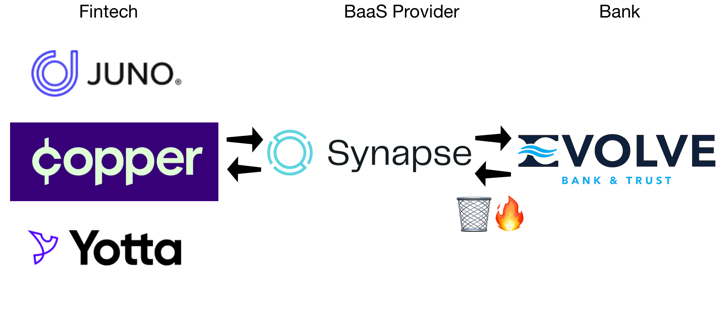
The real-world example is what happened with Juno, Yotta, Synapse, and Evolve Bank & Trust. They had major disagreements about the ledger tracking all the deposits and withdrawals. They all blamed each other for the missing funds (~$50 million). Since no bank actually failed, the FDIC did not step in. No other regulatory agency stepped in. I was surprised. It was all left to a severely-underfunded bankruptcy court, and the mess still isn’t figured out. Someone ran off with tens of millions of dollars, and innocent individuals were left holding the bag.

Source #1:

Raisin is not a bank and your money is always handled by a federally regulated financial institution — whether in transit, stored in the Cash Account, or in an account at a partner bank. The Custodial Bank keeps records of all funds deposited through the Raisin platform for added security.

Source #2

Custodial accounts are accounts held on for the benefit of Raisin customers by a custodial bank at the banks and credit unions where customers deposit their money through Raisin. When a customer makes a deposit through the Raisin platform into a savings product offered by a given financial institution, the funds move from the customer’s external bank account (also referred to as their reference account) to a custodial account held by one of Raisin’s partner custodial banks at the financial institution offering the savings product. Central Bank of Kansas City (CBKC), Lewis & Clark Bank and Starion Bank, each Member FDIC, are the Custodial Banks.

Source #3:

An FDIC-supervised custodial bank opens the “For Benefit Of” account for each customer and agrees directly with Raisin’s customers to act as the custodian of their funds. This custodial bank is authorized by Raisin customers, as their agent, to hold their deposits at federally regulated banks and credit unions on their behalf in a custodial capacity. Customer funds are never co-mingled with Raisin funds.

Again, if everyone does what they say they will, then it’s all good. The problem is what happens when they don’t. If it happens with Raisin (or any of the parties involved, all relatively small institutions), it has the potential to be a complete mess that could take years to untangle. In today’s regulatory environment, I have zero interest in putting my cash into any sort of regulatory grey area.

In contrast, the CIT Bank $225/$300 deposit offer involves a simple, direct relationship with CIT Bank, an FDIC-insured bank, where you have an individual/joint account directly held in your name. There is a single system. There is no potential pointing of figures between multiple parties. There is a long, established history of the FDIC stepping in resolve a bank failure within days. It’s about as safe as it gets.

Bottom line. I’m doing the CIT bank offer, but not the Raisin offer.
Fidelity Money Market Funds: Claim Your State Income Tax Exemption (Updated 2025)

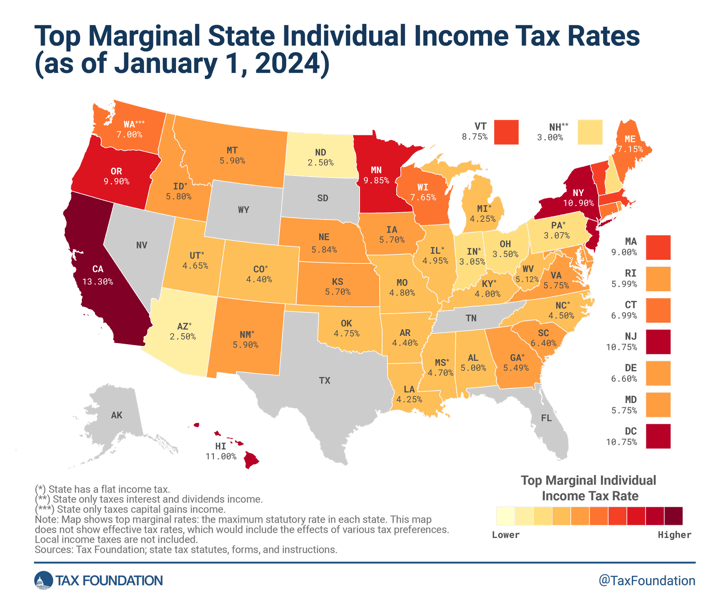
Updated. As the brokerage 1099 forms for the 2024 Tax Year are coming out, here is a quick reminder for those subject to state and/or local income taxes. If you earned interest from a money market fund, a significant portion of this interest may have come from “US Government Obligations” like Treasury bills and bonds, which are generally exempt from state and local income taxes. However, in order to claim this exemption, you’ll likely have to manually enter it on your tax return after digging up a few extra details.

(Note: California, Connecticut, and New York exempt dividend income only when the mutual fund has met certain minimum investments in U.S. government securities. They require that 50% of a mutual fund’s assets at each quarter-end within the tax year consist of U.S. government obligations.)

Fidelity has released US GOI percentages for 2024 on their institutional website, but it’s a little hard to read since it includes a lot of funds and share classes that are used by Fidelity-affiliated financial advisors and institutional portfolios. Their tax document page still says “Expected mid February” – Update 2/22: 2024 Percentage of Income from
U.S. Government Securities now available
. The numbers from both sources are the same, although rounded off differently for some reason.

Here are the results for the most popular core Fidelity money market funds:

  • Fidelity® Treasury Only Money Market Fund (FDLXX, CUSIP 31617H300) – 97.0032%.
  • Fidelity® Government Money Market Fund (SPAXX, CUSIP 31617H102) – 55.0877%.
  • Fidelity® Government Cash Reserves (FDRXX, CUSIP 316067107) – 57.1917%.
  • Fidelity® Treasury Money Market Fund* (FZFXX, CUSIP 316341304) – 50.5640%. *FZFXX did not meet the minimum investment in U.S. Government securities required to exempt the distribution from tax in California, Connecticut, and New York.
  • Fidelity® Government Money Market Fund Premium Class (FZCXX, CUSIP 31617H706) – 55.0877%. This fund has a $100,000 minimum, but also a lower expense ratio than SPAXX, which means it earns about 0.10% more yield annually as of this writing 2/20/25.

To find the portion of Fidelity dividends that may be exempt from your state income tax, multiply the amount of “ordinary dividends” reported in Box 1a of your Form 1099-DIV by the percentage listed in the PDF. For example, if you earned $1,000 in total interest from Fidelity Treasury Only Money Market Fund (FDLXX) in 2024, then $970.03 could possibly be exempt from state and local income taxes. If your marginal state income tax rate was 10% that would be a ~$97 tax savings for every $1,000 in total interest earned.

On a net after-tax basis, folks with a ~10% state income tax rate will likely find that FDLXX earns more interest than the default core holdings of SPAXX/FZFXX, even though the gross yield of SPAXX/FZFXX is higher than that of FDLXX.

To obtain these tax savings, you’ll have to manually adjust your state/local income tax return. I don’t believe that TurboTax, H&R Block, and other tax software will do this automatically for you, as they won’t have the required information on their own. (I’m also not sure if they ask about it in their interview process.) If you use an accountant, you should also double-check to make sure they use this information. Here is some information on how to enter this into TurboTax:

  • When you are entering the 1099-DIV Box 1a, 1b, and 2a – click the “My form has info in other boxes (this is uncommon)” checkbox.
  • Next, click on the option “A portion of these dividends is U.S. Government interest.”
  • On the next screen enter the Government interest amount. This will be subtracted from your state return.

Standard disclosure: Check with your state or local tax office or with your tax advisor to determine whether your state allows you to exclude some or all of the income you earn from mutual funds that invest in U.S. government obligations.

[Image credit – Tax Foundation]

Vanguard Money Market Funds: Claim Your State Income Tax Exemption (Updated 2025)

Updated February 2025. As the brokerage 1099 forms for the 2024 Tax Year are coming out, here is a quick reminder for those subject to state and/or local income taxes. If you earned interest from a money market fund, a significant portion of this interest may have come from US Treasury bills and bonds, which are generally exempt from state and local income taxes. However, in order to claim this exemption, you’ll likely have to manually enter it on your tax return after digging up a few extra details.

(Note: California, Connecticut, and New York exempt dividend income only when the mutual fund has met certain minimum investments in U.S. government securities. They require that 50% of a mutual fund’s assets at each quarter-end within the tax year consist of U.S. government obligations.)

Let’s take the default cash sweep option for Vanguard brokerage accounts, the Vanguard Federal Money Market Fund (VMFXX), which has an SEC yield of 4.29% as of 1/31/25. Vanguard has recently released the U.S. government obligations income information for Tax Year 2024 [pdf] for all their funds, which states:

This tax update provides information to help clients properly report state and local tax liability on ordinary income distributions received from mutual fund investments in 2024.

On the next page, you’ll find a list of Vanguard funds that earned a portion of their ordinary dividends from obligations of the U.S. government. Direct U.S. government obligations and certain U.S. government agency obligations are generally exempt from taxation in most states.1

To find the portion of Vanguard dividends that may be exempt from your state income tax, multiply the amount of “ordinary dividends” reported in Box 1a of your Form 1099-DIV by the percentage listed in the PDF. Note that on the IRS Form 1099-INT, there is a special Line 3 that includes “Interest on US Savings Bonds & Treasury obligations”. However, for the Vanguard funds, they report on 1099-DIV and not 1099-INT. My Vanguard 1099-INT was all zeros.

For the Vanguard Federal Money Market Fund (VMFXX), this percentage was 59.87% in 2024. (For reference, it was 49.37% in 2023.) Therefore, if you earned $1,000 in total interest from VMFXX in 2024, then $598.70 could possibly be exempt from state and local income taxes. If your marginal state income tax rate was 10% that would be a ~$60 tax savings for every $1,000 in total interest earned. For 2024, this fund met the threshold requirements for California, Connecticut, and New York, which require that 50% of the fund’s assets at each quarter-end within the tax year consist of U.S. government obligations.

In comparison, the Vanguard Treasury Money Market Fund (VUSXX) had a GOI percentage of 100% in 2024. (For reference, it was 80.06% in 2023.) If your marginal state income tax rate was 10% that would be a $100 tax savings for every $1,000 in total interest earned. With a very similar SEC yield of 4.27% as of 1/31/25, this is why many people chose to manually buy VUSXX instead of the default settlement fund as it can earn you a higher after-tax interest rate.

The following Vanguard funds and ETF equivalents have 100% of their interest from US government obligations:

  • Short-Term Treasury Index Fund (VGSH, VSBSX)
  • Intermediate-Term Treasury Index Fund (VGIT, VSIGX)
  • Long-Term Treasury Index Fund (VGLT, VLGSX)
  • Extended Duration Treasury Index Fund (EDV)
  • Short-Term Inflation-Protected Securities
    Index Fund (VTIP, VTAPX)
  • Inflation-Protected Securities Fund (VIPSX, VAIPX)

Note that several other Vanguard funds have a lower but nonzero percentage of dividends from US government obligations, including the popular Vanguard Target Retirement Income funds. It may be worth a closer look for residents of certain states, especially those with larger balances and closer to retirement (holds more bonds).

To obtain these tax savings, you’ll have to manually adjust your state/local income tax return. I don’t believe that TurboTax, H&R Block, and other tax software will do this automatically for you, as they won’t have the required information on their own. (I’m also not sure if they ask about it in their interview process.) If you use an accountant, you should also double-check to make sure they use this information. Here is some information on how to enter this into TurboTax:

  • When you are entering the 1099-DIV Box 1a, 1b, and 2a – click the “My form has info in other boxes (this is uncommon)” checkbox.
  • Next, click on the option “A portion of these dividends is U.S. Government interest.”
  • On the next screen enter the Government interest amount. This will be subtracted from your state return.

Here are some links to find the percentage of ordinary dividends that come from obligations of the U.S. government. You should be able to find this data for any mutual fund or ETF by searching for something like “[fund company] us government obligations 2024”]. If you do not see the fund listed within the fund company, it may be assumed to be 0%. The data is sometimes not released until mid-February.

Standard disclosure: Check with your state or local tax office or with your tax advisor to determine whether your state allows you to exclude some or all of the income you earn from mutual funds that invest in U.S. government obligations.

[Image credit – Tax Foundation]

M1 Review: DIY Robo-Advisor, $75 Bonus via Referral

I’ve tried out my share of robo-advisors, which always sounded nice in theory but I eventually became disillusioned as they kept generating lot of unnecessary capital gains every time they change their model portfolios to chase the latest and hottest trends. My favorite service for those that want a little extra help is one where I can pick my own custom target portfolio, but the robo still does the hard work: M1 Finance. Here’s a quick rundown of what makes them different:

  • Fully customizable. You pick your own target asset allocation “pie”. (You can add ETFs or individual stocks.) You can simply copy one of the many model portfolios out there, or make your own custom pie as you like. You have full control! M1 handles the tedious stuff, like rebalancing or dividing a $100 contribution across 8 different ETFs.
  • No commissions. Free stock/ETF trades with a low $100 initial minimum for taxable accounts and a $500 minimum opening amount for retirement accounts. After your initial deposit any amount greater than $10 can be deposited.
  • Free with $10,000 balance. Otherwise $3/month. Most robo-advisors charge an annual management fee of 0.25% to 0.50% of assets, or force you to own something bad, like a lot of low-interest cash. (Looking at you, Schwab…)
  • Free dynamic rebalancing. All new deposits (and withdrawals) will be invested (or sold) dynamically to bring your portfolio back toward your target asset allocation. M1 will also rebalance your entire portfolio back to the target allocation for you with a few clicks (for free) whenever you choose, on demand. You don’t need to do any math or maintain any spreadsheets.
  • Fractional shares (dollar-based). For example, you can just set it to automatically invest $100 a month, and your full amount will be spread across multiple ETFs. Dollar-based transactions were one of the advantages of buying a mutual fund, but fractional shares solve this problem. ETFs are also usually more tax-efficient than mutual funds.
  • Real brokerage account with off-the-shelf investments that you can move out. Some robo-advisors hold special, proprietary funds that you have to sell if you ever leave, possibly creating a big tax bill. (Looking at you, Fidelity…) M1 is built on a regular brokerage account, so you can move your Vanguard/iShares/Schwab ETFs and stock shares out to another broker whenever you want.

Now, for a long time, Vanguard didn’t offer automatic fractional investments into ETFs. But as of October 2024, Vanguard now offers fractional ETF investments.

Still, M1 Finance checks off many of the boxes of my brokerage wish list. The only thing they could add would be to have the high availability of knowledgeable customer service of a huge company like Fidelity or Schwab.

If you want to invest in newer factor ETFs that focus on Small-Cap, Value, Momentum, or Quality factors like those from DFA and Avantis, or a mix of dividend-oriented ETFs like SCHD/VIG/VYM, their service makes it much easier to set up a portfolio mix of different ETFs.

M1 Plus features are now available to everyone. M1 Plus was their premium subscription tier with several additional perks. As of May 2024, everyone gets these features, but they are only free with a $10,000 balance and $3/month otherwise.

  • High-yield savings (currently 4.00% APY as of 7/1/25). FDIC-insured up to $5 million.
  • Competitive margin rates.
  • Custodial accounts for kids.
  • Extra 3pm PM ET trade window.
  • Automated “smart” transfers.

$75 referral bonus. M1 has a $75 referral bonus if you open a new account with $10,000 and maintain it for 30 days. Here is my M1 referral link (thanks if you use it!) from which you must start opening your new account.

A bonus that amounts to 0.75% of your initial deposit with only a 30 day hold is technically a 9% annualized yield.

ACAT Transfer bonus. This is not currently available.

Bottom line. M1 Finance is a brokerage account that acts like a customizable robo-advisor with automatic rebalancing into a target portfolio. You control the model portfolio, and they do the tedious work. Great for implementation of a low-cost, index or passive ETF portfolio. New pricing structure as of May 2024: Free for those with $10,000 in assets, otherwise $3 a month.

MMB Portfolio Asset Allocation & Performance – 2024 Year-End Update

Here’s my Year End 2024 update for our primary investment holdings, including all of our combined 401k/403b/IRAs and taxable brokerage accounts but excluding our house and side portfolio of self-directed investments. Following the concept of skin in the game, the following is not a recommendation, but a sharing of our real-world, imperfect, low-cost, diversified DIY portfolio.

“Never ask anyone for their opinion, forecast, or recommendation. Just ask them what they have in their portfolio.” – Nassim Taleb

How I Track My Portfolio
Here’s how I track my portfolio across multiple brokers and account types. There are limited free advanced options after Morningstar discontinued free access to their portfolio tracker. I use both Empower Personal Dashboard (previously known as Personal Capital) and a custom Google Spreadsheet to track my investment holdings:

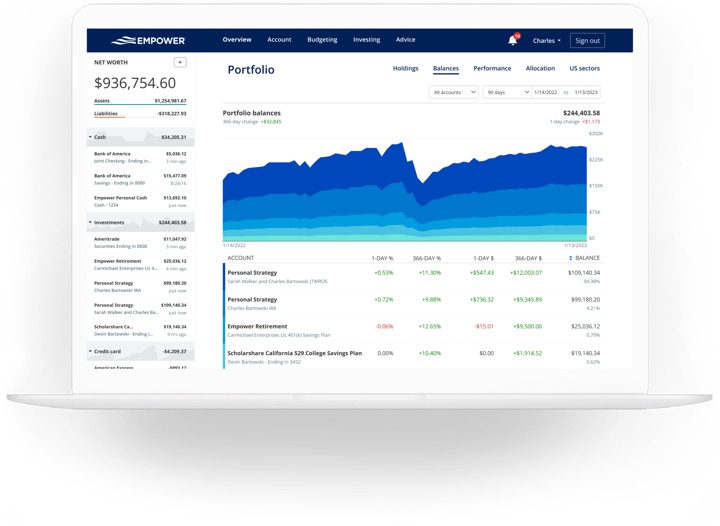
  • The Empower Personal Dashboard real-time portfolio tracking tools (free) automatically logs into my different accounts, adds up my various balances, tracks my performance, and calculates my overall asset allocation daily. Formerly known as Personal Capital.
  • Once a quarter, I also update my manual Google Spreadsheet (free to copy, instructions) because it helps me calculate how much I need in each asset class to rebalance back towards my target asset allocation. I also create a new tab each quarter, so I have a personal archive of my holdings dating back many years.

2024 Year End Asset Allocation and YTD Performance
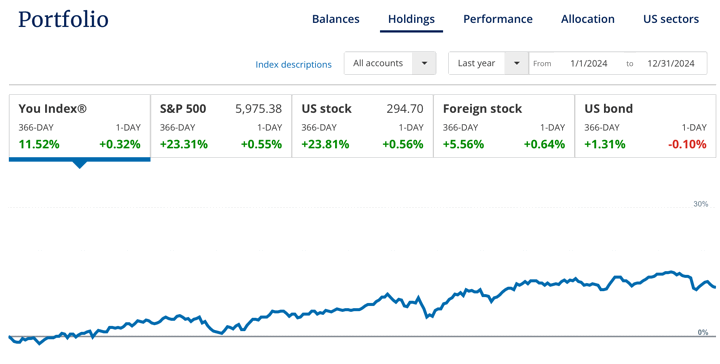
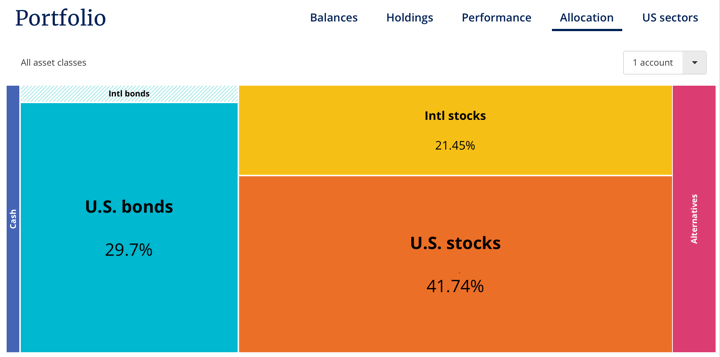
Here are updated performance and asset allocation charts, per the “Holdings” and “Allocation” tabs of my Empower Personal Dashboard.

I own broad, low-cost exposure to productive assets that will provide long-term returns above inflation, distribute income via dividends and interest, and offer some historical tendencies to balance each other out. I have faith in the long-term benefit of owning all of the best businesses worldwide, as well as the stability of high-quality US Treasury debt.

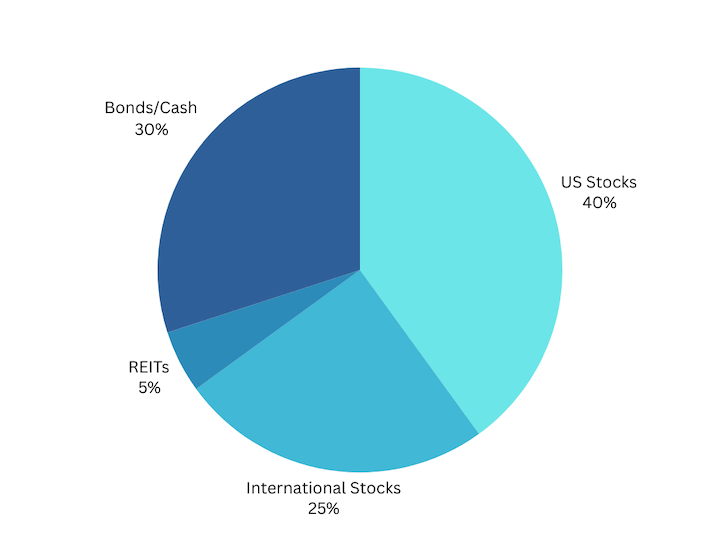
I let my stock holdings float relatively close to the total world market cap breakdown, and it is now at ~65% US and ~35% ex-US. I do add just a little “spice” to the broad funds with the inclusion of “small value” factor ETFs for US and Developed International stocks as well as diversified real estate exposure through US REITs. But if you step back and look at the big picture, this is my simplified target portfolio:

By paying minimal costs including management fees, transaction spreads, and tax drag, I am trying to essentially guarantee myself above-average net performance over time.

The portfolio that you can hold onto through the tough times is the best one for you. Every asset class will eventually have a low period, and you must have strong faith during these periods to earn those historically high returns. You have to keep owning and buying more stocks through the stock market crashes. You have to maintain and even buy more rental properties during a housing crunch, etc. A good sign is that if prices drop, you’ll want to buy more of that asset instead of less. I don’t have strong faith in the long-term results of commodities, gold, or bitcoin – so I don’t own them.

I do not spend a lot of time backtesting various model portfolios, as I don’t think picking through the details of the recent past will necessarily create superior future returns. You’ll usually find that whatever model portfolio is popular at the moment just happens to hold the asset class that has been the hottest recently as well.

I have settled into a long-term target ratio of roughly 70% stocks and 30% bonds within our investment strategy of buy, hold, and occasionally rebalance. My goal has evolved to more of a “perpetual income portfolio” as opposed to a “build up a big stash and hope it lasts until I die” portfolio. My target withdrawal rate is 3% or less. Here is a round-number breakdown of my target asset allocation along with my primary ETF holding for each asset class.

  • 35% US Total Market (VTI)
  • 5% US Small-Cap Value (VBR/AVUV)
  • 20% International Total Market (VXUS)
  • 5% International Small-Cap Value (AVDV)
  • 5% US Real Estate (REIT) (VNQ)
  • 15% US “Regular” Treasury Bonds or FDIC-insured deposits
  • 15% US Treasury Inflation-Protected Bonds or I Savings Bonds

I do let things wobble a bit so I don’t have to keep rebalancing. Also, I have limited tax-deferred space for TIPS so I own less than I might otherwise. So the bonds is closer to 20% Treasuries and 10% TIPS.

Performance details. According to Empower, my portfolio went up around 11.5% in 2024. The S&P 500 went up 23.3% in 2024, while the US Bond index went up around 1.3%. Another year of relative underperformance in international stocks in the books.

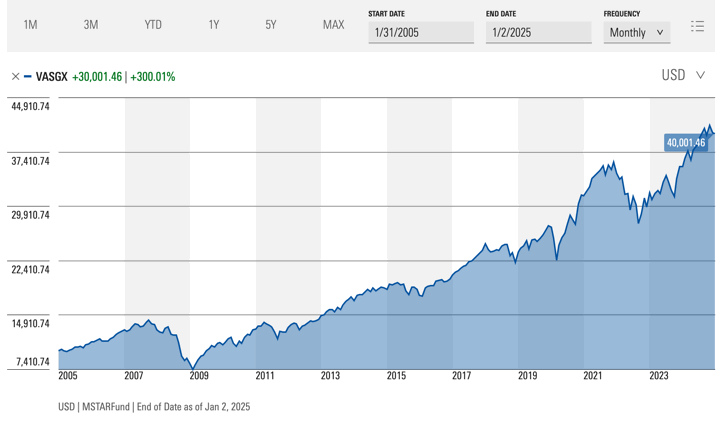
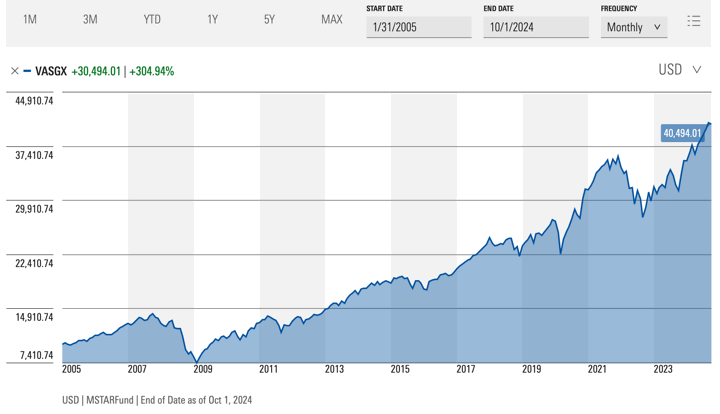
Overall, we spent some of our dividends/interest and also made some 401k/IRA contributions with income to take advantage of tax-deferred opportunities. We no longer have the crazy savings rate of our 20s and 30s. Owning stocks continues to reward long-term investors. Out of curiosity, I generated a Morningstar Growth of $10,000 Chart for the Vanguard LifeStrategy Growth Fund (VASGX) which holds a static 80% stocks and 20% bonds and most closely mimics my portfolio since 2005, roughly when I started investing more seriously and started this blog. A very rough approximation is to expect your money to double every decade (Rule of 72). The money that I invested 20 years ago has indeed roughly doubled twice (4X).

I’ll share about more about the income aspect in a separate post.

TreasuryDirect Customer Service Delays and Estate Planning Concerns

TreasuryDirect.gov is the official site for individuals to directly purchase US savings bonds and US Treasury bonds, including new T-Bills and TIPS at auction. But is it still worth the hassle? Back in August 2024, TreasuryDirect sent me the following e-mail when converting my paper bonds to electronic:

Cases are worked in the order they are received in our office. Your request is important to us and will receive attention as soon as possible. Please be aware of our estimated processing times to process your case which are based on the case type (bolding is mine):

Cases requesting to cash Series EE and/or Series I paper savings bonds held in your name, at least 4 weeks.
Cases requesting to cash Series HH savings bonds held in your name, at least 3 months.
Unlocking your TreasuryDirect account, updating bank information in that account, or converting your paper savings bonds into electronic bonds in TreasuryDirect, at least 4 weeks.
Claims for missing, lost, or stolen bonds, at least 6 months.
All other cases, at least 20 weeks.

If we require additional information to process your case, we will contact you. Thank you for your patience.

That’s at least a month for some pretty basic stuff like unlocking your account because you forgot what you said was your favorite movie. In October 2024, the WSJ published TreasuryDirect to Bond Buyers: Moving Your Money Could Take a Year regarding long delays transferring Treasury bonds to outside brokerages.

The resulting customer service backlog is straining the Treasury Department’s antiquated system, which can require verified signatures and paper forms sent through the mail. People transferring securities from TreasuryDirect to third-party brokerages face especially long waits because those requests are processed manually, according to people familiar with the matter.

TreasuryDirect tries to complete most of them within six weeks, but can take 12 months, depending on capacity. A notice on the TreasuryDirect website says some customer service requests “may require 12 months or more to process.” The notice had said the longest delays were about six months until the end of July.

Finally, there are multiple posts on the Bogleheads, Early Retirement, and Reddit forums about the difficulties of dealing with TreasuryDirect after the account owner passes away. Here’s one example from a user that was already familiar with the website, knew all the account information, and had the beneficiaries assigned correctly, but still encountered multiple forms, conflicting instructions, and months of delays – Treasury Direct – The Eternal Wait and No Way To Track Transfer:

I’m closing in on 3 months waiting for Treasury Direct to transfer several EE bonds and an I bond that were in my dad’s online Treasury Direct account to my online Treasury Direct account. My dad passed away at the end of December 2022 and I was registered as the beneficiary with POD on all of the bonds.

And the follow-up (emphasis mine):

My dad’s I bonds were transferred to me around the 4-5 month mark.

After that experience, I decided to liquidate all of my TD accounts, and will encourage my husband to do the same. I personally don’t want a repeat of this experience, or make my heirs go through such a lengthy process in resolving my estate.

What I learned from this experience is to not discount how much stress and mental bandwidth it takes to deal with TD when you’re also grieving the loss of a family member, and trying to settle the estate so you can move on financially.

Another similar estate horror story here.

Takeaway #1: Expect and prepare for slow service. It’s very clear that TreasuryDirect is an underfunded government program with very limited resources. Even most mega banks no longer cash in old paper savings bonds, so that has increased their workload as well. Any time there is a surge in demand, either due to relatively attractive rates on savings bonds or Treasury bills, they are going to get backed up. If you happen to lock yourself out of your account during one of these times, it may take months to fix it! Be very careful before you close that old bank account linked through TreasuryDirect. Use a reliable password manager, and be sure to add your answers to questions like “Who is your favorite child?”. Be sure to note your account information in multiple documents, in case someone needs to find it.

Takeaway #2: Never use TreasuryDirect for anything besides US savings bonds. TreasuryDirect.gov is the only place where you can purchase US savings bonds, but it is not the only place you can buy individual Treasury bonds and TIPS. Just open an account with a broker with better resources and a bond desk like Fidelity, Schwab, or Vanguard and go through them.

Takeaway #3: Consider your heirs and simplifying your accounts as you age. In my opinion, I would also avoid TreasuryDirect if you are older and you don’t want to burden your estate executors with dealing with TreasuryDirect. You can save them several months and many hours of calls and paperwork by liquidating your assets and consolidating them elsewhere. TreasuryDirect will likely take the longest to resolve out of all of your financial accounts.

Personally, I continue to gradually liquidate the savings bonds in my TreasuryDirect account and buying individual TIPS in an outside brokerage account instead. I will have to pay some taxes on the deferred interest, but since I am getting a 1% to 2% higher fixed rate via TIPS in many cases, it’s not that bad. I also worry that my survivors might completely overlook this account if something unexpected happens (there are no mailed paper statements, or even monthly e-mails of online statements.) I’d like to minimize any unnecessary headaches and consider this part of my overall portfolio simplification process.

If I was younger and still grinding for every small edge, I would probably still accept these shortcomings for the right interest rate and tax deferral properties, but nowadays the calculations are different.

Image source: Sitejabber

Fidelity Rewards Visa Credit Card Review: 2% Flat Cash Back, No Annual Fee ($150 Sign-Up Bonus, $100 TSA PreCheck Credit)

(Update November 2024: This card has added a Global Entry/TSA PreCheck credit worth up to $100 every four years. Might be handy for existing cardholders that have this as an idle card. Currently a $150 sign-up bonus for new customers as well. Updated full review below.)

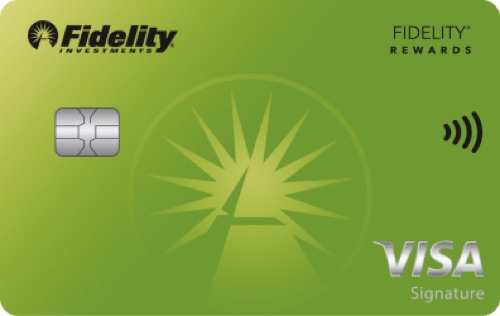
Back in 2019, Fidelity condensed their rewards credit card line-up to a single card, the Fidelity® Rewards Visa Signature Card issued by Elan Financial Services (subsidiary of US Bank). There is currently a $150 bonus if you spend $1,000 in the first 90 days. It earns a flat 2% cash back when directed to an eligible Fidelity Investments account. Here are the highlights:

  • Unlimited 2% cash back, when redeemed into an eligible Fidelity account. You could pick a brokerage account, IRA, or 529 plan.
  • No annual fee.
  • No foreign transaction fees.
  • NEW: $100 credit towards Global Entry/TSA PreCheck application fees. Valid once every four years.
  • BACK: Secondary Auto Rental Collision Damage Waiver. As with many other cards, this is secondary to your personal auto insurance, but will help cover the deductible if applicable.

Details on the sign-up bonus:

Receive 15,000 Bonus Points – which equals $150 cash back, when deposited into an eligible Fidelity account – after you make at least $1,000 in eligible net purchases withing the first 90 days of account opening.2 Existing or previous Fidelity Visa Signature cardmembers are not eligible for this offer if you have received a new account bonus for this product in the last five years.

Details on the Global Entry/TSA PreCheck benefit:

Receive up to 10,000 Reward Points every four years when you apply for either Global Entry® or TSA PreCheck®. That’s worth up to $100 when deposited into an eligible Fidelity® account,¹ once every four years. Be sure to pay the application fee using your card to be eligible.

Eligible Fidelity accounts. The 2% rewards value applies only to points redeemed for a deposit into the following active Fidelity accounts:

  • Fidelity Cash Management Account
  • Fidelity Brokerage account
  • Fidelity-managed 529 account
  • Fidelity Retirement account (IRA, Roth IRA, SEP-IRA, Rollover IRA)
  • Fidelity Go account (robo-advisor)
  • Fidelity Charitable Giving Account (donor-advised fund)
  • Fidelity HSA

My favorite option is actually the 529 plan option if you have kids, because it is the perfect way to quietly grow a little college stash and not just spend your rewards away on a dinner or gadget. Contributions get to grow tax-free with minimal paperwork towards your future college expenses. The IRA option is okay, but you have to be careful to not exceed the annual contribution limits and track your rewards against your other contributions.

I also like that there is an auto-redemption option. You can enable a feature to automatically cash in your points each time it reaches $25 worth and auto-deposit into your 529 plan (or brokerage account, etc). Since the 529 plan will also auto-invest your contribution, it’s all on auto-pilot. No redemptions, no investment decisions, no wasted frequent flier miles, etc.

(Side tip: Grandparents can also set it up to direct their own credit card rewards to automatically redeem into your child’s 529 plan account as well…)

Let’s say you spend $2,000 a month on this card. 2% cash back means earning $40 a month in cash back. Let’s also say you put this into a 529 that earns 6% a year. If you started when your kid was born and waited 20 years until their senior year of college, that would amount to $18,574! I plugged it into this savings calculator.

Concerns? The only main drawback with this card is that it is actually run by Elan Financial, and whenever Fidelity partners with these third-parties, it’s not a perfect match. Elan doesn’t have the same level of customer service as Fidelity, or American Express for that matter. They will give you a harder time with merchant disputes and fraud refunds, for example. I’ve always gotten them worked out in the end, but it took more effort in my experience. I personally wouldn’t want to deal with them on any type of insurance claim.

Bottom line. I think everyone who can handle a cash back credit card (i.e. you carry no high interest credit debt) should have a 2% flat cash back card that applies to all purchases. The Fidelity® Rewards Visa Signature Card can make sense for Fidelity customers because you can set aside your rewards automatically and save money towards a Fidelity 529 college savings or retirement account. I would try to apply when there is a sign-up bonus.

Kudos App: $20 Referral Bonus, 20% Cash Back at PetSmart, 15% Back at VRBO, TripAdvisor, Booking.com

Updated with new 5X promo through October 31st. Kudos is a new mobile app and browser extension that aims to enhance your existing credit card rewards when shopping. It does this by tracking all your rewards credit cards and recommending the best one to use, recommending new credit cards (that’s how they make money), and doubling your credit card rewards when shopping through an affiliated Boost merchant (they are also a shopping portal). New members can get a $20 referral bonus, worth $20 in Amazon gift cards, after their first purchase on a Boost merchant site.

In my opinion, Kudos is not super-interesting unless they have a 5X “Flash Boost Sale”. The best scenario is when it combines with a 5X category from a rewards credit card. Right now they one running until October 31st, 2024. Official 5X October Promo details here.

If you just have a 2% flat cash back card, you can get a total of 10% back on any of the listed merchants (8% from Kudos, 2% from your card). But if you have a 5% cash back category, this turns to 25% total cash back (20% from Kudos, 5% from your card.)

Pet stores are a 5% category for the Chase Freedom/Freedom Flex card for 4th Quarter 2024, which means you can get up to 25% total back at PetSmart. In addition, you can stack this with 40% off your first Auto-Ship order (like Subscribe and Save with Amazon). We just got a new puppy and dogs are expensive, so I’ll take all the help I can get.

Another idea for this promo are to use any 3% back on Travel cards from Chase, BofA, Citi, etc. and get an additional 15% back on VRBO, TripAdvisor, or Booking.com. Those percentages are also better than standard cashback portals.

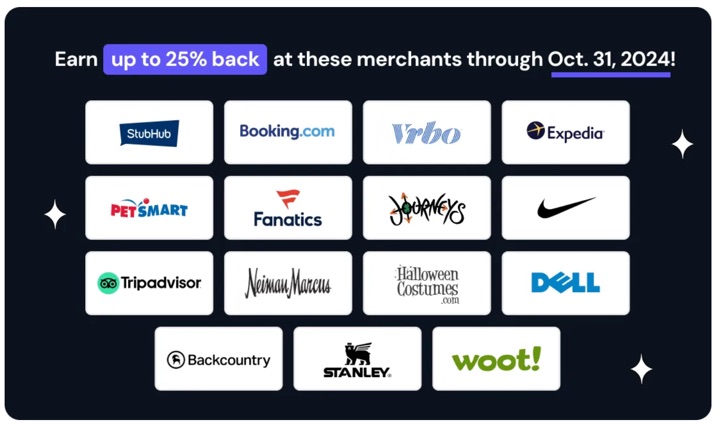
Get ready for a haunting good time with our biggest October Flash Boost sale yet! From October 1 through October 31, 2024, we’re conjuring up some frighteningly fantastic deals. We’re not just offering spine-tingling discounts – we’re multiplying your rewards by 5X at participating merchants. That means you could earn up to 25% in rewards, depending on your card! Here are the top retailers that we’re highlighting with this Flash Boost sale:

Stubhub
Booking.com
Vrbo
Expedia
Petsmart
Fanatics
Journeys
Nike
Tripadvisor
Neiman Marcus
Halloween Costumes
Dell
Backcountry
Stanley
Woot

Step-by-Step Walkthrough

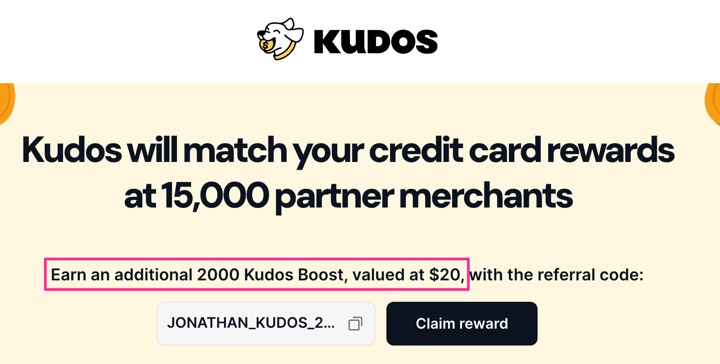
  • Visit my Kudos referral link (I used Chrome Browser) and install their extension. Make sure the promo code JONATHAN_KUDOS_209109 is filled in when applicable to get the 2000 point ($20) referral bonus.
  • Add at least one rewards credit card and number. I recommend linking any Discover it card since it has 5% cash back cards that you hold.
  • After these various things as a new customer, it should be pretty simple to accumulate around 500 Kudos points (worth $5). However, to unlock the $20 referral bonus for myself, I need to make a purchase from a Boost merchant. For this promo, PetSmart would work great.
  • Make sure to turn off any potentially conflicting extensions, like the Capital One 360 Shopping plugin.
  • Chrome extension installed. Check. Card number saved. Check. Visited Boost Merchant from the Kudos site. Check.
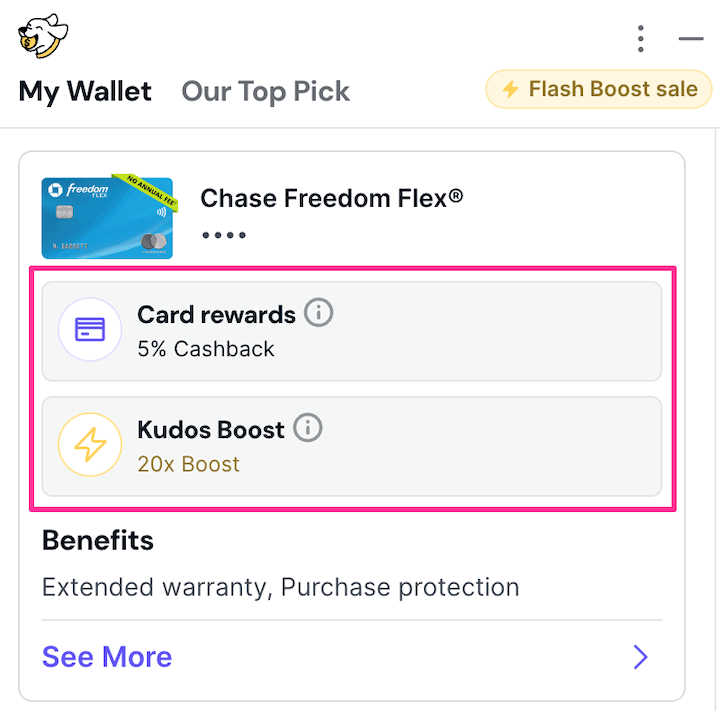
  • During the Purchase process, look to the bottom right corner and click on the yellow dog. You should be presented with and click on the “Activate Boost” button. It should say “Boost Activated”.
  • During the Checkout process, I let Kudos fill in the card information.
  • When finished, the extension should confirm your rewards exactly.

Here’s what you should see:

When Kudos says you’ll get “double your rewards”, that means your existing credit card rewards is 1X, and then will also match 1X. When Kudos says you’ll get 5X rewards, that means your existing credit card is 1X and they’ll add 4X. Like other shopping portals, the points will be pending for 60-120 days because it takes a while for them to get paid from the merchant internally, and also to make sure that you don’t return the item.

MMB Portfolio Asset Allocation & Performance Update – October 2024 (Q3)

Here’s my 2024 Q3 update for our primary investment holdings, including all of our combined 401k/403b/IRAs and taxable brokerage accounts but excluding our house and smaller side portfolio of self-directed investments. Following the concept of skin in the game, the following is not a recommendation, but a sharing of our real-world, imperfect, low-cost, diversified DIY portfolio.

“Never ask anyone for their opinion, forecast, or recommendation. Just ask them what they have in their portfolio.” – Nassim Taleb

How I Track My Portfolio
Here’s how I track my portfolio across multiple brokers and account types. There are limited free advanced options after Morningstar discontinued free access to their portfolio tracker. I use both Empower Personal Dashboard (previously known as Personal Capital) and a custom Google Spreadsheet to track my investment holdings:

  • The Empower Personal Dashboard real-time portfolio tracking tools (free) automatically logs into my different accounts, adds up my various balances, tracks my performance, and calculates my overall asset allocation daily. Formerly known as Personal Capital.
  • Once a quarter, I also update my manual Google Spreadsheet (free to copy, instructions) because it helps me calculate how much I need in each asset class to rebalance back towards my target asset allocation. I also create a new tab each quarter, so I have a personal archive of my holdings dating back many years.

2024 Q3 Asset Allocation and YTD Performance
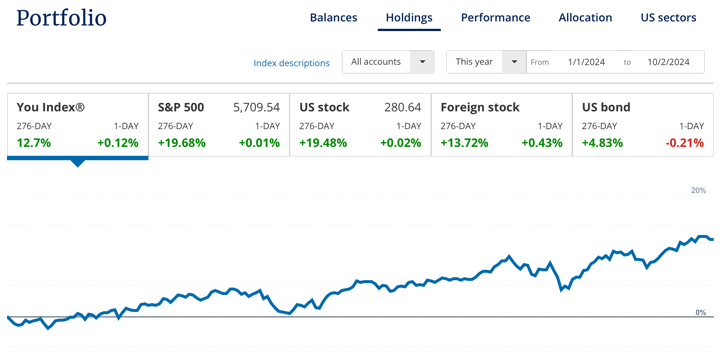
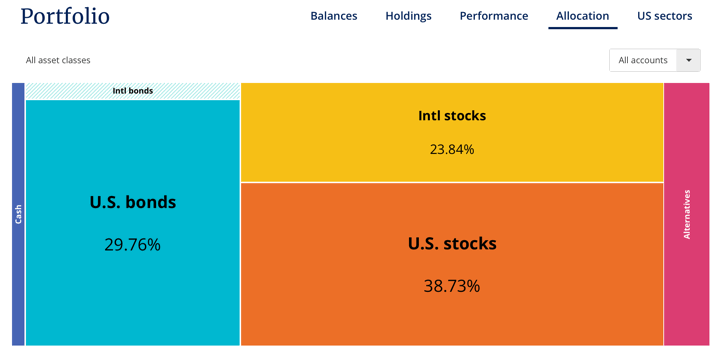
Here are updated performance and asset allocation charts, per the “Holdings” and “Allocation” tabs of my Empower Personal Dashboard.

I own broad, low-cost exposure to productive assets that will provide long-term returns above inflation, distribute income via dividends and interest, and finally offer some historical tendencies to balance each other out. I have faith in the long-term benefit of owning businesses worldwide, as well as the stability of high-quality US Treasury debt. I let my stock holdings float with the total world market cap breakdown, currently at ~62% US and ~38% ex-US. I do add just a little “spice” to the broad funds with the inclusion of “small value” factor ETFs for US, Developed International, and Emerging Markets stocks as well as diversified real estate exposure through US REITs. But if you step back and look at the big picture, this is my simplified target portfolio:

By paying minimal costs including management fees, transaction spreads, and tax drag, I am trying to essentially guarantee myself above-average net performance over time.

The portfolio that you can hold onto through the tough times is the best one for you. Every asset class will eventually have a low period, and you must have strong faith during these periods to earn those historically high returns. You have to keep owning and buying more stocks through the stock market crashes. You have to maintain and even buy more rental properties during a housing crunch, etc. A good sign is that if prices drop, you’ll want to buy more of that asset instead of less. I don’t have strong faith in the long-term results of commodities, gold, or bitcoin – so I don’t own them.

I do not spend a lot of time backtesting various model portfolios, as I don’t think picking through the details of the recent past will necessarily create superior future returns. You’ll usually find that whatever model portfolio is popular at the moment just happens to hold the asset class that has been the hottest recently as well.

I have settled into a long-term target ratio of roughly 70% stocks and 30% bonds within our investment strategy of buy, hold, and occasionally rebalance. My goal has evolved to more of a “perpetual income portfolio” as opposed to a “build up a big stash and hope it lasts until I die” portfolio. My target withdrawal rate is 3% or less. Here is a round-number breakdown of my target asset allocation along with my primary ETF holding for each asset class.

  • 35% US Total Market (VTI)
  • 5% US Small-Cap Value (VBR/AVUV)
  • 20% International Total Market (VXUS)
  • 5% International Small-Cap Value (AVDV)
  • 5% US Real Estate (REIT) (VNQ)
  • 15% US “Regular” Treasury Bonds or FDIC-insured deposits
  • 15% US Treasury Inflation-Protected Bonds (or I Savings Bonds)

Performance details. According to Empower, my portfolio is up about 12.7% so far in 2024. The S&P 500 is up about 19.5% YTD, while the US Bond index is up around 4.8%. I hold bonds and international stocks so that I’m always going to be lagging the hottest sector, but I really can’t complain. International stocks actually had a really good Q3, even though nobody seemed to notice.

I didn’t make any significant buys, just some 401k contributions and reinvested dividends/interest. Peeled off some to pay quarterly taxes. No sell transactions. Owning stocks continues to reward long-term investors. Out of curiosity, I generated a Morningstar Growth of $10,000 Chart for the Vanguard LifeStrategy Growth Fund (VASGX) which holds a static 80% stocks and 20% bonds and most closed mimics my portfolio since 2005, roughly when I started investing more seriously and started this blog. A *very* rough approximation is to expect your money to double every decade (Rule of 72). The money that I invested 20 years ago has indeed roughly doubled twice (4X).

I’ll share about more about the income aspect in a separate post.

Charles Schwab Brokerage: Up to $6,000 New Deposit / Transfer Bonus (New & Existing Customers)

Update: Schwab has suspended/ended this “Up to $6,000” transfer promotion as of October 2024. The referral offer appears to still be available, which is up to $1,000.

Brokerage firms constantly compete for “assets under management”, and many are willing to give you cash to move over your existing portfolio from your existing broker over to them. Unfortunately, many of these offers are for new app startups with questionable customer service. How about a traditional firm with telephones connected to knowledgable humans working inside physical branches in major metro areas?

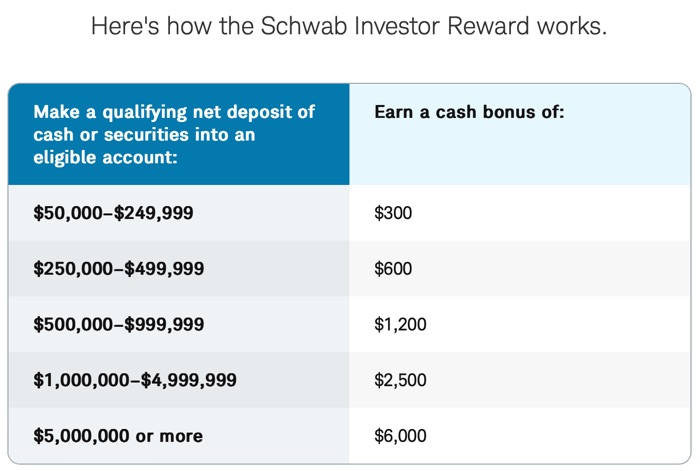
Charles Schwab is currently offering up to a $6,000 cash bonus depending the value of assets that you move over (qualifying net deposit of cash or securities) within 45 days of enrollment. The minimum hold period is one year for taxable brokerage accounts. The percentages aren’t the best, and the tiers are relatively high, but this is actually a brokerage I wouldn’t mind leaving my assets at for the long run. It’s also available to existing Schwab customers.

  • $200 with $50,000–$99,999 in new assets
  • $300 with $100,000–$249,999 in new assets
  • $600 with $250,000–$499,999 in new assets
  • $1,200 with $500,000–$999,999 in new assets
  • $2,500 with $1,000,000-$4,999,999 in new assets
  • $6,000 with $5,000,000+ in new assets

Note: New-to-Schwab clients should compare this with the Schwab Referral Offer, which may offer a slightly higher bonus at specific asset levels (ex. $100 bonus on $25k in new assets, $300 bonus on $50k in new assets, $500 bonus on $100k in new assets). At the higher tiers, the offer above is better. That’s my referral link, thanks if you use it (although please let me know if you have issues with it; I’ve never actually gotten a bonus from Schwab so I’m not sure if it really works).

The easiest option is often to perform an in-kind ACAT transfer of existing securities, which takes less than a week and all of your tax basis information should also move over after another few days. Your old broker may charge you an outgoing ACAT fee about about $75, although you should ask Schwab if they will reimburse you for
this fee.

Both taxable and IRA accounts are eligible. From the fine print and FAQ:

Accounts that are eligible for the Schwab Investor Reward include: Schwab retail brokerage accounts and individual retirement accounts (IRAs), including accounts enrolled in Schwab-sponsored investment advisory programs such as Schwab Intelligent Portfolios®, Schwab Managed Portfolios™, Schwab Managed Account Select®, Schwab Managed Account Connection®, and Schwab Wealth Advisory™.

Schwab Bank Investor Checking™ accounts do not qualify for this promotion whether they are linked to a brokerage or are stand-alone. If you make a deposit in a Schwab Bank Investor Checking™ account, you will not receive the award. The offer also does not apply to the Schwab Global Account™, ERISA-covered retirement plans, certain tax-qualified retirement plans and accounts, education savings accounts, Schwab Bank accounts, or accounts managed by independent investment advisors.

Can two clients in the same home get the award?

Yes. As long as both clients have individual accounts and separately qualify for the Reward, provided that each makes a qualifying net deposit.

Schwab appears to still be offering their $101 Starter Kit promo. But the FAQ says “Can this offer be combined with other offers? No. This offer can’t be combined with other offers.” I’m not sure if it counts as combining if you first open the new account for the Starter Kit bonus, wait, and then participate in this transfer offer.

One major drawback with Schwab is that the default cash sweep is not good. Still just 0.48% APY as of 7/16/24! Boo. You need to take proactive steps to avoid lost interest if you plan to keep significant amounts of cash in their default sweep account. Consider buying Treasury bills, brokered CDs, or Treasury Bill ETFs like GBIL (still possible to lose value). See my separate post on the best alternative Schwab cash sweep options.

Fintechs Missing $100 Million of Deposits Gets More Mainstream Media Attention

Here’s an update on the Yotta/Juno/Synapse/Evolve Bank situation that I wrote about back in June. Unfortunately, nothing really new has happened to help the consumers affected, but perhaps because of that plus the fact that nearly $100 million is missing, there has been some additional coverage in the major financial media outlets about this problem. I’m glad there is finally more attention to this matter.

From the NY Times article What Happens When Your Bank Isn’t Really a Bank and Your Money Disappears? (gift link)

For close to a century, putting your savings into a federally insured bank has been a sure thing: If the institution fails, up to $250,000 of your money will be protected.

What if it isn’t anymore?

The promise of bank insurance — a tenet of U.S. consumer protection since the Great Depression — is now being tested by a crisis swirling around online-only lenders with hundreds of millions of dollars of deposits between them. Customer accounts have been frozen, preventing people from cashing out their life savings. Most depositors have little clue where their money has gone, and whether they will get any of it back.

The turmoil was set off this spring with the bankruptcy of Synapse Financial Technologies, the kind of company you’ve probably never heard of unless you suffered through all the fine print of your account statements. It operated banking software for fast-growing online lenders with names like Juno, Yieldstreet and Yotta.

Backed by some of Silicon Valley’s bigger venture capitalists, the start-ups offer accounts that charge lower fees and pay far higher interest rates than traditional brick-and-mortar banks. Their slick websites advertise insurance from the Federal Deposit Insurance Corporation, the U.S. agency that pledges to pay back lost funds.

[…] The bankruptcy court judge has said that he suspects that tens of millions of dollars will never be found, but is powerless to compel regulators to get involved. “This is a very, very unusual situation,” Judge Martin R. Barash said at a hearing last week.

From the WSJ article Why the Synapse Bankruptcy Has the Fintech World on Edge (archive)

For months now, thousands of consumers have been unable to access money they thought was safely deposited at banks.

They are victims of the bankruptcy of a little-known venture-backed startup called Synapse Financial Technologies, whose shutdown is harming not only consumers but also fintech startups that worked with it, as well as the broader fintech sector. […]

Starting in May, banks including Evolve Bank & Trust and Lineage Bank froze access to accounts associated with Synapse, citing discrepancies in ledgers kept by Synapse. […]

The banks said they don’t know who is owed what. There is a dispute between the banks and Sankaet Pathak, founder and former chief executive of Synapse, about who is responsible for ledger irregularities.
Accounting reconciliation is continuing in the Synapse case, according to a trustee managing the Synapse estate. However, more than $100 million hasn’t been distributed, as of early July, according to the trustee’s reports. Most of that is in pooled accounts held by Evolve and Lineage, where figuring out how much capital is owed to whom appears to be especially difficult.

There is also a shortfall of up to $96 million between cash held at partner bank accounts and Synapse’s ledger balance, according to the trustee.

From Bloomberg article A Fintech’s Collapse Raises Questions About a Hot Business Model (gift link):

Over the past decade, dozens of financial-technology companies have linked up with small and midsize banks across the country. The idea: The fintechs would create slick smartphone apps and offer useful new services to lure customers, and banks would hold on to the deposits, generating lucrative fees from transactions. Importantly, the arrangement allowed the fintechs to tout protection from the Federal Deposit Insurance Corp.

But now, as millions of dollars’ worth of deposits remain frozen months after the collapse of a company called Synapse Financial Technologies, that supposed FDIC protection has come into clearer focus. And those partnerships are facing tough questions.

The reason customer deposits are in limbo is because Synapse was bad at recordkeeping. The firm acted as an intermediary between fintech apps including Yotta and Juno and their banking partners. When Synapse went bankrupt in April, it left behind a tangled mess: The trustee put in charge of Synapse said it was difficult to make sense of its ledgers, as the trustee was trying to resolve a shortfall of as much as $96 million in its accounts.

There is also Techcrunch, this CNBC TV report and follow-up CNBC article.

This was a known hole in the bank regulatory system, but nobody was incentivized to close it. These fintechs have been using “FDIC-insured” in their marketing for years. The FDIC never stopped them. Meanwhile, the banks made money holding the funds. The fintech and BaaS founders made money and were showered with venture capital. Nobody complained while the music kept going. All they had to do was keep a clean ledger of transactions. But somehow they didn’t, whether by accident or on purpose. (Anyone remember the movie Office Space? Missing fractions of pennies can add up…)

As time drags on, Synapse is just trying to walk away quietly without anyone making a fuss out of tens of millions of dollars in missing money. “We’re bankrupt! Nobody’s home! Sorry! Definitely don’t bother the CEO Sankaet Pathak about those missing millions!” Yotta and Juno just appear helpless and incompetent. “We had no idea! Update: We still have no idea! Update 2: We still have no idea!” Evolve has polished up their version of the story, even though they don’t exactly have a spotless reputation either (inadequate compliance practices, huge data breach). Disruption brings about change, so here we are.

Laurel Road Loyalty Checking: $20/Month Perks

Update January 2025: The offer below has expired. Laurel Road has discontinued the upfront bonus for their Loyalty Checking account at this time.

EXPIRED and outdated post:

Laurel Road is a digital brand of KeyBank (not a fintech) that reminds me of SoFi in that they are building a relationship that starts with student loan refinances when you are young, and then expands as you grow older and need new services. They have special products targeted at doctors and nurses including student loan refinances, personal loans, mortgages, bank accounts, and other products like a credit card that earns 2% cashback towards student loans.

The Laurel Road Loyalty Checking Account is available to the general public and has a few interesting features:

  • $300 welcome bonus when you open a Laurel Road Loyalty Checking account and make one or more qualifying direct deposits via an Automated Clearing House (ACH) transaction into the Laurel Road Loyalty Checking account totaling at least $2,500 within the first 60 days after account opening.
  • $20 cash reward for every month you make qualifying ACH direct deposits of $2,500+ each statement period during the first 12 months ($240 total), and $10 for every month after that – for as long as your account is open.
  • No minimum to open. No minimum balance. No monthly fees.

Here is the fine print on the $20 monthly bonus:

Primary account holder is eligible to earn monthly rewards of $20/month from the second through thirteenth statement periods, which is considered your “first year.” From the fourteenth statement period onward, the eligible reward will be $10/month for as long as the Laurel Road Loyalty Checking account (“Account”) is open. To earn monthly rewards, you must make qualifying Automated Clearing House (ACH) direct deposits into the Account totaling at least $2,500 during the statement period. Qualifying ACH direct deposit transactions include most payroll, Social Security, pension and government benefits deposits. Rewards will be deposited into your Account in the statement period after they are earned. Only one Loyalty Checking account per primary account holder. Cannot be combined with other checking bonus, reward, or rate discount offers, excluding any promotional offer for opening the Account. The value of the monthly rewards will be reported to the IRS on Form 1099-INT. Accounts closed within first 180 days will be charged a $25 early closure fee. Accounts closed at the time of monthly rewards payment are not eligible. Offer is subject to change without notice.

I appreciate the simple bonus structure, and it works great if you can easily adjust your work direct deposit through your payroll provider. “Alternative” methods have also worked in the past, but they might be more picky as to what counts as direct deposit than in the past. Note that this checking account pays essentially zero interest, but you don’t have to keep your $2,500+ direct deposit there after it arrives in your checking account.

Qualifying Direct Deposits – A pre-arranged electronic direct deposit through the Automated Clearing House (“ACH”) Network from most employer payrolls, payroll provider (excluding third-party advance payroll service providers), benefits payer such as Social Security or Military Pay, or pension. Non-Qualifying Deposits – Including but not limited to: Point-of-sale (POS) and internet-initiated mobile entry (WEB) ACH transactions; incoming Person-to-Person (P2P) payments made via the ACH Network such as Zelle, PayPal, Cash App, or Venmo (including payroll-related transactions made via P2P providers); mobile check deposits; wire transfers; cash deposits; one-time direct deposits such as tax refunds and corporate reimbursements; internal transfers between Laurel Road or KeyBank accounts; external transfers from another financial institution; and insurance payments and other similar transactions.

In fact, you should actually first consider the Laurel Road High Yield Savings Account $200 Bonus first, as that offer says that the “Referred cannot be an existing or prior Laurel Road member in the last twelve (12) months.”. Therefore, I would do the High Yield Savings bonus first, and then this checking bonus offer second, as it does not includes such language (it only excludes prior *checking* account holders).

You are not eligible for the bonus if you were the primary owner on any Laurel Road checking account within the prior 24 months before opening the new checking account.