A reader asked me if there was a difference between a FDIC-insured “savings” account and an FDIC-insured “money market” account. A bit of online searching and the venerable Wikipedia yielded the answer, plus some interesting facts about savings accounts.
First of all, why do savings account usually have higher interest rates than checking accounts? I think most of us know that banks make money by using our cash deposits and lending it out to others via mortgages, personal loans, or credit cards. However, we also expect that if we do want to withdraw our money, it will be there. To achieve this, each country sets its own reserve requirements, essentially how much cash the bank must physically keep in a vault somewhere to meet expected withdrawal demands.
As of 2006, the required reserve ratio in the United States was 10% on transaction deposits (checking accounts), and zero on time deposits (savings accounts). Due to fractional-reserve banking, having no reserve requirement allows the banks to lend out much more than their actual deposits.
Added: A quick explanation… At a reserve ratio of 10%, let’s say I put in $100. That means the bank can lend out $90. If whoever borrows that $90 put it in a bank, then the new bank can lend out 90% of that, or $81. This could repeat forever, leading to banks lending out 100+90+81+… = $1,000 for each $100 in deposits. This is just for a checking account. For a savings account, with zero required reserves, a bank could theoretically lend out an infinite amount of money (100+100+100+…). Aren’t you glad your money is insured now? 😉
The main difference between checking and savings accounts are their transaction limitations, as outlined by Regulation D. You can only transfer funds out of your savings account up to six times per month by any pre-authorized method like online or telephone transfers, even to a checking account within the same bank. A max of three of these can be via check or debit card. You can still make unlimited withdrawals in person via a teller or ATM.
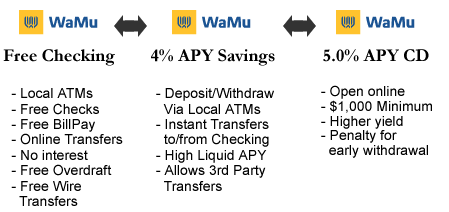
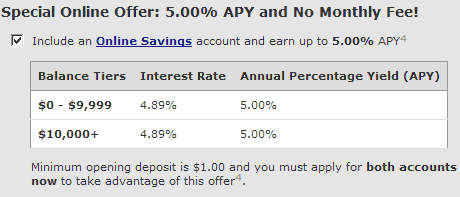
This is why it can be difficult to use your online savings account (at over 5% interest) as your sole account for paying bills and such instead of your checking account (often at 0%). Bank often charge fees for breaking this rule, and must close accounts where this transaction limit is repeatedly exceeded.
Back to the initial question – Is there a difference between a FDIC-insured “savings” account and an FDIC-insured “money market” account? From what I could find, no. They are both time deposit accounts, just with different naming conventions. Traditionally, money market accounts have a higher minimum balance requirement, and are more likely to offer checkwriting or a debit card (subject to the limits above). These both remain different from money market mutual funds, which are usually not FDIC-insured and are instead a collection of short-term debt instruments.
 Another no-fees no-minimums online savings account has arrived. This time it’s E-Trade Bank with the Max-Rate Savings Account. After looking around, here are what I see as the pros and cons of this account as compared to
 RateUSSB * (1 – Fed Tax Rate)
 The Best Credit Card Bonus Offers – 2025
 Big List of Free Stocks from Brokerage Apps
 Best Interest Rates on Cash - 2025
 Free Credit Scores x 3 + Free Credit Monitoring
 Best No Fee 0% APR Balance Transfer Offers
 Little-Known Cellular Data Plans That Can Save Big Money
 How To Haggle Your Cable or Direct TV Bill
 Big List of Free Consumer Data Reports (Credit, Rent, Work)