Search Results for: High Interest Savings

Big Bank Savings Account Promotions: KeepTheChange, Way2Save, and Savings For Success

altext

Instead of simply giving us higher interest rates on savings account, it seems that the big banks are relying on gimmicks to spur account openings. Here are a few. Most involve some convoluted scheme, but they still include the potential for some profit.

Bank of America: Keep The Change

You’ll need a checking account, a savings account, and a check debit card. If you charge say $4.05 on your debit card, $5 is taken from your checking account, but $0.95 is placed in your savings account. During the first three months, they match 100%, which means another 95 cents will be thrown in by BofA at the end of the year, max $250.

Best case scenario, you get 99 cents for charging $1.01 (or even 1 cent). This has led to many people trying various techniques to max out the $250 bonus. Examples: Pumping $1.01 or $2.01 of gas at a time, buying individual stamps from an automated postal machine, paying $1.01 towards your cell phone bill, or using the self-checkout lane at the supermarket and paying for small items you’d buy anyway. You definitely need to be committed to get $250. 🙂

Wachovia Bank: Way2Save

Again, you have a checking account, a special Way2Save savings account, and a check card. For each check card purchase or electronic payment (online billpay or automatic debit), $1 of your own money is moved to the Way2Save account. In addition, you can transfer up to $100 a month from checking to Way2Save. So the amount of money that can be placed into this account is greatly limited.

The special Way2Save account pay 5% APY over the first year, plus an additional 5% bonus at the end of the year. They even have a handy Way2Save calculator to estimate your earnings. (Be sure to compare against a regular 4% savings account.) People might try gaming this by opening multiple accounts, or making lots of electronic transfers.

Washington Mutual Bank: Savings For Success

You’ll need a checking account and a special Savings for Success account. You can open with up to $500. Then set up automatic monthly transfers from your checking to savings (up to $500 per month) for the rest of the year (11 transfers). You cannot make withdrawals during the first year. Your account with earn from 5.50% to 6.50% APY for a year, depending on your state. People also might try opening multiple accounts for this one.

Biggest catch: This program is limited currently to Texas, Illinois, Georgia, and Washington. The rest of us will have to be satisfied with their online-only 4.25% APY savings + checking account combination.

Roth IRA Contribution vs. Emergency Fund Savings

altext

Earlier this week I explored how the performance of money invested in a 401(k) should compare to a regular brokerage account. This brought to mind a different debate:

If you had to choose between contributing $4,000 to a Roth IRA or keeping/putting it towards your Emergency Fund, which would should you choose? We’re assuming you don’t have the funds to do both. Many people put Emergency Fund near the top of their priority lists, just below taking advantage of any “free money” 401(k) match, but above all other retirement accounts. This is because you don’t want to have to dip into retirement accounts and face stiff penalties, or otherwise be faced with other forms of high interest debt like credit cards or personal loans if you need money urgently.

However, the annual $4,000 Roth IRA contribution limit is a “use it or lose it” proposition. You can’t put nothing in this year, and then $8,000 the next. Once April 15th rolls around, you’ve missed out on potential tax advantages that may extend several decades (even to your heirs). This may be mitigated somewhat if you also have a Roth 401(k) or other similar account available.

I used to be in the Emergency Fund First camp, but now I think I’ve changed my mind, mainly thanks to commenter Jbo. Here’s my reasoning. Let’s say you go ahead an contribute $4,000 to a Roth IRA but leave it invested in something safe like a money market fund. Many banks also allow you to open IRA accounts holding certificates of deposit. Now, there are basically two possible resulting scenarios after you do this:

You end up needing the money
No problem, you can always withdraw your Roth IRA contributions without any penalty. Just take out what you need (up to $4,000), and leave the rest in the account. Since it’s in a safe investment it won’t have decreased in value due to stock market volatility. You’ll still lose the tax advantages on any withdrawals, but you’d have missed out anyways.

You don’t need the money
More likely than not, you won’t need all the money, and hopefully within a year or so your emergency fund will be replenished from other sources. Now, you can start really taking advantage of the Roth IRA’s tax benefits and move to riskier investments.

Using the same assumptions as before, a $4,000 post-tax Roth IRA contribution would theoretically end up being worth $40,251 after 30 years. If the $4,000 was placed in a taxable account, you’d only end up with $32,834. Even if you assume inflation will run 3% a year, that’s still $3,000 more in today’s dollars that you made on your initial contribution of only $4,000 by putting it in a Roth.

Am I missing anything? It would seem like putting money in the Roth IRA is a pretty safe bet. The downside is very small, and the upside is very high. One key thing to remember is to keep the Roth IRA money in a safe investment while you are treating it as a emergency fund, as stocks have been known to drop as much as 40% in one year. You don’t want to be having to sell your stocks to get cash after that happens!

  • Make sure your current IRA is charging you as little in fees as possible.  Visit Mint.com and their IRA wizard for a quick look into the best discount brokers offering IRA’s.

Update: My Bank Account Setup To Maximize Interest

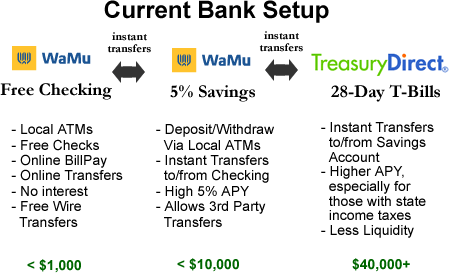
Back in April I shared my personal bank account setup which I felt offered the best balance of convenience, liquidity, and interest paid out for my geographic location and tax situation:

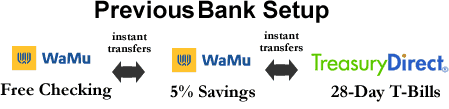
previous bank setup

Basically, I used my Washington Mutual Free Checking / 5% APY Savings (see review) account combo as my core account, but kept most of my money in T-Bills for the higher yield and state income tax exemption. Since then, a couple of things have changed…

First, the rates on 28-day Treasury Bills started to drop significantly, making their tax-equivalent return unattractive. They remain so today, as even the 6-month T-Bill rates are unexciting. In May, FNBO Direct (review) came on the scene and offered 6% APY until 9/28. So as my T-Bills matured I gradually moved them into FNBO.

Then 3 weeks ago, the Fed Funds rate was cut for the first time in years, which caused many banks to adjust the interest rates paid out on high-yield savings accounts. FNBO dropped their rate to 0.85% APY. I have been waiting for the dust to finally settle since, and I think it has since the speculation is now about what will happen during the next Fed meeting at the end of October.

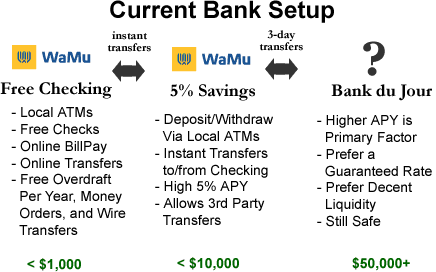
Through all this, the WaMu (online-only) savings account has stayed constant at 5% APY. I’m surprised! I must say though, I’ve been enjoying this sort of “Core and Explore” setup for bank accounts. Most of my day-to-day activities like online billpay, checkwriting, deposits, ATM withdrawals, even getting money orders – they can stay stable and familiar with WaMu. I can also keep a nice chunk of money within quick reach, but still earning 5%. Then I get to rate-chase online with the rest of my temporary $100,000 cash hoard. 🙂 So I think I’ll keep this way as long as I can:

current bank setup

So what is the Bank du Jour? Well I just mailed in my check and signature form for Everbank’s FreeNet checking account last week, but it hasn’t been cashed yet. I like that the 6.01% APY is guaranteed for 3 months, and my Rate Chaser Calculator says the move should clear me at least another $100 over those few months. It may not be as lucrative for smaller balances, but to each their own.

A Few Updates About Banks and Interest Rates

Lots of e-mails coming in from banks today…

HSBC Direct drops from 5.05% to 4.50% APY. Yeesh… not a good sign for online savings accounts in general!

FNBO Direct announces that the new rate as of 1/13/13 is 0.85% APY. Ho-hum, about what I expected. They did also announce a 2% cash back credit card, but only for 12 months. Bye, FNBO, it was fun while it lasted. Currently, I am moving back to my local Washington Mutual checking/saving account. I’m undecided where to go next if I’m going to rate-chase.

Maybe one of these previously-discussed options, maybe Bank of Toledo, but that 10 debit card transaction requirement is a pain and I’m skeptical about how long the 6.01% will last.

Capital One 360 is still at 0.75% APY but is offering a $50 sign-up bonus, higher than the usual $25. Via reader Scott.

Pentagon Federal Credit Union is now offering 3, 4, and 5-year CDs at 6.0% APY. If you’re looking to lock up rates for this long (I’m not), these rates look pretty good. Early withdrawal penalty is 6-months of interest. Membership required, you can join the NMFA for $20 if you don’t qualify otherwise.

(Update) Emigrant Direct is now at 4.75% APY, down from 5.05%. Could have been worse, eh?

What Is The Relationship Between Fed Funds Rate and Interest Rates On Bank Savings Accounts?

With all this talk about the Fed Funds rate drop, a lot of people are wondering what it means for consumer rates like savings accounts, credit card APRs, and mortgage rates. Here, I wanted to explore the savings account relationship. First, some quick definitions:

What is the Fed Funds Rate?
With our current system of fractional-reserve banking, US banks only have to keep a certain amount of money reserved at all times – Currently, it’s only 10% of checking account deposits and nothing (!) on time deposits like savings accounts. Banks usually try to keep as close to this minimum as possible, so that they can lend out the rest at higher interest rates and make that juicy profit.

In order to stay as close as possible, banks often lend money to each other overnight as needed. One bank may have extra in reserves, while another may temporarily not have enough, and this way it’s win-win. The target interest rate for this is the Fed Funds Rate (FFR).

What is the Fed Discount Rate?
This is the exact interest rate at which banks can directly borrow from the Federal Reserve. This is usually a last resort, as such loans are an indication of financial weakness and subject to audit.

What is the relationship between the Fed Funds Rate and interest rates on high-yield savings accounts?
This is just my own speculation, but I would imagine that banks would not want to offer significantly more than the Fed Funds rate. Why would you pay 6% interest out to individuals when you could just pay 5% to another bank? Still, I doubt that banks can borrow an unlimited amount of money via other other banks, so they may be willing to pay a bit more than the FFR if they have the ability to make a profit. Finally, they may just be operating at a temporary loss in order to grab some deposits that hopefully will stay later from branding or just convenience (*cough* FNBO Direct *cough*).

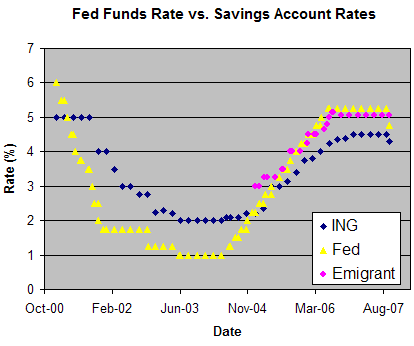
Here is a historical chart of the Fed Funds Rate versus the APY paid by online banks Capital One 360 and Emigrant Direct. I chose these two because they have (1) been around longer than others, and (2) are online and as such should be operating with the thinnest margins. The data points for ING should be close, but not perfectly accurate, as I used Archive.org at 2-month intervals for rate info not available in my own archives.

altext

You can definitely see some correlation, but it’s not perfect. It looks like ING was more aggressive in 2002-2004, and then gradually become satisfied with fatter margins. Emigrant seems to be following the curve closely, which would indicate an interest rate drop soon. So if you want to predict the interest rate of your own bank, not only do you want to look at the FFR, but also the bank’s historical margins and whether they are looking to gain (or simply defend) market-share.

A little birdie told me to expect an FNBO Direct rate definitely under 5% after 9/28. I’m just writing this here to see if it turns out to be correct.

Bank of America Money Market Savings, now 4.65-5.01% APY

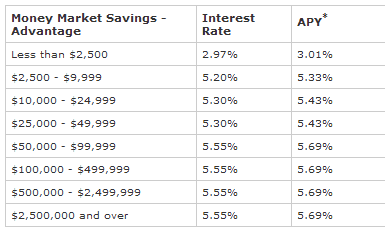
Bank of America now has their own high-yield savings account, though with a minimum balance. You won’t find it advertised though, it’s tucked away in their new My Expressions banking section. If you click around the various organizations, you’ll see a variety of checking/savings combos with different interest rates. The two highest I found were the Humane Society and the Defenders of Wildlife. Here are the current rates for those two groups as of 9/17 for Oregon:

altext

You need $1,000 to open, and a minimum daily balance of $2,500 to avoid a $12 monthly maintenance fee. If you already bank with BofA and can always keep $2,500 in savings, this looks like a great way to boost your interest rate from the usual piddly 0.20%. Be sure to look at the ‘Money Market Savings’ account, not the ‘Regular Savings’ account. Can’t find it? It took me a while too, so I went ahead and made a video showing how to locate the account online.

If you are already have a BofA account you can login at the bottom and have the application pre-filled for you. New customers will experience a hard credit pull. Per a phone call, you don’t need to be a member of the actual association to apply for the account. I just hope these high rates don’t disappear once everyone finds out about them! (Though I’m not helping…) Thanks goes to Trice and BankDeals.

Update on 9/21: The rates have dropped to a range of 4.65% for $2,500+ to 5.01% APY for $50,000+.

Interest Rate Chaser Discussion: Where To Go After FNBO Direct’s 6% APY Promotional Period?

Many people who are with FNBO Direct right now earning 0.65% APY are asking – What is FNBO Direct’s rate going to be after September 28th? After a few phone calls, the official answer is apparently “We’re not going to tell you until we have to… on 9/28.”

This is actually pretty smart on their part. If they announced that the rate is going to drop now, then people may already start moving their money out. It’s better to keep us in suspense, playing off our hope that it will somehow stay high. I personally feel like it’s going to go back to 5.25% at the highest, otherwise they would have told us to kept us from preemptively moving. But that’s just my guess.

If this turns out to be the case, then the rates for no-minimum balance, no-monthly fee, liquid savings accounts will be again clustered closely around (a respectable) 5% APY. For those that want to keep chasing, I also tried to find the best combination of highest rate, FDIC-insured, lower minimums, and high liquidity:

6.01% APY for up to 6 months from EverBank, $1,500 minimum
Although this is technically a promotional rate for their FreeNet Checking Account, since it’s guaranteed you could simply treat it like a 3-month, 100% liquid CD paying 6.01% APY. Here are the details:

  • 6.01% APY guarantee for first 3 months, after it goes to 3.35-4.89% APY based on balance.
  • $1,500 minimum to open, no monthly minimum or fees, no direct deposit requirement
  • Online Billpay costs $4.95/month if you have less than $1,500 in there, $25 fee if closed within 30 days of opening
  • Free ACH in/out funds transfer system
  • Checkwriting (1st 50 free), ATM rebates (up to $6/month), Postage-paid deposit envelopes
  • FDIC-insured (certificate #34775), 3 star “Performing” Safe & Sound rating

After the first 3 months (assuming it’s still available), you can then open a Yield Pledge Money Market that also has 6.01% APY for 3 months. Also $1,500 minimum to open. It has more restrictions since it’s a savings account as well as a monthly minimum balance, so go with the Checking first. In total, this offers up to 6 months more of 6% goodness.

5.70-5.75% APY from IndyMac Bank
Indymac Bank has seen some troubles from the subprime loan mess, even though it specialized more in “Alt-A” loans, which are between prime and sub-prime in quality. However, it does offer some of the current top FDIC-insured rates. Here are two options:

$5,000 Mininum – Internet CD

  • 5.70% APY for 5-month or 6-month Certificate of Deposit.
  • Minimum to open is $5,000.
  • It’s important to note that these are certificates of deposit, and so you can’t transfer money in and out as with checking/savings accounts. In addition, there is a early withdrawal penalty of 1 month of interest.

$25,000 Mininum – Internet First Rate Money Market

  • 5.75% APY for balances above $25,000. No guaranteed term for this rate.
  • Minimum to open is $1,000. Monthly fee of $7 if your balance falls below $1,000.
  • Limited checkwriting is available.

Indymac’s FDIC certificate number is 29730, and it has a 2 star “Below peer group” Safe & Sound rating. Worried about their financial health? Check out my post exploring What happens if my bank goes bankrupt or fails? There may be ways to expand your $100,000 FDIC coverage.

How Do I Compare The Interest Rates and Yields Between Money Market Funds and Savings Accounts?

An alternative to high-yield bank savings accounts are money market funds held in brokerage accounts. Although both money market funds and savings accounts can change their interest rates paid at any time, comparing their actual returns can be confusing.

Comparing Returns
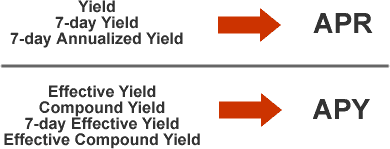
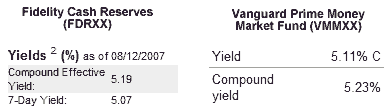
Money market funds usually report their 7-day annualized yield (also listed as just yield, or 7-day yield), which takes the interest paid net of expenses for the last 7 days and assumes that this average continues over an entire year. Compounding is not taken into account, so the 7-day yield should be compared to a bank account’s annual percentage rate (APR).

Some funds also list the 7-day effective yield (also listed as compound yield), which does take into account compounding via the reinvesting of dividends. So the 7-day effective yield should be compared to annual percentage yield (APY).

altext

Here are two examples from Fidelity and Vanguard where they list both. In this case the Fidelity fund would be comparable to a bank account earning 5.07% APR or 5.19% APY.

altext

Since banks usually advertise APY, you can convert if needed using this APY to APR calculator. Keep in mind that since these are moving 7-day averages, the numbers given will change from week to week.

Other Types of Money Market Funds
The above comparison is meant for the most common “taxable” money market funds, which are taxalbe on both federal and state levels just like a bank’s savings account. In addition to these, there are a variety of specific types of funds like Treasury funds (exempt from state income tax) and municipal tax-exempt funds (exempt from federal income tax), and state-specific municipal funds (exempt from both fed and state taxes) that offer special tax consideration.

In this case, you can use a tax-equivalent yield calculator to complete the comparison.

But Is The Risk The Same?
While not eligible to be FDIC-insured as they are not banks, money market funds do have to follow strict guidelines as to maintain the highest credit quality and lowest volatility of the underlying investments. The share is always kept at $1. Due to the recent concerns with mortgage-backed bonds, Fool.com recently asked Is Your Money Market Fund Safe? In my opinion, the risk is a definitely higher than a bank account, but if you hold your money market funds from a respected firm like Vanguard or Fidelity, I would sleep just as soundly, as these companies would repay the funds with their own assets rather than let them falter.

There are also other practical differences between specific banks and specific money market funds, which I am ignoring here.

More Ways to Keep Your Bank Balances High, and Make More Money

Everybody has a high-yield savings or checking account paying 4% or more, right? Here are a few other ways to maximize your bank balances and therefore your interest earned.

Stop withholding too much of your taxes
Did you get your tax refund? If so, that means you withheld too much on your paychecks last year. To fix that for this year, you should consider underwitholding your taxes for profit. You can control your withholding amounts by increasing the number of allowances on your W-4. To see the effects of doing so ahead of time, use the calculators at PaycheckCity.

The easiest rule of thumb to avoid any underpayment penalties, if your income will increase, is to simply pay as much taxes this year as you did last year. Since you don’t have to pay in full until April 15th, putting off $4,000 in taxes until it’s due can earn you over $100 in extra interest.

Pay down even small credit card balances
According to recent Federal Reserve study1, many household still carry small balances of a thousand dollars, even though they have the cash available in savings accounts to pay it off. Perhaps people feel that there is safety in having that extra money in the bank, but in reality credit card can be part of your emergency strategy, especially if you already have balances now. You can pay a variety of critical bills with credit cards now – hospital charges, car repairs, groceries, and more. Paying 15% in interest to the credit card companies while only earning 5% in the bank is a losing proposition, and may result in losing hundreds of dollars a year.

If anything, you should flip this in your favor and borrow at 0% and earn 5% from the bank on that money.

Maximize the float on your credit cards
Another benefit of paying your bills in full is that you get the grace period, which is the period between the end of your statement is generated and when the payment is actually due. During this time (about 20-25 days), you don’t have to pay any interest on your balance in addition to the time you have gotten during the billing cycle. Therefore, I like to use Online Billpay to schedule my credit card payment until very close to the due date.

Here is an example using my WaMu account setup (using the Checkfree Billpay system used by many other banks). If you have $1,500 due on June 29th, I will set my checking account to pay by June 28th (Deliver-by date, with 1 extra day of buffer). Then, I just schedule a future transfer from savings to checking of $1,500 on June 24rd, which is the earliest day which the money may be debited (Start on date). That way, my money is staying in my 5% savings account as long as possible. All in all, very little extra time involved as compared to simply paying the bill online. If you’re just starting this out, you may want to set it with a larger buffer times.

If you have a card issued by FIA (formerly MBNA), some people extend this even further by using the BillPay offered by some FIA cards, which allow you to pay certain bills by putting the balance on your credit card. You aren’t actually paying via credit card so you don’t earn any cashback or rewards, but you can get several more days of interest-free, or “float”, time.

If used together to keep your balances high, these strategies can add hundreds of dollars to your bottom line each year.

1Source and reference: SmartMoney magazine article 7 Money Mistakes to Avoid (only partially available online).

FNBO Direct 6% APY Savings Account Review: Opening Process, Features, and Transfer Schedule

I opened up a savings account at FNBO Direct originally for their high interest rate and no monthly fees. They are currently offering 0.85% APY as of January 2013, still competitive in this current rate environment. Here are my experiences so far as well as some first impressions of this online savings account:

Legitimacy and FDIC Insurance

FNBO Direct is a division of the First National Bank of Omaha, which is a member of the FDIC. If you call the First National Bank of Omaha, they will confirm this link and the website. For the techie folk, the nameservers and IP address range of FNBO.com and FNBODirect.com are the same. Combined with the fact that this account has been around for months, I see no need to worry about the legitimacy of this bank. Many banks choose to distance their online branches from their existing customers, as they are trying to gain new money and low-cost customers who are comfortable with things like electronic statements and online banking.

Opening Process Overview

The opening process went very smoothly. The CashEdge-based application is similar to that of HSBC Direct, but unlike with HSBC there is nothing to wait for in the mail. Nothing to send in either; No paper needed at all!

The application does include an identity verification test based on information from your credit reports. This is identical to what Washington Mutual does for its online savings account. If you have troubles with this, I recommend checking your credit reports for errors. However, a hard credit pull is not performed so it won’t affect your credit.

You can fund via wire transfer, online transfer, or by mailing a check. Here was my timeline:

  • Day 1:Apply online, pass identity verification. Receive e-mail that application was approved. I chose to do an online transfer. Trial verification deposits were sent to funding bank.
  • Day 2:Trial deposits received, and verified (free 57 cents!). FNBO Direct initiates funding transfer.
  • Day 3: I receive my new account number via e-mail, and enroll for online account access. Initial deposit hasn’t showed up, but should go in on Monday (see below). I can add link additional accounts (max of 3) and initiate other transfers.

Account Features, Transfers and Usability

Features
Overall, your basic Capital One 360 clone – $1 to open, no monthly fee, no minimum balances. Otherwise, it’s pretty barebones. No checks. No ATM rebates. You can request an ATM card, which I did, but since it costs $2.50 for each cash withdrawal, I never plan on using it. Here is their complete fee schedule.

Of course, we all know the best feature is the 6% APY interest rate 😉

Transfers
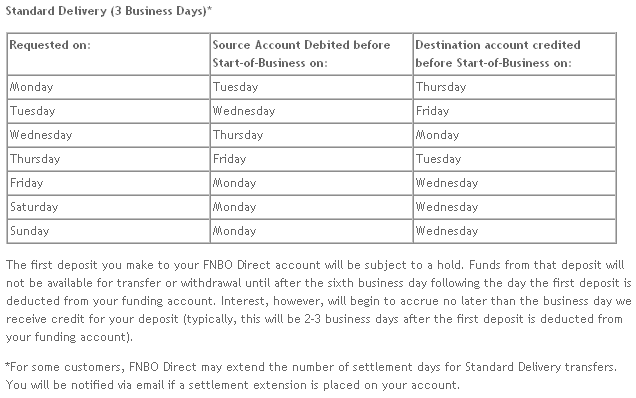
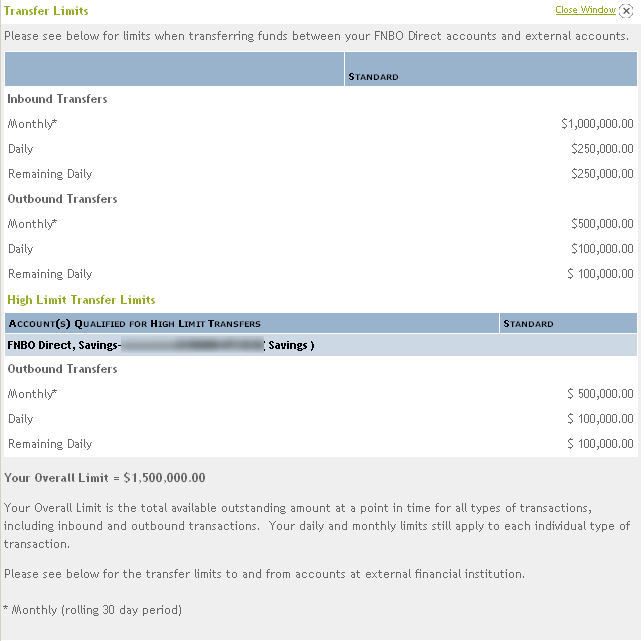
Again this is the familiar CashEdge interface behind the online fund transfers of banks like Bank of America, Presidential Bank, and HSBC Direct. All transfers are free, and the transfer limits are very generous. The transfer schedule appears to be identical to that of HSBC Direct, and takes three business days. (Worst case: If you initiate on Thursday, money is taken out on Friday, but deposit won’t show up at receiving bank until Tuesday.) I know many people dislike these slow transfers, so you should be aware. Here is a screenshot of the schedule:

altext

Note that your initial deposit will not be available for withdrawal for six business days, probably for security reasons.

Usability
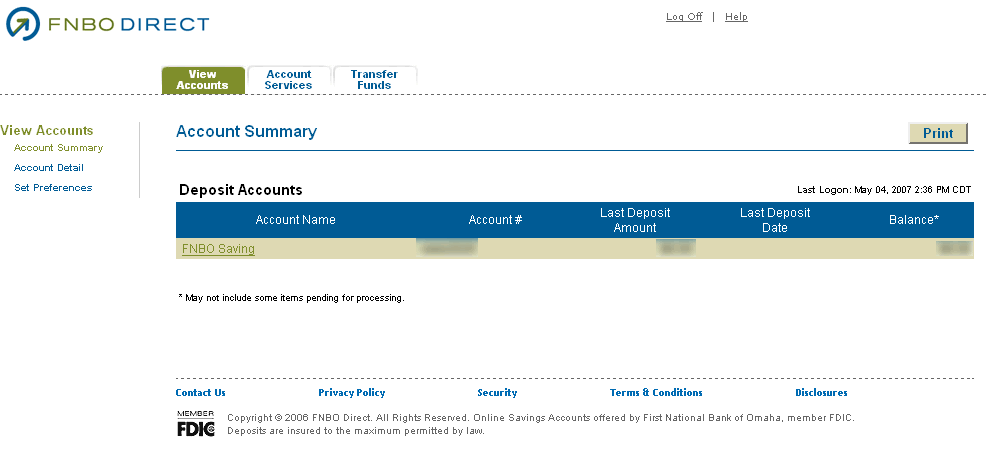
The interface is very simple and utilitarian. I like it. There are only three tabs – View Accounts, Account Services, and Transfer Funds. (Click for a full screenshot of the interface.)

altext

More Information

Customer Service: 877-370-3707, open 24/7.
I’ve called customer service a couple of times, and they do answer and are helpful. Hold times may last a few minutes, but it’s probably due to the recent rush of applicants.

Number of external bank account links allowed: 3

ABA Routing Number: 104000016
I asked them if I could set up third-party transfers like paying my credit card bill with the routing and account numbers, and they said that would be fine. Hopefully it stays that way…

Download formats available: I see no options at all for this. No MS Money, Quicken, or even .csv options.

Interest compounding frequency: Interest is calculated daily and is compounded and credited monthly. Remember, how often interest is compounded really matters very little, especially if you are comparing APYs.

Source: The official website for this online savings account is http://www.fnbodirect.com

My Current Bank Account Setup To Maximize Interest

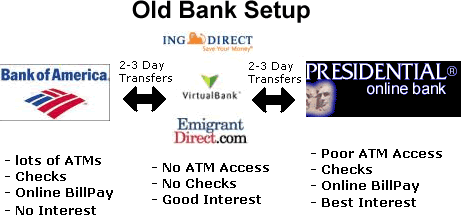
Over a year and a half ago I shared how I juggled my bank accounts to maximize interest. It was the best I could do then, although it was a bit annoying as transfers between banks still took a couple of days.

banksetup.gif

My current set up now involves fewer banks, but I feel it is also both more convenient and earns higher interest. However, whether or not it would work for others depends on their geographic location.

banksetup.gif

Washington Mutual – WaMu has a strong branch presence in my area, and there are also ATMs in the grocery stores. Since they started offering their Free Checking and 5% Savings account combo (must open online; you won’t find this advertised in any branch), I have started using it as my primary account due to the combination of convenience, decent interest, and lack of fees.

I can keep a minimal amount of money in the no-fee checking account for my daily cashflow needs, and then a larger chunk can be kept in the savings account to cover the larger monthly bills paid via scheduled online BillPay transfers. If I need to write a big check or send a wire transfer, I can just move money over from the savings account. Also, I still receive a lot of checks so I like the ability to deposit them directly into my savings account. Overall, this keeps a good chunk of my money instantly accessible yet earning decent interest.

For reference, see my WaMu Free Checking + 5% Savings review and how to fund them directly with existing WaMu accounts.

28-Day Treasury Bill Ladder – Again, this may not work for others because the main draw of T-Bills is that the interest paid is exempt from state and local income taxes, which increases their equivalent yield. For those without state income taxes, they have been yielding around 5.1%-5.3% APY. However, for those that do have such taxes, the equivalent yield is significantly higher. Mine is closer to 5.8%-5.9% APY. Thus, the money I can’t see myself needing in less than 28 days (most of it) is kept here.

In addition, I can link TreasuryDirect to my WaMu savings account, so there is no interest lost during transfers. The money is invested immediately into a Treasury Bill upon withdrawal, and upon maturity the money is immediately deposited back into my savings account.

For more information, please see my entries on converting Treasury Bill auction results to equivalent bank interest rates, and how to build a T-Bill ladder.

Interest Rate Checkup – Online, Brick and Mortar, and Treasury Bills

Here is brief roundup of the top rates for short-term cash accounts with moderate balances.

Online Savings Accounts, No Minimum Balance
HSBC Direct continues it’s 6.0% APY rate on new money until April 30th, and you can open with $1. The highest non-promo rate is from Amtrust Direct at 5.36% APY, although you must open with $1,000. Overall, rates seem to be stable as of late.

Nationwide Brick and Mortar Accounts, No Minimum Balance
Washington Mutual continues to top this area, with their WaMu 5.0% APY Saving Account. You have to open online, but after that it has all the advantages of a local branch savings account; You can transfer instantly to/from their Free Checking account, deposit directly into savings via ATMs or tellers, and take cash directly out via ATMs.

28-Day Treasury Bills Possibly Good Alternative
If you are subject to state income taxes and have cash reserves that you don’t need immediate access to, you should definitely look into Treasury Bills. Rates change weekly, with the most recent auction results showing a 5.267% investment rate. Using my 28-Day T-Bill APR-to-APY calculator with my new Tax Equivalent Yield Calculator, along with an assumed 25% federal/9% state tax bracket, that is the equivalent of a taxable interest rate of 6.12% APY. Treasury Bills are backed by the full faith of the government, and also come in 3-month and 6-month terms.

The downsides to T-Bills include the fact that you will give up some liquidity and they must be bought in $1,000 increments. For more information on how to buy them online and building a T-Bill ladder, please read the posts in my Treasury Bill category archives. Look for a new visual how-to guide coming soon.

Personally, I continue to purchase T-Bills with a portion of my cash balances as I live in Oregon with a 9% state rate. It is actually very easy to have to money transferred to and from your existing high-yield bank account. For example, if you have $30,000 sitting in a bank, you might commit $20,000 to Treasury Bills and keep the rest 100% liquid. It all depends on what you feel comfortable with.

Also see: Rate Chaser Calculator.