Search Results for: High Interest Savings

Opened Rewards Checking and Mega Money Market Savings Accounts at Evantage Bank

I haven’t been much of a interest rate-chaser recently, and it feels like it’s been a while since I’ve opened up a new bank account. For one, I already have a lot of my cash tied up in CDs and I-Bonds. Also, most of my recent cashflow has been going into 401k and IRA contributions.

Now that I have a bit more free time, I decided to open up a new “Rewards Checking” account at Evantage Bank. It offers 5.25% APY on the first $10,000 in balances, and 2.25% APY for anything over that if you meet their requirements of electronic statements and 10 debit card purchases per month. I liked it because it was available nationwide, there were no minimum balance requirements, and didn’t have a direct deposit requirement.

In addition, they have a “Mega Money Market” savings account that is currently paying 3.10% APY on balances to $35,000. (No debit requirements.) So you could keep a total of $45,000 parked at Evantage at a combined interest rate of 3.58%. Not too shabby in this current environment. Alternatively, you could open a second Rewards Checking account and get another $10k at 5.25% (but also with another 10-purchase commitment).

So far, the account application was run by CashEdge, with the usual informational requests and ID verification using questions based on your credit report. The process was completely online, with both online signature cards and an ACH transfer option for initial deposit. I’ll provide a better update once I get started.

I’ve written about rewards checking accounts in the past. They are a gamble and you can earn very little interest if you don’t pay attention to the requirements. In addition, the rates can drop quickly. Look at your own habits, and hopefully these rates will stay competitive for a while.

Evantage is one of identical triplet banks, along with Redneck Bank and AmericaNetBank, which are all owned by the Huckabay family of Oklahoma. The three banks reportedly have different gimmicks to attract publicity – supposedly the redneck, patriot, and high-tech crowd? Apparently it worked, because Redneck Bank isn’t even taking new applications as of yesterday.
Fed Funds Rate Drop Update: Locking In Higher Bank Yields Now

Given the recent drop in the Fed Funds rate to nearly zero, bank have been adjusting their interest rates accordingly. Now that the dust has settled a bit, I suppose it is time to see what rates we can get now for our FDIC-insured cash. It may be a good idea to lock in some CDs based on your time horizon, and/or if you are willing to give up the liquidity.

Liquid Savings Accounts

  • DollarSavingsDirect remains the top overall rate, holding steady at 4.0% APY for now, although it could change at any time. See my quickie review here.
  • The Everbank Yield Pledge Money Market Account is offering 4.00% for 3 months guaranteed as long as you open by 12/31/08. (Balances up to $50,000.) See my review of the application process here. 4% for 3 months is actually better than any other banks’ top 3-month CD rate, while still allowing withdrawals.
  • If you signed up for the WT Direct $250 bonus, just a reminder that today (12/22) now December 31st is the last day to initiate your transfer. So you still have time, and it works out to be a good deal for a couple months of commitment.

Shorter Term (1-2 Year) Certificates of Deposit

  • FNBO Direct is offering a 9-month CD at 3.75% APY, a 1-Year CD at 4.0% APY, and a 2-Year CD at 4.26% APY. These are all very competitive for their respective lengths. The FNBO Direct liquid savings account (my review) also holds steady at 0.85% APY.

Longer Term (3+ Year) Certificates of Deposit

  • Pentagon Federal Credit Union is offering 3-year, 4-year, and 5-year CDs at 4.75% APY. If you aren’t a member, you can join the NMFA for a one-time fee of $20.
  • WaMu actually has a 5-year CD at 5% APY. Not bad if your mortgage is under 5%. Their liquid savings account continues to drop steadily (as we were afraid of) and is now only paying 1.50% APY.

Worry-Free Investing: Calculate Your Risk-Free Savings Rate For Retirement

Conventional advice has been that we should invest in some mix of stocks and bonds to reach our retirement goals. But as we’ve seen, rolling the dice on a varying return distribution every year can be quite stressful. What if we start our retirement planning based on buying a safe investment that guarantees a steady after-inflation return instead? This question is posed in the book Worry-Free Investing by Bodie and Clowes.

Treasury Inflation-Protected Securities (TIPS) are bonds that promise you a total return that adjusts with the CPI index for inflation. Very generally, it works like this: if the stated real yield is 2% and inflation ends up at 4%, your return would be 6%. TIPS are issued and backed by full faith of the U.S. government, so they are as safe as they get. As your investment the automatically adjust with inflation, you will never have to deal with the stomach-churning swings of stocks, and also you avoid the risk of underperforming inflation that traditional (nominal) bonds have.

How much would you have to save if you decided to take zero market risk and invest solely in TIPS? The book outlines the mathematical formulas to use, but also provides a free spreadsheet calculator to do the heavy lifting for us. I uploaded it to ZohoSheets:

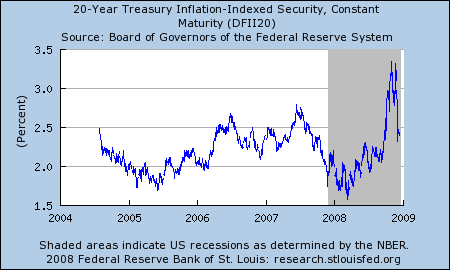
I would recommend playing with the numbers a bit. To start, the book was written in 2003 when the real rates were relatively high at around 3%. Given the recent history of the 20-year TIPS yield (shown below), I would assume a maximum of a 2.5% real interest rate.

I would also change the replacement rate to something that more closely tracks your specific expected expenses. The book recommends the income required to maintain your “minimum acceptable living standard”. For the skeptical and/or early retirees, don’t put in anything for Social Security. Finally, don’t forget to input your current savings.

You now have your personal risk-free savings rate to reach your goals. (Warning: It might be really high! If so, try retiring at 65 and input something for Social Security.) But let’s say you need to save 10%, but you are able to save 15%. You could put the 10% in the ultra-safe TIPS, and put the other 5% in something riskier to boost your returns while still guaranteeing a minimum future income. I’ll share a possible solution from the book once I get access to a flatbed scanner.

Now, there are lots of potential glitches with this simulation. For one, there is reinvestment risk because the TIPS real interest rate will continue to vary, and could drop to much lower levels. The government could even conceivably stop selling new TIPS at any time. Some people are skeptical that the CPI properly tracks inflation. Finally, TIPS are taxed at ordinary income levels, so one should keep them in tax-advantaged accounts. However, most people’s 401ks don’t include TIPS as an option! Otherwise, taxes are going to hurt returns.

In the end, I think a portfolio of 100% TIPS is impractical for most people. However, I definitely like TIPS as a component, and see this thought process as a way to estimate a “target” savings rate that can let those so-inclined to take less risk and sleep better at night.

WaMu/Chase Lowers Interest Rates, Time To Move Banks?

Some eagle-eyed readers let me know late last night that WaMu/Chase quietly made a change to their offered interest rates. Their online savings account is now at 3% APY when attached to their free checking, down from 4%. Not too bad, but no longer the highest yield for a no-minimum-balance savings account.

They also lowered the rates on their online CDs, with the 8-month, 12-month, and 13-month CDs all at 3% APY. It looks like those that opened up one of their 5% APY CDs late last week just got in under the gun. My 12-month CD was successfully funded yesterday, and today I see my 5% APY rate shown online. All signs seem to suggest that Chase will honor these CD contracts. Hurray for small victories 🙂 , I hope everyone who wanted in on these got their application in on time.

Options?
Given these actions, it might be time to move banks soon… now to investigate other attractive all-in-one Checking/Savings combos. Here are some possibilities:

Everbank has their FreeNet checking account with a 1.10% bonus rate for the first 6 months, and then 0.70%-0.86% APY afterwards depending on balance. No minimum balance, but you need $1,500 for free billpay. $6 in free ATM fee rebates each month.

Combine this with Everbank’s Yield Pledge money market account, which also has a 1.10% bonus rate for the first 6 months, and then 0.86% APY afterwards. This account “pledges” to stay amongst the top 5% of competitive banks, and there is a minimum balance requirement of $1,500 to avoid fees.

Fidelity has their mySmart Cash account. It is kind of a checking account/brokerage account hybrid where you can basically use their money market funds (non-FDIC-insured) as the main holding place on your cash for higher yields. You can choose from taxable to tax-exempt money market funds with competitive yields. Their main checking account is FDIC-insured, and is currently earning 1.50% APY. No minimum balance, and you get unlimited ATM fee reimbursements.

WaMu Savings 3.75% APY: Should I Stay With A Struggling Bank?

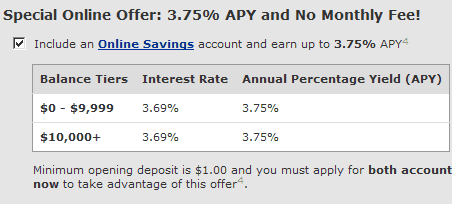
While logging on to my WaMu account I noticed (as did reader Alvin) that the WaMu savings account* is now paying 3.75% APY as of 7/31. Some pages still say 3.30%, but my account details confirm the 3.75% APY. (Login and click on “About this account”.) Or, click here and hit Apply Today, and you should see this:

Of course, if you read the news, you’ll know that Washington Mutual stock is being battered right now. Is this move a sign of desperation? If so, is this rate increase good news or bad news?

It’s All About The FDIC Limits
Well, if you have money over the FDIC insurance limits of $100,000 per titled account, I strongly suggest you stop reading right now and spread it out immediately. Your money is at risk. Here are some good options.

If you are under the limits, then your money is safe. The main things left to worry about are (1) easy access to money, (2) crediting of current interest earned, and (3) future interest rates. But hey, we already have two examples of struggling banks that give us an idea of what we might be in store for.

IndyMac Bank CD Example (FDIC takeover)
I believe that IndyMac failed on a Friday, and branches were closed that day. Over the weekend, branches were closed and the website was down. ATMs and debit cards still worked. By Monday, all the branches were open and the website was back up. Direct deposits, electronic transfers, and written checks went through uninterrupted.

All interest earned in accounts (under the limits) was still credited. Before the failure, IndyMac Bank also had some high interest rates on certificates of deposit (CDs). Upon takeover by the FDIC, an ideal scenario actually happened. For one, you had the option to withdraw your money from a CD with no early withdrawal penalty. Or, if you liked the rate, your CDs could continue to earn the same interest until maturity. This is an even better deal than if IndyMac stayed intact.

Countrywide Example (Bought by Bank of America)
Another struggling bank, this time merged with another existing bank. Currently they are still separate websites, with their own interest rates and products. Nothing really changed from the customer’s point of view. There was no downtime, or lost liquidity. You use the same checks, same debit cards, same website. CD rates and other terms remained the same. A slight bonus was that Countrywide customers could now withdraw money from Bank of America ATMs with no fees. [Merger Info]

So, Will WaMu Fail?
I have no clue. My PTI-style Toss-Up Percentage: 25% Fail, 75% No Fail. But even if it does, given it’s size, I can’t see it disappearing overnight like a small local bank might. It would have to be taken over by another (probably large) bank. In addition, there are so many moving parts that it will probably keeping run as-is for several months even if it does get taken over.

Taking all this into account, I will be sticking with Washington Mutual and happily take the increased interest rate.

* Reminder: This 3.75% rate is only available if you apply online and open a Free Checking account at the same time. If you go into a physical branch, they will deny deny deny! However, after opening you can use it at a branch just like any other savings account. More details.

Update: Best Savings Account and CD Interest Rates, 4%+ APY

It seems that one small silver lining of these ongoing bank troubles is that well, banks need more money in order to keep afloat. This means they are more willing to pay us more $$$ for the privilege of holding onto ours. 🙂 Even the big banks are starting to play along. Thanks to Brian and John for their respective updates.

Big Banks
If you have a decent balance and are willing to lock up your month for a while, below are some nice rates with terms of a year or less. Interest rates might be going back up soon to combat inflation, so locking in a CD longer than that might not be the best idea.

  • Bank of America has a 7-month CD paying 4.11% APY. $5,000 minimum.
  • Washington Mutual has a 8-month CD paying 4.25% APY. $1,000 minimum. They still offer their no-minimum liquid savings account at 3.30% APY.
  • Wachovia has a 12-month CD paying 4.25% APY, as well as a 7-month CD paying 4% APY. $5,000 minimum.

Online Banks
The online bank arena remains the place to be if you want high yields and minimal restrictions, including the ability to withdraw money at any time. All are still FDIC insured.

  • HSBC Direct is offering 3.50% APY with no fees and no minimum balance requirements, guaranteed until 9/15.
  • FNBO Direct is offering 0.85% APY with no fees and no minimum balance requirements, and has maintained a decent track record of consistently high rates.
  • Everbank also has a savings account that offers a nice 4.65% APY for the first 3 months, and then 3.51% APY afterwards. Not bad, considering even the non-special rate is very competitive. I guess that is why they call it the Yield Pledge Money Market account, since it “pledges” to stay amongst the top 5% of competitive banks. There is a minimum balance requirement of $1,500 to avoid fees.

IndyMac Bank Failure Highlights: Another FDIC Insurance Example

Well, it finally happened. IndyMac Bank has been taken over by the FDIC, becoming the second-largest financial institution failure in U.S. history. I’ve been reading a bunch of new stories about it, and here are what I think are the highlights:

Customers: Don’t Panic!
Most people with regular checking or savings accounts don’t have too much to worry about. The FDIC has set up this official information page for customers. You can still use ATMs. Checks you write will still be processed. Electronic deposits and withdrawals will still go through. Online banking, phone banking and even the physical branches will re-open on Monday. You won’t even lose past interest:

All interest accrued through Friday, will be paid at your same rate. IndyMac Federal Bank will be reviewing rates and will provide further information soon. You will be notified of any changes.

From the LA Business Journal:

The Office of Thrift Supervision transferred control of the company to the Federal Deposit Insurance Corp. The FDIC said it will transfer insured deposits and assets of IndyMac Bank to a new federally operated institution called IndyMac Federal Bank that will open Monday. […] Regulators said that customers of IndyMac will have uninterrupted access to their accounts beginning next week at the bank’s 33 branches.

This is consistent with when I explored What happens if my bank fails? The FDIC seems to do a pretty good job of cleaning things up.

…Unless you exceeded the FDIC insurance limits

Customers are insured 100 percent for deposits up to $100,000. The FDIC said the bank has about $1 billion of “potentially uninsured deposits” held by 10,000 depositors. The FDIC said it will begin contacting uninsured customers on July 14. The agency said it plans to give customers with more than $100,000 at least 50 percent of their uninsured deposit amounts.

Wade Francis, president of Long Beach-based Unicon Financial Services, said there is “very little” chance that uninsured depositors will get all their money back because IndyMac had a large number of home loans, which will be difficult to sell off.

It boggles the mind that so many of the very same people who have enough money to exceed FDIC limits in the first place, don’t bother protecting it properly. The whole point of keeping money in banks is so that it is safe… Instead, people are getting 50% and go home and pray to see the rest again. Ouch.

Ouch For the FDIC, Too
From the LA Times:

Federal authorities estimated that the takeover of IndyMac, which had $32 billion in assets, would cost the FDIC $4 billion to $8 billion. […] The agency’s insurance fund has assets of about $52 billion.

That’s a big chunk of the FDIC’s own “emergency fund”…

Reality vs. Perception of Reality
There is a great quote from the 1992 movie Sneakers:

Cosmo: Posit: People think a bank might be financially shaky.
Martin Bishop: Consequence: People start to withdraw their money.
Cosmo: Result: Pretty soon it is financially shaky.
Martin Bishop: Conclusion: You can make banks fail.
Cosmo: Bzzt. I’ve already done that. Maybe you’ve heard about a few? Think bigger.
Martin Bishop: Stock market?
Cosmo: Yes.
Martin Bishop: Currency market?
Cosmo: Yes.
Martin Bishop: Commodities market?
Cosmo: Yes.
Martin Bishop: Small countries?

This is basically what happened to IndyMac bank. From CNN:

The banking regulator said it closed IndyMac after customers began a run on the lender following the [very public!] June 26 release of a letter by Sen. Charles Schumer, D-N.Y., urging several bank regulatory agencies that they take steps to prevent IndyMac’s collapse. In the 11 days that followed the letter’s release, depositors took out more than $1.3 billion, regulators said.

Rewards Checking Accounts: Higher Interest Worth The Extra Trouble?

UPDATE: Rates have dropped, but these checking account still maintain around 2% APY edge over traditional online savings banks and 3% APY over big megabanks.

You may have seen some billboards or heard a radio ad around town for a local credit union offering a curiously high interest rate. 4% APY? Even 5%? They usually go by names like TurboChecking, Great Rate Checking, SuperRewards Checking, or similar. What’s up?

Background
It would seem that small local banks and credit unions are being squeezed on one side by megabanks offering “free” checking and a million ATMs, and on the other side by lean online savings accounts paying higher interest. It’s hard to compete. But then a company called BancVue came up with a different solution for all those small banks and credit unions who want to differentiate themselves.

The basic idea: Offer customers a really high yield and ATM fee rebates, but only if they jump through certain hoops. Hopefully, this carrot will attract lots of new customers. If they don’t, then they just get a plain “free” checking account with piddly interest. In the meantime, you try to make more money with credit card transaction fees and cross-selling other products. BancVue actually guarantees that “Reward Checking relationships will be twice as profitable as your Free Checking relationships”.

The “Catches” and Requirements
So what are the hoops? Usually you have to satisfy all of these restrictions to earn the advertised rate and get ATM fee rebates:

  • Make 8 to 15 “signed” debit card transactions each month (use it like a credit card).
  • Make one qualifying direct deposit, auto-debit, or online bill payment each month.
  • Receive electronic statements only (no paper).
  • Log into your account at least once a month.
  • The rate only applies to the first $25,000 (varies). Balances over that earn significantly less.

As you can see, most of these activities strongly encourage you to shift all your banking activities to this new bank. You have to put money in, spend the money, and even check your balance online every month.

The Potential Profit
The interest rate offered varies from bank to bank, but is usually between 4% and 6% APY. I would say the average no-fee, no-minimum high-yield savings account earns about 3% right now, maybe more. Since these are exactly that – no fees, no minimums, no hassles – I’ll use that as one comparison. If you somehow leave exactly $25,000 in your account at all times:

$25,000 x 6% APY = $1,500 per year

$25,000 x 3% APY = $750 per year

So the 3% interest gap results in a maximum gain is $750 of taxable interest per year, or $62.50 per month. Not bad for those with lots of cash available. But lets say your average balance is $5,000. Then your maximum gain is only $150, or $12.50 per month. The monthly number is probably more appropriate because it is anyone’s guess how long the gap can stay this large. To estimate more accurately the potential gain for your situation, you can use my Ultimate Rate Chaser Calculator.

Concerns and Strategies
Here’s the key thought. If everyone satisfied all of the requirements and earned a FDIC-insured 6% yield, the bank would be losing money like crazy. They are either depending on many people to either forget or screw up somehow. And even if you do, there is the potential that you’ll have to argue with some customer service rep about it. This is in comparison to the relatively stupid-proof no-minimum no-fees savings accounts. For every month you don’t fulfill every requirement, you’ll essentially be losing interest. You might even lose money because ATM fees will not be rebated in that case either.

So first of all, you need a reliable system to satisfy all of the requirements every month, preferably early on in each cycle. Some banks treat electronic transfers from other banks as direct deposit, so scheduling a monthly repeating transfer would work there. For the monthly login requirement, perhaps a monthly Google Calendar or IWantSandy e-mail reminder would be a good idea.

Next, you’d want to make your balance large enough to take advantage of the higher interest rate, but not too high as to you exceed the limit and bring your overall effective interest rate down.

The biggest pain is the ~10 debit card purchases per month (ATM visits don’t count). You don’t want to switch all of your purchases because you’ll be losing out on the potential 1-5% cash back from a cashback or rewards credit card. One strategy is to pay bills like your cell phone or cable bill online, but only in partial amounts like $5. Others make repeated small purchases (i.e. a few stamps) at the Post Office. Here’s my silly but practical solution – each month I take a post-it and cut out only part with a sticky backing. I draw 10 boxes, stick it on the card, and I check off a box each time I use the card for a small purchase.

Finally, these rates can drop at any time, and they often do. Which means if you are really a rate chaser, then you might be finding yourself constantly switching banks, waiting for ATM cards to arrive, and trying to satisfy multiple accounts while moving money around. Since these are small banks, most of them have no online interbank funds transfer system. Result: Lots of hassle.

So, Is It Worth It?
As always, I leave this ultimately up to each person. If you are a real rate chaser, have at least $20,000 in cash, and are very discipline and organized, then this is one way to get some extra yield from your money. If you have low balances or tend to get busy at times, then your chances of actually coming out behind a no-brainer savings account are very real.

For me, the hassle hasn’t been worth it until now, mainly because many of these rates seem to drop right after I consider applying. However, the current the gap between the interest rates offered by online savings accounts is still around 2%, my Vanguard municipal money market yields are pathetic again, and also a local credit union I was going to join anyways is now offering one of these accounts, so I decided to try it out with a bit of cash. So far, it’s okay but I really don’t like having to pray each month that I get the proper interest credited.

Local Banks May Be Best
All things considered, I would recommend first looking for a local bank that offers this program at a good rate. This goes back to the fact that banks are counting on lazy/apathetic people to counter the hardcore rate chasers. If they start losing money, they will lower the advertised rate. A credit union with restricted membership may offer a less diligent customer mix. In addition, I continue to find better customer service if you can simply walk in and talk to a real human. You can find a list of participating banks by state here.

How To Buy Paper Series I Savings Bonds

While on my lunch break, I went over and bought some Series I Savings bonds, due to their high interest rates described here. Technically I had two more days until the 30th to get an April 2008 issue date, but I didn’t want to cut it too close in case there were any problems. I was also fueled by the news that interest rates will probably dropped yet again soon by Bernanke and Co.

Here’s how to do it:

1) Find a bank near you that sells paper savings bonds. Although the TreasuryDirect website says “any financial institution”, not all banks participate. I asked a few smaller ones near work and they did not carry them. The big boys like Bank of America, Washington Mutual, Chase, or Wachovia should all have them. If you don’t have one of these megabanks, just call the biggest banks in your region.

2) Either move funds into an account there, or bring cash. You can’t write a check from another institution, because they need to have the funds immediately. Although I didn’t try, a cashier’s check should work, assuming the bank can simply turn that into cash. I just had them withdraw the funds out of my bank account.

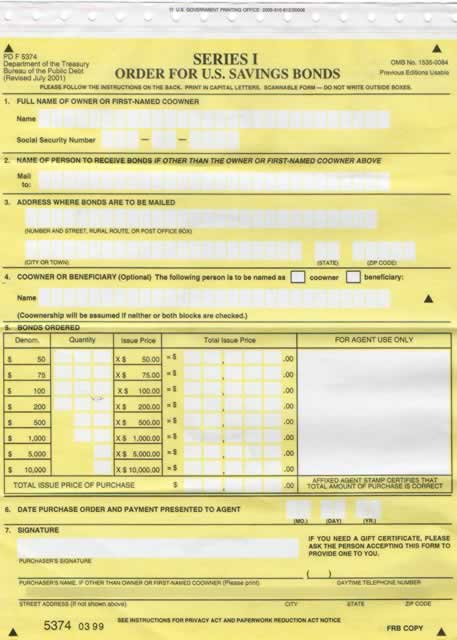
3) Ask for the Series I Savings bonds order form. Don’t be surprised if the teller looks confused, as this isn’t a popular request. Have them ask a supervisor, it should be Form 5374. I had one left over, so here is a scan of what it should look like:

altext

(Some larger banks may have an electronic process.)

Remember, the limit for paper bonds is $5,000 per Social Security number per year. So you can put down $5k for you and $5k for your spouse if you have one, and simply pay $10,000 by yourself. You may also wish to buy something like five $1,000 bonds instead of one $5,000 bond for ease of paper redemption.

The issue date of the savings bond will be the same day that the bank accepts payment. This date will be noted on the application, and the bank should also stamp it to confirm.

4) Wait. The forms says that processing will take 3 weeks, and then it will be mailed to you. You can have it sent to a P.O. Box if you have one, for more security. The processing time won’t affect your interest earned because again as long as you paid in April it will be stamped as issued in April 2008. Also, you can’t cash out until after 12 months, so there is no hurry.

How do I redeem them?
You can either convert these paper bonds to electronic format at TreasuryDirect and redeem online, or cash them in at the same place you bought them (or any other financial institution that sells them). The cool thing about electronic format is that you can do partial redemptions.

Reader Question: When High Pet Costs Threaten Your Finances

I received a very sad e-mail today from reader Tina:

…A recent crisis with my cat has deeply taxed my savings. […] I have spent more than $4500 on my pet in the last three months. She developed lymphoma and the initial hospitalization and testing to find out what was wrong accounted for the bulk of the expense. The rest has been spent on follow-up chemotherapy treatments.

I’m curious how you would handle such a crisis (heaven forbid). Do you think you’d ever get to a point where the price was too high to keep your pet alive (assuming doing so will give it a relatively good quality of life)?

I think this is an important topic, but at the same time it’s very touchy because I’ve found that people tend to have very polarized views on pets. Here is a quote from VPI pet insurance founder Jack Stephens:

Pet insurance is a nonstarter for many pet owners, simply because they take a pragmatic approach to their animals. If the cost of treatment got too high, they would choose to put the animal to sleep.

“About half see the pet as disposable. If it got really ill they just wouldn’t treat it,” said Stephens, whose company conducted research on the issue. The other half “were willing to treat, whatever it took.”

Now, I don’t think it’s nearly as black and white as that, as I think most pet owners love their pets to some degree. But the people on the “pets-as-children” camp are often just as militant as the “they’re just animals-not-humans” camp.

Economic Euthanasia
A recent Slate.com article subtitled What I wouldn’t do for my cat also addressed this issue in depth. (The editor’s choice response letters are also thought-provoking.) It refers to refusing care due to cost as “economic euthanasia”. From reading it, cultural norms seem to be shifting. But in the end, I think it still all comes down to personal priorities.

What is the benefit? Are you talking about the cat or dog coming back to 100% health like a broken bone? Or are you paying to extend its life by weeks while lying in pain? There is a time that palliative care is the most humane choice.

Where is this money coming from? Don’t just look at the number, look at what you’d be giving up. At $2,000, is this money that would go to a vacation to Mexico otherwise? A new HDTV? Payment on your nice car? Now, let’s say it means you can’t buy gas for work or food for your kids. Different story.

Give it away? I think most vets can draw their own line as to what is “necessary”. So if you’re not willing to pay, maybe you should let one of them handle it:

Recently, I called our vet, Dr. Timothy Mann of Northside Veterinary Clinic in Brooklyn, N.Y., to ask him what would have happened if we hadn’t opted to pay for surgery.

“We don’t believe in putting animals to sleep because of money,” Dr. Mann said. “If someone can’t afford or won’t pay to save an animal who can be saved, we’ll save the animal and then keep it or find it a good home.”

Also, be sure to contact local rescue groups. They will be happy to take your sick dog, and will find some way to pay for the care. We are signed up for rescue lists for our specific breed of dog, and we would gladly take another one in if the need arose.

Plan Ahead With Pet Insurance
One way to avoid such difficult decisions is to buy pet insurance. Although it can be expensive at around $30 a month, it will definitely help soften the blow of a huge unexpected bill (although it likely won’t cover it all). Alternatively, put away money regularly in a “pet health savings account”. If you put away just $20 a month and your animal experiences issues at 5 years old, you’d already have $1,200 + interest to cover it.

My Own Doggie Evolution
I never had any pets growing up due to a broad parental ban. Not even a goldfish! My wife, on other hand, was always surrounded by animals. Rabbits, hamsters, guinea pigs, fish, dogs… When we got our first dog from the local Humane Society nearly 3 years ago, I didn’t really know how I would react. Would I love it? Would I ignore it? I must say that our little dude has burrowed his way into my heart. I mean, how can you say no to this buttercream-covered face?

altext

For us, we would give up just about all of our luxuries before withholding healthcare for our dog. We are both in agreement as well, which is great because I know for other couples it can be a point of great tension. Heck, my wife the fashionista would probably wear a potato sack around while selling our car and taking the bus 2 hours to work every day if it came down to it.

However, if it meant sacrificing the health or safety of an immediate (human) family member, I would think twice. By this I mean taking on a dangerous level of debt, or cutting corners in the essentials like nutritious food, health insurance, and safe housing.

But this doesn’t mean I spend my time judging other pet owners for deciding against care due to high cost. For many people pets are not humans, and there is a line to be drawn. But again, if you can’t or aren’t willing to pay please make sure you’ve considered all your options.

Series I Savings Bonds: Inflation Protection + Decent Interest?

The Federal Reserve continues to slash short-term rates, so right now looks like a good time to take a second look at Series I Savings Bonds since they are not directly tied to such rates and also offer protection from inflation.

I-Bonds Quick Summary

  • Series I Savings Bonds (also known as I-Bonds) are investments that have very low risk (backed by the government) and offer to pay interest in two parts: a fixed rate + a variable rate indexed to inflation. The fixed rate is known when you buy, and the variable rate changes every 6 months.
  • You must hold them for at least 1 year. If you redeem within the first 5 years, you lose the last 3 month’s worth of interest. They stop paying interest after 30 years.
  • Interest from savings bonds are subject to federal income tax, but are exempt from local and state income taxes. For people that live in states with high income taxes, this can make them more attractive. They also have some special exemptions when used for educational purposes. See this Tax-equivalent Yield Calculator.
  • As of 2008, you can only buy $5,000 of paper I-bonds and $5,000 of online I-bonds per Social Security Number, per year. However, many users report still being able to buy up to $30,000 at a time online.
  • More info at TreasuryDirect.

Currents Rates and Predictions
Currently, the fixed rate portion of I-Bonds is 1.2%. If you buy a bond now, you will also be guaranteed an variable interest rate of 3.08% for the next 6 months, for a total interest rate of 4.28%.

After that, the rate will adjust every 6 months based on the previous 6 month’s worth of inflation data. The next adjustment will be in May, based on September-March 2008 data. Currently, we have September-February, so let’s use that to make an educated guess. Using the prediction method explained here:

Sept 2007 CPI-U was 208.490. Feb 2008 CPI-U was 211.693. 211.693/208.490 = 1.015363, or a semi-annual increase of 1.536%.

Total rate = Unknown fixed rate + 2 x Semiannual inflation rate + (Semiannual inflation rate X Fixed rate)

If we assume a fixed rate of the current 1.2%, we get
Total rate = 0.012 + (2 x .015363) + (.012 x .015363)
Total rate = 1.2% + 3.09%
Total rate = 4.29%

Now, looking at oil prices, I’m guessing that inflation is probably going to tick upwards some more in March. If we use August-February data, the variable rate would be around 3.37% (total rate 4.57%). Either way, I think it is a fair bet that the variable portion will stay around 3.1% if not higher.

Buying I-Bonds as a 12-month CD
Given these predictions, we can have an idea of what our interest earned will be if we buy now. There is one last “trick” with I-Bonds, and it is that if you buy at the end of the month, you’ll still get all the interest for the entire month as if you bought it in the beginning of the month. Let’s say we buy at the end of March (this week!), hold for the minimum of one year, and pay the 3-month interest penalty. You’ll be able to sell on March 1, 2009 for an actual holding period of 11 months.

We will get 4.38% for 6 months, and ~4.3% for 3 months taking in account the penalty. That’s equivalent to an annual rate of 3.56%. Now, if you live in a state with 9% state income tax, your equivalent yield gets bumped up to 3.9-4.05% depending on if you fully itemize your state income taxes.

Given that you can also find a traditional bank CD that pays around 4% APY currently, this rate is competitive but not a screaming deal. But if you are in the market for some inflation protection and your time horizon is more like 2-7 years, there is low downside and good upside as you can always decide to hold it longer than 11 months if inflation continues to climb and the Fed is unwilling to raise interest rates due to economic recession. I am currently considering buying some of these to hold my emergency funds for this reason, but the lack of liquidity for the first 11 months is a concern.

Buying I-Bonds as a Long-Term Investment
If you want long-term inflation protection and are willing to stray from the ease and convenience of mutual funds or ETFs, I-Bonds might also be a good option. The fixed rate of 1.2% is relatively low historically, but in the current environment it’s actually very good. Other low-risk inflation-indexed products are trading at a negative real yield right now. The next update to the fixed rate will be in May. Given the current rush towards similar products, people are betting that the fixed rate is going to drop even further.

FISN Bank CDs Paying Over 8% Interest: Being FDIC-Insured Isn’t Enough

I’ve already written about Millennium Bank – the offshore bank offering 8% certificates of deposit that are not FDIC-Insured, let alone highly regulated. More recently, a group called the Federally Insured Savings Network (FISN) has been advertising FDIC-insured Certificates of Deposit Paying Over 8%”. What’s the deal?

It definitely looks too good to be true, but let’s look at the fine print and see what we can find. I’ll just focus on the highlighted CDs paying a 8% and 8.25% APR to save some time.

These Are Long-Term Investments With Very Limited Liquidity
The maximum terms for these CDs are for 15 or 20 years! If you wish to withdraw early, you can be sure it will be with a fat penalty. However, it may not even be possible to re-sell them at all. From the disclosure: “Lack of Liquidity. The CDs will not be listed on an organized securities exchange. JPMSI may offer to purchase the CDs upon terms and conditions acceptable to it, but is not required to do so.” This could be worse than even taking money out of your IRA or 401(k).

High Minimum Investments
In this case, you need $25,000 to invest with FISN as your broker to JPMorgan Chase Bank.

They Are Callable, And That’s Not Good
A callable CD means that the bank can say “I found a better deal elsewhere, so I no longer want to pay you this much interest anymore. Bye!” You’ll get your principal plus interest earned up to that point, but this usually happens when interest rates fall, leaving you stuck with alternative paying a lot less than you were getting before.

On the other hand, you the depositor have no such flexibility. You’re still stuck for as long as the bank wishes. Again – up to 20 years! Put another way: Heads, the bank wins; Tails, you lose.

Not A Fixed Rate CD – 8% Rate Isn’t Guaranteed
When talking about a bank CD, you’re usually referring to a fixed rate CD. However with this investment, you may or may not get paid any interest based on the following criteria:

Interest is paid quarterly for every day the 30Yr Constant Maturity Swap (CMS) Rate is greater than the 10Yr Constant Maturity Swap Rate (Positive Yield Curve). If the 10Yr CMS Rate is greater than the 30Yr CMS Rate on any day (Negative Yield Curve) no interest is accrued for that day. Full 8.00% rate guaranteed for first year.

Trying to figure out exactly what CMS rates were made my head hurt. But very generally, if the long-term interest rates are higher than short-term interest rates (positive yield curve) you’ll get paid your fraction of 8% annual interest that day. However, if the curve goes negative, which it has for extended periods in the last few years, you don’t get paid any interest that day. So 8% is basically a best-case scenario. Over a 15-year period, I highly doubt you’ll be getting the full 8% each year. Earning 0% is the worst-case scenario.

I’m Not Interested
So yes, technically these are FDIC-insured to the extent that your principal is safe. But your money could be stuck sitting around earning nothing while inflation eats away at the actual value. And the bank will only keep paying the interest if it remains profitable for them. These seem to be sophisticated investments being marketed at the unsophisticated public. Buyer beware!