Search Results for: High Interest Savings

New Marketing Trick: Short-term FDIC-Insured Bank CDs With Really High Rates

If you still read newspapers like me, you may have come across an advertisement like this one recently touting an abnormally high 3-month or 6-month CD rate in last Sunday’s issue:
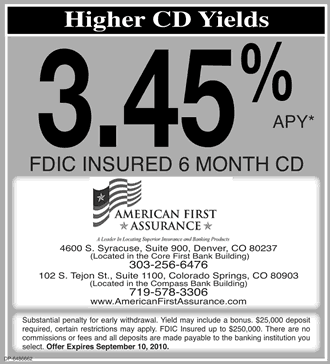
According to Bankrate, the current national average for a 6-month certificate of deposit is 0.37% APY, with their top yield being 1.25% APY. Highly-advertised Ally Bank offers less. So how can a tiny local non-bank that you’ve never heard of beat the rates of even online banks by over 2 whole percentage points?

It turns out that this is the newest version of the “free show tickets for timeshare presentations” marketing ploy. In this case, you must go into the office of an life insurance agent and listen to their sales pitch before getting the bank CD. Allan Roth over at CBS Marketwatch visited one of these offices and wrote about it. These non-bank salespeople are supplementing bank CDs from other FDIC-insured banks with their own money to reach the advertised rate. Questionable? Yes. Scam? Well, maybe not.

How It Works…

  1. You respond to the newspaper ad, and the terms always require you to physically come over to their office.
  2. After dealing with varying levels of life insurance and/or annuities salesmanship, you maintain your desire to open the account.
  3. You write the check for the CD directly to an FDIC-insured bank, with which the sales office is not officially affiliated with. This CD has a realistic rate, say 1% APY or similar.
  4. After a week or two, enough to make sure your funds cleared, the insurance people will cut you a check which together with the bank’s interest, add up to the advertised APY (assuming they are still in business).

How Much Extra Interest?

But really how much money are they losing on this? If you buy a six-month CD with an annual percentage yield (APY) of 3.35% and commit $25,000, you’ll earn approximately $418. With a APY of 1.25%, that is $156. The difference is $262. That’s basically the “bonus” that they are paying to get you into the door.

The article by Roth was initially published more than 8 months ago, so that would suggest that this marketing ploy is working and the word is spreading amongst insurance salespeople. Now, I’m sure some people will call about the CD and either not have the $25k or otherwise decided not to go for it, so that improves their bottom line. I am pretty certain that their ad targets those with large cash balances looking for income-type investments, so that they can pitch annuities with seemingly safe and high yields.

Warnings

If you still want to invest in one of these bank CDs + incentives, you should be prepared to be presented with annuities that will actually seem to yield even more that their advertised 3-month CDs. They will be carefully packaged to look like a good deal. They will be described as “insured” and “safe” because they will be backed by an insurance company. The actual yields will be computed by a formula too complex for most math PhDs to fully understand.

Next, you should check if the extra interest is really worth it due to the fact that you’ll have to deal with paper checks. If you are writing a check from a bank account that isn’t earning interest, that is some lost days of interest right there. Since you’ll be receiving the CD funds as a check as well, that’s another few business days of potential lost interest. Use my handy Ultimate Rate Chaser Calculator to see your net interest boost.

Finally, you should be sure to only write the check to an FDIC-insured institution. You should interact with them directly to ensure safe transfer of funds and proper opening of account. Double-check the CD renewal guidelines, so you are not stuck rolling the CD over for another 3 months.

Here’s a list of other companies that I found offering similar ads. Some are pretty shady in my opinion, and pretend to be an elite broker supplying high-yield bank CDs. Others are actually pretty transparent about the fact that they are offering a carrot for you to listen to their pitch. If you know of any others, please leave a comment below, and I’ll add it to the list.

  • Sun Cities Financial Group (http://www.scfg.com)
  • First Fidelity Tax & Insurance (http://www.firstfidelityamerica.com)
  • American First Assurance (http://americanfirstassurance.com)
  • Integrifirst USA (http://integrifirstusa.com)

I personally wouldn’t trust any of these guys with a $9.99 cut-n-paste GoDaddy website and a rented office with any of my personal details.

Best Banks With Consistently High Interest Rates

It’s one thing to find a bank with a high interest rate, and another thing to have that rate stay high. Many banks post teaser-like rates to attract deposits, and then hope you’ll be lazy and stay while they gradually become uncompetitive. A post yesterday on the NY Times Bucks blog explored ways to counter this.
Bankrate does a quarterly ranking of top banks with consistently high yields, which is “based on the number of times within the quarter that an institution’s yield was among the top 20 for the product category and the relative position of the yield in relation to the others in the product category.” But that’s only one quarter. So the Times asked them which banks have been on top for every single of the last eight consecutive quarters (Q1 2008 to Q4 2009). Good idea!

The next natural question: Which of these banks has the highest rates now? So I visited each site and found the current rates (as of 11/12/13) for their highest yielding savings account (or money market) and their 12-month CD. Since some of the rates were tiered, I picked the rate for a $10,000 deposit and also included the minimum balance needed to avoid fees. Here are the results, sorted by top overall yield:

Banks
Online Savings / Money Market
12-month CD
0.86% APY / 0.86% Intro ($5k+)
0.60% APY
Discover Bank
0.85% APY / 0.70% ($10k+)
0.95% APY
Ally Bank
0.85% APY (No min)
0.98% APY
Stonebridge Bank
1.25% APY ($1k+)
1.50% APY
Intervest National Bank
1.13% APY ($500+)
1.50% APY
American Bank
0.90% APY ($10k+)
1.30% APY
MetLife Bank
0.85% APY ($10k+)
1.15% APY
First National Bank of Baldwin County
0.50% APY ($5k+)
1.35% APY
M&T Bank, NA
0.50% APY (No min)
1.10% APY
UmbrellaBank (now Beal Bank)
0.50% APY ($1k+)
1.06% APY
0.15% APY ($10k+)
1.11% APY

2010 Savings Account & CD Rate Updates

Interest rates are still pretty low as we enter 2010, but I remind people that high nominal rates aren’t always better. Would you rather earn 3% with no inflation or 7% with 5% inflation? In any case, most of us have a chunk of cash and we should still try to earn the most no matter what the rate environment is like right now.
High-Yield Reward Checking Accounts
These are checking accounts that are still fully insured and pay a very high interest rate, as long as you jump through certain hoops each month. This also means that if you make a mistake you’ll forfeit virtually all your interest for that month, so it can be tricky. But for the very diligent, their rates are still averaging around 3-4% APY up to a certain balance limit. Here are a couple of the highest current account available nationwide:

  • Royal Bank of Missouri has their Majestic Checking paying 4.30% APY on up to $25k, which requires 10 check card purchases each month, a direct deposit or ACH transaction per month, and online statements only.
  • Sierra Reward Checking at 4.09% APY on up to $25k, which requires 12 check card purchases each month, a direct deposit/auto-withdrawal, one BillPay per month, and online statements only.

Online Savings Accounts
These accounts pay a yield that at least a full percentage point (1%) higher than any current money market fund, while still providing easy access and safety with minimal hassles. The primary drawback here is that you are limited to a maximum of 6 withdrawals per month, as it is a savings account. Here are account that represent the range of the best current rates.

  • EverBank is offering 1.10% APY for the first 6 months for new accounts. This rate is higher than any 6-month certificates of deposit currently available, which being available for withdrawals at any time. The rate is guaranteed stay in the top 5% of competitive accounts.
  • Alliant Credit Union has a non-promo savings account rate of 2.00% APY. Membership is restricted to people with affiliation to a qualifying organization, but the cheapest way around this is to become a member of a PTA or PTO.
  • Ally Bank Online Savings offers their “no fine print” savings account rate to 0.85% APY as of 11/12/13. No minimum balances, no monthly fees.
  • Veteran online bank Capital One 360 holds up the lower end at 0.75% APY.

Certificates of Deposit
If you are willing to restrict access to your money for a while, your yield can go a bit higher, but not that much. On the other hand, if you think rates will stay low, it may be worthwhile to lock some rates in. Keep an eye on the early-withdrawal penalties if you do think you’ll need to withdraw.

  • 3-Year CD at Pentagon Federal Credit Union will get you 3.0% APY. (6-mo. early withdrawal penalty.)
  • 5-Year CD at Pentagon Federal Credit Union will get you 3.5% APY. (6-mo. early withdrawal penalty.)

US Savings Bonds: Increasing Annual Purchase Limits With A Minor Account

Got a reader question today about the purchase limits for savings bonds:

Can I get around the $20,000 annual buying limit by purchasing I-bonds in my child’s name?

After doing some research, it does appear that yes, you can exceed the usual purchase limits by buying more bonds in the names of your children. Currently, the annual purchase limit is now $5,000 in paper bonds and $5,000 in electronic bonds per series type (EE/I) and per Social Security Number. Thus, a couple could buy a total of $20,000 per year in I-Bonds.

From the TreasuryDirect Change in Annual Purchase Limit FAQ:

I’m buying bonds for myself and my children through my TreasuryDirect account. How does the limit apply to these purchases?

You can buy up to $5,000 each year of electronic Series EE and I bonds in TreasuryDirect on which you are the primary owner, plus up to the limit of each series in the name of each child for whom you’ve established a linked account in the child’s name as primary owner. Minor linked accounts are sub-accounts of your own master account, but do not provide you with ownership rights to securities held in the linked sub-accounts.

The next question is do you have the ability to buy and sell the bonds? From the TreasuryDirect Establish an Account for a Minor page:

A Minor account is a custodial account you may establish for a child under the age of 18 if you are a parent, natural guardian, or person providing chief support. You may purchase, redeem, receive gift deliveries, and perform other transactions within the account on behalf of the minor. When the minor reaches age 18 and establishes his or her own Primary account, you may de-link the securities from the Minor account to move them to the newly established account.

Other considerations
When the child turns 18, it is then in their control and you can no longer perform most transactions like selling the bonds. In addition, there is also the education exclusion which can allow bond owners to avoid paying tax on the interest when used for qualified higher education expenses. If you’re thinking of doing this, remember that the bond has to be in the parent’s name, not the child’s name. More details here. More details on tax considerations here.

The High Price of Cheap Food? Nutrition vs. Cost

In the doctor’s office, I saw the cover article of a recent issue of Time magazine was Getting Real About the High Price of Cheap Food. Inside were some interesting facts. For one, people in the U.S. actually spend less on food now than 30 years ago:

For all the grumbling you do about your weekly grocery bill, the fact is you’ve never had it so good, at least in terms of what you pay for every calorie you eat. According to the USDA, Americans spend less than 10% of their incomes on food, down from 18% in 1966. Those savings begin with the remarkable success of one crop: corn. Corn is king on the American farm, with production passing 12 billion bu. annually, up from 4 billion bu. as recently as 1970. When we eat a cheeseburger, a Chicken McNugget, or drink soda, we’re eating the corn that grows on vast, monocrop fields in Midwestern states like Iowa.

I was most concerned with the actual nutritional value we get from our food. If you look at calories vs. cost, again we see that the foods with the most nutritional value cost the most. This is similar to my popular post exploring What Does 200 Calories Cost?, which found bread and pasta on the cheap end, and fresh fruits and vegetables on the expensive end.

Result: The cheap and filling food has way too many empty calories.

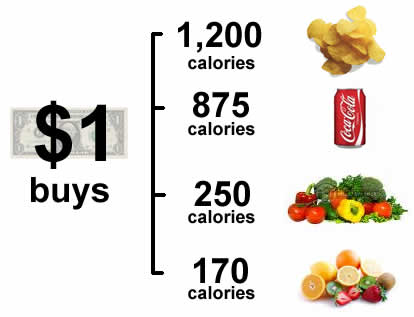
A study in the American Journal of Clinical Nutrition found that a dollar could buy 1,200 calories of potato chips or 875 calories of soda but just 250 calories of vegetables or 170 calories of fresh fruit. With the backing of the government, farmers are producing more calories — some 500 more per person per day since the 1970s — but too many are unhealthy calories. Given that, it’s no surprise we’re so fat; it simply costs too much to be thin.

So what is there to do? The Time article suggests that organic is one way to go:

Organic food continues to cost on average several times more than its conventional counterparts, and no one goes to farmers’ markets for bargains. But not all costs can be measured by a price tag. Once you factor in crop subsidies, ecological damage and what we pay in health-care bills after our fatty, sugary diet makes us sick, conventionally produced food looks a lot pricier.

Personally, I think we should start with finding the foods that provide the best balance between cost and nutrition. I’m still learning, but am trying to incorporate things like lentils, beans, and whole grains into my white-bread-and-rice world. Also, we’ve started buying a “box of vegetables” from a local organic farm (see Community Supported Agriculture). We don’t get to choose what goes in the box and are thus forced to be creative, but on a per-pound basis it costs less than half what a grocery store would charge for non-organic equivalents.

Best FDIC-Insured Interest Rate Roundup

I haven’t done an interest rate update in a while, as sadly there just hasn’t been that much to write about.

Reward Checking Accounts
These are checking accounts, usually through local credit unions, that pay a very high interest rate if you jump through some hoops each month. However, if you make a mistake you’ll forfeit virtually all your interest for that month, so it can be tricky. But for the very diligent, their rates are still averaging around 4-5% APY on balances up to $50,000. Here’s a recent example at 4.01% APY on up to $25k, which requires 10 check card purchases each month, a direct deposit/auto-withdrawal, and online statements.

For more, see my review of rewards checking accounts and also this list of accounts by state. I’d stick with small local credit unions with limited membership eligibility if possible, as the rates tend to be more stable. I myself got burned with nationally-advertised Evantage Bank that dropped its rates shortly after opening.

Online Savings Accounts Rate Updates

  • EverBank is offering 1.10% APY for the first 6 months for new accounts. This rate is higher than any 6-month certificates of deposit currently available.
  • Discover Bank is offering 0.85% APY on its new online savings account.
  • Ally Savings is offering 0.85% APY as of 11/12/13.

Certificates of Deposit
As stated above, for 6-months or less go with EverBank. In general, CD rates have been very low, and given how fast rates can rise as compared to how much further they might fall, I don’t see the benefit in locking up for money for a long period of time. Even a top 3-Year CD might get you 2.76% APY, according to MoneyAisle.

Remember, the new $250,000 FDIC & NCUA insurance limits per titled accounts are currently extended through 2013.

Online Business Savings Accounts

Someone e-mailed me about high-yield savings accounts for businesses. These can be a helpful tool to maximize interest income for all kinds of businesses with idle cash, including sole proprietorships, partnerships, LLC’s, and corporations. Here’s a quick rundown of some favorites.

Capital One 360 

The Capital One Consumer Bank for Business Savings Account pays 0.40% APY and has no minimum balance requirements or monthly fees. The benefit of this savings account is that you get the “it just works” factor of Capital One 360. There are no bells and whistles, it simply pays you a good interest rate, and provides easy and fast transfers to/from your existing business checking account.

Capital One / Costco
If you can open with at least $1000 and will keep at least $100 in your savings account, you can get a slightly higher interest rate of 1.40% APY with the Business Money Market Account from Capital One Bank. The perks of this account include checkwriting ability (you are limited to 6 withdrawals per month, 3 of which can be checks) and the sign-up bonuses for Costco users. Executive members can get $60 and Gold/Business members can get $20 after you open your first account and deposit $5,000 within 30 days.

(Considering upgrading to Executive? Buy a Costco membership certificate and get over $50 in coupons.)

Fidelity Investments
For maximum flexibility, you can open a Fidelity Account for Businesses and invest in anything from a money market fund to bond mutual funds to individual stocks. (Online stock commissions range from $8 to $19.95.) You’ll need $2,500 to open, but there are no minimum balance requirements or annual account fees. Currently, money market yields in general are very low. The Fidelity Cash Reserves fund currently has a yield of 0.28%. But if you were so inclined, you could invest in Treasuries, municipal bonds, inflation-protected bonds, or even dividend stocks.

Ask The Readers: Cash Savings vs. Paying Down Loans

There was a great response to my last Ask The Readers post: Parents Losing Home To Foreclosure!, so here’s another interesting question from one reader who’d like the input from other readers (yes, you!). It a variation of the old saving vs. paying down debt debate:

My wife and I were having a debate about savings as it relates to our home equity line of credit (HELOC). She has been brought up under the mantra of “always have at least 3 months of savings available,” which is fine by me, since I’ve always been a saver. Prior to getting the HELOC, we saw eye to eye pretty well. Now that we have a HELOC with about a $20k balance on it, I no longer would like to put any of my extra funds into a conventional “savings” account, but would rather use it to pay down the balance on the HELOC. To me, this is a game of interest rates — the HELOC is at 3.99% and the savings account is about 1%. I’m an IT guy who likes to see things in black-and-white whenever possible, and this is a case of that. As such, I’m willing to keep a ZERO (or negligible) balance in my savings account and just transfer funds from the HELOC account whenever we need money. I’m having a hard time selling her on this idea, though.

As I see it, I’d rather have $0 in my savings account and and $11k balance on my HELOC, whereas she’d rather have $9k in savings and a $20k balance on the HELOC. Even discounting the tax advantages of a HELOC, it seems like the higher interest rate accrued on the HELOC debt should override the low interest on savings. To me, it’s all one pot of money with differing interest rates. What’s your take? I’m sure this isn’t an uncommon circumstance.

The Liquidity Factor

This doesn’t directly answer the question, but I felt like one missing consideration is liquidity. Are home values decreasing in your area? How much home equity do you currently have? Unless it is a very high number, you may be in danger of having your HELOC frozen by your bank, which means you could be unable to borrow any more money at 3.99%. Many banks have been doing this recently.

If you were in the $0 in savings and $11k balance scenario and needed $1,000 to fix the car or more for some other emergency, what would you do without the HELOC? I am guessing that this is the situation that might worry your spouse, it would worry me!

Readers, what would you do?

Ally Bank Review: Online Savings, 9-month, and 12-month CDs

You may have been seeing a bunch of purple ads for something called Ally Bank recently. Actually, this “new” bank used to be GMAC Bank. But besides a cosmetic name change, they have revamped the website and tweaked their product offerings. Their pitch: “No minimum deposits. No monthly fees. No minimum balance. No sneaky disclaimers.”


Here are the products that are most compelling, with interest rates:

12-month CDAn Ally Bank 12-month CD has a top rate available for a 12-month CD with no minimum deposit restrictions. Interest is compounded daily.

No-Penalty 11-month CD – No early withdrawal penalty, daily compounded interest. With an uncertain future rate outlook, this seems like a good compromise between a savings account and a CD. If rates stay low (or get lower?!) you can stay in the CD and get a great return. If rates start rising, you can keep earning the higher rate up until you withdraw without penalty.

APY Online Savings Account – A competitive rate for an online savings account, a la Capital One 360 and such. No minimum balance, no fees, as you’d expect. Daily compounded interest. A differentiating factor to this account is their fast and easy transfers between Ally and your other banks.

FDIC Coverage & More
I noticed that they now also offer 24/7 telephone customer service and even share the current wait time online. Neat idea, I wish more sites did this:

Ally Bank is FDIC-insured, which means accounts are insured at least to $250,000. The new $250,000 limit was recently extended to at least the end of 2013, after which it is still $100,000.

Personal Finance Ratios: Savings-to-Income, Debt-to-Income, and Savings Rate-to-Income

There was a recent post on how much savings one should have at age 30 over at the Bogleheads forum. Being 30 myself, I was intrigued, but I am in the camp that believes that there is no right answer at 30. You’re still so young that you could just be out of school for a few years, and at that time it’s mostly up to how much student loan debt you racked up. Most important might be your ability to live under your means, and that you’re learning a valuable skill of some sort.

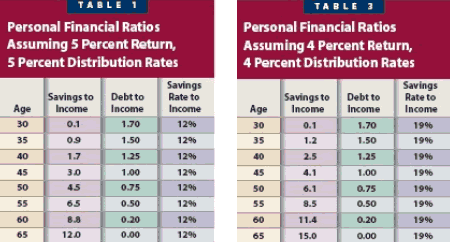
However, there was mention of a paper the the FPA Journal called Personal Financial Ratios: An Elegant Road Map to Financial Health and Retirement, where the author presents a variety of ratios as a rough benchmark to help clients determine whether they are on track to retire by age 65. These include Savings-to-Income, Debt-to-Income, and Savings Rate-to-Income.

The actual numbers depend on how you believe your investments will perform annually after inflation. (5% on the left table, 4% on the right.) Definitions below.

Savings include the current value of one’s investments, such as a 401(k), IRAs, brokerage accounts, investment real estate, and the value of any private business interests. The home is excluded as an investment. Debt comprises all debt, including mortgage, student loans, car, and consumer debt. Savings rate refers to the percentage of pre-tax income an investor is saving each year out of their total income.

A Hypothetical Example
Let’s take a look at a hypothetical 45-year-old individual to see how he might use the ratios to assess his financial circumstances. This person has the following financial statistics:

Salary $110,000
Mortgage $125,000
Auto Loan $25,000
Investments $260,000
Annual Savings $10,000
Employer 401(k) Match $3,000

Based on these statistics, the hypothetical individual ratios are as follows:

Savings to Earnings: $260,000 / $110,000 = 2.36
Debt to Earnings: ($125,000 + $25,000) / $110,000 = 1.36
Savings Rate to Earnings: ($10,000 + $3,000) / $110,000 = 11.8 %

As for us, we’re doing okay according to the table for age 30 regarding the savings-to-income ratios (0.5) and savings rate-to-income ratios (50%+). Our debt-to-income ratio is a bit high though, at around 2. Of course, this is highly dependent on our income number, which might change if we downshift with kids. I guess that’s another reason to wait until we’re a bit older to really start benchmarking like this.

One thing I don’t like about the ratios is that home equity is never included, because the author says that it’s hard to extract home equity. Okay, I agree on that point, but there is no mention of compensating for renters in the analysis. If I have no debt at age 65 + a paid-off house, that’s a lot different than no debt at 65 + still paying rent forever. My largest expense by far is housing (greater than all other expenses combined), and having that taken care of changes my retirement outlook drastically.

So… should we be using these ratios as a benchmark?

My Cash Transfer Hub: E-Trade Complete Savings Account

If you have your cash spread out across several bank accounts, whether it’s to help with chasing higher interest rates, paranoia, or saving for different goals, it can become quite a hassle to transfer money between accounts. I get asked all the time about how I juggle them all.
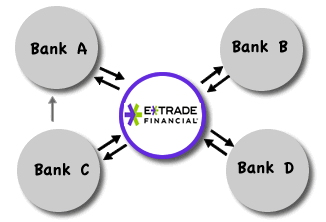
Part of my solution is to utilize the E-Trade Complete Savings account to connect them all together. This is basically E-Trade’s version of the online savings account which I’ve had for years. From my experience, the interest rate goes up and down (it is currently a so-so 1.20% APY), but it works very well for me as my bank “transfer hub”.

What are some important things to look for in such an account?

Basics and Cost
To start off, you’ll want a bank that offers a very low minimum balance and no monthly fees. A decent interest rate would be good, but a top interest rate isn’t critical since this isn’t where you’ll be keeping the bulk of your funds. You might want to keep a little bit of cash here in case you need to transfer some out quickly, and also to keep your bank from closing out an empty account.

Transfer System
Just about all banks allow ACH (automated clearing house) transactions, but you have one party initiate such transactions, and many “old-school” banks don’t do this. Accordingly, you’ll want your hub account to have the ability to “push” or “pull” funds in and out of multiple external bank accounts, with no transfer fee. Some banks only let you link one or two accounts, while others charge you to initiate transfers. For example, Bank of America allows you to move money to BofA for free, but charges if you move money from BofA using their system.

The E-Trade Complete Savings account has no minimum balance and no monthly fees, you can link an unlimited number of accounts, and there are no transfer fees.

Transfer Speed and Interest Crediting Policy
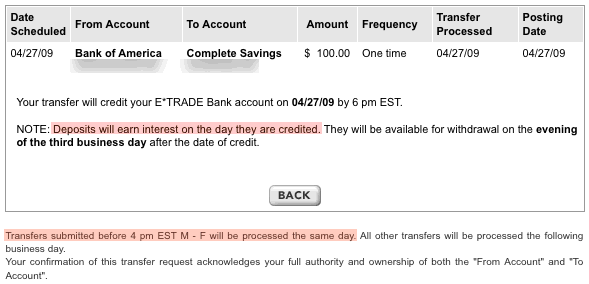
Of course, you’ll want fast transfer times. Some banks take 3 business days to move money in either direction, with your money in limbo and not earning interest anywhere. However, E-Trade is much faster, with transfer times of only 1 business day (which is how long it should take…). Also, if you schedule a funds transfer from an external account to E-Trade before the end of the business day at 4pm EST, they will actually credit your account the same day, even before they withdraw the money (although to prevent fraud you can only withdraw after 3 business days). However, you will start to earn interest starting that day, even before the money actually get debited from your source account!

Here is a sample screenshot:

In fact, if you initiate a transfer on Friday, you can earn interest at both accounts over the weekend. Here is a sample timeline:

  • Friday: You schedule a transfer of $1,000 from Bank A to E-Trade. You start earning interest at E-Trade on Friday. Nothing has happened at Bank A.
  • Monday: $1,000 is withdrawn from Bank A.
  • Thursday: $1,000 is now available to withdraw from E-Trade. You schedule a transfer to Bank B. $1,000 is debited from your account at E-Trade.
  • Friday: $1,000 arrives at Bank B.

Yes, it will take you a week to move the money, but you’ll be earning interest the entire time due to the double-interest over the weekend. Compare this to other accounts where the money is in limbo for 3-5 total days (3 business day + weekends/holidays) and you’re earning zero interest during that time.

For these reasons, I think the E-Trade Complete Savings account is very useful for the ability to connect any two bank accounts and move money relatively quickly with minimal interest loss. If you already trade stocks with them, it’s basically a no-brainer given the horrible yields on money market funds right now.

I have also heard good things about the transfer speed at GMAC Bank, but I don’t know if it’s quite this good as I don’t have any personal experience with them. I’m also concerned about how GMAC Bank will be around… if they get bought or sold to another bank, the website may disappear as well. I’m already going to miss my WaMu interface when I get forced over to Chase next month.

Savings I-Bonds Update: New Inflation (err… Deflation) Rate Announced

New inflation numbers for March 2009 were announced today, so it’s time for the usual semi-annual update:

New Inflation Rate
September 2008 CPI-U was 218.783. March 2009 CPI-U was 212.709, for a semi-annual decrease of 2.78%. Using this official formula, the variable interest rate for the next 6 months will be approximately -5.55%, depending on the fixed rate. What does this deflation mean for the investment returns for I-Bonds?

Buying Now = ~3.08% APR, 11-month investment
If you buy before the end of April, the fixed rate portion of I-Bonds will be 0.7%. You will be guaranteed an variable interest rate of 4.94% for the next 6 months, for a total rate of 5.64%. For the 6 months after that, the total rate will be zero, not -4.85%. This is due to the 0% floor on savings bond rates.

You can’t redeem until 12 months have gone by, and any redemptions within 5 years incur a 3-month interest penalty. However, a known “trick” with I-Bonds is that if you buy at the end of the month, you’ll still get all the interest for the entire month as if you bought it in the beginning of the month. Let’s say we buy at the end of this April, hold for the minimum of one year, and pay the 3-month interest penalty for redeeming within 5 years. You’ll be able to sell on April 1, 2010 for an actual holding period of 11 months.

This would leave you with a 5.64% return on your money for 6 months, and then nothing for 5 months. Overall, that’s a 3.08% annualized return, and you will be exempt from state income taxes on the interest as well. This is very competitive with current bank CD rates.

Buying Later? If you wait until May 1st, you will get a new unknown fixed rate minus 5.55%, for a virtually guaranteed composite rate of zero for the first 6 months. (The next 6 months will be based on an unknown rate based on future inflation.) Unless there is a big bump in the fixed rate that makes it a good long-term investment, sticking with banks or credit unions will likely give you a higher yield.

Low Purchase Limits
The annual purchase limit is now $5,000 in paper I-bonds and $5,000 in online I-bonds per Social Security Number. For a couple, that’s $20,000 per year. Buy online at TreasuryDirect.gov. As for paper, here is a post on how to buy paper savings bonds from your local bank. Some larger banks may have an electronic process.

For more background, see the rest of my posts on savings bonds.