Search Results for: High Interest Savings

Savings I-Bonds March/April 2012 New Rate Prediction: 2.21%

New inflation numbers for March 2012 were announced on April 13th, so it’s time for the usual semi-annual update and rate predictions.

New Inflation Rate
September 2011 CPI-U was 226.889. March 2012 CPI-U was 229.392, for a semi-annual increase of 1.1032%. Using the official formula, the variable interest rate for the next 6 months will be approximately 2.21%, depending on the upcoming fixed rate announcement (although really it’s highly unlikely to be anything but zero).

Purchase and Redemption Timing Tips
You can’t redeem until 12 months have gone by, and any redemptions within 5 years incur a interest penalty of the last 3 months of interest. A known “trick” with I-Bonds is that if you buy at the end of the month, you’ll still get all the interest for the entire month as if you bought it in the beginning of the month. It’s best to give yourself a few business days of buffer time though, since if you wait too long your effective purchase date may be bumped into the next month.

Buying in April

If you buy before the end of April, the fixed rate portion of I-Bonds will be 0.0%. You will be guaranteed the current variable interest rate of 3.06% for the next 6 months, for a total rate of 0 + 3.06 = 3.06%. For the 6 months after that, the total rate will be 0.0 + 2.21 = 2.21%. Let’s say we hold for the minimum of one year and pay the 3-month interest penalty. If you buy on April 30th and sell on April 1, 2013, you’ll earn a 2.27% annualized return for an 11-month holding period, for which the interest is also exempt from state income taxes. This is better than any 1-year bank CD that I can find right now, keeping in mind the liquidity concerns and the purchase limits.

Given the combination of current low rates and the fact that you lose the last 3 months of interest (again, for holding less than 5 years), it might be better to wait long enough to grab 12 full months of interest by holding for 15 months (14 buying late). If you buy on April 30th and hold until July 1st, 2013, you’d achieve a annualized return of ~2.26% over 14 months. After that, you can see what the new rates are and decide whether to keep holding them.

Buying in May

If you wait until May, you will get a new unknown fixed rate plus 2.21% for the first 6 months. I would bet my own money that that the fixed rate will be 0.0% again (any takers?), given current real yields for TIPS. The next 6 months will be based on an unknown rate based on future inflation. If there is high inflation for the next 6-month period, this may get you a higher rate sooner, but buying in April will eventually get you the same rate anyway.

My personal opinion is that you might as well lock on the guaranteed above-market rates for 12 months by buying in April instead of buying in May. You could always wait all the way until in October for the next rate announcement, but if you have the cash now you’ll have the opportunity cost of lower rates until then.

Low Purchase Limits
The annual purchase limit is now $10,000 in online I-bonds per Social Security Number. For a couple, that’s $20,000 per year. Buy online at TreasuryDirect.gov, after making sure you’re okay with their security protocols and user-friendliness.

For more background, see the rest of my posts on savings bonds. I’m keeping all of mine for the foreseeable future, due to their tax deferral possibilities and other unique advantages. Compare the rates on these savings bonds to what you’re earning on your FDIC-insured bank deposits, and you may start hoarding them like me.

Savings Bonds vs. Bank Savings Accounts

(In this post, I’m not going to provide all the background information on savings bonds that I normally do. For that, please read the older posts in my Savings Bonds category.)

When the Treasury announced the $10,000 purchase limit for 2012, a few readers asked if you should buy savings bonds in January, or wait until later in the year. Since then, a few things have happened. For one, the Federal Reserve has basically said that they will keep their target fed funds rates at zero until late 2014, while setting a target inflation rate at 2% annually. Translation: Interest rates on savings accounts and similar products will be remain crap while the things we buy get more expensive.

Also, we have another month’s worth of Consumer Price Index (CPI) data which is how the inflation rate is defined for savings bonds. The next 6-month variable rate update will be based on the CPI-U change between September 2011 and March 2012. We are halfway there:

CPI-U
Sep 2011 226.889
Oct 2011 226.421
Nov 2011 226.230
Dec 2011 225.672
Jan 2012 ?
Feb 2012 ?
Mar 2012 ?

You can see that inflation is actually negative over these three months. However, user MoneyOCD of Bogleheads posted this informational chart showing that in recent years there have been many periods of negative inflation from September to December, only to be followed by periods of higher inflation from December to March.

Basically, making predictions now is premature. If you buy in January through April, you will get a fixed rate of 0%, and a variable rate of 3.06% for six months. Given the interest rate environment, this is pretty much one of the best options for “safe” money. If you wait all the way until May, you’ll get something new based on whatever happens to inflation the next few months along with a fixed rate that will most likely be zero again. The inflation rate resets every 6 months based on your purchase month.

In general, if you have the money and are looking to put it in shorter-term, low risk investments that are guaranteed not to lose money (in terms of face value), I would be maxing out my limit on savings bonds for 2012. Keep in mind that savings bonds can’t be cashed in for an entire year after purchase. My personal opinion on the short-term? I don’t see any benefit in waiting until May. If you have money to put aside now, buy Series I savings bonds now. If you don’t, just wait until you do. The rate is already higher than savings accounts or 1-year CDs, and by waiting around in a 0.75% savings account or 1-year CD you’ll be missing out in interest.

If you’re looking to buy in January, I’d put in your order today at TreasuryDirect. It’s better to buy near the end of the month, as you get credit for the entire month no matter if you buy at the beginning or the end.

Cheap: The High Cost of Discount Culture [Book Review]

Cheap: The High Cost of Discount Culture by Ellen Ruppel Shell covers a wide variety of topics, but the main idea I got from reading it, was that we are too focused on price, and not enough on value. We have shifted from quality, durability, and craftsmanship towards quantity at the lowest possible price. I previously wrote about how it’s harder to judge quality these days as it relates to Coach Outlet stores. Next time you buy something, think about what you actually know about who made the product, the materials or ingredients used, and how long it will last before you have to buy another one.

Thanks to globalization and a relentless pursuit of efficiency, we now have $1 chicken sandwiches, $5 toasters, and $10 IKEA coffee tables. That saves us money, right? However, also notice that it’s often the crap in our lives that gets a bit cheaper. The real essentials – rent, education, healthcare, gas, never seem to get less expensive. On top of that household wages are stagnant, partially because all the jobs making stuff have gone to the countries with cheapest labor before our workforce has had a chance to learn to do something else. Look at the current unemployment rate. So are we really coming out ahead?

The book includes an interesting history of the evolution of retailing and the creation of the discount superstore. There was a time before Wal-mart when small shops sold specialized products through educated salespeople. Now, everything is propelled by mass advertising everywhere, followed by do-it-yourself shopping. Now, I personally like reading tons of peer reviews on Amazon before buying a product, but you have to admit that the genius of a store like IKEA is that so much of the cost is shifted onto the consumer. We load up the huge boxes onto a shopping cart ourselves, cram it into our car, drive it back home (paying for the gas), and build it ourselves with hours of labor.

There is also the interweaving of behavioral economics topics you may be familiar with by academics like Daniel Kahneman and Dan Ariely. For example, you probably get excited when you buy something marked down 60% at the mall. We’re all genetically wired to get hyped up for that, so it’s not surprising. Well, these days basically everything is marked down. Only 20% of department store merchandise is actually sold at full price. If everyone is getting the same “deal”, is it still a deal or just manipulation?

On a related note, discount stores often tout “everyday low prices”, but they really just try to compete hard on things that we buy most frequently and are most familiar with. Wal-mart actually has higher than average prices on about 1/3rd of its inventory. On the items for which prices are lower, the savings is 37 cents, with about 1/3rd of items carrying a savings of no more than 2 cents. The loss leaders draw us in and make us feel like we’re saving money, but the other things we toss in our basket make the profit.

Although some of these trends are unlikely to be reversed, we should remember that it’s not all about the price tag. An example of how things “should” work is the grocery store Wegman’s, which I am not familiar with but sounds a lot like Trader Joe’s on the West Coast. Locally-sourced products, good wages and benefits for employees, and good service create an atmosphere that is not solely focused on price (although it is still an important component).

3.25% APY Savings Account – Deposit Limits, Ohio Residents Only

Reader Alison shares a unique savings account program for residents of Ohio. The SaveNOW program is a higher interest savings account supported by the state in order to encourage savings. The maximum balance on this account is $5,000 and pays 3.25% APY. The fine print regarding deposit limits is a bit confusing. It says:

Limits single deposits to $500 at a time with the exception of lump sum payments such as; a tax return, insurance settlement or inheritance payment

If I read this to mean that each resident to deposit a maximum of $500, every other year, then it would take nearly 20 years to reach the maximum? Otherwise, you might overpay taxes to max out the benefit. In any case, this is not going to make anyone rich, but can be a nice incentive given the program’s goals. A couple could deposit $1,000 every other year up to $10,000 combined.

Does anyone know of similar programs for other states?

Best Banks With Consistently High Interest Rates – 2013 Edition

Will the rate on your high-yield savings account stay high? It’s always hard to tell. Some do, and some banks seem to just give up. The NY Times Bucks blog shared a list of the top 10 banks offering high savings accounts rates over time for the 1st quarter of 2013 as compiled by MoneyRates, of which nine banks that have made the list for three quarters in a row. I’ve looked up their current APYs as well.

Bank Name
Historical Rate
(for ranking purposes)
Current Savings Account Rate (APY)
Discover Bank
1.16%
0.85% APY
1.13%
0.85% APY
1.10%
0.75% APY
Ally Bank
1.01%
0.85% APY

Reminder: Savings Bonds Monthly Purchase Deadline Tips

Here’s a reminder regarding an opportunity to buy savings bonds near the end of May and receive an annualized return of 2.51% over the next 11 months. This would be 1% more than the highest current CD rates, with potential for continued higher interest. See this previous post for more details. The main catch to this opportunity is that you will not be able to sell your savings bonds at all for the next 11 months.
The reason why you want to buy at the end of the month is that savings bonds are labeled by month, and as long you buy anytime in May, it will be stamped with a May 2011 date. Then, on the first day of May 2012, you can redeem for an entire year’s worth of interest. However, you don’t want to miss the deadline, because then your bond will end up an April 2011 bond. The annual purchase limit is currently $5,000 in paper I-bonds and $5,000 in online I-bonds per Social Security Number. For a couple, that’s $20,000 per year.

For electronic bond purchases, Ken of DepositAccounts conducted an experiment as to how late you can wait to buy them on TreasuryDirect. To summarize, in order to avoid this, you should enter your purchase order a minimum of two business days before the last day of the month. For peace of mind, I would pad it 4 business days. You can schedule your purchase ahead of time online (recommended).

For paper bond purchases, you can visit your local bank and ask to buy them. Here are detailed instructions. Not all banks do this, so check ahead of time. The issue date of the savings bond will be the same day that the bank accepts payment. This date will be noted clearly on the application, and the bank should also stamp it to confirm. In this case, if you are familiar with the bank and you have the money available, you could conceivable wait until the last day the bank is open before the end of the month. Again, I’d try a couple days beforehand to be safe.

Savings I-Bonds March 2011 CPI Update: 4.60% Variable Rate = Competitve Interest Rates

New inflation numbers for March 2011 were announced on April 15th, so it’s time for the usual semi-annual update and rate predictions. This time around presents a good buying opportunity for a low-risk investment with interest rates higher than current bank CDs.

New Inflation Rate
September 2010 CPI-U was 218.439. March 2011 CPI-U was 223.467, for a semi-annual increase of 2.30%. Using the official formula, the variable interest rate for the next 6 months will be approximately 4.60%, depending on the upcoming fixed rate announcement.

Purchase and Redemption Timing Tips
You can’t redeem until 12 months have gone by, and any redemptions within 5 years incur a interest penalty of the last 3 month of interest. A known “trick” with I-Bonds is that if you buy at the end of the month, you’ll still get all the interest for the entire month as if you bought it in the beginning of the month. It’s best to give yourself a little buffer time though, since if you wait too long your effective purchase date may be bumped into the next month.

Buying in April

If you buy before the end of April, the fixed rate portion of I-Bonds will be 0.0%. You will be guaranteed an variable interest rate of 0.74% for the next 6 months, for a total rate of 0 + 0.74 = 0.74%. For the 6 months after that, the total rate will be 0.0 + 4.60 = 4.60%. Let’s say we hold for the minimum of one year and pay the 3-month interest penalty. If you buy on April 30th and sell on April 1, 2012, you’ll earn a 1.66% annualized return for an 11-month holding period, for which the interest is also exempt from state income taxes. This is better than any 1-year bank CD that I can find right now, keeping in mind the liquidity concerns and the purchase limits.

Given that you lose the last 3 months of interest (again, for holding less than 5 years), it might be better to wait long enough to grab that 4.60% for the entire 6-month period. If you buy on April 30th and hold until July 1st, 2012, you’d achieve a annualized return of ~2.29% over 14 months.

Buying in May

If you wait until May, you will get a new unknown fixed rate plus 4.60% for the first 6 months. My guess for the fixed rate would be 0.0% again, given current real yields for TIPS. The next 6 months will be based on an unknown rate based on future inflation. Worst case scenario, there will be zero inflation and you get paid nothing. Even in that case, if you buy on May 31st, 2011 and sell on May 1st, 2012, you would end up with an annualized return of 2.51% over 11 months.

If you are looking simply for the highest interest rate for a short period, then it would likely be better to wait until May 31st to buy up your savings bonds this year. If CPI inflation is very low or negative for the next 6 months and you are holding for at least 14 months, then it may end up being slightly better to buy in April. In the end, there’s more potential upside for buying in May, so that’s what I plan to do.

Low Purchase Limits
The annual purchase limit is now $5,000 in paper I-bonds and $5,000 in online I-bonds per Social Security Number. For a couple, that’s $20,000 per year. Buy online at TreasuryDirect.gov. As for paper, here is a post on how to buy paper savings bonds from your local bank. Some larger banks may have an electronic process.

For more background, see the rest of my posts on savings bonds. I’m keeping all of mine for the foreseeable future, due to their tax deferral possibilities and other unique advantages.

What Is A “Safe” Savings Rate? How About 16.62%

The term “Safe Withdrawal Rate” (SWR) usually refers to the amount of your portfolio that you can withdraw each year in retirement safely without running out of money. The “4% rule” is often used, which says that if you want $40,000 inflation-adjusted every year safely , you need $1 million as your target.

Reader Dave thoughtfully sent me an interesting Financial Advisor magazine article about an upcoming academic paper by Dr. Wade Pfau that takes a look at this from another angle. What if you wanted to figure out a “Safe Savings Rate”?

Let’s say you save for 30 years, and then retire (spend) for 30 years. The traditional SWR only depends on the 30-year period when you are saving reach that target number. Instead, what if you looked at the entire 60 year period together. This ends up smoothing things out, because periods of high return are often followed by periods of low return, and vice versa.

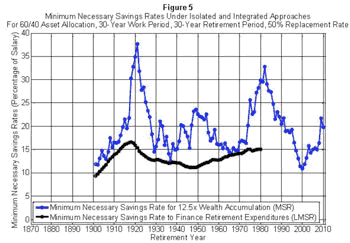
Here are the baseline assumptions. The goal is to withdraw 50% of current salary, inflation-adjusted, during retirement. You maintain a constant asset allocation of 60% stocks and 40% bonds (T-Bills). Results are in the chart below. The blue line is the saving rate according to the 4% rule, and the black line is based on the new 60-year test period using actual investment returns.

Based on market data since 1871, a savings rate of 16.62% would have worked every time. As you can see the black line is also much more consistent over time. Can everyone manage that? Maybe not, but few people are satisfying the 4% rule as well.

The given scenario is not one-size-fits-all, but it would be interesting if this research was expanded into some sort of retirement calculator. For example, all other things held the same, if you saved for 40 years, the safe saving rate drops to 8.77%. If you saved for only 20 years, the safe saving rate rises to over 30%. I’ll have to wait for the published paper to see what happens if you go a bit riskier into say 80% stocks/20% bonds, or if it accounts for changing allocations over time.

Update: Here is a link to the working paper [PDF].

Stable Value Fund 2011 Interest Rate Announced

If you have a 401(k), 403(b), or similar retirement plan, you may have an investment option called a stable value fund. Sometimes it goes by a different name like Guaranteed Pooled Fund, but they are always marked as a conservative investment. The pitch is basically the higher interest rate of longer-term bonds, with the relatively liquidity and stable principal value of a money market fund. I explored the risks and rewards of stable value funds before and currently hold them as part of my bond allocation.

My specific stable value fund is run by Transamerica Financial Life Insurance Company (TFLIC) and offered an interest rate of 3.5% for all of 2010, which was much higher interest than any other similar bond investment was going to pay me. Then they told me that until February 28th, 2011, the interest rate would be 3.0%. Finally, I just received a letter that told me that the interest rate from March 1st to December 31st, 2011 would be lowered to 1.8%.

So, should I stay or should I go? Interest rates continued to drop in 2010, so I did expect them to lower their rate.

Online savings accounts like Capital One Consumer Bank are paying around a low 0.75% APY, and I have no access to something like that in my 401k. They recently announced a self-directed option through Schwab, although I need to find more details about how much transaction costs would be. The Vanguard Short-Term Treasury Fund (VFISX) is currently yielding only 0.66%. Taking a look at current Treasury yields shows the 2-year at 0.78% and the 5-year at 2.30%.

So the interest rate itself is still pretty competitive relative to other “safe’ investment options. My other bond alternative inside the account is the huge PIMCO Total Return fund (PTTRX) with a 3.12% yield and 4.8 year duration, which did pretty well for me when I had it but I worry about asset bloat with $240 billion is assets, manager risk, and interest rate risk.

In the absence of any significantly better options, it looks like I’m staying put.

Found an Old Paper EE Savings Bond

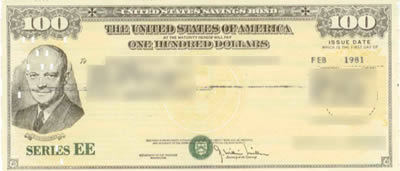
Here’s a blast from the past. I think I was reading an article about how savings bonds stop earning interest after 30 years, and so I asked my mom if she bought any bonds when I was born. I don’t know why, I figured that’s just what people did back then. It turned out she did, and the earliest bonds happen to stop earning interest next this month. She dug them out of storage, and sent me a scan of them:

She bought an EE savings bond with a face value of $100 for the purchase price of $50 in February of 1981. I was two years old. Using the savings bond calculator at TreasuryDirect, I found the current value to be $300.04. So over the last thirty years, the value went up 6x. This works out to an annualized return of about 6.1%.

According to TreasuryDirect.gov, for bonds issued before November 1982:

Bonds which have not reached final maturity are earning interest at either guaranteed or market-based rates; whichever produces the higher redemption value.

The guaranteed “original maturity period” was 9 years for this bond, which meant it was guaranteed to be worth the face value of $100 after 9 years. That works out to an 8.0% annual interest rate. If only we could get such a guaranteed return now, but the early 80s was a time of high inflation.

When the original maturity period ends, the bond enters a new 10-year maturity period where the government can reset the minimum rate. That’s why my bond is now earning only 4%. I can’t find the market rate for 1981, though. I could probably calculate it if I really wanted to, as it is defined as “85% of the average of 5-year Treasury marketable security yields”. The market rate in November 1982 was 13.05%!

If you have some old savings bonds, find them before they stop earning interest completely. In addition, the IRS supposedly requires you to report the interest as earned in the year of final maturity, even if you don’t redeem it. If you have a lost, stolen or destroyed savings bond, you will need to fill out Form PD F 1048. Also check out this Treausury Hunt page.

Potential Unique Advantages of Savings I-Bonds

Even though the current interest rates on Series I Savings Bonds aren’t much higher than other alternatives, these I-Bonds do have some unique characteristics that can keep them attractive.

Inflation-Linked Returns

Along with TIPS (Treasury Inflation-Protected Securities), these are the only investments you can make that are explicitly tied to a measure of U.S. inflation. (Some foreign-countries also have inflation-linked bonds.) Interest rates don’t always move perfectly with inflation, so having such protection can be helpful.

Exempt From State and Local Income Taxes

The interest from I-Bonds are exempt from state and/or local income taxes. Of course, this is only an advantage if you are subject to such taxes.

Tax Deferral

You can choose to either report your interest earned on an annual basis (like a bank CD), or have the interest reporting deferred until maturity or redemption. This can be especially advantageous if you are in a relatively high tax bracket now, but sometime in the future you believe you will have at least one year where you will have lower taxable income (possibly on purpose) and thus can redeem at a lower tax rate (perhps even zero). I-Bonds keep earning interest for up to 30 years.

Educational Tax Exclusion

If you meet the requirements, you can even avoid federal income taxes completely when paying qualified higher education expenses at an eligible institution. More information at this TreasuryDirect page.

According to this FinAid.org page (via Bogleheads Wiki), you can even contribute your proceeds to a 529 plan or Coverdell Educational Savings Account.

Series EE and I US Savings Bonds issued after December 31, 1989 may be redeemed tax-free in order to contribute the proceeds to a section 529 plan or Coverdell Education Savings Account. (To take advantage of this, file IRS Form 8815 to claim an exclusion for the interest after rolling the proceeds of these US Savings Bonds into a section 529 college savings plan or Coverdell Education Savings account. Write “529 College Savings Plan” or “Coverdell Education Savings Account” in the answer to 1(b), where it asks for the name of the educational institution. The specific citation in the tax code for this guidance is IRC Section 135(c)((2)(C).)

One of the restrictions is an income phase-out. In 2010, full phase-out occurs at a modified adjusted gross income of $135,100 for married filing jointly filers and $85,000 for single filers.

Updated 529 College Savings Asset Allocation: Added Stocks, 10-Year 5% APY CD

Since we’re on the topic of college tuitions, I have recently adjusted the investment mix in my Ohio CollegeAdvantage 529 Plan. As I’ve mentioned before, I choose a very conservative mix because I think a 20-year or less horizon with a 4-year or less withdrawal period is actually a pretty short horizon. I just want to see gradual but reliable increases in my balances. In contrast, I view retirement as a 30 year horizon with another 20-30 year withdrawal period.

Previous Asset Allocation

My original asset allocation was 100% Treasury Inflation-Protected Securities (TIPS) through the Ohio 529’s Vanguard Inflation-Protected Bond Option which is essentially the Vanguard Inflation-Protected Securities Fund (VIPSX) with a slightly higher expense ratio. Back in 2009, I ran a comparison of the CollegeSure Tuition-Indexed CDs vs. Inflation-Protected Bonds, and picked TIPS. However, back then the real yield was 1.7%, and it is now 0.49%. Accordingly, the fund has a pretty good performance since then.

Updated Asset Allocation

20% Stocks (simple low-cost index option)
40% Inflation-protected bonds
40% Bank CD 10-year initial term, paying 5% APY.

Adding Stocks

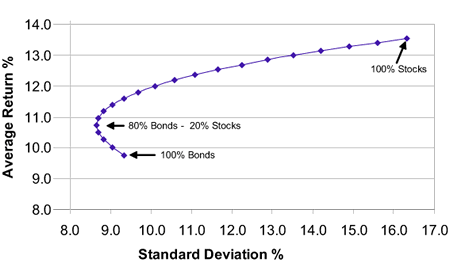
The reason I chose to add stocks is that historically, adding 20% of stocks to a portfolio has actually reduced volatility while increasing returns. Here is a chart from my Choosing An Asset Allocation series of posts. As I get closer to college start date, this 20% portion will go down to zero.

altext

Adding a 5% Bank Certificate of Deposit

Right now, a regular nominal 10-year Treasury Bond yields less than 2.50%. The real yield on a 10-Year TIPS bond is 0.95%, so the market is basically predicting inflation over the next 10 years to be about 1.50% annually.

However, the Ohio 529 plan offers a FDIC-insured certificate of deposit with a 10-year term earning 5% APY through Fifth Third Bank. (Heads up via Bogleheads.) That’s quite a big boost in yield. For every $10,000 I put in today, I’m guaranteed over $15,000 in 10 years. Early-withdrawal penalties are steep at half of accrued interest, so I had to be sure I wouldn’t need the money sooner.

As long as the real yield on the TIPS fund stays below 1%, then as long as inflation stays below 4% over the next decade the CD will win out over TIPS. If inflation somehow goes nuts, then the TIPS will keep the portfolio from falling too far behind. (Hopefully the stocks will help out as well.)

Since these are all in a 529 plans, the gains will be tax-free if used for qualified college expenses, which is good because otherwise federal and state taxes on a bank CD would be pretty high for us.