
I own inflation-linked bonds as part of my investment portfolio. Specifically, Treasury Inflation-Protected Securities (TIPS) make up about 1/3rd of the bond portion, or 10% of my total portfolio. I go into more detail in my post Reasons To Own TIPS, but essentially they pay interest based on a fixed real yield plus ongoing inflation. To simplify: if the real yield is 1% and inflation is 3%, they pay 4%.
Traditional “nominal” Treasury bonds simply pay a flat interest rate that doesn’t change with inflation (i.e. 3%). The difference between the TIPS real yield and the nominal Treasury yield is at any given time is what inflation would have to be for them to pay out the exact same total yield, called the “breakeven inflation rate”. If the real yield on TIPS is 1% while the nominal rate is 3% at the same moment, then the breakeven rate is 2%. You could call it a market-based prediction of future inflation.
It turns out that 10-year TIPS bonds that matured over the last several years mostly underpeformed regular nominal Treasuries, as the actual inflation turned out to be less than the breakeven inflation rate. David Enna of TIPS Watch created the interesting chart below comparing the final performance of TIPS vs. nominal Treasury bonds maturing over the last several years, where green means that TIPS “won” and red means TIPS “lost” in terms of total return. I removed some columns and highlighted the initial breakeven rate (the market-based guess) and the actual inflation rate.
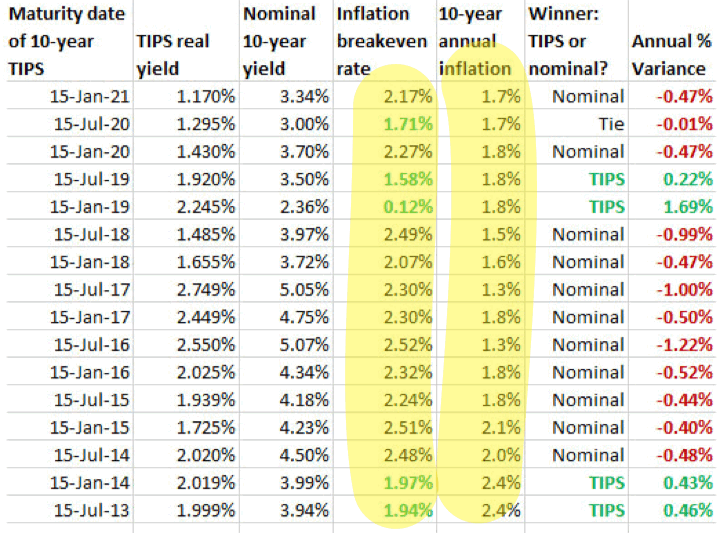
Enna states:
Still, the market-determined inflation breakeven rate measures sentiment and should not be viewed as an accurate prediction. In fact, the market often does a lousy job of predicting future inflation. The fact is, over the last decade, investors have been betting on higher inflation than actually resulted, and that has led to TIPS (in general) under-performing nominal Treasuries of the same term.
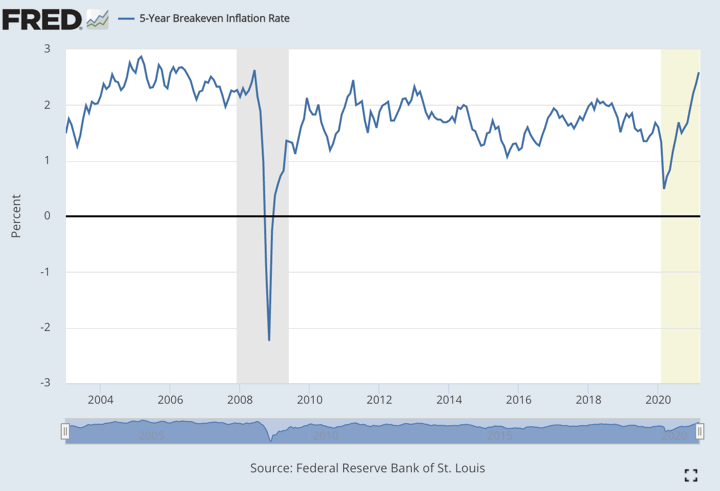
I have read some articles suggesting that you could adjust your TIPS holdings based on the real yield, but perhaps another way is to adjust your holdings based on inflation breakeven rate instead. You can track the 5-year and 10-year breakeven inflation rates at FRED. As of this writing in March 2021, the breakeven inflation rate has been rising very quickly since dropping quickly in early 2020.
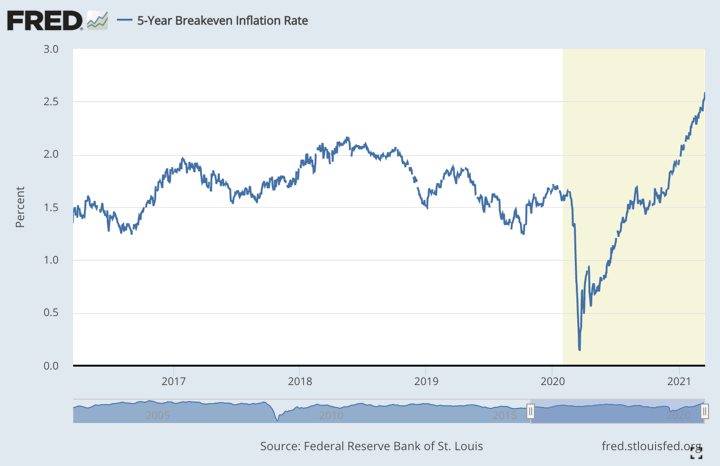
The last time that the breakeven inflation rate dropped so drastically was in 2009. As with stocks, it can pay off to buy when everyone else is afraid. I was lucky to buy a chunk of long-term TIPS in 2009, but I didn’t buy much in 2020 since the real yields were still quite low.
I hold Treasuries, TIPS, and FDIC/NCUA-insured CDs because I like my “safe” assets to be of the highest quality, with no worries about getting both my principal and interest. In addition, TIPS also serves as a hedge against higher-than-expected inflation. However, that also means I might suffer if there is lower-than-expected inflation. My “insurance” didn’t pay out over the last 10 years, but that’s okay. I’m also fine if my don’t make a claim on my auto insurance, homeowners insurance, (and definitely life insurance!).
p.s. If you want to buy TIPS, these days you should consider buying Series I Savings Bonds first these days (up to the purchase limits). Their 0% real yield is better than the negative real yields on nearly all TIPS right now.
 While it seems that Robinhood and Gamestop are officially the new gambling version of a multiplayer online video game (
 Instead of focusing only on






 The last 10 years of stock market returns have been pretty remarkable. If you invested $100,000 in the S&P 500 in the year 2000 and held it though the dot-com crash and financial crisis, you would be closing in on $300,000 today. However, if you retired in 2000 with a portfolio invested in the S&P 500 and used a 4% withdrawal rate (increasing each year by 3% for inflation), your nest egg would less than $50,000 and on a path to zero!
 While poking around the Bogleheads investing forum, I came across a
  One of the biggest problems in retirement planning is making sure a pile of money lasts through your retirement. I have read hundreds of articles about this topic, and still haven’t a perfect solution to this problem. Most recently, I looked into the idea of



 The Best Credit Card Bonus Offers – 2025
 Big List of Free Stocks from Brokerage Apps
 Best Interest Rates on Cash - 2025
 Free Credit Scores x 3 + Free Credit Monitoring
 Best No Fee 0% APR Balance Transfer Offers
 Little-Known Cellular Data Plans That Can Save Big Money
 How To Haggle Your Cable or Direct TV Bill
 Big List of Free Consumer Data Reports (Credit, Rent, Work)