Search Results for: Buying Stocks

MMB Portfolio 2021 Year-End (Late Update): Asset Allocation & Performance

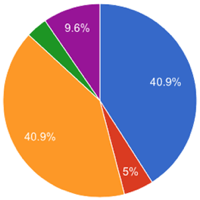
portpie_blank200Here’s my (late) quarterly update on my current investment holdings, as of 1/23/22, including our 401k/403b/IRAs and taxable brokerage accounts but excluding a side portfolio of self-directed investments. Following the concept of skin in the game, the following is not a recommendation, but just to share an real, imperfect, low-cost, diversified DIY portfolio. The goal of this portfolio is to create sustainable income that keeps up with inflation to cover our household expenses.

Actual Asset Allocation and Holdings
I use both Personal Capital and a custom Google Spreadsheet to track my investment holdings. The Personal Capital financial tracking app (free, my review) automatically logs into my different accounts, adds up my various balances, tracks my performance, and calculates my overall asset allocation. Once a quarter, I also update my manual Google Spreadsheet (free, instructions) because it helps me calculate how much I need in each asset class to rebalance back towards my target asset allocation.

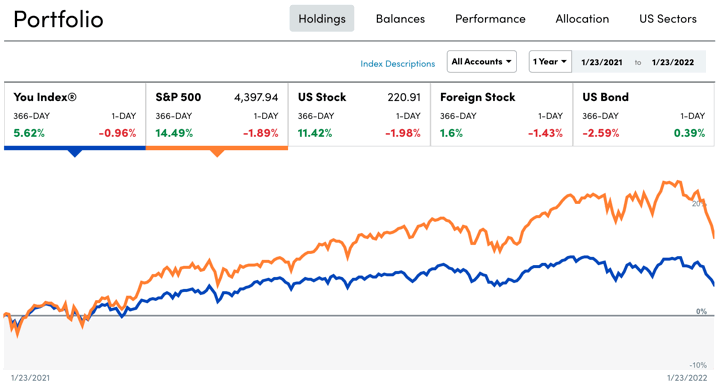
Here are updated performance and asset allocation charts, per the “Allocation” and “Holdings” tabs of my Personal Capital account.

Stock Holdings
Vanguard Total Stock Market (VTI, VTSAX)
Vanguard Total International Stock Market (VXUS, VTIAX)
Vanguard Small Value (VBR)
Vanguard Emerging Markets (VWO)
Avantis International Small Cap Value ETF (AVDV)
Cambria Emerging Shareholder Yield ETF (EYLD)
Vanguard REIT Index (VNQ, VGSLX)

Bond Holdings
Vanguard Limited-Term Tax-Exempt (VMLTX, VMLUX)
Vanguard Intermediate-Term Tax-Exempt (VWITX, VWIUX)
Vanguard Intermediate-Term Treasury (VFITX, VFIUX)
Vanguard Inflation-Protected Securities (VIPSX, VAIPX)
Fidelity Inflation-Protected Bond Index (FIPDX)
iShares Barclays TIPS Bond (TIP)
Individual TIPS bonds
U.S. Savings Bonds (Series I)

Target Asset Allocation. This “Humble Portfolio” does not rely on my ability to pick specific stocks, sectors, trends, or countries. I own broad, low-cost exposure to asset classes that will provide long-term returns above inflation, distribute income via dividends and interest, and finally offer some historical tendencies to balance each other out. I have faith in the long-term benefit of owning publicly-traded US and international shares of businesses, as well as high-quality US federal and municipal debt. My stock holdings roughly follow the total world market cap breakdown at roughly 60% US and 40% ex-US. I also own real estate through REITs.

I strongly believe in the importance of “knowing WHY you own something”. Every asset class will eventually have a low period, and you must have strong faith during these periods to truly make your money. You have to keep owning and buying more stocks through the stock market crashes. You have to maintain and even buy more rental properties during a housing crunch, etc. You might own laundromats or vending machines or an online business. A good sign is that if prices drop, you’ll want to buy more of that asset instead of less.

Find a good asset that you believe in and understand, and just keep buying it through the ups and downs.

I do not spend a lot of time backtesting various model portfolios, as I don’t think picking through the details of the recent past will necessarily create superior future returns. Usually, whatever model portfolio is popular in the moment just happens to hold the asset class that has been the hottest recently as well. I’ve also realized that I don’t have strong faith in the long-term results of commodities, gold, or bitcoin. I’ve tried many times to wrap my head around it, but have failed. I prefer things that send me checks while I sleep.

Stocks Breakdown

  • 45% US Total Market
  • 7% US Small-Cap Value
  • 31% International Total Market
  • 7% International Small-Cap Value
  • 10% US Real Estate (REIT)

Bonds Breakdown

  • 66% High-Quality bonds, Municipal, US Treasury or FDIC-insured deposits
  • 33% US Treasury Inflation-Protected Bonds (or I Savings Bonds)

I have settled into a long-term target ratio of 67% stocks and 33% bonds (2:1 ratio) within our investment strategy of buy, hold, and occasionally rebalance. This is more conservative than most people my age, but I am settling into a more “perpetual” as opposed to the more common “build up a big stash and hope it lasts until I die” portfolio. My target withdrawal rate is 3% or less. With a self-managed, simple portfolio of low-cost funds, we can minimize management fees, commissions, and taxes.

Holdings commentary. I’ve been investing steadily for over 15 years, and the results have exceeded my expectations. There is ALWAYS something that looks worrying. Looking back, my best investment decisions were to NOT do anything different during times of stress. Maybe 2022 will have more such times. Ignore the noise, if you can.

I often wonder how I can teach my children such patience in investing, and that seems to be the hardest aspect.

Performance numbers. According to Personal Capital, my portfolio is up another +13.9% for 2021.

I’ll share about more about the income aspect in a separate post.

MMB Portfolio Update October 2021 (Q3): Asset Allocation & Performance

portpie_blank200Here’s my quarterly update on my current investment holdings as of October 2021, including our 401k/403b/IRAs and taxable brokerage accounts but excluding our house, “emergency fund” cash reserves, and a side portfolio of self-directed investments. Following the concept of skin in the game, the following is not a recommendation, but just to share an actual, low-cost, diversified DIY portfolio complete with some real-world messiness. The goal of this portfolio is to create sustainable income that keeps up with inflation to cover our household expenses.

Actual Asset Allocation and Holdings
I use both Personal Capital and a custom Google Spreadsheet to track my investment holdings. The Personal Capital financial tracking app (free, my review) automatically logs into my different accounts, adds up my various balances, tracks my performance, and calculates my overall asset allocation. Once a quarter, I also update my manual Google Spreadsheet (free, instructions) because it helps me calculate how much I need in each asset class to rebalance back towards my target asset allocation.

Here are updated performance and asset allocation charts, per the “Allocation” and “Holdings” tabs of my Personal Capital account, respectively. (The blue line went flat for a while because the synchronization stopped and I don’t checked my performance constantly.)

Stock Holdings
Vanguard Total Stock Market (VTI, VTSAX)
Vanguard Total International Stock Market (VXUS, VTIAX)
Vanguard Small Value (VBR)
Vanguard Emerging Markets (VWO)
Avantis International Small Cap Value ETF (AVDV)
Cambria Emerging Shareholder Yield ETF (EYLD)
Vanguard REIT Index (VNQ, VGSLX)

Bond Holdings
Vanguard Limited-Term Tax-Exempt (VMLTX, VMLUX)
Vanguard Intermediate-Term Tax-Exempt (VWITX, VWIUX)
Vanguard Intermediate-Term Treasury (VFITX, VFIUX)
Vanguard Inflation-Protected Securities (VIPSX, VAIPX)
Fidelity Inflation-Protected Bond Index (FIPDX)
iShares Barclays TIPS Bond (TIP)
Individual TIPS bonds
U.S. Savings Bonds (Series I)

Target Asset Allocation. This “Humble Portfolio” does not rely on my ability to pick specific stocks, sectors, trends, or countries. I own broad, low-cost exposure to asset classes that will provide long-term returns above inflation, distribute income via dividends and interest, and finally offer some historical tendencies to balance each other out. I have faith in the long-term benefit of owning publicly-traded US and international shares of businesses, as well as high-quality US federal and municipal debt. My stock holdings roughly follow the total world market cap breakdown at roughly 60% US and 40% ex-US. I also own real estate through REITs.

I strongly believe in the importance of doing your own research. Every asset class will eventually have a low period, and you must have strong faith during these periods to truly make your money. You have to keep owning and buying more stocks through the stock market crashes. You have to maintain and even buy more rental properties during a housing crunch, etc. A good sign is that if prices drop, you’ll want to buy more of that asset instead of less.

I do not spend a lot of time backtesting various model portfolios, as I don’t think picking through the details of the recent past will necessarily create superior future returns. Usually, whatever model portfolio is popular in the moment just happens to hold the asset class that has been the hottest recently as well. I’ve also realized that I don’t have strong faith in the long-term results of commodities, gold, or bitcoin. I’ve tried many times to wrap my head around it, but have failed. I prefer things that send me checks while I sleep.

This is not the optimal, perfect, ideal anything. It’s just what I came up with, and it’s done the job. You may have different beliefs based on your own research and psychological leanings. Holding a good asset that you understand is better than owning and selling the highest-return asset when it is at its temporary low point.

Stocks Breakdown

  • 45% US Total Market
  • 7% US Small-Cap Value
  • 31% International Total Market
  • 7% International Small-Cap Value
  • 10% US Real Estate (REIT)

Bonds Breakdown

  • 66% High-Quality bonds, Municipal, US Treasury or FDIC-insured deposits
  • 33% US Treasury Inflation-Protected Bonds (or I Savings Bonds)

I have settled into a long-term target ratio of 67% stocks and 33% bonds (2:1 ratio) within our investment strategy of buy, hold, and occasionally rebalance. This is more conservative than most people my age, but I am settling into a more “perpetual portfolio” as opposed to the more common accumulate/decumulate portfolio. I use the dividends and interest to rebalance whenever possible in order to avoid taxable gains. I plan to only manually rebalance past that if the stock/bond ratio is still off by more than 5% (i.e. less than 62% stocks, greater than 72% stocks). With a self-managed, simple portfolio of low-cost funds, we can minimize management fees, commissions, and taxes.

Holdings commentary. The fact that I did research about Shiba Inu coins today is the latest evidence that there is too much money sloshing around chasing speculative investments. Somehow, I own 4,000,000 SHIB from a recent Voyager referral promotion! You really have to wonder how 2021 events will be described in 2030 or 2040. All I can do is listen to the late Jack Bogle and “stay the course”. I remain optimistic that capitalism, human ingenuity, human resilience, human compassion, and our system of laws will continue to improve things over time.

My thought for the quarter is that there is all this focus on tech/crypto/cloud but I hope we still invest enough in physical things like farming/energy/infrastructure.

Performance numbers. According to Personal Capital, my portfolio is up +11.4% for 2021 YTD. I rolled my own benchmark for my portfolio using 50% Vanguard LifeStrategy Growth Fund and 50% Vanguard LifeStrategy Moderate Growth Fund – one is 60/40 and the other is 80/20 so it also works out to 70% stocks and 30% bonds. That benchmark would have a total return of +10.1% for 2021 YTD as of 10/15/2021.

I’ll share about more about the income aspect in a separate post.

If Retail Investors Are Dumb Money, Who Is Raking Up All The Alpha?

Here’s a follow-up to my post about the return gap of retail investors due to poor timing. For every seller of a stock share, there is a buyer. Therefore, if the timing of retail investors is reliably a little worse than average, we also know that someone else is on the other side of all those trades. Is there a group of non-retail investors that is reliably making money off the “dumb money” trades of retail investors?

Larry Swedroe digs into this question in his Advisor Perspectives article The Suckers at the Investment Table:

New research confirms that institutional investors, such as mutual funds, outperform the market before fees, and they do so at the expense of retail investors. That is bad news for retail investors and for investors in active mutual funds, who underperform after fees.

The research finds that the stocks and bonds individual investors buy go on to underperform and the ones they sell go on to outperform – demonstrating that retail investors are “dumb money.”

Unfortunately for fund investors, the same large body of evidence demonstrates that while mutual funds generate gross alpha, their total expenses exceed gross alpha, resulting in negative alphas for their investors.

If on average, an actively-managed mutual fund generates 0.7% of gross alpha, but after you subtract the expense ratio and trading costs which add up to nearly 1%, the net alpha is still negative. The active manager is the winner, taking all of the alpha for themselves in the form of relentless fees taken as a percentage of the entire asset base. The retail investor/customer still loses out. An fairer fee structure would be to take a larger percentage, but of the alpha only.

People will continue to argue about this, but I’m not surprised to see that these studies found alpha. It’s just much, much harder to do than most people think, and that’s exactly why you almost never see a fee structure based on alpha (thought they do exist). Even Charlie Munger, who is famous for his stock-picking skills and disagreement against the “hard” form of Efficient Market Theory, only says that the top 3% to 4% of professional investment managers will outperform (source):

I think it is roughly right that the market is efficient, which makes it very hard to beat merely by being an intelligent investor. But I don’t think it’s totally efficient at all. And the difference between being totally efficient and somewhat efficient leaves an enormous opportunity for people like us to get these unusual records. It’s efficient enough, so it’s hard to have a great investment record. But it’s by no means impossible. Nor is it something that only a very few people can do. The top three or four percent of the investment management world will do fine.

In the end, costs always matter. If you find a genius to pick stocks but they cost more than they help, then you still lose. The only actively-managed mutual funds that I have seriously considered buying are from Vanguard, which improves the odds with substantially lower expense ratios and a history of investor-friendly practices. As a DIY individual investor buying index funds, you can keep your head down and “grind out” reliably above-average returns over time due to the rock-bottom costs. (There, I fit in my own poker reference!) Even as a DIY individual stock investor, as at least I understand what I own and don’t have to pay a 1% management fee every year.

Myth: It Took 25 Years to Recover From 1929 Stock Market Crash

Sometimes, it pays to scratch a little beneath the surface. In 2012, well-known behavioral scientist Dan Ariely published a paper that found that when people signed an honesty declaration at the beginning of a form, rather than the end, they were less likely to lie. It since has been cited in more than 400 other academic papers. Nine years later, a group of anonymous researchers at Data Colada actually looked at the data and found it clearly fudged using copy-and-paste and a random number generator. (They have to be anonymous to avoid retribution.) Dan Ariely and the other authors have since retracted the paper and disavowed any prior knowledge of the fake data.

You may have heard that it took 25 years for the stock market to recover during the Great Depression. I’ve heard it and simply accepted it as truth, until today. It’s true that the Dow Jones Industrial Average (DJIA or just “Dow”) peaked at 381.17 on September 3rd, 1929. It is also true that the DJIA did not reach that level of 381.17 again until November 23rd, 1954. That is a span of over 25 years.

However, as this 2009 NY Times article by Mark Hulbert explains, that’s not the whole story when you dig a little deeper.

[…] a careful analysis of the record shows that the picture is more complex and, ultimately, far less daunting: An investor who invested a lump sum in the average stock at the market’s 1929 high would have been back to a break-even by late 1936 – less than four and a half years after the mid-1932 market low.

The truth is that it took about 7 years for an investor to recover (1929-1936), even if they invested all their money at the very peak. This came 4.5 years after the Dow hit its period low of 41.22 in the middle of 1932. Why?

  • Dividends. Back then, dividend yields were much higher. The absolute dividend payout did not drop nearly as severely as the prices. When the Dow hit a low of 41.22 on July 8, 1932 (that 90% drop you’ve read about), the dividend yield was close to 14%.
  • Deflation. “The Great Depression was a deflationary period. And because the Consumer Price Index in late 1936 was more than 18 percent lower than it was in the fall of 1929, stating market returns without accounting for deflation exaggerates the decline.” Every dollar actually bought significantly more in 1936 than in 1929.
  • Human misjudgment. The DJIA is composed of 30 stocks, which are picked by humans to represent the broad market. According to this article, a total of 18 companies were swapped in and out of the DJIA between 1929 to 1932. That was the highest number of changes to the Dow ever in such a short amount of time. This was a stressful time, and the Dow committee often “sold low” and “bought high” when picking companies to remove and add.

The Great Depression was still an extraordinarily painful time with minimal social safety nets, followed closely by World War II. I recommend reading The Great Depression: A Diary by Benjamin Roth for a vivid picture of what it felt like to live through the Great Depression.

In normal times the average professional man makes just a living and lives up to the limit of his income because he must dress well, etc. In times of depression he not only fails to make a living but has no surplus capital to buy stocks and real estate. I see now how important it is for the professional man to build up a surplus in normal times.

Even today, how many are prepared for the stock market to go down for 2.5 years and then take another 4.5 years to get back to even?

[5/9/1932] Those men who were wise enough to sell during the boom and then keep their funds liquid in the form of government bonds, etc. were not farsighted enough or patient enough to wait almost three years to re-invest. Most of them re-invested a year or more ago and now find stock prices have sagged to 1/3 of what they were when they thought they were buying bargains.

Still, 7 years is very different than 25 years. Imagine being 50 years old and your IRA contribution at 25 years old is still underwater! The worst time period for stock market returns was actually 1972-1982, when it took roughly 10 years to recover if you invested at the peak:

[…] according to a Hulbert Financial Digest study of down markets since 1900, the average recovery time is just over two years, when factors like inflation and dividends are taken into account. The longest was the recovery from the December 1974 low; it took more than eight years for the market to return to its previous peak, which was reached in late 1972.

None of this, of course, guarantees that stocks will have a quick recovery from the market decline that began in October 2007. But it suggests that the historical record isn’t as bleak as it looks.

MMB Portfolio Update July 2021: Asset Allocation & Performance

portpie_blank200

Here’s my quarterly update on my current investment holdings as of July 2021, including our 401k/403b/IRAs, taxable brokerage accounts, and savings bonds but excluding our house, cash reserves, and a small portfolio of self-directed investments. Following the concept of skin in the game, the following is not a recommendation, but a real-world example of a mostly low-cost, diversified, simple DIY portfolio with a few customized tweaks. The goal of this portfolio is to create sustainable income that keeps up with inflation to cover our household expenses.

Actual Asset Allocation and Holdings
I use both Personal Capital and a custom Google Spreadsheet to track my investment holdings. The Personal Capital financial tracking app (free, my review) automatically logs into my different accounts, adds up my various balances, tracks my performance, and calculates my overall asset allocation. Once a quarter, I also update my manual Google Spreadsheet (free, instructions) because it helps me calculate how much I need in each asset class to rebalance back towards my target asset allocation.

Here are updated performance and asset allocation charts, per the “Allocation” and “Holdings” tabs of my Personal Capital account, respectively:

Stock Holdings
Vanguard Total Stock Market (VTI, VTSAX)
Vanguard Total International Stock Market (VXUS, VTIAX)
Vanguard Small Value (VBR)
Vanguard Emerging Markets (VWO)
Vanguard REIT Index (VNQ, VGSLX)

Bond Holdings
Vanguard Limited-Term Tax-Exempt (VMLTX, VMLUX)
Vanguard Intermediate-Term Tax-Exempt (VWITX, VWIUX)
Vanguard Intermediate-Term Treasury (VFITX, VFIUX)
Vanguard Inflation-Protected Securities (VIPSX, VAIPX)
Fidelity Inflation-Protected Bond Index (FIPDX)
iShares Barclays TIPS Bond (TIP)
Individual TIPS bonds
U.S. Savings Bonds (Series I)

Target Asset Allocation. I do not spend a lot of time backtesting various model portfolios, as I don’t think picking through the details of the recent past will necessarily create superior future returns. Usually, whatever model portfolio is popular in the moment just happens to hold the asset class that has been the hottest recently as well.

I believe in the importance of doing your own research and owning productive assets in which you have strong faith. Every asset class will eventually have a low period, and you must have strong faith during these periods to truly make your money. You have to keep owning and buying more stocks through the stock market crashes. You have to maintain and even buy more rental properties during a housing crunch, etc.

Personally, I try to own broad, low-cost exposure to asset classes that will provide long-term returns above inflation, distribute income via dividends and interest, and finally offer some historical tendencies to balance each other out. I have faith in the long-term benefit of owning publicly-traded US and international shares of businesses as well as high-quality US federal and municipal debt. I also own real estate through REITs.

Again, personally, I simply don’t have strong faith in the long-term results of commodities, gold, or bitcoin. I own my own house, but I choose not to participate in the higher potential gains but also higher potential risks (of both requiring more time and money) of rental real estate.

My US/international ratio floats with the total world market cap breakdown, currently at ~58% US and 42% ex-US. I’m fine with a slight home bias (owning more US stocks than the overall world market cap), but I want to avoid having an international bias.

Stocks Breakdown

  • 43% US Total Market
  • 7% US Small-Cap Value
  • 33% International Total Market
  • 7% Emerging Markets
  • 10% US Real Estate (REIT)

Bonds Breakdown

  • 33% High-Quality Nominal bonds, US Treasury or FDIC-insured
  • 33% High-Quality Municipal Bonds
  • 33% US Treasury Inflation-Protected Bonds

I have settled into a long-term target ratio of 67% stocks and 33% bonds (2:1 ratio) within our investment strategy of buy, hold, and occasionally rebalance. I use the dividends and interest to rebalance whenever possible in order to avoid taxable gains. I plan to only manually rebalance past that if the stock/bond ratio is still off by more than 5% (i.e. less than 62% stocks, greater than 72% stocks). With a self-managed, simple portfolio of low-cost funds, we can minimize management fees, commissions, and taxes.

Holdings commentary. The world seems to have stabilized since the March 2020 market drop and overall panic, but I try not to get too attached to these numbers. They seem too good to be true, even as things continue to open up. All I can do is listen to the late Jack Bogle and “stay the course”. I remain optimistic that capitalism, human ingenuity, human resilience, human compassion, and our system of laws will continue to improve things over time.

I would like to note that when few people were paying attention, TIPS have had a pretty good run for an insurance-like investment. The iShares TIPS ETF (TIP) went up 8.3% in 2019 and 10.9% in 2020. The 10-year breakeven inflation rate between TIPS and Treasury is currently about 2.3%. I’m still happy owning a chunk of my bonds as TIPS.

Performance numbers. According to Personal Capital, my portfolio is up +9.4% for 2021 YTD. I rolled my own benchmark for my portfolio using 50% Vanguard LifeStrategy Growth Fund and 50% Vanguard LifeStrategy Moderate Growth Fund – one is 60/40 and the other is 80/20 so it also works out to 70% stocks and 30% bonds. That benchmark would have a total return of +8.2% for 2021 YTD as of 7/18/2021.

I’ll share about more about the income aspect in a separate post.

Stockpile Review: Starter Investing For Kids, Buy Stock Gifts via Credit Card With No Fee

Stockpile is a niche stock broker that is designed for beginner investors, especially children. You can purchase a gift card for $25, $50, $100, etc. and then a child/parent can redeem that gift card an open their own custodial brokerage account. They receive fractional shares of Apple, Amazon, Google, Berkshire Hathaway, or an index fund ETF which they can watch go up and down in value (or sell). Their tagline is “Starting is everything.”

There are no monthly fees or account minimums. However, until now, they did have trading fees and gift card fees. Before July 2021, Stockpile had a trading fee of 99 cents if paid with cash (fund with bank account) and 99 cents + 3% if paid with credit/debit cards. There was also an additional $2.99 e-gift fee for the first stock (+ 99 cents for each additional company). Physical gift cards had slightly higher fees. Here is how much it used to cost to gift $100 of stock:

If you give Jack one stock, the gifting fee is $2.99 + 3%. To give $100 of Nike stock, for example, you’ll pay $100 + $2.99 + $3.00 = $105.99.

No trading fees. No debit/credit card transaction fees. As of July 7th, 2021, Stockpile announced that they are getting rid of trading fees and gift card fees. You can buy a $100 stock gift card with a credit card for a total price of $100, and the recipient will receive the full $100 of Nike stock or whatever. You can email an “e-gift card”, or print out a physical voucher. (The giver can put a suggested company like Apple on the card, but the recipient can choose to buy a different company.) Here’s a screenshot from the e-mail they send out:

Here’s what they say regarding payment methods:

What payment methods do you accept?
We try to make buying stock as easy as accessible as we can! That means we offer a multitude of ways to get started with investing. The cheapest and most simple is by linking your bank to your Stockpile account. You can link your bank account by following the instructions here. You can also add cash instantly to your Stockpile account using a debit card.

When buying stock on the web, we accept all major debit cards.

You’ll notice it is silent regarding credit cards. A quiet quirk: You can’t buy stocks directly with a credit card for your own Stockpile account, but you can buy e-gift cards using a credit card which can then be redeemed for stock by anyone. Here is a screenshot of the ability to buy a gift card using a credit card with no fees.

Whenever a 3% credit card transaction fee is removed, it makes it more attractive to pay with a credit card in order to generate cash back or airline miles rewards. The possibility of earning 2% cash back upfront on every stock purchase sounds intriguing, but a potential drawback to this is that Stockpile isn’t a full-service brokerage firm, it’s more of a stock piggy bank for kids with limited customer service and support features. (It’s still SIPC-insured.) I don’t know that I’d want to build up my primary portfolio there, even if they do offer broad ETFs like Vanguard Total Stock Market ETF (VTI). Unfortunately, they don’t offer IRAs, so you can’t do your annual IRA contribution.

Another option would be to buy a cash-like ETF. Two options in their catalog are PIMCO Enhanced Short Maturity Active ETF (MINT) and Goldman Sachs Access Treasury 0-1 Year ETF (GBIL). Potential drawbacks here are that the largest gift card you can buy is for $2,000, and they may limit how many gift cards you can purchase.

I tested this out myself as I already have a Stockpile account from a previous promotion, and I was able to successfully buy a $25 gift card using a Chase credit card, but another credit card was rejected. The purchase total was exactly $25, and it was redeemed for exactly $25 of stock (Berkshire Hathaway to avoid dividends and thus extra tax paperwork).

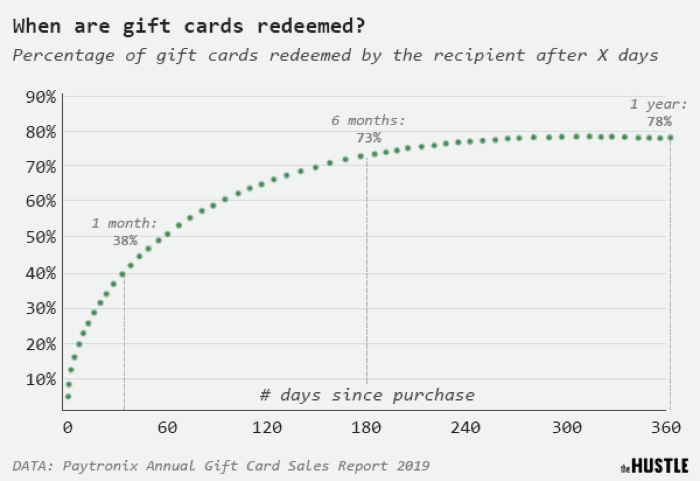
How will Stockpile make money without charging even credit card transaction fees? Even if Stockpile accepts “payment for order flow”, their volume must be relatively low (no daytraders here) and the spread percentage would be far less than 3% on a trade. A better guess is that they found their “breakage” to be sufficient to cover the fees, which refers to the fact that 20% of all gift cards are never redeemed even after a year. (Ever notice how many gift cards are 20% off face value at Costco and Sam’s Club?)

You pay upfront for the gift card, but if they are never redeemed, then Stockpile just gets to keep that as profit. Their breakage is probably less than 20%, but perhaps it is enough for them to make this move.

Bottom line. If you want to teach a kid about stock investing by giving them actual shares of stock, Stockpile is a convenient way to do so and now has no trading fees and no gift card purchase fees. Spend exactly $100 on a gift card, even using a credit card, and they’ll get exactly $100 worth of stock.

S&P 500 Dividend Aristocrats Infographic: Current Dividend Yield vs. Years of Consecutive Dividend Growth

A Dividend Aristocrat is a company in the S&P 500 index that has paid and increased its dividend payout every year for at least 25 consecutive years. You’re looking at companies that have had such reliable profits over multiple economic cycles that they can just keep sending checks to their shareholders every quarter while still not only maintaining but growing their business. Visual Capitalist just created a Dividend Aristocrat infographic that shows all 65 companies on the 2021 list, charted by current dividend yield and years of consecutive dividend growth.

Genuine Parts (GPC) and Dover Corp (DOV) have increased their dividend payout for 65 consecutive years!

Each year, some companies may be added or removed. For example, new in 2021 are IBM (IBM), NextEra Energy (NEE) and West Pharmaceutical Services (WST). Removed in 2021 are Raytheon (RTX), Carrier Global (CARR), Otis Worldwide (OTIS), Church and Dwight (CHD), and Stryker Corporation (SYK). Note that companies are sometimes removed because they were acquired by another company without the same dividend history.

I’ve always maintained a small side account where I own individual stocks and alternative investments. “Play Money”, “Mad Money”, “Fun Money”, whatever you want to call it. Even though it is only a small percentage of my net worth, I have enjoyed growing it over time and learning from the process. For example, I have found that in times of crisis, I am actually more comfortable buying more of the individual companies inside my self-directed account than buying my trusty broad index funds. I’m also a very low turnover investor, and usually make fewer trades per year than fingers on my hands.

I don’t solely buy companies on this list, but many of the companies are good research ideas if you like to learn about history. I prefer the idea of reliable and growing dividend income, not just momentarily “high” dividend yield. Of course, there are many solid companies that don’t satisfy the requirements for this list, and even list includes questionable companies will be eventually cut (like AT&T, which has already announced a future dividend cut even though still on this chart).

Single Family Rental Homes: Asset Class with 8.5% Historical Returns

How about this housing market? A few weeks ago, the CEO of Redfin shared a viral Twitter thread about what he was seeing. Here’s just a snippet:

It has been hard to convey, through anecdotes or data, how bizarre the U.S. housing market has become. For example, a Bethesda, Maryland homebuyer working with @Redfin included in her written offer a pledge to name her first-born child after the seller. She lost.

Inventory is down 37% year over year to a record low. The typical home sells in 17 days, a record low. Home prices are up a record amount, 24% year over year, to a record high. And still homes sell on average for 1.7% higher than the asking price, another record.

What about single-family homes as an investment asset class? Larry Swedroe points to a recent academic study about the historical total returns of single family rentals. Here are some highlights from the paper:

  • The study covers the nearly 30-year period from 1986 to 2014, including zip codes across the largest 15 US metro areas.
  • Total return is broken down into two components: rental income (net of expenses) and house price appreciation, similar to the dividend income and price appreciation of stocks.
  • Across all cities, the total returns were approximately the same: 8.5% total annualized return. On average, this broke down to 4.2% rental income + 4.3% price appreciation.
  • In higher-priced cities, the total returns were composed of lower rental yields but higher price appreciation.
  • In lower-priced cities, the total returns were composed of higher rental yields but lower price appreciation.
  • On average, they found that net rental income is about 60% of gross rental income. In other words, for every $1,000 of gross rent, $400 was eaten up by operating expenses like maintenance, repairs, property taxes, etc.
  • Single family rentals represent 35% of all rented housing units in the US, and have a market value of approximately $2.3 trillion.

According to Swedroe, during the same period the S&P 500 returned 10.7% annualized but with more volatility.

I definitely acknowledge rental properties are the way that many people have built wealth. As individuals can combine cheap leverage from government-subsidized mortgages along with that 8.5% annualized return, that could make the overall return even better than stocks.

I’ve thought about purchasing a rental property (or four) as well, but I’ve always ended up using my time and life energy in other ways. In the end, I look at managing rental properties as more similar to running your own business. If you have the right personality and skillset, then managing rental properties is a great business and a great way to build wealth in terms of return on invested time. But for me, I’d much rather work on online businesses, what I call “digital real estate”. With excess cash from work, I invest in completely passive shares of businesses (stocks) and REITs which require zero ongoing work. When I am fully retired, the dividend checks will simply show up in my brokerage account. I don’t need to screen tenants, hassle them about late rent, argue about security deposits, or worry about evicting a family during hard times.

What about simply buying an REIT that owns single-family rentals? It appears the two biggest are Invitation Homes (INVH) with 80,000 single-family homes and American Homes 4 Rent (AMH) with 50,000 single-family homes. As you might expect, their recent returns have also been quite hot. The 5-year average return for AMH is 17.45%, per Morningstar, but it’s too young to have a 10-year return history. However, the current forward dividend yields of 1.80% (INVH) and 1.02% (AMH) aren’t terribly exciting.

Here’s a 5-year historical performance chart of American Homes 4 Rent alongside some other REITs and the S&P 500, from YCharts. Buying a specific REIT, even if it owns thousands of properties, can still result in a wide range of results.

If you own the broad Vanguard Real Estate ETF (VNQ), you’ll find that 14% of its portfolio is invested in residential REITs. This includes apartments, student housing, manufactured homes, and single-family homes. INVH is about 1.2% and AMH is about 0.65% portfolio weight in VNQ. The mutual fund version of VNQ is VGSLX, and has a 10.5% annualized average return since inception in 2001. That’s not too bad, either, and I’ve been pretty satisfied with my VNQ holding.

But again, single-family real estate is one of the original “side hustles” that helped folks build their own wealth over time. Sometimes, I wonder if I should work on building the required skills and knowledge base, just to keep my future options open and have something to teach my children.

2021 Berkshire Hathaway Annual Shareholder Meeting Video, Transcript, and Notes

Here are my notes on the 2021 Berkshire Hathaway Annual Shareholder Meeting (YouTube, transcript). It was nice to see things nearly back to “normal” with Buffett offering up some lessons and going into some side details, while Munger just gets to the point (and says the stuff Buffett probably secretly wants to say but doesn’t due to the potential blowback).

Preshow comments. First up, a good observation by Karen Wallace of Morningstar during the Yahoo Finance Preshow (of the Super Bowl for Capitalist?!):

Buffett and Munger Don’t really like to speculate with their shareholders’ money. The thing about Warren Buffett is that he didn’t strike oil or develop software, inherit a big pile of money. He built his fortune by picking really solid businesses that generate a lot of cash and that he believes will continue to do well. And he takes the cash from that, he reinvests, he holds on for the longterm. He looks for new opportunities. He wants businesses that he can understand, which is a big part of it.

Here are a few more from William Green, author of the book Richer, Wiser, and Happier.

…think about the ways in which most of us mess up as investors. We’re impatient, we try to time the market, we speculate on things that we don’t really understand. We trade in and out. We’re we’re much too emotional. We get caught up in fads and here you have Charlie and Warren basically just avoiding all of those standard stupidities. And it’s as Charlie says, it’s actually easier to avoid being stupid than to be smart. And so I thought that was a wonderful paradox that you have the smartest guy alive just trying to be systematically less stupid.

And so if you look at a period like this, where everyone is saying I can’t believe they have $145 billion in cash, and they’re not doing anything, why don’t they do something? They’re just so blindly indifferent to those cries from the crowd. And Warren just says we’re not paid for activity, we’re paid for being right.

So there’s an-old fashioned sense of honor and decency and transparency and humor that I think is one of the reasons why we’ve all been coming back year after year and why we’re all happy to see Charlie back this year after being absent last year.

Guess what? Buffett and Munger both own their houses mortgage-free, which they have lived in for the last 62 years.

On my left, Charlie Munger, and I met Charlie 62 years ago. He was practicing law in Los Angeles. He was building a house at that time, a few miles from here and 62 years later, he’s still living in the same house. Now that was interesting because I was buying a house just a few months before 62 years ago, and I’m still living in the same house. So you’ve got a couple of fairly peculiar guys just to start with in terms of their love affair with their homes.

Indirect warning about Tesla. Buffett put up a huge list of automotive companies that went bankrupt. Even if you knew very early on that internal-combustion cars would take over the world, it was quite difficult to know ahead of time the best place to invest. Buffett:

So there was a lot more to picking stocks than figuring out what’s going to be a wonderful industry in the future.

My interpretation: Just because you know that electric vehicles will be huge in the future, doesn’t mean you can pick a big winning EV company (or even that there will be a single big winning EV company).

Why didn’t you buy more during the March 2020 crash bottom? My interpretation: Buffett basically said that they didn’t sell much (just the airlines, which accounted for 1% of all the businesses they own), while they did buy a lot of Berkshire stock via buybacks. They bought Berkshire because they knew BRK was cheap. Everything else, they weren’t as sure. Also, no BRK business took a PPP loan or other government bailout money. Munger adds:

Well, it’s crazy to think anybody’s going to be smart enough to husband money and then just come out on the bottom tick in some crazy crisis and spend it all. Always there’s some person that does that by accident, but that’s too tough a standard. Anybody who expects that of Berkshire Hathaway is out of his mind.

Do you think BRK will do better than the S&P 500 in the future? My interpretation: This question has been asked many times before. Buffett says that index funds are fine, they are what he recommends to others, and what his future widow will own (though still less than 1% of his estate). Upon his death, the rest of Buffett’s shares of BRK (much more valuable) will be donated and sold off gradually over 10+ years, so obviously he still has some faith in it. Munger has no intention of selling. Munger adds:

Well, sure. Well, I personally prefer holding Berkshire to holding the market. So I’m quite comfortable holding Berkshire. I think our businesses are better than the average in the market.

LOL about Munger’s response to the idea of Chevron being evil…

Well, I agree. You can imagine two things. A young man marries into your family, he’s an English professor at, say, Swarthmore, or he works for Chevron. Which would you pick? Sight unseen? I want to admit, I’d take the guy from Chevron. Yeah.

Low interest rates are like reduced gravity.

…it gets back to something fundamental in investments, I mean, interest rates, basically, are to the value of assets, what gravity is to matter, essentially.

[…] I mean, if I could reduce gravity, it’s pull by about 80%, I mean, I’d be in the Tokyo Olympics jumping. And essentially, if interest rates were 10%, valuations are much higher. So you’ve had this incredible change in the valuation of everything that produces money, because the risk-free rate produces, really short enough right now, nothing.

Munger hates Bitcoin.

I think I should say, modestly, that I think the whole damn development is disgusting and contrary to the interests of civilization, and I’ll let leave the criticism to others.

Munger hates SPACs.

I call it fee driven buying. In other words, it’s not buying because it’s a good investment. They’re buying it because the advisor gets a fee, and of course the more that you get, the sillier your civilization is getting, and to some extent, it’s a moral failing too, because the easy money made by things like SPACs and returned derivatives and so on, and so on. You push that to excess, it causes horrible problems with the civilization and reflects no credit on the people who are doing it, and no credit on the regulators and voters that allow it. So I think we have a lot to be ashamed of current conditions.

Munger hates Robinhood, day-trading, and speculating on options.

Well, that is really waving red flag of the bull. I think it’s just God awful that something like that would draw investment from civilized men and decent citizens. It’s deeply wrong. We don’t want to make our money selling things that are bad for people.

Buffett has more cash than ideal, but the prices aren’t right and he will be patient until the prices are right.

We’ve got probably 10 to 15% of our total assets in cash beyond what I would like to have just as a way of protecting the owners and the people that are our partners from ever having us ever getting a pickle. You know, we really run Berkshire and make sure that we don’t want to lose other people’s money who stick with us for years. We can’t help somebody who does and buys it today and sells it tomorrow. But we’ve got a real gene that pushes us in that direction, but we’ve got more than we… We’ve got probably 70 or 80 billion, something like that, maybe that we’d love to put the work, but that’s 10% of our assets, roughly. And we probably won’t get, we won’t get a chance to do it under these conditions, but conditions change very, very, very rapidly sometimes in markets.

Munger on high valuations today leading to lower returns in the future.

…with the, everything boomed up so high and interest rates, so low what’s going to happen is the millennial generation is going to have a hell of a time getting rich compared to our generation. And so the difference between the rich and the poor and the generation that’s rising is going to be a lot less.

On the failure to reform healthcare. My interpretation: When average people don’t directly pay for the service (healthcare), they don’t feel the appropriate pain and thus aren’t motivated to fix things.

My overall observation is one of the biggest skills that Buffett and Munger have is the ability to avoid being swept up in the current trends. They maintain a steady and reasoned mind. They aren’t overly bullish or overly bearish. People have been bugging them about their cash hoard for years, and well, things are too expensive right now, but they know that one day that will change. They still own a lot of businesses and are still net optimists.

If you were to try to copy them (not a recommendation), you might hold 10% more bonds than you held in the past, but still hold onto the rest in stocks. If you were 100% stocks, you might be 90% stocks and 10% bonds. If you were 80%/20%, you might be 70% stocks and 30% bonds. You’re still net optimistic about the future and exposed to more upside, but you realize valuations are high and there may be bargains if there is a crash. This assumes that you have the right personality to buy things during a crisis, however.

Be Guaranteed to Own the World’s Most Valuable Companies in 2051

The 2021 Berkshire Hathaway Annual Shareholder Meeting was on May 1st, 2022 and is now available as a recorded video on Yahoo Finance and a handy Rev.com transcript. I expect the podcast version to be updated shortly. I recommend listening or reading on your own, as I always find valuable tidbits outside the media highlights.

Buffett started out with the 2021 version of his annual advice for the average investor that doesn’t read 10-K SEC filings, shareholder annual reports, and multiple newspapers in their entirety every day: buy index funds. Buffett created a few slides for those “new entrants” who might think stock market investing means trading 25 times a day on Robinhood.

Here are the 20 most valuable companies in the world as of March 31st, 2021. The list includes 13 from the United States, three from China, and one each from Saudi Arabia, Taiwan, South Korea, and France.

He then asks “How many of these companies do you think will be on this same Top 20 list in 30 years? (2051)”

8?

5?

Once you have the answer in mind, you can consider this list of the 20 most valuable companies in the world from ~30 years ago (1989).

There is zero overlap in the two lists in regards to actual companies. Some names might be familiar, but not a single company stayed in the top 20. The 1989 list includes 13 from Japan, 6 from the United States, and one from the Netherlands.

In 1989, the most valuable company was worth $100 billion. (That company, the Industrial Bank of Japan, later merged with another business and that new company is only worth $37 billion in 2021.) Meanwhile, the most valuable company of 2021 is worth over $2,000 billion, a 20X increase.

If you are under the age of 50, you are a time billionaire. Your time horizon is a billion seconds (30 years) or longer. Many things will change over that period. Hopefully you will enjoy a happy, fulfilling life. But if you own a low-cost, market-cap weighted index fund, you will be guaranteed to own the world’s largest companies in 2051. As the late Jack Bogle told us: “Don’t look for the needle in the haystack. Just buy the haystack.” He might have added “…and get on with your life!”.

This comparison also shows why I remain diversified internationally, even though it hasn’t paid off recently. Does anyone really know that the future holds in regards to world geopolitics? It’s possible the US companies will continue to outperform for another 30 years. I hope so, and if that happens then I’ll hold a large majority of US stocks in the future. It will work itself out.

Historical Asset Class Correlations: Which Have Been the Best Portfolio Diversifiers?

When talking about constructing an investment portfolio, you’ll often hear about diversification and buying low-correlation or non-correlated assets.
  • A positive correlation means that the assets tended to move in the same direction. A value of 1 is perfect positive correlation.
  • A negative correlation means that they tended to move in opposite directions. A value of -1 is perfect negative correlation.
  • A zero correlation means that they had no relationship.

Morningstar recently released its 2021 Diversification Landscape Report (free download with e-mail) which includes a lot of great information about the correlations between key asset classes from 2001-2020, including the March 2020 COVID-related market crash. I try not to look too finely at historical numbers, but noticing the overall historical trends can be helpful.

The lower the correlation between asset classes (the less they move in the same direction), the greater the reduction in volatility you get by combining assets. As long as you combine asset classes with correlations below 1, you get some degree of volatility reduction. This M* chart from the paper helps you visualize this:

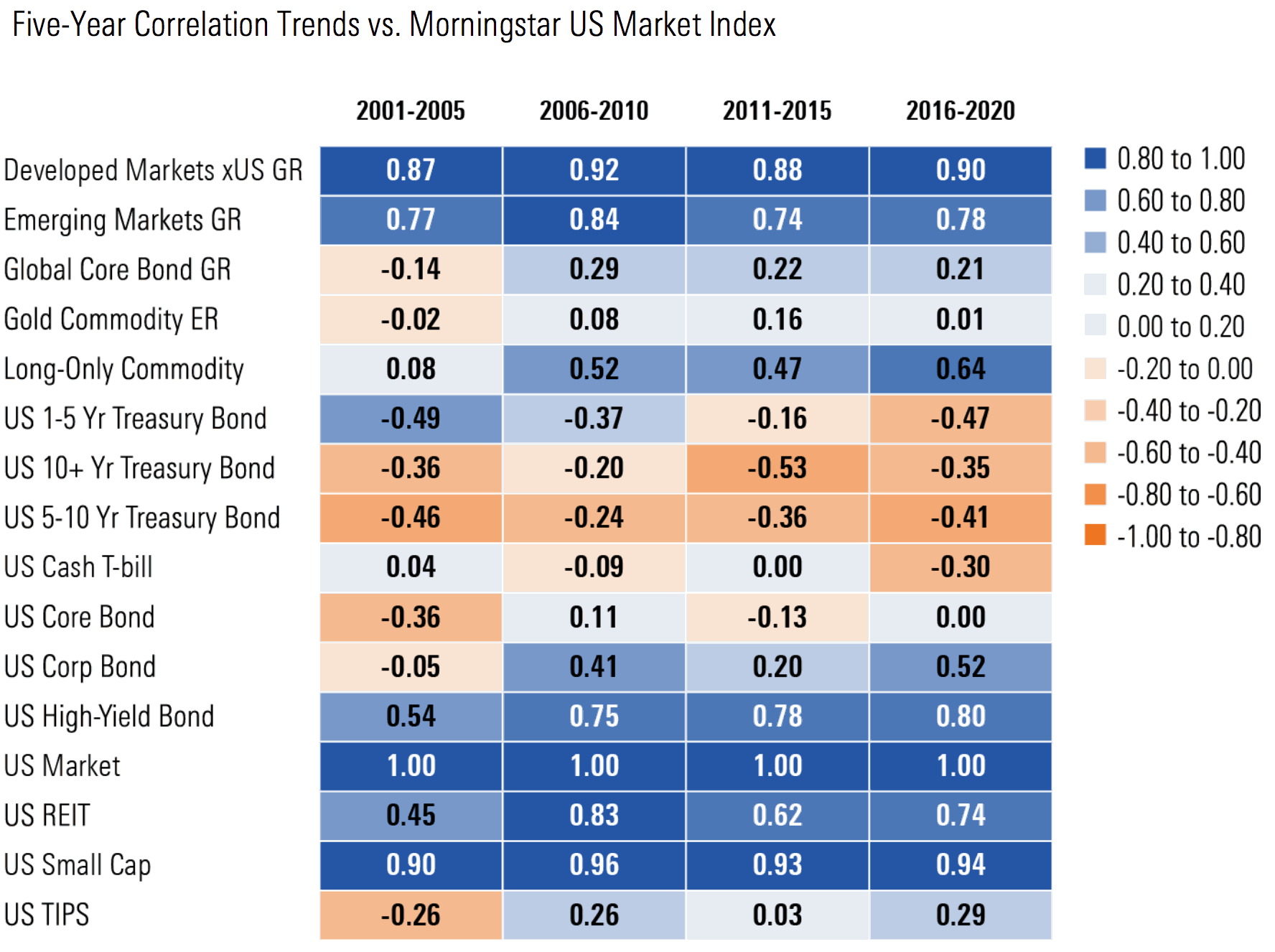
This handy M* table shows how the 5-year correlations between the total US stock market and other major asset classes have changed over the four separate periods of 2001-2005, 2006-2010, 2011-2015, and 2016-2020:

Some quick takeaways:

  • The best portfolio diversifiers for US stocks has consistently been US Treasury bonds. Short-term, medium-term, long-term Treasuries all have consistently negative correlations to US stocks. (There is some problem with the shading in the chart that doesn’t quite match the numbers.)
  • International developed country stocks, Emerging Markets stocks, and US REITs have high correlations with US stocks (which is somewhat expected), but the correlation is still below 1 (roughly 0.80 or so) such that it still offers a little diversification benefit over time.
  • High-yield “junk” bonds are highly-correlated with US stocks. They are just as highly-correlated as international and emerging market stocks, so watch out if you are chasing higher yield with riskier bonds.
  • Gold has been a pretty good and consistent diversifier as well, but only on par with cash (T-bills) not as good as US Treasuries. You just need to believe that the long-term return of gold is high enough to warrant inclusion. These days, gold actually looks better to me than in the past because I figure it will match inflation, and that’s actually better than most cash and bonds right now. Also see: Gold as a Hedge Against Bonds During Low Interest Rates

Gold as a Hedge Against Bonds During Low Interest Rates

Perhaps it is because I somehow ended up buying $5,000 in gold coins a couple weeks ago, but I’ve been doing some reading about gold again. The stock market is at higher and higher valuations, while the Fed promises that interest rates will stay low for a long time. The real yield on TIPS remains negative, meaning that it is highly unlikely that any high-quality investment-grade bonds will beat inflation over the next decade. Is there really no alternative?

This Compound Advisors article does a great job exploring why gold is not an ideal hedge against inflation. The comparison chart below of performance since 1975 summarizes things in one picture. Over the 50 years since the US came off the gold standard, gold has only barely kept up with inflation while stocks and REITs… well, just look:

Here is the price of gold over the last decade (FRED).

Okay, so maybe I’m not interested in holding a huge chunk of gold as a long-term asset. But what about a little bit during this strange period of negative real yields? Movement Capital points out in the chart below that gold prices are “tethered” to real interest rates. Gold prices seem to go up when bonds stop keeping up with inflation.

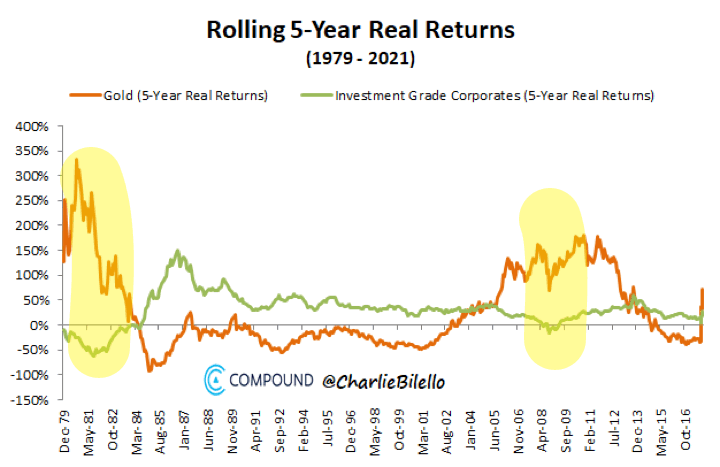
If you own bonds, it is quite possible that your return this year has been negative. I peeked and the Vanguard Total Bond ETF (BND) is down 4% YTD (as of 3/19/21). Gold seems to perform best when bonds perform their worst, as highlighted below:

Therefore, if bonds are supposed to keep your portfolio safe, but right now they are in the vulnerable position of paying out less interest than inflation, gold might be a good complement. Even if gold just matches inflation, you would still come out ahead. Of course, gold often feels so volatile that it is hard to rely on the price for anything specific.

I’ve said before that I simply don’t have the proper faith in gold to own it long-term, and I’m still in that place. I suppose my primary observation is that low interest rates have made nearly everything go up in price (stocks, bonds, real estate, Bitcoin), but gold seems to be mostly ignored.