Search Results for: Buying Stocks

My Money Blog Portfolio Asset Allocation, October 2018

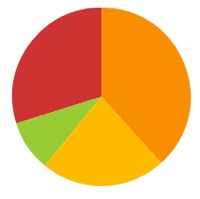
portpie_blank200

Here’s my quarterly portfolio update for Q3 2018. These are my real-world holdings and includes 401k/403b/IRAs and taxable brokerage accounts but excludes our house, cash reserves, and a few side investments. The goal of this portfolio is to create enough income to cover our household expenses. As of 2018, we are “semi-retired” and have started spending some dividends and interest from this portfolio.

Actual Asset Allocation and Holdings

I use both Personal Capital and a custom Google Spreadsheet to track my investment holdings. The Personal Capital financial tracking app (free, my review) automatically logs into my accounts, tracks my balances, calculates my performance, and gives me a rough asset allocation. I still use my custom Rebalancing Spreadsheet (free, instructions) because it tells me exactly how much I need in each asset class to rebalance back towards my target asset allocation.

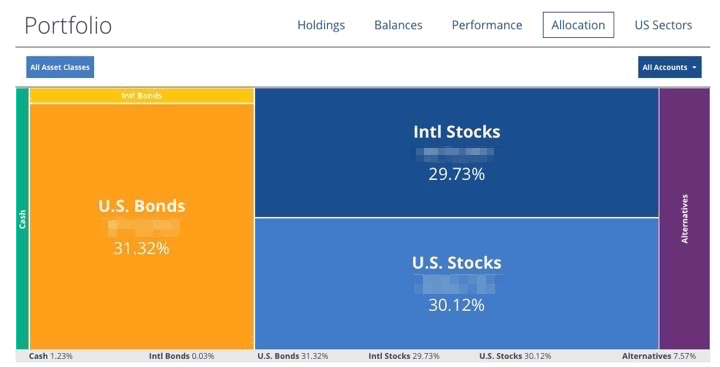
Here is my portfolio performance for the year and rough asset allocation (real estate is under alternatives), according to Personal Capital:

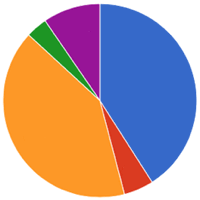
Here is my more specific asset allocation broken down into a stocks-only pie chart and a bonds-only pie chart, according to my custom spreadsheet:

Stock Holdings
Vanguard Total Stock Market Fund (VTI, VTSMX, VTSAX)
Vanguard Total International Stock Market Fund (VXUS, VGTSX, VTIAX)
WisdomTree SmallCap Dividend ETF (DES)
Vanguard Small Value ETF (VBR)
Vanguard Emerging Markets ETF (VWO)
Vanguard REIT Index Fund (VNQ, VGSIX, VGSLX)

Bond Holdings
Vanguard Limited-Term Tax-Exempt Fund (VMLTX, VMLUX)
Vanguard Intermediate-Term Tax-Exempt Fund (VWITX, VWIUX)
Vanguard Intermediate-Term Treasury Fund (VFITX, VFIUX)
Vanguard Inflation-Protected Securities Fund (VIPSX, VAIPX)
iShares Barclays TIPS Bond ETF (TIP)
Individual TIPS securities
U.S. Savings Bonds (Series I)

Target Asset Allocation. Our overall goal is to include asset classes that will provide long-term returns above inflation, distribute income via dividends and interest, and finally offer some historical tendencies to balance each other out. I personally believe that US Small Value and Emerging Markets will have higher future long-term returns (along with some higher volatility) than US Large/Total and International Large/Total, although I could be wrong. I don’t hold commodities, gold, or bitcoin as they don’t provide any income and I don’t believe they’ll outpace inflation significantly.

I believe that it is important to imagine an asset class doing poorly for a long time, with bad news constantly surrounding it, and only hold the ones where you still think you can maintain faith.

Stocks Breakdown

  • 38% US Total Market
  • 7% US Small-Cap Value
  • 38% International Total Market
  • 7% Emerging Markets
  • 10% US Real Estate (REIT)

Bonds Breakdown

  • 50% High-quality, Intermediate-Term Bonds
  • 50% US Treasury Inflation-Protected Bonds

I have settled into a long-term target ratio of 67% stocks and 33% bonds (2:1 ratio) within our investment strategy of buy, hold, and occasionally rebalance. With a self-managed, simple portfolio of low-cost funds, we minimize management fees, commissions, and taxes.

Holdings commentary. On the bond side, as Treasury rates have risen, last quarter I sold my shares of Vanguard High-Yield Tax Exempt and replaced it with Vanguard Intermediate-Term Treasury. I liked the slightly higher yield of that (still pretty high quality) muni fund, but as I settle into semi-retirement mode, I don’t want to worry about the potential of state pension obligations making the muni market volatile. In addition, my tax bracket is lower now and the Federal tax-exempt benefits of muni bonds relatively to the state tax-exempt benefit of Treasury bonds is much smaller now. On a very high level, my bond portfolio is about 1/3rd muni bonds, 1/3rd treasury bonds, and 1/3rd inflation-linked treasury bonds (and savings bonds). These are all investment-grade and either short or intermediate term (average duration of 6 years or less).

No real changes on the stocks side. I know that US stocks have higher valuations, but that’s something that is already taken into account with my investment plan as I own businesses from around the world and US stocks are only about 30% of my total portfolio. I have been buying more shares of the Emerging Markets index fund as part of my rebalancing with new dividends and interest. I am considering tax-loss harvesting some older shares with unrealized losses against another Emerging Markets ETF.

The stock/bond split is currently at 68% stocks/32% bonds. Once a quarter, I reinvest any accumulated dividends and interest that were not spent. I don’t use automatic dividend reinvestment.

Performance commentary. According to Personal Capital, my portfolio now slightly down in 2018 (-2.7% YTD). I see that during the same period the S&P 500 has gained 5% (excludes dividends), Foreign (EAFA?) stocks are down 8.2%, and the US Aggregate bond index is down 2.4%. My portfolio is relatively heavy in international stocks which have done worse than US stocks so far this year.

An alternative benchmark for my portfolio is 50% Vanguard LifeStrategy Growth Fund (VASGX) and 50% Vanguard LifeStrategy Moderate Growth Fund (VSMGX), one is 60/40 and one is 80/20 so it also works out to 70% stocks and 30% bonds. That benchmark would have a total return of +0.07% YTD (as of 10/16/18).

I’ll share about more about the income aspect in a separate post.
Total Bond ETF Review: iShares Aggregate Bond ETF (AGG) or Vanguard Total Bond ETF (BND)

One of the major building blocks of your portfolio is probably a bond mutual fund or ETF. The most popular bond benchmark is the Bloomberg Barclays Aggregate Bond Index (AGG), which basically tracks all U.S. taxable investment-grade bonds. These popular index funds all track some variation of this index:
  • Vanguard Total Bond Market Fund (VBTLX/VBMFX) and ETF (BND). The biggest bond mutual fund. This fund is also inside all Vanguard Target Retirement 20XX or LifeStrategy All-In-One funds.
  • iShares Core U.S. Aggregate Bond ETF (AGG). The biggest bond ETF.
  • Schwab U.S. Aggregate Bond ETF (SCHZ).

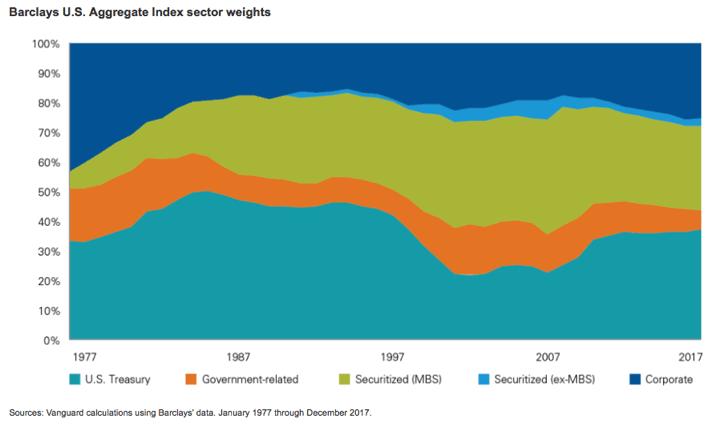
What’s inside a Total Bond fund? A recent Vanguard Blog post provides some insight into the components that make up the Barclays U.S. Aggregate Index from 1977 to 2017:

  • US Treasury. Bonds issued and backed by the US government, including Treasury notes and bonds. (Nominal only, TIPS are not included.)
  • US Government-related. Securities issued by a Federal Agency or a government-sponsored enterprise like Fannie Mae or Freddie Mac. These are either explicitly or implicitly backed by the US government.
  • Securitized (MBS). Mortgage-backed securities, backed by residential mortgages and packaged by Ginnie Mae, Fannie Mae, Freddie Mac, and others including private issuers.
  • Securitized (ex-MBS). Asset-backed Securities, backed by things such as consumer auto loans, credit card debt, and home equity loans.
  • US Corporate. Securities issued by corporations with investment-grade ratings from the major ratings agencies.

The first thing to note is that the bottom three layers are essentially all backed by the US government. When considered in this chart format, you can see that these bottom three layers consistently make up about 60% to 80% of the AGG. Thus, historically you can estimate that roughly 2/3rds of the index is backed by the US government and 1/3rd is privately-backed by securitized assets or corporations.

How much more does a Total Bond fund yield than a Treasury Index fund? Here’s how much the AGG Total Bond index yields above a Treasury index historically:

So the ingredients are little riskier overall than 100% US Treasury bonds, but you also earn a little higher yield.

Which is better? For the most part, I agree with this William Bernstein list of what kinds of bonds should be in an individual portfolio. I slightly prefer either 100% Treasuries, municipal bonds, or bank CDs – all depending on the after-tax yield. The idea is to pick the safest bonds that are hopefully the least correlated with your stocks. For example, the expectation is that Treasuries are more likely to go up when stocks are dropping.

But for the most part, I think a total bond fund is just fine as well. You can see it’s still pretty safe and you get extra interest in exchange for the extra risk that the market has decided is the proper compensation.

First things first – Buying a low-cost total bond index fund is very likely to return more over the long run than an expensive actively-managed bond fund. Choosing between Treasuries and a Total Bond fund is a secondary decision.

Bottom line. Lots of people own bond funds and ETFs that track the US Aggregate Index (AGG). These charts help show you what’s held inside such Total US Bond funds and how much more they yield than 100% Treasury bonds.

Does Robinhood Brokerage Make Money in Shady or Questionable Ways?

Robinhood has gotten a lot of buzz as the smartphone app that offers free stock trades. From the very beginning, the most common question was “How Will They Make Money?” Here’s what Robinhood says in their Help Center:

Robinhood Financial makes money from its margin trading service, Robinhood Gold, which starts at $6 a month. Additionally, Robinhood earns revenue by collecting interest on the cash and stocks in customer accounts, much like a bank collects interest on cash deposits.

However, there is another source of revenue that they don’t mention in their FAQ, but they do disclose in SEC filings (since it is legally required).

Selling order flow. When you make an order to buy or sell stock at a retail broker, the broker usually decides which market-maker can fulfill your request. In turn, market makers are allows to pay brokers like Robinhood, E*Trade, or TD Ameritrade for this “order flow”. This is common practice in the industry. If you have a sophisticated brokerage account, you can choose to direct exactly where your order will go. (Being able to direct your orders isn’t necessarily better unless you know what to look for, i.e. tracking Level 2 quotes.)

Robinhood gets paid 10 times the rate of TD Ameritrade and E*Trade for their order flow? Then came an article Robinhood Is Making Millions Selling Out Their Millennial Customers To High-Frequency Traders where the author Logan Kane made the following observations (via @JBrown6109):

  • These days, the people paying for order flow are often high-frequency trading (HFT) firms.
  • TD Ameritrade made $119 million last quarter from selling order flow. Payments were about a 1/10th of a cent per share.
  • E*Trade made $47 million last quarter from selling order flow. Payments were about a 1/10th of a cent per share.
  • Robinhood does not have to disclose their revenue from order flow as they are private company. (And they don’t.) Payments averaged about $0.00026 per dollar of executed trade value. At $50 average share price, this equates to about a cent per share.
  • This means that Robinhood is getting paid roughly 10x that of E*Trade and TD Ameritrade for the same amount of order flow.

Why? Here are some possibilities:

Theory #1: Robinhood is letting HFT “front-run” their customers, resulting is worse trade execution. If an HFT could give you 2 cents less per share, it would be worth paying 1 cent per share for that order. (Evil laugh.) However, this is countered by the SEC rule of National Best Bid and Offer (NBBO), which says that brokers must trade at the best available bid and ask prices when buying and selling securities for customers. This law may be hard to enforce by the millisecond, but would Robinhood or the HFT really blatantly break the law in this manner? Is it worth the risk to their business?

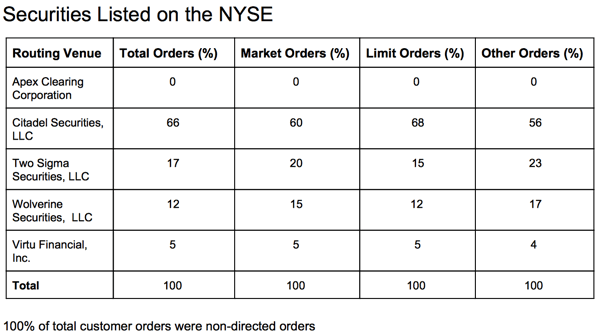
Honestly, I doubt it. Here’s the SEC Rule 606 Disclosure for Robinhood that shows where the orders are routed (source):

Yes, the names like Citadel and Virtu are well-known HFT firms. But Vanguard Brokerage doesn’t sell any order flow at all, yet most of their orders still go through Citadel (source):

Theory #2: Robinhood customers are broke and cheap, so they mostly trade a lot of stocks with low share prices. A lot of this argument is based on the amounts reported on the 606 disclosures. If you change the estimate for average share price traded to $4 a share, then Robinhood would get paid the same amount as the other firms. With zero commissions, anyone can afford to trade a few bucks of stock back and forth.

Theory #3: Robinhood’s order flow is somehow inherently more valuable than that of TD Ameritrade. Big brokers can fill some orders internally (one person is buying at the same time another is selling on the same platform) and they get to keep the market-maker profit. This rebuttal article says that Robinhood internalizes nothing and sells 100% of their orders. Maybe this “unfiltered” order flow is more valuable? Maybe the fact that their customers are younger and mostly non-professional traders make the order flow more valuable? More odd lots? More trades of single shares? More market orders instead of limit? Maybe Robinhood packages the data in some way that makes it more palatable to HFT firms?

HFT firms are using the data to build complex algorithms for their own trading, so they want to understand market behavior. Getting unlimited access to raw order data would certainly be key to understanding the behavior of “dumb money”.

Personally, I think it’s maybe a little #2, but more #3. Robinhood was founded by former HFT software engineers. They know exactly what type of information would be valuable to HFT firms. In fact, I think selling customer data (in aggregate) was a big part of their business model to pull off free trades from the very beginning. So they optimize the selling of your data quietly, while also making money on idle cash and margin subscriptions. It’s also a big money saver when they only answer customer service questions via e-mail and don’t have a phone number.

The bigger question: Do you care? Okay, so Robinhood gets paid by selling your order data. They get paid a penny per share. Some firm will know you bought 10 shares of Nvidia and sold 10 shares of AAPL exactly 54 minutes and 12 seconds after the new iPhone announcement. In some indirect way, this arrangement might give the HFT firms a greater trading edge in the future. In exchange, you get free stock trades today. Is this a bad deal?

They’ve also helped inspire more free trade competition:

Bottom line. I view Robinhood as “free” in the same way that Gmail is “free” and Facebook is “free”. They make money via traditional means, but your personal data and behavior patterns are also part of the true price. The theme of this entire decade is that our personal data is the most undervalued asset (by us). Google, Facebook, Amazon, Visa, every major corporation – they are perfectly aware of the value of data. As the saying goes, “If you’re not paying for the product, you are the product.”

Beware Fintech Making High-Interest Debt Easier Than Ever

Fintech (financial technology) is supposed to make our lives better. You’ll hear how they want to nudge us to save more, invest better, spread risk, and lower costs. But if you look a little deeper, another thing many want to make easier is debt.

Fintech doesn’t make you financially literate. Did you know that banks still make $35 billion a year in overdraft fees? Consider the recent findings of a TIAA Institute study Millennial Financial Literacy and Fin-tech Use reported by Felix Salmon:

One might view fin-tech as a tool that provides convenience, but one that also has the potential to improve personal finance decisions and behavior. It could then promote better personal finance outcomes. But the dynamic is more complex and nuanced, especially when viewed at the level of separate fin-tech activities.

  • Millennials are 40% more likely to overdraw their checking accounts if they use mobile payments.
  • Budgeting tools don’t help either. Millennials who use their mobile devices to track their spending are 25% more likely to overdraw their checking account.

Everyone wants to lend you money, from Goldman Sachs to the mall kiosk cashier. Goldman Sachs started a new high-yield savings account and renamed it Marcus. Many people found it prestigious to “have an account” at Goldman Sachs. But really, that savings account only exists so that Marcus has a cheap source of funds to offer personal loans online at up to 25% APR. A Marcus smartphone app is coming soon. SoFi and every other popular student-loan refinance company is expanding to consumer loans as well. Micro-loan companies like Affirm will let you put a $100 pair of jeans on a monthly payment plan.

Here’s the growth of personal loans since 2010, per Quartz:

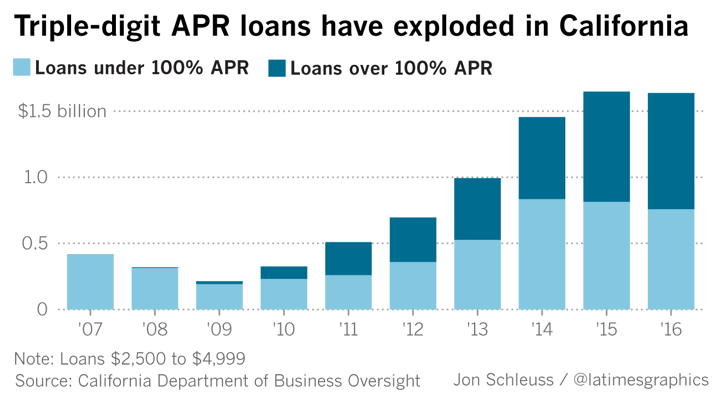
Got bad or no credit? Fintech to the rescue! LendUp, Elevate, and others already provide payday-type loans with 100%+ APRs. Except they aren’t “payday” loans, they are structured as “installment” loans. Instead of just $300, they’ll lend you more money because they lets them escape the payday loan regulations. See the LA Times article Borrow $5,000, repay $42,000 — How super high-interest loans have boomed in California:

They may be new start-ups, but they can still exhibit old-fashioned bad behavior, like promising to help customers build credit but never actually reporting anything to the credit agencies. CFPB Orders LendUp to Pay $3.63 Million for Failing to Deliver Promised Benefits:

“LendUp pitched itself as a consumer-friendly, tech-savvy alternative to traditional payday loans, but it did not pay enough attention to the consumer financial laws,” said CFPB Director Richard Cordray. “The CFPB supports innovation in the fintech space, but start-ups are just like established companies in that they must treat consumers fairly and comply with the law.”

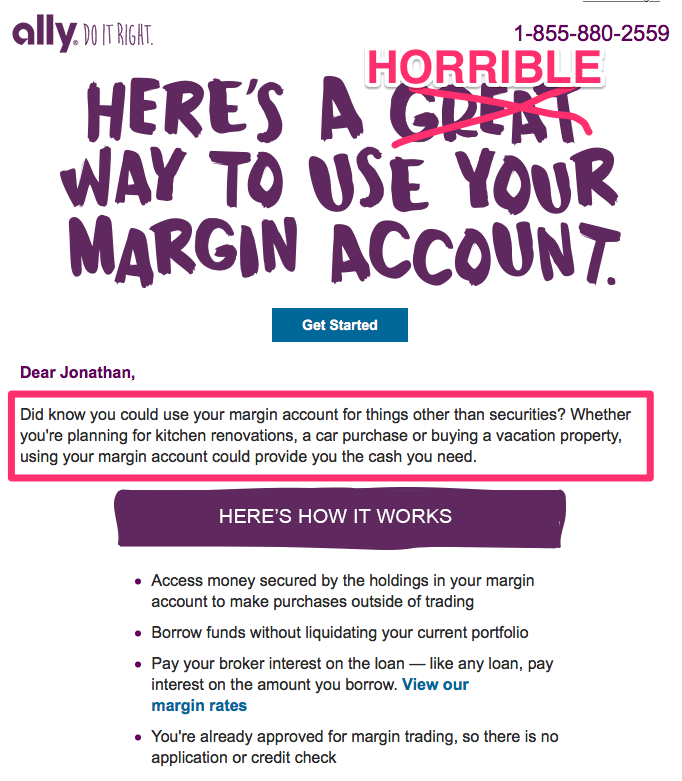
Margin loan for your next iPhone? Right after writing about buying productive assets instead of going into debt, I get this email from Ally Invest:

Margin is something that short-term traders use in order to increase their buying power temporarily. Long-term investors have little to no use for margin since the interest rates will eat up returns. But at least they’d be buying a productive asset if they bought stocks.

Here’s why using margin loans to buy a car or smartphone is a bad idea. First, your interest rate at Ally Invest starts at 9.50% APR and isn’t fixed. So it’s not like you’re getting some awesome rate. 10%-15% APR is as high as credit card interest. Second, this is a collateralized loan backed by your stock holdings. If you don’t pay it back, you don’t just get a ding on your credit score like with a credit card. They sell your stocks and take the money. A home-equity loan is backed by your house, but at least your interest rates are low. Even worse, if the market value of your portfolio drops enough (something not under your control), your broker will issue a margin call. If you don’t pay up immediately, they will forcibly sell your stocks at that low price to pay off your loan.

Bottom line. Fintech may be new, but some things never change. There will always be people selling you things you don’t absolutely need, and now it will be easier than ever to go into debt to buy those things. Be on the lookout for wolves dressed in slick smartphone apps.

Big Picture: Is Compounding Growth Working For or Against You?

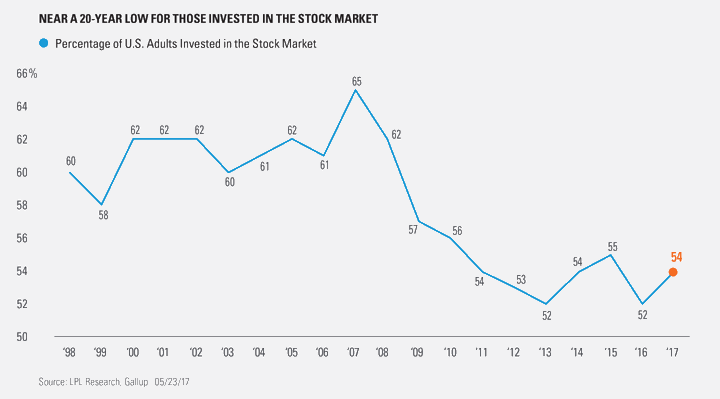
I’m a finance geek and like to dig around in the details like asset allocation or tax strategies. However, sometimes I read some news that reminds me to step back and look at the big picture. Half of all Americans don’t own any stocks at all. Before the 2008 financial crisis, about 2/3rds of US adults had some skin in the stock market, but that number dropped significantly and hasn’t rebounded. From a Gallup poll:

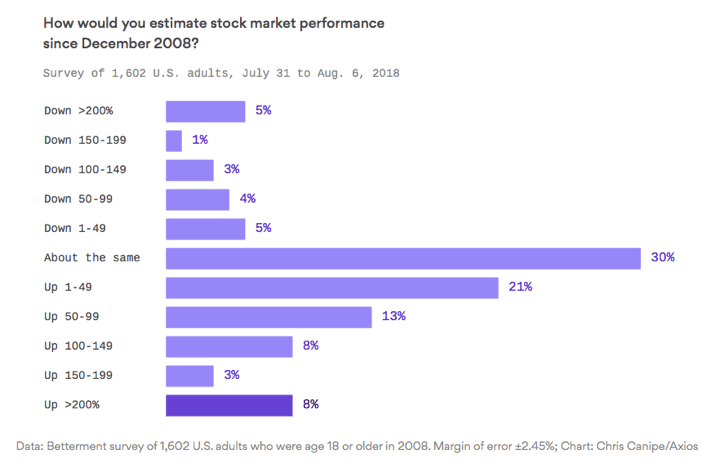
Even out of the half of Americans with some amount of stock ownership, most of them have no idea about stock market performance. Betterment conducted a survey [pdf] asking people to estimate the US stock market performance since December 2008, and Axios made it into a nice chart. Note that all of the respondents in the Betterment survey stated they had at least $1 invested in the stock market.

About half of respondents either thought the stock market dropped or stayed the same over the last 10 years. The correct answer is that the stock market is up over 200%. Only 8% of people who own stock got this right.

I worry that this means that only a small percentage of people are aware of the potential power of investing in productive assets like businesses. Sure, 200% is a lot, but over 10 years it’s not an insane number. At 12% annual growth, your money doubles in 6 years and thus quadruples in 12 years. At 8% annual growth, your money doubles in 9 years and thus quadruples in 18 years. Even at 6% annual growth, your money will double in 12 years and thus quadruples in 24 years.

Owning productive assets like public companies, real estate, or private business ownership gets you on the train powered by compounding exponential growth. Debt like student loans, credit card balances, even a home-equity loan for a new kitchen remodel, that’s like putting the compound interest engine in reverse. I know that it is easier said than done, but one of my favorite quotes from Mr. Money Mustache is that you should treat “debt as an emergency”. The difference between even putting a $50 into stocks a week, versus paying $50 week in interest to carry your debt each month can become the difference between having choices and the treadmill lifestyle forever.

If someone realizes the power of compounding, then they are more likely to covet that rental property or share of Apple stock as much as a new BMW lease or Viking stove. I love buying new shares of VTI. It gives me a dividend gift every quarter. This appreciation is the key to the constant accumulation of productive assets and not stuff.

Warren Buffett on Reaching Stock Market Highs

Warren Buffett had his annual charity lunch today and was on CNBC for a short interview. As usual, he was asked about the current stock market situations and, as usual, he managed to sum everything up in a few folksy sentences. Here’s a direct quote from the full CNBC interview:

If you had your choice between buying and holding a 30-year bond for 30 years or holding a basket of American stocks, there’s just no question, you’re going to do better owning stocks. It’s more attractive than, considerably more attractive than fixed income securities. That doesn’t meant they’re going to go up or down tomorrow, next week, or next year, but over time, a bunch of businesses that are earning high returns on capital are going to beat a bond that’s fixed at roughly 3% or 30 years. And it’s not my field of specialty, but actually they look, stock generally (American businesses), they look cheaper than, generally, real estate.

[…] That’s what you have to do in investing. I mean, you’re sitting with some cash in your pocket. You have savings, and the question is what do you do with it? You can buy a duplex next door and rent it out to people and do fine over time or buy a small piece of farmland or something of the sort or you can put it into something fixed income, bonds, or bank deposits, or whatever it may be.

My interpretation is that you have invest your money somewhere, and if you have a 30-year time horizon and you don’t plan on timing the market in and out, then stocks are still your best bet. Over the long haul, stocks will still outperform bonds and cash (at current interest rates), and he thinks real estate as well right now. Timing the market is too hard to do. Predicting returns over the next 5 years is too hard to do. If you don’t have a long enough time horizon or can’t handle the swings, you shouldn’t be in stocks.

Long-term stock investors just have to take some lumps if prices drop for a while. Keep enough money in bonds and cash so you don’t panic and have money to spend in the meantime.

[I actually have an issue with the CNBC caption “Buffett: Stocks always more attractive than bonds”. He never said that. He specifically noted that the 30-year bond was paying 3%. In the past (1970s?), Buffett has invested in Treasury bonds when the rates were really high and the stock market was overvalued. If today’s rates were 8% instead of 3%, Mr. Buffett would be rational enough to adjust his opinion.]

Reasons To Own TIPS, Treasury Inflation-Protected Securities

When it comes to constructing a portfolio, I used to think it was all about numbers and optimization. When you pick an asset class based on historical data, that assumes you hold through both the good times and the really bad times. It has helped me to keep gathering nuggets of knowledge over time to maintain my faith during those really bad times.
I’d like to start a series of posts to document why I own each specific asset class. Somebody asked me about TIPS the other day, so I’ll start with them. I’m not an investing professional, just a semi-retired DIY investor who wants to keep on learning and would like to share with other like-minded folks. I won’t get into the tiny details, mostly a lot of charts, links, and higher-level ramblings.

Treasury Inflation-Protected Securities (TIPS) are bonds issued by the US government that pay interest which is linked to inflation. Inflation is measured by the Consumer Price Index (CPI). In terms of a useful all-around primer, this Morningstar (M*) article 20 Years In, Have TIPS Delivered? covers a lot of the bases. For more nuts-and-bolts mechanics, see this older Vanguard paper Investing in Treasury Inflation Protected Securities. According to M*, TIPS currently make up about 9% of the overall Treasury market.

Here are my reasons for owning Treasury Inflation-Protected Securities (TIPS):

TIPS are backed by the US Government, just like the more common “vanilla” US Treasury bonds. With bonds, I prefer to stay on the safer end of the spectrum. Bonds are debt, and I don’t want to worry about if I get paid back. Buying US Treasury bonds is the lowest amount of credit risk possible.

TIPS provide a “real” inflation rate at purchase, which means it is guaranteed to provide a set return above inflation (before taxes) until maturity. Very few bonds are structured in this manner. In simplified terms, if the real interest rate is 2% and inflation is 3%, then the total interest paid will be 5%. Working backwards from that, you get the concept of breakeven inflation rate, or the expected inflation by the market (via M*):

The introduction of TIPS brought with it a market-determined observable real rate of interest, which is what the yield on a TIPS is. If you subtract the TIPS yield from the comparable-maturity nominal Treasury yield, you get the market’s inflation expectation over the period until maturity of these two bonds. This is called “breakeven inflation,” because it is the level of inflation at which returns for the nominal and inflation-indexed bonds should break even.

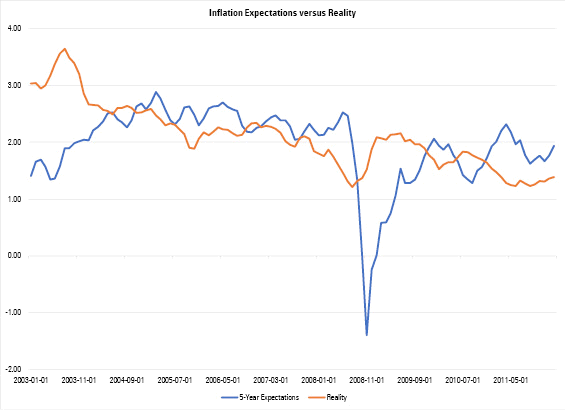
Here’s how the expected inflation and actual inflation compared for 5-year periods since 2003. For the most part, they have been pretty close:

TIPS thus provides insurance against *unexpected* inflation. TIPS are often described as an inflation hedge, but it’s more of a hedge against unexpected inflation. All bonds are already priced with inflation in mind. If everyone thinks inflation will be high, then bonds across the board will be priced to pay out more interest to counter that.

The reason why you don’t hear much about TIPS in the media is that over the last several years, there hasn’t been any unexpected inflation. If you bought fire insurance on your house, and your house hasn’t burned down yet, are you going to stop buying the fire insurance?

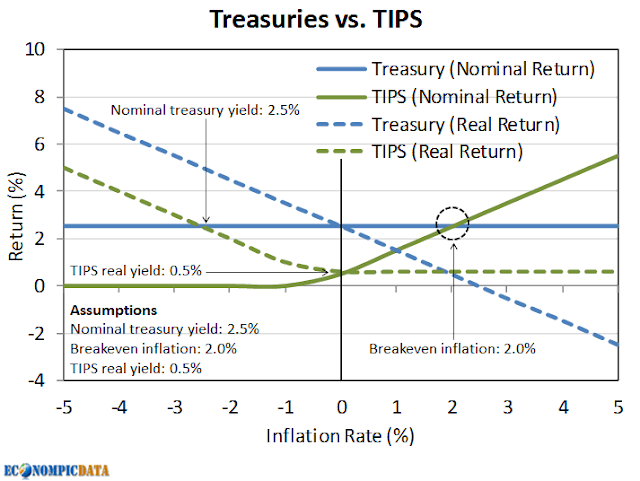
TIPS also provides a certain amount of protection in case of severe deflation. TIPS are guaranteed to return par at maturity, meaning they have floor value even in a case of severe deflation. This asymmetry helps make TIPS attractive relative to Treasuries, as best explained by this EconompicData post:

Thus, assuming a view that an inflationary and deflationary scenario are equally likely, the unlimited potential outperformance of TIPS vs. Treasuries in an inflationary environment and limited upside of Treasuries vs. TIPS in a deflation environment would sway an investor towards TIPS.

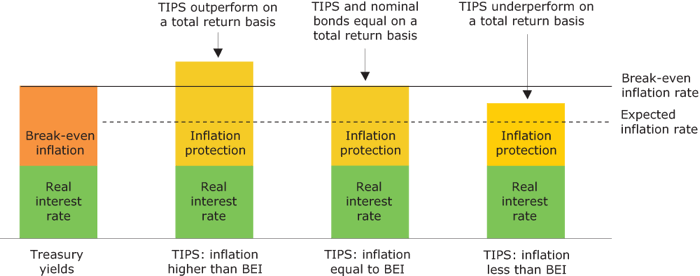
If inflation meets the market expectations, then TIPS and Treasuries will have the same return. If actual inflation is higher than the (expected) breakeven inflation rate, then TIPS will pay more than the regular Treasury bond. If actual inflation is less than the (expected) breakeven inflation rate, then TIPS will pay less than the regular Treasury bond. Here’s a simple graphic from AAII:

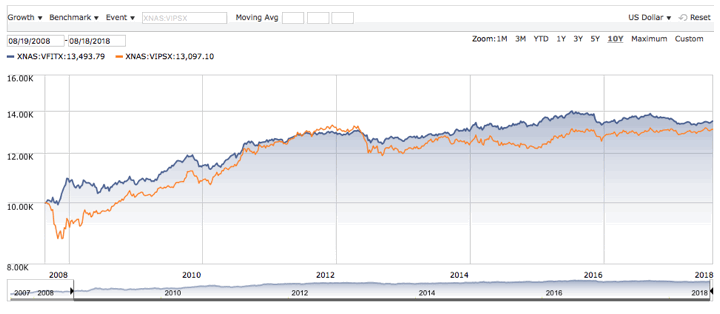
Here’s a 2008-2018 Morningstar chart comparing the growth of $10,000 between the Vanguard Intermediate Treasury Fund (VFITX) and the Vanguard Inflation-Protected Securities Fund (VIPSX). You can see while there is definitely a difference – sometimes one leads, sometimes the other – but over the last 10 years the net return has been very similar. Again, inflation has not been much higher (or a lot lower) than expected.

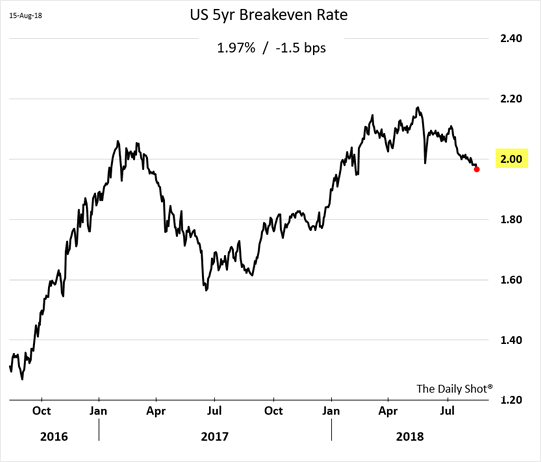
Do you think future inflation will be higher than the current expected number? Here’s the 5-year breakeven inflation rate for the last couple of years. Via WSJ Daily Shot.

If I had to bet, I would bet that the future inflation number will be higher than 2% then less than 2%. However, most likely they will return around the same amount. So this is not a huge risky bet. In terms of the big picture, it’s a relatively wimpy bet. I currently hold about 1/3rd of my portfolio asset allocation in bonds, and about 1/3rd of those bonds are invested in TIPS. That means about 11% of my total portfolio is in TIPS. If the real yields on TIPS were to go back higher to historical levels, I would go back up to 50% of bonds in TIPS.

Here are some reasons for NOT owning Treasury Inflation-Protected Securities (TIPS).

  • TIPS are not part of the efficient frontier. If you run an mean-variance blah-blah-blah optimizer, you won’t find TIPS on the ideal risk/return curve.
  • TIPS have a low historical correlation with stocks, but not as low as regular Treasuries – regular Treasuries are a better bet to go up when the stock markets crash.
  • TIPS have only been around for 20 years. You might argue that they have not been tested in severe high-inflation environment.
  • As with nominal Treasuries, the interest is taxable as ordinary income rates, not the lower dividend or long-term capital gains rates as with stock dividends. You’ll have to pay taxes on this interest every year – it can’t be deferred like if you buy a stock and hold it for a long time. If you buy individual TIPS, you’ll also have to pay income taxes on the inflation adjustment without actually getting the interest until maturity. This is called “phantom income” but can be avoided if you buy TIPS via an ETF or mutual fund. TIPS are thus generally recommended to be kept in tax-sheltered accounts. (TIPS interest is exempt from state and local taxes, however.)
  • Some people worry that the government will fudge the CPI numbers if high unexpected inflation really becomes a problem.

Zero to $1 Million in 14 Years: Maxing Out 401k and IRAs from 2004-2017

Like many others, I had a vague goal of $1 million net worth in my 20s. It’s easy to find a theoretical path a million. For example, $750 per month earning 8% returns for 30 years with get you there. Doing the actual earning, saving and investing is the hard part. It gets even harder during a bear market when your money feels like it is burning up in flames.
On the list of “Things I Would Tell My Younger Self”, I would include “Be patient and keep saving. You’ll get there.” Or by changing up the phrase “Always Be Closing” popularized in Glengarry Glen Ross – “Always Be Contributing” (ABC). One of the major benefits of writing this blog was keeping my focus on this path.

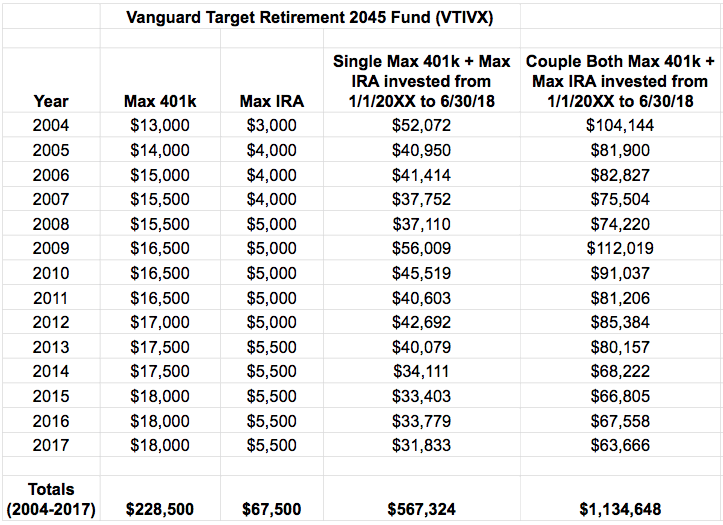
This is how a real couple could have gone from zero to $1 million from 2004 to 2017. My spouse and I both had our first full year of full-time jobs in 2004. From 2004 to 2017, we contributed the maximum allowable limit to both of our 401k and IRAs each year. The contribution limits rose gradually over the years. (Company match is not included here.) We invested our money in low-cost index Vanguard funds – mostly stocks with a little bonds – which can be closely approximated by the Vanguard Target Retirement 2045 fund (ticker VTIVX). This fund had its share of ups and downs with the market. It crashed a lot in 2008 and 2009. It went back up a lot afterward. We just kept contributing and buying each year.

Using Morningstar tools, I found the final amount today if the limit was invested on January 1st of each year. For example, if both of us invested $16,000 in Vanguard Target Retirement 2045 at the beginning of 2004 ($13k + $3k), that investment would now be worth $104,144 as of June 30, 2018. And so on for each subsequent year. As you can see, if you add all the years up, you would reach over $500,000 for an individual and over $1,000,000 for a couple:

These numbers won’t be the same across other time periods, but they do represent a real-world experience. I’ve done a variation of this before in What If You Invested $10,000 Every Year For the Last 10 Years? 2008-2017 Edition.

According to Vanguard, 13% of their plan participants maxed out their 401k plans in 2017. 58% of participants had their entire account balance invested in a single target-date fund or similar managed allocation.

Bottom line. A real couple that started saving as 26-year-olds in 2004 and maxing out both their 401k and IRA plans each year could have reached $1 million by age 40 in 2018. All with a simple Vanguard Target Retirement index fund. This requires a lot of steady saving, but the important part is that it required no special investment skill. You didn’t need to recognize bubbles. You didn’t need to time bottoms. You didn’t need a fancy asset allocation, estimate future cashflows, understand price/book ratios, or even rebalance. Always be contributing.

My Money Blog Portfolio Asset Allocation, July 2018

portpie_blank200

Here’s my quarterly portfolio update for Q2 2018. These are my real-world holdings and includes 401k/403b/IRAs and taxable brokerage accounts but excludes our house, cash reserves, and a few side investments. The goal of this portfolio is to create enough income to cover our regular household expenses. As of 2018, we are “semi-retired” and spending some of the dividends and interest from this portfolio.

Actual Asset Allocation and Holdings

I use both Personal Capital and a custom Google Spreadsheet to track my investment holdings. The Personal Capital financial tracking app (free, my review) automatically logs into my accounts, tracks my balances, calculates my performance, and gives me a rough asset allocation. I still use my custom Rebalancing Spreadsheet (free, instructions) because it tells me where and how much I need to direct new money to rebalance back towards my target asset allocation.

Here is my portfolio performance for the year and rough asset allocation (real estate is under alternatives), according to Personal Capital:

Here is my more specific asset allocation, according to my custom spreadsheet:

Stock Holdings
Vanguard Total Stock Market Fund (VTI, VTSMX, VTSAX)
Vanguard Total International Stock Market Fund (VXUS, VGTSX, VTIAX)
WisdomTree SmallCap Dividend ETF (DES)
Vanguard Small Value ETF (VBR)
Vanguard Emerging Markets ETF (VWO)
Vanguard REIT Index Fund (VNQ, VGSIX, VGSLX)

Bond Holdings
Vanguard Limited-Term Tax-Exempt Fund (VMLTX, VMLUX)
Vanguard Intermediate-Term Tax-Exempt Fund (VWITX, VWIUX)
Vanguard High-Yield Tax-Exempt Fund (VWAHX, VWALX)
Vanguard Inflation-Protected Securities Fund (VIPSX, VAIPX)
iShares Barclays TIPS Bond ETF (TIP)
Individual TIPS securities
U.S. Savings Bonds (Series I)

Target Asset Allocation. Our overall goal is to include asset classes that will provide long-term returns above inflation, distribute income via dividends and interest, and finally offer some historical tendencies to balance each other out. I personally believe that US Small Value and Emerging Markets will have higher future long-term returns (along with some higher volatility) than US Large/Total and International Large/Total, although I could be wrong. I don’t hold commodities, gold, or bitcoin as they don’t provide any income and I don’t believe they’ll outpace inflation significantly.

I think it’s important to imagine an asset class doing poorly for a long time, with bad news constantly surround it, and only hold the ones where you still think you can maintain faith.

Stocks Breakdown

  • 38% US Total Market
  • 7% US Small-Cap Value
  • 38% International Total Market
  • 7% Emerging Markets
  • 10% US Real Estate (REIT)

Bonds Breakdown

  • 50% High-quality, Intermediate-Term Bonds
  • 50% US Treasury Inflation-Protected Bonds

I have settled into a long-term target ratio of 67% stocks and 33% bonds (2:1 ratio) within our investment strategy of buy, hold, and occasionally rebalance. With a self-managed, simple portfolio of low-cost funds, we minimize management fees, commissions, and taxes.

Real-world asset allocation details. No major changes from the last quarterly update. For both simplicity and cost reasons, I am no longer buying DES/DGS and will be phasing them out whenever there are tax-loss harvesting opportunities. New money is going into the more “vanilla” Vanguard versions: Vanguard Small Value ETF (VBR) and Vanguard Emerging Markets ETF (VWO).

My taxable muni bonds are split roughly evenly between the three Vanguard muni funds with an average duration of 4.5 years. I am still pondering going back to US Treasuries due to changes in relative interest rates and our marginal income tax rate. Issues with high-quality muni bonds are unlikely, but still a bit more likely than US Treasuries.

The stock/bond split is currently at 70% stocks/30% bonds. Once a quarter, I reinvest any accumulated dividends and interest that were not spent. I don’t use automatic dividend reinvestment. Looks like we need to buy more bonds and emerging markets stocks.

Performance and commentary. According to Personal Capital, my portfolio has basically broken even so far in 2018 (+1.5% YTD). I see that during the same period the S&P 500 has gained 6.5% (excludes dividends) and the US Aggregate bond index lost 1.7%. My portfolio is relatively heavy in international stocks which have done worse than US stocks so far this year.

An alternative benchmark for my portfolio is 50% Vanguard LifeStrategy Growth Fund (VASGX) and 50% Vanguard LifeStrategy Moderate Growth Fund (VSMGX), one is 60/40 and one is 80/20 so it also works out to 70% stocks and 30% bonds. That benchmark would have a total return of +2.8% YTD (as of 7/25/18).

As usual, I’ll share about more about the income aspect in a separate post.

My Money Blog Portfolio Asset Allocation, March 2018

portpie_blank200

Here is a First Quarter 2018 update for my primary investment portfolio. These are my real-world holdings, not a recommendation. It includes tax-deferred 401k/403b/IRAs and taxable brokerage accounts and excludes our primary home, cash reserves, and a few side investments. The goal of this portfolio is to create enough income to cover our regular household expenses. As of 2018, we have started the phase of “early retirement” where we are spending some of the dividends and interest from this portfolio.

Actual Asset Allocation and Holdings

I use both Personal Capital and a custom Google Spreadsheet to track my investment holdings. The Personal Capital financial tracking app (free, my review) automatically logs into my accounts, tracks my balances, calculates my performance, and gives me a rough asset allocation. I still use my custom Rebalancing Spreadsheet (free, instructions) because it tells me where and how much I need to direct new money to rebalance back towards my target asset allocation.

Here is my portfolio performance for the year and rough asset allocation (real estate is under alternatives), according to Personal Capital:

1803_pc1b

1803_pc2b

Here is my more specific asset allocation, according to my custom spreadsheet:

1803_spread1

Stock Holdings
Vanguard Total Stock Market Fund (VTI, VTSMX, VTSAX)
Vanguard Total International Stock Market Fund (VXUS, VGTSX, VTIAX)
WisdomTree SmallCap Dividend ETF (DES)
WisdomTree Emerging Markets SmallCap Dividend ETF (DGS)
Vanguard Small Value ETF (VBR)
Vanguard Emerging Markets ETF (VWO)
Vanguard REIT Index Fund (VNQ, VGSIX, VGSLX)

Bond Holdings
Vanguard Limited-Term Tax-Exempt Fund (VMLTX, VMLUX)
Vanguard Intermediate-Term Tax-Exempt Fund (VWITX, VWIUX)
Vanguard High-Yield Tax-Exempt Fund (VWAHX, VWALX)
Vanguard Inflation-Protected Securities Fund (VIPSX, VAIPX)
iShares Barclays TIPS Bond ETF (TIP)
Individual TIPS securities
U.S. Savings Bonds (Series I)

Target Asset Allocation. Our overall goal is to include asset classes that will provide long-term returns above inflation, distribute income via dividends and interest, and finally offer some historical tendencies to balance each other out. I personally believe that US Small Value and Emerging Market will have higher future long-term returns (along with some higher volatility) than US Large/Total and International Large/Total, although I could be wrong. I don’t hold commodities futures or gold (or bitcoin) as they don’t provide any income and I don’t believe they’ll outpace inflation significantly. I also try to imagine each asset class doing poorly for a long time, and only hold the ones where I think I can maintain faith.

Stocks Breakdown

  • 38% US Total Market
  • 7% US Small-Cap Value
  • 38% International Total Market
  • 7% Emerging Markets
  • 10% US Real Estate (REIT)

Bonds Breakdown

  • 50% High-quality, Intermediate-Term Bonds
  • 50% US Treasury Inflation-Protected Bonds

I have settled into a long-term target ratio is 67% stocks and 33% bonds (2:1 ratio) within our investment strategy of buy, hold, and rebalance. With a self-managed, simple portfolio of low-cost funds, we minimize management fees, commissions, and income taxes.

Real-world asset allocation details. For both simplicity and cost reasons, I am no longer buying DES/DGS and will be phasing them out whenever there are tax-loss harvesting opportunities. New money is going into the more “vanilla” Vanguard versions: Vanguard Small Value ETF (VBR) and Vanguard Emerging Markets ETF (VWO).

I’m still a bit underweight in TIPS and REITs mostly due to limited tax-deferred space as I don’t want to hold them in a taxable account. My taxable muni bonds are split roughly evenly between the three Vanguard muni funds with an average duration of 4.5 years. I have been seriously thinking of going back to US Treasuries due to changes in relative interest rates and our marginal income tax rate.

My stock/bond split is currently at 69% stocks/31% bonds. I continue to invest new money on a monthly basis in order to maintain the target ratios. Once a quarter, I also reinvest any accumulated dividends and interest that we did not spend. I don’t use automatic dividend reinvestment. First of all, we spend some of our dividends now. In addition, I can usually avoid creating any taxable transactions unless markets are really volatile.

Performance and commentary. According to Personal Capital, my portfolio has basically broken even so far in 2018 (-0.70% YTD). I see that during the same period the S&P 500 has lost 0.63% (excludes dividends) and the US Aggregate bond index has actually lost 1.55%.

An alternative benchmark for my portfolio is 50% Vanguard LifeStrategy Growth Fund (VASGX) and 50% Vanguard LifeStrategy Moderate Growth Fund (VSMGX), one is 60/40 and one is 80/20 so it also works out to 70% stocks and 30% bonds. That benchmark would have a total return of -0.98% YTD (as of 4/9/18).

In a separate post, I’ll share about more about the income aspect.

Robinhood App Review: Free Stock Trades, Free Options Trading, No Minimum Balance

robin0

Updated. Robinhood is one of the new wave of brokerage apps. They started with free stocks trades, but have since expanded their suite of services to the following:

  • Free stock and ETF trades. No minimum balance requirement.
  • Free options trading. No commission and no per contract fee, plus no exercise or assignment fees.
  • Free trading of Bitcoin and other cryptocurrencies 24/7.
  • Free share of stock for new users with referral.

Top alternatives to Robinhood.

  • WeBull (free stock bonus). WeBull app is also good for active traders with free stock trades and free options trades, but adds a real customer service phone number where you can talk to a human, as opposed to Robinhood’s email address.
  • SoFi Invest ($75 bonus). SoFi also offers free stock trades and “slices” (fractional shares), along with a sign-up bonus and free tickets to events (SoFi is short for Social Finance).
  • Firstrade. Firstrade includes free trades of mutual funds, which is rare… if that is your thing.

Background. I’ve been Robinhood beta user since mid-2014. I was skeptical as I’ve been an long-time early adopter of free trading platforms (read: cheapskate investor). In August 2015, they rolled out both iOS and Android app and reported processing over 2 million free trades. In 2017, they reached over a million users. In 2017, Bloomberg reported them raising money at a $1.3 billion valuation. In 2020, CNBC reported them raising money at an $8 billion valuation!

Application process. You must provide your personal information including Social Security number, net worth, income, investing experience, etc. This is the same as any other brokerage firm, but this may also be the first such account for many users. Everything was done online; there were no paper documents that required mailing or faxing.

Core features review.

  • Legit. Robinhood Financial is a member of the SIPC which protects the securities in your account up to $500,000. Data is encrypted with SSL. Apex is their clearing firm.
  • $0 commission trades. Yes, it works, all with no minimum balance requirement.
  • Market orders, limit orders, stop limit orders, and stop orders available. Certain orders may be entered as good for the day or good till canceled (GTC).
  • No short-selling.
  • Free options trading: No commission and no per contract fee upon buying or selling options, as well as no exercise or assignment fees. Level 2 self-directed options strategies (buying calls and puts, selling covered calls and puts) as well as Level 3 self-directed options strategies such as fixed-risk spreads (credit spreads, iron condors), and other advanced trading strategies are available.
  • Customer service limitations. The Robinhood customer service phone number is (650) 940-2700 during during market hours (9:30am – 4:00pm EST), however many readers have reported difficulty getting through. (Update: I no longer see any mention of this phone number on their website.) They want you to use their customer service email “support@robinhood.com”. The lack of instant customer service via phone is one major way that Robinhood is not the same as a major brokerage account like Fidelity or Schwab.

Funds transfers. You can manually link any bank account with your routing number and account number, but you can also directly use your username and password at these banks: Chase, Bank of America, Citibank, Wells Fargo, U.S. Bank, Charles Schwab, PNC, Silicon Vally Bank, and USAA. ACH transfers are free and take approximately 3 business days (same as other brokerages). There is also a automatic deposits feature where you can schedule ACH transfers on a weekly, biweekly, monthly, or quarterly basis.

ACAT account transfers. Robinhood now accepts incoming stock transfers from outside brokerage accounts. To do this, go your app account menu, select “Banking”, then select “Stock Transfer” and follow the on-screen instructions. Incoming transfers are free. Outgoing transfers will incur a $75 fee.

Robinhood Instant. Robinhood Instant is a free upgrade that gets you a “limited margin account” that has the following features:

  • Immediate access to funds from selling stock. That means you can reinvest those funds without waiting two days for settlement. (All brokerage margin accounts offer this.)
  • Limited instant deposits. Use up to $1,000 of your pending bank deposits right away. No waiting 2-3 days for a bank transfer to complete.

What’s the catch? Getting free trades is great, but be aware of the following:

  • Although they announced that a web interface is available, I have been on the waitlist since early November (currently #600,000 in line). Full rollout is not scheduled until some time in 2018. Everyone can access their account via a mobile Apple iOS or Android device (iPhone, iPad, iPod Touch, Android phone, Android tablet).
  • There are unofficial sites that use the Robinhood API to provide web access, but I would be wary of sharing your login credentials with a 3rd-party.
  • I’m currently on a wait list for the free options trading as well.
  • Broker-assisted phone trades are $10 each, according to their fee schedule.
  • Electronic statements are the default and only free option. I don’t even see an option to enable paper statements in the app, but according to their fee schedule paper statements cost $5 a pop.

How do they make money? First, Robinhood will make some money the same way other brokers do: collect interest on your idle cash, charge you interest for margin loans, and sell order flow. The most innovative prospect is to the plan to sell API access to other financial apps.

The fact that Robinhood sells order flow may leave you with a slightly worse execution price as compared to other brokers with more complex order routing. If you are making large value trades, then this small percentage difference may add up to something significant that matters more than commission price. With my tiny order volume, I am fine with them selling my order flow if they are giving me commission-free trades.

Robinhood Gold is their premium service tier that gives you extending trading hours and interest-free margin for $10 a Month. My Robinhood Gold review.

User interface. Over the last 10 years, I’ve opened an account at the majority of the “discount” brokerage firms. I’ve had $0 trades before, along with $2 trades, $2.50 trades, $4.95 trades and so on. What makes Robinhood special is their modern, app-centric approach. I agree with this quote from Wired:

But the app’s simplicity is meant to be about more than style. Ease of access and understanding is meant to make Robinhood compulsively engaging for a new generation of investors that don’t find the stock market very accessible from the mobile screens at the center of their lives.

Screenshots.

robin1 robin2

robin3 robin4

Recap. Robinhood delivers on their $0 stock trades promise with no minimum balance. The app interface is clean and intuitive. Customer service can be slow to respond as they direct you to contact them only via email.

My Money Blog Portfolio Asset Allocation, 2017 Year-End Update

portpie_blank200

Here is a year-end update on my investment portfolio holdings for 2017. This is my last-minute checkup in case I need to rebalance to make another other tax-related moves. This includes tax-deferred 401k/403b/IRAs and taxable brokerage holdings, but excludes things like our primary home, cash reserves, and a few other side investments. The goal of this portfolio is to create enough income to cover our regular household expenses.

Actual Asset Allocation and Holdings

I use both Personal Capital and a custom Google Spreadsheet to track my investment holdings. The Personal Capital financial tracking app (my review, join free here) automatically logs into my accounts, tracks my balances, calculates my performance, and gives me a rough asset allocation. I still use my custom Rebalancing Spreadsheet (instructions, download free here) in order to see exactly where I need to direct new investments to rebalance back towards my target asset allocation.

Here is my portfolio performance for the year and rough asset allocation (real estate is under alternatives), according to Personal Capital:

1712_pc1

1712_pc2c

Here is my more specific asset allocation, according to my custom spreadsheet:

1712_portpie

Stock Holdings
Vanguard Total Stock Market Fund (VTI, VTSMX, VTSAX)
Vanguard Total International Stock Market Fund (VXUS, VGTSX, VTIAX)
WisdomTree SmallCap Dividend ETF (DES)
WisdomTree Emerging Markets SmallCap Dividend ETF (DGS)
Vanguard Small Value ETF (VBR)
Vanguard Emerging Markets ETF (VWO)
Vanguard REIT Index Fund (VNQ, VGSIX, VGSLX)

Bond Holdings
Vanguard Limited-Term Tax-Exempt Fund (VMLTX, VMLUX)
Vanguard Intermediate-Term Tax-Exempt Fund (VWITX, VWIUX)
Vanguard High-Yield Tax-Exempt Fund (VWAHX, VWALX)
Vanguard Inflation-Protected Securities Fund (VIPSX, VAIPX)
iShares Barclays TIPS Bond ETF (TIP)
Individual TIPS securities
U.S. Savings Bonds (Series I)

Target Asset Allocation. Our overall goal is to include asset classes that will provide long-term returns above inflation, distribute income via dividends and interest, and finally offer some historical tendencies to balance each other out. I don’t hold commodities futures or gold (or bitcoin) as they don’t provide any income and I don’t believe they’ll outpace inflation significantly. I also try to imagine each asset class doing poorly for a long time, and only hold the ones where I think I can maintain faith.

Stocks Breakdown

  • 38% US Total Market
  • 7% US Small-Cap Value
  • 38% International Total Market
  • 7% Emerging Markets
  • 10% US Real Estate (REIT)

Bonds Breakdown

  • 50% High-quality, Intermediate-Term Bonds
  • 50% US Treasury Inflation-Protected Bonds

I have settled into a long-term target ratio is 67% stocks and 33% bonds (2:1 ratio) within our investment strategy of buy, hold, and rebalance. With a self-managed, simple portfolio of low-cost funds, we minimize management fees, commissions, and income taxes.

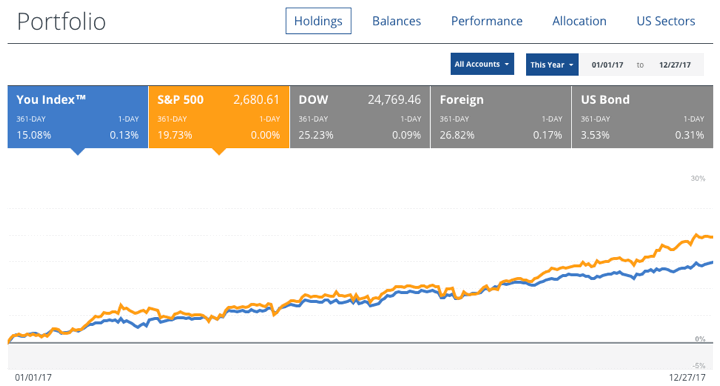
Performance, details, and commentary. According to Personal Capital, my portfolio has gained 15.08% overall in 2017 (with a few days left to go). In the same time period, the S&P 500 has gained 19.73% (excludes dividends) and the US Aggregate bond index has gained 3.53%. For the first time in a while, my sizable allocation to developed international and emerging markets stocks has boosted my overall return.

My stock/bond split is currently at 70% stocks/30% bonds due to the continued stock bull market. I continue to invest new money on a monthly basis in order to maintain the target ratios. Once a quarter, I also reinvest any accumulated dividends and interest. I don’t use automatic dividend reinvestment. This way, I can usually avoid creating any taxable transactions unless markets are really volatile.

For both simplicity and cost reasons, I am no longer buying DES/DGS and will be phasing them out whenever there are tax-loss harvesting opportunities. New money is going into the more “vanilla” Vanguard versions: Vanguard Small Value ETF (VBR) and Vanguard Emerging Markets ETF (VWO).

I’m still somewhat underweight in TIPS and REITs mostly due to limited tax-deferred space as I don’t want to hold them in a taxable account. My taxable muni bonds are split roughly evenly between the three Vanguard muni funds with an average duration of 4.5 years. I may start switching back to US Treasuries if my income tax rate changes signficantly.