Search Results for: Buying Stocks

$30,000 Beat-the-Benchmark Experiment – One Year Update, Part 1

It’s finally been a full year since starting my Beat the Market Experiment, a series of three portfolios started on November 1st, 2012:

  1. $10,000 Passive Benchmark Portfolio that would serve as both a performance benchmark and an real-world, low-cost portfolio that would be easy to replicate and maintain for DIY investors.
  2. $10,000 Beat-the-Benchmark Speculative Portfolio that would simply represent the attempts of an “average guy” who is not a financial professional and gets his news from mainstream sources to get the best overall returns possible.
  3. $10,000 P2P Consumer Lending Speculative Portfolio – Split evenly between LendingClub and Prosper, this portfolio is designed to test out the alternative investment class of person-to-person loans. The goal is again to beat the benchmark by setting a target return of 8-10% net of defaults.

I’m splitting this summary up: Part 1 will focus on the Benchmark vs. Beat-the-Benchmark results. Part 2 will include the P2P lending performance. Values given are as of November 1, 2013.

$10,000 Benchmark Portfolio. I initially put $10,000 into index funds at TD Ameritrade due to their 100 commission-free ETF program that includes free trades on the most popular low-cost, index ETFs from Vanguard and iShares. With no minimum balance requirement, no maintenance fees, and no annual fees, I haven’t paid a single fee yet on this account. The portfolio used an asset allocation model based on a David Swensen model portfolio, which I bought and held through the entire yearlong period.

The total portfolio value after one year was $12,095, up 21%. Here’s how each separate asset class fared from November 1st, 2012 to November 1st, 2013 (excluding dividends):

  • Total US Stocks +$986 (+25%)
  • Total International Stocks +$588 (+15%)
  • US Small Cap Stocks +$150 (+30%)
  • Emerging Markets Stocks -$3 (-1%)
  • US REIT +$72 (+7%)

Screenshot of holdings below:
[Read more…]

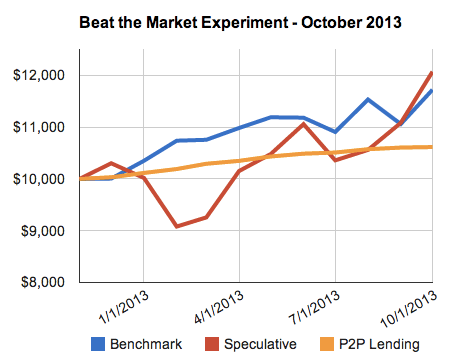
$30,000 Beat-the-Benchmark Experiment Update – October 2013

Here’s the October 2013 update for my Beat the Market Experiment, a series of three portfolios started on November 1st, 2012:

  1. $10,000 Passive Benchmark Portfolio that would serve as both a performance benchmark and an real-world, low-cost portfolio that would be easy to replicate and maintain for DIY investors.
  2. $10,000 Beat-the-Benchmark Speculative Portfolio that would simply represent the attempts of an “average guy” who is not a financial professional and gets his news from mainstream sources to get the best overall returns possible.
  3. $10,000 P2P Consumer Lending Speculative Portfolio – Split evenly between LendingClub and Prosper, this portfolio is designed to test out the alternative investment class of person-to-person loans. The goal is again to beat the benchmark by setting a target return of 8-10% net of defaults.

As requested, I updated the scale to zoom in on the comparison chart.

Summary. 11 months into this experiment, the Benchmark and Speculative portfolios are both up between 15-20%. The Speculative portfolio is actually winning now ($12,071 vs. $11,723). I sold all my AAPL shares in September. Both P2P portfolios continue to earn interest and are still on pace for an 8%+ annual return, but the growth rate has slowed lately as late loans have been taking a toll. Values given are after market close October 1, 2013.

$10,000 Benchmark Portfolio. I put $10,000 into index funds at TD Ameritrade due to their 100 commission-free ETF program that includes free trades on the most popular low-cost, index ETFs from Vanguard and iShares. With no minimum balance requirement, no maintenance fees, and no annual fees, I haven’t paid a single fee yet on this account. The portfolio was based loosely on a David Swensen model portfolio with a buy-hold-rebalance philosophy. Portfolio value is $11,723. Screenshot of holdings below:

[Read more…]

Vanguard STAR Fund vs. Vanguard Balanced Index Fund

I previously wrote about how the Vanguard Balanced Index Fund was a good example of the benefits of holding both stocks and bonds in your portfolio. Now, I’d like to extend this and compare the Vanguard Balanced Index Fund (VBINX) with another veteran balanced fund, the Vanguard STAR Fund (VGSTX). They are similar yet different:

Vanguard STAR Fund
(VGSTX)
Vanguard Balanced Index Fund
(VBINX)
Overall Asset Allocation 60% Stocks
40% Bonds
60% Stocks
40% Bonds
Expense Ratio 0.34% 0.24%
(0.10% Admiral shares)
Geographic Exposure Both US and international stocks, US bonds only US stocks only
US bonds only
Investment Style Actively-managed,
11 underlying funds
Passively-managed,
cap-weighted index
10-year annualized returns (as of 6/30/2013) 7.22% 6.86%
(6.98% Admiral shares)

Here’s a chart of how $10,000 invested 10 years ago would have done. With the Vanguard STAR fund, you’d have $20,653 today. With the Vanguard Balanced Index fund, you’d have $19,749. (This is with Investor shares, which have a lower minimum investment than Admiral shares. The minimum used to a lot higher, but now it is $10,000 for Admiral shares.)


(click to enlarge)

My observations:

[Read more…]

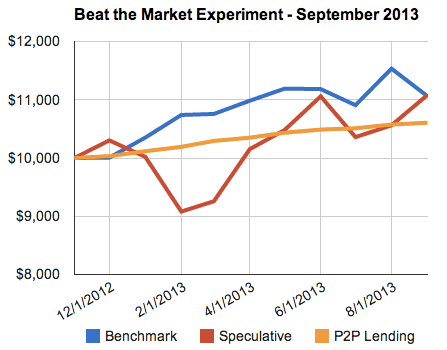
$30,000 Beat-the-Benchmark Experiment Update – September 2013

Here’s the September 2013 update for my Beat the Market Experiment, a series of three portfolios started on November 1st, 2012:

  1. $10,000 Passive Benchmark Portfolio that would serve as both a performance benchmark and an real-world, low-cost portfolio that would be easy to replicate and maintain for DIY investors.
  2. $10,000 Beat-the-Benchmark Speculative Portfolio that would simply represent the attempts of an “average guy” who is not a financial professional and gets his news from mainstream sources to get the best overall returns possible.
  3. $10,000 P2P Consumer Lending Speculative Portfolio – Split evenly between LendingClub and Prosper, this portfolio is designed to test out the alternative investment class of person-to-person loans. The goal is again to beat the benchmark by setting a target return of 8-10% net of defaults.

As requested, I updated the scale to zoom in on the comparison chart.

Summary. 10 months into this experiment, the Benchmark and Speculative portfolios have suddenly pulled neck-and-neck, with less than $25 separating them ($11,060 vs $11,083). Both US and Emerging Markets stock indexes have dropped recently, while my Apple shares have risen in anticipation of new product launches before the holiday season. Both P2P portfolios are still paying out competitive interest although late loans continue to pop up. Values given are as of September 1, 2013.

$10,000 Benchmark Portfolio. I put $10,000 into index funds at TD Ameritrade due to their 100 commission-free ETF program that includes free trades on the most popular low-cost, index ETFs from Vanguard and iShares. With no minimum balance requirement, no maintenance fees, and no annual fees, I haven’t paid a single fee yet on this account. The portfolio was based loosely on a David Swensen model portfolio. Portfolio value is $11,060. Screenshot of holdings below:

[Read more…]

GMO July 2013 7-Year Asset Class Forecast

It may qualify as market noise, but I admit to looking at the GMO 7-Year Asset Class Forecasts whenever they come out once a quarter (or more often now?). You can read it and other market commentary from Jeremy Grantham (whose opinions I respect) for free by registering on their website. The most recent one was released a few days ago:


Source: GMO.com (click to enlarge)

Most of the time, I just like looking at these forecasts because they reinforce the idea that I should rebalance and buy whatever has been underperforming lately. Right now, that’s Emerging Market stocks. I also see some logic in buying some Timber REITs as part of my REIT exposure, as I don’t believe Timber REITs are included in the Vanguard REIT ETF (VNQ). Invest in tree farms!

I don’t like the “High Quality US Stocks” category because it doesn’t explicitly state what those are. How else will we know if the prediction was right?

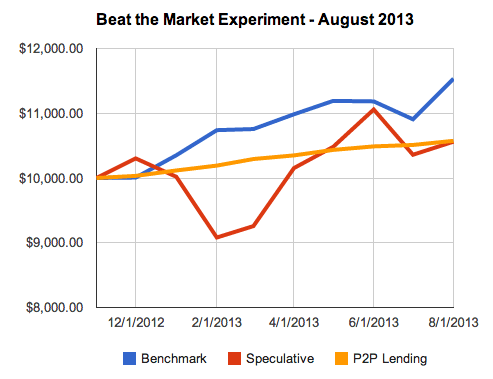
$30,000 Beat-the-Benchmark Experiment Update – August 2013

Here’s the August 2013 update for my Beat the Market Experiment, a series of three portfolios started on November 1st, 2012:

  1. $10,000 Passive Benchmark Portfolio that would serve as both a performance benchmark and an real-world, low-cost portfolio that would be easy to replicate and maintain for DIY investors.
  2. $10,000 Beat-the-Benchmark Speculative Portfolio that would simply represent the attempts of an “average guy” who is not a financial professional and gets his news from mainstream sources to get the best overall returns possible.
  3. $10,000 P2P Consumer Lending Speculative Portfolio – Split evenly between LendingClub and Prosper, this portfolio is designed to test out the alternative investment class of person-to-person loans. The goal is again to beat the benchmark by setting a target return of 8-10% net of defaults.

As requested, I updated the scale to zoom in on the comparison chart. You can view it the old way here.

Summary. Values are as of August 1, 2013. 9 months into this experiment, the passive benchmark portfolio remains the leader and if anything is widening the gap. My neglected speculative portfolio has been more volatile and also consistently behind the benchmark in this bull market. As for the P2P portfolio, it is starting to look like LendingClub may perform better than Prosper. Although my Prosper portfolio is earning slightly higher average interest, it also has significantly more late loans which has more than offset the higher interest. I’m slightly above 8% annualized return for LendingClub currently using my metrics, slightly below 7% for Prosper.

$10,000 Benchmark Portfolio. I put $10,000 into index funds at TD Ameritrade due to their 100 commission-free ETF program that includes free trades on the most popular low-cost, index ETFs from Vanguard and iShares. Also no minimum balance requirement, no maintenance fees, no annual fees. The portfolio was based loosely on a David Swensen model portfolio. Screenshot, click to enlarge:

[Read more…]

Shareholder Yield: Better Stock Screening Metric Than Dividend Yield?

I’ve read a few books about dividend investing and remain interested in the idea, although I’m not confident enough (yet?) to allocate my portfolio that way. Portfolio manager and writer Mebane Faber has a short book called Shareholder Yield: A Better Approach to Dividend Investing that offers another tweak on dividend investing strategy.
The book starts with an overview of history and academic research. First, a little over half the total return of the US stock market since 1871 is due to dividends. The smaller half is price appreciation, which when people talk about the S&P 500 index is all price appreciation. Second, stocks with higher dividends have had a higher historical return than stocks with little or no dividends.

So dividends are good, but they aren’t the entire picture. There are five ways for management to deploy the free cash flow generated by the company:

  1. Invest in existing operations,
  2. Acquire other businesses,
  3. Pay down debt,
  4. Repurchase stock (reducing outstanding shares), and
  5. Distribute cash to shareholders.

[Read more…]

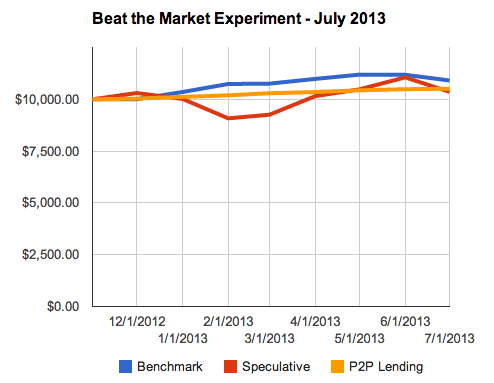
$30,000 Beat-the-Benchmark Experiment Update – July 2013

Here’s the July 2013 update for my Beat the Market Experiment, a series of three portfolios started on November 1st, 2012:

  1. $10,000 Passive Benchmark Portfolio that would serve as both a performance benchmark and an real-world, low-cost portfolio that would be easy to replicate and maintain for DIY investors.
  2. $10,000 Beat-the-Benchmark Speculative Portfolio that would simply represent the attempts of an “average guy” who is not a financial professional and gets his news from mainstream sources to get the best overall returns possible.
  3. $10,000 P2P Consumer Lending Speculative Portfolio – Split evenly between LendingClub and Prosper, this portfolio is designed to test out the alternative investment class of person-to-person loans. The goal is again to beat the benchmark by setting a target return of 8-10% net of defaults.
1307_btmsummary

Summary. Values are as of July 1, 2013. 8 months into this experiment, the passive benchmark portfolio remains the leader despite a slight drop this month. The speculative portfolio has definitely been more volatile and is back to lagging again. As for the P2P portfolio, it is starting to look like LendingClub may perform better than Prosper. Prosper simply has more late loans in the pipeline, although I’m still hopeful for solid overall returns.

$10,000 Benchmark Portfolio. I put $10,000 into index funds at TD Ameritrade due to their 100 commission-free ETF program that includes free trades on the most popular low-cost, index ETFs from Vanguard and iShares. The portfolio was based loosely on a David Swensen model portfolio. Screenshot, click to enlarge:

[Read more…]

$30,000 Beat-the-Benchmark Experiment Update – June 2013

Here’s a condensed June 2013 update for my Beat the Market Experiment, a series of three portfolios started on November 1st, 2012:

  1. $10,000 Passive Benchmark Portfolio that would serve as both a performance benchmark and an real-world, low-cost portfolio that would be easy to replicate and maintain for DIY investors.
  2. $10,000 Beat-the-Benchmark Speculative Portfolio that would simply represent the attempts of an “average guy” who is not a financial professional and gets his news from mainstream sources to get the best overall returns possible.
  3. $10,000 P2P Consumer Lending Speculative Portfolio – Split evenly between LendingClub and Prosper, this portfolio is designed to test out the alternative investment class of person-to-person loans. The goal is again to beat the benchmark by setting a target return of 8-10% net of defaults.
1306_btmsummary

Summary. Values are as of June 1, 2013. 7 months into this experiment, the passive benchmark portfolio remains the leader although last month it was pretty flat. The speculative portfolio is bouncing back quite nicely, almost matching the benchmark portfolio. The P2P lending portfolio is still rather young, but I’m satisfied with the current trend of having 5 out of 450+ loans that are over 30 days late.

$10,000 Benchmark Portfolio. I put $10,000 into index funds at TD Ameritrade due to their 100 commission-free ETF program that includes free trades on the best low-cost, index ETFs from Vanguard and iShares. The portfolio was based loosely on a David Swensen model portfolio. Screenshot, click to enlarge:

[Read more…]

$10,000 Beat-the-Benchmark Experiment Update – May 2013

Here’s a condensed May 2013 update for my Beat the Market Experiment, a series of three portfolios started on November 1st, 2012:

  1. $10,000 Passive Benchmark Portfolio that would serve as both a performance benchmark and an real-world, low-cost portfolio that would be easy to replicate and maintain for DIY investors.
  2. $10,000 Beat-the-Benchmark Speculative Portfolio that would simply represent the attempts of an “average guy” who is not a financial professional and gets his news from mainstream sources to get the best overall returns possible.
  3. $10,000 P2P Consumer Lending Speculative Portfolio – Split evenly between LendingClub and Prosper, this portfolio is designed to test out the alternative investment class of person-to-person loans. The goal is again to beat the benchmark by setting a target return of 8-10% net of defaults.

Executive summary. Six months have gone by since this experiment started, and the passive portfolio has ridden a hot stock market nearly the entire time. My speculative portfolio is catching back up a bit after my Apple holdings stumbled, while the P2P lending portfolio is still too young to make any firm conclusions. The details are below:

$10,000 Benchmark Portfolio. I put $10,000 into index funds at TD Ameritrade due to their 100 commission-free ETF program that includes free trades on the best low-cost, index ETFs from Vanguard and iShares. The portfolio was based loosely on a David Swensen model portfolio. Screenshot:

[Read more…]

$10,000 Beat-the-Benchmark Speculative Portfolio Update – April 2013

Here’s the April 2013 update for my speculative portfolio, the second of three portfolios being tracked monthly as part of my Beat the Market Experiment. Here’s an update on the overall race; the bull stock market has pushed the passive benchmark portfolio into the lead past my lagging stock picks.

$10,000 Beat-the-Benchmark Speculative Portfolio as of April 1, 2013. Many people speculate with their money, buying and selling stocks now and then, but they rarely track their performance even though they may brag about their winners. Honest tracking is the primary reason for this “no-rules, just make money” account. I am using a TradeKing account for this portfolio as I’ve had an account with them for a while and am comfortable with their low-cost $4.95 trade structure, free tax-management gain/loss software, and free dividend reinvestment. Here is a screenshot taken from my TradeKing home page on 3/31/13 after market close:

[Read more…]

$10,000 Beat-the-Benchmark Speculative Portfolio Update – March 2013

Here’s the 2nd piece of the monthly updates for my Beat the Market Experiment, a set of three portfolios started on November 1st, 2012. Since this update is rather boring, let me provide an update on the overall experiment:

  1. $10,000 Passive Benchmark Portfolio that would serve as both a performance benchmark and an real-world, low-cost portfolio that would be easy to replicate and maintain for DIY investors.
  2. $10,000 Beat-the-Benchmark Speculative Portfolio that would simply represent the attempts of an “average guy” who is not a financial professional and gets his news from mainstream sources to get the best overall returns possible.
  3. $10,000 Consumer Loan Speculative Portfolio – Split evenly between LendingClub and Prosper, this portfolio is designed to test out the alternative investment of peer-to-peer loans. The goal is again to beat the benchmark by setting a target return of 8-10% net of defaults.

$10,000 Beat-the-Benchmark Speculative Portfolio as of March 2, 2013. Many people speculate with their money, buying and selling stocks now and then, but they rarely track their performance even though they may brag about their winners. Honest tracking is the primary reason for this “no-rules, just make money” account. I am using a TradeKing account for this portfolio as I’ve had an account with them for a while and am comfortable with their low-cost $4.95 trade structure, free tax-management gain/loss software, and free dividend reinvestment. Here is a screenshot taken from my TradeKing home page 3/2/13 mid-day:

[Read more…]