Search Results for: Buying Stocks

Global Asset Allocation Book Review: Comparing 12+ Expert Model Portfolios

gaafaberI am a regular reader of Meb Faber’s online writings, and volunteered to received a free review copy of his new book Global Asset Allocation: A Survey of the World’s Top Asset Allocation Strategies. It is a rather short book and would probably be around 100 pages if printed, but it condensed a lot of information into that small package.

First off, you are shown how any individual asset class contains its own risks, from cash to stocks. The only “free lunch” out there is diversification, meaning that you should hold a portfolio of different, non-correlated asset classes. For the purposes of this book, the major asset classes are broken down into:

  • US Large Cap Stocks
  • US Small Cap Stocks
  • Foreign Developed Markets Stocks
  • Foreign Emerging Markets Stocks
  • US Corporate Bonds
  • US T-Bills
  • US 10-Year Treasury Bonds
  • US 30-Year Treasury Bonds
  • 10-Year Foreign Gov’t Bonds
  • TIPS (US Inflation-linked Treasuries)
  • Commodities (GSCI)
  • Gold (GFD)
  • REITs (NAREIT)

So, what mix of these “ingredients” is best? Faber discusses and compares model asset allocations from various experts and sources. I will only include the name and brief description below, but the book expands on the portfolios a little more. Don’t expect a comprehensive review of each model and its underpinnings, however.

  • Classic 60/40 – the benchmark portfolio, 60% stocks (S&P 500) and 40% bonds (10-year US Treasuries).
  • Global 60/40 – stocks split 50/50 US/foreign, bonds also split 50/50 US/foreign.
  • Ray Dalio All Seasons – proposed by well-known hedge fund manager in Master The Money Game book.
  • Harry Browne Permanent Portfolio – 25% stocks/25% cash/25% Long-term Treasuries/25% Gold.
  • Global Market Portfolio – Based on the estimated market-weighted composition of asset classes worldwide.
  • Rob Arnott Portfolio – Well-known proponent of fundamental indexing and “smart beta”.
  • Marc Faber Portfolio – Author of the “Gloom, Boom, and Doom” newsletter.
  • David Swensen Portfolio – Yale Endowment manager, from his book Unconventional Success.
  • Mohamad El-Erian Portfolio – Former Harvard Endowment manager, from his book When Markets Collide.
  • Warren Buffett Portfolio – As directed to Buffett’s trust for his wife’s benefit upon his passing.
  • Andrew Tobias Portfolio – 1/3rd each of: US Large, Foreign Developed, US 10-Year Treasuries.
  • Talmud Portfolio – “Let every man divide his money into three parts, and invest a third in land, a third in business and a third let him keep by him in reserve.”
  • 7Twelve Portfolio – From the book 7Twelve by Craig Israelsen.
  • William Bernstein Portfolio – From his book The Intelligent Asset Allocator.
  • Larry Swedroe Portfolio – Specifically, his “Eliminate Fat Tails” portfolio.

Faber collected and calculated the average annualized returns, volatility, Sharpe ratio, and Max Drawdown percentage (peak-to-trough drop in value) of all these model asset allocations from 1973-2013. So what were his conclusions? Here some excerpts from the book:

If you exclude the Permanent Portfolio, all of the allocations are within one percentage point.

What if someone was able to predict the best-performing strategy in 1973 and then decided to implement it via the average mutual fund? We also looked at the effect if someone decided to use a financial advisor who then invested client assets in the average mutual fund. Predicting the best asset allocation, but implementing it via the average mutual fund would push returns down to roughly even with the Permanent Portfolio. If you added advisory fees on top of that, it had the effect of transforming the BEST performing asset allocation into lower than the WORST.

Think about that for a second. Fees are far more important than your asset allocation decision! Now what do you spend most of your time thinking about? Probably the asset allocation decision and not fees! This is the main point we are trying to drive home in this book – if you are going to allocate to a buy and hold portfolio you want to be paying as little as possible in total fees and costs.

So after collecting the best strategies from the smartest gurus out there, all with very different allocations, the difference in past performance between the 12+ portfolios was less than 1% a year (besides the permanent portfolio, which had performance roughly another 1% lower but also the smallest max drawdown). Now, there were some differences in Sharpe ratio, volatility, and max drawdown which was addressed a little but wasn’t explored in much detail. There was no “winner” that was crowned, but for the curious the Arnott portfolio had the highest Sharpe ratio by a little bit and the Permanent portfolio had the smallest max drawdown by a little bit.

Instead of trying to predict future performance, it would appear much more reliable to focus on fees and taxes. I would also add that all of these portfolio backtests looked pretty good, but they were all theoretical returns based on strict application of the model asset allocation. If you are going to use a buy-and-hold portfolio and get these sort of returns, you have to keep buying and keep holding through both the good times and bad.

Although I don’t believe it is explicitly mentioned in this book, Faber’s company has a new ETF that just happens to help you do these things. The Cambria Global Asset Allocation ETF (GAA) is an “all-in-one” ETF that includes 29 underlying funds with an approximate allocation of 40% stocks, 40% bonds, and 20% real assets. The total expense ratio is 0.29% which includes the expenses of the underlying funds with no separate management fee. The ETF holdings have a big chunk of various Vanguard index funds, but it also holds about 9% in Cambria ETFs managed by Faber.

Since it is an all-in-one fund, theoretically you can’t fiddle around with the asset allocation. That’s pretty much how automated advisors like Wealthfront and Betterment work as well. If you have more money to invest, you just hand it over and it will be invested for you, including regular rebalancing. The same idea has also been around for a while through the under-rated Vanguard Target Retirement Funds, which are also all-in-one but stick with simplicity rather than trying to capture possible higher returns though value, momentum, and real asset strategies. The Vanguard Target funds are cheaper though, at around 0.18% expense ratio.

Well, my portfolio already very low in costs. So my own takeaway is that I should… do nothing! 🙂

Alpha Architect also has a review of this book.

Bogle on Mutual Funds, An Investment Classic Book Review #TBT

boglebook729

Whenever I feel overwhelmed by the amount of noise coming at me through my computer screens, I read a book. When the new books on my desk don’t impress, I find an old book. That is how I came to buy a used, first edition of Bogle on Mutual Funds last year from Amazon for a penny + $3.99 shipping. John Bogle is best known as the founder of Vanguard who brought index funds to retail investors and changed the entire industry. Since most people just know him as the Index Fund Guy, I feel that he is under constant pressure to stay “on message” and only promote buy-and-hold passive investing.

But you know what? Even though many would prefer the world to be black and white, it isn’t. For a very long time, Bogle also ran and owned low-cost actively-managed funds like the Vanguard Wellington and Wellesley funds. To this day, a big chunk of Vanguard assets are actively-managed. Even recently, he has expressed skepticism about the trend towards holding more non-US international stocks.

When you read the circa-1993 material in Bogle on Mutual Funds, I feel like you get more of the “grey” Bogle. There is advice on how to pick a good stock mutual fund, even amongst actively-managed funds. There are some practical considerations for picking amongst asset classes. Of course, the main takeaways are still there:

  • Index funds are a great invention for long-term investors.
  • Low costs are very, very important.
  • Low portfolio turnover and minimizing taxes are very important.

But the book also includes a lot of little nuggets like comparing dividend yield relative to interest rates. First, here is a chart from the book showing how S&P 500 dividends have grown steadily with inflation. Meanwhile, the yield from a bond may start out higher, but would remain be constant until maturity.

divinflation

Unfortunately, defining what constitutes too high a price for dividends is a fallible exercise, one that must take into account not only the average historical valuations for stocks but the current valuations for other investment alternatives as well. History suggests that stocks are relatively expensive when the price paid for $1 of dividends is above $30 (i.e., a yield of 3.3%) and relatively cheap when the price paid is less than $20 (a yield of 5%). However, stocks may well be attractive at a yield of, say, 3.5% if there are compelling reasons to assume that their dividends will increase rapidly or if yields on other classes of financial assets are relatively unattractive.

In the example shown in Figure 2-5, buying a portfolio of stocks at a 3% yield rather than a bond at a 7% yield might not be a sensible investment, especially considering the incremental risk incurred in holding stocks. When stocks yield 4.5% and bonds yield 6%, that may be quite another story.

As of mid-2015, the S&P 500 dividend yield is ~2% and 30-year Treasury bonds are ~3%. The relative difference between the stock yield and the bond yield only 1%, even less than the 1.5% gap that he calls “quite another story”. This would suggest that (long-term) the S&P 500 is expensive historically, but still attractive relatively when compared to bonds at this point.

Anyhow, I bring this up is because Bogle on Mutual funds has just been republished as part of the “Wiley Investment Classics” series. (#TBT = Throwback Thursday.) It’s a great book and you could buy it to have it in Kindle format or to support Bogle, but you can also buy a used, 1st edition hardcover for $4 shipped. (Or borrow it from a library, but this is going in my permanent collection.) Unfortunately it is not a “revised” edition where the charts are updated or there is new investment commentary based on current market conditions. The only difference that I could find between my 1993 version and my 2015 review copy is a new 17-page introduction which mostly talks about the history of the book itself.

If you’re going to buy something new, I’d recommend their other Bogle classic – John Bogle on Investing: The First 50 Years – which is a compilation of his best speeches over the years going back all the way to his 1951 undergraduate senior thesis. I haven’t read that one yet, but I really enjoyed a similar compilation of Charlie Munger speeches.

Target Date Retirement Funds: Beating The Behavior Gap

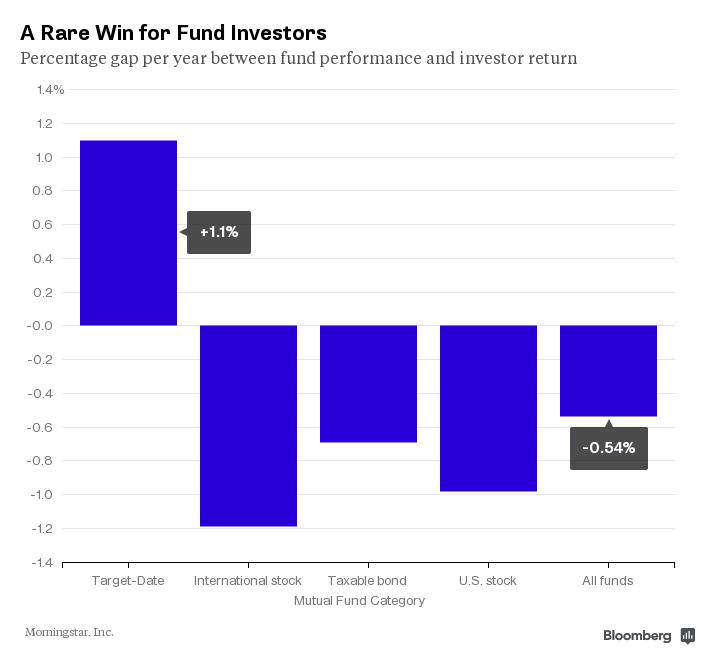
The general consensus behind target-date retirement funds is often “They’re okay… but here’s something better!”. Any all-in-one product will be imperfect. But I still like them on the whole and have written previously about how Vanguard’s target-date retirement funds are underrated. If you’re invested in them, this Bloomberg article and Morningstar data should make you feel even better about it.

Most mutual fund investors actually do worse than market returns due to poor behavior, termed the “behavior gap“:

But target-date funds have one big advantage over other kinds of mutual funds, the data show. The average mutual fund has a flaw, which is that the average investor hardly ever does as well as his or her funds. Investors tend to jump in and out of funds at the wrong time. They buy high, choosing funds only after they’ve done well. And they sell low, dumping underperforming funds just as they’re about to take off.

However, owners of target-date fund actually did better:

targetdategap

On average, target-date fund investors are doing 1.1 percent better per year than their funds. Investors in almost every other fund category lagged their funds over the past decade, including a -0.98 percent underperformance for U.S. equity funds and -1.3 percent for municipal bond funds.

The outperformance may be a temporary anomaly, but I do think there are unique features of these all-in-one funds (and their investors) that will persist:

  1. Self-selection. If you buy a target-date fund, you desire simplicity. You have a degree of humility. You don’t overestimate your skills as an investor, otherwise you’d buy something else.
  2. Optical illusions. If you own an all-in-one fund that holds both stocks and bonds together, you don’t have the problem of seeing one investment drop while the other rises. It’s all mixed together in one pot, so the impact is usually dulled. This is the benefit of buying a “balanced” fund.
  3. Automatic rebalancing. Anything that makes you look at your investments is an opportunity to make an emotionally-driven choice. Since these funds even rebalance their holdings for you automatically, you’re not even required to rebalance, which can be hard to do. Right now, a portfolio would probably have to sell stocks and buy some bonds while the media keeps talking about rising rates.
  4. Tweaking is difficult. If you have one stock fund and one bond fund, it’s very easy to buy little more of one or a little less of the other. With an all-in-one fund, it’s harder to tweak your mix.

So you don’t have to do anything, and if you want to do something besides just buy more, it’s a pain. All this means less trading, which over the long run is a good thing.

So don’t be ashamed of buying a diversified, low-cost Target Date fund like Vanguard 20XX or Fidelity Freedom *Index* 20XX funds. The article ends with a good reminder that costs still matter. Don’t overpay for one of these funds either, and maybe even raise a little stink if you are being asked to.

ComputerShare and Company-Specific DRIP Plans: Still A Good Option in 2015?

drip200Here’s a reader question that arrived this week:

I know you write a lot about investing, but can you write a little more about ComputerShare as a way to save money vs buying stock with online brokerages. I just read in WSJ how its cheaper if you are a buy and hold kind and its just as good as someone holding your paper stock certificates.

I am assuming that the WSJ article in question is the one about Ronald Read, the maintenance worker and janitor who saved up $8 million using DRIP plans.

A thrifty lifestyle, solid investing acumen, plenty of patience and the benefits of compounding were at the center of the story of Ronald Read—the quiet and simple-living Vermonter who enjoyed playing the stock market and left behind a nearly $8 million estate when he died last year at the age of 92.

Dividend Re-Investment Plans (DRIPs) traditionally refer to companies that let individuals to buy their shares directly from them and then allow them to automatically reinvest any dividends into more shares. Reinvesting those dividends increased the number of shares owned, and when combined with per-share price appreciation often leads to significant gains over time.

DRIPs were one of the first low-cost, buy-and-hold investment strategies. Stock commissions used to run over $30 per trade, whereas many DRIP plans let you buy shares for free or just a few bucks. This allowed mom-and-pop investors to put away as little as $25 a month without the entire nut being eaten by fees.

I started learning a tiny bit about investing in the late 1990s, which was near the rise of the online broker and the beginning of end of for DRIP plans. I still remember buying a book about DRIPs from Moe’s Books (used book store that is still going!) and being very fascinated by the idea. These days, paper certificates are pretty much gone and transfer agents like ComputerShare manage DRIP plans for most companies electronically. ComputerShare manages plans for Procter & Gamble, ExxonMobil, Coca-Cola, Johnson & Johnson, Wal-Mart, AT&T, Verizon, and several more.

For the most part, there are better low-cost, buy-and-hold options out there now. Let’s take a look at the Coca-Cola DRIP plan. It costs $10 to set up, $2 per automatic purchase plus a $0.03 per share processing fee. Reinvestment of dividends cost 5% of amount reinvested up to a maximum of $2.00. You need $500 to start and there is a $50 ongoing minimum investment.

Every company has different rules, and sometimes there is a purchase price discount. However, you are still buying individual stocks so what happens when you end up holding a Enron, MCI Worldcom, or even a Kodak or Sears? You could juggle 30 different stock plans like Ronald Read did – one of his stocks bombed too but his diversification protected his portfolio – but that gets to be a lot of work and paying $2 times 30 starts adding up.

Now consider that you can buy an ETF like the Vanguard Total Stock Market ETF (VTI) with zero commission and zero setup fees from Vanguard or TD Ameritrade and holds 3,800 stocks for you all at once for an expense ratio of $5 a year per $10,000 invested. If you like the dollar-based simplicity of DRIPs (all of your $50 a month gets invested in partial shares), you can buy the mutual fund version (VTSMX) at Vanguard which supports fractional shares and free automatic dividend reinvestment.

Even if you still wanted to buy individual stocks, many discount brokers including TradeKing and TD Ameritrade offer low commissions and free dividend reinvestment. Hold one stock or 100, all on a single statement. The Robinhood app lets you buy stocks with zero commission if you have a smartphone. You can buy up to 30 stocks at once for $9.95 at Motif Investing.

The Affluent Investor by Phil DeMuth – Book for $100,000+ Club

affinvestor

This week I’ve been trying to catch up on my book reviews (you should see my “to read” shelf!), and after a good beginner book I thought I’d write about a good intermediate-to-advanced book. You’ve probably noticed there are a lot of starter books out there for novice investors but not as many with more advanced advice ($$$… the potential audience is a fraction of the size). Addressing this deficiency is the goal of The Affluent Investor by Phil DeMuth.

In terms of the title, the industry classifies you as “mass affluent” if you have investable assets between $100,000 and $999,999. From $1 million to $10 million you are “high net worth”. This definition excludes some possibly important stuff – your income, the value of your personal residence, pensions, etc. But in real world terms, I would say this book is for anyone who isn’t living from paycheck-to-paycheck. If you have a $10,000 portfolio and have a surplus each month, sooner or later you will reach $100,000. If instead you have a credit card balance and it just keeps inching up, then you need something closer to a Dave Ramsey book.

The overall tone of the book is that of a close friend who is smart and into finances. DeMuth is already a financial advisor to rich folks so the last part is expected. What I mean is that he will be blunt and isn’t afraid to make stereotypical assumptions in order to rattle off all his tips. At only 200 pages, most things are only touched upon in a concise manner. Here’s a rough outline of the topics covered:

  • Big picture rules. Get and stay married. Make sure you can afford your children. Avoid debt. Save early and invest it. Diversify. Plan ahead.
  • Financial advice based on life stage. He puts you in the basic “affluent” mold of 20-35s have a kid buy a house, 35-55 working hard at professional career making most of your money, 55-65 protect assets and prepare for retirement, and 65+ retire and spend down money.
  • Financial advice based on job. Has special advice for doctors, lawyers, small business owners, and corporate executives.
  • General investing advice and “Can you do better?” investing advice. General investing advice is keep costs low and buy index funds that closely approximate the global market portfolio. “Can you do better?” advice touches on things like value stocks, small-cap stocks, dividend stocks, momentum, low-beta, etc.
  • Asset protection. Being affluent means you have money, and other people will want it. Insurance, buying real estate with LLCs, homestead exemptions, and similar topics are are very complex but his take is condensed into less than a page each.
  • Tax minimization. IRAs, 401ks, Solo Pensions, 529 plans, Health Savings Accounts, etc.

Here are things you might expect from a “book for rich folks” but won’t find inside:

  • You won’t get in-depth, hand-holding walkthroughs of anything. Consider the book as a push in the right direction for researching ideas.
  • You won’t find his secret list of the best hedge fund managers.
  • You won’t find tips on how to get rich with real estate.
  • You won’t find advice on how to pick individual stocks like Warren Buffett.
  • You won’t find him selling his own personal advisory services.

A general problem with all books of this type is that the advice is pretty short and to the point, but it doesn’t provide very much supporting evidence. You’ll either have to do your own due diligence, or blindly decide to trust the author. I’ve read books where the author might sound convincing but their advice is horrible. In my opinion, I think for the most part the advice in this book is good. But I’m just another person on the internet, so again do your own research.

In conclusion, I think this book covers a lot of questions that are commonly asked by the intermediate individual investor. It’s not too long and not too short. Some of the advice won’t fit your own situation, but at this level if you just find one solid actionable idea that makes the entire $18 book worth it. I’m personally going to look into the solo defined-beneift plan idea again, although I may still be too young to take full advantage.

Vanguard High-Yield Corporate Bond Fund Review (VWEHX)

vanguardinvThe Vanguard High-Yield Corporate Bond Fund (VWEHX, VWEAX) is a low-cost, actively-managed bond fund that invests in medium- and lower-quality corporate bonds and is advised by Wellington Management Company. I don’t own any in my retirement portfolio, but while reading the book The Affluent Investor by Phil DeMuth, I was intrigued by this interesting tidbit:

If you have settled on buying them anyway, at least wait until the spread between treasury bonds and junk bonds of the same maturity is wide (say, 4 percentage points). The fund to own is Vanguard’s (ticker: VWEHX), which has a gimmick: it buys the highest rated junk bonds. Many institutional investors can only hold investment-grade bonds as a matter of policy, and they are forced to liquidate bonds that get downgraded even when it makes no sense to do so. Vanguard lies in wait to take advantage of their mistake. This is a hedge fund strategy in a bond fund wrapper.

(I should add that this is after the author warns you about the high-yield bond asset class in general, and how if you adjust the higher yields to account for higher defaults, the net advantage can be small or even zero. He also adds that high-yield “junk” bonds are also quite volatile and should be treated like equities.)

But going back to the quote, DeMuth is saying that this fund tries to take advantage of a specific market inefficiency. I’ve never seen this strategy mentioned in either any Vanguard materials or financial media coverage. I went back and took a closer look at their prospectuses and other investor documents.

I was aware that VWEHX tends to invest in the higher-quality portion of the junk spectrum. From the Product Summary on their website:

Created in 1978, this fund seeks to purchase what the advisor considers higher-rated junk bonds. This approach aims to capture consistent income and minimize defaults and principal loss.

From the Fund Prospectus (dated 5/28/14):

The Fund invests primarily in a diversified group of high-yielding, higher-risk corporate bonds—commonly known as “junk bonds”—with medium- and lower-range credit- quality ratings. The Fund invests at least 80% of its assets in corporate bonds that are rated below Baa by Moody’s […] The Fund may not invest more than 20% of its assets in any of the following, taken as a whole: bonds with credit ratings lower than B or the equivalent, convertible securities, preferred stocks, and fixed and floating rate loans of medium- to lower-range credit quality.

Digging further into the Prospectus, we find the following under the “Security Selection” heading:

Wellington Management Company, LLP (Wellington Management), advisor to the Fund, seeks to minimize the substantial investment risk posed by junk bonds, primarily through its use of solid credit research and broad diversification among issuers. […]

The Fund will only invest in bonds and loans that, at the time of initial investment, are rated Caa or higher by Moody‘s; have an equivalent rating by any other independent bond-rating agency; or, if unrated, are determined to be of comparable quality by the advisor. […]

Wellington Management selects bonds on a company-by-company basis, emphasizing fundamental research and a long-term investment horizon. The analysis focuses on the nature of a company’s business, its strategy, and the quality of its management. Based on this analysis, the advisor looks for companies whose prospects are stable or improving and whose bonds offer an attractive yield. Companies with improving prospects are normally more attractive because they offer better assurance of debt repayment and greater potential for capital appreciation. […]

To minimize credit risk, the Fund normally diversifies its holdings among debt of at least 100 separate issuers, representing many industries. As of January 31, 2014, the Fund held debt of 172 corporate issuers. This diversification should lessen the negative impact to the Fund of a particular issuer’s failure to pay either principal or interest.

Here’s a quick summary of the Moody’s Credit Rating hierarchy, per Wikipedia:

Investment Grade

  • Aaa – Highest quality and lowest credit risk.
  • Aa – High quality and very low credit risk.
  • A – Upper-medium grade and low credit risk.
  • Baa – Medium grade, with some speculative elements and moderate credit risk.

Below-Investment Grade (“Junk”)

  • Ba – Speculative elements and a significant credit risk.
  • B – Speculative and a high credit risk.
  • Caa -Poor quality and very high credit risk.
  • Ca – Highly speculative and with likelihood of being near or in default, but some possibility of recovering principal and interest.
  • C – Lowest quality, usually in default and low likelihood of recovering principal or interest.

From the Annual Report (dated 1/31/15):

This is the first time we are reporting the performance of the High-Yield Corporate Fund against its new benchmark composite index, which consists of 95% Barclays U.S. High-Yield Ba/B 2% Issuer Capped Index and 5% Barclays U.S. 1–5 Year Treasury Bond Index. As we mentioned when we made the change in November, we believe that the composite index is a better yardstick for the portfolio. It more closely reflects the portfolio’s longtime strategy of investing in higher-rated securities in the below-investment-grade category while maintaining some exposure to very liquid assets.

From Wellington Management Advisor Letter (part of Annual Report, dated 1/31/15)

The decline in commodity prices sparked a significant widening of high-yield bond spreads, and although the problems now affecting high-yield energy credits are justifiable, they are relatively isolated
to that industry. We are looking to take advantage of recent dislocations created by the sell-off in non-energy companies, where wider spreads are attractive and the credits are well-supported by strong fundamentals.

The fund remains consistent in its investment objective and strategy and maintains a significant exposure to relatively higher-rated companies in the high-yield market. We believe that these issuers have more consistent businesses and more predictable cash flows than those at the lower end of the spectrum. We prefer higher-rated credits in order to minimize defaults and provide stable income. We continue to diversify the fund’s holdings by issuer and industry and to de-emphasize non-cash-paying securities, preferred stock, and equity- linked securities (such as convertibles) because of their potential for volatility.

Costs and Fees

The expense ratio of the High-Yield Corporate Fund Investor Shares at 0.23% and Admiral Shares at 0.13% are very low in comparison to the peer group average of 1.11% for High-Yield Funds (calculated by Lipper). The fact that Vanguard itself runs at-cost and the fund advisor Wellington agrees to only takes a fee of 0.03% are quite impressive:

Wellington Management Company LLP provides investment advisory services to the fund for a fee calculated at an annual percentage rate of average net assets. For the year ended January 31, 2015, the investment advisory fee represented an effective annual rate of 0.03% of the fund’s average net assets.

In comparison, sometimes the creator of an index (like the S&P 500) will want a few basis points just for allowing a fund to follow their computer-generated list of companies. Wellington is pruning through thousands of often-illiquid bonds.

Portfolio Credit Quality

Here is the breakdown of the Vanguard High-Yield Corporate Bond Fund portfolio by credit rating as of 1/31/15. Remember that Baa and above is investment grade, so the vast majority (87%) of their holdings are indeed the top two rungs of the non-investment-grade spectrum. I assume that the 5% allocation to US government bonds is in case of an increase in fund redemptions.

vghighyield

Recap
I am neither recommending nor discouraging investment in this fund. There are many types of risk involved: credit risk, interest rate risk, liquidity risk, poor security selection risk. I was just intrigued by a quote in a book and wanted to dig into it further.

I have read through the prospectus and annual reports and pointed out all of what I saw were pertinent mentions of their investment and bond selection criteria. I didn’t find anything particular in Vanguard’s materials about picking bonds that have recently fallen from investment-grade to just below investment-grade, but such a strategy would certainly align with their historical portfolio and stated goals of holding the “best of the junk”.

If this is indeed a significant market inefficiency, I wonder why it still exists. Perhaps you can only do it with a very low expense ratio? I don’t believe there is any other actively-managed bond fund consisting of high-yield bonds that has such a low expense ratio; 0.13-0.23% is nearly as low as many index funds.

The low costs alone create a relative performance advantage for this fund. I chose not to emphasize past performance as that can be fleeting, but this fund’s past performance numbers also beats their Lipper peer group average over the last 1, 5, and 10 years.

Now, I do own shares of the Vanguard High-Yield Tax-Exempt Fund, which has a different advisor; Vanguard Fixed Income Group. I wonder if they do a similar thing there?

Beware of Mutual Funds That Artificially Juice Their Dividend Yield

juicingdividendsI like seeing my dividend income roll in each quarter, as do many other investors. But are mutual funds artificially “juicing” their reported dividend yields to attract investors? This is explored in a recent academic paper Juicing the Dividend Yield: Mutual Funds and the Demand for Dividends, which I found via Alpha Architect. Here is the abstract:

Some mutual funds purchase stocks before dividend payments to artificially increase their dividends, which we call “juicing.” Funds paid more than twice the dividends implied by their holdings in 7.4% of fund-years examined. Juicing is associated with larger inflows, and is more common among funds with unsophisticated investors. This behavior is consistent with an underlying investor demand for dividends, but is hard to explain by taxes or need for income, as funds can generate equivalent tax-free distributions by returning capital. Juicing is costly to investors through higher turnover and increased taxes of 0.57% to 1.52% of fund assets per year.

The problem with making extra trades to make your dividend yield look higher is that it is not tax-efficient. The increased turnover itself creates extra capital gains and trading costs. Also, when a funds buy a stock just before the ex-dividend date, then that dividend no longer qualifies for the lower dividend tax rate. I just ran across this problem last month when doing my taxes and looking at my qualified dividend income percentages. (I’m not saying that WisdomTree is not engaging in any “juicing” behaviors, it is very hard to actually calculate and there are other factors involved.)

Interestingly, the paper authors propose addressing that exact problem. Make it easier on investors and require funds to report their qualified dividend income percentages (emphasis mine):

One minimally intrusive regulatory change that could improve investor decision-making is to require funds to break out dividend income into qualified dividends (entitled to a reduced income tax rate, when the stock was held for 60 days or more) and non-qualified dividends (which pay the full income tax rate, for stocks held for less than 60 days) when reporting their distributions in filings such as annual reports. Such disclosure would not harm an investor that was already informed about juicing, but would ensure that investors had easy access to the information necessary to make an informed decision if they chose to do so.

Bottom line: Juicing exists and it hurts investors with higher turnover and higher tax bills, but it’s hard to know when by just looking at the usual mutual fund stats. Until then, be careful if you’re buying an actively-managed fund primarily due to their high dividend yield.

How Often Should I Rebalance My Investment Portfolio? Less Than You Might Think

An important tenet of portfolio construction is rebalancing your portfolio to maintain your desired risk profile and also provide the best risk-adjusted returns. The next question is usually – Okay, so how often do I rebalance? Well, this Vanguard article targeted at financial advisors answers that question (found via Abnormal Returns).

Longer answer:

Our 2010 study looked at the performance of portfolios that used rebalancing strategies based on various time intervals, allocation thresholds, and combinations of both. The time-based portfolios were rebalanced monthly, quarterly, or annually, while the threshold categories were rebalanced when allocations deviated by a predetermined minimum (in this case 1%, 5%, or 10%) from their target allocations. The “time-and-threshold” strategy combined periodic monitoring with predetermined minimum rebalancing thresholds. […] We found that no one approach produced significantly superior results over another. However, all strategies resulted in more favorable risk-adjusted portfolio returns when compared with returns for portfolios that were never rebalanced.

vgrebal

Short answer: It doesn’t matter, as long as you do it regularly and without emotion. Rebalancing every month was no better than rebalancing just once a year.

Personally, I try to rebalance whenever I make my monthly share purchases by buying underweight asset classes, but I will only sell and create a taxable event once a year if things are really out of whack. The more common problem is that you are afraid to rebalance because that usually means buying whatever has been getting crushed and selling what has been rising. If you haven’t done it recently, that probably involves selling some stocks and buying some bonds. Like the shoe company says, just do it!

Early Retirement Portfolio Update – June 2014 Asset Allocation

I want to get back to doing quarterly updates to our investment portfolio, which includes both tax-deferred accounts like 401(k)s and taxable brokerage holdings. Other stuff like cash reserves (emergency fund) are excluded. The purpose of this portfolio is to create enough income on its own to cover all daily expenses well before we hit the standard retirement age.

Target Asset Allocation

aa_updated2013_bigger

I try to pick asset classes that will provide long-term returns above inflation, regular income via dividends and interest, and finally offer some historical tendencies to balance each other out. I don’t hold commodities futures or gold as they don’t provide any income and I don’t believe they’ll outpace inflation significantly. In addition, I am not confident in them enough to know that I will hold them through an extended period of underperformance (and if you don’t do that, there’s no point).

Our current ratio is about 70% stocks and 30% bonds within our investment strategy of buy, hold, and rebalance. With low expense ratios and low turnover, we minimize our costs in terms of paying fees, commissions, and taxes.

Actual Asset Allocation and Holdings

1406_actualaa

Stock Holdings
Vanguard Total Stock Market Fund (VTI, VTSMX, VTSAX)
Vanguard Total International Stock Market Fund (VXUS, VGTSX, VTIAX)
WisdomTree SmallCap Dividend ETF (DES)
WisdomTree Emerging Markets SmallCap Dividend ETF (DGS)
Vanguard REIT Index Fund (VNQ, VGSIX, VGSLX)

Bond Holdings
Vanguard Limited-Term Tax-Exempt Fund (VMLTX, VMLUX)
Vanguard High-Yield Tax-Exempt Fund (VWAHX, VWALX)
Stable Value Fund* (2.6% yield, net of fees)
Vanguard Inflation-Protected Securities Fund (VIPSX, VAIPX)
iShares Barclays TIPS Bond ETF (TIP)
Individual TIPS securities
US Savings Bonds

Changes
I joined the exodus out of PIMCO Total Return fund earlier this year after their recent management shake-up. It actually coincided with my 401(k) allowing a self-directed brokerage “window” with Charles Schwab that allows me to buy Vanguard mutual funds, albeit with a $50 transaction fee. But my 401k assets are finally large enough that the $50 is worth the ongoing lower expense ratios. I’m buying more REITs and TIPS in order to take advantage of this newly-flexible tax-deferred space. I’m still holding onto my stable value fund, but I may sell that position as well in the future.

I think I mentioned this elsewhere, but I am now accounting for my Series I US Savings Bonds as part the TIPS asset class inside my retirement portfolio. Before, they were considered part of my emergency fund. They offer great tax-deferral benefits as I don’t have to pay taxes until they are redeemed. I don’t plan on selling any of them for a long time, at least until my tax rate is much lower in early retirement.

Another Reason Why Vanguard Target Retirement Funds Are Underrated

Index funds are growing increasingly popular. Yet Carl Richards tweets that over the last 15 years, the actual investor return for the popular Vanguard S&P 500 index fund (VFINX) lags nearly 2% a year behind the fund’s official return. That works out to a final balance that is 24% less. This means that if you account for the timing of actual dollar inflows and outflows, the average investor in the fund actually earned a lot less than they might think. (More explanation on investor returns vs. advertised returns here.)

Here’s the data taken straight from Morningstar. The longer the time period, the worse the relative performance:

As Abnormal Returns put it, “indexing is no panacea“. I think part of the problem is that people use the S&P 500 as a proxy for the overall stock market and thus trade it much more frequently… and poorly. If you were really afraid during the 2008 financial crisis, it was really tempting to sell your stock shares and keep it in something “safe” instead like bonds or cash. You may still be in cash today after missing out on the rebound.

But what about the Vanguard Target Retirement 20XX Funds, which are basically just a mix of different index funds? Specifically, let’s take the Vanguard Target Retirement 2045 Fund (VTIVX). It’s mostly stocks, and mostly US stocks at that, so it should behave similarly to VFINX. Check out the 10-year growth chart comparison with the S&P 500 fund:

However, the average investor returns for the Vanguard Target Retirement 2045 Fund are much closer to the fund returns. The investor return over the 10-year period is actually better than the fund return, although some of that may have to do with the small asset base in 2004.

Why is this? My opinion is that people who own the Vanguard Target Retirement fund trade a lot less frequently. Part of this is self-selection. If you buy this fund, you desire simplicity. Also, if you own an all-in-one fund that holds both stocks and bonds together, you don’t have the problem of seeing one investment drop while the other rises. This is the benefit of buying a “balanced” fund.

You won’t see Vanguard Target Retirement funds being touted very much in the financial media. Their returns are rarely at the top since they are index-based, so magazines and newsletters won’t write about them. Most advisors are supposedly charging you for their “expert” advice, so they will of course recommend something more complicated. Even index fund enthusiasts like myself often don’t invest in them because we like to fine-tune and tinker (sometimes to our detriment).

Despite their boring nature and lack of publicity, I have long recommended Vanguard Target Retirement funds to members of my family. They are simple yet diversified, have very low expenses, and designed to be left alone. You don’t even have to rebalance your holdings; it is done for you automatically. Could you do better? Maybe. Could you do worse? Definitely.

Investing Guide

Here is a collection of posts about investing that I am trying to organize into a more orderly fashion. More to be added soon.

General Investing
Capitalism is an incredible thing, with millions of people working hard everyday to create value. Invest soundly and watch your money grow.

Making an Asset Allocation Plan

  1. Disclaimer and General Philosophy
  2. Consider Simply Buying The Entire Market
  3. Efficient Frontier and Modern Portfolio Theory
  4. Deciding On The Stocks/Bonds Ratio
  5. Deciding On The Domestic/International Ratio
  6. Considering The Diversification Benefits Of Small and Value Stocks
  7. Equity Asset Allocation: Comparison of 8 Model Portfolios
  8. Investing In Real Estate Through REITs?

Blog Flashback: 5 Years Ago, S&P 500 at 750

How time flies. Almost exactly 5 years ago on November 21st, 2008, I was sitting alone in yet another hotel on a business trip in a city that I can’t even remember. CNN was on TV as I wrote the following in a blog post with the title S&P 500 at 750:

While the present looks bleak, the potential for future returns is looking brighter and brighter for long-term investors. The opposite was true a few years ago. If you’re young and still putting money away, this is a good thing! (Although adequate emergency funds should be your first goal.)

Here are selected comments on that post that I admit gave me some doubt:

However, EPS estimates, and therefore valuations, are ridiculously high.

Putting money into a market that represents the old model right now seems like pure folly.

This bear market will last 3-12 years!

I think it’s funny that many of you are down 50% and think that you will break even in a few years, or justify by saying “I’m for the long term”. […] Also, most of the dividends being advertised are based on fantasy (again), just like the EPS, because companies will be cutting them a lot to survive. So no, the S&P isn’t cheap to buy and buy-and-hold is really dead.

[Read more…]