Search Results for: Buying Stocks

Understanding the Risks and Downsides of Bonds

pie_flat_blank_200To get the full return of any asset class, you’ll have to own it through the good times and the bad times. The good times are easy, but getting through the bad times requires deeper understanding and faith. You’ll usually hear this about holding stocks through their inevitable drops and crashes. But recently, many bond funds have dropped in value instead. Here’s a somewhat-reassuring chart from A Wealth of Common Sense comparing historical drawdowns between the S&P 500 stock index and 5-Year US Treasury bonds:

bondsrisks2

Even so, having an investment that is supposed to be “safe” wobble 5% can still be worrisome. If Bank of America or Chase Bank announced tomorrow that their customers with balances above FDIC limits would lose even 1% of their excess deposits, there would be a huge crisis due to the perceived level of safety. A recent post by Longboard Funds makes an interesting claim: “…investors destroy more of their bond returns than their stock returns.”

This statement reminded of my surprise when reading this Bogleheads forum post on 11/14/16:

Bonds have been dropping every day [recently…]
Why? I thought they were a stable fixed investment.

S/he wasn’t alone, and I received a couple of similar e-mails, but I was struck that this person had been a member of the forum for over 2 years, made over 600 posts, and had previously detailed their asset allocation very specifically: “Brokerage account 65/35 | VG total Market 35% | VG total Intl 12% | VG small cap value 12% | VG Reit index 6% | VG Total Bond 35% | TSP Account 75/25 | C Fund 45%, S 15%, I 15%, G 25% | EE Bonds = Emergency Fund” Why did they buy all these things? No doubt from reading a lot of well-meaning advice from well-meaning people.

Bonds can certainly go down. There are also many different types of bonds. Longboard Funds put the two major risks of bonds into a nice graphic:

bondsrisks

This won’t be a bonds primer, but instead I offer up how I try to treat bonds as part of my investment portfolio:

  • I own bonds as a ballast and diversification element in my portfolio. (I also own stocks for inflation-beating growth.) I want relatively low volatility, but there will still be some based on credit and duration risk. I will take a little bit of each type of risk, but not too much.
  • I also own bonds for modest income. I will be satisfied earning only modest interest rates that will roughly match inflation over the long run, and be happy if I earn 1% or 2% more than inflation.
  • In order to take on a small amount of credit risk, I will stick to US Treasury bonds, investment-grade corporate bonds, and investment-grade municipal bonds.
  • In order to take on a small amount of interest rate (duration) risk, I will stick to bond mutual funds with a relatively short duration (less than 5 years). The term “intermediate” could mean anything from 2 years to 10 years, so I’ll have to be careful. As a result, I will be less-exposed to short-term losses if interest rates rise quickly.
  • In order to reduce the risk of any single bond default, I will own a large number of bonds inside a mutual fund or ETF. An exception would be individual US Treasury bonds as they all share the same, highest credit quality available.

Someone else may want to pursue higher bond returns and be willing to take on more risk. You could buy bonds from countries with shakier credit ratings. You could buy bonds from riskier companies. You could buy bonds with longer duration/maturities.

If you look again at that top chart, you can see several drawdowns of around 5% for a 5-Year Treasury. But what about a 20-Year Treasury, or 5-Year Junk Bonds, or international bonds from Argentina or Venezuela? It’s possible for some bond funds to drop 10% or more. If you are buying bonds because you think they are safe, stick to the safer bonds and realize that even they might still drop in price for a while.

HBO Documentary: Becoming Warren Buffett

HBO has a new documentary film called Becoming Warren Buffett that includes a more personal look at his life, including “never-before-released home videos, family photographs, archival footage and interviews with family and friends.” I just watched it on using the HBO Now 30-day free trial. Here’s the HBO trailer:

My notes:

Warren Buffett does have a folksy exterior. He drives around in his own car, eats at McDonald’s, drinks Coke, and still lives in the same house he bought in 1957 for $31,500. He doesn’t have a personal stylist or fashionable clothes. He likes to say things that sound like common sense.

Some people think this is a fake exterior. I don’t think so. Some people take this to mean that “anyone” can get rich buying and selling stocks. I also don’t think so.

Warren Buffett is also extraordinarily intelligent and competitive. His net worth is one of his scorecards. His skill is capital allocation and that involves extreme emotional detachment and rationality. These are features that aren’t visible, and he’s better at it than you are.

Warren Buffett is always learning and improving. Buffett skipped grades, finished high school at age 16, and finished his undergraduate degree in 3 years. However, instead of any degree hanging on his office walls, he has a certificate from a Dale Carnegie course on public speaking. Buffett realized his weaknesses and worked to improve himself.

Charlie Munger shared an analogy with someone who can juggle 15 balls in the air. How did that happen? Well, at some point they started with one ball, practiced, and then two balls, and then practiced some more…

The film does explore his personal life, albeit in a very sensitive and respectful manner. His emotionally volatile mother is mentioned but not explored deeply. His father was a great influence and Warren keeps a picture of his dad on the wall in his office. His late first wife, Susan, was shown as a very kind, considerate person. In her interviews, she came off as very well-spoken, fair, and intelligent. She definitely played a huge part in his overall development. She is also a huge reason that eventually $100 billion is going to charitable causes to improve the world.

Buffett has said many times that he won the “ovarian lottery”. He was born in the United States. He was born a male. He had many opportunities to succeed and support structures if he failed.

As a relatively new and clueless parent, I wonder about his kids. Warren Buffett spent most of his time working and not much time raising the kids. I wonder what they would have been like if their father didn’t become famous and rich. (Supposedly when they were young, Warren really wasn’t all that rich or famous yet.) Today, all three of them appear to be well-adjusted adults, but everyone’s job is to give away their parent’s money. Do they do this out of obligation to their parents? Out of obligation to make sure the money is well spent? Is this the “job they would get if they didn’t need a job”?

Warren attributes his financial success to “Focus”. Was that laser focus detrimental to his family and other personal relationships? What if he had just stopped when he reached $10 million or whatever?

Warren Buffett is worth over $60 billion, yet he doesn’t meet certain definitions of “retirement”. What Buffett has always been keen on is constructing a life that fits him. His version of financial freedom includes sitting by himself and reading 5-6 hours a day and thinking. He’s loved being his own boss since filing his first income tax return at age 13 and taking a $35 tax deduction for the use of his bicycle and watch on his paper route.

I think hero-worshipping can be dangerous when you simply try to follow everything about someone else. Every human has their flaws. We should extract the qualities that we admire, and try to emulate those qualities. Warren Buffett has a lot of worthy attributes and I value his shareholder letters, but I certainly don’t want to “be just like Warren Buffett”. For me, I respect that he basically figured out how he wanted to live his life (no bosses, lots of reading) and that he achieved it an early age. The eventual billionaire status doesn’t really excite me, other than the fact that he managed to remain “grounded” and relatable.

Overall, the film does offer some new personal glimpses but not much new deep material for those that have read his biographies – The Snowball: Warren Buffett and the Business of Life by Alice Schroder and Buffett: The Making of an American Capitalist by Roger Lowenstein.

Howark Marks Oaktree Memo: NFL Bettor’s Guide vs. Coin Flip

silver_eagleHoward Marks released another Oaktree memo earlier this month that somewhat coincides with this weekend’s Super Bowl. Inside, he revisited the New York Post NFL Bettor’s Guide, a panel of “experts” offering their opinion of winning picks for each NFL game during the season. The picks are relative to the point spread offered by the bookmakers. The experts further specify up to three “best bets” each week.

Here were the results after the 2015 NFL Season (from last year’s memo):

nflbet1

Here were the overall results after the 2016 NFL Season:

  • The best picker was right 55.1% of the time.
  • The worst picker was right 48.8% of the time.
  • On average the pickers were right 51.6% of the time.

In terms of the “best bets” only:

  • The best picker was right 62.7% of the time.
  • The worst picker was right 43.1% of the time.
  • On average the pickers were right 54.0% of the time.

Here’s my take on the observations in the memo:

All results cluster closely around 50/50. A blindfolded squirrel (or me flipping a coin) could easily blend in with this panel of “experts”. Some do a bit better than 50/50 (but not much better), while others do a bit worse (but not much worse). This is exactly what the distribution of a high number of coin tosses looks like. It’s very hard to consistently beat the point spread created by the “market” consisting of other bettors.

Don’t forget the vigorish. When you place a bet with a sports book, they charge a fee (“the vig”) for their services. For example, you may have to bet $110 to win $100. That translates to a roughly 5% commission on each bet. Even if you were right on average 54% of the time, you would still lose money in the long run after fees.

These are results from people who are paid to observe, analyze, and write about football games. Yet their performance could be mostly explained by luck, and even any slight outperformance on average is more than negated by fees.

In terms of investing, there are also many “experts” willing to offer their opinion on winning stock picks or other financial forecasts. Most will be average, or perhaps even slightly above average. However, history (and common sense math) shows that their performance won’t be good enough to offset the higher fees that they charge. In addition, there is no surefire way to find these above-average pickers ahead of time (using past performance doesn’t work). Due the presence of such fees, you can guarantee yourself “above average” net results by simply buying low-cost index funds.

I’m not one of those people that completely dismiss the possibility of skill in investing, but you if do want to go that route you should be realistic. If you’re picking your own stocks, keep an honest tab on your performance. If a mutual fund is charging 1.5% annually today to actively manage US stocks, it is rather unlikely that it will outperform a low-cost US stock index fund in the long term. On the other hand, an actively managed mutual fund that charges 0.15% annually and has various other positive factors has a more reasonable chance of slight outperformance. However, at the same time you must also accept the possibility of slight underperformance.

New Year’s Checklists: What Is Your Financial Priority List?

scale_money

Updated for 2017. You’ve worked hard and you have some money to put away for your future self. What should you do with your money? There is no definitive list, but each person can create their own with common components. You may also want to revisit it again every year.

You can find some examples in this Vanguard blog and see what I had down in this 2006 blog post. Here’s my current list:

  1. Invest in your 401(k) or similar plan up until any match. Company matches typically offer you 50 cents to a dollar for each dollar that you contribute yourself, up to a certain amount. Add in the tax deferral benefits, and it adds up to a great deal. Estimated annual return: 25% to 100%. Even if you are unable to anything else in this list, try to do this one as it can also serve as an “emergency” emergency fund.
  2. Pay down your high-interest debt (credit cards, personal loans, car loans). If you pay down a loan at 12% interest, that’s the same as earning a 12% return on your money and higher than the average historical stock market return. Estimated annual return: 10-20%.
  3. Create an emergency fund with at least 3 months of expenses. It can be difficult, but I’ve tried to describe the high potential value of an emergency fund. For example, a bank overdraft or late payment penalty can be much higher than 10% of the original bill. Estimated return: Varies.
  4. Fund your Traditional or Roth IRA up to the maximum allowed. You can invest in stocks or bonds at any brokerage firm, and the tax advantages let you keep more of your money. Estimated annual return: 8%. Even if you think you are ineligible due to income limits, you can contribute to a non-deductible Traditional IRA and then roll it over to a Roth (aka Backdoor Roth IRA).
  5. Continue funding your 401(k) or similar to the maximum allowed. There are both Traditional and Roth 401(k) options now, although your investment options may be limited as long as you are with that employer. Estimated annual return: 8%.
  6. Save towards a house down payment. This is another harder one to quantify. Buying a house is partially a lifestyle choice, but if you don’t move too often and pay off that mortgage, you’ll have lower expenses afterward. Estimated return: Qualify of life + imputed rent.
  7. Fully fund a Health Savings Account. If you have an eligible health insurance plan, you can use an HSA effectively as a “Healthcare Roth IRA
    where your contributions can be invested in mutual funds and grow tax-deferred for decades with tax-free withdrawals when used towards eligible health expenses.
  8. Invest money in taxable accounts. Sure you’ll have to pay taxes, but if you invest efficiently then long-term capital gains rates aren’t too bad. Estimated annual return: 6%.
  9. Pay down any other lower-interest debt (2% car loans, educational loans, mortgage debt). There are some forms of lower-interest and/or tax-deductible debt that can be lower priority, but must still be addressed. Estimated annual return: 2-6%.
  10. Save for your children’s education. You should take care of your own retirement before paying off your children’s tuition. There are many ways to fund an education, but it’s harder to get your kids to fund your retirement. 529 plans are one option if you are lucky enough to have reached this step. Estimated return: Depends.

I wasn’t sure where to put this, but you should also make sure you have adequate insurance (health, disability, and term life insurance if you have dependents). The goal of most optional insurance is to cover catastrophic events, so ideally you’ll pay a small amount and hope to never make a claim.

Year-End Portfolio Rebalancing: Impact on Returns vs. Risk

scaleAs we close in on the end of the year, it is a good time to take stock of your investment portfolio. If you haven’t already, you should consider rebalancing your portfolio back towards your target asset allocation. Overall, this means selling your recent winners and buying more of your recent losers.

Now, you may think that rebalancing will improve your returns because you are “selling high” and “buying low”. However, the full picture is a bit more nuanced than that. If you think about it, the asset classes with the highest returns should eventually take over the portfolio if you never rebalance. If you started in 1965 with 50% stocks and 50% bonds and did nothing to 50 years, your portfolio in 2015 would have been overwhelmingly stocks. If you kept selling stocks and buying bonds, you would have probably lowered your returns in the long run. So why rebalance?

rebalchart

In his post How Portfolio Rebalancing Usually Reduces Long-Term Returns (But Is Good Risk Management Anyway), Michael Kitces provide a handy visual to summarize the effect of rebalancing into two scenarios:

  1. When rebalancing between asset classes with similar returns, the likely effect is to help increase your overall returns while not affecting your risk. An example is rebalancing between US and International stocks.
  2. When rebalancing between asset classes with different returns, the likely effect is to help lower your overall risk (improving your risk management in the chart) while decreasing your overall return. An example is rebalancing between stocks and bonds.

In the end, Kitces reminds us while your overall returns probably won’t be enhanced, the net effect of rebalancing is better risk management. I think of it similarly as preventing my portfolio from getting “out of control”. This is why people create “rebalancing bands” that let their portfolios wander a bit but not too much. For example, a 20% target allocation can vary from 15% to 25% before being rebalanced back towards the target number.

Warren Buffett’s Ground Rules: Shared Concepts with Low-Cost Index Funds

groundrules0If you get in a debate about owning index funds, Warren Buffett will likely be invoked as an example of successful stock-picking. A recent book called Warren Buffett’s Ground Rules: Words of Wisdom from the Partnership Letters of the World’s Greatest Investor covers a period when Buffett was arguably at his peak of active stock trading. However, even during this time, Buffett’s rules and wisdom still shared a lot in common with low-cost index investing.
From 1956 to 1970, Buffett managed a relatively modest amount of money through the Buffett Partnership Limited (BPL), mostly from family and close friends. Already a good teacher, he wrote his partners a series of transparent, frank, and educational letters. While he does write a lot about his outperformance goals and successful trades, but here are examples of how you can be both a Buffett fan and an index fund fan.

You are buying fractional ownership of a real business. Too often, stock trading is treating like playing a game with numbers that zip up and down. Even if you just buy index funds, you should always realize that you are still buying a piece of a business and all its future earnings. These businesses employ hard-working people and provide tangible value and useful services to customers.

In the long-term, the market is efficient. Value investing tries to take advantage of times when the quoted prices of shares vary from “intrinsic value”. Market quotes will vary in the short-term, and you can’t predict them. You can only choose whether to buy, sell, or do nothing. However, value investing also relies on the price eventually returning towards intrinsic value in the long run.

If you buy index funds, you do not spend your time and energy determining intrinsic value. However, you also believe that the markets will work themselves out over the long run.

In the short-term, be ready for big drops in prices. Even though index funds give up the search for intrinsic value, all stockholders are subject to the same short-term swings. From a 1965 BPL letter:

If a 20% or 30% drop in the market value of your equity holdings is going to produce emotional or financial distress, you should simply avoid common stock type investments. In the words of the poet Harry Truman – “If you can’t stand the heat, stay out of the kitchen.” It is preferable, of course, to consider the problem before you enter the “kitchen”.

Beating a diversified index of companies is hard. From a 1962 BPL letter. Buffett made these observations more than a decade before a single person owned an index fund… because they didn’t exist yet.

The Dow as an investment competitor is no pushover and the great bulk of investment funds in the country are going to have difficulty in bettering, or perhaps even matching, its performance.

You may feel I have established an unduly short yardstick in that it perhaps appears quite simple to do better than an unmanaged index of 30 leading common stocks. Actually, this index has generally proven to be a reasonably tough competitor.

Consider after-tax results. Buffett offers good advice in that you should always keep track of your portfolio on an after-tax basis. If you are creating a lot of short-term capital gains, your outperformance has to be rather significant in order to counteract the additional tax drag. This doesn’t mean that Buffett never traded – he did a lot of transaction in the partnership years – but he also had many years of awesome returns.

Today, some people criticize Berkshire for not distributing a dividend, but in fact Berkshire does a great job deferring taxes so that the growth can keep compounding and keep your after-tax returns higher. If cash is needed, a Berkshire shareholder can always sell some shares.

A market-cap-weighted index fund usually has very low turnover and thus minimized tax drag. An actively-trading mutual fund that has the same pre-tax performance numbers as a passive mutual fund will often have lower after-tax performance.

More assets makes it much more difficult to create outperformance. More assets doesn’t always translate into lower returns, but as Buffett states you must have enough ideas to put that money to good use. From a 1964 letter:

Our idea inventory has always seemed 10% ahead of our bank account. If that should change, you can count on hearing from me.

Buffett stopped accepting new partners when asset levels reached $43 million. He decided to unwind the partnership completely in 1969, for a variety of reasons. He eventually found a better way to align his interests by all becoming shareholders of Berkshire Hathaway (and only taking a small salary as CEO).

A mutual fund with high performance will naturally attract a lot of assets. The good ones will stop accepting funds if the asset levels outrun their supply of great ideas. The bad ones will keep accepting funds because it means higher management fees. However, with Vanguard index funds the problem goes the other way. As the asset levels rise, the costs go down and the performance is unaffected. Here’s an interesting profile of the little-known manager of the Vanguard Total Market Index Fund, which now holds nearly a trillion dollars in assets.

Home Country Bias in Stock Market Investing

Vanguard has a new research paper about global asset allocation. One of their findings was that market-cap-weighted indexed portfolios provided higher returns and lower volatility than the average actively managed fund. Thus, they suggest that a good starting point for all investors is a portfolio that is weighted according to the world’s relative market values.

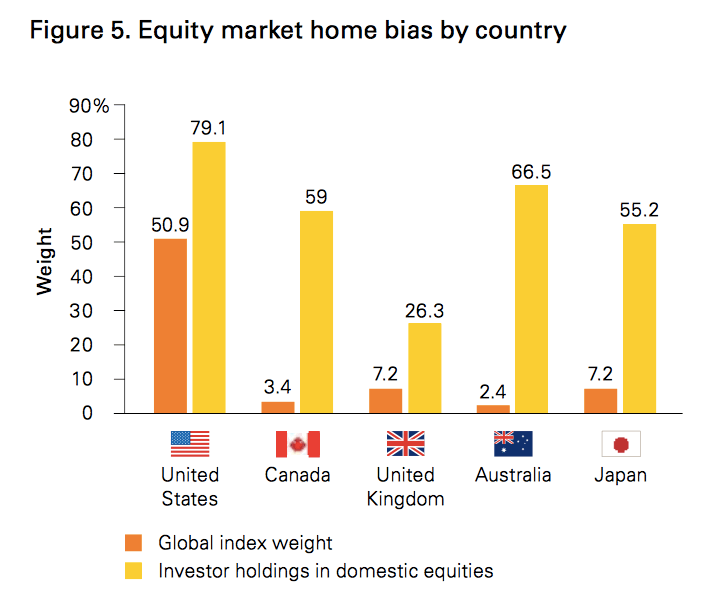
However, in every country that they examined, investors on average had a home-country bias, tending to own more equity from the country they live in than the market-cap weighting would suggest. The chart below is rather striking. Found via Reformed Broker and Abnormal Returns.

homebias1

homebias2

Americans on average hold roughly 80% in US stocks, while the US market makes up 50% of the global market. However, the average Canadian resident holds roughly 60% in Canadian stocks while only making up 3% of the global market. Australian residents hold roughly 66% in Australian stocks while only making up 2% of the global market. I find this very interesting.

This is where I should state proudly that my stock holdings are split 50% US and 50% International, with equal amounts of the Vanguard Total US ETF (VTI) and Vanguard Total International ETF (VXUS) or their mutual fund equivalents. However, I admit that I do worry about the political and economic environments of other countries, especially given current events. On the other hand, I worry that I am being influenced by recent past performance. I usually end up telling myself that I am buying the haystack and letting the markets work themselves out over the long run.

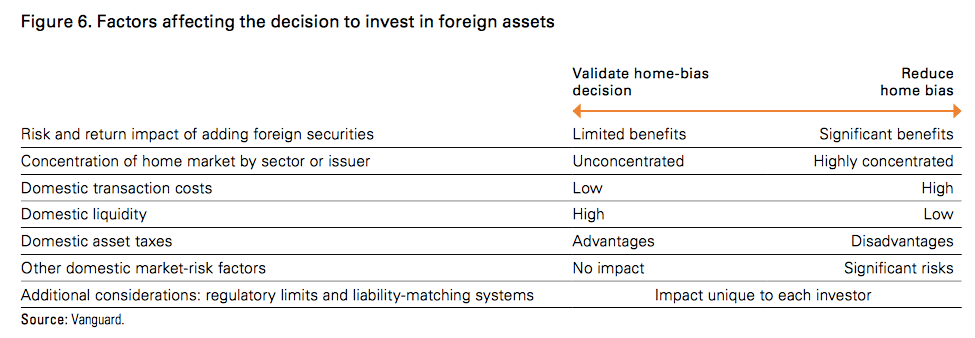
The Vanguard paper also offers a guide to weighing various factors in deciding the amount of your home bias. Here’s a summary chart:

homebias3

The New Financial Bundle: Checking + Savings + Credit Card + Brokerage + Retirement Advice

allytk

Last week, Ally Financial announced that they are acquiring TradeKing. What made this interesting was that they didn’t refer to TradeKing as a discount brokerage firm, but a “digital wealth management company”. This another move from independent start-up (TradeKing merged with Zecco earlier) to big, corporate “bundle”. The traditional communications bundle includes TV, home internet, home phone, cellular phone, and cellular data. The new financial bundle will include:

  • Checking account – Daily cash management, paycheck target, online bill payment, ATM access, debit cards.
  • Savings account – Liquid savings, higher interest rate.
  • Credit card – Easily-accessed credit line.
  • Self-directed brokerage account – DIY investments including individual stocks, options trading.
  • Professional portfolio management – Managed accounts including advice regarding asset allocation, taxes, retirement income, and more. Both lower-cost robo-advisor and higher-touch human advisor platforms.

Here’s my opinionated rundown on some of the bigger firms in this new area. Some of the “pros” aren’t that strong, and some of the “cons” aren’t that bad, but it helps organize my thoughts.

Ally Financial / TradeKing

  • Pros: Competitive interest rates on checking and savings, ATM fee reimbursements, $5 brokerage trades.
  • Cons: No physical branches. No credit cards (yet). Robo-advisor program is still relatively small and new.

Bank of America

  • Pros: Huge physical branch and in-house ATM footprint. Merrill Edge commission-free trades starting at $25k minimum asset balance, $6.95 trades otherwise. Credit card rewards bonus with minimum asset balance.
  • Cons: Low interest rates on banking products. Merrill Lynch advisor network is big and uses traditional fee system, so I’m not a huge fan but others may like it. No robo-advisor program (yet).

Fidelity

  • Pros: Decent cash management account with ATM fee reimbursements, selected commission-free ETFs, somewhat limited but low-cost index fund selection, $7.95 trades otherwise, 2% cash back credit card.
  • Cons: Low interest rates on banking products, human-based Portfolio Advice is relatively expensive and pushes expensive actively-managed funds. Lower-cost robo-advisor is probably coming soon, but yet released.

Schwab

  • Pros: Decent cash management account with ATM fee reimbursements, commission-free Schwab ETF trades with low-cost index options, $8.95 trades otherwise, 1.5% cash back American Express, low-cost robo-advisor via Intelligent Portfolios.
  • Cons: Low interest rates on banking products.

Vanguard

  • Pros: Large selection of low-cost funds and ETFs, commission-free Vanguard ETF trades for all, $7 non-Vanguard ETF/stock trades (or less based on asset level). Portfolio advice includes robo-component plus available human representative.
  • Cons: Limited availability and features on banking accounts. Limited portfolio support for buying non-Vanguard products. No credit cards.

I still believe that the self-directed investor is best off picking individual products a la carte, but it will be interesting to see how things change in the coming years. Each financial mega-institution will likely improve upon their weaknesses, and offer significant perks and discounts for keeping all your money with them.

Exceeding $500,000 SIPC Insurance Limit at Vanguard (or any Brokerage)

sipcThis post is for the fortunate folks who may possibly exceed the often-quoted $500,000 limits for SIPC insurance ($250,000 for cash). The way this insurance works wasn’t necessarily obvious to me, and although it is often compared to the FDIC insurance of banks, there are many important differences.

The Securities Investor Protection Corporation (SIPC) is a federally-mandated and member-funded organization that provides insurance to customers against the insolvency of broker-dealers. If needed, the SIPC can borrow from the US Treasury to meet its obligations. All broker-dealers are required to be members, including Vanguard (brokerage accounts, not mutual fund-only accounts), Fidelity, Schwab, TD Ameritrade, E-Trade, TradeKing, Robinhood, Betterment, Wealthfront, and so on.

Your assets, for examples shares of Apple stock or an S&P 500 mutual fund, are required by federal law to be held separately from the broker’s assets at all times. Broker-dealers are subject internal and external audits, surprise regulatory examinations, and weekly and monthly reporting requirements. Thus, in the vast majority of cases, there are no missing securities and the primary role of the SIPC is to oversee the transition of assets from the failed brokerage firm to another solvent firm. If there are missing assets, then the SIPC will cover of up $500,000 of missing assets ($250,000 maximum for missing cash), per legal entity.

What is a separate legal entity? Per Wealthfront:

The following would qualify as separate legal entities, each subject to the $500,000 limit: your individual account, your trust, your IRA, your spouse’s individual account, trust and IRA, your joint account, as well as a custodial account for a child. Two IRA accounts held by the same client would be considered one legal entity and thus are combined for purposes of insurance coverage. The same combination occurs when a single client holds two individual taxable accounts.

Another way is to simply hold your assets at two different broker-dealers. If you had an individual taxable account at TD Ameritrade and another at Fidelity, that would be two accounts with $500,000 at each.

How often has SIPC insurance actually been exceeded? Only in less than 0.1% of claims. Here are some stats from a Betterment article based on the SIPC 2014 annual report [pdf]:

Since the inception of SIPC in 1971, fewer than 1% of all SIPC member broker-dealers have been subject to a SIPC insolvency proceeding. During those proceedings, 99% of total assets distributed to investors came directly from the insolvent broker-dealer’s assets, and not from SIPC. Of all the claims ever filed (625,200), less than one-tenth of a percent (352) exceeded the limit of coverage.

Example of meeting and/or exceeding SIPC limits. So for example, you could have $2 million of non-cash assets at a failed firm in a single taxable account. If 75% of assets are recovered from the failed firm, you get $1.5 million back from the firm and $500,000 from the SIPC. If only 50% of the assets are recovered, that’s $1 million back from the firm, $500,000 from SIPC, and you’d be out $500,000 unless there are additional recoveries in the future.

Again, a recovery rate as low as 50% is highly unlikely based on historical failures. Per the SIPC annual report, the average recovery rate for insolvencies is 99%. Most examples that I’ve seen use a 90% recovery rate as a conservative example.

However, if you altered the scenario above to have your $2 million separated in to $500,000 in your individual taxable account, $500,000 in your spouse’s individual taxable account, and $1,000,000 in a joint taxable account, then even in that unlikely 50% recovery rate you’d be made whole.

Situations covered by SIPC insurance

  • Brokerage firm insolvency or bankruptcy.
  • Unauthorized trading. SIPC covers securities may have been “lost, improperly hypothecated, misappropriated, never purchased, or even stolen” by the broker-dealer.

Situations NOT covered by SIPC insurance

  • Market price drops. Fluctuations in the market value of your investments are not covered. In the event of a claim, you will receive the value of the securities held by the broker-dealer as of the time that a SIPC trustee is appointed.
  • Claims in excess of insurance limits. See above.
  • Certain investment types are not covered. As summarized by FINRA:

    Not all investments are protected by SIPC. In general, SIPC covers notes, stocks, bonds, mutual fund and other investment company shares, and other registered securities. It does not cover instruments such as unregistered investment contracts, unregistered limited partnerships, fixed annuity contracts, currency, and interests in gold, silver, or other commodity futures contracts or commodity options.

  • Certain other types of fraud. For example, if a scam artist tricked you into buying a penny stock which is now worthless, that is not connected to an insolvency by the broker-dealer, and is thus not covered by SIPC insurance.

Excess of SIPC Insurance. Many brokerage firms pay for optional, additional insurance on the private market for their clients called “excess of SIPC” insurance in the unlikely situation where a client may exceed SIPC insurance limits. You should contact your brokerage firm or look through their boring annual notices.

For example, I have the majority of my assets held in a new “merged” account at Vanguard Brokerage Services. Looking through their VBS semi-annual notice, you can find the following:

VMC [Vanguard Marketing Corporation] has secured additional coverage for your account, which applies in excess of SIPC, through certain insurers at Lloyd’s of London and London Company Insurer(s) for eligible customers with an aggregate limit of $250 million, incorporating a customer limit of $49.5 million for securities and $1.75 million for cash.

Note the total aggregate limit of $250 million, though. Last time I checked Vanguard mutual funds had over $3 trillion in assets under management. $250 million divided by $3 trillion is only 0.01%. Of course, most of those assets are not held in Vanguard Brokerage Services (but in institutional funds and other mutual fund accounts outside of VBS). Still, $250 million across all of their accounts doesn’t seem like very much. A few big fish with $50 million accounts and most of that would already be used up.

Additional ways to reduce your risk. The basic idea here is that the only way you’ll lose a big amount of money is a spectacular failure. In the past, the brokerage firms that have had spectacular failures have shared a few common traits – bad behavior. Don’t do anything that would foster such bad behavior.

  • Don’t hold your money at a firm that does proprietary trading. If a broker-dealer trades with their own money, there is a greater chance a bad trade will bankrupt them. Also, there may be a greater temptation to “borrow” some client funds to cover any unexpected cashflow needs.
  • Don’t use margin accounts, stick with cash accounts. In a margin account, technically your broker is often allowed to “borrow” your securities for their own purposes (usually loaning it to other broker-dealers). In a cash account, there is no such permission given. This is a bit extreme in my opinion, but perhaps something to consider.
  • Don’t invest in exotic, non-transparent strategies. If your brokerage firm only sells plain vanilla investments, it is much harder to hide any shady business. Mutual funds and ETFs are highly regulated by the SEC. Hedge funds are not nearly as closely-regulated.
  • Keep good records. You should keep copies of trade confirmations. You should keep copies of your latest monthly or quarterly statement of account from your brokerage firm. A trustee may ask you to supply copies of these documents in the case of erroneous statements or trades.

My two cents. Purely my opinion, but this is how I see it:

  • Keeping your accounts to each stay under the $500,000 limit (and not hold cash in excess of $250,000) is the only way to know that you’ll be 100% covered in the cases listed above. Just because something hasn’t happened in the past, doesn’t mean it won’t happen. Unlikely is not impossible.
  • If your account has between $500,000 and $5,000,000 in it, and you’re holding traditional mutual fund or ETFs inside, you’d need a bankrupt firm with less than a 90% recovery rate to lose any money (possibly much less). That is admittedly quite rare. You will have to weigh the risk against the added hassle of splitting your accounts by either institution or legal entity.
  • If you have more than $5,000,000 at a single account type at one broker-dealer, I think it starts to definitely become worth the extra effort to split your assets by either institution or legal entity. The risk may be small, but the potential losses are big. If you have this much, why mess around?
  • I wouldn’t put too much faith into excess SIPC insurance. They usually come with an aggregate limit and you have no idea how close the firm’s current assets are to exceeding that value. The amount of protection you’d receive is not under your control.

Prosper Review for Investors: Understanding Risks and Returns

lcreview_logo200I lent out my first $25 to a stranger on Prosper nearly 8 years ago, in October 2007. Since then, the peer-to-peer (P2P) lending environment has undergone a variety of changes. I’ve made hundreds of P2P loans both hand-picked and algorithm-driven, sold them on the secondary market, and experienced the effect of defaults on my returns.

I’ve written several posts along the way, but here is my condensed (but still detailed) overview. Many of the other Prosper reviews tend to focus on the positives. While Prosper certainly has potential, I’d rather go deeper into the possible risks to an investor’s hard-earned money.

The attraction: Be the bank. Earn high interest rates. We’ve all seen the big banks charge mountains of interest, while us regular folks pay it. The average interest rate on credit card loans remains around 15% APR. The basic model for P2P loans is that anyone can become that bank and invest in loans to other individuals. Prosper will take a little cut for helping out, but the bulk of the interest (and risk) goes to the investor.

The reality: Higher net returns than other alternatives, but the risks hide in the details.

Detail #1: Significant loan defaults occur over time. The good news now that P2P loans have been around for a while is that you have more historical performance numbers to consider. Prosper lets you see this historical data in great detail, but you have to look carefully. Here’s a snapshot of what you’d see now at Prosper.com/Invest, labeled “Seasoned Returns*”.

lcreview_returns_10mo

Here’s what that asterisk means:

*Seasoned Return calculations represent historical performance data for the Borrower Payment Dependent Notes (“Notes”) issued and sold by Prosper since July 15, 2009. To be included in the calculations, Notes must be associated with a borrower loan originated more than 10 months ago; this calculation uses loans originated through May 31, 2012. Our research shows that Prosper Note returns historically have shown increased stability after they’ve reached ten months of age. For that reason, we provide “Seasoned Returns”, defined as the Return for Notes aged 10 months or more.

The initial interest rate on your notes is only a theoretical maximum return. For example, for the last quarter of 2015, the average interest rate was 11.06% for 36-months 15.47% for 60-month loans. Every time a borrower defaults – and trust me, if you buy any meaningful amount of notes, some will default on you – your return will go down. With loans as little as 10 months old, their quoted “increased” stability is not the same as stability.

Here’s a chart from competitor LendingClub showing how net annualized return has decreased with loan age (for different vintages of past loans). Note that the net return numbers still keep going down after 10 months.

lcreview_returns_vint

If anything, I would prefer to use this alternative table provided by Prosper. These estimated net numbers are more realistic. The table also includes a daily snapshot of their current inventory, which may give you an idea of relative availability by rating. Note that there are much fewer of the highest-risk, highest-expected return loans available.

prreview_returns_available

Finally, don’t forget that not everyone gets the average. You can’t buy a “Prosper index fund”. You may be above average, but be prepared for below-average returns as well.

Detail #2: Liquidity concerns. When you buy traditional mutual fund that holds investment-grade bonds, with just a few clicks, you can sell that investment on any given trading day. You will get a fair market price, and you will find a buyer for all of your shares.

If you invest in a Prosper note and you need to cash out before maturity, you will have to sell on the secondary market. Now, if you have pristine loans with a perfect payment history, today you’ll probably be able to sell your notes at near or even slightly above face value. But here are the possible haircuts:

First, you will have to pay a transaction fee of 1% of face value on all sales. Second, if you have loans that have ever been late or has a borrower whose credit score has decreased since loan origination (they track that), you will have a harder time finding a buyer and the price will probably be lower than face value. Finally, for Prosper if your loan is currently late, you can’t sell it on the secondary market for any price. You can’t even offload it for a penny.

In my experience, I liquidated ~85% of my loans at about a 0% net haircut, ~10% were sold at a slight loss due to their imperfect history, and ~5% could not be sold at all. While this is certainly better than having no liquidity at all (like a lot of real-estate crowdfunded debt), it also takes a few hours of work at least to maximize your selling prices on 100 or 200 loans.

All of these haircuts taken together can take a significant hit against your total returns. Also, just because you have buyers today doesn’t mean there will be buyers tomorrow. Therefore, I would not invest if you don’t expect to hold the loan until maturity. Some people try to arbitrage things by buying notes and selling them quickly on the secondary market to residents of states that can only buy notes on the secondary market.

Detail #3. Diversification is critical. A defaulted loan wipes out both principal and interest, resulting in a big hit on your overall return. Therefore, your best bet is to never put any more than the $25 minimum into any one note. Remember this statistic: For Notes purchased since July 2009, every Prosper investor with 100 or more Notes has experienced positive returns. In other words, no investor has lost money overall if they held at least 100 notes! 100 times $25 = $2,500 which I think is the minimum you should invest with.

Detail #4. Taxes. P2P notes are a somewhat different animal, and at year-end you’ll receive some tax forms that will be unfamiliar to most people. These may include:

  • 1099-OID
  • 1099-B (Recoveries for Charge-offs)
  • 1099-B (Folio secondary market)
  • 1099-MISC

If you file your income taxes yourself, it is not impossible to figure out but it will take some extra research and effort. Here is my Prosper tax guide that offers some guidance. If you pay a tax professional, they may charge extra for the added complication.

For the most part, the interest you receive will be taxed as ordinary income, the same rate as interest from bank savings accounts. This can be quite high depending on your income, so you may want to consider holding your Prosper notes inside a tax-sheltered IRA. Looking back, I wish I put my Prosper notes inside an IRA.

Detail #5. Automatic investing. The days of hand-picking loans are pretty much over. I recommend using the Quick Invest feature that Prosper offers in order to automatically filter through and buy the notes that fit your criteria. Loan supply is often limited, and this way you can actually get those loans before someone else buys them.

You can let Prosper pick the loans for you, or you can spend your time looking for “better” filters. There are some free tools out there that help sift through the past performance data. There are even paid services out there that do this for you, but I am uncertain how the cost/benefit would shake out.

Detail #6. Past performance vs. future possibilities. Although past returns are great, another economic recession may have a severe impact on your future loan returns. In the end, these are unsecured loans like credit card debt. If people lose their jobs, they will stop paying. Just because nobody has lost money in the past with 100+ loans, that doesn’t guarantee that you won’t lose money in the future. Unlikely does not mean impossible.

Traditionally, high-quality bonds are a diversifier to stocks. But Prosper notes are more like low-quality bonds. If the economy tanks, defaults will rise and your returns will drop. But if the economy tanks, your stocks will drop too. Are you ready for both to suffer significant drops during times of financial stress?

Detail #7. What if Prosper goes bankrupt? As a company, Prosper Marketplace Inc. (PMI) has historically had a hard time actually making a steady profit themselves. In 2013, Prosper started structuring their notes so that they are held in a new legal entity called Prosper Funding LLC (PFL). This remote entity is designed to stand alone and be protected from any creditor claims in the event that Prosper Marketplace, Inc. goes bankrupt. PFL can keep on running and servicing loans. This is a good move in my opinion, but it is still unknown how well this legal strategy will work, or if future lawsuits can put the assets of PFL at risk.

In other words, don’t put all your eggs in one basket. Due to #6 and #7, Prosper notes should only be a portion of your fixed income assets.

Summary. P2P loans are becoming a legitimate asset class, gathering billions of dollars from Wall Street and other institutional investors. Interest rates remain low, and thus the high yields and competitive past returns from these Prosper notes are still very attractive. Let’s face it, even a tempered expectation of 8% net annual return is hard to ignore! But before you make the jump, make sure you fully understand the risks and how to best mitigate them.

  • Understand that your final returns will be significantly less than your starting yield. Look at historical numbers for guidance.
  • Don’t invest money you will need before the loan ends (3-5 years).
  • Diversify across as many loans a possible (100+ notes).
  • P2P notes should only be a portion of your fixed income assets.
  • Expect to spend extra time to acquire notes and prepare taxes.
  • Consider holding notes inside a tax-sheltered IRA.

I hope that this information helps you decide whether investing in Prosper loans is right for you.

GMO 7-Year Asset Class Return Forecasts, December 2015

As 2015 winds down, here is a snapshot of the asset class forecasts provided by GMO and the most recent market commentary by co-founder Jeremy Grantham. You can access both of these at GMO.com, although some items require free e-mail registration.

Here is a snapshot of their 7-year expected future returns by asset class, inflation-adjusted, published in mid-December 2015 and using data as of November 30, 2015.

gmo_7year_1511

The chart represents real return forecasts for several asset classes and not for any GMO fund or strategy. These forecasts are forward-looking statements based upon the reasonable beliefs of GMO and are not a guarantee of future performance. Forward-looking statements speak only as of the date they are made, and GMO assumes no duty to and does not undertake to update forward-looking statements. Forward-looking statements are subject to numerous assumptions, risks, and uncertainties, which change over time. Actual results may differ materially from those anticipated in forward-looking statements. U.S. inflation is assumed to mean revert to long-term inflation of 2.2% over 15 years.

I like to keep track of these forecasts along with those provided by:

Here are some reasons why I like keeping track of these types of forecasts:

  • The projections are based on fundamental, historical, and valuation-based models. This is not to say they can’t be wrong, but the strategy is at least unemotional and provides a reasonable range of expectations.
  • They usually provide support for rebalancing and buying more of beaten-down and unpopular asset classes. Currently, Emerging Markets stocks would fit that description.
  • They usually temper the mass enthusiasm for putting all your money in hot and popular asset classes. Currently, US stocks would fit that description.

Do Financial Advisors Really Keep Portfolios and Clients Disciplined?

I written about Dimensional Fund Advisors (DFA), a mutual fund family that is powered by top academic research. Another things that makes DFA unique is that they are only sold through approved financial advisors. You can’t buy them with just any old brokerage account. (Exceptions are certain 401(k)-style retirement plans and 529 college savings plans.) Allan Roth has new article about DFA funds in Financial Planning magazine, which is a trade publication targeted to financial professionals.

Why not sell directly to Average Joe investor? Here is David Butler, head of DFA Global Financial Advisor Services:

DFA has no intention of bypassing the advisor channel and offering its funds directly to retail investors. “We think advisors help keep investors disciplined,” Butler says.

In my previous post The True Value of a Real, Human Financial Advisor, I wrote about this concept. A good client advisor will help you keep your cool when the next disaster comes. Vanguard says that the biggest “value add” from good advisors is their “behavioral coaching”. A good financial advisor keeps you from making the “Big Mistake” that derails your plans.

onepage_bigmistake

But later in the same Allan Roth article, the idea of advisors as disciplinarians is called into question.

But do investors get better returns? I tested Butler’s claim that DFA advisors help keep investors disciplined by asking Morningstar to compare the performance gap between the two fund families. The performance gap is the difference between investor returns (dollar weighted) and fund returns (geometric).

Over the 10 years ending Dec. 31, 2014, the DFA annualized performance gap stood at 1.28% versus only 0.22% for Vanguard. When I showed these figures to Butler, he responded, “It’s hard to make an argument about the discipline of advisors based on these figures.

Here’s a primer on investor returns vs. fund returns. Investor returns are the actual returns earned by investors, based on the timing of their buying and selling activities.

The next step was to compare the investor returns of DFA’s largest fund, DFA Emerging Markets Value I Fund (DFEVX) with $14B in assets with the closest Vanguard competitor, Vanguard Emerging Markets Index Fund (VEMAX) with $54B in assets. I personally think a better comparison would be with their DFA Emerging Markets Core Equity I Fund (DFCEX), so I’m throwing that in as well.

DFA fund returns are often higher relative to index fund competitors. Here’s a Morningstar chart comparing the growth of $10,000 invested 10 years ago in each of the three funds. You can see the DFA funds do slightly better in terms of fund returns. Click to enlarge.

dfa_em_vg_10k

But what about investor returns? I took some screenshots of their respective Morningstar Investor Return pages.

dfa_em1b

dfa_em_vg

dfa_em3

We see that after accounting for the timing of actual cashflows, the average investor in the DFA fund actually lost money with an annualized return of -1.01% and -2.04%! Meanwhile, the average Vanguard investor earned over 6% annualized.

The three mutual funds don’t have the exact same investment objective, but they do both all pull from the overall Emerging Markets asset class. The DFA funds try to focus ways to earn greater long-term return by holding stocks with a higher “value” factor, but it also has a higher expense ratio. The Vanguard fund just tries to “buy the haystack” and passively track the entire index.

Let’s recap. The stated reason why DFA is only sold through advisors is that they offer more discipline. We are told that such behavioral coaching is where human advisors provide their greatest value. However, the evidence available suggests that DFA advisors are less good at trading discipline than when a similar fund is completely open to retail investors.

I found this rather surprising. I used to think that restricting my potential advisors to those were affiliated with DFA was one way of getting an “above-average” advisor. But after doing my own research, I found that even though DFA investments are generally lower-cost, the additional fees charged by individual advisors ranged widely from reasonable to quite expensive.

I am confident there are financial advisors that can provide the proper behavioral coaching that makes them well worth the cost. At the same time, clearly many are not providing the advertised guidance and discipline. The problem remains – how does Average Joe investor find the good ones? I still know of no clear-cut way.