Self-Employed or Freelance? Maximize Your Business Mileage Tax Deduction

An important part of maximizing the profit from your own business – no matter how small – is to be smart with taxes. If you are running a side business on top of your day job, you may be paying around 50 cents of every dollar made towards taxes. This means, that for every $1 in tax deductions you find, you are keeping an extra 50 cents in your pocket.

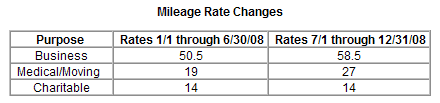
One of the more tedious tax deductions for self-employed folks is deducting transportation expenses. The simplest way to claim this deduction for those without vehicles used solely for business is to track the number of miles driven for business use. (You can also record actual automobile expenses like gas and maintenance, and pro-rate.) The IRS just announced yesterday that the standard mileage deduction will be 58.5 cents/mile for all business miles driven for the last half of 2008, up from 50.5 cents/mile.

From above, this means that for every single business mile you deduct, you might save around 29 cents. Deducting just 100 miles per month would save you around $350 over a year. Put another way, not tracking 100 miles a month will lose you $350 a year. There are many complex rules for what constitutes eligible business travel, but it can be worth asking your accountant or reading up. Here are some examples:

  • Driving to the office supply store to make business purchases.
  • Driving from your home office to an external location meet a client.
  • Driving to the bank to deposit checks or make other business transactions.
  • Driving to pick up mail from your UPS Store or P.O. Box.
  • Driving to the post office to send business-related mail or buy stamps.

Many times, you might do this stuff without a second thought. But with gas costs so high, I would argue that we need to recoup whatever we can get. Trust me, these miles can add up quickly!

How do I properly track such mileage? At most office supply stores you can buy a mileage logbook. Or, simply start up a spreadsheet program and create these columns: date, purpose (bank, etc.), odometer start value, odometer stop value. Print it out, slap it on a clipboard, and stick it permanently in your car like I do. Record everything immediately, it should take seconds; you can add up the miles later. (Added: mileage log template for Excel)

What about driving from my self-employed home office to my day job with another employer? Nope, although it would be sweet to deduct such commuting costs, this is not qualified business travel. However, if you have a second site for your own business like a storefront, travel to/from your home office to/from that site can be deductible.

What if my UPS mailbox is next to my day job? Here’s where things get a bit fuzzy. You definitely aren’t allowed to deduct personal trips. But let’s say the supermarket is right next to your business bank. Since you’re already there, isn’t doing some grocery shopping the the eco-friendly thing to do? From my non-official understanding, you would need to prove that your trip to the bank is necessary and the primary reason for the trip, and not just an excuse to go to the supermarket. Making an actual deposit transaction would seem to be sufficient in that regard.

But if you are trying to say that your “business bank” is 30 miles away from your home office and just happens to be the one next door to your 9-5 job, then that may be much harder to justify. It is truly necessary to use that branch?

There’s more… You may also be able deduct mileage driven for charity, medical treatment, job searches, and moving.

References: IRS Publications 535, 463, and 529

IRS Economic Stimulus Check Promotions: 10% Bonus at Albertson’s, Kroger, K-Mart, Sears, and More

The economic stimulus checks are coming! Before depositing your tax rebate at the bank, it might be a good idea to see what retailers will offer you for it. While I don’t necessarily like the idea of treating this extra money as different from any other money (a dollar is a dollar), you might as well take advantage of the promotions if it doesn’t change your intended spending patterns. Although some of these require an economic stimulus check, others work with any tax refund check.
Even if the big names like Kroger and Albertson’s don’t ring a bell, read the lists below carefully for a store that is near you. For example, in Portland, Oregon there is the popular Fred Meyer chain, which I didn’t know was part of the Kroger family.

Supervalue Inc. Supermarkets – 10% Bonus
Including Acme, Albertsons, bigg’s, Cub Foods, Farm Fresh, Hornbacher’s, Jewel-Osco, Lucky, Shaw’s/Star Market, Shop ‘n Save and Shoppers Food & Pharmacy. From their press release:

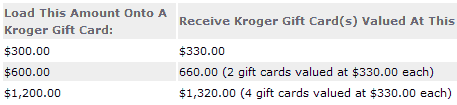
Customers who are interested in growing their refunds should bring their government-issued economic stimulus or tax refund checks, along with government-issued identification, to customer service counters at their local stores between May 2 and July 31, 2008, to purchase store gift cards in $300 increments, not to exceed $1,200 per household. Each gift card will be loaded with an additional $30, to bring each gift card total to $330.

Kroger Co. Supermarkets – 10% Bonus
Including Kroger, Baker’s, City Market, Dillons, Fred Meyer, Food 4 Less, Fry’s, Gerbes, Hilander, Jay C, King Soopers, Owen’s, Pay Less, Ralphs, Smith’s and QFC stores. From their press release:

Kroger customers who are interested in exchanging their refunds or economic stimulus checks should present their check and customer loyalty card at their local store’s Customer Service center from May 2, 2008 through July 31, 2008. The program is limited to one offer per household with a limit of $1,200.00.

Kroger tax rebate promo

Sears, K-Mart, and Land’s End – 10% Bonus
I was going to buy a Martha Stewart futon from K-mart just last week… From their press release:

When customers bring their stimulus checks to a Sears or Kmart cash register, they can convert the amount of the check into gift cards, plus receive a bonus gift card worth an additional 10 percent. To be eligible, the amount of gift cards purchased must be equal to the full value of the stimulus check. The gift cards can be redeemed at any Sears, Kmart or Lands’ End retail stores or online at sears.com or landsend.com. The promotion is scheduled to last from May 14 to July 19, 2008.

Radio Shack – 10% off $50+ Purchase
Targeted at the “underbanked”, but if by chance you want something from there… Personally, I’ve only bought a headphone splitter from there in the last 5 years. Their press release.

Customers who use their checks to pay for purchases above $50 between May 4 and July 12, 2008, will receive a 10 percent discount on their purchases. Any amount left over from the purchase will be placed on a Vision Silver Prepaid MasterCard, which can be used at any place that accepts MasterCard.

Via Reuters, Fatwallet, and Consumerist. Oh, Staples has a page of special offers like $50 off $500 spent on computers, but nothing specifically tied to a stimulus check. Anyone else?

Don’t lose those $660 gift cards!!

Does The Government Underestimate Inflation Through The Consumer Price Index (CPI)?

Many people, including myself, are worried about inflation. Is it just because of the current housing and stock market conditions, or are our bills really a lot higher than before? The inflation numbers that we usually hear about are based on the Consumer Price Index (CPI). Variations of the CPI are published monthly by the government’s Bureau of Labor Statistics, and they supposedly track the prices consumer pay for a basket of goods and services. For example, a greatly simplified basket may include a month’s rent, 10 pounds of steak, a tank of gas, and a laptop. As the price of this basket goes up, that’s inflation.

Why Does CPI Matter?

  1. Payouts on inflation-protected investments like TIPS and Series I bonds are indexed directly to the CPI.
  2. Social security payments, pensions, and inflation-indexed annuities all rely on CPI data to determine their annual adjustments.
  3. The size of individual income tax brackets, personal exemptions, and the standard deduction are tied to movements in the CPI.
  4. Low inflation numbers (especially when they are much less than GDP growth) make the economy seem healthy.

However, there is some controversy over whether the CPI is an accurate measure of inflation. As you can see above, there are many reasons why the government and large pension groups would like to see a lower inflation number. Lower inflation numbers mean lower payouts, a smaller budget deficit, and a happy stock market.

In 1995, the Boskin Commission study suggested that the CPI overestimated inflation by around 1.1% every year, and in 1996 changes were made to counteract these alleged errors. But critics say these changes were completely unnecessary, and now the CPI underestimates inflation by around 1.1% per year. Here are some of the arguments:

Substitution Adjustments
It was suggested that if steak becomes too expensive and people buy hamburger instead, then the CPI should just start using hamburger prices instead. After all, that is what people are buying right? Not only does this reduce inflation, critics wonder where this is headed. Hamburger gets too expensive, so then we eat hot dogs. Hot dogs turn into… dog food?

In addition, let’s say we go from using steak to hamburger due to price, and then back to steak again once it gets cheaper. Roundtrip, this substitution system would say that there was zero or even negative inflation during this time. But obviously prices actually rose. Just doesn’t sound right.

Quality, or Hedonic, Adjustments
A second major factor is that the CPI tries to adjust for increases in quality as well as increases in price. If a car costs 10% more, but it is 10% higher in quality, then there was no inflation. Okay, I can see this in certain examples. But critics point out that many times the consumer has no choice but to pay the higher price, so why aren’t we taking this into account?!

Example: If the government mandates an additive to your gasoline that costs an extra 20 cents per gallon, there is no affect on the CPI because this 20 cents was an improvement in “quality”. But we still get stuck with higher bills!

I wonder… if we follow all these quality adjustment ideas, isn’t shifting from steak to hamburger losing quality and shouldn’t that be adjusted for as well?

What If We Remove These Adjustments?
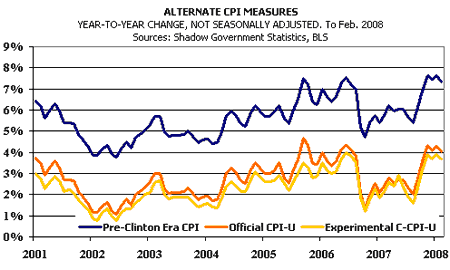
Here are two estimates of what the CPI number would look like without these adjustments. From Shadows Stats2 (Clinton era means 1996, when the changes were made):

altext

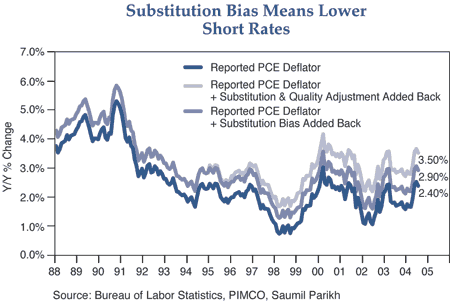
From Bill Gross and PIMCO3:

altext

Personally, I think the government has a vested interest in getting the inflation numbers at least somewhat correct (considering the scrutiny they are under), but at the same time they want to err on the low side rather than the high side. Some of the methods they use definitely seem to support this goal, and I wouldn’t be shocked if the CPI-based inflation numbers lagged what consumers actually experience by up to 1% per year at times. This may be something to consider when buying anything indexed to the CPI.

Sources and More Information

  1. The great inflation cover-up by Elizabeht Speirs, for Fortune Magazine.
  2. Consumer Price Index by ShadowStats / John Williams – Slightly more aggressive and controversial.
  3. Haute Con Job by Bill Gross – He runs PIMCO and the largest bond mutual fund in the world, so not quite a kook. Also see Con Job Redux.
  4. US CPI Inflation Statistics Manipulation and Deception? by Ronald Cooke.

Find Out How To Lower Your Property Taxes

While I tend to be straight-laced when it comes to taxes, I also think it is our right – heck, even our duty – to pay as little taxes as legally required. I take every deduction that I can substantiate. While learning about property taxes, I read that somewhere between 30-60% of homes in many areas are over-assessed. If the estimated assessment value is too high, then those homeowners are paying too much in taxes! In areas of dropping home values, you may be able to get your assessment lowered.

But don’t expect anybody to tell you this. From this 2000 and 2004 articles about property taxes, both from CNN Money:

“It’s an unfair system,” Lewis said. “You can go to one particular block in Long Island, for example, where 11 houses got a tax reduction last year because they filed grievances. The remaining 4 homeowners who didn’t file a grievance are still overpaying. In most municipalities, if you don’t file it means you accept the assessment value of your home.”

“The bottom line is that if homeowners aren’t focused on what has happened in their marketplace, they are paying too much in property tax,” says John Brusniak, a Dallas property tax lawyer.

My sister-in-law recently contested her assessment and successfully got a reduction in her property taxes. The way to do it seems to be for (1) each homeowner to do a little research as to how their local government does their property taxes, (2) figure out if they are over-assessed, and then (3) file an appropriate appeal if necessary.

How Are Assessments Calculated?
This varies between states and even counties, but it could be based on:

  1. the sales of comparable homes in your neighborhood,
  2. the replacement value of your home, or how much it would cost to build your home from scratch at current material and labor costs,
  3. a multiplier of how much rental income your property would produce,
  4. or the most recent purchase price, plus an inflation adjustment.

You can usually find an assessment report at the tax collector’s office showing you how they got their number. Now you have to reverse engineer things to figure out how you can argue it back down. For example, you might have comparables with lower prices, or they might have marked down your square footage or other details wrong. Use sites like Zillow or Domania as well, since they can be based on tax records. Ideally, you’ll find a house just like yours, but with a lower assessment value.

The Appeals Process
Check out your local state website. If you live in California, there is this Guide to Residential Property Assessment Appeals. In New York, they have a Guide to Fair Assessments For Property Owners.

After looking at a few examples, some places seem to have a written form you can fill out first (an informal review). From this SF Chronicle article:

If your home is worth less than you paid, chances are you also can get a temporary reduction in your property taxes – without a battery of lawyers or dubious arguments about functional obsolescence. Just ask your county assessor for an informal review of your assessed value. It’s free and easy to do yourself. […] In most counties, you can simply call or write your assessor’s office or download a form from its Web site and mail it in.

If that fails, then you might have to perform a formal appeal which involves meeting with officials and assessors face-to-face. It doesn’t seem all that complicated, besides building up your evidence the most important thing to have is persistence. Hurray for bureaucracy!

p.s. If you’re selling your home, consider that a lower assessment (and thus a lower tax bill for the new owner) can help you sell your home faster or even for a higher price.

Renting A Room To A Relative: Setting A Price, Tax Issues

We are considering renting a room to one of our siblings temporarily. She’s moving out here for a new job, and since we live in an pricey area living with us will offer her a way to save up some money. On our side, we are two people with four bedrooms, so we have plenty of room right now.

Of course, horror stories abound when renting to family members. I don’t know what to say about that. I don’t foresee it being a problem as we are pretty close, and we are all responsible professional adults, but I’m sure everybody else says that as well. Being that we recently rented a unit from a another family member successfully, I also feel good being able to “pay it forward”.

The Plan
We would collect “rent”. The idea is that she would pay 1/3rd of all utilities (gas, electric, water, garbage, cable, internet) plus some buffer for other miscellaneous household maintenance items. This obviously will be much less that what it would cost to share an apartment on the open market, let alone a studio. So she’s paying her way, but we aren’t making much profit if any, ideally preventing any guilt or resentment on either side.

The Problem: Fair Rental Price
But then I did some research about the potential tax implications. Is rent always taxable income, even if from a relative sharing a home? From what I can tell, the IRS says yes. (Someone please correct me if I’m wrong.)

However, if I am reading the IRS “Renting to Relatives” regulations right, the good news is that if I rent out the room at “fair rental price”, I can start deducting a portion of my expenses – including interest, taxes, repairs, maintenance, utilities, insurance, and depreciation. This has the potential to offset the rental income completely (resulting in no net tax owed), although I can’t create a loss since it’s my personal home.

The bad news is that if I don’t charge fair market rent, then I can’t deduct anything. 100% of the rental income is now fully taxable as passive income. Having to pay taxes on money that is basically covering the utilities just doesn’t sound right.

Solution?
From anecdotal evidence, I’m sure compliance is spotty at best in this area. What if a son pays $200/month to live with Mom and Dad? But to fall in line with the rules, it seems like I should either (1) charge something close to “market” rent and maybe buy her a nice gift later or (2) not charge anything at all. My idea was simply have her pay some of the utilities directly. This way I don’t actually accept any money. Any suggestions?

Do I Need To Make Any Last Minute Year-End Tax Moves?

Yikes, I’m cutting things close this year. Time to see if there are any last-minute things I need to do with the last two business days before 2008.

Selling Losing Stocks or Mutual Funds
If you have some investments that are currently in the negative and you don’t want anymore, you might consider selling them and taking the loss. This is because you can deduct the loss against your other capital gains, or even reduce your taxable ordinary income (up to $3,000 each year). In general, people like doing this. You can’t buy the same “substantially identical” investment again for 30 days though, as that would break the IRS wash sale rule.

If you have some index funds that have high unrealized losses, you might even sell them and buy a similar fund at the same time. Again, the general idea here is to take advantage of the fact that the IRS tax capital gains and capital losses differently. Losses can “save” you money at your ordinary tax rate (up to 35%), while long-term capital gains are capped at 15%. More information and an example of this technique here.

I don’t have anything that I’m looking to sell, as most of my investments are in tax-deferred accounts. I have a $31 loss right now in BRSIX, but that’s not worth the potential commission of buying a similar fund.

Make A Tax-Deductible Donation
If you mail in a donation (including a check or credit card info), it must be postmarked by December 31, 2007. Be sure to get a receipt! Usually the easiest thing is to just charge it on your credit card in time. That way you have your credit card statement as backup, and you’ll also earn some cashback rewards while you’re at it. This is the first year we might actually get to itemize our deductions, so that’s kind of nice.

On a side note, all of my Kiva loans are still doing fine, and one was even paid back early (the somewhat-controversial one from apparently-rich Ukraine!).

Using Up Flexible Spending Account funds
Our usual routine is to spend the rest of our FSA money on contact lenses solution, eyeglasses, Benadryl, and Aleve at Costco. From last year, here is a big list of things that qualify for Flexible Spending Account reimbursements. If you don’t have any immediate needs, Mapgirl had a good suggestion that you can complete your first aid/emergency kit with things like gauze that don’t expire.

Have Your Baby Before New Year’s Day, Save Thousands

The baby wings of hospitals are getting really busy now, more than any other time of the year. And it’s all Uncle Sam’s fault, because having a baby any time before 11:59pm on December 31st can mean over a thousand dollars in child tax breaks. In fact, if you have an income low enough to qualify for the earned income credit, the difference can amount to more than $3,000.
The New York Times explores this phenomenon that is making December 28th the most popular birth date of the year. It’s like something out of Freakonomics, which explored curious ways that people respond to financial incentives.

By my calculations, about 5,000 babies, of the 70,000 or so who would otherwise be born during the first week in January, may have their arrival dates accelerated partly for tax reasons. When Mr. Chandra interviewed one mother in central Kentucky, she told him her doctor encouraged her to schedule a late-December birth well in advance, to be sure she got a delivery room. Anecdotes aside, Mr. Chandra thinks my estimate of 5,000 is conservative, based on his own more sophisticated statistical analysis.

The article goes on to talk about the potential health concerns of timing births in this way. I’m no doctor, but I would think common sense would suggest that that pushing things forward by more than a couple weeks just for the money might be a bad idea. Induced births and C-sections are also more expensive than natural births, which knocks up the cost of healthcare in general if not directly to the parents. I guess I could see this being something to consider if the due date was January 1st or something, but otherwise it’s something I’ve never even thought about!

Multiple Jobs? Don’t Overpay Social Security Tax

Remember when you got your first paycheck and wondered why it was so small? All 16-year-olds hate FICA. 🙂

Even though it’s not included when we talk about marginal tax rates, all employees have to pay 6.2% of their gross income to Social Security and 1.45% for Medicare. (Double that for self-employed folks.) However, there is a limit for Social Security – the tax only applies to the first $97,500 of wages for 2007 ($6,045), no matter how many different sources it came from. The problem is, your employers have no idea what you’re making at your other jobs, or when you reach that cap.

I came across this WSJ article which tells you how to get any overpaid amount refunded back to you at filing time. Keep in mind it’s using cap values for 2006.

If you worked for two or more employers and had too much withheld, you can claim the excess as a credit.

Here’s a hypothetical example supplied by the IRS: Suppose you’re married and file jointly. Your spouse didn’t have any income last year. You worked for a company that paid you $58,000 during 2006 and withheld $3,596 (6.2% of $58,000) in Social Security tax. You also worked for another employer who paid you $47,000 and withheld $2,914 of Social Security tax (6.2% of $47,000).

Thus, the Social Security tax withheld totaled $6,510. That’s $669.60 more than you actually owe ($6,510 minus $5,840.40). So you’re entitled to a credit of $669.60. Enter it on Form 1040, line 67, or on Form 1040A, line 43.

I would assume that TurboTax or similar would catch this, but it’s definitely worth double-checking.

I was also trying to find online if you could direct your employer to stop withholding Social Security taxes if you “know” you’re over the limit already, but it seems like you can’t. They just keep withholding as if that was your only job. But what you can do is change your total tax withholding values (increase exemptions, etc.) in order to counteract this overpayment and reduce your future refund.

IRS: How Does Your Income Stack Up? What Portion of Taxes Do You Pay?

The IRS recently released the data from 2005 tax returns. Kiplinger has an article How Do You Rank as a Taxpayer? which digs into this new information:

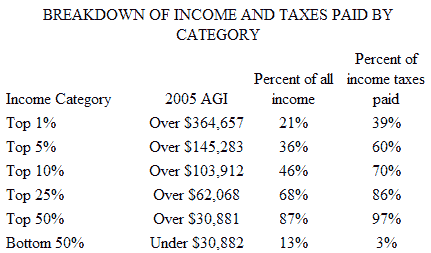
New data show that an income of $30,881 or more puts you in the top half of the class. Earning about twice that much — $62,068 — earns you a spot among the top 25% of all wage earners. You crack the elite top 10% if you earn more than $103,912… And $364,657 buys top bragging rights: Earn that much or more and you’re among the top 1% of all American earners.

Keep in mind this is actually adjusted gross income (AGI), which adds in investment income but leaves out pre-tax 401k contributions. The data doesn’t distinguish between single and joint returns either, and payroll taxes are also not taken into account.

Still, the chart below does an interesting comparison of the percentage of all income with the percentage of taxes paid. The top 1% earn 21% of all income and pay 39% of all taxes. The bottom 50% earn 13% of all income, but pay only 3% of all taxes.

altext

These stats are interesting but not really surprising given our progressive tax system. Maybe being in the top 1% isn’t all that great… nah. 😉

More Roth vs. Traditional 401k/IRA Data: Historical Marginal Tax Rates vs. Median Income

In my Roth or Traditional 401k decision process, I chose the Roth for the rest of this year. This essentially means that I’d rather pay up to 28% of tax right now on my contribution rather than pay whatever the going rate will be 30+ years from now. But why? I’m have relatively high income right now – Shouldn’t my income in retirement be less if I really want to be a beach bum? Probably, but here’s why I think 28% is still a pretty good deal based on history…

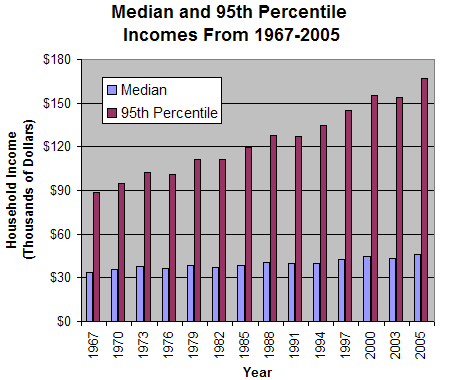
Having to guess what tax rates will be 40 years into the future is a daunting task! So let’s start by looking 40 years in the past. From 1967 to 2005, I found the both the median household income and the 95th percentile income from the U.S. Census Bureau. I chose these to roughly represent “middle” and “high” income levels.

altext

As you can see, both grow with time. (Yes, the gap between them is increasing. Let’s sidestep that hot potato right now.)

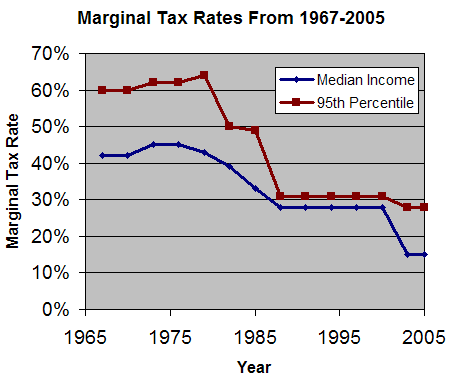
Next, I found the corresponding marginal tax rates that such incomes would have paid each year. Since we are looking at households, I used the tax information for the Married Filing Jointly status as an approximation. I ignored things like standard or itemized tax deductions across the board to keep it simple. With this information, we can roughly see how the marginal tax rates have changed over time, while still adjusting for the gradual increase in incomes:

altext

Results and Conclusions
We are currently experiencing some of the lowest marginal tax rates in recent history. The average marginal tax rate for a median, or “middle income”, household from 1967 to 2005 was 33%. The average marginal tax rate for a “high income” household was 44%. Today, we are only at at 15% and 28%, respectively. Assuming that today’s tax rates will continue on for the next 20, 30, 40 years may not be the best idea.

Will they get even lower? Or even flatten out? I don’t think so. Considering the historical rates we say above, and combining that with our continuing government deficits and the prospect of a nationalized health care system, I personally find it unlikely that in 2047 my marginal tax rate will be lower than 28%, even at median income levels. What do you think?

To be sure, this is a very simplified analysis. I am not even looking at total tax rates, just marginal ones for the express purpose of directing my IRA and 401k contributions. If you know of a better study done elsewhere that I missed, please do share.

Choosing Between the Roth or Traditional 403b / 401k : Our Decision Process

My wife now has the new option of contributing to Roth 403b plan with her new position, and we had to make a decision on whether or not to go with it. Here is our thinking process, which should also apply to Roth 401ks.

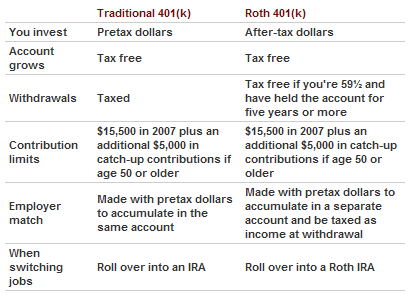
I found a few good articles online, including Is the Roth 401(k) Right for You? by Emily Brandon at US News, and Choosing Between Traditional and Roth 401(k)s from Yahoo Finance. Here is a nice table outlining the major differences:

altext

As my last video post outlined, the main difference between a Roth 401k and a Traditional 401k is when you pay the taxes. With the Traditional, you get to defer your income taxes now, but you must pay taxes up on withdrawal. With the Roth, you pay tax now, but you don’t own any taxes upon withdrawal.

So the first question is – when do you want to pay the taxes? Obviously this takes a bit of guessing as who know what tax rates will be in the future. You can also try and look at the 2007 tax brackets for a little guidance. Historically, I believe our tax rates are actually on the low side. If your income is relatively low now compared to what you think you’ll make when withdrawing, you should lean towards the Roth. If you expect an especially high income this year, it may be better to go Traditional. Be sure to take into any big tax deductions that you might have now but not in retirement (think mortgages and child credits). If you think it will be the same, I think you’ll see below that the Roth tends to win any tie-breakers.

(There are also those that think Roth accounts will be double-taxed in the future, so you might as well get the tax break now.)

Before, when our incomes were lower, it was an easy choice to go with the Roth. Now, we may get bumped into the 33% bracket. I doubt we’ll be making this much in retirement, I just don’t plan on saving up long enough to generate that much income. But I have a suspicion that tax rates will also be higher later. And I haven’t even considered possible AMT consequences.

The Roth has “bigger” contribution limits. Sure, the official employee contribution limit for both of them is $15,500 for 2007, but you can see that $100 in post-tax contributions requires a bigger out-of-pocket sacrifice than $100 of pre-tax money. This means that maxing out a Roth effectively allows you to defer taxes on more money. Since we aren’t eligible for a Roth IRA anymore, perhaps we should take advantage of this additional opportunity.

Matching works the same either way. Employer matches can only go in your Traditional 401(k) pool of funds, so we don’t have to worry about this here.

Roth 401(k)s get rolled over into Roth IRAs, which don’t have Required Minimum Distributions (RMDs) and other attractive estate features. I like the idea being able to delay withdrawing any money until I want to, which I can’t do with a Traditional 401(k). I’m not really concerned with inheritance stuff right now.

Final Decision? I still need to look into AMT effects, but for now I think we will be going with the Roth. Here is our plan: I want to max out my Traditional 401k this year in order to lower our taxable income and keep us in the 28% marginal bracket. Then, I think we can take full advantage of the Roth 403(b) on my wife’s side. This also gives us some diversification between accounts – If we have a high-tax year in retirement, we can withdraw Roth funds. If we have a low-tax year, we can withdraw and pay tax on Traditional funds. Did I miss anything?

Video Post: Basics of Comparing Investing in a Roth 401k vs. a Traditional 401k

I just made my first video blog post which covers part of choosing between a Traditional and a Roth-type of retirement account, be it IRA, 401(k), or 403(b). I’ve covered this topic before, but I wanted to start out with something that I get asked often and also can benefit from the additional information available from a video format.

There are a couple of reasons why I decided to do this:

  1. No Credit Needed made his own first video about the Envelope System of budgeting. I thought it was a good way to explain the concept.
  2. At the same time, my father said that my blog should be more interactive (read: it was dull). When your own father says your blog isn’t cool enough, you know you have to do something!

I don’t think my servers can handle the bandwidth, so I had to throw it up on YouTube. Hopefully it’s not too blurry. It’s certainly a lot more work making a video than typing, so please let me know what you think.