What’s My Marginal Tax Rate Bracket For 2007?

For future reference, here are the tax brackets for 2007.

Marginal Tax Rate [Taxable Income] Single Married Filing Jointly
10% $0-$7,825 $0-$15,650
15% $7,826-$31,850 $15,651-$63,700
25% $31,851-$77,100 $63,701-$128,500
28% $77,101-$160,850 $128,501-$195,850
33% $160,851-$349,700 $195,851-$349,700
35% > $349,700 > $349,700

I notice that this year being married with dual incomes will result in us paying more in taxes than if we had stayed single. I really wish the tax code was more simple and logical. Actually, I’m more scared about the AMT this year, which this does not take into account.

For comparison, here are the 2005 and 2006 tax brackets. Taken from IRS.gov. See here for state income tax information.
Will Income and Social Security Taxes Go Up Or Down In The Future? A Look Back

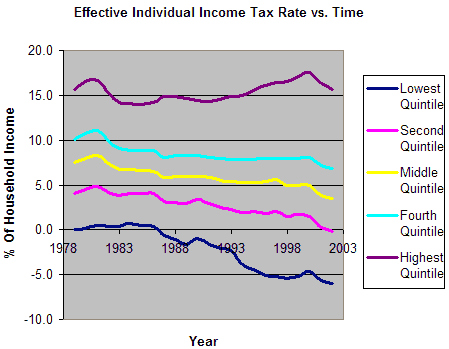
Everybody says up, right? While I can’t predict the future, I thought it would be interesting to see what the historical tax rates were for different income groups. Here is some data taken from the Congressional Budget Office about historical federal tax rates as a percentage of “comprehensive household income”, defined as pretax cash income plus income from other sources like rental income and dividends. Note that this isn’t the same as your marginal income tax rate, which is the tax rate on your last dollar earned; This is a percentage of all your income.

altext

As a reference, here are the quintiles for annual household income as defined by the US Census Bureau in 2005:

1st Quintile: $0 – $18,500
2nd Quintile: $18,500 – $34,738
3rd Quintile: $34,738 – $55,331 (Median: $46,326)
4th Quintile: $55,331 – $88,030
5th Quintile: Over $88,030

Looking at the chart, it seems that the top quintile has paid about the same amount overall, while the overall effective federal income tax rate has actually fallen for the rest.

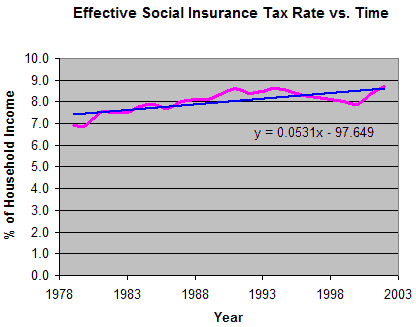
Now, what about social insurance payroll taxes that go towards Social Security and Medicare? These have been going up over time for just about everybody:

altext

I even added a linear trendline, which although completely unscientific, suggests that if such a trend continues the effective percentage will increase approximately 1% every 20 years.

Lessons Learned From Examining My Payroll Taxes

As hundreds of high school kids run out this month and get their first summer job, they will also be greeted with their first wonderful paycheck… that and the phrase “What’s FICA and where did all my money go?” Ah, payroll taxes. First, some quick definitions of where your money is going other than federal, state, and local income taxes:

Social Security Tax
This is also commonly marked as FICA-O, SS, SSWT, or OASDI. If you work for an employer, 6.2% of your wages is withheld by the government for social security programs. Your employer also must contribute a 6.2% matching contribution that isn’t mentioned. For 2007, both the employee and employers contributions only apply to the first $97,500 of wages.

Medicare Tax
Also marked as FICA-M, MI, Med, or MWT, this tax is a flat 1.45% taken from your gross wages with no income limit to pay for Medicare, our national health insurance for the elderly. Your employer also kicks in another 1.45%.

Even though both of these contributions technically only go to pay current obligations and don’t even guarantee you benefits in the future, Uncle Sam is still taking 7.65% (15.3% total) out of each paycheck for help people survive their retirement years. It makes you wonder – shouldn’t we be doing at least the same on our end? Here are a few other observations from looking over my paystub:

Automatic Saving Helps Ensure Success
Notice how the government always get their payroll taxes before you even get cut a check. They know that in general people don’t budget well very well and tend to spend what they get. Can you imagine what would happen if everyone simply got a bill for Social Security and Medicare taxes at the end of the year? Yeesh. This is why you should “Pay Yourself First”, whether through automatic 401k deductions or automatic transfers into a savings account. It’s the best way to ensure it your savings will happen.

Pre-Tax Deductions Also Save On Payroll Taxes
Several other items can deducted from the paycheck automatically, on a pre-tax basis. Examples include:

  • Health, Vision, and Dental Insurance
  • Parking fees
  • Healthcare Flexible Spending Accounts (FSAs)
  • Dependent Care Spending Accounts
  • Basic Life Insurance

I always thought that this just meant I didn’t have to pay income tax on these payments, but after doing some reverse math it turns out that I’m not subject to payroll taxes on them either! Try looking at your own paystub. That’s an additional 7.65% in savings on stuff that would otherwise be paid with after-tax money, making Flexible Spending Accounts and makes buying the employer health plan even a better deal than I had previously calculated.

Unfortunately, your 401(k) contributions are subject to SS/Medicare even though they are exempt from income taxes. However, when you make a withdrawal you do then pay income taxes, but not SS/Medicare. At least for now…

April 17th Is Coming! How I Estimated My Tax Liability For Tax Extension Form 4868

do not forgetPlease don’t take the following as tax advice. It’s what I did, not necessarily what others should do.
I’m filing Form 4868 for an automatic extension of time to file my tax return. But that doesn’t give me any extra time to pay any taxes owed, so I must estimate my tax liability and send that in. Specifically, I must pay at least 90% of my total tax due by April 17th in order to avoid penalties for late payment. However, you will still be liable for any interest accrued on any balance due when you file your return. Either way, it’s good to overestimate a bit and make sure it’s all paid off. Here are my quick and dirty calculations:

Estimating total taxable income. I added up all the income from our W-2s, 1099-MISCs, 1099-INT, 1099-DIV, capital gains, and other gross business receipts to get our gross income. I took out our 401(k) contributions and a few of the larger business expenses that I have documentation for. Other may need to take into account other items that make up their adjusted gross income (AGI).

Instead of worrying about itemized deductions, I just subtracted out the personal exemption of $3,300 per taxpayer and the standard deduction ($5,150 for Single, $10,300 for Married Filing Joint) from my estimated AGI. This leaves me with my estimated taxable income.

Estimating tax liability. You can either use the tax tables starting page 66 of the 1040 instructions, or use the tax schedules shown here. They both give you the same numbers. This estimated tax liability goes into Line 4 of Form 4868.

Finding out what taxes you’ve already paid. For us, this consisted of the tax withheld from our W-2s and the estimated quarterly payments I made for the business. These payments go on Line 5 of Form 4868.

Finally, logically we end up with Taxes Still Owed = Tax Liability – Taxes Paid. You can then either:

  1. Write a check for this amount payable to the “United States Treasury” and mail the form in at the cost of a stamp,
  2. or sign up for an account at TaxACT and e-file Form 4868 for free. I chose this option as it lets me withdraw money electronically from my savings account. Also, this way I can get an e-file confirmation in a few days instead of hoping the Postal service doesn’t lose my check. You don’t have to do your taxes or anything else at TaxACT if you don’t want to.

If you don’t owe anything, you still should file the form. I just e-filed my extension. Woohoo! Now I can procrastinate for another 6 months…

Where Are All My 1099 Forms?

Here I am, trying to start on my taxes but wondering why only half of my clients sent me a 1099-MISC this year! It turns out that businesses do not have to send a 1099-MISC to corporations no matter how much money they paid them. My business is an S-Corporation, so instead of having nice printed forms that clearly show how much they paid me in 2006, I get… nothing. I still have my own accounting books, but I have found in the past that my records and my client’s records aren’t always in sync.

For example, I might do a job in November, send the invoice in December, their check is written in late December but I don’t receive and deposit it until early January. Is this income for 2006 or 2007? Since I am on a cash basis, I would usually say 2007. But they may say December. If they give me a 1099 saying it counts for December 2006, I would just put it down for 2006 to avoid any conflicts and potential IRS red flags.

Upon reading up on this is some tax forums, I actually found that many people see this as a good thing for corporations. Because a 1099 isn’t generated, there is less of a paper trail to disprove whatever one decides to put down on their tax returns. Generating a 1099 when one isn’t required is almost akin to tattling. Still, I miss being able to cross-check my records.

Time to file a tax extension!

Stressed About Your Tax Return? Get an Automatic Filing Extension

If April 17th seems like it is approaching faster than ever this year, perhaps it is time to consider filing an extension. I myself am still waiting on several 1099 forms, some of which had to be corrected. Here’s what I dug up for us procrastinators 😉

What exactly does filing an extension get me and how do I do it?
Sending in IRS Form 4868 by April 17th will land you an automatic six-month extension until October 15, 2007 to file your tax return. You can either mail in the paper form or use a tax software package. If you are eligible for Free File, you may be able to e-file for free as well. However, it is important to note that filing the form does not change the due date for when you have to pay any owed taxes.

How much do I need to pay to avoid late-payment penalties?
You must still pay at least 90% of your total tax due by April 17th in order to avoid penalties for late payment. However, you will still be liable for any interest accrued on any balance due when you file your return. Therefore, it’s a good idea to overestimate your taxes owed initially, and then plan on receiving a small refund when you officially file.

What I intend to do is just run a quick online tax return that pads my income a bit and also neglects any itemized deductions or business expenses. If you stop before actually filing, you can get a quick and dirty number without having to pay anything.

If it looks like you are getting a refund already, then you don’t need to do anything more. Otherwise, any tax owed can be paid via regular employer withholding, estimated tax payments, or you can simply attach a check along with Form 4868. If you e-file, you can also pay via an electronic withdrawal from your bank account or with a credit card (subject to an additional fee).

Don’t forget to also file an extension for your state taxes!
Every state has their own rules and forms, but generally they give you same deal: you can easily get a extension to file, but any taxes owed are still due by April 17th.

IRS Calculator To Help Determine Sales Tax Deduction

If you itemize deductions and live in a state with sales tax, give the IRS Sales Tax Deduction Calculator a spin.

Taxpayers who itemize deductions on Schedule A of the Form 1040 in 2006 have the option of deducting the amount of state and local sales taxes paid instead of deducting their state and local income taxes paid. Taxpayers cannot take a deduction for both sales and income taxes.

Residents of states with no income tax should definitely look into this. If you have made some large purchases this past year, it may also be worth the effort to dig up those receipts. Via Consumerist.

Should I Do My Own Taxes Or Hire An Accountant?

10-key calculator, image credit: OfficeDepot.comI mentioned earlier that I am forgoing all the free federal and state tax filing software options and paying an accountant this year. A reader asked why. That’s a good question, here’s what I (as a non-tax pro) think the decision process should look like:

Do I even want to deal with it?
Some people just think about taxes and feel queasy. It’ll cost at least $100 to pay a person to do it for you, but it’ll get done. Or maybe you feel your time is worth enough that it’s cheaper to just outsource it.

Try doing it online yourself for free first
Most online tax websites only make you pay for your return at the very end, when you want to print or e-file. So you can go through the entire process and even figure out your refund without paying a dime. I used to run my taxes both with H&R Block and TurboTax online just to make sure the final numbers were identical (they weren’t once!). Usually they ask enough questions to tease out any concerns you might have. If you find yourself unsure of something, maybe it’s time to do some more reading or pay for an accountant.

The side benefit to doing this is that it makes you get all your records and papers in order. This will save your accountant time, and thus save you some money!

Taxes Too Complicated?
If your taxes are easy (you don’t itemize), I bet that any software will ask the same questions as the people at your local H&R Block. But in my case, I formed an corporation for my business this year, and with the payroll issues, qualified expenses, and deductions there is no free online version I could try for free. I could buy a copy of the beefier TaxCut Business that handles corporations, but it’s very possible that I’d still miss something.

Therefore, I want my records to be examined at least once by a professional who’s familiar with similar small businesses – an independent accountant, not a chain. If I’m lucky, I will find someone that adds value and maybe even form a long-term relationship. If not, at the very least I’ll have the finished return to act as a template for next year’s taxes.

Tax Tip: Don’t Forget Your $30+ IRS Telephone Tax Refund

Since the IRS starts accepting electronic returns this week, let’s start off with the tax tips. First, an easy one: the IRS Telephone Tax Refund.

Summary: Courts decide old phone tax not legit, should be refunded. You and I get money back.

Easy way: Check a box and take the standard amount, which is $30-$60 depending on how many exemptions you claim. Single people with one exemption get $30. No bills, no paperwork.

Hard way: Gather all your old cell phone, landline, and VoIP bills from February 28, 2003 to August 1, 2006 and add up all the excise tax you paid for those 41 months. If it’s more than what you would have gotten with the easy way, fill out Form 8913 and get that amount instead. If you kept your bills, this might be worth the effort.

I’m going to a CPA this year to get my taxes done for the first time ever, I wonder what he’d say if I came in with a huge box of paper and pretended that they were 41 months of phone bills that I wanted him to sift through…

More information from the source: Telephone Tax Refund Q&A page.

Does Your Income Vary? Get Around Roth IRA Income Limits

In my post about Roth IRA conversions, commenter JT pointed out a good way to get around the Roth IRA income limits if your income varies from year to year. Simply put contribute to a non-deductible Traditional IRA, and wait until your modified AGI drops below the $100,000 limit to do the conversion into a Roth. Maybe you plan on going back to school or are cutting back your hours to stay home with the kids? Although the limits go away in 2010 anyways, it’s something to consider.

For example, in 2005 I made too much to fully fund my Roth (phase out) but I?d be making less than $100K MAGI (salary – 401k) in 2006, so before April 15th in 2006 I put the excess contribution (4000 – what I was able to contribute directly to my Roth) into a Non-Deductible IRA then did an immediate Roth Conversion (no taxes since there was no gain). Full Roth Contribution even though I was in the phase-out range?

An important note – when you do a Roth Conversion the IRS sees all of your traditional IRAs as a pool, so if you have a traditional IRA from a 401(k) rollover then the above trick doesn?t work since you will owe taxes on a portion of the money?

My Traditional to Roth IRA Conversion Decision Process

For the best site that I’ve found to the Traditional-to-Roth IRA conversion process (and more clear than the IRS instructions), see the Fairmark guide. Reading through it, you can see there are a ton of variables to consider, including evaluating your current situation and predicting future legislation. Here’s a summary of my decision process after reading the guide:

Am I Allowed To Convert?
My main concern was the income limits. No matter if you are single or married, your total combined modified adjusted gross income (MAGI) cannot be over $100,000. The definition of MAGI is pretty confusing – either read Pub 590 or better yet Fairmark again for the details. But one way to lower your MAGI is to make contributions to your employer’s retirement plan (401k, 403b). Making more pre-tax contributions to enable you to convert pre-tax contributions to post-tax contributions may seem a bit paradoxical, but I just see it all as increasing your retirement savings.

Note that the income limits are scheduled to be removed in 2010.

What Types Of IRAs Can I Convert?
You can convert both a SEP-IRA or Traditional IRA into a Roth IRA. You can also convert an old 401k/403b/457 plan from your employer to a Traditional IRA, and then convert that to a Roth IRA if you satisfy all of the conditions. My current Traditional IRA is a mishmash of all three of these – an old Rollover 401k, straight Traditional IRA contributions, and a SEP-IRA.
[Read more…]

Myths About Marginal Tax Rates Explained

Taxes are always confusing, and marginal tax rates are no exception. Although I am no accountant, here are some clarifications on how to use the 2006 tax bracket table I just posted.

First, it should be noted that it is for taxable income, not gross income. In very broad terms, taxable income is your gross income minus exemptions and deductions. Everybody has the standard deduction ($5,150 for single taxpayers and $10,300 for married taxpayers filing jointly for 2006), and many people have more from things like personal and dependent (kids) exemptions, mortgage interest, and state income taxes. For example, if you were single and had $35,150 in gross income, with the standard deduction you would only have a taxable income of $30,000. You owe no tax on the first $5,150.

But remember, gross income also takes into account interest and capital gains from selling investments in addition to just salary. So estimating your actual taxable income without actually filling out a 1040 form can be a bit tricky.

Second, it’s your marginal tax rate, not your overall tax rate. Marginal tax rate means this is the rate at which your next dollar earned will be taxed. So it’s not retroactive to the dollars you already earned, and you can never make less money after getting a raise.

For example, if you were single and had $30,000 of taxable income, and got a $1,000 raise later to $31,000, your entire $31,000 will not be taxed at the 25% rate (a big jump from 15%!). Only the $350 above $30,650 would be taxed at the 25% rate. Your total taxes would then be:
[Read more…]