$8000 Housing Stimulus Tax Credit: Requirements and Common Questions

Still lots of questions about the $8,000 First-Time Home buyer Tax Credit. Here are some answers:

What is the definition of a first-time home buyer?
You are considered a first-time homebuyer if:
– You purchased your main home located in the United States after April 8, 2008, and before December 1, 2009.
– You (and your spouse if married) did not own any other main home during the 3-year period ending on the date of purchase.

Do I have to pay the homebuyer tax credit back? How much is the credit for? $7,500 or $8,000?
It depends. For homes purchased in 2008, the $7,500 credit (or 10% of purchase price, if less) operates much like an interest-free loan. You generally can repay it equal installments over a 15-year period unless you move out or sell the home earlier than that. The maximum credit is reduced to $3,750 for married individuals filing separately.

For homes purchased in 2009, you must repay the $8,000 credit (or 10% of purchase price, if less) only if the home ceases to be your main home within the 36-month period beginning on the purchase date. The maximum credit is reduced to $4,000 for married individuals filing separately.

What is the definition of main home? Does a condo count? How about an RV?
Your main home is the one you live in most of the time. It can be a house, houseboat, housetrailer, cooperative apartment, condominium, or other type of residence.

What if I don’t owe or pay any income taxes?
This is a refundable tax credit, which means that even if you don’t owe any taxes, you will receive the credit amount via check or other means. For example, if before this credit you had a tax liability of $5,000 and withheld $4,000, you would owe the IRS $1,000. If you qualify and claim a $8,000 tax credit, you would now receive $7,000.

What are the income restrictions?
The amount of the credit begins to gradually phase out for taxpayers whose adjusted gross income is more than $75,000, or $150,000 for joint filers. It is completely phased out when your AGI is $90,000, or $170,000 for joint filers.

Can I just buy a home from a relative and pocket the $8,000?
You don’t qualify for the tax credit if you bought the house from a “related person.” According to the IRS, a related person includes:

  • Your spouse, ancestors (parents, grandparents, etc.), or lineal descendants (children, grandchildren, etc.).
  • A corporation in which you directly or indirectly own more than 50% in value of the outstanding stock of the corporation.
  • A partnership in which you directly or indirectly own more than 50% of the capital interest or profits interest.

How do they determine the purchase date as applied to the cutoff dates?
If you bought an existing home, the date of purchase is your closing date, not the day that you sign a purchase contract or enter escrow. If you constructed a new home, you are treated as having purchased it on the date you first occupied it. (Seems like some wiggle-room here.)

What IRS Form Do I Have To Fill Out? Can I File For 2008 or 2009 Tax Years?
That would be the new revised version of IRS Form 5405 (where most of this information is from), which you fill out and attach to Form 1040. Any updated tax preparation software should be able to handle this. If you already bought your house in 2009, you can file either on your 2008 or 2009 tax returns. (Why not get it now?)

What if two unmarried people buy a house together?
If two or more unmarried individuals buy a main home, they can allocate the credit among the individual owners using any “reasonable” method. The total amount allocated cannot exceed the smaller of $7,500 ($8,000 if you purchased your home in 2009) or 10% of the purchase price. A “reasonable” method is any method that does not allocate all or a part of the credit to a co-owner who is not eligible to claim that part of the credit.

I am not a U.S. citizen. Can I still claim the tax credit?
If you are a resident alien according to IRS Pub 519 and satisfy all the other requirements, then yes you can claim the credit. Nonresident aliens are not eligible.

American Recovery and Reinvestment Act of 2009 Highlights

The House and Senate have reached an agreement on the American Recovery and Reinvestment Act of 2009, better known everywhere as “that huge stimulus bill“. I couldn’t stop myself from taking a peek. Here are some details that directly affect most taxpayers:

“Making Work Pay” Tax Credit: $400 per person, $800 per family
Apparently it won’t be sent out as a lum-sum check this time, but will directly increase your paycheck as an extra $13 a week in take-home pay starting in June (since it is retroactive to 2009), falling to about $8 a week in January 2010. I tend to think a lump-sum would have more “bang”. Starts to phase out at $75,000 modified adjusted gross income for single filers, $150,000 for married filing jointly.

“Not Working” Tax Credit: $250 per person
For retirees, disabled individuals and others who don’t work, they will receive a one-time $250 payment. This will probably be a check in the mail.

$8,000 First-Time Homebuyer Tax Credit
Although there was talk of a $15,000 tax credit for all homebuyers, it looks like it was greatly reduced and still restricted to first-time homebuyers. Starts to phase out at $75,000 modified adjusted gross income for single filers, $150,000 for married filing jointly.

If you bought your house between April 9, 2008 and December 31st, 2008, the first-time homebuyer tax credit remains at $7,500 and you will have to pay it back over 15 years, or when you sell the house. If you bought your house after January 1st, 2009 and before December 1st, 2009, the credit is now increased to $8,000 and you will not have to pay it back as long as your live in it for 3 years.

New Car Tax Deductions
If you buy a new car, you can deduct the interest you pay on your loan as well as the taxes you paid on it (on up to $49,500). Starts to phase out at $125,000 modified adjusted gross income for single filers, $250,000 for married filing jointly.

…and a whole lot more, including expanded unemployment benefits. An example of a tiny tidbit that got mixed in? In 2009 and 2010, you can now use your 529 plan money to pay for “computers and computer technology”, which could include peripherals, software, and even broadband internet fees.

Free Tax Filing Software Options: IRS, TurboTax, TaxCut, TaxACT

Due to a combination of owning a corporation, moving mid-year, and all the residency and payroll rules attached to assigning incomes between states, we are hiring a CPA this year. This MSN Money article says that 62% of Americans pay a professional to do their taxes. I’m actually surprised by this number, as I think most people can get by just fine by using current tax software. I’ve certainly been happy to do so for the last decade.

Below are several free ways to get your taxes done, besides of course using old pen n’ paper. As you’ll see, for just about everyone there is at least one option for completely free Federal filing with E-file. And even if you add in State, it shouldn’t cost more than $14 with E-file.

IRS Free File – Income Restricted
If your 2008 adjusted gross income of $56,000 or less, there are a variety of options from 20 different software companies available from the Free File Alliance at IRS.gov.

Free File Fillable Tax Forms [IRS]
If you already know which tax forms you need to fill out, the IRS now lets you fill them out electronically and file them electronically for free. This is not the same as the income-restricted “Free File” above. Via Consumerist.

TurboTax
You can use the TurboTax Federal Free Edition if you have a simple tax return, for example one that only requires the 1040EZ return with no itemized deductions. State is $25.95.

TurboTax Business
If you have a corporation, partnership, or multi-member LLC and think you can handle it yourself, you can get TurboTax Business for Federal filing free with Federal E-file included.

H&R Block TaxCut
The free version of TaxCut is also restricted to those with simple returns.

Not quite free, but you can also get TaxCut standard for Federal for $1 with free Federal E-file at Dollar Tree stores. It has no income restrictions and handles itemized deductions. State return is the upsell, at $29.99 extra (see below for more options).

TaxACT
Competing well with the big boys is TaxACT, which offers a free federal return for everyone with no restrictions, with free Federal E-file included. State return is $13.95 with E-file included.

The TaxACT “Ultimate” Bundle is $16.95, includes data importing, and the state return. However, there is a returning customer’s offer that gives you 30% off, bringing the total cost to $11.90. The link does not appear to actually discriminate between new and returning customers.

State Income Taxes
Many states also offer their own online income tax filing programs. I don’t have time to compile all the links this year, but use this old list as a starting point, or just Google your own state’s tax website. In many cases, filing a state return manually is not very difficult.

Strategies For Maxing Out Your 401k/403b and Company Match, True-Up Contributions

Why the interest in 401k limits? Well, we found out that my wife now gets a company match to her 403b retirement plan. Score! I then wanted to explore how to maximize both our $16,500 401k limits and the company match.

Example: Maxing Out But Missing Out Too

You make $120,000 per year and get a full 3% company match during each pay period. Let’s just say you get paid $10,000 gross monthly. However, you are a really motivated saver and can defer 20% of your income each month into the 401k.

For the first 8 months of the year, you put away $2,000 (20% of $10,000) and the company matches $300 (3% of $10,000). That’s brings you to $16,000 in salary deferrals. On the 9th month you can only contribute $500, which the company also matches $300 again. On the remaining 3 months of the year, you can’t contribute at all, so there is nothing to match! Even though you contributed significantly more than 3% of your salary, you’ll miss out on $300 x 3 = $900 of free money.

Solutions and Potential Problems
The solution is usually given to space out your salary deferrals evenly throughout the remainder of the year. For the above example, you would divide $16,500 by 12 = $1375 each month. If you can only set percentages, you’d set aside 13.75% each month ($1,375 / $10,000).

The problem with this is that for those people who earn hourly wages, overtime, or bonuses, it can be hard to synchronize. Get paid too much, and you’ll lose match again. Get paid too little, and you might max out your match, but not fully reach the $16,500 limit. Also, if you quit or are laid off before the end of the year, you might not be able to reach the limits either.

My tweaked solution. I would vary the percentage so that you always contribute at least 3% each pay period the entire year, but otherwise front-load contributions early on. Again with the example, you could set aside the $2,000 per month for 6 months, and then put in $750 per month for 6 months. Percentage-wise, this is 20% for first half the year, and then 7.5% for the last half. This way, you are balancing getting your annual limit maxed out as closely as possible, along with getting all the available match.

True-Up Contributions

But before going too far, you should ask your benefits administrator whether they offer what is called “true-up” contributions. What this does is compare your year-to-date (YTD) contributions to your YTD salary. If you contributed at least 3% of your YTD salary, but did not receive a 3% company match, then they will send in an additional contribution to “true-up” the numbers.

Some companies perform this true-up calculation after every pay period, while others wait until the end of each year. If they true-up every pay period, then it would seem to be a good idea to contribute as much as you can as early as you can – you’ll get the full year’s match early this way.

Our company does one true-up after the end of the year, and the credit doesn’t show up until March. However, I was also told that if you aren’t employed in March, you won’t get this credit. So again, the front-load with minimum method might be the best idea to get your match as it comes available.

As I write this, I realize that I really overthink some of this stuff. What can I say, I’m excited about our new match, and I just can’t help myself!

Add More Money Your Roth IRA – Undo and Redo Contributions After Losses?

So you listened to the financial experts and dutifully contributed $5,000 to your Roth IRA in early 2008. Unfortunately, stuff hit the fan and now you’re left with a lot less. Wouldn’t it be nice to be able to find some silver lining and shield another ~$1,000 plus earnings from taxes forever?

Well, here’s a slightly controversial idea that I ran across in this Boglehead Forum thread that might help you do just that. I think the easiest way to explain it is to continue with an imaginary scenario. Note that this leaves some variables in exchange for simplicity.

Example Scenario
Sometime in early 2008 you contributed $5,000 to your Roth IRA for the 2008 tax year. At the time, your IRA was worth $20,000 in total after the contribution. Now, in January 2009, the entire IRA is now worth $15,000.

You first “undo” your 2008 $5,000 contribution by following the same steps as someone who ended up being ineligible for a Roth IRA due to too much income*. Because your entire IRA account dropped by 25%, your $5,000 contribution is considered to have dropped by the same amount. You end up receiving a check for $3,750. You have received a return of your contribution, and have now technically contributed nothing to your 2008 Roth IRA.

Soon afterward, you simply open up a new IRA either at a new broker, or at your current broker if they are on the ball and have your 2008 total contributions as zero. (Otherwise they might throw a fit…) You can now throw in another $1,250 and contribute $5,000 again to your Roth IRA for the 2008 tax year before April 15th, 2009. Even if you just reinvest the $3,750 the same way as you did before, by using this strategy you have allowed another $1,250 to grow shielded from taxes, forever.

Is This Legal?
This is somewhat similar to the Traditional-to-Roth IRA reconversion method to save taxes. I read some skeptical posts in the BH thread as to the legitimacy of this action, but none were really backed by any evidence. I don’t see why both methods aren’t equally legal.

As another example, you might have made two separate $5,000 contributions by accident, and need to undo one of them. If everything is accounted for correctly by your IRA custodian, the IRS shouldn’t blink an eye. Here is another educated discussion in support of this idea. Other tax pros please add your thoughts in the comments below.

We ended up not being eligible for a Roth IRA this year, but if I was a candidate I think I would take advantage of this idea. In the long run, even stuffing another $1,000 in a Roth could save a lot of money in taxes.

* More information on correcting excess contributions in this Investopedia article. It must be done by the owner’s tax-filing deadline, which usually April 15, 2009 unless you file for an extension. Note that this is not the same as taking a distribution.

Free Equifax FICO Score Redux

Looks like Equifax and FICO are giving out another 10,000 free FICO scores (expired!). Again… no credit card or trial required. This is an official FICO score based on your Equifax credit file. Score only, no credit report. This time you don’t have to sign up for an extra forum account.
If you already got one of these free scores recently, you are out of luck. There is a limit of one every 12 months. The site URL is FreeFICOScore.com, which really sounds spammy, but it is verified by Verisign to be run by Fair Isaac Corporation.

Historical Federal Tax Rates by Income Group

In my last post on 2009 marginal tax rates, reader Alexandria (aka MonkeyMama) made a very good point that planning our retirements around future tax brackets is very difficult as they change all the time. But isn’t that what we are forced to do every time we contribute to a IRA and/or 401k? We can either pay tax now (Roth), or pay tax later (Traditional). In any case, I figured I should look into this more.

I previously explored this area in my post about historical marginal tax rates vs. median income. There, I concluded that at my current high income level, my personal tax rates would probably go up in the future. Now why might I change my mind?

Total Federal Tax Rate vs. Income Group
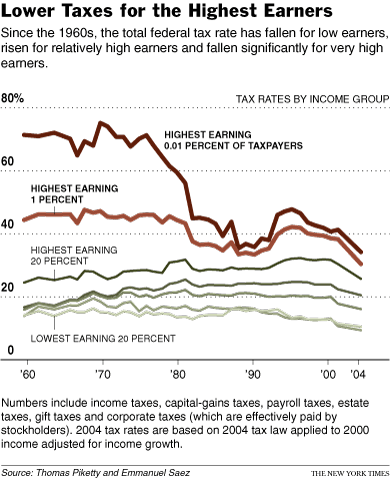
More recently, the NY Times published the following graph that plots the total federal tax rate vs. income starting from the 1960s. Total federal tax rate includes income taxes and also things like payroll taxes and capital-gains taxes.

As you can see, tax rates as a whole have been dropping recently and are relatively low compared to the past. I would also note that the total tax rate at the median income group (middle 20% line) has varied very little over the last few decades, hovering around 18-20%.

Federal Income Taxes For Median Family
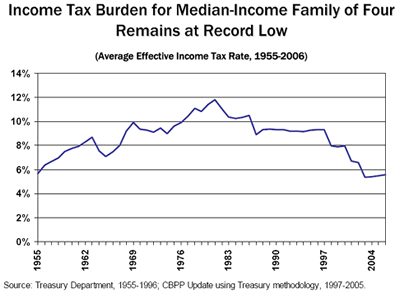
Next, here is a 2006 chart from the Center on Budget & Policy Priorities, which is based on Treasury Dept. data. The Center estimates that the median-income family of four will pay only 5.6 percent of its income in federal income taxes in 2006, the lowest since 1955.

As you can see, the range for this median family has stayed between 6 and 12%.

My short take. Tax rates right now are historically low. Given this and all our future governmental obligations, they will most likely go higher. However, future tax hikes will probably be more heavily placed on high income earners as opposed to those earning at the median or below. The tax rate paid by the “middle class” tends to stay in a relatively low and narrow range.

Everyone’s situation is different. Right now, we are earning in the top 5% or so. But in retirement, I think we can easily fit into this median group, especially if the mortgage is paid off. So even though the future is unknown, my bet is that our tax burden will decrease upon retirement.

2009 Marginal Rate Brackets For Federal Income Tax

For personal reference, there are the new 2009 federal income tax brackets, which have been adjusted for inflation. This is taxable income, so it is after any exemptions and either standard or itemized deductions have taken place, as well as pre-tax contributions to Traditional 401ks and IRAs. (And all that other stuff that makes the tax manual so thick.)

Marginal Tax Rate [Taxable Income] Single Married Filing Jointly
10% $0-$8,350 $0-$16,700
15% $8,350-$33,950 16,700-$67,900
25% $33,950-$82,250 $67,900-$137,050
28% $82,250-$171,550 $137,050-$208,850
33% $171,550-$372,950 $208,850-$372,950
35% > $372,950 > $372,950

The value of each personal exemption also increased to $3,650, up $150 from 2008. The standard deduction is now $11,400 for married couples filing a joint return (up $500), $5,700 for singles and married individuals filing separately (up $250) and $8,350 for heads of household (up $350). Source: IRS.gov

If you are like many others and didn’t get a raise that matched inflation last year, at least you might pay a little less in taxes.

Since we’re married, I always pay attention to the point where you jump from 15% to 25%, which this year is $67,900. (With the two personal exemptions and a standard deduction, this would be a gross income of $86,600.) My fuzzy goal is to be able to live on less than this amount in (early?) retirement, so that all my IRA and 401(k) withdrawals will be taxed at a maximum of 15%.

Undo/Redo Traditional to Roth IRA Conversion After Market Losses

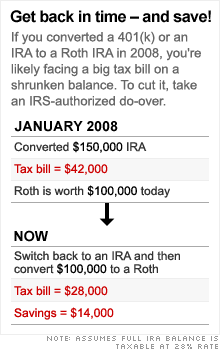
If you did a Traditional IRA to Roth IRA conversion in 2008, and have since suffered some significant losses, you may want to consider undoing the conversion now that it is 2009. Then, as long as you wait 30 days after that and still qualify, you can redo the conversion again. This way, you only owe income taxes on the lower amount.

This Roth IRA conversion “do-over” is discussed in this CNN Money article, which included a helpful example scenario:

One of the main considerations are that you want to make sure your losses are enough that they likely won’t be recouped in the 30 days you are “out” of the market. One option is to re-invest the money in a taxable account during that period, but you’d be subject to more potential losses, as well as taxes on gains.

Another consideration is that you are essentially doing a entirely new 2009 conversion. You’ll have to again meet the income limits, and make sure your new tax bracket is acceptable to you. I did a Traditional to Roth IRA conversion in 2007 and shared my decision process, including the eligibility requirements and how to pay for it. There are more details on reconversions in this Fairmark article.

Next up: Controversial ways to deal with other Roth IRA losses.

Tax-Loss Harvesting For Buy & Hold Mutual Funds and ETFs

Always the procrastinator, I finally sold some shares of my punished mutual funds and ETFs in order to do some tax-loss harvesting. There are only two days left in 2008!

What is Tax-Loss Harvesting?
The main idea of this tactic is to legally pay less taxes by taking advantage of the fact that losses are taxed at potentially different percentages than gains are.

The IRS lets you claim a deduction for investment losses against your ordinary income, up to $3,000 each year. (If your net capital loss is more than this limit, you can carry the loss forward to later years.) For example, if you lose $3,000 on an investment, and you realize that capital loss by selling the stock or fund that incurred the loss without realizing any capital gains in the same year, you can claim a $3,000 deduction on your income tax return. This means you won’t have to pay income tax of up to 35% on $3,000 of your income that you would’ve had to pay otherwise.

On the other hand, a realized capital gain of $3,000 which you held for at least a year would only be taxed at a maximum of 15%. Therefore, although losses are still undesirable, if we plan on holding the investment for at least another year, we should “harvest” all the losses we can get.

Expanded Example

Taken and edited slightly from a older post:

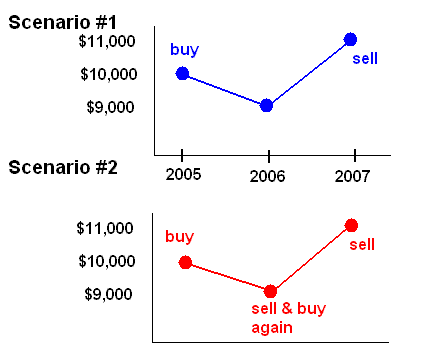
Scenario #1: You are in the 28% tax bracket. Say this year you bought $10,000 of IVV, an ETF that tracks the S&P 500. In 2006 it drops to $9,000, and in 2007 it rebounds to $11,000 and you sell. You’d have a long-term gain of $1,000 from your original $10k, so you pay 15% in taxes ($150), and end up with $10,850 in your pocket. Net gain of $850.

taxloss.gif

Scenario #2: Same 28% tax bracket, same start period. You buy $10,000 of IVV, and in a year (2006) you sell at $9,000, and the very same day you buy IWB, an ETF that tracks the Russell 1000 Index, but is very similar (but not identical) to the S&P 500. Since it tracks very closely, your $9,000 of IWB in 2006 will also rise back to $11,000 in 2007. After a year and a day, you sell your IWB for $11,000.

Now in 2006, you had a capital loss of $1,000 from your IVV. So you deduct $1,000 from your ordinary income taxed at 28% and save $280 in taxes. That’s $280 in your pocket. Then, in 2007 you realized a long term capital gain of $2,000. You pay your 15% tax ($300) and you end up with $11,000 – $300 = $10,700. Add in your $280 from the last year, and you end up with $10,980.

This time, even though you had basically the same level of market risk, you obtained a net gain of $980.

Substantially Identical?
Note that you must do this with similar, but not “substantially identical” investments. For example, you can’t buy IVV back again right after selling it and try this. That would be called a ‘wash sale‘ by the IRS.

Your Own Financial Rescue Plan, Part 1: Adequate Cash Reserves

Well, the big boys are getting their rescue/bailout plan, but I guess ours got lost in the mail… So what should we do? I think that everyone should take a second look at their cash reserves. Do you have enough?
What Job Security?
These days, I don’t see any job as safe. My company went from interviewing people to hiring… nobody. Even local and state governments are facing major budget deficits. At a minimum, I would want a few months of living expenses to tide me over until I find another job. I still remember the dot-com bust days when former tech workers ended up living in their cars.

A Reason Not To Invest In Stocks
Hey, if you’re looking for an excuse not to buy any more stocks for a while, beefing up your emergency fund is not a bad one. Any money you may need within 5 years should be in cash or short-term investments anyway.

A Reason *To* Invest In Stocks
Ironically, after you build up a nice cushion, it may actually make you feel better about investing in the stock market. I definitely helps me to keep short-term money separate from long-term money. As such, I’m still applying my upcoming income towards maxing out my 401(k) for 2008. But after that, I will probably start to save another three months of living expenses, for a total of 9 months in cash.

Less Credit Available
A lot of people used to simply assume that their home equity line of credit (HELoC) could serve as their emergency fund. But these days, it just takes one letter in the mail that says your HELOC is frozen or greatly reduced. You don’t want to be forced into taking an early withdrawal from your 401(k) or IRA, or paying exorbitant credit card interest.

If anything, apply for a credit card with a low fixed interest rate now while it is still offered. Here is a list of no fee 0% APR balance transfer credit cards. Just buy goods as you regularly would, and pay the minimum while saving the difference in an interest-bearing account. (Don’t go buying more stuff, obviously!)

Looking Ahead
For me, an alternative reason for increasing my cash reserves is that I can also use it later for investing in real estate. I still don’t see many opportunities with good cashflow right now, and may not see them for another couple of years. But I want to be ready, as the no-money-down days may never come back.

Where do you keep it?
As long as it is safe and liquid, I just go by rate. Use the new FDIC insurance estimator if you have lots of money. Both Vanguard and Fidelity are participating the money market fund insurance program, so they are super-duper safe now. . Well, your old money is safe. Still, I consider money market funds with Fidelity and Vanguard as safe as FDIC-insured, although this is only my opinion. However, my cash is currently split between:

  1. Series I US Savings Bonds – Bought in April with 1.2% fixed rate, now only 0% fixed rate available. Note that they are illiquid for the first 12 months. Rates adjust semi-annually. I earn 4.38% for 1st six months, 6.06% for 2nd six months. With recent inflation, my 3rd six months should also be pretty good. Exempt from state income tax as well.
  2. 12-Month 5% APY CD at WaMu/Chase – Sadly, no longer available.
  3. Low or no-minimum banks with high liquidity – A big chunk currently in transit to Everbank at 1.10% for first 6 months.

Recommended Book On Tax Deductions For Home Businesses and Freelancers

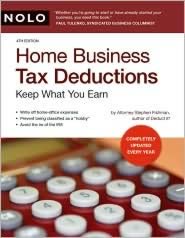
I got a lot of positive responses from my self-employed tax-related post yesterday. I’ll be happy to continue sharing more of my experiences, but given the complexity of tax issues I wanted to throw out a book recommendation – Home Business Tax Deductions: Keep What You Earn by Fishman.

This is my hands-down favorite book on tax deductions for those with home-based businesses. It has saved me many times the $20 cover cost. I checked this book out from the library first as well, but ordered it online within a few days. I’ve read several other tax books and they are either (1) too light on the details, or (2) too aggressive and bordering on both the unethical and illegal. This book provides a good summary of the IRS code, and practical ways to substantiate deductions that you qualify for.

The primary benefit of a good tax book is that it gives you the confidence to take the deductions that you deserve and qualify for. Many times people simply don’t try because they are afraid of the Big Bad Audit. Instead, I am now confident that I followed the rules and can pass an IRS inspection. Remember the difference between tax avoidance and tax evasion:

Tax Avoidance is perfectly legal. The courts have stated clearly that you have no duty to pay more taxes that what is minimally required by law. You have every right to take all legitimate deductions and also to structure your business to minimize taxes.

Tax Evasion is a crime. This involves fraud, misreporting income, or taking deductions that you do not qualify for.

(Is it tacky to quote yourself?) Even if you have an accountant, I think it is good to understand a bit of what is going on.