2010 Roth IRA Income Limits Effectively Removed

Okay, let’s try this again. There are no longer any income phase-outs on Roth IRA conversions from Traditional IRAs. As in previous years, individuals or couples with a modified adjusted gross income (MAGI) over a certain limit are ineligible to contribute directly to a Roth IRA. In 2010, the phase-outs begin at $105,000 for single filers and $167,000 for those married filing jointly.

However, with no conversion limitations, people with any income can simply contribute to a Traditional IRA and then convert that to a Roth IRA immediately afterwards.

This is great news for those higher income earners who have been previously unable to contribute to a Roth IRA. In addition, if you have been contributing to a non-deductible Traditional IRA in previous years, you can now finally convert those already-taxed funds into a Roth IRA, which is almost as good as retroactively contributing to a Roth IRA. You’ll only have to pay taxes on any gains you earned on the contributions, not the actual contributions themselves since they were already taxed before. (With the recent market performance, that isn’t much of a problem for most of us…)

One additional wrinkle is that if you have a mix of pre-tax and post-tax contributions inside all of your combined Traditional IRA funds, you cannot convert them separately. For example, if you have a mix of 50% pre-tax and 50% already-taxed funds, then any converted amount will be assumed to be 50% pre-tax and 50% post-tax. You can’t just convert the post-tax part. This could be one reason not to roll over all pre-tax 401k funds into a Traditional IRA whenever possible.

More info: IRS Publication 590, “What’s New for 2010”

2010 Roth IRA Income Limits Removed

Due to stupid errors in my original post, I have gone ahead and written it over. Please see my updated post: 2010 Roth IRA Income Limits Effectively Removed.

2010 Tax Brackets – Federal

Here are the new 2010 federal income tax brackets, as formatted for my own future reference. Due to low inflation, they only differ very slightly from the 2009 tax brackets. These tables are based on taxable income, which is not the same as the gross income on your paystub or the adjusted gross income (AGI) listed on your tax return. Taxable income is after taking any deductions and other exemptions you are eligible for.

Marginal Tax Rate [Taxable Income] Single Married Filing Jointly
10% $0-$8,375 $0-$16,750
15% $8,375-$34,000 $16,750 -$68,000
25% $34,000-$82,400 $68,000-$$137,300
28% $82,400-$171,850 $137,300-$209,250
33% $171,850-$373,650 $209,250-$373,650
35% > $373,650 > $373,650

The value of each personal exemption stays the same as 2009, at $3,650. The standard deduction also remains $11,400 for married couples filing a joint return and $5,700 for singles and married individuals filing separately. Heads of household get slight $50 bump up to $8,400.

Since we’re married, I always pay attention to the point where you jump from 15% to the 25% bracket, which this year is $68,000. If you assume we only take the two personal exemptions and a standard deduction, this would work backwards into a gross income of $86,700.

More info: IRS.gov

California Increases Income Tax Witholding By 10%

California has come up with another “creative” way to get some money from its residents. First, I had to figure out how to redeem my California IOU. Now starting back on November 1st, the state increased the income tax withholding on regular wages by 10%. There is no actual accompanying tax increase, they are just looking for an interest-free loan from now to when you file your income taxes.
According to the Franchise Tax Board, previously a single taxpayer making $51,000 a year and claiming one withholding allowance would have had $40.58 a week withheld from his or her paycheck. After Nov. 1, withholding increased to $44.64 a week, an increase of $4.06. Taking an extra $20 a month from someone making $51,000 a year seems more annoying in principal than anything else.

If you want to “undo” this gimmick, you can increase the number of withholding exemptions you claim on form DE-4, Employee’s Withholding Allowance Certificate, from your payroll department. You can also increase the exemptions on your W-4 form as well, but that just decreases the amount of federal tax withheld.

Fool around with the calculator at PayCheckCity and see how changing the number of allowances changes things (I don’t know if they’ve updated their calculators to include this change, but you’ll get the general idea). Just be sure that you’re paying enough income taxes to avoid underpayment penalties.

A much more detailed (and long-winded) article can be found at SacBee.com. Thanks to reader Sharon for the heads up.

How To Redeem California IOUs (Registered Warrants)

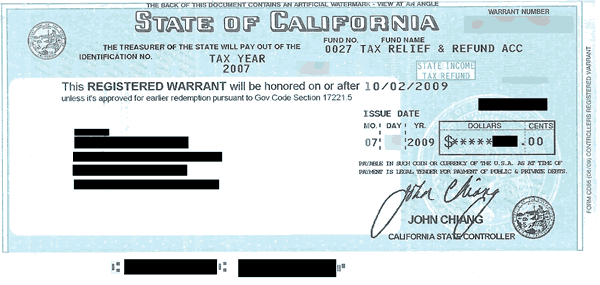
Back in July, the state of California started issuing what they called Registered Warrants, aka IOUs, to taxpayers, vendors, and local governments to whom they owed money. Due to a “cash-flow infusion” from JP Morgan Chase, the redemption date was moved up a month to as early as last Friday, September 4th. Through August 31st, the state had issued 457,238 IOUs totaling $2.37 billion. Here’s mine 🙂


(click for larger version)

Since I had to figure this out myself, I’ve tried to collect all the disparate information about how to redeem these IOUs below. The interest rate for these IOUs was set at 3.75% per year. You can estimate the interest accumulated on your IOU using this Excel calculator. Each $1,000 of IOU issued on July 2nd would have only accumulated about $6.70 of interest by now.

In Person

If you live near Sacramento, you can redeem your IOU with all accumulated interest in person for a check (not cash) at the State Treasurer’s Office located at 915 Capitol Mall, 1st floor.

Walk in hours are Monday through Friday from 8:00 a.m. to 4:00 p.m. Third parties redeeming IOUs by mail must include a notarized bill of sale signed by the person to whom the IOU was issued.

Via Snail Mail

You can also mail your IOU to the State Treasurer’s Office. According the state, IOU holders should receive their checks in a week to 10 days including mail time. Mail to:

Attention: Registered Warrant Desk
State Treasurer’s Office
915 Capitol Mall
Sacramento, CA 95814

It seems like you just mail the IOU by itself, although one press release said to be sure to include a return address. This makes sense especially if your address is different than the one printed on the IOU.

Pay Your Other Tax Bills

You can also use it as direct payment towards current and past due personal and corporate tax obligations. It is not clear if they will account for interest earned, but I can only guess that they won’t.

To pay a tax liability with an IOU, endorse the IOU on the reverse side with the phrase “Pay to the order of Franchise Tax Board” and your signature then mail it with the tax bill or estimated tax voucher. By law, FTB cannot deposit the IOU until it is payable, but FTB will credit the taxpayer’s account on the date the IOU is received to stop the accrual of interest. If the IOU is not sufficient to pay the outstanding balance, taxpayers should send an additional payment for the difference. Otherwise, the taxpayer will receive a bill reflecting the new balance due.

Deposit Directly At Bank

Some major banks with a presence in California, as well as many local community banks and credit unions are accepting these IOUs from their customers. Whether they will cash IOUs from non-customers, or if they will credit interest earned, is something to verify directly with them. If they do credit interest and you have an account with them, this would be the easiest and fastest method.

The following major banks will accept IOUs from their customers:
Bank of America (starting Sept. 9th)
Bank of the West
Citibank
Union Bank
US Bank (starting Sept. 8th)
Wells Fargo

The following major banks will NOT accept IOUs from their customers:
Chase

Wells Fargo and Bank of America have publicly stated that they will credit interest paid by the state to their customers’ accounts. BofA will accept the IOUs on September 9th, and then will credit the interest owed by the state on these items to customers’ accounts within approximately 30 days (I suppose when they redeem it themselves). WF will only credit if the interest amount exceeds $5. Wells will stop crediting customers for interest due after September 30th, but will continue to cash them for face value after that date. BofA will accept the IOUs through October 9th.

Sources: State Comptroller’s Office, CA Treasurer’s Office, Franchise Tax Board, FTB release, BofA press release, Bizjournals

Should You Keep Your Emergency Fund In Your 401k?

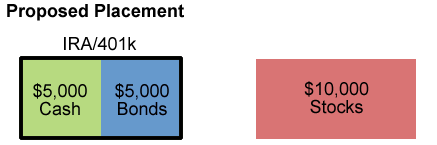
Before you jump to an answer or nasty comment, please give me a chance to elaborate. 🙂 Recently, I ran across an interesting article in the Bogleheads Wiki titled Placing Cash Needs in a Tax-Advantaged Account. Essentially, because of the way the U.S. tax code works it can often be better to keep certain asset classes like cash inside tax-advantaged accounts like IRAs and 401ks. Therefore, if your emergency fund is cash, why not put it inside as well?

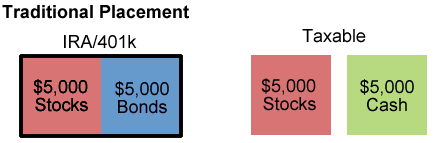
I’ll use the example given. Let’s say you have a 401(k) with a balance of $10k and also taxable assets of $10k, for $20,000 total. You choose to have $10k in stocks, $5k in bonds, and $5k in cash for your emergency account. The “traditional” placement for an emergency fund is in your regular taxable account, perhaps in a bank savings account. The rest of the assets are distributed according to this tax-efficient placement chart.

However, in this scenario all your interest earned on your cash will be taxed at your marginal ordinary income tax rate, which can be as high as 35%. See table of 2009 Marginal Tax Rate Brackets. Meanwhile, your stocks will mostly give off dividends, which are taxed at a current maximum rate of 15%, and possibly quite less. So why not put the cash into the 401k?

Emergency!

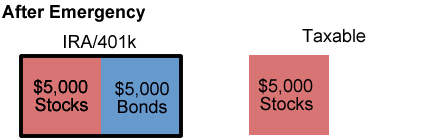
You may wonder what happens if you do need access to that $5,000. You would simply sell $5,000 of the stocks in your taxable account, and simultaneously buy $5,000 of stocks in your 401k plan. This way, your final asset allocation will look exactly the same as if you just spent your cash from the traditional setup:

If you happen to sell your stocks at a loss, then you may be able to deduct a loss if you avoid a wash sale. You can do this by not purchasing a “substantially identical” security within 30 days, but you can buy something very similar. For example, you might buy the S&P 500 ETF (IVV) and sell the Russell 1000 ETF (IWB). They are very strongly correlated, as shown in this chart. This may or may not be worth the hassle depending on how big a loss you’re looking at.

If you happen to sell your stocks at a long-term gain, then you’ll again only paid long-term capital gains taxes of at most 15%. If you sell at a short-term gain (held less than a year), then you’ll have to pay ordinary taxes on the gain. So it might be good to wait a year to institute this new setup.

The Catch
So there you have it, there is an argument for some people to put their emergency funds into their 401ks! However, for most people I don’t think this idea is very practical. For one, most people have relatively small emergency funds, so the difference in taxation scenarios won’t be very high. This is especially true in the current low-interest rate environment. The highest potential tax savings would go to those with large 401k balances and high income tax brackets.

Finally, besides a few stable value funds that I’ve seen, the yields on money market funds found inside retirement plans are rarely the best available. I can usually find much higher interest rates outside my 401k, usually by at least 2% APY or more.

Picture of California Tax Refund IOU (Registered Warrant)

You may have heard that California is broke, and is sending out IOU slips instead of checks for income tax refunds. I thought that I would be safe as I usually owe taxes, but due to an amendment of my return, I ended up getting one in the mail as well. Here is a scan for historical preservation:


(click for larger version)

Of course, I receive it the day after major banks like Bank of America stopped accepting them. There are some local credit unions that still accept them from members, but as they pay 3.75% interest I might just wait and see how things go.

Hopefully this doesn’t turn out to be really historical, as in “remember when California started printing its own money and the state government imploded?”…

Creating Your Own Three Legged Stool of Retirement

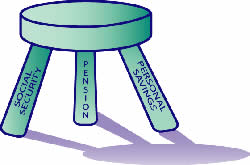
You may have heard the term “three-legged stool”, taken from the idea that a stool needs three legs to maintain balance. (Photographers use tripods, no duopods or quadrapods. Even a four-legged chair will likely wobble.)

Old Three-Legged Stool of Retirement

Traditionally, the components of the three-legged stool of retirement have been presented as Social Security benefits, Pensions, and Personal Savings (401k, IRA, and other assets).

stool
image via Michigan.gov

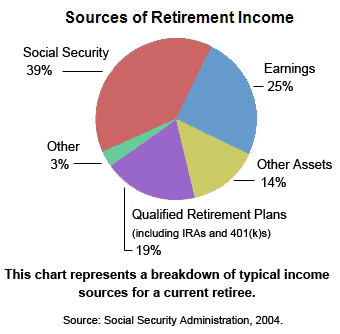
This is partially supported by data from the Social Security Administration:

pie chart
image via Pbs.org

The Qualified Retirement Plans slice combines pensions, 401ks, and IRAs together, making it hard to see the breakdown. The Other Assets include income from other investments like capital gains or dividends from taxable accounts and real estate. We observe that a quarter of all income in retirement is still from working for a paycheck.

Shaping Your Own Retirement Legs

These are just averages, and each of us will have their own path to retirement. If you’re planning on retiring early, you won’t have Social Security yet. For people born after 1960, the full retirement age for benefits is already 67, and expect it to rise even further the younger you are. I think some form of SS will still be around when I’m 70, but who knows.

1. Flexible, reliable, part-time income
We already saw that lots of people over 65 still work. Even though I want financial independence early, I’ve also come to realize that I’ll never stop working. Ask yourself what are you really going to do in retirement? In addition, I think it would be stressful to stare at a big pile of cash and think to myself – “Crap, I hope this lasts for 30+ years!” Maintaining a part-time job and the related skills would help my cashflow, and also ensure that I could return to the workforce if disaster strikes.

I would want a part-time job that could provide some socialization and a sense of improving your community or helping others. Most of my imagined jobs involve teaching, coaching, sporadic technical consulting, or something tourism-related. It can’t be 9-5, and I’d want to be able to take months off at a time. This won’t be easy to find, so I need to start developing more “fun” skills as well as personal relationships now.

2. Personal Savings: Accumulate 30 times annual (non-housing) expenses
Without a pension or Social Security, you’ll need to live off your own savings. If you invest in a balanced portfolio of 60% stocks and 40% bonds, studies have estimated that you can have a “safe withdrawal rates” of about 4% per year. By being a bit more conservative than that, this means accumulating 30 times your annual expenses.

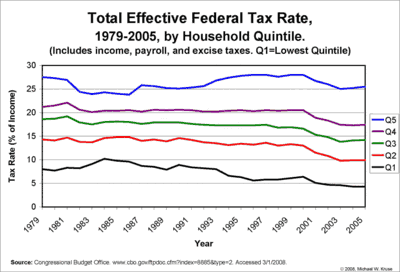
For example, if your annual expenses are $30,000, then you need to save $900,000. This is a very general rule of thumb. Taxes are tricky, but if your income is only $30,000 per year, you won’t be paying very much income tax. Check out the historical effective tax rate over a past 25 year timespan:

For reference in 1995, to be in the bottom 50% (safely in Q1/Q2) your adjusted gross income had to be under $31,000. And this even includes payroll taxes of about 9%, which you won’t have to pay on investment income. The result: very low taxes (possibly under 5%) if you keep your expenses down! Which brings me to…

3. A Paid Off House
I don’t think everyone needs to own a home. However, I happen to enjoy many of the intangibles of owning a home, I love my house and neighborhood, and plan on staying here a while. The cost of this leg can vary widely, from a $1,900 house in Detroit to… where I live, so choose where you want to live carefully. 😉

Financially, owning a home protects you from future inflation and rising rents. You are still subject to property taxes and maintenance costs.

In addition, not having to pay rent means you need less income from savings, reducing your needed nest egg in #2 above. You also pay less taxes. Withdrawing additional money from an IRA, for example, will mean subjecting them to your marginal tax rate, which could be 25% or higher. So to pay $750 in rent, you’d have to withdraw $1,000. Not very efficient.

So there, you have it, my three-legged stool. Yours may be very different – you may like renting, have a pension, own investment property, or have some other sources of income. I still worry about health insurance, but I’m still hopeful that some positive health care reform will occur that will create affordable health insurance for individuals under 65 not covered by an employer group plan.

* You can read more about the last two legs in my related post A Quick & Dirty Plan To Reach Financial Freedom.

Mortgage Interest Tax Deduction on Rental Property

As pointed out by reader Jason, another consideration when evaluating the cashflow potential for a rental property is whether you can deduct the mortgage interest on your taxes. To see what the rules are, I always like to start directly at the source, which meant a stroll through those fun IRS publications.

First, I started with IRS Pub. 936, Home Mortgage Interest Deduction. There is the basic definition of a “qualified” home:

For you to take a home mortgage interest deduction, your debt must be secured by a qualified home. This means your main home or your second home. A home includes a house, condominium, cooperative, mobile home, house trailer, boat, or similar property that has sleeping, cooking, and toilet facilities.

Then there is the question of how much you live in the second home:

Second home rented out. If you have a second home and rent it out part of the year, you also must use it as a home during the year for it to be a qualified home. You must use this home more than 14 days or more than 10% of the number of days during the year that the home is rented at a fair rental, whichever is longer. If you do not use the home long enough, it is considered rental property and not a second home. For information on residential rental property, see Publication 527.

If you live in it enough, it is treated as a “vacation” property and you can deduct the mortgage interest. In general, you are limited to the interest paid on the qualified loan limit of $1,100,000 for “home acquisition debt” combined for both first and second houses.

However, for a full-time rental, we are led to IRS Pub. 527, Residential Rental Property, which states:

Generally, the expenses of renting your property, such as maintenance, insurance, taxes, and interest, can be deducted from your rental income.

Interest expense. You can deduct mortgage interest you pay on your rental property. Chapter 4 of Publication 535 explains mortgage interest in detail.

Okay, now I’m off to IRS Pub. 535, Business Expenses, specifically the section on Interest.

You can generally deduct as a business expense all interest you pay or accrue during the tax year on debts related to your trade or business. Interest relates to your trade or business if you use the proceeds of the loan for a trade or business expense. It does not matter what type of property secures the loan. You can deduct interest on a debt only if you meet all the following requirements.

* You are legally liable for that debt.
* Both you and the lender intend that the debt be repaid.
* You and the lender have a true debtor-creditor relationship.

There are special rules for the capitalization of interest if you actually build the home yourself.

Summary
I am not a tax professional, but from reading the above publications, it appears that mortgage interest on a 100% rental home is not tax-deductible as an itemized deduction as your primary house may be.

However, chances are that it is an eligible expense that can offset your rental income and still reduce your tax burden in a similar manner. If you made $10,000 in annual rental income but paid $8,000 in mortgage interest, and ignoring other factors like depreciation, you’d only owe income taxes on the difference of $2,000. (Dealing with writing-off rental losses is for another post.) The amount paid that lowers your loan principal is not an eligible expense.

As long as you have adequate rental income, this would make the mortgage interest as an expense better than just an itemized deduction, since everyone gets the standard deduction. For 2009, the standard deduction is $5,700 for single filers, and $11,400 for married filing jointly. Only total itemized deductions above that amount would provide added savings.

WaMu Free Checking is now Chase Free Extra Checking

More changes… WaMu bank accounts are gradually being converted into Chase accounts, and customers will have to log in at Chase.com with new usernames. Mine is switching over May 22nd. The popular WaMu Free Checking account becomes the Chase Free Extra Checking account, and keeps a lot of the useful perks. I received another mailed pamphlet from Chase outlining all the details, but I couldn’t find a link online, so I typed out the highlights below.

Benefits

  • No monthly service fee, no minimum balance requirement.
  • No fee for money orders, cashier’s checks and travelers checks.
  • No Chase fee for non-Chase ATM withdrawals.
  • No fee for Domestic Outgoing for Foreign Outgoing Wire Transfers.
  • You will continue to receive your discounted or free check orders when ordered from us.
  • One insufficient funds/Returned Item Fee will be refunded annually. However, the refund will no longer be automatic, you must call in and specifically request it. Also, it will no longer carry over if unused.

Changes

  • The 0.03 Cash Back debit rewards program is discontinued.
  • We may change your account to a Chase Better Banking Checking account when you do not have at least one customer-initiated transaction over the past six monthly statement cycles (which has a $12 monthly fee if minimum balance is not met).

The WaMu Online Savings account will be converted to a Chase Premier Savings account, with the monthly fee “waived at this time”. I could not find any information on the interest rate, but I have a feeling this account will not return to its former high yields.

Added: According to the letter I received, the account numbers, checks, and ATM/debit cards will remain the same and active.

A Quick & Dirty Plan To Reach Financial Freedom

Despite the current financial funk, I still desire financial freedom. The general idea is simple; I need to generate enough income from my assets to pay for my expenses. Here is how I’ve been framing the problem in my mind recently. I’m 30 now, let’s say I want to be “retired” by age 50.

Part 1: Accumulate 30 times annual (non-housing) expenses

There are numerous studies about the “safe withdrawal rate” from a portfolio, and they usually end up at around 3% to 4%. This usually means that with $1,000,000 dollars, you have a high (say 99%) chance of being able to produce $30,000 to $40,000 of income each year plus inflation adjustments for a long period of time (30+ years).

This is the same as saying you need to save 25 to 33 times your annual expenses.. If you’re conservative (or young), I’d go with a higher number, so I picked 30. Multiply your annual expenses by 30. You need that much money to retire. All of these are based on historical numbers, so this is only an estimate.

Right now I’d estimate our annual non-housing expenses at about $24,000 per year ($2,000 per month). Previously I’ve found that we spend about $18,000 per year, but that neglects a few things like health insurance and car deprecation. (Again, health insurance for those that retirement very early and are not healthy might be a bogey.)

$24,000 x 30 = $720,000.

At about $200,000 in non-housing assets right now, that leave me $520k left. Divided by 20 years and assuming no investment return, that would require $25k per year (not inflation-adjusted). At a 3% annual real return, I’d still need to save nearly $20k per year.

Remarks
With this part, you can see the power of frugal living, or the damage done by lifestyle inflation. $500 a month is $6k per year. $6k x 30 = $180,000.

So if I could cut $500 a month in my expenses, I’d need to save $180,000 less. On the other hand, if I grow some bad habits and start spending $500 more a month, I’d need to save $180,000 more. Either way, that’s a big number! This is why I still need to complete my line-by-line examination of expenses.

Part 2: Own my house / Pay off mortgage

I currently have 29 years left on a 30-year fixed mortgage. For us, that would mean another ~$470,000 in mortgage principal, but more when you count in all that interest.

According to this mortgage calculator, if we make one extra monthly payment per year (simulating a bi-weekly acceleration plan), that’d give us about 24 years before we’re done. If I made two extra monthly payments per year, it’d be shaved down to 20 years, which has the house paid off at age 50. Lots of other considerations, but I’m strongly leaning towards it.

Remarks
I know that you could easily roll up “housing” costs into Part 1 above, but I didn’t for a few reasons. For one, housing is one of the few expense areas where you can essentially “buy” all future costs. For example, you can’t pay a lump sum in exchange for all the electricity you’ll consume in your lifetime. Same thing for your grocery bill, or even a car since you’ll have to replace it. But if you own your house, you’ve basically cut out rent forever (just left with maintenance and property taxes). It also reduces the danger of inflation eating up your spending power.

The second reason is lower taxes. Owning your own house not only saves you from have to pay a housing payment, but also keeps you from having to earn the gross income needed to generate that after-tax amount. Ignoring house, I saw above that I only need to generate $24,000 of income per year total. The income taxes on that amount is very, very small. Using current numbers it might be less than 5% overall, with my marginal tax bracket at a mere 10% after taking out the personal exemptions and standard deductions.

But if I need to generate another $24,000 of income to cover housing ($2k per month in rent), then that additional $24k would be taxed at much higher rate of 15%. With state tax, the difference might be another 5%.

Try out this method with your own numbers, and see what happens. When I run the numbers like this, I know that I could retire much earlier if I moved to a cheaper place upon retirement. But is it worth it? It’s all about priorities…

Summary of California’s Upcoming New Tax Hikes

A lot of states are struggling these days, including the Golden State. Even though California already had the top marginal personal income tax rate and highest base sales tax rate in the country, they are getting even higher. According to a legislative study, the following four tax increases will make an average family of four with an annual income of $75,000 pay $963 more a year in taxes. Here’s how it breaks down:

#1 – Sales Tax
Starting April 1st, the base sales tax rate will rise from 7.25% to 8.25%. While this is only one additional penny per dollar, relatively it is a 12% increase in sales taxes. The base rate doesn’t include taxes added by individual cities and counties. For example, the total sales tax rate in San Francisco will now be 9.5%. In some cities it will break 10%.

#2 – State Income Taxes
Personal income taxes would increase across the board by 0.25 percent on taxable income for 2009. The highest bracket is now 10.55%. A single person with more than $47,055 in taxable income will be in a marginal bracket of 9.55%. Remember, this is on top of Federal income taxes.

Examples: This equates to an additional $125 for taxpayers filing jointly with $50,000 in taxable income, $250 for taxpayers filing jointly with $100,000 in taxable income, and $1,250 for taxpayers filing jointly with $500,000 in taxable income.

If California receives $10 billion or more in certain types of assistance from the federal stimulus package, the tax increase would drop by half to 0.125 percent. However, a recent study by the state Department of Finance has found it unlikely that this level will be reached ($2 billion short).

#3 – Annual Vehicle Licensing Fees
These fees will double, to 1.15% of the car’s value each year. On a new car valued at $25,000, the vehicle license fee will be $288. The increased fee is effective on registrations beginning May 19.

#4 – Dependent Tax Credit
This tax credit will be reduced by $210 (for each dependent).

Sources: LA Times, SF Chronicle, Sacramento Bee.