 Sometimes saving money just involves being lucky. I don’t really keep up with mortgage rates anymore, but last week an e-mail subject line just happened to catch my eye that mortgage rates are at “record lows”. I always figured that my 5.125% rate was so low that another refinance or loan modification probably would never be worth it, but it turns out that rates are so low they just might. Here’s a quick snapshot of rates from a Wall Street Journal article on 7/16/10:
The 30-year fixed-rate mortgage averaged 4.57% in the week ended Thursday, unchanged from a week earlier and down from 5.14% a year earlier. Rates on 15-year fixed-rate mortgages were 4.06%, extending the lowest point since Freddie started tracking it in 1991, and down from 4.07% last week and 4.63% a year earlier. […] To obtain the rates, the mortgages required payment of an average 0.7 point. A point is 1% of the mortgage amount, charged as prepaid interest.
has ads now for 4.25% fixed for 30 years and 3.75% for 15 years. As for me, I might be able to get my interest rate below 4.75% and have a “breakeven” period of less than 3 years. I’m awaiting official paperwork. Ask your loan servicer and/or mortgage broker what they can do for you. Can’t hurt to ask!
Meanwhile, I was playing with the Refinance Breakeven calculator over at DinkyTown and found out that there are multiple definitions of “breakeven period”. Before, I simply figured that a refinance would cost X dollars upfront in fees and closing costs, but would save me Y dollars per month. Divide X by Y, and you’d have a breakeven point. For example, if it cost you $2,400 in fees but saved you $100 per month, you’d break even in 24 months. Past that, you’re saving $100 every month. In this case, if you plan to keep your mortgage for longer than 24 months, then refinancing makes sense.
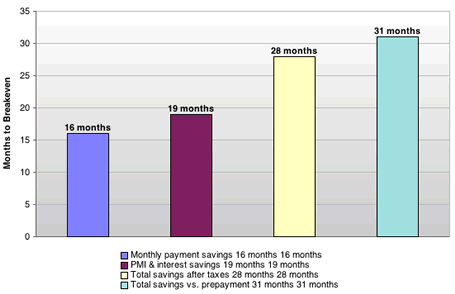
However, there are actually four possible breakeven methods presented:
- Monthly payment savings. The simple formula described above. The number of months it will take for your monthly payment reduction to be greater then your closing costs. Doesn’t take into account that you may be making more monthly payments.
- Interest savings (plus PMI if applicable). The number of months it will take for your interest and PMI savings to exceed your closing costs.
- After-tax interest savings (plus PMI if applicable). The number of months it will take for the after-tax interest and PMI savings to exceed your closing costs. This takes into account that the interest and PMI being paid may be tax-deductible, while the closing costs are paid with after-tax money only. Depends on your income tax rate.
- Total after-tax interest savings vs. prepayment. This is the most conservative breakeven measure, and will result in the longest breakeven time period. This method considers that you could take the amount spent on refi closing costs and instead make a large prepayment on your existing mortgage. Then, it calculates the number of months it will take for the after-tax interest and PMI savings to exceed both the closing costs and any interest savings from prepaying your mortgage.
Which method is best?
First, I should add that you could complicate things even further by assuming any money not paid out immediately could earn a rate of return (savings accounts, CD, etc.) But that would make my head explode, so I won’t. The calculator suggests that methods #2 and #3 are most commonly accepted, and I would tend to agree. If you are sure that your interest is 100% tax-deductible (you exceed the standard deduction provided by the IRS without it), then you should use the value from #3. Otherwise, something in between #2 and #3 is probably the most accurate.
Method #4 compares with another theoretical situation that only applies if you really want to make a lump-sum prepayment and keep the higher monthly mortgage payment over a shorter mortgage term. For many people, the goal is to lower the monthly outlay and improve cashflow as well as save money on interest.
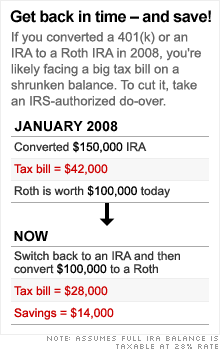
 So, you’ve done your research, read the articles, crunched the numbers, and you want to convert your Traditional IRA held at Vanguard into a Roth IRA. But, how do you actually do it at Vanguard.com? There is no explicit “Convert” button or link to run this conversion. After some fumbling around, I managed to figure it out. But why not just share it here in mind-numbing detail and hopefully save folks some time.

 401k company matches are great ways to boost your retirement savings, but sometimes you have to be careful in order to capture it all. My wife’s company offers a 3% match, but only up to 3% of whatever you contributed that pay period. What if you contribute less than 3% for some period, and then a much larger amount a later period, with the overall total being much more than 3%? With some plans, you are simply out of luck and have missed out on potential money. Other plans offer what is called a “catch-up” or “true-up” contribution. Do you know which one you have?
 This is how I did my extension last year. Just sign up with TaxACT and e-file your extension for free through them. It’s quick. It’s easy.
 This one’s a little harder to find, but here are some step-by-step instructions. Go to the Free File Fillable Forms site (say that 5 times fast) and click on “Start Free File Fillable Forms”. Click “Sign-in” on the top left, and create a new account.

 The Best Credit Card Bonus Offers – 2025
 Big List of Free Stocks from Brokerage Apps
 Best Interest Rates on Cash - 2025
 Free Credit Scores x 3 + Free Credit Monitoring
 Best No Fee 0% APR Balance Transfer Offers
 Little-Known Cellular Data Plans That Can Save Big Money
 How To Haggle Your Cable or Direct TV Bill
 Big List of Free Consumer Data Reports (Credit, Rent, Work)