A Comparison Of Home Flipping Shows: Flip This House, Flip That House, and The Property Ladder

Ever since starting the house search and finding some real dumps with potential, I’ve been really into those home-flipping shows on TV. I’m not interested in any quick buy-fix-sells nor do I have illusions of making $50,000 in a month, but I do like to see the ways people can improve a neglected house and how much it roughly costs. I’m not sure if I’m alone here with my secret obsession, but after two months of having my TiVo packed full of episodes, here is my personal summary of the differences between three popular shows:

Flip This House on the A&E Channel focuses on the real estate flips of experienced investor teams. They pretty much know that they are doing, so I almost just sit back and take notes. My favorite team by far is Trademark Properties, with leader Richard Davis and trusty sidekick Ginger. They always seem very smart and professional in all their dealings. Apparently, Davis has a lawsuit against A&E over alleged non-payment, and so has moved to a new show on the TLC channel called The Real Estate Pros. I’ll definitely follow them there.

Then there are the temperamental Montelongo brothers. I thought they were entertaining in the earlier episodes, but in the recent ones they just seem to be faking drama (and doing it poorly). They wouldn’t be the first ones, as apparently another Flip This House team was accused of faking episodes and stealing money from other investors, resulting in all episodes involving them being pulled off the air.

Creative name, huh? TLC’s Flip That House usually has episodes involving more novice flippers, often first-timers. Surprisingly, most of the flippers seem to stay on track, and although there are some stumbles here and there, they usually come out only a bit behind schedule with the house looking beautiful. What I don’t like about this show is they always show “projected profit”, as if the flippers always get their full asking price for their house. Overall, I like this show, but it does seems to try a little too hard to make the flippers look good.

Are you tired of seeing all these greedy flippers? Do you want to see some people crash and burn? Then The Property Ladder (TLC) is the show for you! Composed almost completely of first-time flippers, this show isn’t afraid to reveal the ugly side of flipping. Hideous remodels, poorly-managed contractors, going insanely over-budget, fighting between partners, you name it. They give you status updates like “The house sat on the market for 10 weeks with not a single bid. Bob is now looking for renters.” Think of it as a show about what not do to.

There you have it, from stories of seasoned pros to the completely clueless.

Why Paying Down Your Mortgage Early Can Be A Smart Investment

Still no house yet. But I have been reading about mortgages, and one common debate amongst mortgage holders is whether to send in extra money towards the principal in addition to the required monthly payments. Usually, the argument evolves into these two opposing views:

No, you shouldn’t pay extra because:

If you put that money in stocks instead, you would most likely get a higher return on your money in the long term. Mathematically, paying down a mortgage is like leaving money on the table.

Yes, you should pay it down because:

Stock market returns aren’t guaranteed, whereas paying down the mortgage is guaranteed savings. Debt is a burden, and it’s hard to put a price tag on the psychological benefit of owning your house free and clear.

Now, I understand both of these views, and in the big picture, I really think if this is what you’re worrying about then you’re already ahead of the game. You might even think you already know which view I personally lean towards. But what if there was another perspective that satisfied both sides?

What happens when you pay extra towards your mortgage?
With a mortgage, your monthly payments are amortized, which means each one includes a portion that goes to pay interest and a portion to pay down your remaining loan balance, or the principal. If you make an extra payment towards principal, then this in turn directly decreases the amount of interest you’ll be paying in the future.

So if you pay $1,000 towards your mortgage with an interest rate of 6%, then you’re saving $60 of interest that you would have otherwise had to pay every single year for the rest of your mortgage term.

Put differently, it’s like you’re earning an after-tax return of 6% every year on your money.

But wait, what about the tax benefits of mortgage interest?
Yes, mortgage interest is tax-deductible, but you have to temper this with a few realizations:

  1. Everyone already gets the standard deduction, which in 2007 is $5,350 for singles, and $10,700 for married folks. Only the amount that your itemized deductions exceed this amount actually saves you money.
  2. The amount of interest you pay on your mortgage decreases every year, so your tax benefit will decrease as well over time.

For example, let’s say you are a married couple with a $250,000 mortgage loan balance for 30 years at a fixed 6% rate, and in the 25% income tax bracket. $250,000 x 6% is only about $15,000 of interest paid in the first year. Subtract out the standard deduction of $10,700, and your additional deduction is only $4,300. So you’re only saving 25% of $4,300 and not the whole $15,000. This means your 6% interest rate only goes down to the equivalent of about 5.6%. In addition, according to the standard amortization schedule your annual interest paid will go down to less than $11,000 in year 15. So after 10-15 years, your mortgage deduction will be less than the standard deduction, leaving you with possibly no benefit at all.

Now, if you have a large mortgage or have lots of other itemized deductions, then your tax benefits may be much more significant. In this case, your equivalent interest rate may be extraordinarily low. But for many homeowners, it’s not as large as they might think. (If you have a ton of other itemized deductions, also be wary of the AMT.)

For this example, you could be conservative and say that paying extra towards your mortgage is only earns about a 5.5% annual after-tax return for the rest of the scheduled term of the loan.

A fixed rate of return, every year, for a long time. Hmmm… that sounds like a bond! In comparison the 30-year Treasury bond is currently yielding only 4.88%. After a 25% federal tax, that return is only 3.66%! I choose Treasury bonds because they also contain essentially zero risk of default.

In other words, paying down your mortgage can very similar to holding an attractively-priced long-term bond. (If you have a rock-bottom rate, it could also be an unattractive bond.) So maybe that’s how we should treat it. Just like you don’t compare stocks directly to bonds because they have different risk/reward relationships, perhaps we shouldn’t compare paying down a mortgage to stocks either.

Right now, I currently hold about 10% bonds in my retirement investment portfolio. My prospective interest rate is around 6% if I get a mortgage. I could simply decrease my position in bond mutual funds and put that money instead towards paying extra towards a mortgage. When looking solely at my mutual fund accounts, this would result in my percentage of stocks increasing. This way, I can potentially get the best of both worlds:

  • I’m improving my overall investment portfolio. I am essentially buying a bond that brings me a return higher than what is otherwise available, perhaps by up to 1-2 percentage points. I do lose some liquidity as I can’t get my money out without taking a home equity line of credit and paying additional fees. But as long as it’s not my whole bond allocation, I can still rebalance as needed. My intended bond allocation will only increase as I get older, in any case.
  • I also pay my house off earlier, complete with all the happy fuzzy feelings attached. 😀

What if you don’t own any bonds? Well, if you’re the type of person who’s 100% stocks, then you’re probably so confident in the markets that you wouldn’t want to pay down your mortgage early anyhow. If you do want to pay it down, then consider it a small allocation to bonds that will lower the overall volatility of your portfolio.

Now, this doesn’t mean that paying down a mortgage should be a higher priority than things like maxing out your IRA, paying down higher-interest debt, or even an emergency fund. But it does provide me a way to pay down my future mortgage without having to worry that I am losing money somewhere else.

Housing Bubble Talk: The Real Estate Cycle Is Moving Along Nicely

I couldn’t help but catch some of the news coverage about this week’s continuing fallout from subprime loans, the resulting stock market wobbles, and the overall tightening of the credit market. CNBC’s ratings must be through the roof. Then tonight I stumbled upon a post on the housing bubble blog Patrick.net about it being a point of inflexion:

I believe we are now at what will be seen as the inflexion point. It took a long time to get here, but the housing bubble is finally recognized as a pass? concept. The real debate now is how much and how long of a correction.

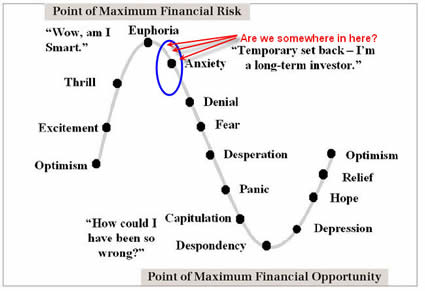
This reminded me of the graph below, which I brought up when I asked If Real Estate Prices Are Cyclic, Where Are We Now?. This was back on January 4th, 2007.

altext

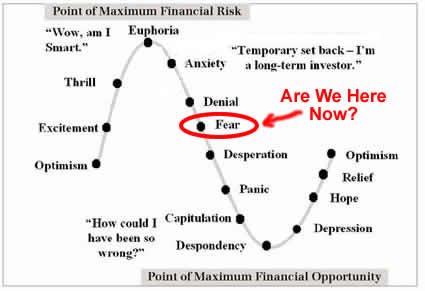
At that time, I guessed we were somewhere around Anxiety. Now, seven months later, where are we now? I’d say we’ve moved past both Anxiety and Denial already, and we are solidly at Fear. Mathematically, the inflexion point (aka inflection point) is where the second derivative changes sign. Guess where the inflexion point on such a sinusoidal graph is?

altext

As this CNN Money article about tighter lending standard suggest, I may be well positioned to benefit from this progression:

In addition, tightened lending standards stemming from the subprime crisis likely mean fewer buyers, pushing down home prices. The one catch is this: You’ve got to be a buyer with good credit, a low debt to income ratio, a healthy down payment, verifiable income, and looking to finance less than $417,000 (the cutoff for so-called jumbo loans).

Bring on the Desperation! 😉

Saving For A Home On Your Own: Learning From Those Who Did It Successfuly

How about some helpful investigative reporting from the media this time? The New York Times article Every Penny Counts profiles six New-Yorks who managed to buy their home without the benefit of rich relatives or Wall Street bonuses. While the stories weren’t surprising, I still found them to be very reassuring and even inspiring. In addition, I tried to pick out a few useful themes:

Make The Home A Priority
There’s saying you want a home, and then there’s taking action to get that home. One of the new homeowners put it bluntly:

?If you want to own a place, you have to do everything to own a place and everything else comes second.?

Along those lines, every single person profiled changed their lifestyles to make saving up over $20,000-$100,000 a reality. While it wasn’t easy, each person did it their own way. Take Pablo Ag?ero and wife Janey Lee:

They gave up smoking to cut costs, they stopped meeting friends after work for beers, they didn?t buy new clothes, and they stashed away tax refunds and as much of their earnings as possible. Whenever they wanted to buy drinks, gadgets or cookware, they asked each other: ?Do I want an iPod or a house? Do I want a latte or a house??

Or Amy Wegenaar:

So she went into savings overdrive: she went grocery shopping only with a list and cut out luxuries like expensive juices. When she went out with friends, she ordered the happy-hour drink specials and often chose Mexican food so they could munch on free chips and split a cheap entree. She shopped the sales racks at Urban Outfitters and sewed dresses from discounted fabric she bought on the Lower East Side.

Getting Support From Your Family and Friends
Obi Onyejekwe actually made friends with co-workers who also wanted apartments of their own:

They chose to eat out at places with entrees that never cost more than $15 and went to events like the Warm Up dance parties at P.S. 1, where the only thing they bought was beer. ?A lot of pressure to spend and splurge wasn?t around because everybody was saving to buy real estate,? he said.

It worked: He and 8 friends now own homes that cost $320,000 to $550,000.

On top of this, I say share your goals with your friends. Tell them why you’d rather watch the game at home, or why you can’t fly out to Vegas. They should understand, and might even share the same dreams or at least wouldn’t mind saving a few bucks themselves.

Don’t forget your family either, all I ever hear is “Did you find a house yet?” I think being in this together with my wife has made the process a hundred times easier than if it was just me.

Exploring Condo Living: How Do I Find A Good Homeowners Association?

Where we live, most first-time homebuyers purchase condominiums or townhouses. (I haven’t seen any co-ops?) Besides simply finding a unit that you like, I’ve been worried about having to deal with homeowners associations, or HOAs. There are plenty of horror stories about evil HOAs out there, as outlined by this Yahoo Finance article 10 Things a Homeowners Association Won’t Tell You. They are often cast as petty and heavy with politics:

When one Virginia homeowner asked for permission to hang Christmas tree lights in 1992, the board didn’t like the idea but didn’t know how to prevent it. “We struggled with this one,” says lawyer Benny Kass, who represented the association. “But we finally concluded that the restriction against hanging lights was valid because you were pounding nails into the wood, and that was a fire hazard.” Ho-ho-ho.

…and they’re not afraid to sue you over it:

Experts estimate that in California, 75% of the homeowners associations are embroiled in a legal tangle of some kind. Chicago attorney Mark Pearlstein, who represents associations, figures that 60% of all condo boards and homeowners associations in Illinois are involved in some kind of legal suit.

…or they could simply be ineptly run:

Ron Williams, an engineer with R.J. Moore, a consulting company that specializes in reserve accounting, once worked with a Northern Virginia condominium that had a paltry $100,000 set aside. “Closer to $1.25 million would have been considered healthy,” says Williams. When power-plant equipment gave out in early 1994, the association didn’t have the $400,000 needed to replace it. The solution: A $2,400 special assessment to each of the 170 unit owners and a 22% increase in monthly dues.

It’s almost enough to make me stop looking at them at all! Instead, I’ve tried to make a list of things to try and at least screen out HOAs with obvious signs of problems:

Try to get a copy of the homeowners association agreement and recent meeting minutes. I figure if I am serious about buying a place, I would want to read about all the things I can’t do like replace the flooring, how many units are allowed to be rented out… or if I can put up Christmas lights! Also, I’d like to see in writing exactly what my fees are covering – usually water, sewer, common areas, and basic cable TV. If possible, have an attorney read through it. (It helps if you have friends that are lawyers!)

By reading about recent meetings, I can hopefully get an idea of what issues are currently being debated, and how petty they are. I’m not sure how easy this will be though – whenever I ask the listing agent about HOA-specifics, they always seem off-balance and say something about “Oh, the last owners loved living here, I’m sure they are wonderful”.

Learn about the reserve fund to avoid big assessments. One common nightmare would be to move in, only to be hit with a big assessment for fixing the pool that you’ve never even used yet. I’d want to make sure the reserve is large enough to handle expected and unexpected future maintenance costs. A friend told me you can get a list of all previous assessments if you ask, as well as any planned future assessments. Part of this is also noting the overall age of the building, as well as the existing condition of all the common areas. From the Yahoo article:

When it comes to checking up on a reserve fund, there are two good rules of thumb. First, about 20% to 25% of your dues should go toward the reserve fund, says Robert Nordlund, president of Association Reserves, a California company that specializes in reserve accounting. Second, there should be a long-term schedule for the reserve fund in the annual budget, including a projection of upcoming expenses for each common-area item: elevator repairs, painting, pool maintenance and so on. Reserve accountants suggest that the account should contain no less than 70% of the projected reserve budget. If the account is 30% funded or less, you can expect to be hit with some big assessments down the road.

Try to talk to an existing owner that’s not the seller. Usually there is someone outside playing with their kids or walking the dog. I don’t mind striking up a conversation with a potential neighbor to try and get an insider’s view. On top of HOA questions, I’d ask things like how long they’ve lived here, if it’s been getting better or worse, how good the soundproofing between units is, and if it’s a family-oriented complex.

Ask your buyer’s agent to do some research as well. You have a buyer’s agent, right? Ask if he/she has clients that either live there now or have sold a unit there in the past. If not, have them do some digging and ask their co-agents.

Are you a condo owner? I’d love to hear your experiences and tips on dealing with HOAs specifically.

Open Houses From A Buyer’s Perspective

We did an Sunday Open House run yesterday, checking out some of the the different neighborhoods available to us. Some observations:

Beware of the sign-in sheets. Address? Phone number? E-mail? No way. I’ve since realized that Open Houses are actually more for listing agents to gain new clients than anything else. Prospective buyers walk in, put down their personal information, and of course… would you like to sit down for a free consultation? Also, if you have a buyer’s agent and don’t put that down on the sheet, the seller’s agent can argue for the entire commission. All in all, it appears to offer nothing for the buyer.

Stop with the “creative” listing photos. I hate when you see a picture of a lake or something on the MLS listing and it turns out you had to stand on the roof and lean over 45 degrees in order to see that view. If it’s not available from inside the house and without gymnastic talent, then it doesn’t count.

Staging actually does work. Some of the houses that have been obviously “staged”, with zero clutter, nice place settings with candles on the dining table, neatly folded towels in the bathroom, and flowers everywhere. I thought I would hate it, but I actually quite liked it.

Too much personal stuff is bad. Then there are the people with the huge collection of dolls or nude statues lining the halls. I’m sorry, but your stuffed dogs are distracting and really hurting my own ability to visualize living in your house.

What, no cookies? For some reason, I read somewhere that you should always have something baking at an Open House. But out of the 10 houses we saw, I got no cookie action. So sad…

Despite some gripes, I do like the idea of Open Houses. It’s low-stress and is much more definitive than just pictures.

14 Free Brochures To Help People Understand Home Mortgage Loans

It seems that many people have strong opinions about the subprime mortgage fallout. One common thread was that people really do need to get better educated about the mortgage lending process. What wasn’t agreed upon was who should shoulder that responsibility – the lender, the borrower, or the government? My view was that better transparency is in order, and the FTC concurs:

The Federal Trade Commission today released a Bureau of Economics report presenting the results of a study that found that mortgage disclosure forms fail to convey key mortgage costs and terms to many consumers. The study also concluded that better disclosures can be created to help consumers understand the costs and terms of mortgages to enable them to make informed decisions about mortgage products.

?Mortgage disclosures designed more than 30 years ago can be confusing even for simple loans, and they do not address the variety and complexity of today?s mortgage products,? FTC Chairman Deborah Platt Majoras said. ?Although mortgage disclosures, alone, will not prevent deceptive lending practices, consumers who understand mortgage terms and choices are less likely to fall victim to these practices.?

Even if you disagree, the fact is that the government already does have some helpful information out there, and hopefully if we spread the word around the tax money already spent on making them won’t be wasted. 🙂 I sure wish Ms. Williams read a couple of these beforehand.

First up is the U.S. Department of Housing and Urban Development, whose mission is to “increase homeownership, support community development and increase access to affordable housing free from discrimination.” They have a whole section on Buying A Home, and even a brochure on finding the best mortgage [pdf]. Inside, it shows you how to compare all the costs involved in obtaining a mortgage. There is even a helpful Mortgage Shopping Worksheet included to help you out.

Shopping around for a home loan or mortgage will help you to get the best financing deal. A mortgage? whether it?s a home purchase, a refinancing, or a home equity loan?is a product, just like a car, so the price and terms may be negotiable. […] Shopping, comparing, and negotiating may save you thousands of dollars.

Next, you have a Guide to Mortgage Products [pdf] from the Federal Reserve Bank of Boston. It’s presented through a true/false question-and-answer format which makes it very digestible, and has a nice glossary of lending terms at the end.

What you should ask the lender:
? Which of your products offers the lowest interest rate?
? Will my interest rate be fixed or variable (change periodically)?
? If the interest rate can change, when will it change and how high or low can it go?
? If the lender offers an introductory or ?teaser? rate, ask, When does the rate expire and how will the new rate change my monthly payment amount?
? If the rate expires, what will the new rate be, and will it be fixed or variable?

Finally, check out these 12 others from the Federal Citizen Information Center:

– A Consumer?s Guide to Mortgage Lock-Ins
– A Consumer?s Guide to Mortgage Refinancing
– Buying Your Home: Settlement Costs and Helpful Information
– Consumer Handbook on Adjustable Rate Mortgages
– Guide to Single Family Home Mortgage Insurance
– Home Buyer?s Vocabulary
– Home Mortgages: Understanding the Process and Your Rights to Fair Lending
– How to Buy a Home with a Low Down Payment
– How to Dispute Credit Report Errors
– The HUD Home Buying Guide
– When Your Home Is on the Line

Subprime Mortgage Troubles Caused By Both Bad Lenders, and Bad Borrowers

I’ve been seeing a lot of media coverage on the increase in foreclosures recently. It’s clear that there have been examples of predatory and misleading lending practices, as well as examples of people showing poor financial judgment, although most articles seem to focus on the former. But I couldn’t help finding this Wall Street Journal article ‘Subprime’ Aftermath: Losing the Family Home to be almost amusing. If it was trying to illustrate how sub-prime lenders were evil, it did a really bad job.

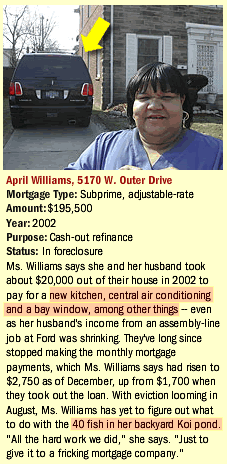
Take Ms. April Williams, who is the main character interviewed for this story and also featured in the box to the right.

“This has stripped us of our whole pride,” says April Williams, 47 years old, who has until August to pay off her mortgage or vacate the two-story Colonial at 5170, where she and her husband have lived for 11 years. “There’s going to be no people left in Detroit if they keep doing this to them.”

They did this to them? Let’s see here – they have an unstable job, but still decide to purchase stainless-steel appliances, custom tile, a new bay window, central air-conditioning, a backyard koi pond… and is that a $50,000 Lincoln Navigator luxury SUV parked in her driveway??

For this specific situation, I feel like both sides are in many ways getting their just desserts. Borrowers like Ms. Williams were greedy, bought more toys than they could afford, and now have to deal with the penalties. Their lenders were also greedy in extending them so much undeserved credit, and I’m sure will be losing money in the event of a foreclosure.

As for the big picture, I have mixed feelings. The capitalistic pro-free markets side of me thinks the system will fix itself. Lenders who got hit with all these defaults will tighten borrowing standards accordingly to maintain profits, while continuing competition will keep them honest. A bail-out would just create a bigger mess of things.

At the same time, I do think there should be regulations that require more simplicity and transparency in mortgage lending and real estate transactions. Everyone I talk to says that they are faced with 6 inches of paperwork when closing on a new home, and none of them fully understands it all. Everybody says “just sign”. There could be a clause that gives up your first-born child for $19.95 and you wouldn’t know it in all that legalese.

Rising Mortgage Interest Rates: Good or Bad For Potential Home Buyers?

The hot real estate news this week is that interest rates on mortgage loans rose abruptly, thanks to some international happenings influencing Treasury rates here. According to this NY Times article, the national average for the 30-year fixed-rate mortgage jumped to 6.74 percent yesterday. At the beginning of the year, the average was only 6.18 percent.

As a potential homebuyer, my question is, will this be make homes more or less affordable? On one hand, rising interest rates will mean a bigger monthly payments for the same loan amount. But on the other, such higher payments may also start pushing home prices downwards. I’m sure the answer to this question is extremely complex, but I started to run some simple scenarios anyways.

Effect of Interest Rates on Monthly Payments
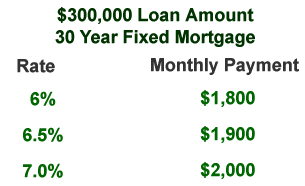
Here what happens when the rates change on a $300,000 loan:

altext

As a rough estimate, when the interest rates rise by 1%, the mortgage payment rises by 11%. (Used the calculators at Dinkytown.)

Effect of Interest Rates on Affordability
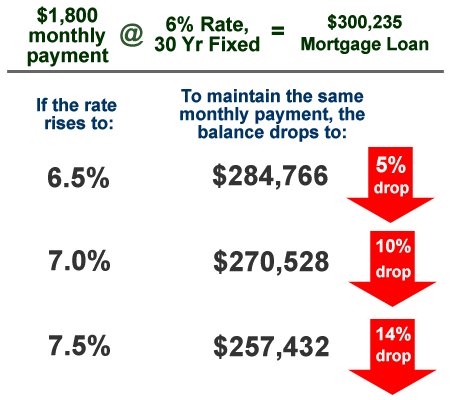
For better or worse, lenders determine how much house you can afford by figuring out a maximum monthly payment based on your income. (I’ve written before about how these lending ratios can vary.) So if you keep the same maximum payment and the rates rise, then you can only afford a smaller loan amount. Here are some numbers starting with the previous example of a $300,000 loan.

altext

So? Good or Bad?
I’m just using loan balances here, so I’m ignoring the dampening effect of house downpayments. And again, actual housing prices don’t fluctuate according to such simple rules. Maybe housing prices won’t drop enough to counter the higher payments from future interest rate hikes.

Still, one thing is for sure – people who have been shopping for homes may not be able to afford what they thought they could or maybe even were already pre-approved for. Rising interest rates can also affect the housing market in other indirect ways. For example, when people with adjustable-rate mortgage try to refinance to a lower fixed rate, they’ll either be rejected or still be faced with a much bigger mortgage payment. This may lead to more foreclosures and lower prices. At least I selfishly hope so…

CNBC’s The Millionaire Inside: Battle Of The Get-Rich Guru Soundbites

altext

Is it just me, or is CNBC TV becoming the financial network for those with 18-second attention spans? (Not that I’m not in their target audience!) Last night, I happened to catch their new series called The Millionaire Inside, which is supposed to bring together today’s “top money mentors” and share their secrets to success. The first episode, Your Guide To Wealth, included the following guests:

Even though I’ve never even heard of the last two, I actually had some hopes for this show… but after watching it I was completely underwhelmed. It was 30 minutes of each guru taking turns rehashing their same, old, vague sound-bites as to how to become a millionaire. In fact, the only amusing part was when Phil Town bashed real estate as a stupid investment compared to stocks, and the real estate folks started to get whipped in a tizzy. Here’s are the rest of my episode notes:

David Bach says:
– You can’t get rich with a budget. (How helpful!)
– Pay yourself first, make it automaticTM
– Buy a home as soon as possible, don’t rent.

Phil Town says:
– 15% annual return in stocks can be achieved with 15 minutes of research a week.
– Buy companies you know, when they are “on sale”.
– Rule #1 is “Don’t lose money”
– Don’t buy real estate, buy REITs instead

Loral Langemeier says:
– Be your own boss
– Make your own “cash machine” by starting your own business
– It’s okay to straddle, or keep your own job for a while.

Barbara Corcoran says:
– The shortcut to wealth is real estate
– Now is the perfect time to buy real estate, when everyone is unsure
– Set a goal to buy your 1st investment property in 6 months

Motivational? A little bit. Good advice? Some of it is, some of it is highly questionable. Vague? Nebulous? Oversimplified? YES.

Maybe the next few episodes will actually provide something actually practical or actionable, but I’m not holding my breath. If you don’t get CNBC, you can also download it for free on iTunes (search for “Millionaire Inside” or try this link.).

Pay Your Mortgage On Credit Cards, Buyer’s Agent Rebates Are Not Taxable, Japan’s Real Estate Bubble

Buyer’s Agent Rebates Are Not Taxable
It struck me that the buyer’s agent rebates I am seeking may be taxable income. That would stink. But it seems that Redfin, another company that does rebates in selected areas, received a private letter ruling from the IRS that states that such rebates are not considered income. 1099s are not submitted, and nothing is reported to the IRS.

Japan’s Real Estate Bubble
Got Bubble? I stumbled upon this article comparing the Japanese real estate bubble with the situation in the US. Did you know that residential real estate in Tokyo dropped for 17 straight years? Definitely will be reading more about this.

Pay Your Mortgage On Credit Cards
It had to happen one day. Although there are some hoops to jump through (you can’t be sub-prime) and it’s only available through specific lenders, American Express is letting people pay their mortgages with a credit card. There’s a $395 initial fee paid at closing, but the potential rewards might let you break even after only a few years.

Finding A Home Buyer’s Agent: Commission Rebates, Interview Questions

We know that it is important to find a good buyer’s agent that listens to our needs, will help us negotiate with sellers, and basically guide us through the entire buying process. On the other hand, we are very comfortable sifting through the MLS listings online, have lived in the area already for many years, and can do much of the research ourselves.

So what was our next move? Tired of working of word-of-mouth, we decided to narrow things down a bit another way. Typically a buyer’s agent gets 3% of the sales price of the home, paid by the seller. But in 40 states, it is legal and increasingly common for the buyer’s agent to rebate you back a portion of this commission. In a slowing market, there can be a glut of agents thirsty for your business. Some say agents that are willing to rebate aren’t as good as full-price agents, which may be true on average, but I don’t see how paying full-price guarantees a good agent either.

Instead of haggling with them directly, I decided to try a site called HungryAgents, which is almost like a reverse-auction for buyer’s agents. Here’s the process if you’re a buyer:

  1. You fill in your desired neighborhood, type of property, price range, and expected time of purchase.
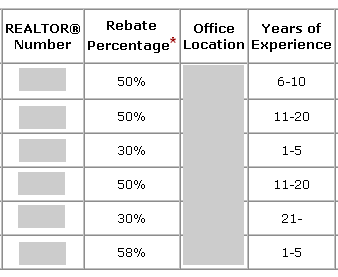
  2. Agents will send you the percentage of their commission they are willing to rebate you, as well as possibly a short bio. You might just get to see their years of experience, which isn’t too helpful. However, they do not get your e-mail or phone number so they can’t harass you.
  3. You get to look at the offers, and then choose who you allow to contact you. You are not bound by anything at all. You can interview the agents you like, and go with one of them or just walk away completely.

Here are the results we got after only 24 hours. Up to 58% off – a discount of 1.74% of the sale price. This would amount to $8,700 on a $500,000 home… not too shabby. We’re going to contact the three people who agreed to 50% off and interview each of them one at a time.

altext

Another site is BuySide Realty, which rebates 75% of the commission it receives as the buyer?s agent. However, they only provide the bare minimum of services for their 25%. A BuySide agent will not show you houses or send you pertinent listings. I can’t tell if someone will even be present at closing, it looks like everything is done remotely. This is too DIY for me, but might work for an experienced buyer.

Now I ask for your suggestions: What kind of questions should I ask the Realtors to see which one to go with?

* Rebates are not allowed in Alaska, Iowa, Kansas, Louisiana, Mississippi, Missouri, New Jersey, Oklahoma, and Oregon.