In Defense Of Buying: Our Housing Situation Explained

credit: bestridehome.comI’m probably going to be writing a good bit about our house buying process in the upcoming months, and wanted to clarify our position a bit. Of course, you are still free to disagree with me afterwards 😉

Right now, we’re just looking. So far it’s just idle online surfing from afar on various MLS listing sites and on Craigslist. Before we buy, we have a lot of research to do. We want to get a better idea of neighborhoods, school districts, average lot sizes, specific neighborhood characteristics, traffic, and long-term growth prospects. In fact, we are going to be renting on a month-to-month basis after the move, it’s already been set up. We are in no rush to buy a house, and plan to be both patient and discerning.

I do think that housing is overpriced in many areas. I’ve seen and written about the inflation-adjusted price charts, read various bubbleobsessed sites, detailed how they can be a horrible investment, and calculated the crazy median price-to-income ratios of many cities. And I’ll continue to digest all the information I can.

But I’m also willing to buy if the deal is right. If we find a house in a neighborhood we like, on a bigger lot, a little beat-up perhaps, at a price that is below average for the area, then yes, we may buy the house.

Why? Going back on an old saying about the stock market, it’s not timing the market, it’s time in the market. If we were unsure if we were going to stay 3, 5, or even 7 years here, we wouldn’t buy. This is the exact reason we didn’t buy three years ago, even though we probably could have profited nearly $100,000 by now. Is the housing market going to drop 20% next year? Stay stagnant for a decade with rising inflation? If we wait, when is it too early to buy back in? Too late? I don’t know, and I don’t care. I’ll buy when I find what I like at a price that I’m willing to pay. It may take two months… or two years.

Now here is where you’re going to have to choose whether or not to believe me. We plan on owning this house… forever. This may seem unrealistic given that the average person moves within 7 years, but the average person also doesn’t save over 40% of their after-tax income. We know what we want. This upcoming move has been the culmination of years of waiting and careful planning. I won’t say that there is no emotion to this purchase; the idea of owning a house that we can pour some sweat into, learn some remodeling skills, and make your own is one of the best intangible benefits of owning I can think of. At the same time, we weren’t going to move back until we could afford a house on just one income. And we can now.

All this being said, this is an explanation, not a recommendation. Whether to buy a house is a decision every family has to make for themselves. Either way, I’ll be making plenty of updates along the way so stay tuned!

Gathering Local Statistics About A Housing Market

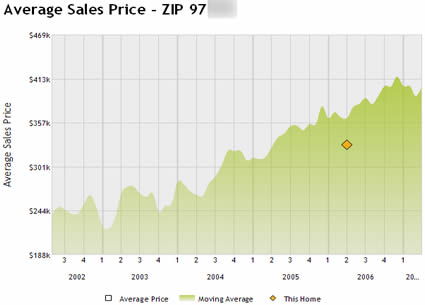
We’re still casually browsing for houses long-distance, and have been using many online tools to help gauge the market. At the house value site Cyberhomes.com, we also found that it offered a lot of good statistics at the local level. This is probably available elsewhere too, but it’s presented very clearly here. They offer charts such as:

  • By Zip Code – Average sales price over time, Sales price vs. living area, Sales count by price range
  • By Market – Average price over time, Sales volume over time, Sales price per square foot
  • Market Fundamentals – Median sales price, Unemployment rate , Housing permits, Buy/sell indicators
  • Market Heat Maps – View geographical variations in housing price, house price changes, and housing density on a color-coded heat maps

Just type in an address, click on View Details, and scroll down to the Charts & Graphs section. You can even zoom in on a specific time range. Here are four sample charts for my old house in Portland, Oregon:

altext

Up, up, and away! A little stalling recently, though…
[Read more…]

How Many Square Feet Should Our Home Have?

image credit:  governing.typepad.com

Housing bubble concerns aside, we’re starting to look at some homes on the internet to get an idea of what prices are like right now. One thing we need to decide is what size of place to look at. I was going to title this post “How big a house do we really need?”, but I realized that too often the word “need” is used when we really mean “will be satisfied with as the spoiled people that we are”. 🙂

I mean, I spent the majority of my childhood living in an 800 sq. ft. apartment that is smaller than where we live now with half the people. And now I’m complaining about clutter! What happened?

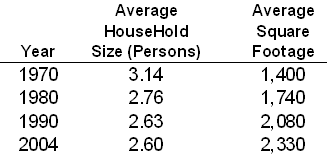
There’s also been some rumblings about the backlash against so-called McMansions, so I decided to look up some stats on average home sizes versus the average number of people in the household. The results were very surprising to me:

altext
Source: U.S. Census Bureau

So from 1970 to 2004, the average household shrunk by 27%, but the average square footage grew by 66%. (Using median numbers gave similar results.) Now numbers can be misleading, but just by looking at the layout of older houses, people really do seem to expect more space now.

Right now it’s just the two of us. Kids are a big unknown, it could be a couple years, it could be more. Hard to predict. Our parents are also hinting that we should have an extra guest room too (ahem). Initially, we are looking at detached homes of about 1,500 square feet, which usually results in a kitchen, one living room, one dining area, 3 bedrooms and 2 baths. No formal dining rooms, family rooms, or other such extras. Since I want one room to be a home office, that leaves one bedroom for us and one flexible bedroom that could be a guest room or for children someday. In the future, I could conceivable make the home office convert to a guest room at night

We know the “average” person moves in less than 7 years, but all of our siblings have settled down in their first homes. And the whole reason we are moving is to be near family, so this home might just last us a very long time. Still, we could go smaller and get a 2-bedroom condo for now. This would save some money now, but we’d have to move again later.

It’s a tough decision! Homeowners: How did you decide how much space you wanted to buy? Was it limited to how much you could afford, what was available in the neighborhood you like, what your friends had, or other considerations? Did you buy what you need right now, or did you look ahead to the future?

Got Good Credit? Rent It Out For Cash!

You have bad credit. You want to buy a house. Why bother with such old-fashioned ideas like paying off debts and slowly building back your credit? You want that McMansion now! All those other sub-prime defaults are just crimping your style. Well, now you can simply buy good credit! Or more accurately, rent it.
It’s been a well-known practice for parents add to their kids as authorized users on their credit card accounts. Besides letting them buy textbooks, this can boost their credit scores because that larger and long-standing credit line will show up on their borrowing history as if it were theirs. Now add three critical facts:

1. Authorized users don’t have to be related to you.
2. There is no limit on how many authorized users you can.
3. There is no law against the rental or sale of authorized-user designations.

You see where this is going? From a recent Washington Post article titled Credit Scores for Sale:

Exploiting that loophole, numerous companies have popped up on the Internet offering to buy and rent out the credit card “trade lines,” or accounts, of credit card holders with high limits and perfect payment histories.

The person seeking a higher credit score does not obtain access to the credit card. Within 30 to 90 days of being added to the account, the national credit bureaus incorporate the primary cardholder’s ongoing account information into the files of the authorized user. The score-raising attributes of the primary cardholder’s stellar payment record then flow through to the new user.

One example site mentioned is AddaTradeLine.com. The site screams shady. Still, I wanted to see how much my “seasoned” credit lines were worth.

2) How much will I get paid?

The amount varies, and it depends on the age of the card, and the credit limit. We pay the most for old cards (30-40 years old) and high limits (100k or more) We do pay for any cards you have with a limit of at least 1k, and at least 6 months old. If the card is less than 6 months old, but has a credit limit of $5,000 or more, we can rent that as well. We are currently offering 25% payout on what our customers pay. Based on our current pricing, you would receive anywhere from $125 to $625 per transaction. To get paid at the higher tiers, you need to have a more attractive credit card account. An example would be a 30 year old Visa card with a reported limit of $150,000. A typical example of an $125 tradeline payout would be one 3months old, with a limit of $7,500.

They report people adding upwards of a hundred authorized users per card on a desirable credit line! That’s over $10,000, with no direct hit to your credit score.

But is this really safe? (Let me put on my evil thinking-cap.) If you add a stranger as an authorized user, they can get your credit card number from their credit reports (some have them partially blocked out, but not my old Transunion one). Since you’re having the extra card sent to your own home, your address may even show up on their credit reports as an alternate address. If they do a reverse phone book lookup on that address, they would have your name. So now they have your name, address, and credit card number. There are a very finite amount of possible expiration dates. And they are an authorized user. Hmm… even with ethical considerations aside, this doesn’t seem like a good idea. Thanks to Nathan for the tip.

Besides, I already profit from my good credit score by sacrificing a bit of it to borrow money for free and earn interest off it.

More Thoughts On Buying Vs. Renting Calculations

There were some great comments on the NY Times buy vs. rent article, and many of them echo my own sentiments. Buying versus renting a house is a very individual decision. I do agree that the point of the article is that due to people’s differing time horizons and job instability these days, buying could be a great idea, but is definitely not an no-brainer. Renting is not “throwing money away” when you are faced with a mortgage payment that’s triple the rent and a 6% commission upon selling in a few years.

As the calculator suggests, the financial reality depends heavily on the rent/buy ratios in your neighborhood and how long you intend to stay.

When doing these rent inputs, you should really compare apples to apples. If you’re comparing the rent on a 2-bedroom apartment and the mortgage on a 4-bedroom detached house, which is really where you want to be living? You can always buy a 2-bedroom condo or rent a 4-bedroom house.

Who cares if the “average” homeowner stays in their house for 5 years? It’s you that matters. Some people are in volatile fields, or are young and want to live in hip urban areas for a short while, or just expect to move soon. This might tilt you towards renting. Others, like me, are moving to a specific city explicitly to live near family. We plan to stay indefinitely, possibly in the same house forever. Our brothers and sisters have lived in their first houses for the last several years.

Another big factor is what you expect your future annual home price appreciation to be. Historically, it’s been about 5-6%. But since we’ve been seeing 10-20+% for the last few years, it would seem likely that the next several years would be below that 5-6% average.

However, the last time I checked, the U.S. stock market has also been beating it’s 10% historical returns over the last few years. Does that mean we should assume lower returns the next few years? Some investors certainly think so, but the research shows that even professional money managers are horrible at such market timing.

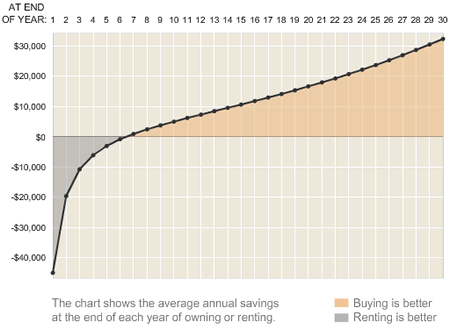
In the end, I can try and make some predictions, but I don’t want to make a big bet on them being right. My opinion is that I just want the damage to be small if I’m wrong. For example, let’s look at an example graph from the calculator for a $500,000 house:

Buy Vs. Rent Calculator Results

Ignoring my specific inputs, let’s just focus on the fact that the break-even time shown is about 6 years. This 6 year number is the result of about 10 different guesses. Still, there is a period of +/- 2 years where the difference between renting and buying is not horrendous. A person’s feelings about such intangibles like a love or hate of doing home improvements could sway them in either direction.

As for us? The plan remains to buy a home towards the end of this year. I haven’t shared the neighborhood, so nobody can tell us if it’s a good or bad decision yet 😉

New York Times Weighs In On Buying Vs. Renting A Home

I am still “away from the office”, but here is a very interesting New York Times article about buying versus renting a house I wanted to share – A Word of Advice During a Housing Slump: Rent. I’ll add more commentary after I fly back tomorrow, because we actually have been looking at some houses and neighborhoods in between family events while we are down here.

In particular, I enjoyed playing with this interactive Buy vs. Rent Calculator, because it shows you how sensitive these calculations are to your assumptions. A 1% difference in expected home price appreciation can make your expected “break-even” time vary by 5 years or more! (I am very skeptical that I or anyone else can predict the home appreciation rate in any specific area within 1% for the next several years.)

Google Now Lets You Search Real Estate Listings

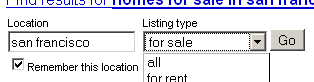
You can now use the search engine to find homes for sale, rent, or even those in foreclosure. To try it yourself, just type in “Portland real estate” or “Home for sale in Chicago” into Google. You’ll see something like this:

Google Real Estate Screenshot

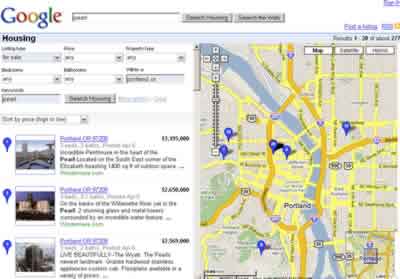
Which then leads to you the results:

Google Real Estate Screenshot

From the Google Blog announcement:

When you want more information on a particular home, you can click straight through to the source of the listing?no detail pages or sign-up forms get in the way. And when Google gets the same listing from multiple sources, we show links to all the data providers and websites, ranked according to many factors including, but not limited to, the quality and comprehensiveness of the data…. We don’t sell houses, deal with agents’ compensation, or charge for leads. Our business is helping people find the information they’re looking for?when you have it, we send them directly to you.

I just tried it, and I while it’s not revolutionary, I did find a few houses that weren’t on the MLS and on some smaller For Sale By Owner websites that would be otherwise hard to find. I also like being able to see the locations on Google Maps. I wonder if this will help push the MLS to be more open, which would be helpful for potential homebuyers.

The Intangible Advantages And Disadvantages Of Owning A Home

Many times you hear people say “Owning your home is not an investment.” It may not be an investment, but it does involve spending money that could be better used elsewhere. Still, I do admit that there are intangible benefits that you can’t easily put a price on when you own your own home. Here are some advantages that come to mind:

It will be very rare that you will be kicked out of your home. As someone who has been unceremoniously given 30 days notice to leave a rental that they enjoy, I look forward to a day when I don’t have to worry about frantically searching for another rental or hiring a moving company. As long as I avoid any future freeway developments I should be able to find a home I can live in for as long as I want.

You can improve your home. I have zero desire to fix up my current rental. Why bother? Heck, I’ll probably just lose my deposit if I try. But in a place I own, I can start to make little customizations that make life just that much cozier. First thing, I would make my house totally energy-efficient, both saving me money and reducing consumption. Then, I could the flooring, split a big bedroom into two smaller ones, make a garden, whatever.

It’s hard to measure this, but I feel like such improvements would really improve my happiness level. Of course, I can also think of some disadvantages:

What if your neighbors are jerks? What if they hate my dogs, or worse, like to breed vicious pit bulls? (It’s happened. Dogs have died.) I’ve had my share of annoying neighbors. Selling a house definitely costs more than simply moving out of an apartment, even if you have to break the lease.

For condos: What if your homeowners association stinks? I’ve heard some horrors stories about egomaniac HOA presidents with their overpriced pet projects and expensive assessments. I don’t think anyone loves their HOA.

Improvements cost money. If some people consider having a mortgage to be a form of forced-saving, maybe renting is a form of forced-frugality? Most renters don’t have weekly trips to Home Depot or argue about what kind of tile to put in their kitchens. They just call the landlord when something breaks.

After writing this, it seems that a lot of my feelings center around permanency. For me, I don’t want to move to a bigger house in less than 5 years. I’m tired of moving every 12 months. I want a home. I just have to find one at the right price.

Homeowners: What are some intangibles that I missed?

Considering For Sale By Owner? Get Listed On The MLS For Free

Although I feel like they are a bit late to the party, a new site called Iggys House will allow people to list their properties on the Multiple Listing Service (MLS) for free in certain states. Currently 20 states are offered, with more to scheduled to come later. After looking around online, it appears this usually costs around $300 from other For Sale By Owner websites. I wonder what the wholesale cost for a listing is…

According to their press release, 12% of home sales in 2006 were sold by their owners without any agent assistance (or I guess MLS listings?). About 7% hired a ‘discount listing agent’ that performed few if any additional services beyond simply listing the home on the MLS.

How to they plan on making a profit? By using the publicity gained from this to promote their services as buyer’s agents. They figure if you are a do-it-yourself seller, why not be a do-it-yourself buyer? Their sister company, BuySide Realty, provides homebuyers 75% of the commission it receives as the buyer’s agent. They claim to be the largest online buyer’s agent company, with buyers earning an average rebate of more than $11,000.

I’ve never heard of an online buyer’s agent before. As a potential buyer, I’m very intrigued. (I guess their tactic worked!) Back of the envelope calculation: $500,000 home x 3% buyer’s agent commission x 75% = $11,250 rebate. Has anyone used one before?

Are Homes Actually A Horrible Investment?

Here’s an article specifically designed to push people’s buttons: Why Your Home Is Not the Investment You Think It Is from the Wall Street Journal. It questions the plan of many people to use their home as part of their retirement strategy, and points to economic studies that show that houses often (1) cost more than most people make when they sell and (2) rarely match the long-term returns of stocks or other investments.

Did you know:

  • If you bought a house in Los Angeles in 1990, just as the real-estate market turned downward, you would have had to wait a decade for your home’s value to return to what you paid.
  • If you bought in Rochester, N.Y., in 1980, you would have seen only a mediocre 4% annual growth for the next 25 years.
  • If you bought in Dallas in 1986, as the oil boom went bust, your home wouldn’t have appreciated at all before 1998.

Some other excepts:

When most homeowners figure their returns, they don’t do much more than subtract the price they paid from the price they received. Then they come up with a really big return because they paid only a 10% or 20% down payment. So they figure they made a huge “profit.”

But they didn’t. That’s because the costs of owning a home — buying it with a long-term mortgage and then paying taxes on it, insuring it, repairing it, renovating it — sap most of what most homeowners think they make in price appreciation.

I can agree with this. This overestimation of returns happens all the time in all forms of investing.

Boom market or bust, home buying has so many extra costs — from upfront “points” paid to a lender to title insurance and appraisal fees — that over the first five to seven years, a renter who invests the equivalent of a down payment in stocks could easily do better overall than a house buyer. Compounding that problem: Most homeowners move within seven years.

As the ownership timeline stretches out to 15, 20 or 30 years, however, the buyer will almost certainly do better than the renter, especially given the tax benefits of paying mortgage interest over traditional rent and the big rebate when the owner finally sells.

There is always a break-even point. Recently, it has been as little as one year, but now it may be 5 – 10 years. This will vary by location, as some areas are still going up, while other are well on their way down.

Whether you come out ahead depends on where and when you buy. Even cash buyers might be surprised to see that they can’t be assured of making a profit.

“The Costs of Home Ownership” table is a simplified rundown on a typical single-family home — a house that was bought for $50,000 in 1977 — based on national appreciation rates as reported by the Office of Federal Housing Enterprise Oversight (OFHEO). Included are modest estimates of other home-owning costs (not adjusted for inflation). To keep things simple, there are no transaction costs, no additional borrowing to finance improvements and no refinancing costs, all of which would drive the expenses even higher. It’s not a pretty picture.

altext

I’m sorry, but this analysis seems a bit biased. Let me count the ways:

  1. The interest rate is at 8.72%. While it may have started out that high, there’s no way they wouldn’t have refinanced within those 30 years and significantly lower their rates.
  2. $3,000 a year for taxes and insurance my be reasonable, but still feels on the high side for a house that went from $50k to $300k. That 6% to 1% annually, with an average of about 4% due to exponential growth. Maybe if they lived in Texas.
  3. $150,000 for “major repairs” on top of $1,800 every year in “maintenance costs”? My parents have lived in their house for almost twenty years and have replaced their heater once. That’s it. What costs $150k to fix on a $300k house?

While their point is made that you need to take in all housing costs, if you take out the $150,000 bombshell, both scenarios made a decent profit.

In the end, I think it’s good that people take a critical look at some of their housing assumptions. Maybe they are a worse investment than some people think. As for me, my basic opinions remain the same:

Regarding buy-vs-rent, I think people should run several different possible scenarios and make a decision based on their specific geographic location and potential need to move. You may need to stay in the house for 5-10 years to making buying profitable. Most calculators rely on several hard-to-predict factors, including the annual appreciation of the property, the annual rising of rent, and the assumed return on the money that is not put towards a mortgage, i.e. when you “rent and invest the difference.” Keep in mind that you’ll need a 10+ year horizon to guarantee that you’ll get 8% or whatever in stocks. If you’ll need the money sooner, you should probably keep it in more conservative investments and lower your projections. Try a bunch of different combinations of numbers to see how they affect the results.

Finally, housing prices are not as efficient as stocks. It is quite possible to negotiate with buyers and be picky in this buyer’s market. I don’t have to pull the trigger unless I see both a house and a price that I like.

Subprime Mortgage Lenders Getting Hammered: What Does This Mean For Housing Prices?

Stock Chart for NEW

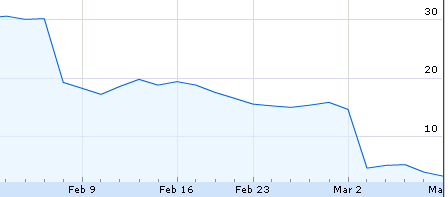
Although I should be paying more attention to the mortgage market, I’ve only gotten a chance to catch up this weekend. Above is the stock chart for New Century Financial (NEW), the second-largest subprime lender in the country. It basically dropped from $30 to $3 a share in a month, and is no longer taking any new loan applications. From this AP article:

“New Century, already the target of shareholder lawsuits, alarmed investors Thursday when it announced one of its financial backers had turned off the funding spigot. The company said last month it had failed to keep tabs on how frequently borrowers missed payments.

What? As a subprime lender, how is this fathomable? It looks like their fellow lenders haven’t been doing so hot either:

  • Countrywide Financial Corp. (CFC), the largest U.S. mortgage lender, recently told its brokers to stop offering borrowers the option of no-money-down home loans.
  • WMC Mortgage, part of General Electric (GE), recently laid off 20% of its workers and is no longer taking no-down-payment loans.
  • Washington Mutual is no longer making no-down-payment loans.
  • Fremont General Corp. recently shut its doors completely, and is seeking a buyer for its subprime operations after getting a cease-and-desist order from the Federal Deposit Insurance Corp.
  • More than 20 other subprime lenders have stopped lending or gone bankrupt in the past year due to increasing defaults.

The New York Times just published this article titled “Crisis Looms in Mortgages“. Some excerpts:

“What’s happening is the front end of this wave of teaser-rate loans that are coming into full pricing,” Federal Reserve Governor Susan Bies said on Friday. “So what we’re seeing in this narrow segment is the beginning of the wave. This is not the end, this is the beginning.”

?I guess we are a bit surprised at how fast this has unraveled,? said Tom Zimmerman, head of asset-backed securities research at UBS, in a recent conference call with investors.

Like worms that surface after a torrential rain, revelations that emerge when an asset bubble bursts are often unattractive, involving dubious industry practices and even fraud. In the coming weeks, some mortgage market participants predict, investors will learn not only how lax real estate lending standards became, but also how hard to value these opaque securities are and how easy their values are to prop up.

It is too early to tell how significant a role mortgage fraud played in the rocketing delinquency rates ? 12.6 percent among subprime borrowers… Some 35 percent of all mortgage securities issued last year were [subprime], up from 13 percent in 2003.

I can’t help but predict repercussions from this fallout to the rest of the mortgage world. Bad loans » Stricter lending standards » People qualifying for smaller loans and thus less buying power » Lower housing prices?

Of course this starts just when I am starting to browse the MLS listings again. Let’s see how badly I can mistime this thing…

Buying A Home In The San Francisco Bay Area On $75,000 A Year

Besides shopping at Whole Foods or Trader Joes, it seems like one of the major hobbies of young professionals in cities like Los Angeles or San Francisco is to complain that we can’t afford a house given our mere $50,000-$100,000 salary. It’s true. Housing is pricey. But every time I hear this lament, I think of the e-mail I got from a single woman who made it happen on $75,000 per year in the Bay Area. How did she do it?

She saved for a few years, and made it a priority. Sure, rent is high, but there is still a lot of fat in a $75,000 salary. By far, the easiest way to save money is to get a roommate. Your rent goes down by at least a third, utilities are cut in half, and if you get along you can save a lot in food. Even if you live by yourself, I would say that saving $10,000 a year should be possible, even on top of saving 10% towards retirement. If you think I’m insane, I would definitely take a look at your definitions of “needs” and “wants”.

She got realistic. If you grew up in the suburbs, you’ll may feel like living in anything but a 2,000 square foot ranch home is just not acceptable for a hard-working educated person like yourself. Nope. Homes like that cost $1 million here. First step, downgrade your size requirements. Her sights moved down to townhouses, and then to condos or even studios.

She got even more realistic. Still too pricey in the trendy areas. Time to give up? No, time to downgrade your location requirements. The East Bay is filled with workers that commute to either to San Francisco or San Jose every morning. She finally found a nice $300,000 1-Bedroom condo in the East Bay for which she paid $30,000 down. Since it was near public transportation, her total commute is a reasonable (for the area) 45 minutes door-to-door.

She’s got almost $100,000 in equity now. Fast forward to today, and her $300,000 condo is worth more than $350,000. Add in her down payment and the small bit of her mortgage payments that goes toward principal, and she’s got a good chunk of equity built up. If her career (and boyfriend) keeps moving in the right direction, her next property just might be that 2,000 square foot ranch home in the suburbs…

It won’t happen overnight, but from her I know that the now seemingly bizarre idea of saving for 3-5 years for a down payment really does work. There is light at the end of the tunnel. At least these days people are less likely to think “dude, I have to buy now or I’ll be forever priced out of the market”. You can save without pressure under the guise of waiting the market out… with me! 🙂