Discussing Home Buyer’s Agent Commission Rebates

Up until a few years ago, the status quo was that the real estate agent who helps you buy your home get half of the 6% commission, so 3% of the sale price of your home. On an average (again, around here) $600,000 home, that’s $18,000. That may be split between the principal broker and the agent (unless you have an independent agent), but that’s still quite a pay day. Nowadays, there are several websites and agents who will offer you a cut of this 3% commission – often for a reduction in features. Here are a few of the more prominent ones:

(*Our eventual agent was found using this service.)

However, the National Association of Realtors is actively lobbying against this practice. Currently, these states ban buyer rebates: Alaska, Iowa, Kansas, Louisiana, Mississippi, Missouri, Montana, New Jersey, New York, Oklahoma, Oregon, Tennessee, and Wyoming.

But should this practice be illegal? Many people – most real estate agents – sure think so. I disagree, and find this stance very anti-consumer. Hey, I can understand not wanting to lower my income. But that’s capitalism. If an agent can operate well without rebates, then they should do so and refuse to offer any such rebates. But if someone else is willing to negotiate their fee, what’s wrong with that? I feel that like for any service provided, both the price and the features should be negotiable. Imagine every car costing $20,000 no matter what, every computer costing $1,000, every haircut costing $50. Yes, a discount agent might offer discount service. But a full-price agent can also offer poor service. In the end, each home buyer should be able to make their own value judgments.

Even our current arrangement is primarily a result of legacy and tradition, not logic. Until the 1990s, in many states there were no “buyer’s agents” at all. All agents represented the seller, which means they had a fiduciary responsibility to the seller – and only the seller. Only within the last decade or so have agents who solely represent the buyer become widely accepted. I believe commission rebates are simply the next evolution in real estate practices.

In the end, not everyone has the same needs. If someone wants a full-service agent who works for a big company like REMAX or Century 21, who will interview the client and figure out the best neighborhood for them, call them with updates every day, and drive them to each house in their nice car (why do they all drive either a Benz or a Lexus?), then they should have the right to do so. On the other hand, my agent has almost 20 years of experience, and is her own principal broker. She drives a Honda Accord, and I’ve never been inside it. We get full MLS access and we e-mail her what houses we want to see. We already have a lawyer who reads real estate contracts all day long in the family.

In addition, if price is such a key ingredient to agent quality – why can’t I offer $5,000 plus the 3% commission to my buyer’s agent? By that logic, that should get me a sweet agent who’ll bargain the pants off the seller and get me a house 20% below market… right?

Finding A Buyer’s Agent, Part 1: The Search Begins With Ourselves

We’ve been slowly moving forward with the home-buying process, but I’ve fallen behind on the updates. We are far from experts and we might have done it all wrong, but here’s how we found our buyer’s agent to represent us. We started by essentially interviewing ourselves.

Preliminary Research
First, we had to see what was out there. We went on Open Houses every single weekend for months. We looked at houses in “bad” neighborhoods, “good” neighborhoods, and everything in between. We looked at homes priced from $260,000 to $3,800,000. High-rise condos, nice townhouses, detached houses, even a shack with no water heater (but great lot). Close by and far away.

Next, we used online resources such as MLS listing websites. These days you can get a ton of information online in most metro areas, including e-mail updates of new listings. However, I am always suspicious that these sites are somewhat delayed compared to what real estate agents who pays hundreds of dollars for “real” MLS access gets. But by poking around online you can find recent sold data, tax records with previous sales history and home sketches through the city or county, and more.

By combining the real-life visits and the data available online, we started getting really good at doing our own home appraisals. By taking careful note of prices, price drops, whether the house sold or not, and for how much they sold for, we got a feel for the housing markets in different areas. We would predict whether a new listing would be sold within a week, or if it would languish for months. This allowed us to help narrow down what we cared about, and how much each separate feature might cost us.

Oh, and we asked our friends a lot of questions. 😀

Deciding On Our Needs
This helped us figure out what we wanted from a buyer’s agent:

  • Access to homes. Real estate agents will often give each other lockbox codes with no problems, but not just random people calling them up. This can get us in faster, and often with less hassle.
  • Shield us from other agents. When a listing agent sees a buyer without an agent, what they see is potential client to show other houses too. They start asking more questions about what we do, what neighborhoods we’re looking at, and so on. We just want the facts on the house.
  • Guidance after offer acceptance. Our parents, brothers, sisters, friends – they all have bought houses. I’ve read enough books to know what the steps are and what the terminology is, but it’s still good to have someone who’s done it 100 times before and seen all the potential hiccups.
  • Patience. I would be upfront with the fact that we were going to be direct and picky buyers. We don’t want to see every house, just the select few that meet our criteria. We want to see a house, decide on a price we were willing to pay, and make an offer the same day. If they refuse, then we move on. If we don’t see a house we like for months, then that’s also fine with us. In that way, we didn’t need to be called every day or feel pressured. But if something did come up, we would be willing to move fast. We have the down payment and mortgage pre-approval ready to go.
  • A second opinion and another set of eyes. I have a father-in-law that can just about build a house by himself, so that helps us a lot. But just having an experienced person point out flaws or features can be great.

Now, could we find such a person, and perhaps even get a commission rebate? I mean, we are talking about a $500,000+ home here. It turns out we could, and we did. (To be continued in Part 2.)

How Do You Track Your Home Value In Net Worth?

Calculating net worth from an accounting perspective is simply assets minus liabilities. However, most people who track their net worth (like me) end up making some judgment calls. I mean, that printer by your computer has a value. If you put it up on Craigslist, you might get $20 for it. But I doubt you measure it’s value in your “net worth”. What about your car? Jewelry? Your home?

Here are some ideas on accounting for your home in your net worth:

Option #1 – Estimate market value, and subtract amount owed.
I think this is the most technically accurate definition of home equity: fair market value (asset) minus loan balance (liability). However, the hardest part is calculating fair market value. Even professional home appraisers have told me it’s “not rocket science” and there is a lot of subjectivity. (Hint: Most appraisals are ordered by the lender, and the lenders really like it when the home appraises near the purchase price. It makes loans go through smoothly.)

Some ways to estimate current market value:

  • Use a home valuation website like Zillow or Cyberhomes. The problem is that these sites often rely on tax records or other databases with outdated information, leading to some weird numbers. Even comparing the exact same house on the two websites side-by-side, I have found them to differ by up to 20%.
  • Take your purchase price, and then adjust according to the the percentage change in your area. For example, if you bought for $200,000 and the median house price in your town went up 10%, then put your value at $220,000
  • Use your local tax authority as a reference. Some areas estimate your home’s value every year, and use it to find your property taxes due.
  • Do your own comps. Did a neighbor’s house just like yours sell recently? Find the cost/area ($/sq.ft.) and compare to your own square footage.

Finally, you could also take off 3-6% to account for the (almost) inevitable real estate commissions you’ll have to pay upon selling.

Option #2 – Track the amount of mortgage balance loan paid off.
Here you essentially assume that your home just stays at the price that you paid for it. So all you need to track is the sum of your down payment and the amount of loan principal paid off so far. This should be included in your mortgage statement.

Alternatively, you could view this as a “countdown to loan payoff”. You’re ignoring the month-to-month fluctuations of the real estate market, and focusing on what you have left to pay before actually owning your home.

Option #3 – Just ignore it.
If you plan on staying in your home for the foreseeable future, then you may not care what your home value is. Your mortgage payment is simply a housing payment like rent, except that one wonderful day it you’ll just be left with property taxes. It doesn’t change how you spend your money, or how much you wish to save.

Any other ideas?

Subprime Mortgage Bailout Concept Extended To SUV Owners?

Are you sick of hearing about the subprime mortgage crisis? I sure am. But here’s a satirical news story from Patrick.net that even I found amusing – SUV Bailout To Keep America Humming.
Lawmakers in Washington are near final agreement on a proposed $400 billion bailout of SUV buyers. The massive amount of debt taken on by drivers in an attempt to ensure that their vehicles are significantly bigger than their neighbors? vehicles has resulted in millions teetering on the brink of bankruptcy. ?We need to keep these people in their Hummers, at whatever cost to taxpayers? said Treasury Secretary Henry Paulson. Paulson is expected to announce details of the plan as soon as Wednesday, said sources familiar with the matter.

With more than 2 million drivers facing higher interest costs and the possible loss of their oil-company-friendly vehicles if they cannot meet the payments, the future of US overconsumption is at stake. The White House on Friday said it was appropriate to build a ?bulwark? against the SUV sector?s woes. ?After all?, said President Bush, ?it would not be American for us to live within our means and be responsible for our own financial decisions. Those who failed to spend themselves deeply into debt should pick up the tab to keep real Americans riding high.?

While not perfect, here are the ways in which I agree with this SUV analogy:

  1. Stuff is stuff. You have a $20,000 car through a $20,000 loan. You stop paying that loan. What happens? It gets repossessed! You don’t really own that car. You only own the right to use it as long as you make the loan payments. When I hear “they’re taking my home away!!”, I empathize the same amount as if they said “they’re taking my car/iPod/HDTV away!!” (which might be a lot or a little depending on the circumstances).
  2. Mortgages are sold by salespeople. Cars are sold by salespeople. HDTVs are sold by salespeople. I don’t recall any laws being broken here, so what did we really expect from them? Sound financial advice? Unbiased opinions? We never fault car salesmen for painting their products in a good light, we take responsibility if we bought a Hummer we couldn’t afford.

Ironically, there actually are tax advantages for large SUVs when used for small businesses.

A Glimpse Into Our Arguments About House Buying

Here’s a condensed update to our home-buying story. Our discussions about the subject have been going like this:

Should we buy or rent?
– We should just buy if we intend to live in it for a decade.
Do you want a condo or a house?
– A house. 3 bedrooms, 1500 square feet.
Okay, let’s look at houses… They are all well over $500,000.
– Ouch. What about a condo?
If we buy a condo we’ll probably want to move when we have kids.
– Well if we are going to move, we should just rent.
But I want to settle down…
– Okay, let’s keep looking and see what we get.

The only real compromise seems to be to buy a more expensive house than our initial $500,000 target price, one that we can live in indefinitely. But if that’s the case, I want to get a good deal on that perfect house. Prices here are holding pretty steady, so any offers we make are being rejected. So we keep looking, and sometimes her patience wears thin. I feel she wants to settle, she feels I am too picky. I am stubborn about this because it is such a huge commitment.

The fact is that $500,000 buys you a two-bedroom condo in a so-so building with a so-so commute here. If such high prices seem crazy to you, check out this article about affordability in California:

The percentage of households that could afford an entry-level home in California stood at 24 percent in the third quarter, unchanged from the same period a year ago, according to a report released Thursday.

The California Association of Realtors said the minimum household income needed to purchase an entry-level home at $482,910 in California in the third quarter of 2007 was $99,590, based on an adjustable interest rate of 6.56 percent and assuming a 10 percent down payment. […] The monthly payment including taxes and insurance was $3,320 for the third quarter of 2007.

Yep, crazy sounds about right.

Help Your Family Buy A House – And Make It An Investment

Over Thanksgiving my parents and I discussed the possibility that one day my parents might retire and move near us. Of course, my parents live in a “normal” part of the country where a 2-bedroom condo doesn’t cost $600,000. So the idea of us helping them to buy a home sometime in the future came up. If my siblings and I all put in an equal amount, we would simply inherit an equal share when the time came.

Coincidentally, I also ran across this article by the “Mortgage Professor” which addresses a similar idea: A new take on gift of equity: Turn it into an investment. Instead of a parent simply giving their kids money for a down payment which may put a dent in their own retirement savings, they should structure it as an investment with multiple shareholders.

He has made an Excel spreadsheet which tracks the percentage of home equity that is owned by each party. It took me a while to figure out all the variables, but here are the basics of what you need to consider:

  • Ongoing investments. Sometimes you not only need help with a downpayment, but also the monthly payment. Or maybe you don’t need it but the investor wants to help out. Ongoing payments are also handled by the worksheet.
  • Interest rate. You’ll need to set an rate of return for the investor’s cash if they “cash-out” before the end of the mortgage. One suggestion is to simply make it the same as the mortgage rate.
  • Rent credit. If only one party is occupying the home, they should be required to credit to the investor a market rate of rent. The rent should include regular adjustments to keep in line with inflation.
  • Property improvements. It should be decided how property improvements will be decided upon and how to credit each partner.
  • Exit strategy. If you don’t plan to ever sell the house, then you should outline an exit plan so that the investor can get access to their money after a set period of time.

So let’s say an investors helps put down $25,000 on a $300,000 house. The assisting investor wouldn’t just be getting $25,000 + 6% a year, you’d also be collecting a portion of “rent” from the person you are helping. The occupant gets to buy their house with less money tied up initially, and would be sharing any potential profit or loss. Sure there is plenty of room for conflict, but I think for some families it might work out well.

We Got Pre-Qualified For A Mortgage, And It Was Shocking!

We decided to sit down with a mortgage broker and get officially pre-qualified for a mortgage. Actually “officially pre-qualified” is an oxymoron because the whole process only involved a legal pad and a calculator. The following is just our experience, yours might vary significantly, I really don’t know.

If you’re not familiar with the terms, “pre-qualified” is just a very rough estimation of what kind of loan you can get from a lender. You tell them your credit score (roughly), your income, your debts, and your current assets. They don’t verify any of this, or run a credit check. It’s basically means nothing to a seller. On the other hand, a “pre-approval” is based on your actual credit score and verification of all your numbers (at least for a full-documentation loan). You need to submit tax returns, old W-2 forms, bank statements, paystubs – basically your entire financial life laid bare. This may offer an edge if a seller is comparing offers between you and another seller without a pre-approval.

Lender Ratios
But for me, the main reason for doing this is to find out what their lender ratios were. Also called the debt-to-income ratio, this is all your monthly liabilities (housing payments, car notes, credit card payments, student loan payments) divided by your gross income. This gives you the maximum debt load that the lender will accept and still lend you money. By housing payments, this usually means PITI, or principal + interest + taxes + insurance, so it’s a little more than just the straight payment from a mortgage calculator.

Also, historically, there were two lender ratios, at “top” and “bottom” value (Example: 28%/36%). The bottom (lower) number was the max ratio allowed for [housing] divided by [gross income]. The top (higher) number was the max ratio for [housing + other debt] divided by [gross income]. You had to be below both ratios to qualify for the loan. But I was told that if you have no other debt, that we can bump right up to the top value. I guess before they figured you had a good chance of adding on more “other debt” later in life, but now they just care about total debt load. So really there is only one ratio in many instances – the top one.

Historically, the top lending ratios were somewhere in the neighborhood of 38%. But I was surprised to hear that it’s more like 45-50% now in expensive areas like California, and he has seen as high as 60%! Keep in mind this is a percent of gross income before income taxes! 😯

A 5.75X Income Multiplier!?
Let’s say your gross income is $100,000/year ($8,333/month) and you manage to be clear of any other debts. (This is just for a round number.) Using this Mortgage Qualification Calculator, I plugged in zero down payment, the default property tax (1%) and insurance (0.5%) rate estimates, a 6% mortgage rate, and a 50/50 lender’s ratio. Here are my results:

[Read more…]

10 Reasons You Should Never Pay Off Your Mortgage

A mortgage broker I was introduced to recently just sent me this article on 10 Great Reasons to Carry a Big, Long Mortgage by Ric Edelman. Apparently Mr. Edelman is the expert to be quoted on this subject, as I’ve heard his name associated with this idea several times. Here are his ten reasons along with limited excerpts of the original article. My response is included at the end.

Reason #1: Your mortgage doesn’t affect your home’s value.
You’re buying your home because you think it will rise in value over time. Yet, the eventual rise (or fall) in value will occur whether you have a mortgage or not. So go ahead and get a mortgage: Your house’s value will be unaffected.

Reason #2: You’re going to build equity anyway.
Many homeowners try to build equity in their house by paying off the mortgage. But that produces weak results when compared to the equity you’ll build simply by watching the house appreciate in value. So go ahead – keep the mortgage. You’ll build plenty of equity anyway.

Reason #3: A mortgage is cheap money.
[…] You’ll find that mortgages offer you perhaps the cheapest way to borrow. Mortgage loans offer low interest rates because you post the house as collateral: If you fail to repay the loan, the lender sells your house to recoup its money.

Reason #4: Mortgage interest is tax-deductible.
Not only are mortgage loans low in cost, the interest you pay is tax-deductible. You can save as much as 35 cents in taxes for every dollar you pay in interest. That means a 6% mortgage loan really costs as little as 3.9%. Why carry 18% credit cards, paying interest that is not tax-deductible, when you can instead carry a 6% mortgage with interest that is tax-deductible? Your mortgage is probably the cheapest money you can borrow, so it makes sense to get as much of it as you can.

Reason #5: Mortgage interest is tax-favorable.
Assume you have both a 6% mortgage and a 6% profit on your investments. The mortgage is deductible at your top tax bracket, but the investments are taxed as low as 15%. For someone in the 25% tax bracket, that means the mortgage costs them 4.5% while the investment nets them 5.1% after taxes. In other words, tax law makes it beneficial for you to maintain your mortgage.

Reason #6: Mortgage payments get easier over time.
[…] You might be struggling to make your mortgage payment at first, but over time you can expect your payments to become cheaper relative to your income – especially if yours is a fixed-rate loan. That way, your payment never rises, but your income does.

Reason #7: Mortgages let you sell without selling.
In time, you may well find that your home has grown substantially in value, and you may begin to worry that you might lose that equity if there’s a decline in real estate values. You don’t want to sell the house, which is the obvious way you can capture the value, but there is another answer: get a mortgage. By cashing out some of the equity, you essentially collect the value of the house in cash without actually having to sell the house.

Reason #8: Large mortgages let you invest more money more quickly.
Assume you own a house and want to buy a larger home. So you sell your old house and net $300,000. Now you’re ready to purchase a new $500,000 home. How much should you put down? Should you make a 10% down payment of $50,000? Or should you put down the entire $300,000 in proceeds from the sale of the old house?

Big mortgages mean small down payments. Small down payments mean you retain lots of cash that you can then invest.

Reason #9: Long-term mortgages let you create more wealth.
Do you merely want to eliminate your debt, or do you want to truly build wealth? Please realize that the former does not automatically result in the latter. Indeed, many people who are debt-free are also dead broke.

So, the real goal is to create wealth. You do that by adding as much money as you can to your savings and investments. And the best way to do that is to lower your monthly expenses. That’s why long-term loans are better than short-term loans: the longer the term, the lower your monthly payment. And the lower the payment, the more money you have left over that you can place into investments.

Reason #10: Mortgages give you greater liquidity and greater flexibility.
(Long story about Sam and Nick).

My Reaction
I’m not going to refute any of his overall points – they are mostly true but his main problem is that he tends to overgeneralize. Instead, I’ll just say that the basic premise of this argument is actually very simple. Essentially you are trying to perform an arbitrage – you wish to borrow money cheaply (mortgage), and you invest it at a higher rate (stocks), with the difference being your profit. This is very similar to what people used to do with no fee 0% balance transfers and high-interest bank accounts back when they were paying 5% interest.

However, an important difference is that you don’t know what your investment returns will be, and the arbitrage gap is not definite. Edelman uses in his Sam/Nick story an assumed annual return of 8% after taxes. He doesn’t acknowledge that there is no investment product that Sam can buy that guarantees that (very optimistic) return. In reality, people invest in expensive mutual funds with varying returns, endure tax consequences from frequent trading, or attempt market timing with bad results. The market may return 8%, but the average person might only get 6% after all is said and done. Someone will do worse, others will do better. Of course, most people think they will do better…

As other have put it – If someone walked up to you an offered you a credit card with a 5% APR for life with no cash advance fees or other catches, would you use it to buy stocks? Say you expect 8% investment returns. Does that mean you’d even borrow money at 7.8%? There’s got to be some room for error.

If I had a 5% mortgage rate and had a lot of itemized deductions, I would be pretty comfortable not paying it off early – especially if I had not maxed out my contribution to tax-deferred accounts like 401ks yet. However, if I had a 6.5% mortgage rate and had lost my interest deduction due to the AMT, it would be a much closer call. In that case, I would probably treat paying it off like a bond.

Two Types Of Home Sellers: Which One Is Better?

Here’s an observation that may not be true in all areas, but one that I’ve seen consistently. When a home is for sale, there seems to be two schools of thought:

Price it high, and hold out for a sucker
Here the idea is that all you really need is one person to be willing to pay your bloated price, so you might as well price it 10-20% above what the comps would suggest. Then you wait, not taking any lower offers. If it’s still not sold after 2 months, you lower the price 5%. Again you wait, not taking any lower offers. After another 2 months, you make another 5% drop. Rinse and repeat until you get a taker.

We actually found a place we really liked and put in an offer for what we thought was slightly below market value but fair (and what we were willing to pay). Let’s say it was listed at $600,000. We offered $480,000, and was promptly countered at $580,000. We walked away. The problem with such an annoying seller is that sooner or later they either keep lowering their price, or all of sudden get desperate. The market is getting softer, and it ended up selling at $475,000 to another buyer 4 months later, below our initial bid!?! Very frustrating.

This type of thing probably worked a couple years ago, but now it just seems risky and annoying unless you really don’t want to sell. Sure you might get lucky, but chances are you’ll be holding on the house for a long time.

Price it low, and get it sold quickly
The other type of seller lists it for under market price by 5-10%. When a house is first listed, you have the greatest amount of attention from every buyer looking for a similar house. You can generate buzz, and hopefully a bidding war. The seller may not get every last penny, but the house is sold and they can move on to the next deal. After the first week or two, you’re just left dealing with any new people looking in that area, and interest drops off significantly.

My feeling is that if our sellers simply listed at $480,000, they would have gotten multiple offers and could have played them off of each other, possibly ending up with a final price $500,000. But they decided to gamble, which didn’t work out for them but could still do okay for others.

Effect Of Credit Score On Mortgage Rates and Monthly Payments

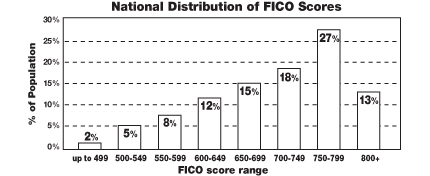
Did you know that 58% of people have FICO scores over 700? Here is the distribution, taken from myFICO.com:

altext

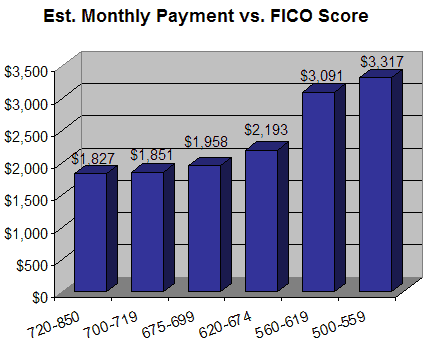
Although one’s credit score is only one of the criteria for getting the lowest rate on a mortgage, and every lender has their own unique qualification formulas, I wanted to see what the general relationship between credit score and the resulting monthly payments was. Here is some data taken from their Loan Savings Calculator using national average rates, a 30-year fixed rate mortgage, and a $300,000 loan balance.

altext

It would appear that once you reach a score of 700, you are pretty much getting the lowest mortgage rates available. And FICO seems to suggest that lenders don’t differentiate between someone with a 721 and someone with a pristine score of 820 or 830. The main goal is simply to reach that “good enough” level of the top 40% or 58%. After that, nobody cares. This agrees perfectly with my previous conversations with local mortgage brokers.

On that note, I also think a good one will tell you what you need to do, if you don’t qualify initially, to get the lowest rates. You shouldn’t go crazy beforehand trying to tweak your FICO to wring out 6 more points. Of course this works best if you already correct any major concerns, like errors on your credit report. Have you checked your free credit report from Uncle Sam lately? I haven’t, need to get on that…

Fed Rate Cut: Affect On Mortgages and Savings Accounts?

I’m sure you’ve heard by now, Bernanke and Friends cut the Fed Funds rate by 50 basis points to 4.75%. It was the first rate reduction in 4 years, which then spawned the biggest one-day gain in the Dow in about the same time. It seems like everyone has an opinion on the Fed rate cut. Some said it was needed to curb the hysteria and possible recession, while others thought it was just a bail-out for people who took unreasonable risks and now don’t have to pay the price. Personally, I think it’s just trying to delay the inevitable, but I’m no economist. I always try to keep a long-term view on the stock market, so I’m not that concerned there. So how else will this affect things?

Savings Account Rate Drops?
Capital One 360 has already dropped their savings rate from 0.80% to 0.75% APY as of today (plus their checking tiers as well), and I expect some other high-yield savings accounts to follow. I think one hope we have is that banks may want to stay at 5.0% for psychological reasons. If you want to lock in some 6-month or 1-year certificates of deposit, I wouldn’t wait too long to do so. Anybody notice any other drops?

Mortgage Rate Drops?
Personally, I’m hoping that this rate drop doesn’t work, and the the housing market continues to weaken. That way, I can still get a low mortgage rate with our excellent credit, and a house at more reasonable prices! But I wonder if significantly lower mortgage rates will actually occur…

Open House Stories: Short Sales, Timeline of a House Flop

It’s becoming our weekly ritual to browse Open Houses on Sundays. We usually try to have a theme, from “cheap condos we’d eventually outgrow” to “houses that would be a stretch, but we could live in forever”. Last week, we actually did “beautiful multi-million dollar homes we’ll never afford” just for fun and possible remodeling ideas.

More and more short sales
One common theme that we’ve been noticing across the board is more short sale houses. Whenever you see a house listed for sale that just seems too cheap, it’s likely a short sale. A short sale is a type of pre-foreclosure situation where the buyer is already in default of the mortgage loan, but the bank has not foreclosed yet. Here, both the lender and borrower agree to sell the house for a price that won’t pay off the entire loan balance. The lender avoids a long foreclosure process and potentially lower price upon the eventual auction, and the borrower prevents an foreclosure from completely killing their credit history.

From the buyer’s perspective, it can be both good and bad. You might get a good deal, but it can get complicated. Instead of a seller accepting your offer within 24 hours, you’re looking a 2-4 weeks while the lender takes multiple offers, checks you out, demands pre-approval letters and sometimes large upfront deposits. There are more details than this, but that’s my basic understanding.

Flip or Flop
Today, we got to see the results of a house flip gone bad, just like on the TV show Property Ladder. They had the classic mistakes – they took too long with the remodel, they priced it too high and stayed stubborn, and they ran out of money before they could sell. Here’s the general timeline:

6/05: Bought house for $850,000. Remodeled… adding the obligatory hardwood floors, fixed up the bathroom, did some painting.
7/06: Listed for $1,100,000
8/06: Dropped to $1,050,000
9/06: Dropped to $1,000,000
3/07: Taken off market, decided to wait things out
8/07: Short sale at $800,000

The carrying costs for the loan were probably around $5,000 a month, although I think the “owners” did live in it or at least rented it out, as there was clothes hanging in the closets. Add in the remodeling costs, and things look pretty bleak. Even if they do get a short sale, forgiven debt is considered taxable income. I wish I could feel sorry for them, but the signs seem to indicate that just they got too greedy.