Should Home Ownership Be The Dream?

Now to the bigger picture… As of today, the U.S. government is the largest mortgage lender in the country. And that means, if things continue to go badly in the housing market, you and I as taxpayers get to pay for bad mortgages! Hurray!

How did we get into this mess? On Monday’s PBS Marketplace public radio show, economist Gregory Ip had some interesting commentary. I think sums it up nicely, as well as asks some good questions.

Americans woke up today to learn the federal government had basically taken over Fannie Mae and Freddie Mac. It’s one of the biggest government takeovers in history.

This moment, though, has been years in the making. We knew these companies were a potentially dangerous hybrid. They are chartered by Congress to promote home ownership. But they are owned by shareholders who want the maximum possible profit. This means that they could take big risks with the knowledge that if they got into trouble, they’d be too important for the government to allow to fail. The Bush administration tried to constrain Fannie and Freddie, just as its predecessor did. But with the support of many in Congress the companies always fought off these efforts.

And then the housing crisis hit. Far from shrinking them, the Bush administration was now forced to ask the companies to expand their role of buying and guaranteeing mortgages, because, quite simply, private investors no longer wanted to. Unfortunately, just when the economy needed Fannie and Freddie the most, they couldn’t do the job, because they had lost so much money on the mortgages they already owned.

Treasury says it acted this past weekend to keep the housing and financial markets stable. But it still hasn’t answered the question: What role should the government play in home ownership, and do these companies have a part to play? Yes, common stock holders have been punished. They’ve lost almost their entire investment. And over time, the companies will have to shrink under the terms of the deal with Treasury. But Fannie and Freddie will continue to exist unless and until Congress revokes their charters. And the final decision of the companies’ fate will rest with the next president and the next Congress.

Then there’s the question we as a country must answer: How much should we promote home ownership? If we conclude taxpayers should back most mortgages, we must find a transparent and accountable way to do it. It’s not at all clear that these companies can accomplish that.
Fannie & Freddie Failure = Mortgage Rates Drop By 0.5%

I’m still on several mortgage brokers’ e-mail lists, and it appears that the government takeover of Fannie Mae is a glimmer of sunshine in what has probably been a very bleak few months for them. The message: Mortgage rates have dropped by around 50 basis points (0.50%) today! So if you are in the market for a loan or refinance, you might want to see what’s available out there.

This Reuters article questions if the drop will last:

The 30-year fixed-rate mortgage has fallen to near 6.00 percent on Monday from 6.50 percent on Friday, according to Greg McBride, senior financial analyst at Bankrate, Inc, in North Palm Beach, Florida.

[…] “The question is how much of the interest rate drop will actually stick,” he said. […] “There are concerns about how much debt the U.S. will be issuing as a result of this bailout and that could pressure benchmark Treasury yields, offsetting some of the improvement in mortgage spreads”

Biweekly Mortgage Payment Plan: BiSaver vs. Do It Yourself

Most homeowners know that they have the option to pay more than their required monthly mortgage note, which will directly reduce the principal. Assuming there is no prepayment penalty, due to the power of compound interest (backwards?) this can significantly shorten your loan period. Whether or not this is a mathematically and/or behaviorally optimal idea is a subject of debate, which I won’t go into here.

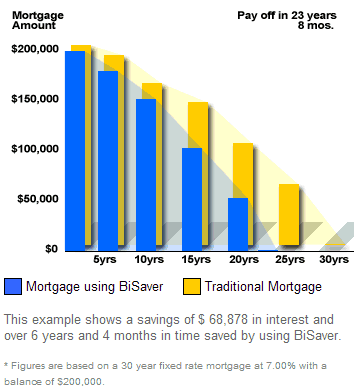
Anyhow, one of the more popular ways to do this is the “biweekly payment plan”. Imagine you had a 30-year mortgage with a payment of $1,200 per month. If you paid $600 every 2 weeks instead, you would be done with the mortgage about five years early! (Use this calculator for more exact numbers.) Because there are 52 weeks in a year and not 48 (12×4), you are essentially making one extra mortgage payment per year.

The attraction of the biweekly plan is that it often coincides with your biweekly paycheck and thus you don’t “feel” that you’re paying extra.

BiSaver®
Today I got an letter from my bank lender about a program called BiSaver, which is basically an automated bi-weekly payment system. Every two weeks the increased biweekly amount is taken from my bank account, and it is eventually paid towards my loan.

However, it costs $399 upfront, plus $1.50 each transfer ($39 annually)*. Another sneaky way they make money is off of the float. Say your loan is due on the 31st of the month. Earlier in the month, on say the 1st and 15th those two biweekly payments (ex. $750 x 2) will be taken out of your bank account. But according to the fine print, only on the 31st will the amount be paid toward your mortgage. In the meantime, BiSaver is earning interest off of those payments.

I really hated this part of their sales pitch:

Can I pay biweekly without BiSaver®?

No. We are not aware of any mortgage company that will accept biweekly or semimonthly payments for a monthly mortgage. What you may do is submit more than your regular monthly payment each month to reduce your principal balance faster and save interest.

No? If you don’t credit the actual payment until the end of the month, then you’re not saving me anything anyways! In fact, I’m losing the opportunity to earn interest in my own savings account.

Yes, You CAN Do It Yourself For Free
After some research, I found out that “BiSaver” is simply a third-party company that goes around pitching this system to mortgage holders like it is some sort of secret sauce. But really they just accept the payments, and then forward them on to the lender. While it purports to “pay for itself in interest savings” almost instantly, it also neglects to mention that anyone can do this for free. If anything, I’d be paying for the convenience factor. But first ask your bank about one of these options.

Lender-Initiated Automatic Transfers. Right now, my mortgage payment is due on the 15th and the amount is automatically sucked out of my checking account every 10th. This is a system offered by my lender. So I called them up and asked if I could add an additional principal payment to each monthly transfer. The said I could, and it would be free! This confirms my theory that BiSaver pays lenders to market to their customers this fake package, and gives them some sort of kickback. Why not just tell us about the free option??

To replicate the results of the BiSaver program, simply take your monthly mortgage payment and divide it by 12. Now add that to your monthly payment amount. So if you originally paid $1,200 you would add $100 for a total of $1,300 per month.

Use Online Billpay. Now, if your lender doesn’t allow this, then you should still be able to make extra principal payments by check. Now simply use your bank’s online billpay system and have them send a monthly recurring payment for $100 (using this example) to your lender. To force a paper check, you should simply set up the payee as a “custom payee” and supply the mailing address. You should also be able to designate what to write on the memo line of the check. Again, ask your lender for specifics, but something like “principal reduction” or “apply towards principal only” and also your loan account number should ensure that it does not get confused with your regular payment or escrow account.

Use Savings Accounts. The most simple way to think about this is that you need to make an extra payment per year. Every Jan 1st, just write an extra check for $1,200. If you like automation, just setup recurring withdrawals with an online savings account – they all offer this feature. If you use Capital One Consumer Bank, open up a new subaccount.

* Note: $399 + $39 per year, growing at a rate of 5% annually (not 8% to account for inflation) comes to $3,306 at the end of 25 years. Don’t pay for a biweekly payment system when you can do it for free!

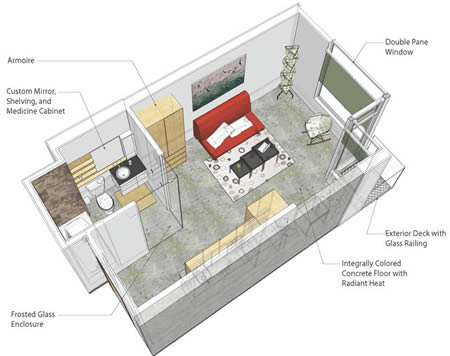
For Sale: 250 sq. ft. Condo for $279,000

Heard some buzz today about some tiny new condos:

Via SFGate:

Home, small home: 250 square feet in SoMa
New condo development targets young first-time buyers without too much stuff

It’s about the size of seven ping-pong tables – and all yours starting at $279,000.

A San Francisco design and development firm has begun marketing 98 tiny condominiums – ranging from 250 to 350 square feet – at the Cubix Yerba Buena building in SoMa. […]

The kitchen area includes a mini sink, two-burner electric cooktop, half fridge and microwave-convection oven. The appliances are stainless steel; the countertop synthetic brown stone. There isn’t room for a bed and a sofa, so each studio is staged with a sofa-bed. They come with a wardrobe but no closets.

Efficient? Yes. $300,000? No thanks.

I could probably live in this place if I was single, but no way with two people working varying hours and wanting occasional privacy. At some point, why not just let people live in RVs in parking garages?

Trying To Learn From Millionaires In The Making

CNN Money has recently put up a new profile in their series on Millionaires in the Making. This one about the caught my eye because of they share similarities to us. They are married and under 30, with no kids. A relatively high combined income. Lives in an area with a high cost of living. Saves half of their income. But they have a net worth of over $500,000 already? Maybe I could learn a few things.

Jobs. He is a software engineer. She used to process mortgage loans. But now she bought a retail store selling fancy soaps. Combined income is $174k, but they don’t break it down. Their balance sheet lists the store being worth $125,000 with a $72,000 business loan. It is also unknown what this store value is based on – a multiple of net annual earnings?

From what I know about such shops, they are really hard to make successful, but can be very lucrative if you are. With the current economic downturn, I don’t know if I’d be selling $10 soap. All in all, too risky for me.

Housing. They rent a house from his parents for $650. I know for a fact this is at least 50% below market rent, probably much more. Smart move for them, but hard to replicate for the average person.

Real Estate Invesments. They made $110,000 from buying and selling a condo during the boom years. I cannot necessarily attribute this to skill, and I certainly can’t duplicate it. They then went out and bought three rental properties in Arizona and Texas, which have current negative cashflow of $750/month. Their balance sheet says they have $40k in home equity, but you have to wonder how realistic those values are. Previously, one rental sat empty for 9 months. Not mentioned is their mortgage situation; are these adjustable-rate or fixed?

Overall, I’d say they have only broke even in this department. I wouldn’t want those properties.

Stock Investments. $88,000 (37% of portfolio) is in Microsoft stock. Even if purchased at a discount as a fringe benefit, many ESPP participants sell as soon as possible to grab the profit. Rest of portfolio is 99% stocks, though not much other detail. Lots of risk here, much of which is connected with his job as well. MSFT performance has not been impressive. Hmm, not much learned here either.

Spending and Priorities. According to the graphic, their non-housing expenses are about $17,500 per year. This is right at about our spending levels, which is $18,000 per year.

The article then goes into how they never travel and rarely eat out (and split meals when they do). However, she also wears a $20,000 engagement ring, and they own 4 cars including a $30,000 Subaru WRX. Although not what I would do, who cares if that’s what truly makes them happiest. I wouldn’t call them misers. They tithe to their church and still control spending, which is respectable.

Recap

This couple is doing the “big stuff” very well. They make a lot of money, and only spend about half of it. Multiply this by many years and you get a fat net worth. But other than that, I can’t really say I want to emulate them. They have a lot of risk in a boutique shop, cashflow-negative rental properties, single-stock investments. None of these created their high net worth, in fact they might have even detracted from it.

But we do share the same goals of early retirement, so I wish them luck. They might need it!

$7,500 Tax Credit for First-Time Home Buyers

I’ve been hearing a lot about this new $7,500 tax credit for first-time home buyers, which is part of the newly passed 2008 American Housing Rescue and Foreclosure Act. Is it as great as it sounds?

A new website has been put up with more information about this tax credit. Curiously, the fact that this “credit” has to be paid back over the next 15 years (or when you sell) is conveniently left out of the “At A Glance” section, and you have to scroll down to question #15 in their Frequently Asked Questions to learn about the repayment terms. Did I mention the site was created by the National Association of Home Builders? No way would they want to mislead potential home buyers, right?

To qualify, you must close on your new house between April 9, 2008 and July 1, 2009. A good summary of this tax credit interest-free loan is in this Fortune article:

The “first-time home buyer credit” is a temporary refundable, repayable tax credit equal to 10% of the purchase price of a home, up to $7,500 for singles and married couples filing jointly. (Singles who buy a house together get only $3,750 each, as do married couples filing their tax returns separately.) […]

But the way the credit works, it’s actually more like an interest-free loan. Two years after you claim this credit, you have to start paying it back. The payback comes over 15 years in 15 equal installments–meaning you owe an extra $500 on your tax return each year. Sell your house, and you have to pay the rest back that year from your profits. (No profits, no pay back. Also, if you die, your heirs are off the hook.)

The allowed credit starts being reduced once a single has $75,000 of modified adjusted gross income, or once a couple has $150,000 of income. The credit goes away entirely at $95,000 for singles and $170,000 for couples.

The justification behind a $7,500 interest-free loan is that it is supposed to ease the “pain” of having to come up with closing costs and a downpayment. But wait… Wasn’t the housing bubble caused in part by people being tempted into buying houses they couldn’t really afford because they didn’t need to first save up for closing costs or a downpayment? I find it ironic that our choice of “buyer assistance” is even more easy lending.

Now, of course I would still grab this tax “credit” if I was going to buy a house anyway. I’d happily take a 0% interest loan on $7,500 for any period. But why not just give us something simple and straightforward, like a check for $1,000? My guess is that the phrase “$7,500 tax credit” works better to pacify angry citizens.

Ask The Readers: Is This Affordable Housing Opportunity A Good Deal?

Despite the drop in housing prices in many areas, I have still been noticing an increase in “affordable” housing projects that are meant for people earning around the median income level – not only low-income households. Even back in 2005, for many areas the median house cost between 6 and 12 times the median annual income. A cousin of mine had to line up and enter a lottery simply for the chance at buying an affordable housing development, but didn’t “win”. I saw a model unit of the condos, and they were very nice.

However, the obvious catch is that because you are buying well below market price, you can’t just turn around and sell it at market price. A reader AM recently e-mailed me some details about an opportunity in his area below. (I have edited it minimally for spelling and brevity.)

I am asking for your view on one of my biggest financial purchase – the home. It’s a newly built home in a great community, offered under affordable housing scheme of the county & city, so there are restrictions about selling the house and the price of resale. As buying a house is an investment also so I wanted to be double sure that is it a good ides to buy such a house. The covenant for resale says:

The “Resale Value” shall be derived from the Base Price of the property. The “Base Price” is the original price paid by the buyers now intending to sell the property. The Resale Value shall be equal to the Base Price plus an amount equal to 1.125% per calendar quarter for each year from the date of the original sale to Buyers to the date of the agreement for the resale from the buyer to a new purchaser, compounded quarterly.

Does this seems a reasonable enough return. Price of house under this scheme will be around $350,000 but similar new houses in the same community costs around $550,000. Obviously as per the covenant when I offer the house for sale at a later time first right of purchase is of County’s if county declines or doesn’t responds in 30 days it can be offered in market but only buyers with income restrictions can buy it (which will be lifted if it remains unsold for 3 months) but the new buyer will have to abide by resale value set by county. The term of covenant is 15 years, I can sell it at market price after 15 years but i can keep only the price as described above in the resale price, rest will go to county.

Does this sounds like a reasonable option both from getting a house and investment perspective? Reason I am interested in this is because I can not buy a normal house now for another couple of years and from next year I will be above the qualified income limit.

This must be near an urban area, if “affordable” housing is $350,000! This development also seems to be separate single family houses instead of the condos I am more familiar with. On the surface, the agreement seems to guarantee a yearly return of 5%, assuming the property is indeed priced at such a steep discount. A year or two ago, 5% might have been scoffed at – but now, I’m sure lots of people wish their house would appreciate 5% each and every year.

But is this a good deal, all things considered? Some thoughts:

  • How’s financing? If you are getting a mortgage with 6% interest on something that will appreciate 5% per year for the first 15 years, is that good? Don’t forget the upfront costs to a mortgage like closing costs.
  • How much to rent a similar place? I asked, and the reply was $2000-$2200 per month. Even with no money down, this would make the mortgage payment about the same as rent. (Assuming 30-year fixed-rate mortgage at current averages of ~6.1%.)
  • Do you plan on staying? Is this house really what you want, or are you changing your desires (either making them bigger or smaller) to fit into this opportunity. If so, you might not need to worry about what happens in 15 years or so.

I’m sure I’m overlooking some things. Please, ask more questions about details of the offer and/or add in your own opinions in the comments below.

Why Do Real Estate Agents Put Their Photo Everywhere?

Most of my friends on Facebook show themselves doing something they love as their profile pictures. Hiking, partying, sitting on a beach. But ones that are now real estate agents? I get the standard “Hey, I’m a real estate agent!” pose. You know, the one that looks like a mix between Glamour Shots and something you’d find in a yearbook. I swear, they all go to the same photographer. I even found this parody of the situation:

Is this required to obtain your Realtor license? “You must slap your picture on everything possible. Any house you sell, your business cards, your MLS listings, billboards, your car. Please consider tattooing your picture and phone number on your child’s forehead.” Yes, I know that familiarity supposedly breeds trust. But it still creeps me out. You’d think consumers would have a better way to pick a real estate agent…

Poll: Two Housing Petitions, What Is Your View?

I couldn’t help but notice that two mortgage crisis petitions that people have sent me info about recently are pretty much in direct opposition of each other. Of course, both claim to represent the average middle-class citizen.

No Intervention
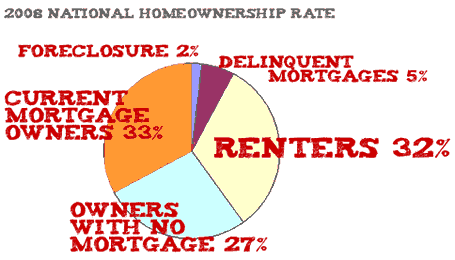
First up is the petition at AngryRenter.com. Their general message is that they are tired of both the borrowers and lenders who have contributed to these inflated housing prices. As I understand it, they think any intervention will simply keep housing prices artificially high, preventing existing renters (32% of households) the ability to buy their own home. Many are those that could have gotten no-doc, interest-only, zero down loans, but did not. They want no governmental intervention or “”bailouts”. I thought this chart was interesting:

7% of folks are either delinquent on their mortgages or in foreclosure? That’s seems like a lot, I wonder what a “normal” percentage is.

Lots of Intervention
The next one is by the Neighborhood Assistance Corporation of America (NACA). They place the blame squarely on the mortgage lenders, and want lots of governmental intervention to borrowers with adjustable-rate mortgages. They are very angry at the money being spent to keep Bear Stearns afloat. Specifically, the want the government to:

  1. Stop any future interest rate resets.
  2. Reduce the current interest rates to the initial rate.
  3. Impose a moratorium on foreclosures.
  4. Require restructuring of all troubled mortgages to an affordable long-term mortgage payment.

I am guessing they want the lenders to cover the cost of doing all of this.

Which Petition Do You Agree With?

View Results

Loading ... Loading ...

How’s The Housing Market In Your Neighborhood?

The slowdown continues in my neck of the woods – a recent house that had been stubbornly overpriced for over a year on my street (we actually made a verbal offer, but the seller wouldn’t budge) finally sold for over $120,000 less than its initial list price. I’m sure the relatively low purchase price of our house didn’t help. At least we are not hit by the collateral damage from foreclosures to condo owners who have never missed a payment. When a multiple units are being foreclosed upon, nobody pays the maintenance fees, which means the existing residents have to pick up the slack. Of course, this means less people want to buy into that building… creating a bad downward spiral.

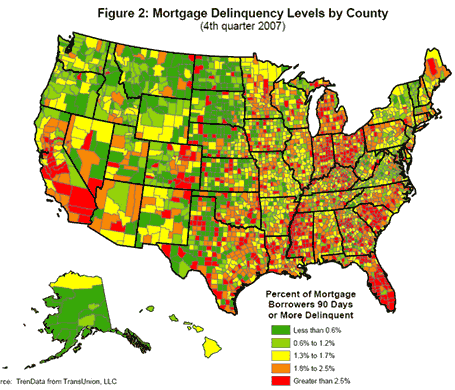
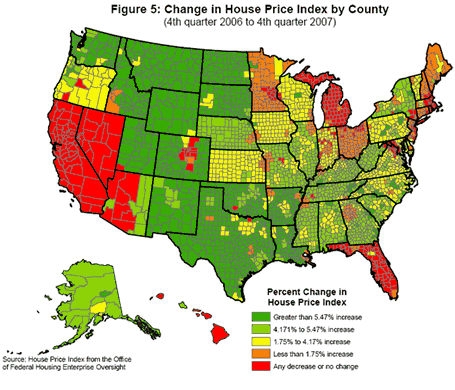
However, some areas seems to be fairing better than others, even if only being one county over. In a recent speech by Ben Bernanke, he showed some interesting geographical heat maps revealing the variation in both foreclosure rates and price trends across the country. Keep in mind the graphs only go until the end of 2007.

You can find both the text of the speech and additional graphs at the bottom of this Federal Reserve page. Via Matrix via Mapgirl.

Good Credit Can’t Protect You From Ignorance

Maybe I just didn’t get enough sleep last night, but the media really has to do a better job to find people with problems that I can sympathize with. The title of this Fortune article is Good credit can’t protect borrowers from bad loans – “More and more home owners with high credit scores are falling behind on their mortgage payments. Here’s why.”

Trish Phillips had enough income to pay about $1,300, perhaps $1,400 a month for her home, which cost $279,900. The minimum payment on her option ARM was $1,276, but she was incurring interest of more than $2,000 a month. The difference of about $800 was added to her mortgage balance every month. […]

According to Phillips, who was making the minimum payments, that meant her monthly bill would jump to $2,300 after just a couple of years and then to more than $3,000 a year after that. She knew she couldn’t afford it and went for help.

Phillips admits that she didn’t clearly understand the loan terms before she closed on the house and says her mortgage broker didn’t explain them. She had misgivings but, “I was afraid of losing the down payment,” she said.

Okay, so why are people with good credit falling behind? Because they are also buying $300,000 homes without even understanding the basics of how their mortgage works. Even if you assume you can refinance, how are you going to do so if you can’t even afford the payment on an interest-only loan? She was actually increasing her loan amount each month.

As for Phillips, she managed to get her loan modified, with Sichenzia’s help. Her payment is now frozen for three years at $1,281 a month and her balance will not increase during that time.

Pretty nice. Wish I could freeze my loan balance for three 3 years while paying less than the interest accruing.

I have nothing personal against Trish Philips. If I were her, I’d be happy to save a ton of interest and have frozen payments for 3 years. Score for her, the crazy lenders should share the pain. But seriously, is this the best you can do? Aren’t there stories out there of people overcoming real problems which weren’t self-imposed? (Although it has since been removed, the original article showed her posing by her Harley Davidson.)

My problem with these stories is that if the house had appreciated in value, these homeowners would be perfectly happy with their risky loans. I don’t like that they get the upside, but no downside.

Question… If I sell you a Hummer and don’t tell you it only gets 10 miles per gallon, and shortly after buying it you can’t afford the gas to drive the Hummer anymore, is that my fault or yours?

Do You Have More Questions About Buying A House?

I have organized all of my experiences as a first-time homebuyer to one central page. It’s huge, sometimes I can’t believe I wrote all that stuff. Hopefully it can be of some help so other folks. Although I have few things left, I seem to be close to wrapping things up.

Do you have any other questions about buying a home you’d like to see answered? Please leave a comment below. I’m sure I’ve missed some things. I continue to be amazed by how confusing and complicated the home-buying process can be. No wonder so many people simply make inflated offers and sign their mortgages without even reading them…