$8000 Housing Stimulus Tax Credit: Requirements and Common Questions

Still lots of questions about the $8,000 First-Time Home buyer Tax Credit. Here are some answers:

What is the definition of a first-time home buyer?
You are considered a first-time homebuyer if:
– You purchased your main home located in the United States after April 8, 2008, and before December 1, 2009.
– You (and your spouse if married) did not own any other main home during the 3-year period ending on the date of purchase.

Do I have to pay the homebuyer tax credit back? How much is the credit for? $7,500 or $8,000?
It depends. For homes purchased in 2008, the $7,500 credit (or 10% of purchase price, if less) operates much like an interest-free loan. You generally can repay it equal installments over a 15-year period unless you move out or sell the home earlier than that. The maximum credit is reduced to $3,750 for married individuals filing separately.

For homes purchased in 2009, you must repay the $8,000 credit (or 10% of purchase price, if less) only if the home ceases to be your main home within the 36-month period beginning on the purchase date. The maximum credit is reduced to $4,000 for married individuals filing separately.

What is the definition of main home? Does a condo count? How about an RV?
Your main home is the one you live in most of the time. It can be a house, houseboat, housetrailer, cooperative apartment, condominium, or other type of residence.

What if I don’t owe or pay any income taxes?
This is a refundable tax credit, which means that even if you don’t owe any taxes, you will receive the credit amount via check or other means. For example, if before this credit you had a tax liability of $5,000 and withheld $4,000, you would owe the IRS $1,000. If you qualify and claim a $8,000 tax credit, you would now receive $7,000.

What are the income restrictions?
The amount of the credit begins to gradually phase out for taxpayers whose adjusted gross income is more than $75,000, or $150,000 for joint filers. It is completely phased out when your AGI is $90,000, or $170,000 for joint filers.

Can I just buy a home from a relative and pocket the $8,000?
You don’t qualify for the tax credit if you bought the house from a “related person.” According to the IRS, a related person includes:

  • Your spouse, ancestors (parents, grandparents, etc.), or lineal descendants (children, grandchildren, etc.).
  • A corporation in which you directly or indirectly own more than 50% in value of the outstanding stock of the corporation.
  • A partnership in which you directly or indirectly own more than 50% of the capital interest or profits interest.

How do they determine the purchase date as applied to the cutoff dates?
If you bought an existing home, the date of purchase is your closing date, not the day that you sign a purchase contract or enter escrow. If you constructed a new home, you are treated as having purchased it on the date you first occupied it. (Seems like some wiggle-room here.)

What IRS Form Do I Have To Fill Out? Can I File For 2008 or 2009 Tax Years?
That would be the new revised version of IRS Form 5405 (where most of this information is from), which you fill out and attach to Form 1040. Any updated tax preparation software should be able to handle this. If you already bought your house in 2009, you can file either on your 2008 or 2009 tax returns. (Why not get it now?)

What if two unmarried people buy a house together?
If two or more unmarried individuals buy a main home, they can allocate the credit among the individual owners using any “reasonable” method. The total amount allocated cannot exceed the smaller of $7,500 ($8,000 if you purchased your home in 2009) or 10% of the purchase price. A “reasonable” method is any method that does not allocate all or a part of the credit to a co-owner who is not eligible to claim that part of the credit.

I am not a U.S. citizen. Can I still claim the tax credit?
If you are a resident alien according to IRS Pub 519 and satisfy all the other requirements, then yes you can claim the credit. Nonresident aliens are not eligible.

Nice & Simple Explanation of the Credit Crisis

By now, most of us have some sort of idea of what caused the current financial crisis. Some notable attempts at a simplified explanation include these Powerpoint slides with stick figures, this British comedy routine, and the “Giant Pool of Money” NPR audio broadcast. Even the New York Times had a go.

Well, here’s one more by Jonathan Jarvis, which also happens to be excellent. If anything, it surely has the best animation and graphics of them all. Also available in high-definition (but it’s big). Via Bogleheads.

February 2009 Financial Status / Net Worth Update

Net Worth Chart 2008

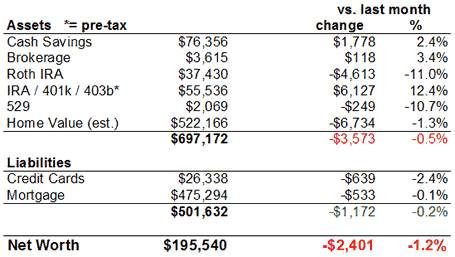
I pretty much have a general feeling of malaise right now. Hiring freeze at one job, big group meeting about how “we don’t have to worry about layoffs… right now” at the other. And now it’s time to look at my incredibly shrinking net worth… I know I have it really good in general, but let’s just make this quick. 😉

Credit Card Debt
I do not carry consumer debt. In the past, I have been taking money from credit cards at 0% APR and immediately placing it into high-yield savings accounts or similar safe investments that earn 5% interest or more, and keeping the difference as profit. I even put together a series of step-by-step posts on how I make money off of credit cards this way. However, given the current lack of good no fee 0% APR credit card offers, I am just waiting to pay off my existing balances.

Retirement and Brokerage accounts
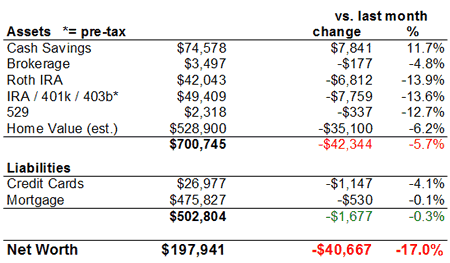
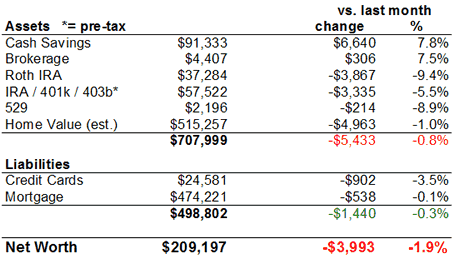
The media has pronounced last month as the “Worst January Ever” for the Dow (-8.8%) and the S&P (-8.6%). The value of our passively-managed portfolio shrank accordingly. Our 401(k) contributions for the month and new company match got swallowed up instantly by losses. Same old, same old.

Cash Savings and Emergency Funds
Our net cash balance (aka emergency fund) increased a bit, and remains more than 12 months of our total monthly expenses. Let’s hope we don’t need it.

I intend to contribute again to a non-deductible Traditional IRA for 2008. My reasons are basically the same as last year: Should I contribute to a non-deductible IRA? The limits for Roth conversions are removed in 2010, which is just around the corner.

Home Equity
I continue to estimate our home value using internet tools, starting with the average estimates provided by Zillow, Cyberhomes, Coldwell Banker, and Bank of America. After taking off 5% to be conservative and 6% for expected real estate agent commissions (11% total), I am left with $515,257.

I need to work out the last few kinks in my new long-term goals, in order to regain some focus. You can see our previous net worth updates here.

$7,500 Credit For First-Time Homebuyers May Not Have To Be Paid Back

Since my post on the $7,500 tax credit for first-time home buyers has over 225 comments and growing, I thought I should point out that both the current House and Senate versions of the Obama Stimulus bill remove the requirement to pay back the credit over 15 years.

If it becomes law, this will be essentially $7,500 of free money for most first-time home buyers. You’ll have to wait until you file your taxes in 2010 to claim the credit, but you might be able to adjust your tax withholding to improve cashflow until then.

According to this CNN Money article, it will also expand the eligible dates retroactively to January 1st, 2009 until the end of June or August.

To be eligible, buyers cannot have owned a home for the past three years, and the new home has to be used as a primary residence. The credit phases out as income rises above $75,000 for singles and $150,000 for couples, and disappears entirely at $95,000 and $170,000, respectively.

Will this really make a long-term difference?

How To Protect Your Home Equity Lines of Credit (HELOC) From Being Frozen: Max It Out?

When I bought our house, I considered setting up a home equity line of credit (HELOC) for primarily for emergencies. For a while there were a bunch of deals that offered no application fees, no closings costs, and no annual fee. Why not have a cheap safety net around? Some people even expected their HELOC as their primary emergency fund.

However, these days with loan-to-value ratios skyrocketing and lenders trying to limit their risk exposure, many HELOCs are getting frozen or reduced with little notice. Some lenders like National City Bank (now PNC Bank) and E-Trade have even been paying people to close their HELOCs early to avoid angering customers. Turns out they aren’t a very reliable safety net.

So what can you do about it? Yesterday, a reader left an interesting comment on a previous post I wrote about reasons why all homeowners should have a HELOC:

After hearing of people getting their HELOCS frozen, I tapped my HELOC which is prime minus 25 basis points. I took the proceeds and opened a one-year CD at Wachovia paying 4% APR for a 12 month CD (this was back in Dec 08). I’m actually making money on it and I have the emergency cash available. I don’t see interest rates rsing in the next year, given the economic depression.

The numbers do look a lot better than last time I looked. HELOCs are often indexed to the WSJ Prime Rate, for example being set at Prime minus 0.5%. The prime rate varies, but is currently only 3.25%. This means it’s possible to borrow the money and place in a safe FDIC-insured savings account or CD earning approximately the same amount of interest. (Interest paid on HELOCs is generally tax-deductible if you itemize deductions and your interest is under $100,000.)

In fact, you could easily be making money this way. If the interest rate spread does go up significantly, you can just pay back the loan.

Now, maxing out your HELOC may lower your credit score, so you might not want to take all of it out. I guess it all depends on how badly you want the safety net. On the other hand, if you have a really good rate you could arbitrage out a decent amount of profit for a while…

January 2009 Financial Status / Net Worth Update

Net Worth Chart 2008

Credit Card Debt
I have no actual consumer debt. In the past, I have been taking money from credit cards at 0% APR and immediately placing it into high-yield savings accounts or similar safe investments that earn 5% interest or more, and keeping the difference as profit. I even put together a series of step-by-step posts on how I make money off of credit cards this way. However, given the current lack of no fee 0% APR credit card offers, I haven’t been as active with this recently.

Retirement and Brokerage accounts
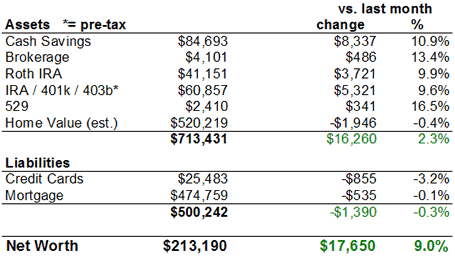
The value of our passively-managed portfolio bounced back by about 10% compared to last month. There were no new contributions. As noted, we did manage to max out both of our 401(k)s this year, and plan on making 2008 IRA contributions by the April deadline.

Cash Savings and Emergency Funds
Our emergency fund balance is nearly at 12 months of our total monthly expenses. So theoretically both my wife and I could be laid off and we would be okay for 12 months without having to sell any longer-term investments. I am very happy with this cash cushion.

Where is it? I suppose you could say I “actively manage” my cash, putting it in various places to maximize yield while maintaining the highest possible safety. For example, I have some in a previous WT Direct promo at over 6% annualized interest, some in Series I Savings Bonds at over 6%, and a chunk at a WaMu 12-month CD paying 5% APY with about 10 months remaining.

Compare this to the piddly 0.14% for 90-day T-Bills and 0.43% on 1-year Treasuries! If you didn’t get in on any or all of these, keep reading or subscribe to updates for new deals as they come up.

Home Equity
I continue to estimate our home value using internet tools, starting with the average estimates provided by Zillow, Cyberhomes, Coldwell Banker, and Bank of America. This left me with $584,516. Then, I shave off 5% to be conservative and subtract 6% for expected real estate agent commissions (11% total) to reach my final estimate. Fortunately, we bought as prices were falling already, and the area where we live has not been hit nearly as bad as other major metropolitan areas.

Looking ahead, I am working on new goals for 2009, and also better metrics for measuring our financial progress. You can see our previous net worth updates here.

Good Time To Ask About Refinancing Your Mortgage: I Might Save $50,000!

With the rate drop yesterday, mortgage rates are at amazing lows. People in the office are bragging about locking in 4.50% mortgage rates with no points, or 4.25% with 1 point. While I haven’t done a lot of in-depth research on this topic, I would agree that right now is a good time to explore your options. (Especially if you have a good credit score and a loan-to-value ratio below 90%.) My favorite source for helpful mortgage info remains the Mortgage Professor.
Breakeven Calculators
The main cost of a mortgage refinance are the points and settlement costs (appraisal, etc.). The primary benefit (when you aren’t trying to pull cash out) is a lower monthly payment. This way, you can find a break-even point after which you save money with the refinance, say 20 months. Obviously, you’ll want to be confident that you’ll be holding the loan longer than that. Here are two breakeven calculators: one and two.

If you want instant savings or are just short on cash, you can attempt to find a “no cost” refinance, where you get a rate with negative points that actually cover your upfront costs. Even better, to avoid funny business later, find a lender that actually guarantees that they will cover all settlement costs. However, your rate might not be the best.

After reading up on some articles on the Professor’s website, here seems to be a possible action plan:

  1. Check with competitors first to get an idea of what combination of rates and closing costs you can get. Try an Upfront mortgage broker or lender.
  2. Armed with this information, call your loan servicing company and ask about your remaining loan balance. Casually ask what could be done with the current low rates. If needed, use your rates collected previously to let them know you’re shopping around and make them go one better. Your existing lender may have more flexibility in waiving and/or reducing fees.
  3. Ask for a loan modification if your lender has not sold the loan, and are servicing it themselves (see below).

My Refinance Attempt

I am in the least common situation, where I got my loan through a community bank who did not sell the loan. They are both the lender and servicing agent. Thus, they are very interested in keeping my loan and not losing it to a refinance. After talking to them, the refinance route was not looking too good, and so they offered me a rate reduction instead. I got to keep my same loan with the same remaining term length, but the rate would be reduced from 5.625% down to 5.125% for a $500 fee. Neither of us has to pay for an appraisal, title insurance, document fees, recording fees, or another mortgage broker commission.

After running the numbers, I would be saving $150 per month, which would give me a break-even period of only 4 months! The catch: I had to lock today to get it guaranteed, and I could not lock again for 30 days. I decided to not to be greedy and locked it in (at no cost). I should get the paperwork tomorrow. If I have a $150 lower monthly payment for the next 29 years, that’s a potential savings of $50,000! ($150 x 12 x 29, but less if you calculate back to present value…)

It’s almost too good to be true, considering I don’t have to try and go through the hassle of a refi. In fact, since I paid points to lower my mortgage rate initially, I thought my chances for a profitable refinance were slim to none. Now, I still have to look at the fine print, so this is not a done deal.

Again, I am not an expert on this stuff. But given the weird situation we have right now, if you have a mortgage professional that you trust, you might want to give them a call. This one phone call today saved me tens of thousands of dollars. I just read a newspaper article that they have gotten more loan requests in the last two weeks than they have had in the last 11 months! So while they are busy again, they are less likely to take your business for granted.

Good luck, and share your success stories below! Oh, and if you missed it before, you can read about our (long) first-time home-buying experience here.

December 2008 Financial Status / Net Worth Update

Net Worth Chart 2008

Credit Card Debt
I have no actual consumer debt. In the past, I have been taking money from credit cards at 0% APR and immediately placing it into high-yield savings accounts or similar safe investments that earn 3-5% interest or more, and keeping the difference as profit. I even put together a series of step-by-step posts on how I make money off of credit cards this way. However, given the current lack of good low fee 0% APR credit card offers, I don’t think I’ll be doing anymore in the near future.

Retirement and Brokerage accounts
Ignoring new contributions, my retirement accounts have lost about ~$8,500 over the last month. I will perform another portfolio update soon to find more accurate year-to-date return numbers.

I have sent in another $5,000 late last month and $5,000 this month in order to max out my pre-tax 401k contributions for this year. My asset allocation is way off target so I need to sit down and try to rebalance using these funds today. It might be tricky to due to the $10,000 minimums for index funds at Fidelity, and I might actually buy ETFs and pay the trade commission.

Cash Savings and Emergency Funds
Why am I not panicking (yet)? Well, I think a big part is my fat cash pile that serves as my emergency fund. In my mind, having a separate short-term reserve keeps me from worrying about my long-term “can’t touch” portfolio.

I have about $49,000 net in sitting in different forms of safe cash earning from 3 to 6% interest, while now my entire retirement portfolio is worth about $93,000. I will keep accumulating cash until I reach a full year’s worth of expenses, which is about $60,000. I think this is prudent given the high unemployment rate right now.

Home Equity
This is the second month of testing out my new way of estimating our house’s value. Again, I take the average estimates provided by Zillow, Cyberhomes, Coldwell Banker, and Bank of America. Then, I shave off 5% to be conservative and subtract 6% for expected real estate agent commissions (11% total). I use this final number as my estimate for home value. Looks like my home value has dropped by another 1% or so.

Overall, another tough month. However, I am very thankful we both still have jobs – knock on virtual wood!

You can see our previous net worth updates here.

November 2008 Financial Status / Net Worth Update

Net Worth Chart 2008

Credit Card Debt
If you’re a new reader, let me start out as usual by explaining the credit card debt. I’m actually taking money from 0% APR balance transfer credit cards and instead of spending it, I am placing it in high-yield savings accounts that actually earn 3-4% interest or more, and keeping the difference as profit. I put together a series of step-by-step posts on how I do this. Please check it out first if you have any questions. This is why I have credit card balances – I am not accumulating more consumer debt.

Retirement and Brokerage accounts
Well, it’s time to uncover my eyes and peek at my financial statements. My retirement accounts have lost another $15,000 (14%) over the last month, in addition to the $12,000 from last month. I did not make any further investments besides the $5,000 in early October.

However, I am still planning to max out my 401k salary deferral by the end of the year, and will still be buying stocks according to my previously set asset allocation plan. I still believe that stocks are the best bet for inflation-beating returns in the long run.

Cash Savings and Emergency Funds
I remain a big proponent of emergency funds held in safe cash or cash-equivalent accounts. We now have approximately 7 months of our actual monthly expenses saved up. Increasing this is a lower priority than the 401k contributions, though.

Home Equity
I am testing out a new way of estimating our house’s value. First, I take the average estimates provided by Zillow, Cyberhomes, Coldwell Banker, and Bank of America. Then, I shave off 5% to be conservative and subtract 6% for expected real estate agent commissions (11% total). I use this final number as my estimate for home value.

I know that each of these sites can be inaccurate, but I am primarily looking for overall trends based on recent comparable sales, and this should take care of that with minimal effort. Feedback is welcome. The mortgage amount is taken directly from my loan statement. Which reminds me, I might need to see if I can argue with the tax collector about my property tax appraisal.

We are still socking away about half of our take-home pay each month, but this looks like the worst drop ever in our net worth. Let’s hope it stays the worst! 😉

You can see our previous net worth updates here.

Weekend Reading: Diary From The Great Depression

Not enough doom and gloom in your diet? The Big Money shares the diary of Benjamin Roth, who was a lawyer during the Great Depression. Via the Consumerist. Here’s an excerpt:

June 5, 1931. Immediately after the 1929 crash the speculators rushed in to buy “bargains” but were badly mistaken because the market kept going down and down even tho’ industrial leaders kept on assuring the people that everything was fine and the worst was over. At the present time the newspapers are urging people to buy these “bargains” but opinion is much divided as to whether or not the bottom has been reached.

Investments in real estate and mortgages fared almost as badly as stocks. Since 1929 foreclosure by the banks has been the order of the day. Day after day real estate can be bought for the price of the first mortgage and there are no bidders except the bank which holds the first mortgage. In this way the banks are becoming the holders of huge quantities of real estate.

Although Slate is a respected name, for some reason I am still skeptical of these diaries. Where did they find this diary? Why has it never been published before if Roth died in 1978? I’m sure people would have been interested back in 1987. Did people write using “quotes” back in 1931? The parallels are almost too close and the writing seems nicely edited.

But, taking it at face value, reading it definitely does provide some food for thought. For example, are stocks really a bargain now? It may not be wise to bail out completely from stocks, but it may not be wise to overly load up on them either. Everyone is trying to predict the bottom, but we might have to be prepared to wait for a while. Gee, it turns out that predicting the short-term movements of the market has always proven to be a weak point for the “experts”!!

Financial Meltdown Explained: Greed, Leverage, and Keeping Up With The Joneses

Yesterday on CNBC, the Bank of America CEO Ken Lewis talked about the financial meltdown. He pinned on a few things: greed, leverage, and keeping up with the Joneses. Lots of homeowners out there are in trouble with their mortgages. Some got defrauded, some simply made poor decisions. But Wall Street executives that earn millions of dollars a year also got caught up in the exact same mistakes.

Greed & Keeping Up With The Joneses

John and Jane Taxpayer want a nice big house. They’ve never been able to own one before, with only tiny savings and so-so credit. But they want one so bad! Besides U.S. home values would never go down, right?

Wait… maybe this might not be smart. But my friends and neighbors have new houses, so that must mean it’s okay! Sign me up!

Bob and Christina the CEOs run an investment business, and want big profits. He’s earning a decent amount with his hedge funds and traditional bonds, but man, these collateralized debt obligations (CDOs) are yielding like 10% and still look safe. They are based on mortgages, and U.S. home values would never go down, right? With these increased returns, I’ll be an hero, and my company’s stock price will soar!

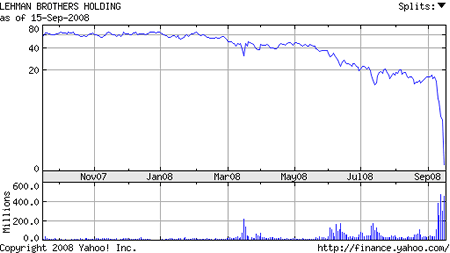
Hmm… maybe this might be riskier than it looks? But wait, the big boys like Washington Mutual, Bear Stearns, and Lehman Brothers are doing it. Sign me up!

Leverage

John and Jane Taxpayer used to need 20% down and good credit for long-term fixed rate mortgage. They only have $5,000 saved up, but want a $300,000 house. Hey, no problem! You just need that $5,000 and you can have your house… with 3/1 ARM that resets to a sky-high rate (which you can refinance later, I promise…). Mortgages are the easiest leverage to obtain for consumers. Three years later… the house value dropped 25% and is now only worth $225k. They put up $5k, and are now down $75k.

We can ride out the storm, as long as we can refinance this adjustable 15% rate! Somebody lend me more money!! No? Crap.

Bob and Christina the CEOs usually only buy investment with their assets. But man, these CDOs are such a good deal. Based on my currently good credit rating, I can borrow at like 7% and these CDOs earn 11%. Sweet leverage! So even though I only have like $10 billion dollars, I can use that to buy $100 billion dollars of tasty mortgage-backed securities!

Of course, if they start getting valued at 75 cents on the dollars, my $100B turns into $75B. I started with $10B, and now on paper I’ve lost $25B. Our credit rating drops. We need more capital. Somebody lend us more money!! No? Crap.

Rule of Thumb For Reasonable Housing Costs?

In an earlier post on motivating myself to work harder, I had thrown out a piece of “common” financial advice:

Spend less than 30% of income on housing.

It was really just an afterthought, but I got a bunch of e-mails about it. Where did you get this? Why 30%? Is that gross income or after taxes?

The source of this “rule of thumb”, which is about as useful (or useless!) as most such rules, is the traditional underwriting requirements of mortgage lenders. You know, before many of them went nuts.

Lender Ratios
Also called the debt-to-income (DTI) ratio, this is the maximum debt load that the lender will accept and still lend you money. You have two types of debt. Housing debt, which usually means PITI, or principal + interest + taxes + insurance, so it’s a bit more than just the straight payment from a mortgage calculator. The “other debt” is the sum of your other recurring monthly liabilities – car loans, credit card balances, student loan payments.

There are usually two lender ratios, a front and a back (Example: 28%/36%). The front ratio meant housing debt divided by gross income. The back ratio was housing + other debt divided by gross income. Usually you have to satisfy both of these ratios.

Some superficial online searching reveals that Fannie Mae and Freddie Mac allow a maximum of 28% for the front ratio and 36% for the back ratio. FHA loans have ratios of 29% and 41%. So that’s where my 30% number came from. Of course, even earlier this year you could find people allowing front ratios of 50-60%.

So if your gross income was $4,000 a month, to get a conforming Fannie Mae loan your housing payment should be no more than $1,120 per month. At the same time, your housing + other debt obligations altogether should be below $1,440 per month.