
Continued from Part 1, where you should have figured out what type of loan you want to get, gathered copies of your important paperwork, and gathered a list of potential lenders. Now to narrow things down to one final lender.
III. Narrowing Down The List
To trim down your list, you may want to call some of them up and ask them a few questions.
1) What type of loans do they specialize in? (Don’t tell them what you’re looking for yet.)
2) What do you need for a rate quote and Good Faith Estimate? What is your quote? Many will give you a rate quite easily, but the GFE is sometimes harder without submitting private information. Just remember, any such quote is only as good as the information you provide.
3) How fast can they lock their quoted rate/points if you choose them? Can I lock this quote you just gave me today? Will they provide written lock confirmation? Will they guarantee their lender fees? (See below.)
Some other people throw in some quiz questions that relate to guessing future mortgage rates, but I don’t really care about that. Your final list might look something like this:
- A few Upfront Mortgage Lenders. These lenders have agreed to disclose accurate rates/points for the market niche they service, as well as guarantee their lender fees. At the very least, you should be able to get a good idea of a competitive current rate.
- First-time homeowner programs in your area, or perhaps you have a preferred lender for your housing project.
- Credit unions that are either local or otherwise restrictive (only teachers in your county, military affiliation, etc.)
- A broker that was highly recommended by a trusted friend experienced in real estate.
- A loan officer from a “big” bank, perhaps where you have an existing relationship.
IV. Compare Good Faith Estimates
When you apply for a mortgage, the government requires your lender to give you a Good Faith Estimate (GFE) within three days of your application. But you should be able to get one, or something similar to one, beforehand with no cost. When done, you should have GFEs from about 2-5 people to compare side-by-side. The actual document looks like a huge list of different fees and can be pretty confusing, but you need to simply break it down into three parts:
a. Interest Rate / Discount Points
– Use interest rate, not APR
– Also note lock period
b. Fees Paid To Lender (Add these all up)
– Application Fee
– Commitment Fee
– Rate Lock Fee
– Origination Fee
– Funding Fee
– Administrative Fee
– Transfer Fee
– Processing Fee
– Loan Set-up Fee
– Wiring Fee
– Discount Fee
– Flood Certification Fee
– Tax Service Fee
– Underwriting Fee
[Read more…]


 If you’re shopping for a new mortgage, there is now another option out there. The Zillow Mortgage Marketplace attempts to make connecting borrowers and lenders as effortless as typing a search on Google. Will it work?
 We are considering renting a room to one of our siblings temporarily. She’s moving out here for a new job, and since we live in an pricey area living with us will offer her a way to save up some money. On our side, we are two people with four bedrooms, so we have plenty of room right now.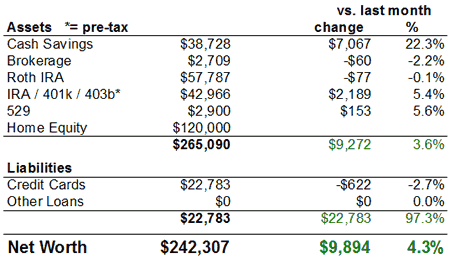
 Along with other deals that I blog about, this helps me earn

 With my new fat mortgage, I’m considering whether to also take out a Home Equity Line of Credit (HELoC). This is not a home equity loan where you take out a lump sum at a fixed rate, but is a line of credit usually at a variable rate. I think of it as a credit card that is secured by my house (!). I don’t plan on actually using it, but I think it might nice to have around as long as the upfront costs to me are minimal. Here’s why:
 The Best Credit Card Bonus Offers – 2025
 Big List of Free Stocks from Brokerage Apps
 Best Interest Rates on Cash - 2025
 Free Credit Scores x 3 + Free Credit Monitoring
 Best No Fee 0% APR Balance Transfer Offers
 Little-Known Cellular Data Plans That Can Save Big Money
 How To Haggle Your Cable or Direct TV Bill
 Big List of Free Consumer Data Reports (Credit, Rent, Work)