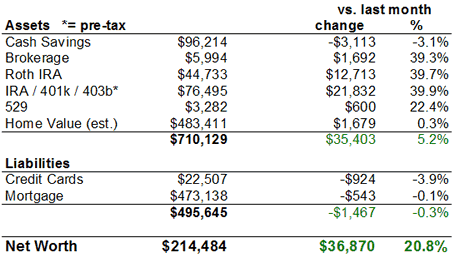
Monthly Financial Status / Net Worth Update (May 2009)

Net Worth Chart 2009

Credit Card Debt
In the past, I have taken money from credit cards at 0% APR and placed it into high-yield savings accounts or similar safe investments that earn 4-5% interest or more, and keeping the difference as profit. I even put together a series of step-by-step posts on how to make money off of credit cards in this way. However, given the current lack of great no fee 0% APR balance transfer offers, I am have not been as active in this “game” recently. My credit score remains high enough that I haven’t seen any negative actions.

Retirement and Brokerage accounts
The market rally was sustained during April, so our predominantly passive investment portfolio increased a bit. We contributed another $2,312 in 401(k) salary deferrals this month including company match. See my investment portfolio page for more details.

I get attracted to various different ideas as time passes, but I really haven’t changed my investment portfolio in about two years now. I always need to remind myself to stick to the basics.

Cash Savings and Emergency Funds
Our cash savings rose again, and although I want to keep one year of expenses for our emergency cash reserves, I need to start putting more money to work in the stock market and other investments. It’s just hard to let go of the security of cash right now. We are contemplating whether we want to save up for a rental property.

Home Equity
I used the same internet valuation tools as before – Zillow, Cyberhomes, Coldwell Banker, and Bank of America (old version).

I have zero personal input here, I just average out what the sites say. They say up. The number shown is after an additional 11% reduction to be more conservative. Not that it really matters, as I am primarily focused on paying off the mortgage, as outlined in my quick and dirty plan for financial freedom!
Amortization Schedules and Principal Prepayment, Part 2: Verification

Yesterday in Part 1, we talked about the basics of amortization and mortgage prepayment. In this post, I just wanted to share some other interesting results I got when tinkering around with the amortization schedule.

Are you always paying the same amount of interest?

As I noted before, amortization is a way to make equal payments but still preserve the right ratio of principal paydown and interest. You can check this using the same schedule of payments as before, except now I’m just looking at it broken down by 12 years instead of 360 months. ($200k mortgage, 30-year fixed at 5%).

If you have a loan of $200k at 5% interest, simple arithmetic will lead you to guess you’ll pay around $10,000 of interest the first year. As you see above, during the first year you actually pay $9,933 towards interest, as your loan balance went from $200,000 down to $197,049 over time. If you simply divide the $9,933 by the average of $200,000 and $197,049, again you’ll get 5%.

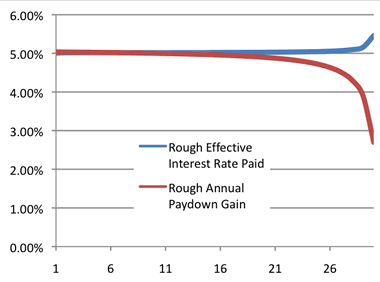
This just provides a rough estimate, but you can see that you’re always paying 5%, even as the principal shrinks. Only at the very end does it vary slightly, not sure why exactly, but I’m guessing due to smaller numbers. The lender isn’t ripping you off by having you pay a ton of interest in the first year. You just have a lot of interest to pay! Kind of neat, actually.

Is your investment return from paying extra towards principal really the mortgage’s interest rate?

When you pay down your mortgage at 5% interest, it is often assumed that this is the same as investing that cash elsewhere and earning 5% per year. (Ignoring tax issues.) But is it?

Again, a quick check on the spreadsheet confirms this. Let’s say I am just starting Year 2. If I prepay the entire equity portion of $3,102, this will advance me to Year 3 of the schedule, and I will be shaving off one year from my mortgage. In other words, my $3,102 will be worth an entire year’s worth of payments, or $12,884, in 29 years. This works out to be the same as a 5.03% annualized return. Close enough for me. Again, if you prepay near the very end of the term, the percentage starts to drop off a bit. But remember, if you’re prepaying, you’ll probably be finished with your mortgage well before reaching that point.

I’ve plotted both the effective interest rate paid and the paydown investment return (gain) below:

You can play with the spreadsheet yourself at Google Docs or in Microsoft Excel format.

Amortization Schedules and Principal Prepayment, Part 1: Shortening a 30-Year Mortgage Into 15

I’ve been tinkering around with my mortgage. Have you ever wondered how the monthly payment was determined? It’s called amortization. An amortization schedule is a way to make equal payments over a period of time, but have the payments split between principal and interest so that the interest paid over time decreases over time along with the loan amount remaining. It is a balancing act to be fair to both borrower and lender, and you can find a mathematical derivation here.

The most direct way to see where you are on your amortization schedule is to ask your lender to send you a copy. Alternatively, you can generate one yourself by using a mortgage calculator with this feature. Here is the amortization schedule for a $200,000 loan with a fixed interest rate of 5% over 30 years.

(May not be visible in RSS format. Here is the direct link.)

As you can see, in the beginning most of your payment goes towards interest, and only a little reduces your principal, or outstanding loan amount. As time goes on, your payment stays the same, but the chunk going towards interest decreases as the principal shrinks.

Mortgage Principal Prepayment
If you want to pay off the loan in less than 30 years, you’ll have to pay more than required. This is known as principal pre-payment. The effect of making such additional payments can be visualized by imagining that it moves you “ahead” in the amortizaton schedule.

Here’s an example using the schedule shown above. Let’s say you’re just getting ready to make your first payment of $1,074. At this rate, you still have 359 out of 360 monthly payments left to go! How much money would it take to shave off one extra payment off the end? To find that, you just have to look at the principal portion of Month #2, which I highlighted orange: $241.

If you pay $241 additional with your first payment now, you’ll won’t have to pay the $1,074 due on Month #360. Why is this? Working backwards, you can confirm that this is pretty much a 5% compounded return on $241 for 30 years, as expected. In addition, you’ll be shifted forward to Month #3 on the schedule. So next month your (still required) payment of $1,074 will have a bit more applied towards principal, and a bit less towards interest.

Making a 30-year Mortgage into a 15-year Mortgage
This actually creates an interesting way to shorten your mortgage. What if you kept paying the next month’s principal payment on top of your required $1,074 each month. You’d add on $241, then $243, then $245, and so on. Every month you’d shave off one month off the end, leaving you with a 15-year mortgage! You can also imagine this as skipping every other payment by just paying the principal and saving the interest.

This can work out nicely because the extra required will start out reasonably low at $241, and increase gradually with time along with your income and/or cashflow.

An alternative is to add $510 to every payment each month to shorten the term to 15 years. Although if you’re sure you want to do that, you might want to just get a 15-year fixed mortgage at a lower interest rate.

Read on in Part 2: Return on Investment Verification.

A Quick & Dirty Plan To Reach Financial Freedom

Despite the current financial funk, I still desire financial freedom. The general idea is simple; I need to generate enough income from my assets to pay for my expenses. Here is how I’ve been framing the problem in my mind recently. I’m 30 now, let’s say I want to be “retired” by age 50.

Part 1: Accumulate 30 times annual (non-housing) expenses

There are numerous studies about the “safe withdrawal rate” from a portfolio, and they usually end up at around 3% to 4%. This usually means that with $1,000,000 dollars, you have a high (say 99%) chance of being able to produce $30,000 to $40,000 of income each year plus inflation adjustments for a long period of time (30+ years).

This is the same as saying you need to save 25 to 33 times your annual expenses.. If you’re conservative (or young), I’d go with a higher number, so I picked 30. Multiply your annual expenses by 30. You need that much money to retire. All of these are based on historical numbers, so this is only an estimate.

Right now I’d estimate our annual non-housing expenses at about $24,000 per year ($2,000 per month). Previously I’ve found that we spend about $18,000 per year, but that neglects a few things like health insurance and car deprecation. (Again, health insurance for those that retirement very early and are not healthy might be a bogey.)

$24,000 x 30 = $720,000.

At about $200,000 in non-housing assets right now, that leave me $520k left. Divided by 20 years and assuming no investment return, that would require $25k per year (not inflation-adjusted). At a 3% annual real return, I’d still need to save nearly $20k per year.

Remarks
With this part, you can see the power of frugal living, or the damage done by lifestyle inflation. $500 a month is $6k per year. $6k x 30 = $180,000.

So if I could cut $500 a month in my expenses, I’d need to save $180,000 less. On the other hand, if I grow some bad habits and start spending $500 more a month, I’d need to save $180,000 more. Either way, that’s a big number! This is why I still need to complete my line-by-line examination of expenses.

Part 2: Own my house / Pay off mortgage

I currently have 29 years left on a 30-year fixed mortgage. For us, that would mean another ~$470,000 in mortgage principal, but more when you count in all that interest.

According to this mortgage calculator, if we make one extra monthly payment per year (simulating a bi-weekly acceleration plan), that’d give us about 24 years before we’re done. If I made two extra monthly payments per year, it’d be shaved down to 20 years, which has the house paid off at age 50. Lots of other considerations, but I’m strongly leaning towards it.

Remarks
I know that you could easily roll up “housing” costs into Part 1 above, but I didn’t for a few reasons. For one, housing is one of the few expense areas where you can essentially “buy” all future costs. For example, you can’t pay a lump sum in exchange for all the electricity you’ll consume in your lifetime. Same thing for your grocery bill, or even a car since you’ll have to replace it. But if you own your house, you’ve basically cut out rent forever (just left with maintenance and property taxes). It also reduces the danger of inflation eating up your spending power.

The second reason is lower taxes. Owning your own house not only saves you from have to pay a housing payment, but also keeps you from having to earn the gross income needed to generate that after-tax amount. Ignoring house, I saw above that I only need to generate $24,000 of income per year total. The income taxes on that amount is very, very small. Using current numbers it might be less than 5% overall, with my marginal tax bracket at a mere 10% after taking out the personal exemptions and standard deductions.

But if I need to generate another $24,000 of income to cover housing ($2k per month in rent), then that additional $24k would be taxed at much higher rate of 15%. With state tax, the difference might be another 5%.

Try out this method with your own numbers, and see what happens. When I run the numbers like this, I know that I could retire much earlier if I moved to a cheaper place upon retirement. But is it worth it? It’s all about priorities…

April 2009 Financial Status / Net Worth Update

Net Worth Chart 2009

Finally a bit of green!

Credit Card Debt
For newer readers, don’t worry. In the past, I have been taking money from credit cards at 0% APR and immediately placing it into high-yield savings accounts or similar safe investments that earn 5% interest or more, and keeping the difference as profit. I even put together a series of step-by-step posts on how to make money off of credit cards this way. However, given the current lack of good no fee 0% APR balance transfer offers, I am just waiting to pay off my existing balances.

Retirement and Brokerage accounts
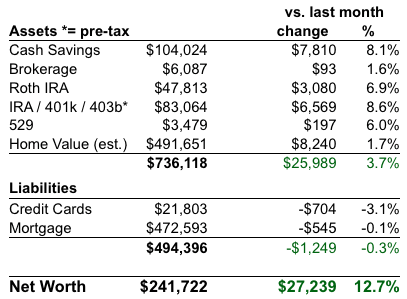
March was a rebound month for the stock market, and our balances went up accordingly. We contributed $10,000 into IRAs, and $12,969 in 401(k) salary deferral and company match. A chunk of that was a true-up contribution from 2008. Score! See my 2009 Q1 portfolio update for more details.

Cash Savings and Emergency Funds
Our cash savings did drop due to the IRA contributions, but we still have over a years worth of expenses set aside. I want to keep one year of expenses for our emergency fund, and start looking for places to invest the rest.

Home Equity
I used the same internet valuation tools as before – Zillow, Cyberhomes, Coldwell Banker, and Bank of America (old version). The magical elves have decided that my home is worth a tiny bit more this month. The number shown is after another 11% reduction to be more conservative.

It’s been about a year that I’ve had this mortgage, and I am wondering if I should commit some cash towards paying down the mortgage principal too. If I make an extra mortgage payment each year, I replicate a biweekly accelerated payment plan, and can shave around 5 years off my 30-year mortgage.

Save Money on Housing: Move To a Lower Cost-of-Living Location… Like Austin, Texas?

As you may know, I own a house in an expensive area of the country. I love my house, and I love where I live, but I also admit that I occasionally daydream about moving somewhere with a lower cost of living.

In my experience, many people don’t like the idea of moving elsewhere because it involves something unknown and unfamiliar. However, if you ask people to think back to the places they have been, they’ll speak fondly of those places. Specifically, I think about moving back to a place that I spent several childhood years in – Austin, Texas.
Now, there are many things to consider before moving besides costs. These may include:

  • Can you find a job there? If so, how will the pay change? Will it offset the change in cost of living?
  • Do you enjoy the local culture? Can you easily participate in your hobbies and interests?
  • Love, family, weather, traffic, nightlife, cultural diversity, etc.

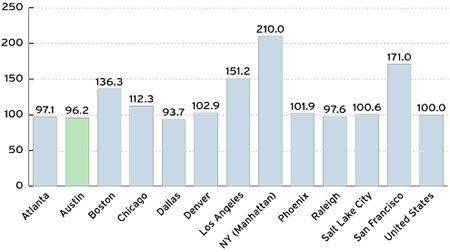
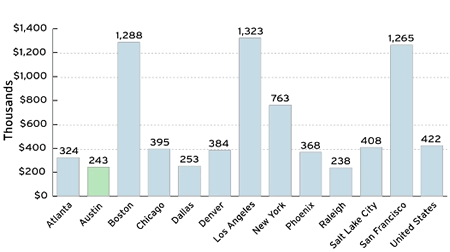
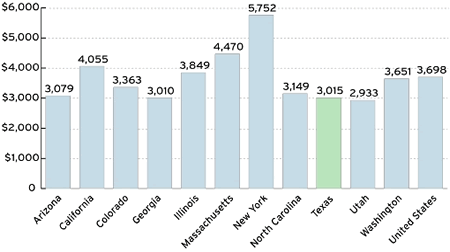
I think a lot of people who haven’t lived in Texas (and most other areas) may have a misconception or stereotype of what it’s like to live there, and that is especially true of Austin. What I like about the area includes the relatively temperature weather, a large university center, a strong tech industry, and of course a low cost of living and tax burden. As for the financial details, I grabbed some graphs from the Austin Chamber of Commerce website, which were based on independent data.

Cost of Living Index, 4 Quarters Ending Q2 2007

The index takes into account the combined costs of housing, utilities, transportation, healthcare, and other factors. According to this CNN calculator based on the same index, if you are earning $100,000.00 after tax in San Jose (CA), the comparable after-tax income in Austin is 61,217.

Average Home Price, Middle Management Housing, 2007

(For the chart, a “middle management house” is a single-family dwelling model with approximately 2,200 sq.ft., 4 bedrooms, 2 1/2 baths, family room, and 2-car garage.)

These might have changed a lot since 2007, but the median home price in Austin is still a shade under $200,000. If a house in California costs $600,000 that only costs $200,000 in Austin – how many more years of work would it take to pay for an extra $400,000 plus mortgage interest? Would you move to Texas if it meant you could retire an entire decade earlier? Hmmm…

Tax Burden: State & Local Taxes Per Capita, 2005

So not only do things cost less, but I can also earn a lower salary and still get the same after-tax results. In general, Texas ranks 45th out of the 50 states in terms of total taxes per $1,000 of income. With no personal income tax, the primary taxes in Taxes are property and sales tax. In Austin, property taxes are about 2.2% of appraised value per year.

Quick Summary
Going by the numbers, moving somewhere else can certainly seem attractive. For me, not only do things cost less as a whole, but my income would take much less of a tax haircut as well. Now, I don’t think everyone should move, and I have no plans currently to do so myself. But if you are re-examining your financial situation, it can be worthwhile to keep an open mind and consider the possibilities. Everything is a trade-off, and what you gain may be worth more than what you lose.

Save on Housing Costs: Renegotiate Your Rent With Landlord

altext

If you are are a renter in this market, you may be able to lower your monthly housing costs with a little research and courage. Mary Pilon of the WSJ Wallet Blog recently showed how she reduced her rent by 11% by writing a convincing letter to her building manager’s office. She even shares a form letter that people can use themselves. I reverse-engineered some of it to see what types of ammunition might be useful when negotiating with your landlord:

Provide local statistics. A quick Google News Search with the keyword of your city and “average rent” or “rental vacancy rate” should bring up some useful stats. For example, according to Forbes, Atlanta is the nations 3rd most empty city, with rental vacancy rate of 16.1%.

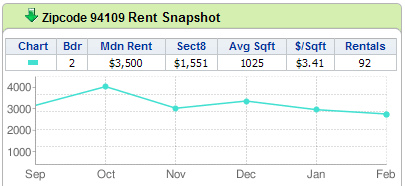
Provide concrete, real examples. Use rent-comparison tools like Rentometer or Zilpy to find out how your rent compares with local properties. (Zilpy also provides rental trends by zip code, as shown below.) Try to find places that are very similar or better than yours, but which are renting for less than you pay now. You could even provide the exact Craigslist page.

Of course, the best comparison is with another person in your complex. Ask what your neighbors what they are paying. That’s how Pilon found out her neighbors were paying $300 a month less than her. If you’re not that close to them, perhaps start up a conversation with “Hey, how’s it going. Isn’t it a bummer that our rents are going up?”. You might get a “Yours too?” or a “Really, mine’s still $XXX…” I don’t see people being overly uptight about sharing rents.

Show why you are attractive renters. Some landlords try to squeeze out every last penny of rent, and deal with the resulting turnover, but 99% of the casual landlords I know would gladly give a discount to low-maintenance tenants. I know some who literally haven’t raise rent in a decade because the renter pays rent like clockwork, takes care of the house, and never bugs them unless it’s really important. You’ll want to show why you should get a discount too.

Remind them that you have a solid rent payment history. Perhaps you have excellent credit scores, or maybe it has greatly improved since you first moved in. Point out any minor repairs or maintenance that you have done on the house, or offer to do some in exchange for a rent reduction. Provide reasons why you want to become a long-term renter, or even agree to extend your lease.

These tactics may not work in all areas of the country, but in lots of places it should at least be worth a shot. The worst thing they can say is no.

$750B From Federal Reserve = Mortgage Rates Dropping To Historic Lows Again?

The market news from yesterday was that the Federal Reserve announced that it would buy $300 billion of long-term Treasury bonds, along with an addition $750 billion in mortgage-backed securities. My mortgage broker sent out a corresponding e-mail stating that he expected mortgage rates to drop somewhere around 3/8 to 1/2 points on conforming 30-year fixed mortgages.

The wholesale mortgage rate on a 30-year fixed loan with zero points, a 740+ FICO score and 20% down-payment was about 4.7% recently. The average rate from Bankrate was 5.29%, with an average total of 0.33 points. I don’t recall the exact numbers, but that sounds pretty close to the best rates I saw a few months ago.

If you’re shopping for a mortgage right now, or maybe you have even already locked in your rate, it may be a good idea to see what’s up. I recently shaved off $150 a month off my mortgage payment permanently with a loan modification (not federally subsidized) after researching refinance options. Don’t forget the current $8,000 first-time homebuyer tax credit as well.

For the interested, here is my collection of posts about my home-buying experience.

Walking Out On My Mortgage? My View

Here’s my personal response to my question: Would You Ever Walk Away From Your Mortgage? I didn’t initially mean to make this a separate post, but it ended up being a bit long. Ethics are always a fuzzy area and very difficult to explore clearly on paper. The question also hits close to home, because it’s quite possible in the near future that I could also owe more on my mortgage than my house is worth. Hurray leverage!

Ethics and Debt
Everyone has their own ethical standards. When thinking about this problem, the first example I thought of was unsecured debt like credit cards. Let’s say you could extract $100,000 cash from credit cards (actually not that hard just a year ago). What’s to keep you from running away with it? Besides an sense of honor, one major deterrent would be that your credit score would be junk for 7 years or so.

But what if that obstacle was removed? Let’s say you knew you were going to move to Thailand forever. Then you could keep the money and there would be no financial consequences. (Heck, $100k would probably fund a few years in Thailand…) Now, I think most people would agree that this would be unethical. I do. Of course, some might point out that Citibank or American Express knew this was a possibility, so too bad for them, right?

Going back to mortgages, the only addition is that your house is now placed as collateral. Does the addition of collateral change the ethics of paying the loan back? I don’t think so. If somebody walks away, then they’re basically saying their collateral isn’t worth much anyway. So I must conclude that there is still an ethical obligation to at least attempt to repay any loan.

Practical Matters: Hardship and Math
Now, it’s easy to say you’ll always repay your loan when you’re not staring down the possibility of bankruptcy or losing decades worth of saving.

Extreme Example #1: Easy Money
Let’s say you have $100k in the bank, but you decide to go ahead and buy a $300k house with 0% down. The local economy collapses, and the house is now only worth $100k. Certainly, you could suck it up and keep paying your mortgage even though you have $200k of negative equity to overcome. How can anyone not be tempted to just walk away and go buy the house next door for cash with only $100k? You’d be walking away from $200,000.

Here is a video from CNBC about a guy asking about if he should walk away from his home (via TBP). Starts at 0:30.

He bought the house for $600k and says it is only worth $270k now. His outstanding balance is $350k, so he’s underwater by about $80k. All of the show’s hosts tell him that it his is obligation to keep paying. They even suggest that he is irresponsible for having a interest-only mortgage which resulted in some negative amortization. However, this guy initially put up a 50% downpayment on this house. Yes, the guy has already lost $300,000! What if he had put down nothing? Can these they each honestly say they would walk away from $330,000?

Sure, if I was only $10,000 or probably even $100,000 underwater on my mortgage, I wouldn’t walk away if I could still make the payments. The phrase “good faith effort” comes to mind. But to be honest, I think there would be a point where practicality would step in. It might be high, but the point is the number exists. Would I be willing to work for an additional decade in order to feel better about paying off a mortgage? I don’t think so. So I can’t necessarily judge others who have done the same, even if their tipping point was lower.

Extreme Example #2: Impending Bankruptcy
This time, imagine you just lost your job. Your ARM loan has reset, you can’t refinance, and your mortgage payment is now $3,000 per month. Rent on a comparable house would be $1,000 per month. You have $25,000 in savings. You can either walk away now, and make a go with your $25,000, or wait it out and face probable bankruptcy. Then you’ll not only lose your house but also be broke. In this situation, I’d definitely cut my losses. I would not sacrifice the financial security of me and my family over a house loan.

Poll: Would You Ever Walk Away From Your Mortgage?

In order to qualify for federal loan modification assistance, your mortgage balance can be no larger than 105% of the appraised value of your home. So what if your house’s value dropped so much that you owe more than that? (This is referred to as being “underwater”.)

One option that many people are considering is to simply stop paying your mortgage, walk away, and mail your lender the keys. This is especially true in the 27 states in the US that have “non-recourse” mortgages, where the lenders can’t even seek the difference between what you owed and what they auctioned your house for.

Some people view paying your a mortgage as a moral and/or ethical obligation. Others view it simply as a legal contract, where you agreed to borrow money with your house as collateral. The lender takes on the risk of you walking away, in exchange for a certain interest rate. You, on the other hand, must deal with the consequences of a damaged credit history.

For the purposes of this poll, “walking away” means doing so voluntarily before circumstances would force you into foreclosure. What do you think?

Would You Ever Walk Away From Your Mortgage?

View Results

Loading ... Loading ...

I won’t take a stand either way for now, but will post my own thoughts tomorrow. Elaborate on your choice in the comments below!

Do I Qualify For Loan Modification? The New Homeowner Affordability and Stability Plan

I’ve been reading through the details of the new Homeowner Affordability and Stability Plan, which is letting lenders modify mortgages as of March 4th. Most of the information is collected here, where you can find a fact sheet, a two-page summary of modification guidelines, and the 17-page full list of guidelines.

Eligible borrowers can either refinance into a new, more affordable mortgage, or obtain a modification of their existing loan. Your existing mortgage must have been originated on or before January 1, 2009. I’ve tried to briefly summarize the rules below.

How do I qualify for a refinance?
The Home Affordable Refinance program will be available to 4 to 5 million homeowners who have a solid payment history on an existing mortgage owned by Fannie Mae or Freddie Mac. Normally, these borrowers would be unable to refinance because their homes have lost value, pushing their current loan-to-value ratios above 80%. Under the Home Affordable Refinance program, many of them will now be eligible to refinance their loan to take advantage of today’s lower mortgage rates or to refinance an adjustable-rate mortgage into a more stable mortgage, such as a 30-year fixed rate loan.

How do I qualify for a loan modification?
Borrowers who are struggling to stay current on their mortgage payments may be eligible (even if they are not currently behind on payments!) if their income is not sufficient to continue to make their mortgage payments and they are at risk of imminent default. This may be due to several factors, such as a loss of income, a significant increase in expenses, or an interest rate that will reset to an unaffordable level.

In general, you may qualify for a mortgage modification if (a) you occupy your house as your primary residence; (b) your monthly mortgage payment is greater than 31% of your monthly gross income; and (c) your loan is not large enough to exceed current Fannie Mae and Freddie Mac loan limits.

How will my existing loan change?
The modification sequence requires first reducing the interest rate (subject to a rate floor of 2%), then if necessary extending the term or amortization of the loan up to a maximum of 40 years, and then if necessary forbearing principal. Principal forgiveness or a Hope for Homeowners refinancing are acceptable alternatives.

I think I’m eligible! How do I start the process?
Gather up your income documentation (paystub, your most recent income tax return, all mortgage documents, and all information on all debts like car, student, or credit card loans. Then contact your lender or HUD-approved counselor and ask to be considered under the Homeowner Affordability and Stability Plan.

It would seem that a lot more people might be interested in the refinancing aspect of this plan. I don’t qualify for a loan mod, but am certainly above 80% loan-to-value. However, I doubt my rate can get much better. The main obstacle is to find out if you indeed have a Fannie or Freddie loan. I wonder if the closings costs will be subsidized – they mention that appraisals would be waived in some cases.

March 2009 Financial Status / Net Worth Update

Net Worth Chart 2009

Time for another super-happy-fun net worth update…

Credit Card Debt
For newer readers, don’t worry. In the past, I have been taking money from credit cards at 0% APR and immediately placing it into high-yield savings accounts or similar safe investments that earn 5% interest or more, and keeping the difference as profit. I even put together a series of step-by-step posts on how to make money off of credit cards this way. However, given the current lack of good no fee 0% APR balance transfer offers, I am just waiting to pay off my existing balances.

Retirement and Brokerage accounts
Unless you’ve been completely devoid of human contact for the last few weeks, you know the market is in the dumps. I really don’t have much market commentary to make, besides the fact that I still intend to keep investing. I’ve been trying to cut back on the CNN/CNBC-types of financial news actually and focus more on things I can change, which as a result has helped keep me a bit more optimistic.

Cash Savings and Emergency Funds
Our emergency fund has increased a bit, but this snapshot was taken before we each put $5,000 into our 2008 IRA contribution. So really it remains at about a year of our current expenses.

Home Equity
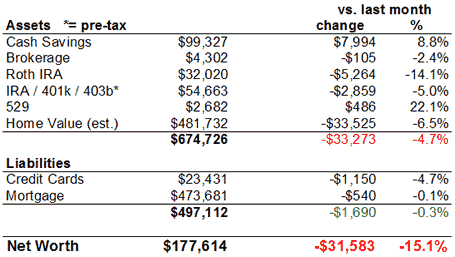
This is where most of this month’s drop comes from. I used the same internet valuation tools as before – Zillow, Cyberhomes, Coldwell Banker, and Bank of America (old version) – but while most of them continued their gradual decline, the Coldwell Banker estimate dropped by over $140,000 in one month! After taking off 5% to be conservative and 6% for expected real estate agent commissions (11% total), the overall average estimate dropped by $34k. Well look at that, I am nearly “underwater” on my house despite putting 20% down a year ago. Oops.