Rental Property vs. REZ Residential Index ETF

Many people see owning a rental property as a ticket to prosperity. But wouldn’t it be nice if you could simply own an interest in a rental property, but not have any of the accompanying hassles? I’m far from an expert in this field, but let’s take a look at an REIT that invest in residential real estate.

What is an REIT?
REIT stands for Real Estate Investment Trust. From the National Association of REITs website:

A REIT is a company that owns, and in most cases, operates income-producing real estate such as apartments, shopping centers, offices, hotels and warehouses. Some REITs also engage in financing real estate. The shares of many REITs are freely traded, usually on a major stock exchange.

To qualify as a REIT, a company must distribute at least 90 percent of its taxable income to its shareholders annually. A company that qualifies as a REIT is permitted to deduct dividends paid to its shareholders from its corporate taxable income. As a result, most REITs remit at least 100 percent of their taxable income to their shareholders and therefore owe no corporate tax.

Since all the REIT income usually “passes through” straight to the shareholders, you are getting relatively direct exposure to real estate. You’re not investing in raw materials, a homebuilder, or some other derivative.

REZ Residential ETF
The iShares FTSE NAREIT Residential Plus Capped Index Fund (ticker REZ) is an ETF that tracks the FTSE NAREIT All Residential Capped Index. Here is the breakdown by industry breakdown and also the top 10 holdings.
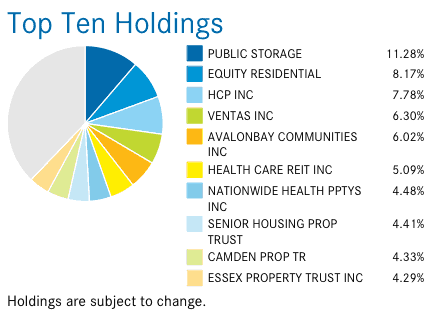
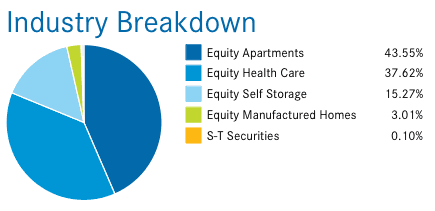
As you can see, this is not the same as owning a single-family house, or even a bunch of single family houses. The fund holds interests in apartment complexes, healthcare facilities such as seniors housing communities and skilled nursing facilities, and also self-storage companies. For example, you can search online through the apartment complexes owned by Equity Apartments.

The annual expense ratio for REZ is 0.48%, which is on top of the built-in costs spent by each individual REIT. iShares also has ETFs focused on the different sectors such as Retail (retail stores, shopping malls) and Office/Industrial (office and industrial buildings).

ETF Advantages
One obvious advantage of owning an ETF instead of a single rental property is simplicity. You don’t have to spend time and effort dealing with finding tenants, maintenance issues, or problems with local government. You don’t have to search for properties to buy, negotiate prices, or obtain financing. You also don’t have to ever worry about keeping up cashflow, as there are no mortgage payment due each month.

Then there’s liquidity. If you need to sell, REZ has decent share volume so you can just type in a sell order and you’re done. You pretty much know the market price at all times.

Which One Is Better?
Here’s the tough question. Which will have the better return? With a single property, you are looking at monthly cashflow and property appreciation (plus possible tax benefits). With the ETF, you have your quarterly dividends and share price appreciation.

REZ currently has a current distribution rate of 5.11% based on its last quarterly dividend of 0.3003 cents per share, while the dividend yield listed on Yahoo! is 8.84% based on TTM (sum of all dividends paid out in the trailing twelve month period). According to the iShares page the Price/Earning ratio was 33 and the Price/Book ratio was 1.73 as 6/30/09.

The trailing 1-year total return of REZ is -39.64% according to Morningstar. (Too new for older numbers.) However, depending on how much your rental house was leveraged, many private investors could have done much worse. If you put $10,000 down on a $100,000 house and the house dropped just 5% in value, you would have essentially lost 50% of your $10,000 as well. I’m not sure what the total leverage of the REITs in this ETF are.

Also, we have to go back to the fact that this REIT doesn’t hold a bunch of detached single-family houses. Healthcare facilities seem like they would be a good source of income in a growing field. However, they could also be susceptible to political changes in Medicare rules.

I think its safe to say that any individual property could do worse or better than REZ. Perhaps a better question is how much you value diversification. Instead of putting your money into one property in one area, with an ETF you are instead owning a slice of thousands of different properties across the country. If you have high confidence in your abilities to select and manage a single property, that might be the better way to go.

Should Home Equity Be Part Of Your Portfolio Asset Allocation?

When people talk about asset allocation, they usually refer to the relative amount of stocks or bonds in their portfolio (like the model portfolios shown here). But I am occasionally asked whether to include personal home equity in asset allocation. If you have a significant amount of home equity, does this mean you are overexposed to the Real Estate sector? Should you change your other investments to compensate?

Conspiracy Theory Argument
Professional portfolio managers are usually paid based on a percentage of assets under management, or when you make trades. Since they don’t usually control your home equity, they can’t charge you for it, which is why some say the industry secretly decided it shouldn’t be included in asset allocations.

I’m not so sure about this one. Most people don’t have professional money managers. And if they do, for example I’m betting that most advisors would include a huge 401(k) in their planning even they didn’t control it.

Pricing and Liquidity Argument
It is very hard to determine the true market value of an individual house. You can’t sell only a portion of it, which means you can’t rebalance relative to other asset classes. Because of these issues, some people say personal home equity shouldn’t be included.

Still, this is also true of investment/rental properties, which I think should be included in asset allocations just as much as owning any company with physical assets.

My Answer: It Depends?
I plan on staying in the same geographical area indefinitely. Once I’ve committed to buying a place, I’m mainly trying to pay off all “future rent” at once. If I never move, then obviously it won’t much to me what happens to housing prices. If housing prices in my area go up, then my house value will go up, and an alternative house I want to buy will go up. The opposite will be true if housing prices go down. Over the long term, prices should pretty much match inflation. So I don’t consider my house as part of my portfolio.

However, if I planned to sell my house upon retirement, and then use the money to move to a significantly cheaper home and use the difference to cover other expenses, then I would care about my house value because I would have to “cash out” at some point. Some people end up relying on a reverse mortgage to pay for things, which would be a similar scenario.

Notes From A Kiyosaki Rich Dad, Poor Dad Series Audio CD

While going through some old boxes, I found an old CD case containing some audiobook recordings from a real estate program by Robert Kiyosaki and Dolf De Roos. I’m pretty sure they are from this set called Rich Dad’s Roads To Riches – 6 Steps To Becoming A Successful Real Estate Investor.

Kiyosaki is best known for his book Rich Dad, Poor Dad (my 2005 review). People tend to either hate him or love him, but to me he’s just a guy who has wrapped up a legitimate way to make money – investing in real estate – and tried to simplify and market it to the general public in a palatable way. You can read about most of the criticisms at this link, although it is a bit long (Reed really hates this guy.). I see his books as having the occasional nugget of wisdom buried in a pile of shiny happy fluff.

Luckily, I took notes when I listened to it the first time, so I didn’t have to go through it all over again. Here’s the stuff I decided was worth remembering.

  • Avoiding Alligators. A general rule is that you should never invest in a home that does not immediately produce positive cashflow. In other words, the rent covers your mortgage plus other expenses, and you don’t have to keep making monthly payments out of your savings or income. A property that requires more money every month is called an “alligator”. Why? Because you have to constantly feed it and feed it. If you ever stop, it eats you.
  • When To Expand. Along the same lines, if you keep buying alligators, you can only buy a finite number before all your money is tied up feeding them. If you buy cashflow-positive properties, it is much easier to keep buying them. Once your property value increases, you can extract the equity by refinancing and use to invest in another cashflow positive house. This way, you’re never in a bind with regards to cashflow.
  • Tenant Screening Tip. When looking for tenants, always ask for the contact information of the current landlord and the landlord before that. This is because the current landlord might lie to you in order for you to accept their nightmare tenant, and have them move out peacefully. The previous landlord will be willing to tell you the truth.
  • Treat It Like A Business. Don’t put up with tenants that chronically pay rent late. Maintain concrete rules for due dates, charge late fees when applicable, and if necessary, initiate the eviction process promptly. If you show them that you won’t tolerate late payments, this will either whip the wishy-washy ones into shape, or get rid of the bad ones as soon as possible.

The rest:

  • The 100:10:3:1 Rule. This rule basically states that to find an appropriate real estate investment, you’ll need to look a 100 properties, makes offers on 10 of them, attempt to finance 3, and you may finally buy one of them. Basically: look hard and be picky.
  • On Leverage. $10,000 can control $10,000 worth of stocks. If it goes up 10%, then you are up $1,000. Alternatively, $10,000 can control $100,000 worth of real estate through borrowing money (leverage). If your real estate goes up 10%, then you’re up $10,000. Of course, they don’t focus on the fact that if your home’s value drops by just 10%, you’re completely wiped out. The ability to leverage cuts both ways, but can help with cashflow.
  • Property Manager. Hate the idea of fixing toilets at 3am in the morning? Hire a “good” property manager. Unfortunately, no tips were included on how to find such a mythical creature. (Similar to unicorns and the “cheap and prompt handyman”) Also, property managers usually charge about 10% of your gross rent.

Recasting/Re-amortization of Mortgage with Principal Prepayment

I’m getting ready to pay some extra money towards my mortgage loan, and remembered that I have an option to re-amortize my mortgage loan if I make a substantial principal prepayment. This is also known as “recasting” a mortgage. Basically, my monthly payments are lowered slightly over the same remaining term instead of simply accelerating my loan payoff schedule. My interest rate and escrow payments stay the same, and I don’t have to pay any fees or closing costs.

Most loans that are sold off to investors do not allow recasting, as I imagine they don’t want the added complexity. However, some allow either a one-time recast, and other allow repeated recasting if the extra payment is large enough. Ask your lender about this feature beforehand if you’re interested in it. In my case, I get to re-amortize whenever I pay a lump-sum of at least $10,000.

My tentative plan, discussed briefly in my Quick & Dirty Plan To Reach Financial Freedom, is to make two extra mortgage payments a year. (If interest rates rise enough, the money will simply be placed into a long-term bond.) This will shorten my 30-year mortgage by an entire decade, so I’m mortgage-free in 20 years at age 50. The commonly discussed biweekly payment plan is the same as making one extra mortgage payment each year, and knocking off about 5-6 years.

For my mortgage, if I pay exactly $10,000, it would only lower my normal mortgage payment about $50 a month. Theoretically, if I keep my payments the same as if I didn’t re-amortize, my total interest paid would be the same, and my loan would still be paid off 10 years early. The lower required mortgage payment would simply provide an added bit of flexibility in case I run into financial trouble.

However, for my situation the $10,000 requirement would mean I’d have to wait and lump my payments every other year instead of making the payments whenever I like. I don’t think $50 a month is worth the added hassle, as I really do want to have this thing paid off in 20 years.

(As a reminder, I think paying extra towards your mortgage should only be done after you have maxed out your tax-deferred accounts like IRAs/401ks, as well maintaining an emergency fund or other liquid assets.)

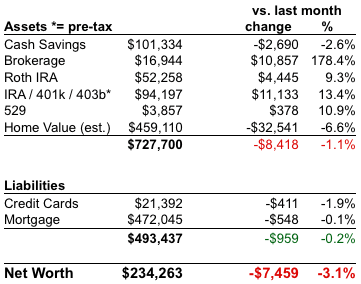
Monthly Net Worth Update – July 2009

Net Worth Chart 2009

Credit Card Debt
I have taken money from credit cards at 0% APR and placed it into online savings accounts, bank CDs, or savings bonds that earn 4-5% interest (much less recently), and keeping the difference as profit. I even put together a series of step-by-step posts on how to make money off of credit cards in this way. However, given the current lack of great no fee 0% APR balance transfer offers, I am mostly waiting on existing offers to end. My credit score remains high enough that I haven’t seen any negative actions.

Retirement and Brokerage accounts
Markets most went sideways this past month. 401k contributions are still going regularly, and I want to make my 2009 non-deductible IRA contributions soon. I still think the best thing to do is to keep investing regularly, although it is quite boring to watch.

Cash Savings and Emergency Funds
We still have a year’s worth of expenses in our emergency fund, and it is still growing. Possible uses for extra cash might include capital improvements to the house, including a solar hot-water system to reduce electricity bills, or a photovoltaic system to possibly eliminate them! I love the idea of selling electricity back to the city.

Home Equity
Using four different internet valuation tools – Zillow, Cyberhomes, Coldwell Banker, and Bank of America (old version) – I took the average and took off 5% to be conservative and 6% for real estate agent commissions.

We remain “underwater”, with our outstanding mortgage balance greater than what we probably would net after selling our home. Home equity variations continue to dwarf all other activity, which is somewhat annoying since it’s not that important. Just gotta shrink that mortgage!

Creating Your Own Three Legged Stool of Retirement

You may have heard the term “three-legged stool”, taken from the idea that a stool needs three legs to maintain balance. (Photographers use tripods, no duopods or quadrapods. Even a four-legged chair will likely wobble.)

Old Three-Legged Stool of Retirement

Traditionally, the components of the three-legged stool of retirement have been presented as Social Security benefits, Pensions, and Personal Savings (401k, IRA, and other assets).

stool
image via Michigan.gov

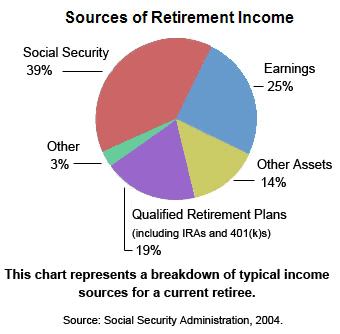
This is partially supported by data from the Social Security Administration:

pie chart
image via Pbs.org

The Qualified Retirement Plans slice combines pensions, 401ks, and IRAs together, making it hard to see the breakdown. The Other Assets include income from other investments like capital gains or dividends from taxable accounts and real estate. We observe that a quarter of all income in retirement is still from working for a paycheck.

Shaping Your Own Retirement Legs

These are just averages, and each of us will have their own path to retirement. If you’re planning on retiring early, you won’t have Social Security yet. For people born after 1960, the full retirement age for benefits is already 67, and expect it to rise even further the younger you are. I think some form of SS will still be around when I’m 70, but who knows.

1. Flexible, reliable, part-time income
We already saw that lots of people over 65 still work. Even though I want financial independence early, I’ve also come to realize that I’ll never stop working. Ask yourself what are you really going to do in retirement? In addition, I think it would be stressful to stare at a big pile of cash and think to myself – “Crap, I hope this lasts for 30+ years!” Maintaining a part-time job and the related skills would help my cashflow, and also ensure that I could return to the workforce if disaster strikes.

I would want a part-time job that could provide some socialization and a sense of improving your community or helping others. Most of my imagined jobs involve teaching, coaching, sporadic technical consulting, or something tourism-related. It can’t be 9-5, and I’d want to be able to take months off at a time. This won’t be easy to find, so I need to start developing more “fun” skills as well as personal relationships now.

2. Personal Savings: Accumulate 30 times annual (non-housing) expenses
Without a pension or Social Security, you’ll need to live off your own savings. If you invest in a balanced portfolio of 60% stocks and 40% bonds, studies have estimated that you can have a “safe withdrawal rates” of about 4% per year. By being a bit more conservative than that, this means accumulating 30 times your annual expenses.

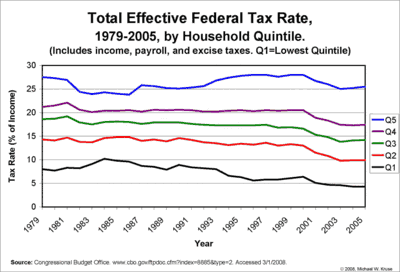
For example, if your annual expenses are $30,000, then you need to save $900,000. This is a very general rule of thumb. Taxes are tricky, but if your income is only $30,000 per year, you won’t be paying very much income tax. Check out the historical effective tax rate over a past 25 year timespan:

For reference in 1995, to be in the bottom 50% (safely in Q1/Q2) your adjusted gross income had to be under $31,000. And this even includes payroll taxes of about 9%, which you won’t have to pay on investment income. The result: very low taxes (possibly under 5%) if you keep your expenses down! Which brings me to…

3. A Paid Off House
I don’t think everyone needs to own a home. However, I happen to enjoy many of the intangibles of owning a home, I love my house and neighborhood, and plan on staying here a while. The cost of this leg can vary widely, from a $1,900 house in Detroit to… where I live, so choose where you want to live carefully. 😉

Financially, owning a home protects you from future inflation and rising rents. You are still subject to property taxes and maintenance costs.

In addition, not having to pay rent means you need less income from savings, reducing your needed nest egg in #2 above. You also pay less taxes. Withdrawing additional money from an IRA, for example, will mean subjecting them to your marginal tax rate, which could be 25% or higher. So to pay $750 in rent, you’d have to withdraw $1,000. Not very efficient.

So there, you have it, my three-legged stool. Yours may be very different – you may like renting, have a pension, own investment property, or have some other sources of income. I still worry about health insurance, but I’m still hopeful that some positive health care reform will occur that will create affordable health insurance for individuals under 65 not covered by an employer group plan.

* You can read more about the last two legs in my related post A Quick & Dirty Plan To Reach Financial Freedom.

Your Take: Rent Control Based On Tenant’s Income?

I saw this LA Times article San Francisco beefs up renter protections over at SavingFreak, and it nagged at me all day as both a recent renter and possible future landlord.

Here’s the quick summary. City Supervisor Chris Daly introduced legislation to add the following additional tenant “protections”:

  • Landlords cannot raise the rent above 33% of tenant’s income. An alternative amendment restrict this to situations where the tenant has a “hardship” – defined as being unemployed, having wages cut, or living on a fixed income and receiving a cost of living increase.
  • Allows tenants to add roommates other than family to help pay rent, even if explicitly forbidden in the rental contract.

My take. I think this going too far, and I am glad the mayor seems to agree and will veto it. Already 88% of rental units in San Francisco are subject to rent control, with annual rent increases being capped at an average of 2% per year. Now a landlord must charge rent based on a person’s future income? How can they control that? And then tenants can bring in whomever they want as additional roommates, also creating more wear and tear on the place?

This is different from having the government provide unemployment benefits, or even “bailouts”. This is forcing individuals to directly subsidize other individuals arbitrarily. Imagine being a cabinet maker and being forced to accept a 50% discount to any customer who lost their job recently, regardless of your own costs or financial needs. I echo the concerns of this editorial:

We all like the idea of businesspeople doing the benevolent thing when their customers are hurting, but it is not fair for a public entity to force such behavior on a private one.

Am I missing something here? Let me know in the comments.

Mortgage Interest Tax Deduction on Rental Property

As pointed out by reader Jason, another consideration when evaluating the cashflow potential for a rental property is whether you can deduct the mortgage interest on your taxes. To see what the rules are, I always like to start directly at the source, which meant a stroll through those fun IRS publications.

First, I started with IRS Pub. 936, Home Mortgage Interest Deduction. There is the basic definition of a “qualified” home:

For you to take a home mortgage interest deduction, your debt must be secured by a qualified home. This means your main home or your second home. A home includes a house, condominium, cooperative, mobile home, house trailer, boat, or similar property that has sleeping, cooking, and toilet facilities.

Then there is the question of how much you live in the second home:

Second home rented out. If you have a second home and rent it out part of the year, you also must use it as a home during the year for it to be a qualified home. You must use this home more than 14 days or more than 10% of the number of days during the year that the home is rented at a fair rental, whichever is longer. If you do not use the home long enough, it is considered rental property and not a second home. For information on residential rental property, see Publication 527.

If you live in it enough, it is treated as a “vacation” property and you can deduct the mortgage interest. In general, you are limited to the interest paid on the qualified loan limit of $1,100,000 for “home acquisition debt” combined for both first and second houses.

However, for a full-time rental, we are led to IRS Pub. 527, Residential Rental Property, which states:

Generally, the expenses of renting your property, such as maintenance, insurance, taxes, and interest, can be deducted from your rental income.

Interest expense. You can deduct mortgage interest you pay on your rental property. Chapter 4 of Publication 535 explains mortgage interest in detail.

Okay, now I’m off to IRS Pub. 535, Business Expenses, specifically the section on Interest.

You can generally deduct as a business expense all interest you pay or accrue during the tax year on debts related to your trade or business. Interest relates to your trade or business if you use the proceeds of the loan for a trade or business expense. It does not matter what type of property secures the loan. You can deduct interest on a debt only if you meet all the following requirements.

* You are legally liable for that debt.
* Both you and the lender intend that the debt be repaid.
* You and the lender have a true debtor-creditor relationship.

There are special rules for the capitalization of interest if you actually build the home yourself.

Summary
I am not a tax professional, but from reading the above publications, it appears that mortgage interest on a 100% rental home is not tax-deductible as an itemized deduction as your primary house may be.

However, chances are that it is an eligible expense that can offset your rental income and still reduce your tax burden in a similar manner. If you made $10,000 in annual rental income but paid $8,000 in mortgage interest, and ignoring other factors like depreciation, you’d only owe income taxes on the difference of $2,000. (Dealing with writing-off rental losses is for another post.) The amount paid that lowers your loan principal is not an eligible expense.

As long as you have adequate rental income, this would make the mortgage interest as an expense better than just an itemized deduction, since everyone gets the standard deduction. For 2009, the standard deduction is $5,700 for single filers, and $11,400 for married filing jointly. Only total itemized deductions above that amount would provide added savings.

Finding an Investment Property with InvestorLoft and PropScout

CNN Money recently listed 5 new tools for homebuyers, one of which was InvestorLoft.com. At first glance, it looks like a Zillow for investment properties.

I decided to run a quick search using their PropScout tool for an investment property in California for under $300,000. I sorted by cashflow, as I that would be a primary requirement were I ever to get into a rental property. One of the top results was a little ski chalet in South Lake Tahoe for $269,000. With a estimated positive cashflow of over $50,000 per year, I was starting to think InvestorLoft was in serious “Beta”, but decided to keep looking further. Besides, I’ve spent a good deal of time up there, so I was intrigued. Could I swing a nice little ski cabin for myself?

Cashflow Breakdown: InvestorLoft vs. My Numbers

You have to register (free) to see details, but here is the property link. Click on the “View Financials” tab to see the breakdown.

Expenses
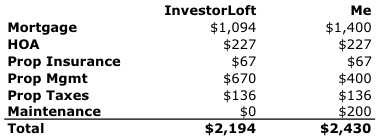
InvestorLoft’s default mortgage numbers have you putting 20% down, and financing the remaining 80% with an interest-only loan. I’d probably go with a 30-year fixed fully-amortized loan, and these days investment property have much higher interest rates. At 20% down and 7% interest, I got $1,400 for an estimated mortgage payment.

This chalet is really a townhouse, so it comes with HOA fees. Property management costs look to be estimated at 10% of gross rent, although as you’ll see below I don’t agree. No maintenance costs were estimated, but as a vacation rental with high turnover, I put in $200 per month. Here are the final numbers side-by-side:

Income
Here’s where that crazy cashflow number comes from: The expected monthly rent was $6,700 a month. (This is also why the property management cost above was $670 a month.) “Rental estimates based on 26 comparable rental listings with matching number of bedrooms and size in a 1.5 mile radius. ” Hmmm. First of all, there’s no way a month-to-month tenant would pay $6,700 a month for this wood shack. It has to be a vacation rental, and I can only guess that they are assuming 100% occupancy.

For some comparisons, I looked up similar properties at VRBO.com – Vacation Rentals by Owner. This chalet does not have the nicest interior, but the location is above average and is near the main highway.

Roughly, it would seem like I could charge $100 a night (taxes not included) for this chalet during May-November, along with a $75 cleaning fee per stay. It could go up to $150 a night during peak ski season (December-April). Occupancy rates would have to be a conservative 50% during the offseason and 75% during peak season. If I assume that I break even on the cleaning fees, that would work out to an average monthly rental income of $2280.

(I wasn’t quite sure how much a property manager would charge for managing a vacation property with people coming and going, especially if bookings were made online, so I estimated it around 20% of gross rent.)

Results
Too bad, it looks like I’m not going to get rich by buying this chalet. The InvestorLoft estimated monthly cashflow was a positive $4,094 a month, while my own rough numbers have me about $200 a month in the hole. I know I am being conservative in some areas, but I think that’s how you have to do it, especially for something optional like a vacation rental. The numbers actually aren’t horrible, though, it might warrant some more investigation…

InvestorLoft looks to be another one of those internet tools that you’re happy exists because you’ll play with it, but you can’t rely on them as there is still plenty of room for improvement.

Mortgage Rate Reset Timeline: Another Wave Coming

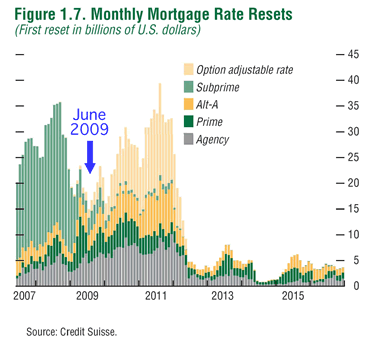
One of the things I like to read when I get the itch for some stock market opinion (which isn’t very often) is John Hussman’s weekly market commentary. Not that he’s always right, and I don’t own any of his mutual funds, but I like to hear his reasoning. In this week’s 6/8 post, he references a chart that shows us in a temporary lull of mortgage resets. The infamous subprime “wave” is past, but there is another big wave of option ARM and Alt-A resets ahead:

As I’ve noted before, recent months have represented a lull in the reset schedule, which was accompanied until recently by a moratorium on new foreclosures. Those foreclosures are now ramping up quickly, and a fresh surge in resets will add to the difficulties beginning later this year.

The chart originates from an IMF report entitled Assessing Risks to Global Financial Stability.

These upcoming resets may not be as bad as they are supposedly borrowers with slightly better credit profiles, assuming that enough people can refinance their mortgages to something they can afford. But it’s kind of hard to refinance when you’re upside on your house. Even I’m basically upside-down on my mortgage, and I had a 20% downpayment. Thank goodness I have a 30-year fixed, a steady job, and no desire to move!

I’m not changing my asset allocation by selling stocks or anything right now, but I’m also not getting too attached to these recent market gains. Plenty of uncertainty ahead!

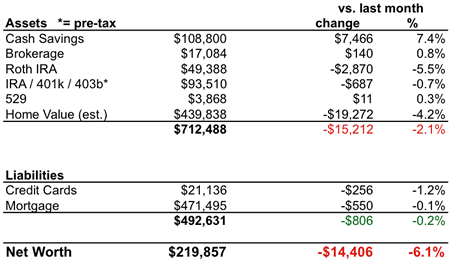
Monthly Financial Status / Net Worth Update (June 2009)

Net Worth Chart 2009

Credit Card Debt
In the past, I have taken money from credit cards at 0% APR and placed it into online savings accounts or similar safe investments that earn 4-5% interest or more, and keeping the difference as profit. I even put together a series of step-by-step posts on how to make money off of credit cards in this way. However, given the current lack of great no fee 0% APR balance transfer offers, I am have not been as active in this “game” recently. My credit score remains high enough that I haven’t seen any negative actions.

Retirement and Brokerage accounts
Markets went up, although as usual I don’t know why. I’ve been swearing off CNBC so I’m especially detached from all the buzz. Most of our retirement accounts rose about 10% the last month, which was over a $10,000 gain. I actually wish it stayed down so I could start investing some of my new cashflow at lower prices. However, waiting for it to drop again is not logical behavior, or so I keep reminding myself…

Cash Savings and Emergency Funds
We did still save a good deal of cash from our income this month, but I shifted about $10,000 of it into my brokerage account so that I can start investing in taxable accounts, which skewed the values above a bit. We still have a year’s worth of expenses in our emergency fund, which always gives me the warm fuzzies.

Home Equity
Using four different internet valuation tools – Zillow, Cyberhomes, Coldwell Banker, and Bank of America (old version) – I took the average and took off 5% to be conservative and 6% for real estate agent commissions. These sites are really wonky. Last month I was actually up, but this month my home’s estimated value dropped over $32,000 in a month. Shrug. I’m lucky that our work situation is doing well and we have no plans on moving.

According to my quick and dirty plan for financial freedom I should start paying extra towards my mortgage, but I’m having a hard time pulling the trigger on this one as well. I feel inflation coming. Should I just invest in stocks, and keep my 5% mortgage as long as possible?

Terminix Inspection and Protection Plan For Termites: Worth It?

Another one of my new joys of home ownership is having to worry about termites eating my house from the inside out. Munch munch munch! The previous owners were signed up for something called the Terminix Inspection and Protection Plan, and the bill for next year came in recently so I’m trying to decide whether to renew. According to the Terminix website, it includes

  • Certified annual inspection of your home and property
  • No termite control fees if activity is found
  • Free repairs of new termite damage upon discovery of live activity

The price is supposed to vary by area but for me it costs about $300 per year. This fee does not include any sort of preventative treatment.

So basically, I pay a regular annual fee which will cover all of my future termite control costs. Sort of a termite insurance plan. Well, almost all because the fine print excludes drywood termites, which are different from the more common ground or subterranean termite. According to Orkin, subterranean termites cause 95% of all termite damage in North America. However, they also thrive primarily in warmer coastal areas like where I live. So… I don’t know if this is a big deal or not.

Annual Inspection – Visual Only
I’ve already experienced an annual inspection earlier in the year, and I wasn’t really impressed. Basically a guy shows up with a stick and walks around the inside and outside of your house looking for evidence of termite activity. He looked under the sinks, inside cabinets, and pokes a few spots here and there. He did not inspect the attic, which would seem to be an easier place to spot termite damage. It took less than 20 minutes.

I pointed out a beam in the garage that had a hole in it and that released what looked like termite droppings (little brown salt-sized bits) when poked. He confirmed that it was termite droppings, but concluded they were old and there was no live termites. The house had been treated for termites when we bought it, so he might be right. But how can he tell that they haven’t returned? He didn’t take any samples for testing, take pictures, or anything like that.

No More Termite Bait Traps
Since our house has a bunch of those little green termite bait traps all around the outside, I thought he’d be checking those as well. Nope, it turns out that they stopped using that system (at least in my area). That struck me as lazy and/or cheap. I’d much rather be able to lift up a cylinder and see if there are termites lurking around, rather than only rely on seeing termite poop or actual visual damage to my house. I mean, look at this little factoid taken from their own site:

Costs vs. Alternatives
In the end, I’m not all that excited to pay $300 for someone to visit my home once a year, especially when they have an incentive to not find anything wrong. I don’t even get any preventative treatments, say once every 3 years or something. I haven’t gotten a quote back from Orkin yet, but according to their website they still do the bait and monitoring system.

According this CostHelper page, chemical treatment would cost around $1,350-$2,500 and a tent fumigation would cost $1,200-$2,500 for a 1,250 square foot house. Extreme damage would involve wall removal and replacement, which Terminix supposedly covers but sometimes only with a fight (see below).

Consumer Complaint Websites
I read through this RipOffReport page as well as this Terminix Consumer Alert page.

What do you think? Anyone have any experience with Terminix, especially their “Inspection and Protection Plan”?