Net Worth & Goals Update – March 2010

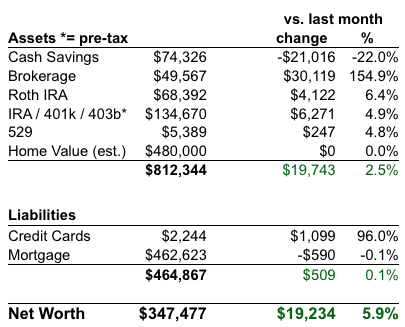
Net Worth Chart 2010

Lack of Recent Updates
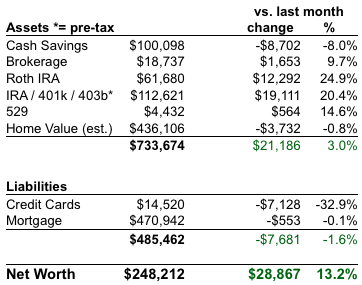
Up until last December, I had done regular monthly updates of our net worth for five consecutive years. However, recent personal events made me much less interested in detailed, analytic planning towards early retirement. As a result, I have barely checked any of my statements in the past few months, other than to make sure they weren’t negative. I think I made a few trades here and there, but for the most part haven’t bought or sold any stocks to maintain my asset allocation. I haven’t even converted my Traditional IRAs to Roth IRAs like I had planned, or made any IRA contributions for 2010.

Instead, reading blogs and other financial news has simply been a recreational escape for me, and I think my blogging has reflected that. I still had fun learning about ways to save money here and there, and enjoy keeping track of other market changes and various offers out there.

However, it’s time to catch back up a bit! Here we go…

Credit Card Debt
In the past, I have taken money from credit cards at 0% APR and placed it into online savings accounts, bank CDs, or savings bonds that earn 4-5% interest (much less recently), and keeping the difference as profit. However, given the current lack of great no fee 0% APR balance transfer offers, I am currently not playing this “game”. My balances are simply monthly charges that I have not yet paid in full when due.

If you’re looking for a competitive offer, Citibank is offering 0% APR for 15 months with a 3% balance transfer fee.

Income
We’re both still working, but will be taking some unpaid time off in April which will reduce income temporarily. Our monthly expenses are still much less than our (regular) income, so while we may eat into savings a bit, I expect to bounce back into the positive very quickly.

Retirement and Brokerage accounts
Near the end of last year, I had gradually moved $30,000 into a brokerage account at OptionsHouse to invest in ETFs due to their $3.95 trades. In my usual way, I then thought about switching instead to WellsTrade since I now had the $25,000 required to get 100 free trades per year. Stuff happened, the application process took too long, I got distracted, and the money is still sitting mostly non-invested. Grrr.

As stated above, besides our regular 401k contributions, we haven’t made any real moves in our retirement accounts either.

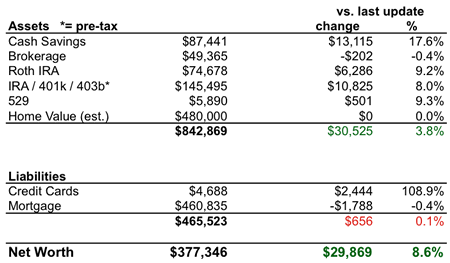
The stock market has done relatively well in the meantime, with the S&P 500 nearly hitting 1,200. Our total retirement portfolio is now $269,538 or on an estimated after-tax basis, $233,164. At a theoretical 4% withdrawal rate, this would provide $777 per month in after-tax retirement income, which brings me to 31% of my long-term goal of generating $2,500 per month.

Cash Savings and Emergency Funds
We continue to keep a year’s worth of expenses (conservatively set at $60,000) in our emergency fund. It’s still a nice warm safety blanket. I am thinking of moving a chunk of it into several separate 5-year CDs from Ally Bank, as they pay 1.60% APY (as of 10/25/13) and each would have a small early-withdrawal penalty of only 60 days interest.

Home Value
I am no longer using any internet home valuation tools to track home value. After using them for a year, I went back to simply taking a conservative estimate and focusing on mortgage payoff. After checking them again today, I am staying away. A house nearby sold recently for $500,000 but is listed at both Zillow and Coldwell Banker as being sold for $1,000,000. Needless to say, it is skewing my home value estimates!

It would seem that I am currently long on thoughts and short on action. Time to fix that.
Real Estate Price Trends Across United States – Zillow

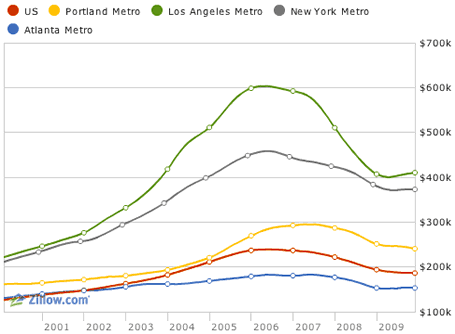
How’s the housing market in your area doing? You can find what Zillow thinks in their Real Estate Market Reports for many metro areas. There are lots of options to play with; you can view different metrics, change the time period, or even compare entire states.

Here’s a graph of Zillow’s Home Value Index for the US as a whole as well as selected large cities over the past decade. As you can see, there was a wide range of price swings from city to city.

It would interesting to see the same chart but with rental rates instead.

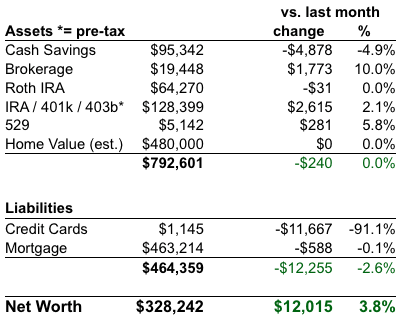
Monthly Net Worth & Goals Update – December 2009

Net Worth Chart 2009

Wow, December already…

Credit Card Debt
Up until now, I have taken money from credit cards at 0% APR and placed it into online savings accounts, bank CDs, or savings bonds that earn up to 4-5% interest (less recently), and keeping the difference as profit. However, given the current lack of good no fee 0% APR balance transfer offers , I am no longer playing this “game”. The balance that you do see is either before the end of the statement or during the grace period, where I’m also not paying any interest.

Retirement and Brokerage accounts
Mrs. MMB and I have both maxed out our 401k salary deferrals for 2009. We have also started to invest in regular taxable accounts by investing $30,000 that was previously being held as cash. I’ll outline the trade activity in an upcoming portfolio update.

Our total retirement portfolio is now $231,368 or on an estimated after-tax basis, $191,475. At a theoretical 4% withdrawal rate, this would provide $638 per month in after-tax retirement income, which brings me to 26% of my long-term goal of $2,500 per month.

We are also getting ready for a Traditional-to-Roth conversion once the income limits are removed in 2010. We’ll need to gather up some information in order to see how much tax we owe on any gains. More details on this to come.

Cash Savings and Emergency Funds
We keep a year’s worth of expenses in our emergency fund. Potential large expenses include $10,000 for home improvement projects (minor roof repair and solar water heating), as well as $15,000-$20,000 on a new car to replace our 1995 Nissan. Hope it can last us 15 years as well!

Home Value
I am no longer using any internet home valuation tools to track home value. Some people have suggested using my tax assessed value, but I also think that is too high. I simply picked what I felt is a conservative number based on recent comparables, $480,000, and keep it for at least 6 months if not a year. (Currently on month 3 out of 6.) For the most part I am concerned about mortgage payoff, which I still plan to accomplish in 20 years at most.

You can view previous net worth updates here.

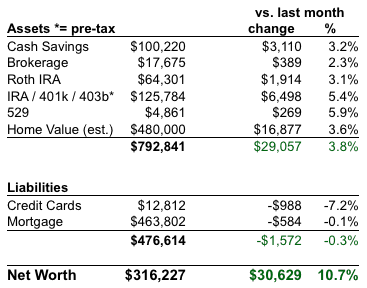
Monthly Net Worth & Goals Update – November 2009

Net Worth Chart 2009

Credit Card Debt
In the past, I have taken money from credit cards at 0% APR and placed it into online savings accounts, bank CDs, or savings bonds that earn 4-5% interest (much less recently), and keeping the difference as profit. I even put together a series of step-by-step posts on how to make money off of credit cards in this way.

However, given the current lack of great no fee 0% APR balance transfer offers, I am no longer playing this “game” and have just paid off my last 0% offer for now. This makes the net worth chart a bit funny, but it should clear up next month.

Retirement and Brokerage accounts
Our total investment portfolio increased by a few thousand dollars since last month. DW’s 401k was already maxed out at $16,500. I made another $1,000 contribution to my Solo 401k, for a total of $16,500 contributed in 2009 as well. (I forgot the limit was $16,500 and not $15,500 last month…) This makes us done with our goal of maxing out both our 401k salary contributions for 2009.

I am starting to build up too much cash, and have started investing for retirement in a taxable brokerage account as well. In the interest of tax efficiency, I’ll have to move around some investments in order to keep bonds in the tax-advantaged IRAs/401k and the “extra” stocks in taxable. I expect to finish investing $20,000 this week.

Taking that additional 20k into account, our total retirement portfolio is now $211,095, or on an estimated after-tax basis, $170,047. At a 4% withdrawal rate, this would provide $567 per month in tax-free retirement income, which brings me to 23% of my long-term goal of $2,500 per month.

Cash Savings and Emergency Funds
We keep a year’s worth of expenses in our emergency fund. Another $10,000 is earmarked for upcoming home improvement projects that I keep putting off (minor roof repair and solar water heating).

Home Value
I am no longer using any internet home valuation tools to track home value. Some people have suggested using my tax assessed value, but I also think that is too high. I simply picked what I felt is a conservative number based on recent comparables, $480,000, and keep it for at least 6 months if not a year. (Currently on month 2 out of 6.) For the most part I am concerned about mortgage payoff, which I still plan to accomplish in 20 years at most.

You can view previous net worth updates here.

Monthly Net Worth & Goals Update – October 2009

Net Worth Chart 2009

Credit Card Debt
For newer readers, I have taken money from credit cards at 0% APR and placed it into online savings accounts, bank CDs, or savings bonds that earn 4-5% interest (much less recently), and keeping the difference as profit. I even put together a series of step-by-step posts on how to make money off of credit cards in this way. However, given the current lack of great no fee 0% APR balance transfer offers, I am mostly waiting on existing offers to end.

Retirement and Brokerage accounts
Wife’s 401k was already maxed out at $16,500 for 2009. I made another $5,500 contribution to my Solo 401k, for a total of $15,000 contributed in 2009. This makes us about 95% done with our goal of maxing out both our 401k salary contributions for 2009.

Our total retirement portfolio is now $190,085, or on an estimated after-tax basis, $152,349. At a 4% withdrawal rate, this would provide $508 per month in tax-free retirement income, which brings me to 20% of my long-term goal of $2,500 per month.

Cash Savings and Emergency Funds
We still have a little over a year’s worth of expenses in our emergency fund. Part of the cash is earmarked for some smaller home improvement projects.

The next step is to put future funds into buying ETFs in a taxable brokerage account since I no longer have room in tax-sheltered accounts. I’ll probably use TradeKing or Scottrade as my buy-and-hold ETF broker, and keep Zecco as my “play money” account.

Home Value
I am no longer using any internet home valuation tools to track home value. If I still did, it would have been $572,000. Some people have suggested using my tax assessed value, but I also think that is too high. I am simply picked what I felt is a conservative number based on recent comparables, $480,000, and keep it for at least 6 months if not a year. This way, I just focus on the mortgage payoff, which I still plan to accomplish in 20 years at most.

You can view previous net worth updates here.

Are Internet Home Valuation Tools Worth Using? 12 Months of Historical Data

If you like to keep up with my net worth updates, you’ll know that I’ve been trying to estimate my home’s value using four different internet valuation tools:

  • Zillow.com
  • Cyberhomes.com
  • Coldwell Banker
  • Bank of America (older version)

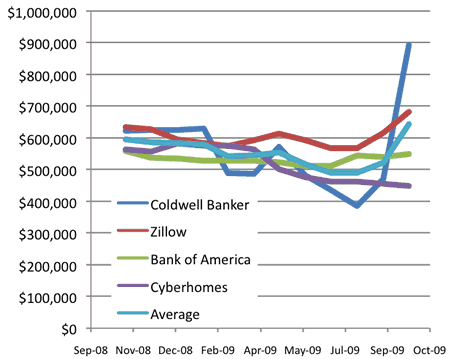
It’s finally been a year since I started using these tools, and I wanted to look back on how successful this experiment has been. Some give one numerical estimate and some give ranges. When I got a range of values, I simply used the midpoint. Here are the results over the past year:

Accuracy. We all know the real value of a house is what someone is willing to pay for it. (Actually, it’s what a bank is willing to lend that person…) But as a group, I would say these services can’t possibly be accurate because they all seem to disagree all the time. In nearly every month, estimates would differ by $50,000 or more. Half are up over the past year, and the other half are down.

Even though they all seem to use similar housing information databases, all of them must interpret the data differently. Some may take into account the change in value of all houses in zip code, or the city in general. Or they may differ in what properties they consider to be comparable sales (by zip code, by distance, size, or age). How do you weigh different physical factors (i.e. number of bedrooms, bathrooms, and square footage)?

Volatility. Bank of America appears to have had the least volatility over the last year, while Coldwell Banker has the wildest swings. I believe the recent upswings are due to some more houses being sold in my area at the higher range recently, while for a time very few houses were being sold and those were at the low end. If so, it would follow that Coldwell Banker weighs recent sales more heavily.

Should I Keep Using These Tools?

Even though the house you live in might not be considered an investment per se, I still think one should track it’s value. The fact is that $200,000 in home equity here could buy me an entire house elsewhere if I were to move. (And I know people who have done just that.) I have seen that home price trends can vary across different neighborhoods within the same area, so you can’t just go by city-wide data.

However, due to the lack of reliable estimates from these internet valuation tools, I’m going to stop using them in my net worth updates. I initially tried to deal with the variations by taking the average of all four and also subtracting 5% to be conservative and 6% for real estate agent commissions, but the swings still dwarfed all my other accounts. I’m still undecided about what alternative to use.

Extra Mortgage Principal Payments + Moving Soon = Good Short-Term Investment?

I received an interesting reader question last week about a scenario where you are very sure that you’re going to sell your house in a few years. In that case, would paying down your mortgage principal create an opportunity for a relatively high return with minimal risk? The e-mail:

Your blog is very insightful. I had an idea that I wanted to run by you. I plan to list my condo for sale in about 14 months. Currently I have a 2nd mortgage with an 8.875% rate. I want to have the most net cash at the time of sale, so I’m thinking the safest investment I can make over the next 14 months is to pay down this mortgage. If my math is correct, I would get a 4.9% return on the avoided interest (less what I would have gotten back from deductions). Am I crazy, or does it seem like I’ve found a good place to put my cash until I leave?

I’m not a mortgage professional, but it would seem to me that in theory this should work. When you make the additional principal payments, every future mortgage payment will also include less interest and more towards paying the loan balance down even faster. When you sell the house, you’ll get your “return” from this lower loan balance.

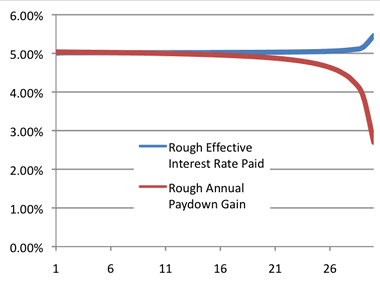
The annul return from paying down your principal should be roughly equal to the annual interest rate of your loan. The reader had an 8.875% second mortgage, which would seem like a pretty great short-term return over 14 months. The exact return might be a little off to the amortization schedule, it should be close. The mortgage interest may be tax-deductible, but remember that interest from a bank CD outside an IRA is also fully taxable. Check out these related posts:

Within the posts above, based on the amortization schedule of a 30-year fixed mortgage at a 5% interest rate, I plotted both the effective interest rate paid and the annual investment return from prepaying below:

I suppose that one big risk in doing this is that you don’t end up selling the house, so your cash is now stuck in the home’s equity and will be more difficult to access. So you’ll have to be fairly confident that you will be selling the house, or at least be okay with the possibility of just having a smaller mortgage balance.

100-Year Floods Are More Common Than You Think

altext

I hope that all of you in the Atlanta metro area are safe and dry right now. I’d also like to take this chance to correct a common misconception, which is often promoted by the media every time a flood occurs. As just one example, take this CNN article:

He hustled out of bed and rushed to the door. There were his neighbors, surrounded by floodwaters the neighborhood is supposed to experience only once every 100 years.

The highlighted sentence is not accurate, and gets people thinking strange thoughts like “Oh the last flood was in 1969, I should be good until 2069 or so”. The fact is there is a reason we hear about such floods all the time. Let’s look at what FEMA has to say:

The term “100-year flood” is misleading. It is not the flood that will occur once every 100 years. Rather, it is the flood elevation that has a 1-percent chance of being equaled or exceeded each year. Thus, the 100-year flood could occur more than once in a relatively short period of time.

Again, if you live in a 100-year floodplain, you have 1 percent chance of being flooded every year. Think of how concerned you’d be if you were told there was a 1-in-100 chance of your house burning down every year. The way the math works out, this means that over a 30-year mortgage, there is a 26% chance you’ll have a 100-year flood during that time period (1 – (0.99)30). This is also why most people with home loans in such areas are required to buy flood insurance.

Many people are in 500-year flood plains, which gets people even less worried. “The last flood was in 1909, we’re good for another 400 years!” Actually, having a 0.2% chance of a flood each and every year works out to a 6% chance of occurring at least once over a span of 30 years, or 1-in-17.

If you haven’t already, take some time and check if you are in a flood plain here. Some may consider buying flood insurance even if you are not required to by your mortgage lender. We ended up buying a modest amount of building coverage from the NFIP.

Investing in California Municipal Bonds?

Recently, I’ve been taking another look at investing in California municipal bonds. Even if you don’t live in California, the yields can be quite attractive. But is it a good idea?
Tax-Equivalent Yields
Right now, the Vanguard California Intermediate-Term Tax-Exempt Fund (VCAIX) has a yield of 3.49% with an average maturity of 7 years. In addition, since the interest from this fund is exempt from both federal and California state income taxes, the equivalent taxable yield is actually much higher. You can use a tax-equivalent yield calculator to find out how it works out for your tax brackets.

If you are in the 33% federal tax bracket and 9.3% CA bracket, that 3.49% would be the same as a taxable bond yielding 5.74%. Even for an out-of-state investor, the federal tax exemption alone gets you to 5.21%, which is higher than many mortgage interest rates.

If you are in the 25% federal tax bracket and 9.3% CA bracket, that 3.49% would be the same as a taxable bond yielding 5.13%. For an out-of-state investor, the equivalent yield is 4.65%. As you can see, these yields are definitely more attractive for those in higher tax brackets.

Safety Concerns
Is this reckless rate chasing? Let’s look at a few articles on California munis by Vanguard, Schwab, and Fidelity. Here are some highlights:

  • You’re nearly first in line. California’s constitution requires that state general-obligation bond payments take priority over other payments except for those that fund education. This means as a bondholder you’re ahead of other government employees, firefighters, and basically everyone else.
  • Diversify. If you do invest, don’t make it all of your portfolio. There is still some risk. You can still hold other national muni funds, US. Treasury bonds, and investment-grade corporate bonds.
  • Buy a bond fund. I would invest in a managed municipal fund and not in individual securities unless I was very experienced. You don’t want to have to navigate a minefield of call risk, GO bonds, bonds based on sales tax revenue vs. utility fees, and other tricky details.

Holding Period Concerns
It’s important to note the maturity and duration of the bonds you’re buying, because if you have to sell sooner than the average maturity, you’ll be greatly exposed to price volatility. For example, if California’s credit rating drops further, then the current market value of the bonds you buy will also drop. If you sell early, you’ll have to take a loss. However, if you are able to hold a bond until maturity, you’ll still get the fixed yield and the principal back, so it won’t affect you.

Also, if you sell early and the bond value has increased, you may be subject to capital gains taxes from which you are not exempt.

My Personal Opinions
I’ve been keeping track of all the ways the state of California has been trying to manage this budget shortfall, and it is clear they are ready to take some very drastic steps to cut expenses. In any event, I fail to see how the U.S. government would not bail out California if things got really bad. If private corporations can get bailed out, why not a state full of voters? I’m not alone, however, as these bonds have been rallying as of late.

I am thinking of investing in California municipal bonds for a very specific scenario: I would buy them instead of paying down my mortgage further, as the tax-equivalent interest rate from the bonds is actually higher than my (tax-deductible) mortgage interest rate. This way, I both come out ahead in terms of interest and I have good liquidity if I wish to access the money for some reason. I also don’t see myself as taking too much extra risk, as I would with a stock fund for example.

Monthly Net Worth Update – September 2009

Net Worth Chart 2009

Credit Card Debt
For newer readers, I have taken money from credit cards at 0% APR and placed it into online savings accounts, bank CDs, or savings bonds that earn 4-5% interest (much less recently), and keeping the difference as profit. I even put together a series of step-by-step posts on how to make money off of credit cards in this way. However, given the current lack of great no fee 0% APR balance transfer offers, I am mostly waiting on existing offers to end.

Retirement and Brokerage accounts
Not much stock market movement this past month. Wife’s 401k was already maxed out at $16,500 for 2009. I made another $5,000 contribution to my Solo 401k, for a total of $10,000 contributed in 2009. This makes us about 80% done with our goal of maxing out both our 401k salary contributions for 2009.

Our total retirement portfolio is now $181,673, or on an estimated after-tax basis, $145,887. At a 4% withdrawal rate, this would provide $486 per month in tax-free retirement income, which brings me to 22% of my long-term goal of $2,500 per month.

Cash Savings and Emergency Funds
I did pay an additional $6,000 towards my mortgage this month, which ate up a lot of cash. This is roughly two extra mortgage payments, which if I do this every year will put me on track to shorten my 30 year mortgage to 20 years. Depending on interest rates, future contributions may be invested into municipal or government bonds.

We still have a little over a year’s worth of expenses in our emergency fund.

Home Value
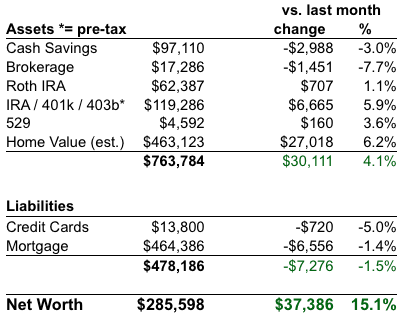
Using four different internet valuation tools – Zillow, Cyberhomes, Coldwell Banker, and Bank of America (old version) – I again took the average and took off 5% to be conservative and 6% for real estate agent commissions. This ended up giving me a 6% value increase this month, which again makes my home value movements dwarf all other activity for this net worth measurement.

I’ve been using these internet tools for 10 months now, and while I like being able to track the overall trend in home values, the wide swings in estimates make me very skeptical of their accuracy. I expect to do this for another 2 months so that I have an entire year of data, but after that I will switch to another less volatile method.

You can view previous net worth updates here.

Ask The Readers: Parents Losing Home To Foreclosure

I just got a rather difficult question in my inbox, and thought that it would be a good idea to get some perspective and advice from my thoughtful readers to help another reader. Be gentle! I think this could happen to many of us.

Jonathan – what would you do in my shoes:

Parents are in their late 50’s, bought a house they can’t really afford (@7% interest rate) and are going to be foreclosed on within the year.

If I co-sign/add my income to theirs, together we make enough for them to qualify for a refinance @4.5% 5/1 ARM. Possibly long enough for them to sell the house in the next 5 years and recover some of their lost equity (80% of their savings were tied up in the downpayment that has almost all evaporated).

However, I obviously take a credit hit and a significant risk if one of them can no longer make even the reduced payment. I am single, without kids, and in my late 20’s, working an average job (moderate job security).

Thanks for any suggestions – your blog has spared me the same fate as my parents.. so far.

First, I’m glad to hear that you are trying to help your parents, even though they made a significant financial mistake.

Do you live in a non-recourse state, where they can’t go after other assets if you default on a mortgage loan? Have you confirmed that you can get the new loan with the current loan-to-value ratio? Your income might be enough, but they still might reject or require another downpayment. If so, how much does lowering the interest from 7% to 4.5% lower the monthly payment? Would your parents be able to afford the new payment without assistance? How stable is their income?

In the end, I would say that if this requires large cash injections from you and not just your credit score and income verification, it is risky to bet that your home value will rebound in 5 years. It might, or it might not in such a short timeframe. If they live in a non-recourse state, I would at least explore the possibility of having your parents let the house go and get by with bad credit and the rest of their savings. Can they rent a place for a lot cheaper?

However, if they can swing the new payment with your co-signature only, perhaps it is worth a try. The hardest part is probably convincing your parents to downgrade their lifestyle and housing preference to something more realistic. It’s a tough situation. What would you do, readers?

Monthly Net Worth Update – August 2009

Net Worth Chart 2009

Credit Card Debt
For newer readers, I have taken money from credit cards at 0% APR and placed it into online savings accounts, bank CDs, or savings bonds that earn 4-5% interest (much less recently), and keeping the difference as profit. I even put together a series of step-by-step posts on how to make money off of credit cards in this way. However, given the current lack of great no fee 0% APR balance transfer offers, I am mostly waiting on existing offers to end. I just paid off a large-ish balance this month.

Retirement and Brokerage accounts
Besides watching another market rally, we made a bunch of retirement contributions this month. Wife’s 401k is now maxed out at $16,500 for 2009. I made a $5,000 contribution to my Solo 401k. This makes us about 65% done with our goal of maxing out both our 401ks for 2009.

Early in the month, I also decided to go ahead and make our IRA contributions for 2009 (non-deductible due to income limits). So that’s another $10,000.

Cash Savings and Emergency Funds
We still have a little over a year’s worth of expenses in our emergency fund. I was supposed to use up some of the cash to make a principal prepayment this month, but didn’t do it due to a variety of reasons. Mainly, I wanted to do things in order and do the retirement contributions above first. We also found that we have a roof leak that may require some cash.

In addition, we have gotten some quotes on a solar hot-water system for the house, which seems like it would have a fast payback period of 2-3 years. A photovoltaic system would cost significantly more and have a payback period of around 8-9 years depending on size. Still researching this.

Home Equity
Using four different internet valuation tools – Zillow, Cyberhomes, Coldwell Banker, and Bank of America (old version) – I again took the average and took off 5% to be conservative and 6% for real estate agent commissions. The bloodshed slowed a bit this month. 🙂

All in all, more steady progress. I feel like I’m not learning a lot from these updates, but it seems to be a good habit to keep an eye on things.