Gift Code for Free Insurance Kit + Will & Trust Kit From SuzeOrman.com

Suze Orman is giving away her stuff again!

Insurance Kit
I’m not 100% sure of what all this kit provides you, but it appears to be some sort of questionnaire which helps determine your insurance needs. I’ll try it out myself shortly. From the site:

This one-of-a-kind program provides you and your family with an instant, on-line evaluation of your insurance needs. Suze’s Insurance Kit provides easy to understand, step-by-step advice to help you determine if you have the right coverage in place for all the important areas of your life.

It also includes a disaster simulator and a online home inventory tracker which can store photos and receipts in case of an insurance claim.

To get your free activation code, enter the following gift code: “people first“.

Will and Trust Kit
Based on a question-and-answer format, this software includes the ability to create a will, a revocable trust, Financial Power of Attorney, and an Advanced Directive / Durable Power of Attorney for Healthcare. I’m not sure how this compares to a more established legal service like LegalZoom which I had considered using up until now (I used them to incorporate my home business), but they charge about $100 for a basic will.

I would think that it would at least be an acceptable stopgap solution for those with simple estates, but for those who have lots of assets or complex issues, hiring an attorney would be worth the extra cost. I think having an advanced healthcare directive is an even better idea. Remember, it’s your family that will have to deal with all this! Do them a favor.

To get your free activation code, enter the same gift code: “people first“.

Estimate Your Life Expectancy With The Longevity Game

Part of estimating your needs in retirement and also in buying life insurance is to know your likely life expectancy. Although kind of morbid, one calculator to help you do this is The Longevity Game by Northwestern Mutual. You just answer a few questions about your lifestyle and family history, and it gives you a number based on their actuarial tables. Fun animations too!

It turns out my median life expectancy is 85, while my wife’s is 95. Not sure how she plans on enjoying a decade without me, but I have been working out more this week as a result. 🙂 This site was found inside one of the 18 books I am trying to read simultaneously, Worry-Free Investing. The books uses it to show that for couples, there is a very good chance at least one of you will reach 95 or 100. So if you want to retire early, you basically need a portfolio that you can live off the income essentially forever while also having the principal keep up with inflation.

Free Online Will & Trust Kit From Suze Orman

On a recent episode of the Suze Orman TV show, she announced that you can go to her website and get her Online Will & Trust kit for free for a limited time. . Here’s how to get it:

  • Go to SuzeOrman.com.
  • Click on Will & Trust Kit link on upper left menu.
  • Click the orange Gift Code button.
  • Type in the code “people first”.

I signed up for the initial profile successfully, but haven’t finished the questionnaires. The software includes the ability to create a will, a revocable trust, Financial Power of Attorney, and an Advanced Directive / Durable Power of Attorney for Healthcare. One less reason for putting off doing one of these if it’s free! 🙂

I’m not sure how this compares to a more established legal service like LegalZoom which I had considered using up until now (I used them to incorporate my home business), but they charge about $100. I suppose I must add that if you have substantial assets an estate attorney might be worth the extra cost.

Iowa Floods: Reconsidering Flood Insurance

altext

This is not how I like to get reminded of things, but sometimes that’s just how it goes. I hope all those out there affected by the floods are at least safe. A few months ago I wrote about buying flood insurance even if you are not required to by your mortgage lender. This means you are outside the 100-year floodplain, but could still be in the 500 year floodplain (1 in 500 chance each year, or 0.2%). Check if you are in a flood plain here. We got quotes, but never actually got around to buying a policy due to a combination of cost concerns and simply forgetting about it.

1 in 500? Why bother? Well, reports say that one third of Iowa is currently underwater. From one local newspaper:

“We’ve been taking a lot of calls, but most people don’t have flood insurance,” said State Farm Insurance Agent Doug Valentine. “This flood has blown through the 500-year flood plain and most only have to have insurance if they are in the 100-year flood plain because the banks require it.”

Valentine said many homeowners will soon face a difficult decision on what they will do given many will still have mortgage payments to be made and no insurance to cover rebuilding. “They may have to plow it down and will have $200,000 in payments on a $100,000 house,” he said.

This got me thinking – how likely do you think it is that your house will burn down, which is a major reason for homeowner’s insurance? Perhaps a 0.2% chance each year of severe flooding is worth insuring against. Insurance is all about paying to transfer the risk for events that can crush you. On that note, I also will need to check if our policy cover sewer backup, which has also caused a lot of damage in the Midwest.

Calculating Life Insurance Needs: Capital Needs Analysis

There are a bunch of different ways to determine how much life insurance you need, from a simple “ten times your salary” to complex Monte Carlo simulations. Somewhere in between is the “capital needs analysis”, which is often used by insurance brokers and financial planners. This is what most online life insurance calculators use (examples here, here, and here), although I like the idea of doing it by hand to play with the numbers. I have a brochure from my State Farm agent with some stats, and also found another good example in this worksheet.

What is your goal?
Here’s the fun part. You get to imagine you’re dead. Will the remaining partner stay at home with the kids? Work and pay for daycare? Some people basically want to replace everything – their future income and also leave an inheritance or other lump-sum. Others want to make sure their dependents would be able to live as close to the “same life” as possible. This means staying in the same house, working (or not working) at the same jobs, driving the same cars, the same lifestyle. Then there is the “adapted life” approach, where maybe they would downsize somewhat, but have all the critical areas covered.

How much monthly income will your survivors need?
It’s usually easier to think of this monthly, and then multiply by 12. Include housing, transportation, education, childcare, insurance, entertainment, and perhaps also regular retirement savings. The average cost of daycare for a 4-year-old is around $8,000 per year. Now subtract any sources of income. The survivor’s salary, existing passive or investment income, rental income, Social Security benefits, etc.

Then, you have to decide what amount of money can create this income. Lots of guessing on your rate of return and length of withdrawal period is involved here. If you are young, you could buy an immediate annuity which will pay out about 4% inflation-adjusted a year (a certain % will be taxable). This is the same as multiplying by 25. So to create an annual income of $40,000 per year, you’d need a lump sum $1,000,000. As you get older, the payoff gets better. A more conventional approach seems to multiply by about 15.

Add in lump sum expenses
You’ll probably want to take care of debts like student loans, credit cards, funeral costs, and medical bills. A recent survey put the average funeral cost at over $6,000. If you haven’t already accounted for it above in housing, you may want to pay off the mortgage on your home or set aside money for retirement. Finally, you may want to consider the education costs of your children. The average cost for tuition + room/board for an in-state college is now nearly $14,000 per year.

Add these two big numbers up, and you have you future capital needs. You can then subtract out the insurance you have through work if you like. Finally, you should subtract your current assets, taking into account their liquidation restrictions. The difference provides an estimate of how much life insurance to shop for.

This all sounds simple, but in going through it myself there are so many variables. For starters, most couples will probably have different insurance needs for each person. Do I really want to pay off the entire house, or just allot for the mortgage payment? How many kids am I supposed to plan for? I end up with a number anywhere between $500,000 to more than $1M depending on different assumptions. (I’m open to advice here.) The good thing is that I am hoping that each $500k of coverage will only be about $30/month. I also may end up buying multiple life insurance policies as life goes on and stack them on top of each other.

Inflation?
If you buy a 30-year term policy with $500,000 of coverage now, at 3% annual inflation that you benefit will only be worth half as much after 23 years. But I don’t really worry about that, because for every year that I keep living, I should be saving enough that I don’t need as much coverage. And after the end of my term, we should have enough assets so as to not need any life insurance at all.

4 Free Reports With Your Personal Insurance, Employment, and Tenant History

Most of us know about the free credit reports from AnnualCreditReport.com. This is mandated by the Fair and Accurate Credit Transactions (FACT) Act, which basically says that consumers should be able to see (and dispute) the massive amount of information contained in private corporate databases. But in addition to credit information, there are a lot of other databases with your personal information floating around. You can get one of each report free every rolling 12-month period.

Insurance Claims History
If you would like to know what the insurance companies are saying about you behind your back, you definitely want to get a free copy of your CLUE Personal Auto Report and Personal Property Reports, which you can get instantly online or by calling 1-866-312-8076. CLUE stands for Comprehensive Loss Underwriting Exchange.

The C.L.U.E. ®Personal Property report provides a seven year history of losses associated with an individual and his/her personal property. The following data will be identified for each loss: date of loss, loss type, and amount paid along with general information such as policy number, claim number and insurance company name.

The C.L.U.E. ®Auto report provides a seven year history of automobile insurance losses associated with an individual. The following data will be identified for each loss: date of loss, loss type, and amount paid along with general information such as policy number, claim number and insurance company name.

In addition, you should also request your free A-PLUS report (Automated Property Loss Underwriting System), which is a smaller database that also contains information about property loss claims. Insurance companies use this data to decide your premiums, so you’ll want to clear up any mistakes right away as they are probably costing you money right now!

This brings me to another use for CLUE reports. If you are seriously looking at buying a home, you should spend the $20 and get the CLUE report for the property and see its claim history. For example, if the water heater broke and flooded the basement two years ago, you may have a hard time finding homeowner’s insurance due to mold concerns.

Employment History Report
When a potential employer runs a background check through ChoicePoint, this is the information they see. It doesn’t seem to claim be comprehensive, as their site states:

The ChoicePoint Workplace Solutions Inc. Employment History report contains information related to your employment history as well as other information regarding your background. […] Our files would only contain information on you if ChoicePoint provided your Employment History Report to an employer.

I would think you’d still want to make sure nothing inaccurate is on there. To get your free employment history report, call 1-866-312-8075. More information here.

Tenant History Report
This report will can be important if you are a renter and someone runs a background check on you at ChoicePoint.

The Resident Data Inc. Tenant History report contains information related to your tenant history as well as other information regarding your background. […] Our files would only contain information on you if ChoicePoint provided your Tenant History Report to a housing provider.

To get your free tenant history report, call 1-877-448-5732. More information here.

Employer-Sponsored Group vs. Individual Life Insurance

I’m not an insurance or benefits expert, but while looking at life insurance I wanted to compare the coverage available from my employer vs. what I could buy on my own. As with most things insurance-related, there are big variations in group life insurance coverage, so I can only speak to what I have for the most part. We get a credit each paycheck for which we can spend on health, dental, life, and disability insurances.

Maximum Coverage
For my plan, I can only get up to $500,000 of coverage for myself and partner. So if I want more, my only choice would be to look privately for equivalent term life insurance.

Ability To Find Coverage
The best thing about group insurance from work is that your risk is spread across a big pool of people, so it should be easier to be granted coverage. But many workplaces still require you provide “evidence of insurability” once you increase your coverage limit past a certain amount. This may involve a simple questionnaire, or it could require a doctor exam and bloodwork. It seems unclear exactly how “healthy” you have to be in order to qualify for increased group coverage, but I’m guessing it would preclude major pre-existing conditions like cancer or heart disease. The limit where they start checking can also vary from $5,000 to $500,000.

Portability of Insurance
When you qualify for and buy a level term life insurance policy, you are guaranteed coverage for the length of that term (10, 20, 30 years, etc.). But if you rely on your employer’s group life insurance, usually the coverage stops when you leave the job. It’s almost like a 1-year term policy. My concern is, if you have you leave your job because you are seriously disabled, then you might end up both uncovered and unable to find new insurance.

However, looking around there might be some flexibility in certain plans. For one, you might have a “Waiver of Premium” benefit that continues the insurance protection through age 65 with no further premium payments should you become disabled. Or the policy may allow you to “continue coverage through an individual term policy without evidence of insurability as long as you continue to pay premiums”. Would this still be at the group insurance rates (minus employer subsidies)? A lot of this stuff seems to be left out of my Open Enrollment Guide, so I suppose an e-mail to the correct Human Resource person would be in order.

Cost
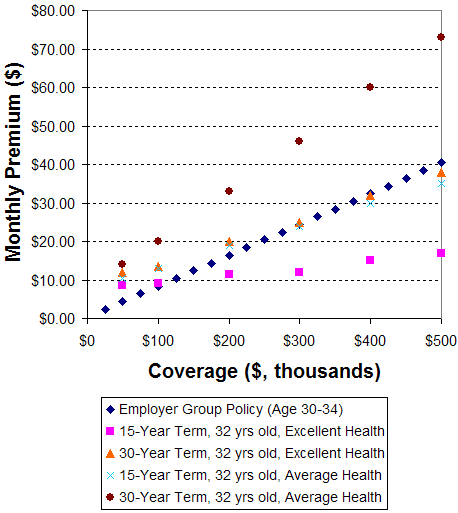
Many people get a certain amount of “free” life insurance from work, with the option to buy more. I think anything over $50,000 of coverage is paid with after-tax money, so I plotted out the monthly cost of my group plan vs. coverage levels below. I then went to Term4Sale and found the average of the top 5 quotes for both 15 and 30-year term insurance policy (rated A+ or better), for both the best tier of health (Preferred Plus) and the lowest allowable (Standard).

If you are youngish and in good health, even a long 30-year term policy is comparable to the group rates. Even if you are in average health, the cost of my employer group insurance is comparable to the premium on a 15-year term policy.

Summary
Again, this is only based on my plan, although I found my wife’s numbers to be similar. If you are lucky to have no-questions-asked insurance with high limits and you are in below-average health, it might be good to use your group plan. But if you are looking for extra coverage for a guaranteed period of time and are at least relatively healthy, it’s probably just as cheap if not cheaper to go with an individual plan. If you are an older worker, things may tilt back in favor to group life, but I haven’t run those numbers. In any case, it’s worth a comparison before your next Open Enrollment period.

We used to just buy some extra coverage from work due to the convenience factor, but why pay more when I could both save money and have a better, portable plan?

I Suppose I Should Buy Life Insurance Now…

Up until now, there are two reasons I don’t have any privately-bought life insurance. For one, as I’ve mentioned nobody is actually dependent on my income. Wife is doing fine, don’t have any kids yet. We also have 1x annual salary’s worth of life insurance as a benefit from our employers, and she’ll get all my retirement account funds if something happens to me. The other reason is that I know that life insurance is priced based on tiers of health, and I’ve been secretly thinking that I can back into my high-school swim team physique and get the absolute cheapest level of life insurance.

However, I’m starting to think both of these reasonings are flawed.

I used to think that there was no need for life insurance if nobody needs your income. But perhaps I should amend this – You need to weigh the chances that someone will eventually need your income. For example, if I fully plan on having kids within the next 2-5 years then my income will probably be needed at that time. And as someone else mentioned in a comment, life is a funny thing and you never know when my wife might just get pregnant unexpectedly.

So the question is, do I really gain anything by waiting until the last minute? The risk I take is that in the meantime my health deteriorates and I become uninsurable. You might find out you have cancer, fight bank and end up in remission, and lead a long life. You develop a heart condition have it under control, and be perfectly functional. But in either case, nobody will be issuing you an affordable policy.

(This argument has also been used by an insurance salesmen telling me to insure my kids starting at birth with a whole life policy, but I think that is stretching things a bit.)

What about trying to get healthier first? The fact is that if I’m young and even slightly healthy, term life insurance is still going to be relatively cheap, whether or not I manage to stamp out my love of ice cream. One easy-to-use site to do some quick comparisons on is Term4Sale.com. Currently, it says I can get $500,000 of 20-Year Term insurance (non-smoker) for about $25 for the highest Preferred Plus tier. But the lower Preferred tier is only $5 more, and the even lower Regular Plus/Select tier is only $10 more per month. The site estimates that I can have both elevated cholesterol and raised blood pressure and still land in one of these groups.

I would say if you’ve been harboring this desire to get healthy for more than 6 months or so and haven’t made significant progress, it’s time to give it up and pay the extra $5 per month. 🙂

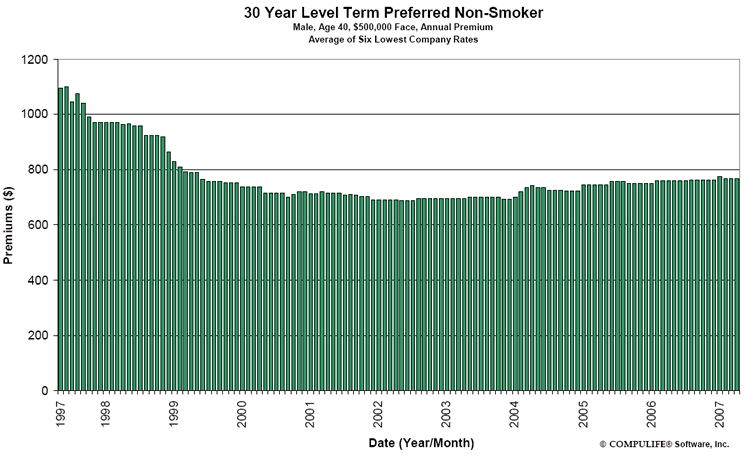
Finally, the current cost of term life insurance is still historically low, so there is not much incentive to wait for better overall rates. Here is the general trend over the last 10 years for 30-year term (click to enlarge):

Yet another thing that reminds me that I’m not getting any younger…

Useful Information From Your Social Security Statement

I recently received a nice greenish pamphlet from the government, my Social Security Statement! I thought it would tell me how much to expect from them in retirement… instead it just says is that I haven’t accumulated enough work credits to get Social Security benefits. Gee, thanks… *toss*. But wait, a few recent events have shown me other ways that it can be useful.

How Do I Get A Copy? If you are 25 or older, you should automatically receive it annually about 3 months before your birthdate. Otherwise, people of any age can request a copy to be sent to them. Here’s a sample statement.

Use #1: Find Out How Much Money Have You Earned In Your Lifetime
One of the books I am currently reading is the much-praised Your Money or Your Life. In it, one of the first exercises is find out how much money you’ve earned in your lifetime. Under the Your Earning Record section of your SS statement, it will break down all the (taxed) income you’ve ever made by year. Add it all up, and you should have your lifetime income. Besides breaking out your old Quicken files or tax returns, this is probably the only place all this information is easily available.

Why do this? For one, you may be surprised by how much money you have been able to earn, and this should boost your confidence. Second, if you compare this number to your current net worth, you may also be surprised by how little you’ve actually kept so far. Hopefully this will motivate you to waste less money.

…Or it could be cool just to know how much money you’ve ever made. 😉

Use #2: Life Insurance Planning
I’m also (slowly) doing some research on life insurance. In calculating how much life insurance you’ll need, you may want to consider what sources you already have. Many people don’t know that Social Security offers survivorship benefits if you have kids, or spouses of retirement age. In fact, about 20% of all Social Security benefits are paid out to those younger than age 62.

Under the Your Estimated Benefits Section, there is information for your estimated survivor benefits if you die. Currently, it says that my child would get over $1,100 per month if I died, and my spouse caring for the child would get over $1,100 per month as well. Over $26,000 a year? Really? This is much more than I would have imagined. As far as I can tell, this until the child turns 18.

There are also disability benefits listed, but usually privately-bought disability insurance only covers up to 60% of your original income, so I would still try to buy all I could get.

Use #3: Realize The Whole Thing Might Be Wishful Thinking
Finally, there’s a happy message snuck in at the bottom:

Your estimated benefits are based on current law. Congress has made changes to the law in the past and can do so at any time. The law governing benefit amounts may change because, by 2041, the payroll taxes collected will be enough to pay only about 75 percent of scheduled benefits.

Free Accidental Death & Dismemberment Insurance… Yay?

I’ve been noticing that multiple banks like Washington Mutual, Bank of America, and other banks have been offering me “free” Accidental Death & Dismemberment (AD&D) Insurance. Usually I get around $1,000 to $3,000 of complimentary coverage, just for being a valued customer. Awww, how thoughtful! At first glance, it sounds pretty good. That could cover a few funeral expenses in case I decide to go sky-diving again.

Of course, they are always “proud” to be able to offer you more coverage at a rock bottom price. Additional covered for you is only $1 per month for each $10,000 of coverage. But wait, that makes my $1,000 of free coverage worth…. 10 cents a month Hmm, they must value me a lot to spare $1.20 a year for me…

As you might guess, the price isn’t that great. And again it only covers accidental death, so it’s not as comprehensive as traditional term life insurance. But it does cover dismemberment, and somehow my morbid sense of humor was amused by the dismemberment payouts. I can just imagine some actuary researching on how many people lose a thumb and index finger on the same hand. Just a thumb? They’ll be fine.

100% Benefit
Death 🙁
Both Feet or Both Hands
Entire Sight of Both Eyes
One Hand and One Foot
One Hand and Sight of One Eye
One Foot and Sight of One Eye
Speech and Hearing

50% Benefit
One Hand or One Foot
Entire Sight of One Eye
Speech or Hearing

25% Benefit
Thumb and Index Finger on Same Hand

So, should I bother taking it? I’ll probably pass, but it is still free. If I add up all my offers over time I might eventually build up a nice bounty. Probably not worth giving up the personal information needed, though. Anyone else sign up?

Reader Question: When High Pet Costs Threaten Your Finances

I received a very sad e-mail today from reader Tina:

…A recent crisis with my cat has deeply taxed my savings. […] I have spent more than $4500 on my pet in the last three months. She developed lymphoma and the initial hospitalization and testing to find out what was wrong accounted for the bulk of the expense. The rest has been spent on follow-up chemotherapy treatments.

I’m curious how you would handle such a crisis (heaven forbid). Do you think you’d ever get to a point where the price was too high to keep your pet alive (assuming doing so will give it a relatively good quality of life)?

I think this is an important topic, but at the same time it’s very touchy because I’ve found that people tend to have very polarized views on pets. Here is a quote from VPI pet insurance founder Jack Stephens:

Pet insurance is a nonstarter for many pet owners, simply because they take a pragmatic approach to their animals. If the cost of treatment got too high, they would choose to put the animal to sleep.

“About half see the pet as disposable. If it got really ill they just wouldn’t treat it,” said Stephens, whose company conducted research on the issue. The other half “were willing to treat, whatever it took.”

Now, I don’t think it’s nearly as black and white as that, as I think most pet owners love their pets to some degree. But the people on the “pets-as-children” camp are often just as militant as the “they’re just animals-not-humans” camp.

Economic Euthanasia
A recent Slate.com article subtitled What I wouldn’t do for my cat also addressed this issue in depth. (The editor’s choice response letters are also thought-provoking.) It refers to refusing care due to cost as “economic euthanasia”. From reading it, cultural norms seem to be shifting. But in the end, I think it still all comes down to personal priorities.

What is the benefit? Are you talking about the cat or dog coming back to 100% health like a broken bone? Or are you paying to extend its life by weeks while lying in pain? There is a time that palliative care is the most humane choice.

Where is this money coming from? Don’t just look at the number, look at what you’d be giving up. At $2,000, is this money that would go to a vacation to Mexico otherwise? A new HDTV? Payment on your nice car? Now, let’s say it means you can’t buy gas for work or food for your kids. Different story.

Give it away? I think most vets can draw their own line as to what is “necessary”. So if you’re not willing to pay, maybe you should let one of them handle it:

Recently, I called our vet, Dr. Timothy Mann of Northside Veterinary Clinic in Brooklyn, N.Y., to ask him what would have happened if we hadn’t opted to pay for surgery.

“We don’t believe in putting animals to sleep because of money,” Dr. Mann said. “If someone can’t afford or won’t pay to save an animal who can be saved, we’ll save the animal and then keep it or find it a good home.”

Also, be sure to contact local rescue groups. They will be happy to take your sick dog, and will find some way to pay for the care. We are signed up for rescue lists for our specific breed of dog, and we would gladly take another one in if the need arose.

Plan Ahead With Pet Insurance
One way to avoid such difficult decisions is to buy pet insurance. Although it can be expensive at around $30 a month, it will definitely help soften the blow of a huge unexpected bill (although it likely won’t cover it all). Alternatively, put away money regularly in a “pet health savings account”. If you put away just $20 a month and your animal experiences issues at 5 years old, you’d already have $1,200 + interest to cover it.

My Own Doggie Evolution
I never had any pets growing up due to a broad parental ban. Not even a goldfish! My wife, on other hand, was always surrounded by animals. Rabbits, hamsters, guinea pigs, fish, dogs… When we got our first dog from the local Humane Society nearly 3 years ago, I didn’t really know how I would react. Would I love it? Would I ignore it? I must say that our little dude has burrowed his way into my heart. I mean, how can you say no to this buttercream-covered face?

altext

For us, we would give up just about all of our luxuries before withholding healthcare for our dog. We are both in agreement as well, which is great because I know for other couples it can be a point of great tension. Heck, my wife the fashionista would probably wear a potato sack around while selling our car and taking the bus 2 hours to work every day if it came down to it.

However, if it meant sacrificing the health or safety of an immediate (human) family member, I would think twice. By this I mean taking on a dangerous level of debt, or cutting corners in the essentials like nutritious food, health insurance, and safe housing.

But this doesn’t mean I spend my time judging other pet owners for deciding against care due to high cost. For many people pets are not humans, and there is a line to be drawn. But again, if you can’t or aren’t willing to pay please make sure you’ve considered all your options.

Should I Buy Mortgage Protection Life Insurance?

You guys were right. Less than a month since we closed on our mortgage loan, we are already getting bombarded with letters offering “mortgage life insurance”. The official-looking letters seem like they are from your lender, but are really just another piece of junk mail.

The pitch is pretty simple – it will pay off your entire mortgage in the event of your death. You don’t want your family to lose their home, do you? *sniff* *sniff* If I do it soon, I don’t even have to submit to a medical exam. (This is not the same as Private Mortgage Insurance or PMI, which is to protect the lender when you have a small downpayment.) The problem is that it’s usually a better idea to simply buy a plain term life insurance policy with a comparable or greater cash payout. Here’s why:

Term Life Insurance Offers More Flexibility
So let’s see, if I buy mortgage protection insurance and die then my loan is paid off. What about the rest of the monthly bills? Childcare? The house isn’t everything. Wouldn’t you rather leave your family a lump sum of cash to do whatever you want with, rather than have a paid-off home with all of the equity stuck inside? They could even buy an annuity to replicate your income.

Mortgage Life Insurance Has A Shrinking Payout
Remember, this insurance only covers the mortgage. As the years pass, you keep paying premiums, but your loan balance keeps on shrinking! After 10 or 20 years, your benefit will be greatly reduced. Compare this with most term life insurance policies which offer a fixed payout.

Oh, and don’t be fooled by a “return of premium” (ROP) feature. Sure, they’ll refund 100% of your premiums at the end of the term. Not only does this cost more than non-ROP insurance, but that’s ignoring the fact that in the meantime they’ve been investing your premiums and making lots of money off of it (which you could have been doing instead). And if you miss just one premium payment you’ll be disqualified.

Term Life Insurance Is Probably Cheaper
Insurance is all about statistics. If the policy requires “no medical exam”, then it’s going to be more expensive in order to cover everyone. If you don’t smoke and are in average or above-average health, then you should simply apply for insurance that does require a medical exam. Now, if you are in poor health, then this might be an opportunity to get some insurance that otherwise might not be available to you. But remember that there are also a few no-medical-exam term life insurance companies out there.

Mortgage Protection Life Insurance Is Hugely Profitable
In addition, simply since this product is marketed by fear (remember your homeless family!) and primarily through unsolicited mailings, it has a higher profit margin and thus higher cost than regular term life insurance. This is supported by this InsWeb article that states:

The National Association of Insurance Commissioners (NAIC) says that mortgage insurance lenders pay out only about 40 cents in benefits for every dollar consumers spend buying that type of policy, compared with 90 cents on the dollar paid out to consumers who hold regular term life policies.

60% profit vs. 10% profit! I wouldn’t even bother myself, but if you must, simply comparing quotes with an insurance comparison website like SelectQuote will provide you an easy answer as to which is a better deal.