Auto Insurance Rate Averages by State

Here is a chart of average auto insurance rates by state, via AARP.com, shaded by overage ranges. Click for an interactive map with more details and a ranking.
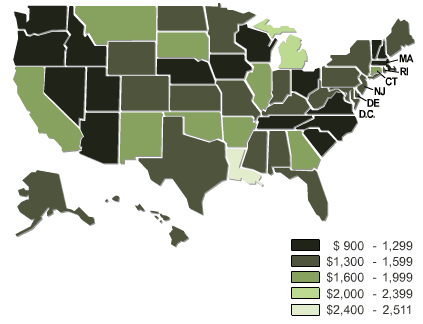
I wonder why rates in Louisiana are so high. $2,500 per year? Is it fear of flooding? Laws that encourage suing other drivers?

From the site: “Rates were calculated for more than 2,400 vehicles for model year 2010; based on a 40-year-old single male driver who commutes 12 miles to work; includes $500 deductible on collision and comprehensive coverage.” I wish they also shared how much liability coverage they chose, as that is the largest component of my premium.

How To Appeal Health Insurance Claim Denials – Flowchart

The US Department of Labor estimates that about 1 in 7 claims to employer health insurance plans are initially denied. A patient advocate says that she wins 80% of appeals. Yet only 4% of denials are appealed. These stats are taken from the AARP article The Health Claim Game. Are insurance companies relying on the “hassle factor” to help their bottom line? (…reminds me of The Incredibles and Insuricare)

Whether you think so or not, dealing with health insurance claims can be a nightmare. At the end of this article, a handy flowchart is provided which walks you through the “claim game”. Here’s the text:

To Make Insurers Pay

WHEN YOUR CLAIM IS DENIED…

1. Don’t pay the bill.
2. Get a reason for the denial in writing.
3. Review and follow your plan’s rules.

…Make the easy fixes…
• Missing information? Fill it in.
• Coding mistake? Have your doctor fix it.

…And assess other reasons for the denial.
Health care reformers want to end these exceptions, but for now they are hard to overcome:
• Preexisting condition
• Lifetime-benefit cap
• Change of employer, so coverage was delayed

These may be worth challenging:
• No network facility or physician was available
• Drug wasn’t FDA-approved for your illness
• Treatment was deemed unnecessary or unproven

WHEN PREPARING AN APPEAL…

1. Check the back of your denial notice to see how long you have to file—it’s usually 180 days.
2. Gather objective evidence of medical necessity, such as test results and prior failed treatments.
3. Gather journal articles showing the treatment is safe, effective.
4. File the request in writing (certified mail, return receipt).

IF YOU WANT HELP, SEEK OUT…

• A nonprofit patient advocate (your state’s insurance regulator or a disease association can suggest names)
• A lawyer if there’s a large sum of money at stake and you might end up in court.

IF YOUR INSURER STANDS FIRM, YOU CAN SEEK AN INDEPENDENT REVIEW…

If yours is a fully insured plan—that is, the insurer pays the claims. (Though insurers administer all kinds of health plans, roughly half are self-funded, meaning your employer pays the claims.) You have a fully insured policy if you buy insurance on your own.

To appeal a final rejection by a fully insured plan…
Go to your state insurance regulator.

To appeal a final rejection by a self-funded plan…
You will likely need to go to court, though your state insurance regulator can sometimes jawbone on your behalf.

The article also mentions a few potentially helpful groups to ask for further assistance – the Medicare Rights Center, the Patient Advocate Foundation, and Advocacy for Patients with Chronic Illness.

Are You Protecting Your Most Valuable Asset?

We are all leading busy lives, and it’s all to easy to “miss the woods for the trees”. What if we prioritized by taking a step back and simply asked ourselves – what is our most important asset? Are we adequately protecting that asset?

Yourself

Unless you’ve got a trust fund or are close to retirement, you’re likely going to have to rely on yourself to work for a while. What if you couldn’t? You need disability insurance.

The first place a lot of people go for disability insurance is work. There is either short-term and long-term insurance, and it’s important to know both what triggers a insurance payout and how much money you’ll get. Sometimes, as long as you can sit and do some form of work, you’re not considered disabled. If you want to get a form of disability insurance that kicks when you can’t do your specific job anymore, then I usually see a recommendation to see an independent insurance broker that works with several different insurers. Social Security will kick in as a last resort, but it’s also hard to qualify and definitely won’t replace all your income.

Your Spouse

If you’ve got children or are already disabled yourself, you might depend most on your spouse for income. If that person is your most important asset, then you need both disability and life insurance. Term life insurance is cheaper because it is straight insurance without any investment component to muddle things up. Start with Term4Sale for some quotes and leads to local agents. Don’t forget about life insurance for yourself, as you might be the most important asset to your spouse as well.

Your Home Equity

Even after the credit crisis, a lot of people have a great chunk of their net worth tied up in their house. Do you have adequate homeowner’s insurance? It’s important to check on how much coverage you have, and what it covers. Do you have actual replacement cost coverage, or just an estimate? Are you covered in case of hurricane, flood, or earthquake?

Your Pension / Investments

Perhaps you are nearly or already living off your accumulated assets. Good job! If you have a pension, be aware of the financial stability of your former employer. Understand what the Pension Benefit Guaranty Corporation will pay out in the worst case. Some people decide to take a lump sum in case of future bankruptcy. In general, make sure your investment mix is aligned with your need and tolerance for risk. Consider this rough rule of thumb.

Avoid a Madoff situation. Is someone else in charge of your investments? Do a basic check at FINRA. Whoever manages your portfolio should use an independent financial institution, known as a custodian, to hold your assets. They should also be audited by a licensed, independent, and preferably well-known firm.

As for me, I’ll be looking at some individual disability plans in the near future.

Nashville Flood Lessons: Do You Need Flood Insurance?

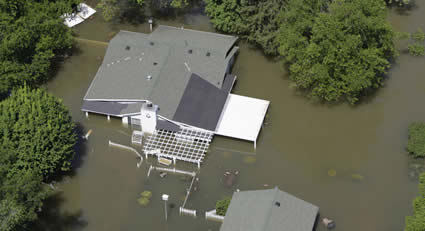
After reading about the recent flooding in the Nashville area, I again find myself reminding people to consider optional flood insurance. First, some background. Most homes that are in 100-year flood plains are required to buy flood insurance. This is because the banks know that this designation means that you have a 26% chance of a 100-year level flood within a 30 year span.

However, even if you are outside these areas, you may still be in danger of a serious flood. Often these areas are shown on flood maps as 500-year flood plains. Many people read this and think something like “…last flood was in 1909, we’re good for another 400 years!” Actually, having a 0.2% chance of a flood each and every year works out to a 6% chance of occurring at least once over a span of 30 years, or 1-in-17. According to an article from from CNM News:

The flooding in Nashville has been deemed a “500 year” flood, as the Cumberland River rose to over 51 feet (floods occur at 40 feet). The flood waters took over portions of Downtown Nashville, as well as the Opryland area.

What if it happens to you? Most homeowner’s insurance policies don’t cover flood damage. More from BusinessInsurance.com:

The National Flood Insurance Program, which is run by the Federal Emergency Management Agency, may cover some losses experienced by businesses and homeowners that purchased the coverage. However, Mr. Costner and other insurance experts said flooding reached areas that are not federally designated flood zones. According to FEMA, Nashville and Davidson County, Tenn., had 4,100 NFIP policies in force as of March.

All of Nashville only had 4,100 policies? This means that not very many people were even required to buy it. This USA Today piece tells the stories of several riverfront homes that weren’t covered.

Tiffany Wiggers says she doesn’t have flood insurance and, in fact, she paid $15,000 extra to be closer to the river. “Everybody on this side of the street, we paid lot premiums to be near the river: $15,000. You have to laugh to keep from crying,” […] She says she and her husband questioned the real estate agent, builder, lender and an insurance agent about flood insurance, but all said it wasn’t necessary. “They all said, ‘You’re not in a flood plain, so you don’t need it,’ ” recalled Wiggers for USA Today, who was taken from her home via rescue boat. “I was like, ‘FEMA and the bank said we won’t need it, so we’re in the clear.’

If you haven’t already, take some time and check if you are in a flood plain here. But it could be that the any flood maps are outdated or inaccurate. Add in some common sense if you are near a body of water. In the end, you may consider buying flood insurance even if you are not required to by your mortgage lender. We carry a modest amount of optional building coverage from the NFIP.

Healthcare Reform Highlights For The Self-Employed

Until now, I haven’t written much about healthcare reform issues – it’s just feels so daunting and politically-charged. I do support the eventual separation of work and health insurance, as I think that all unemployed, partially-employed, and self-employed individuals should get access to affordable healthcare. As the dust settles a bit, I took a look through the many attempts of media to break down the healthcare reform bill into manageable bites. Here are my notes:

2010

  • Employers with fewer than 25 employees (more if you have part-time employees) and less than $50,000 in average wages may be eligible for tax credits worth up for 35% of paid premiums. Note: The tax deduction is not available to sole proprietors, so you may want to consider an LLC or corporation form.
  • All health insurance plans must allow people to maintain dependent coverage for children until they turn 26. This could help out the many young and self-employed. Also prohibits insurers from denying coverage to children because of preexisting health problems.
  • If you are self-employed and have medical conditions that make it hard to find any health insurance at all, there will be a high risk pool set up to create “affordable” premiums. I wonder how affordable that will actually end up being.
  • Insurers will no longer be able to put lifetime limits on coverage, or cancel policies that are already in service (except for fraud).
  • Starting September 2010, all coverage must include basic preventive care. As many small businesses can now only afford catastrophic coverage, this may mean additional benefits.

2011

  • Companies with less than 100 employees will be eligible for grants to set up wellness programs. Employers can offer employees bonuses of up to 30% of the cost of insurance.

2013

  • Limits medical expense contributions to tax-sheltered flexible spending accounts (FSAs) to $2,500 a year, indexed for inflation. (I wonder how much it costs to administer one of these for a self-employed person.)

2014

  • All U.S. citizens and legal resident must have health insurance, or else pay a fine. People who are satisfied with their employer-provided coverage don’t have to do anything.
  • Health plans no longer limit coverage based on preexisting conditions, or charge higher rates to those in poor health. Premiums can vary only by age, place of residence, family size and tobacco use. Wow!
  • Individuals and small businesses with up to 100 employees will be able to shop for coverage from newly-created health insurance exchanges. Theoretically, this will allow individuals to get rates just as competitive as current large group plans.
  • Small business owners who purchase coverage through the exchanges can receive a two-year tax cut for up to 50% of what they contribute toward their employee health insurance premiums.
  • Individuals may receive income-based tax credits for insurance bought from the exchanges. Sliding scale credits will eventually phase out for households above four times the federal poverty level, until about $43,000 for an individual or about $88,000 for a family of four.

Sources: CS Monitor, Health Reform and Small Business, USA Today, HealthReform.gov

Insurance Quiz: Can You Beat 4 out of 10 Correct?

Argh… they got me. I usually filter out PR emails, but I went ahead and took the Insurance Intelligence Quiz by the National Association of Insurance Commissioners (NAIC). According to them, a recent survey found Americans only answered an average of 4 out of 10 questions correctly. The quiz turned out to be reasonably quick and the questions weren’t horrible, so I figured I’d share it for the semi-competitive folks out there that want to test their insurance knowledge.
Quiz Spoilers below…

I ended up getting 8 out of 10 correct. I did not know that auto insurance was not required in all 50 states. Well, technically not required in New Hampshire and Wisconsin. I found this information from Carinsurance.com:

New Hampshire state law does not require minimum auto insurance coverage. However, if you are at-fault in an accident without having insurance coverage you will be required to get car insurance. In this state it is advised that if you own a vehicle you get at least some type of bodily injury coverage, in addition to $25,000 worth of property damage.

Many people believe that Wisconsin does not require insurance, which is true however you must have other means to pay for damages you cause if you are at fault in an accident.

Wisconsin has a financial responsibility law that pertains to any motorist licensed to drive in Wisconsin. This law is designed to make sure anyone operating a vehicle has insurance or enough money to pay for damages to others that may have been caused by a motor vehicle. These requirements may be met through an automobile liability insurance policy, a surety bond, personal funds or a certificate of self-insurance.

I also missed the 100/300/100 question, which is bodily(per person)/bodily(total cap)/property damage. This is a quick way to check up on how much your insurance covers in the even of an accident. I used to think my insurance was pretty cheap, only to find out it was because my coverage limits were near the state minimum.

NY Times Financial Tune-Up: Interactive Checklist

The NY Times has a new series called the Financial Tuneup: Take a Few Hours and Unlock Some Cash. Essentially these are all the things that you probably know you should do, but never get around to. By compiling them all into a interactive checklist, they suggest setting aside a specific time each year to focus on these activities.

Here’s a quick excerpt of the To-Do’s that are included on their 31 item list. If you’ve read virtually any personal finance blog or magazine for longer than 10 minutes, you’re probably familiar with most of them and why they should be done.

  • Rebalance your investment asset allocation
  • Open an online savings account
  • Consolidate to a better rewards credit card
  • Lower your interest rate on existing debt
  • Check your credit reports
  • Check in on your Flexible Spending Account
  • Haggle or shrink your landline, cell phone, and cable bills
  • Update your life insurance to meet needs
  • Shop around for home and/or auto insurance

Reading through the list, it reminded me a lot of the 15-Minute New Year’s Resolutions that I introduced this January (but then lost a little steam). It also fits in well with the new Gladwell-esque book The Checklist Manifesto by Atul Gawande, which explores the power of checklists and how they can reduce mistakes in even simple areas like hand-washing and make complex tasks much more manageable. It easy to see how a checklist in this scenario can help you focus your energy and reduce oversights.

As long as it can reduce the barrier to action enough for people to check off a few more items, I’d say it was a great idea. Are you motivated yet?

Surviving the Great Baseball Card Bubble

From the 1630s tulip mania to the Roaring 1920s to the Dot-com Bust to Real Estate, I thought I had read about all the bubbles. But it seems that I forgot that I was right in the middle another one – the baseball card craze of the late 1980s and early 1990s.

I was about 10-14 during these years, in which I had just the right combination of a little bit of spending money, a love of sports, and greed. All my friends collected cards, and we traded them daily. Baseball cards were our form of currency. You could buy homework answers, protection from bullies, or even temporary popularity. I would secretly only spend half of my lunch money and go hungry for a few hours before running home to buy another pack of cards.

In the new book Mint Condition: How Baseball Cards Became an American Obsession, James Davieson tells the story of how this bubble formed and subsequently popped. This Slate article The Great Baseball Card Bubble includes a few excerpts. This one hit especially close to home:

American boys growing up in the 1980s approached Beckett Baseball Card Monthly with something like religious reverence. For many of us, it was the first magazine we bought and the only one we leafed through regularly. The magazine’s circulation eventually reached about 1 million, with many of those issues no doubt destined for the book bags of young boys. We walked the school hallways in the ’80s with our Becketts sandwiched between our textbooks, and we followed the price fluctuations of our favorite players with slavish devotion. Beckett’s valuations served as the foundation for all card trades.

To this day, I have about 3 years of worn out Becketts stacked up in my parent’s house. Looking back it was basically the stock market for kids, except instead of real-time quotes we only had monthly updates. Quality downgrades, riding momentum, pure speculation, it was all there. And just like mortgage-backed securities, when the mass media starts calling something a legitimate investment, a crash is soon to follow.

By the ’80s, baseball card values were rising beyond the average hobbyist’s means. As prices continued to climb, baseball cards were touted as a legitimate investment alternative to stocks, with the Wall Street Journal referring to them as sound “inflation hedges” and “nostalgia futures.” Newspapers started running feature stories with headlines such as “Turning Cardboard Into Cash” (the Washington Post), “A Grand Slam Profit May Be in the Cards” (the New York Times), and “Cards Put Gold, Stocks to Shame as Investment” (the Orange County Register). A hobby bulletin called the Ball Street Journal, claiming entrée to a network of scouts and coaches, promised collectors “insider scouting information” that would help them invest in the cards of rising big-league prospects. Collectors bought bundles of rookie cards as a way to gamble legally on a player’s future.

Of course I had to idea what inflation hedges were back then, but I did view them as an investment. Baseball cards were a store of value, and were sure to only increase as time went on, right? Even now, I still have a few unopened packs of 1989 Upper Deck, the first “premium” baseball card. I used to fight the urge to open them, balancing the curiosity of whether I had a Ken Griffey, Jr. rookie card, or whether it was better to keep it an unopened mystery.

I suppose I did learn a few things about personal finance in those days. But after reading all this, I figure I can complete my Nolan Ryan 1968-1993 Topps collection on the cheap. 🙂

American Express Extended Warranty Review

Roomba VaccumIf you’re like me, you’re vaguely aware that you can get some sort of additional warranty coverage from your credit card, but not interested enough to carefully read those little brochures with the tiny print that come in the mail. Today a fellow named Joe sent me a story about his broken Roomba which describes his experience with American Express when his beloved vacuum broke after 18 months, which was 6 months past the manufacturer’s 1-year warranty. It’s a bit long-winded, but in the end AmEx did refund his original $300 purchase price. After reading it and doing some other hunting around, here’s a summary of the American Express Extended Warrant feature:

The Basics

All American Express (AMEX) cards (as well many versions of Visa and MasterCard) offer an automatic warranty extension if you buy the product using their card. Specifically for American Express, here is the fine print from the their FAQ page:

1. How does the Extended Warranty work?
When you charge the cost of a covered product with your American Express® Card, the Extended Warranty will extend the terms of the original manufacturer’s warranty for a period of time equal to the duration of the original manufacturer’s warranty, up to one additional year on warranties of five years or less that are eligible in the U.S.

In other words, in general they will double the original manufacturer’s warranty, but only up to one year. This is unless your product has a warranty of over 5 years as default. If you are still covered by the original warranty, you must go through the manufacturer. You do not need to sign-up or perform any kind of activation process to get this extended warranty.

Things You Need To Keep

American Express seems to advertise this service the most, and anecdotally is one of the best at actually coming through with their promise. However, you’ll still need to keep several pieces of information to support your claim. For all your big purchases, use an AmEx and keep these papers somewhere organized!

  • The original purchase receipt, which notes which product you bought, the date of purchase, and that it was bought entirely with an American Express card.
  • The product warranty card, which outlines the details of the original manufacturers warranty.
  • Your old AmEx credit card statement, which lists and matches the purchase receipt above.
  • The broken product. AmEx may choose to replace your item, repair it, or refund the purchase price. They choose, so keep what you have until they say so. If they replace it, they may ask you to send the broken item back to them.

Filing a Claim

To start a claim, the Extended Warranty department’s phone number is 1-800-225-3750. You can check the status of your claim online at www.americanexpress.com/onlineclaim. Be prepared to wait two weeks for the claim to process after submitting support materials.


Starwood Preferred Guest Credit Card from American Express

My Swiss army knife of travel rewards cards. You get 1 point per $1 spent, and 20,000 Starwood points = 25,000 airline miles (free ticket). Essentially up to 1.25 miles per dollar spent, and you can convert to a variety of airlines or free hotel rooms. Top off an account, or convert a big lump sum.

Currently, the sign-up bonus is 10,000 points after first purchase. On top of that, you can also get an additional 15,000 points by spending $5,000 on the card within the first 6 months. Annual fee is waived for the first year, and is $65 the second year if you keep it.

American Express Disclaimer: This content is not provided or commissioned by American Express. Opinions expressed here are author’s alone, not those of American Express, and have not been reviewed, approved or otherwise endorsed by American Express. This site may be compensated through American Express Affiliate Program.

Free Suze Orman Will & Trust Kit Gift Code

You can get the SuzeOrman.com Will & Trust Kit for free if you enter the gift code STAR on this page. Save the resulting activation code. Retail price is is $13.50.

Based on a question-and-answer format, this online software includes the ability to create a:

  • Will
  • Revocable Trust
  • Financial Power of Attorney
  • Advanced Directive / Durable Power of Attorney for Healthcare

I’m not sure how this compares to a more established legal service like LegalZoom which I had considered using up until now (I used them to incorporate my side business), but they charge about $70 for a basic will. I would think that this SuzeOrman option might be an acceptable temporary solution for those with very simple estates. However, for those who have enough assets to actually require a revocable trust, hiring an attorney would be worth the extra cost.

As for the advanced healthcare directive or power of attorney, I think that this could be useful at least to get the discussion started on what your wishes are with your family if you do become incapacitated.

Unemployed: COBRA vs. Individual Health Insurance

With unemployment still at historic highs in many areas, a common concern is what to do about health insurance. A friend of mine was recently notified that he was going to be laid off, and so we talked about some of the options out there, and I told him I’d do some research about it since I had recently looked into an individual health plan.

About COBRA, Stimulus Bill Subsidy
COBRA gives people who lose their jobs the right to continue coverage under their group health plan. The catch is that workers must pay the entire premium themselves (plus a 2% administrative fee), which can be a lot higher than just the partial payment the employee usually pays. According to this WSJ article, the average cost of COBRA coverage for a family is $13,000 a year. In my friend’s case, he was surprised to see his corporate employer paid nearly $600 a month for his health insurance.

Keeping insurance continuity is important beyond immediate health concerns, because if you don’t have health insurance for more than 63 days, then even group health insurance plans can reject you later due to any pre-existing conditions. That can be a total disaster.

However, in February 2009 the “Stimulus bill” included a provision that would cover 65% of the COBRA premium for up to 9 months for people who qualify. You must have been involuntarily terminated between 9/1/08 and 12/31/09, and also not exceed an adjusted gross income over $125,000 for individuals ($250,000 for married couples filing jointly). According to this IRS page, there is no paperwork or extra tax return details to deal will; you just pay the 35% to your employer and let them handle it. In my friend’s case, this would lower his required payment about $210 a month for the next 9 months. That’s quite a discount!

Individual Health Plans
Still, if you are relatively young and in good health, you should be able to get a much cheaper health plan from many insurers. Group health insurance by definition has to cover everyone in the company, and may cover a lot more than you’d be willing to pay for yourself. However, you’ll have to familiarize yourself with some of the terminology. Here’s another quote from the WSJ article:

“My beef with Cobra is that it is the same gold-plated plan that my employer offered, when I would settle for copper or tin,” he says. Instead, he bought a catastrophic health plan, which covers only major hospitalizations, for $100 a month.

One of biggest comparison sites for individual plans is eHealthInsurance.com, which has a separate section on short-term health insurance plans. From their site:

Short-term health insurance plans provide you with coverage for a limited period of time, and may be an ideal solution for those between jobs or those waiting for other health insurance to start. Typically, short-term plans offer coverage up to six months, although some plans may offer coverage up to 12 months.

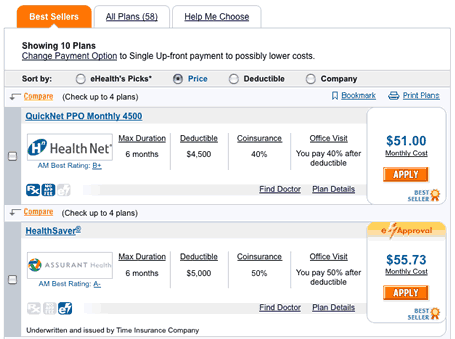
Indeed, I found basic 6-month plans starting at $50 a month, though they come with some hefty deductibles. As quote above, the idea here is just cover catastrophic events.

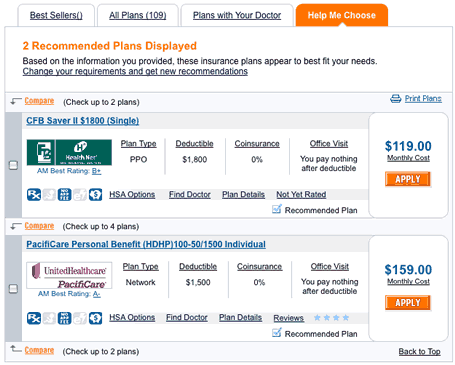
If you see the tab labeled “Help Me Choose”, I found the questionnaire there really helpful in narrowing down the choices. I figured I would want a temporary plan that would basically cover everything over, say $1,000-$2,000, but everything below that I would pay for, including doctor’s visits. The recommended plan ended up being a regular individual plan (not short term) that only cost $120 per month.

The annual deductible was $1,800, but I with 0% co-insurance (nothing above the deductible) as opposed to the 20-40% co-insurance on other plans. So the most I’d be out-of-pocket would be $1,800 a year. If there was no 65% subsidy, this $120/month insurance would beat out the $600/month COBRA option easily. Even now, it’s close. I could even add on a health savings account (HSA) and put more money away tax-deferred.

(The above is just an example. Your actual comparison results are dependent on age, sex, and location.)

State Farm Auto Insurance & Rental Car Coverage

Do you know if your auto insurance company will cover you in an accident in a rental car? According to a survey by Progressive Insurance, only 25% bother to ask. We are looking into booking a rental car for a week, so I called State Farm to double-check what the current rules are. A week of loss-damage waiver (LDW) would cost well over $100, so it was definitely worth a phone call.

Below is what I got from my agent, but I’m sure that auto insurance laws vary by state, so don’t assume the following extends to you. Call yourself! If you’re really serious, you’ll get them to show you where all this is written out in your insurance policy. I know I kept mine somewhere.

Liability Coverage. Your existing limits extends to the rental car.

Comprehensive Coverage. This extends to the rental car. Your same deductible applies.

Collision Coverage. This extends to the rental car. Your same deductible applies.

Other Possible Charges
This could be good news for some, but perhaps not quite so good if you have high deductibles. In addition, she did point out that there are certain things that State Farm will not cover from the rental car companies.

  • Claims Processing Fees or “Administrative” Charges – If you get in an accident, it sounds like they can charge you a fee just to deal with it. Blech.
  • Loss-of-Use Charges – The rental car company will claim that for every day the car was being fixed, they could have rented it out. They don’t even have to prove that they were out of cars at the time.

Secondary Rental Car Insurance
This is where the secondary rental car insurance from credit cards can come in handy. Details can still vary depending on the specific card, so look for specific wording in the paperwork that they mail you with the tiny print on amazingly thin paper. Here’s some sample info from Visa:

Visa Auto Rental CDW reimburses you for the deductible portion of your personal automobile insurance, valid administrative and loss-of-use charges imposed by the rental car company, as well as reasonable towing charges resulting from covered damage or theft of the rental vehicle while it is your responsibility.

This seems to plug in the remaining holes in coverage, besides the vague usage of the word “valid”.

Unlimited Non-Owned Car Coverage (UNOC)
Another option is to purchase an additional rider on your auto insurance, which State Farm calls UNOC. She quoted me about $30 per 6-month period. However, you can simply add it on and take it off for something as short as a month, which on a pro-rated basis would cost only $5.